
Module 21 Solar Activity its Effects on Earth
- Slides: 47
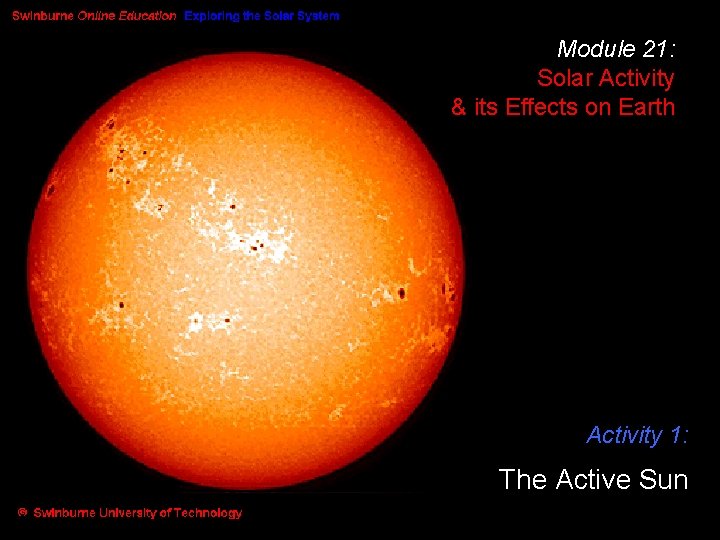
Module 21: Solar Activity & its Effects on Earth Activity 1: The Active Sun
Summary: In this Activity, you will learn about • the magnetic field of the quiet Sun • the Zeeman Effect • sunspots and bipolar pairs in the active Sun • solar flares and solar cosmic rays • quiescent and loop prominences • the different rotation of parts of the Sun • cycles of activity in the Sun
Click on the picture below to see part of a NASA movie showing many of the solar features to be discussed in this Activity. If you have a sound card on your computer, you will be able to hear a commentary. Click on image to view movie
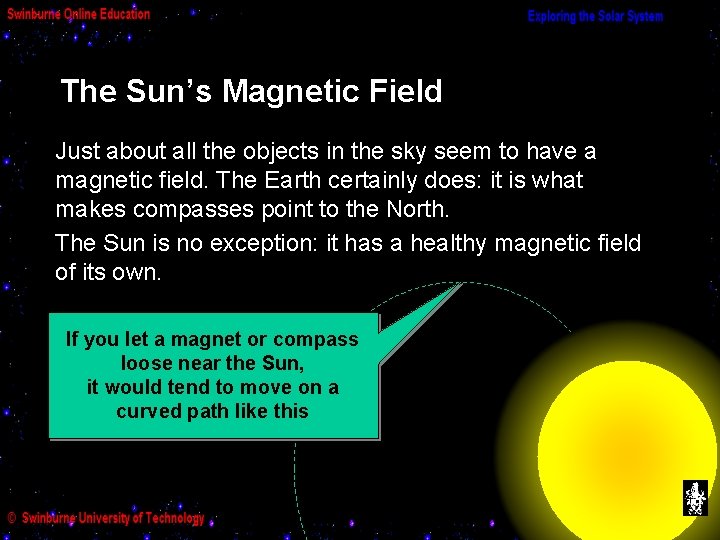
The Sun’s Magnetic Field Just about all the objects in the sky seem to have a magnetic field. The Earth certainly does: it is what makes compasses point to the North. The Sun is no exception: it has a healthy magnetic field of its own. If you let a magnet or compass loose near the Sun, it would tend to move on a curved path like this
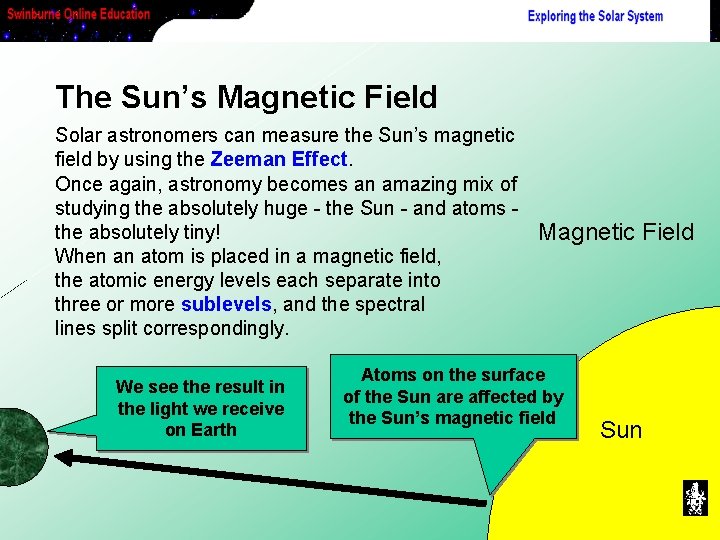
The Sun’s Magnetic Field Solar astronomers can measure the Sun’s magnetic field by using the Zeeman Effect. Once again, astronomy becomes an amazing mix of studying the absolutely huge - the Sun - and atoms the absolutely tiny! When an atom is placed in a magnetic field, the atomic energy levels each separate into three or more sublevels, and the spectral lines split correspondingly. We see the result in the light we receive on Earth Magnetic Field Atoms on the surface of the Sun are affected by the Sun’s magnetic field Sun
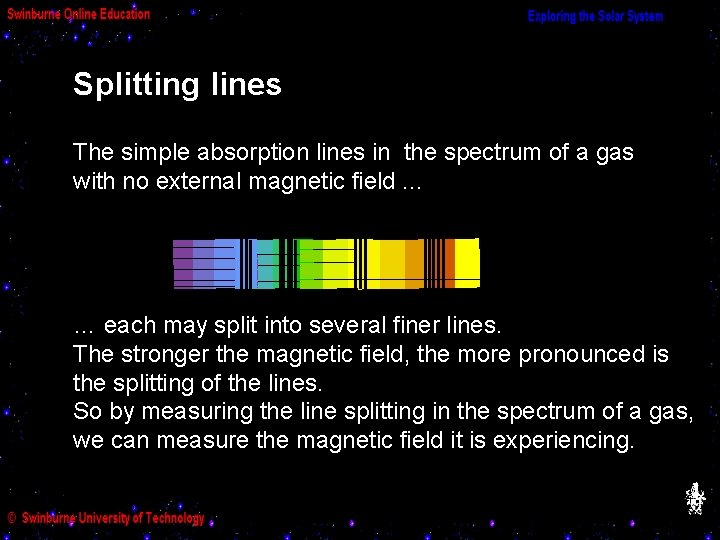
Splitting lines The simple absorption lines in the spectrum of a gas with no external magnetic field. . . … each may split into several finer lines. The stronger the magnetic field, the more pronounced is the splitting of the lines. So by measuring the line splitting in the spectrum of a gas, we can measure the magnetic field it is experiencing.
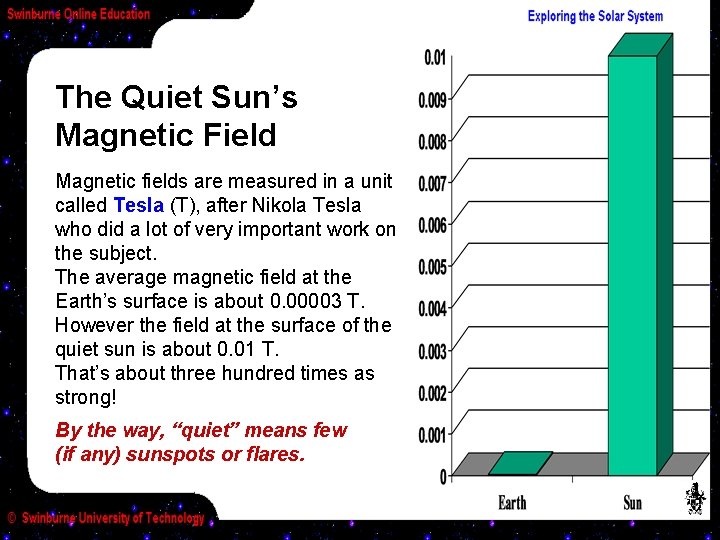
The Quiet Sun’s Magnetic Field Magnetic fields are measured in a unit called Tesla (T), after Nikola Tesla who did a lot of very important work on the subject. The average magnetic field at the Earth’s surface is about 0. 00003 T. However the field at the surface of the quiet sun is about 0. 01 T. That’s about three hundred times as strong! By the way, “quiet” means few (if any) sunspots or flares.
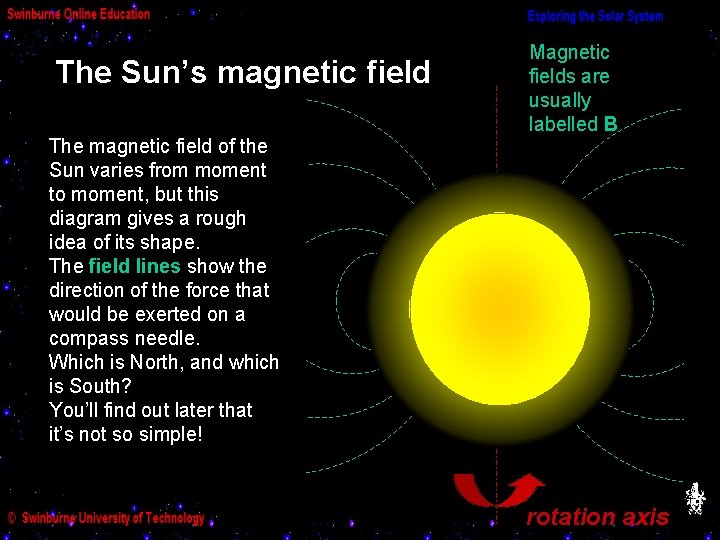
The Sun’s magnetic field The magnetic field of the Sun varies from moment to moment, but this diagram gives a rough idea of its shape. The field lines show the direction of the force that would be exerted on a compass needle. Which is North, and which is South? You’ll find out later that it’s not so simple! Magnetic fields are usually labelled B rotation axis
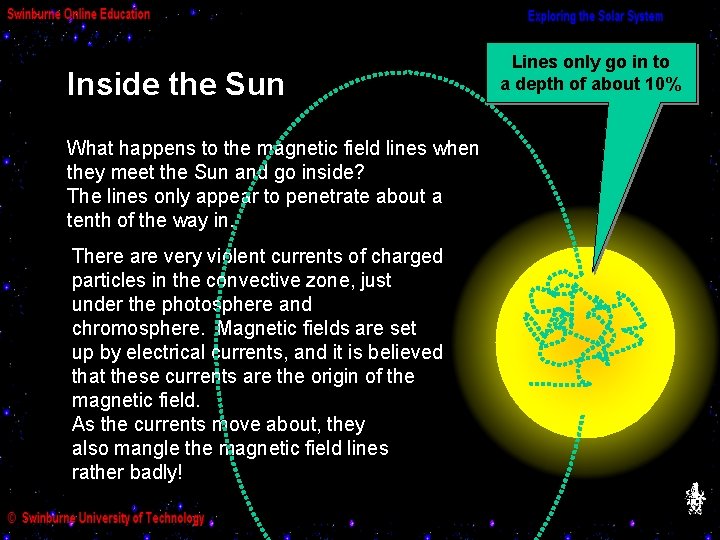
Inside the Sun What happens to the magnetic field lines when they meet the Sun and go inside? The lines only appear to penetrate about a tenth of the way in. There are very violent currents of charged particles in the convective zone, just under the photosphere and chromosphere. Magnetic fields are set up by electrical currents, and it is believed that these currents are the origin of the magnetic field. As the currents move about, they also mangle the magnetic field lines rather badly! Lines only go in to a depth of about 10%
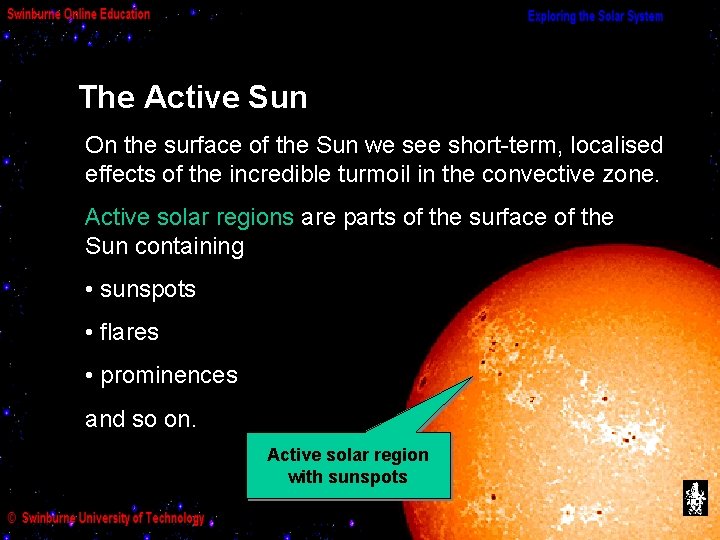
The Active Sun On the surface of the Sun we see short-term, localised effects of the incredible turmoil in the convective zone. Active solar regions are parts of the surface of the Sun containing • sunspots • flares • prominences and so on. Active solar region with sunspots
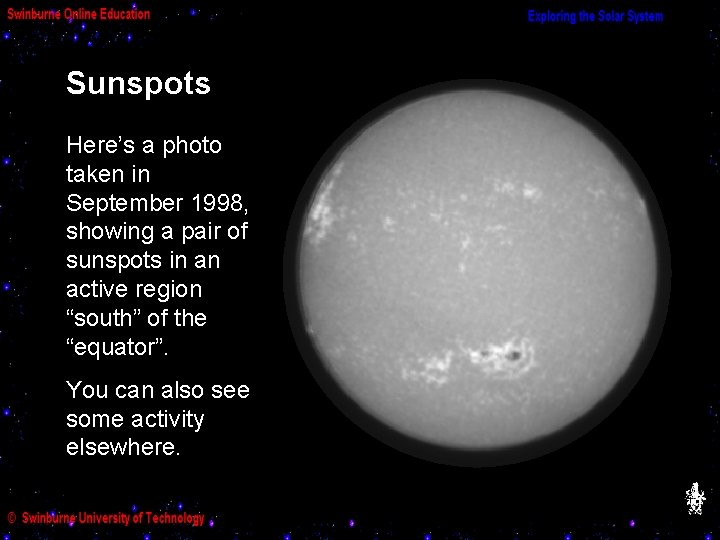
Sunspots Here’s a photo taken in September 1998, showing a pair of sunspots in an active region “south” of the “equator”. You can also see some activity elsewhere.
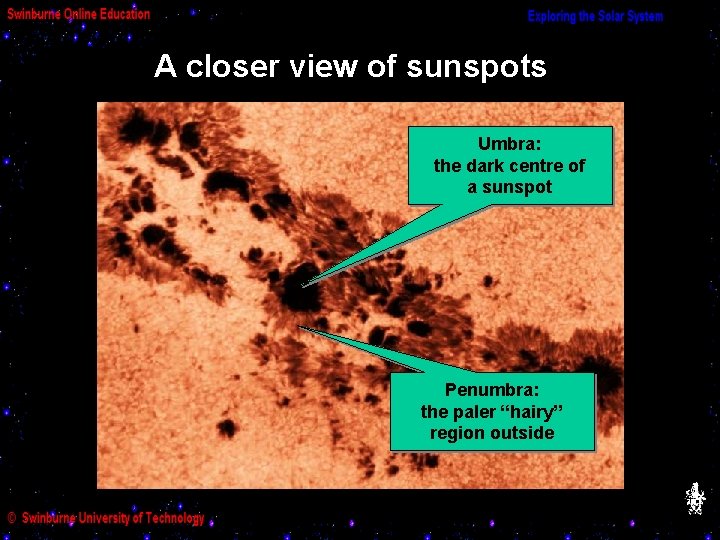
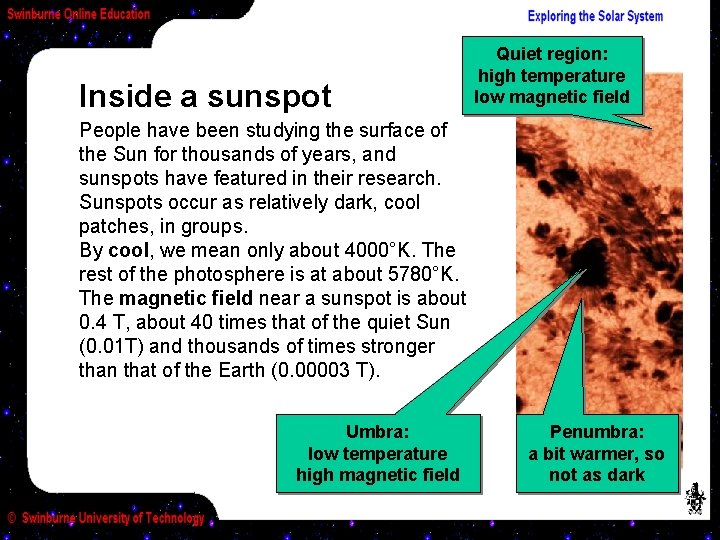
A closer view of sunspots Umbra: the dark centre of a sunspot Penumbra: the paler “hairy” region outside
Inside a sunspot Quiet region: high temperature low magnetic field People have been studying the surface of the Sun for thousands of years, and sunspots have featured in their research. Sunspots occur as relatively dark, cool patches, in groups. By cool, we mean only about 4000°K. The rest of the photosphere is at about 5780°K. The magnetic field near a sunspot is about 0. 4 T, about 40 times that of the quiet Sun (0. 01 T) and thousands of times stronger than that of the Earth (0. 00003 T). Umbra: low temperature high magnetic field Penumbra: a bit warmer, so not as dark
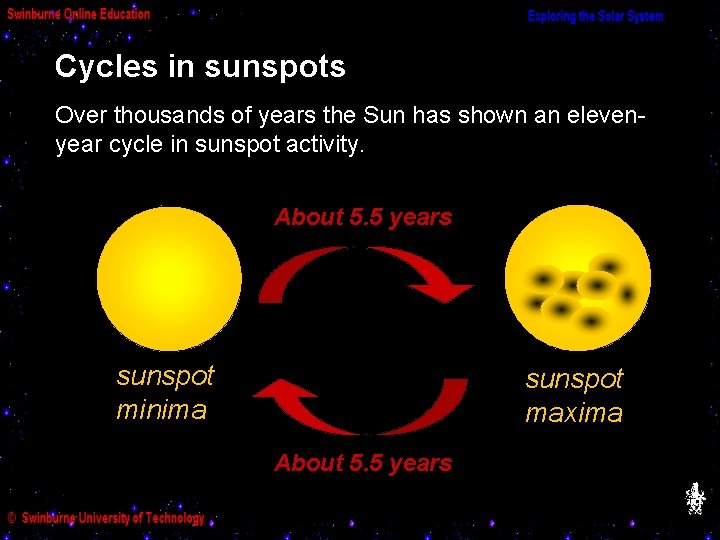
Cycles in sunspots Over thousands of years the Sun has shown an elevenyear cycle in sunspot activity. About 5. 5 years sunspot minima sunspot maxima About 5. 5 years
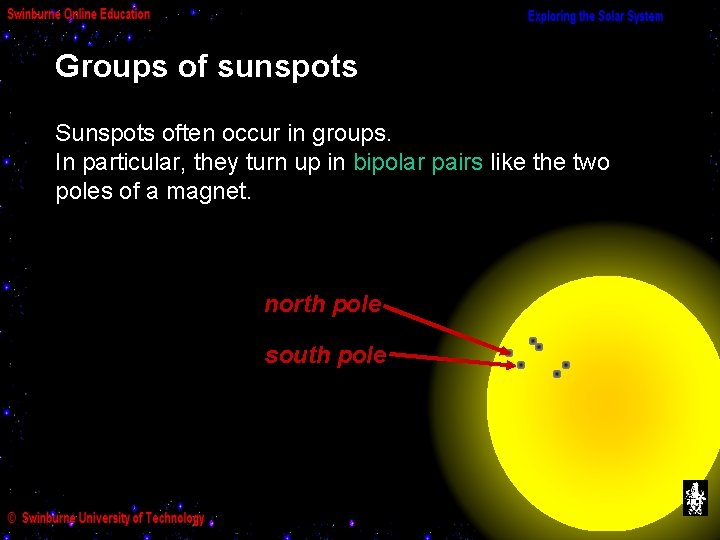
Groups of sunspots Sunspots often occur in groups. In particular, they turn up in bipolar pairs like the two poles of a magnet. north pole south pole
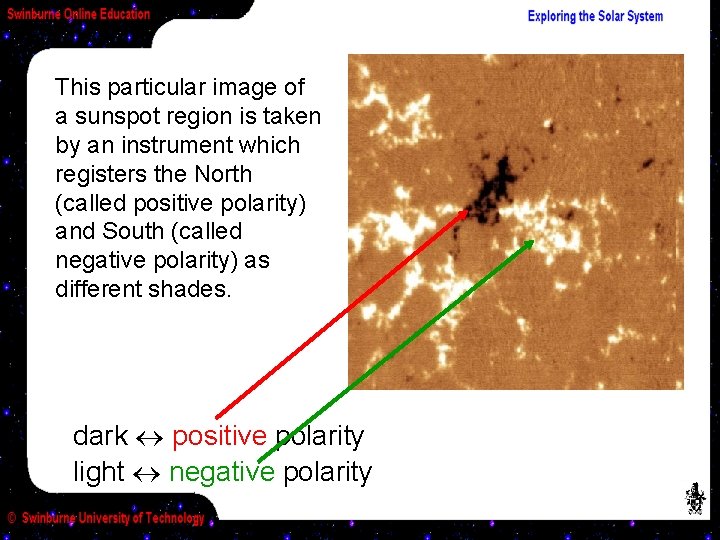
This particular image of a sunspot region is taken by an instrument which registers the North (called positive polarity) and South (called negative polarity) as different shades. dark positive polarity light negative polarity
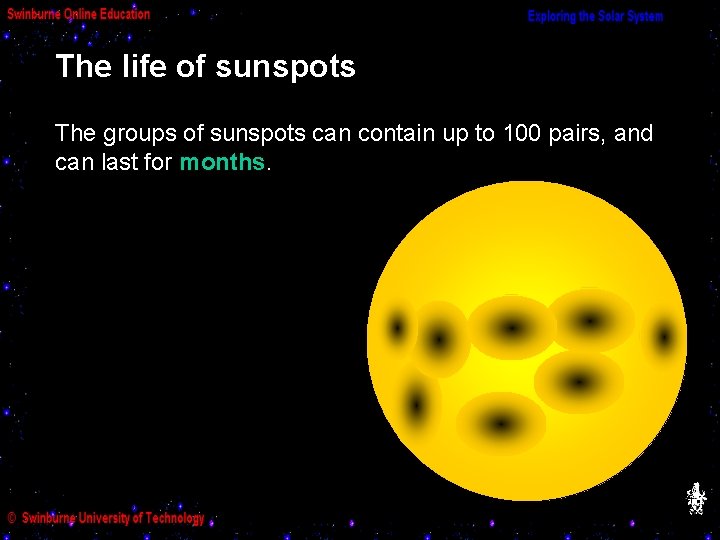
The life of sunspots The groups of sunspots can contain up to 100 pairs, and can last for months.
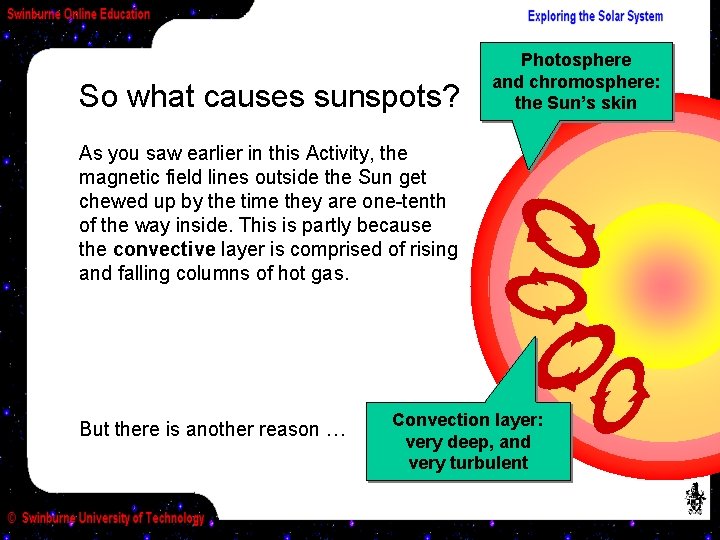
So what causes sunspots? Photosphere and chromosphere: the Sun’s skin As you saw earlier in this Activity, the magnetic field lines outside the Sun get chewed up by the time they are one-tenth of the way inside. This is partly because the convective layer is comprised of rising and falling columns of hot gas. But there is another reason … Convection layer: very deep, and very turbulent
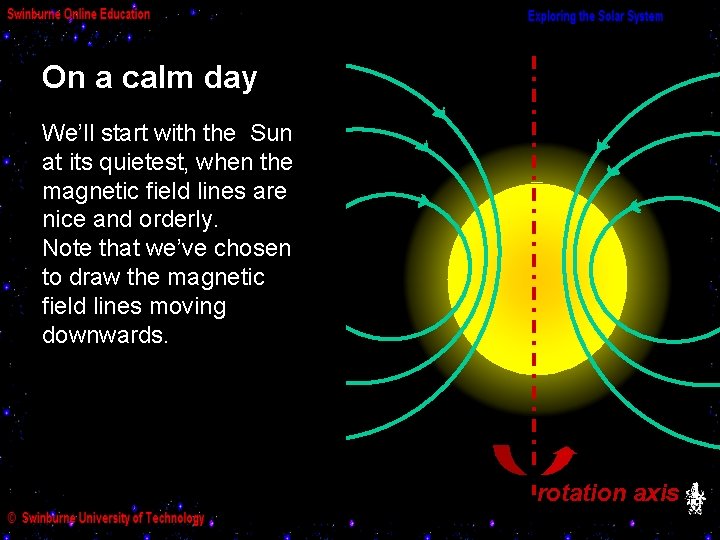
On a calm day We’ll start with the Sun at its quietest, when the magnetic field lines are nice and orderly. Note that we’ve chosen to draw the magnetic field lines moving downwards. rotation axis
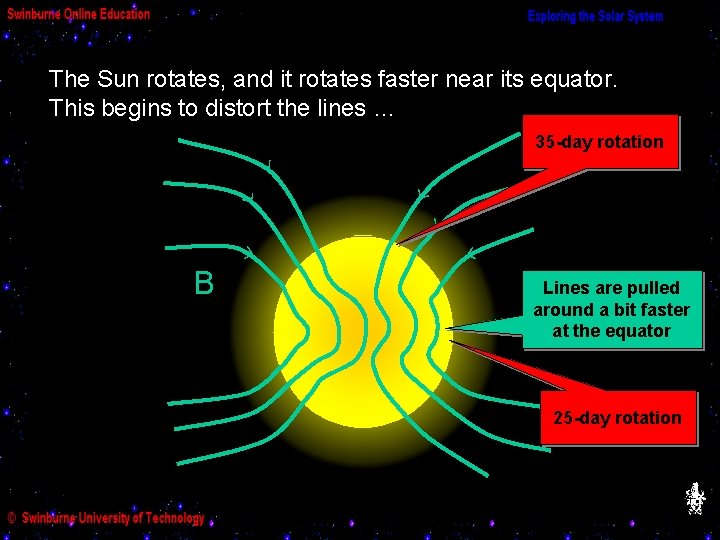
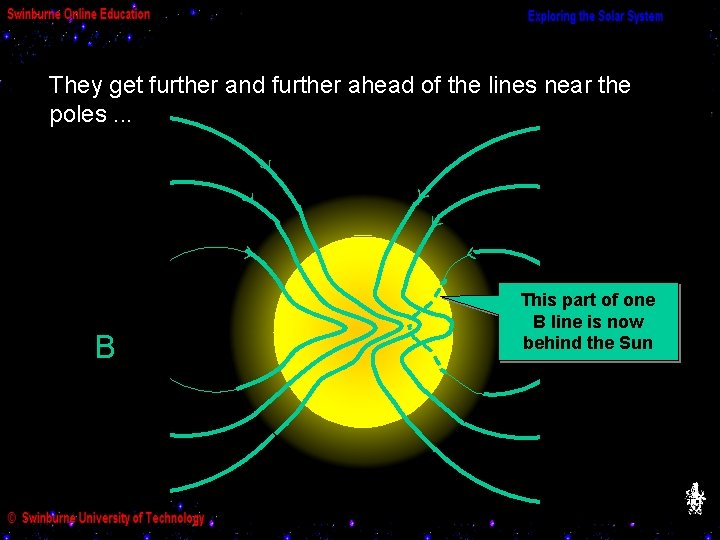
The Sun rotates, and it rotates faster near its equator. This begins to distort the lines … 35 -day rotation B Lines are pulled around a bit faster at the equator 25 -day rotation
They get further and further ahead of the lines near the poles. . . B This part of one B line is now behind the Sun
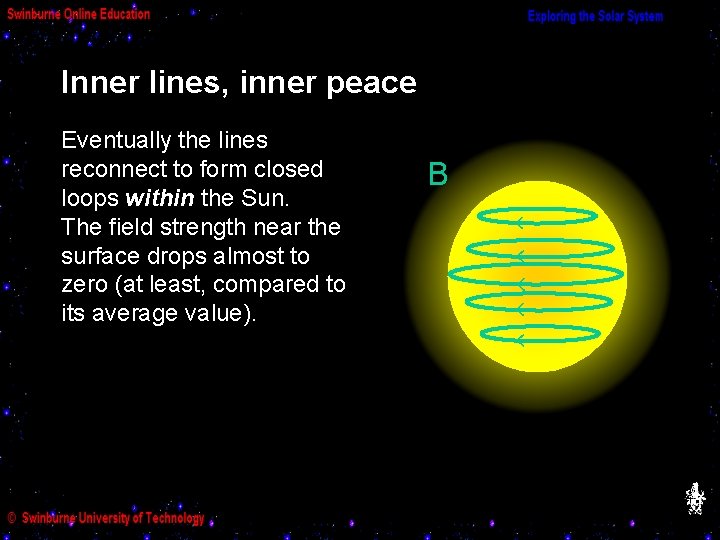
Inner lines, inner peace Eventually the lines reconnect to form closed loops within the Sun. The field strength near the surface drops almost to zero (at least, compared to its average value). B
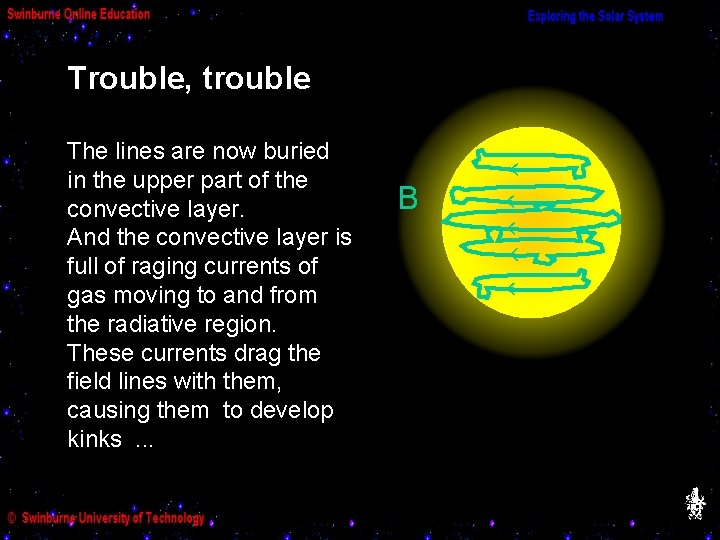
Trouble, trouble The lines are now buried in the upper part of the convective layer. And the convective layer is full of raging currents of gas moving to and from the radiative region. These currents drag the field lines with them, causing them to develop kinks. . . B
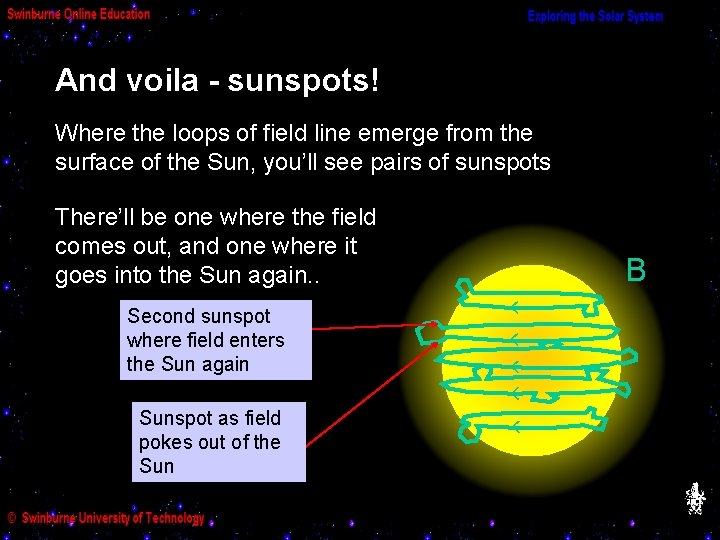
And voila - sunspots! Where the loops of field line emerge from the surface of the Sun, you’ll see pairs of sunspots There’ll be one where the field comes out, and one where it goes into the Sun again. . Second sunspot where field enters the Sun again Sunspot as field pokes out of the Sun B
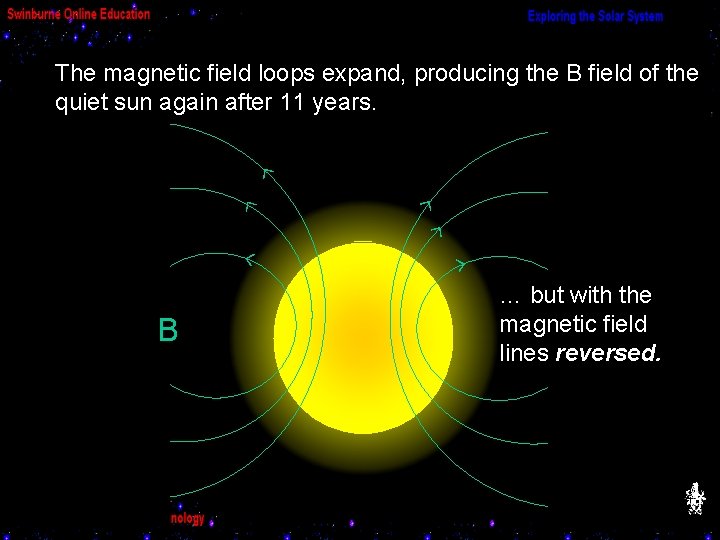
The magnetic field loops expand, producing the B field of the quiet sun again after 11 years. B … but with the magnetic field lines reversed.
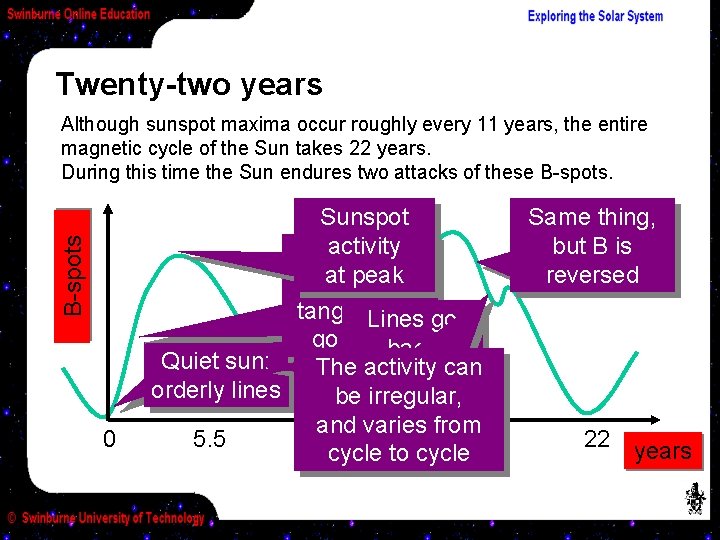
Twenty-two years B-spots Although sunspot maxima occur roughly every 11 years, the entire magnetic cycle of the Sun takes 22 years. During this time the Sun endures two attacks of these B-spots. 0 Sunspot activity Lines start peak to at become tangled. Lines and go go inside back Quiet sun: The activity outsidecan orderly lines be irregular, and varies from 5. 5 11 14. 5 cycle to cycle Same thing, but B is reversed 22 years
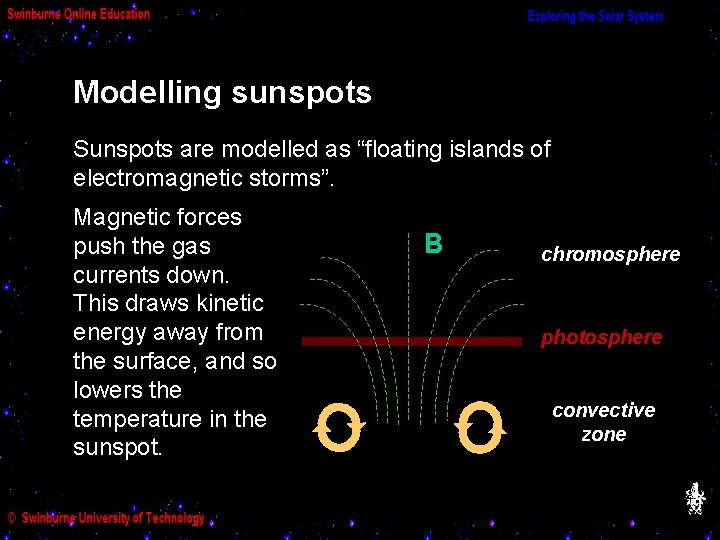
Modelling sunspots Sunspots are modelled as “floating islands of electromagnetic storms”. Magnetic forces push the gas currents down. This draws kinetic energy away from the surface, and so lowers the temperature in the sunspot. B chromosphere photosphere convective zone
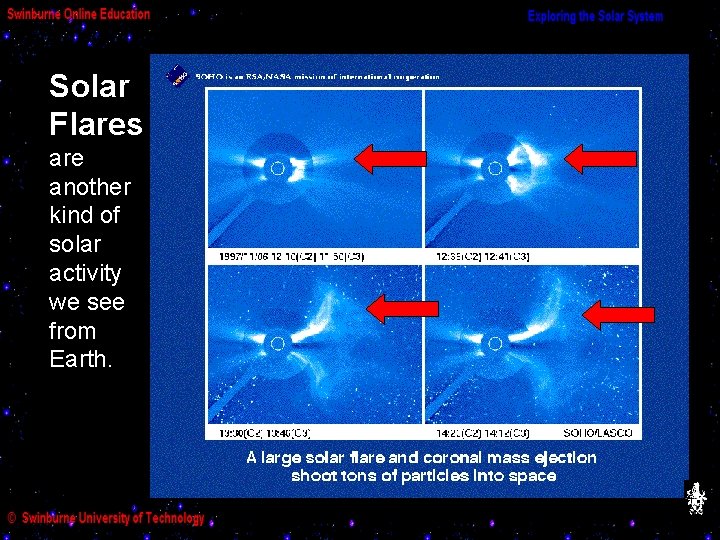
Solar Flares are another kind of solar activity we see from Earth.
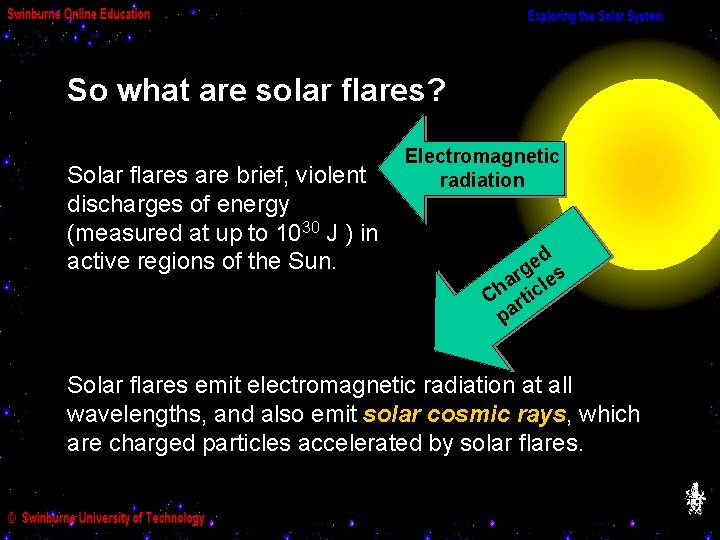
So what are solar flares? Solar flares are brief, violent discharges of energy (measured at up to 1030 J ) in active regions of the Sun. Electromagnetic radiation d e rg les a Ch rtic pa Solar flares emit electromagnetic radiation at all wavelengths, and also emit solar cosmic rays, which are charged particles accelerated by solar flares.
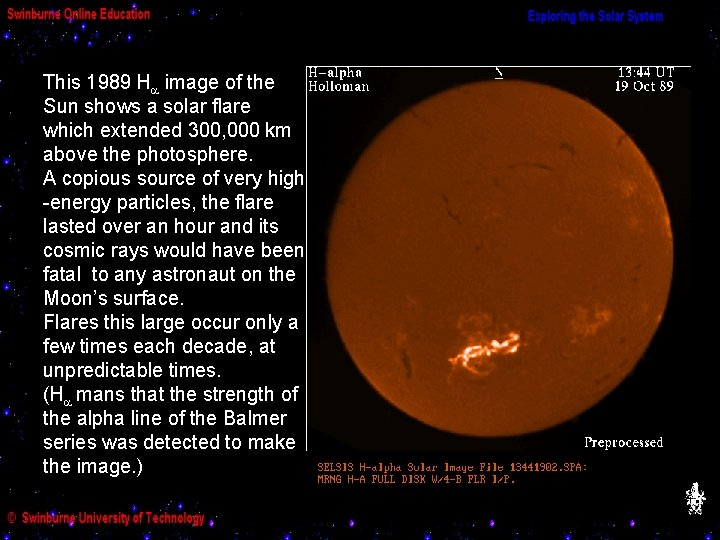
This 1989 H image of the Sun shows a solar flare which extended 300, 000 km above the photosphere. A copious source of very high -energy particles, the flare lasted over an hour and its cosmic rays would have been fatal to any astronaut on the Moon’s surface. Flares this large occur only a few times each decade, at unpredictable times. (H mans that the strength of the alpha line of the Balmer series was detected to make the image. )
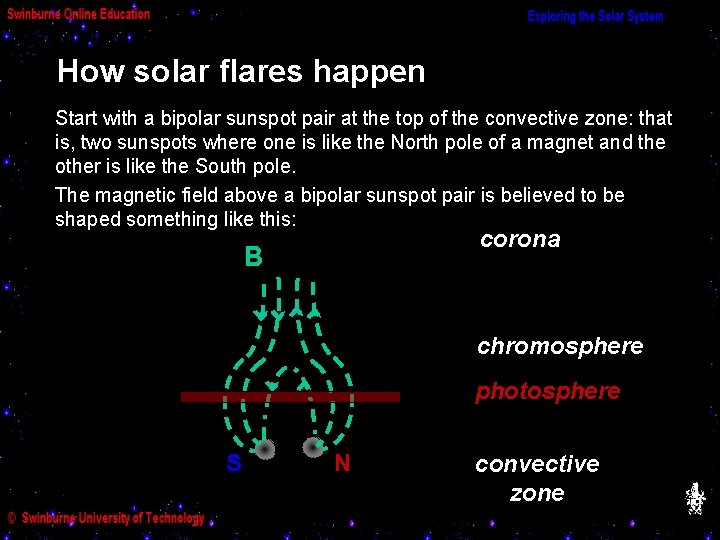
How solar flares happen Start with a bipolar sunspot pair at the top of the convective zone: that is, two sunspots where one is like the North pole of a magnet and the other is like the South pole. The magnetic field above a bipolar sunspot pair is believed to be shaped something like this: corona B chromosphere photosphere S N convective zone
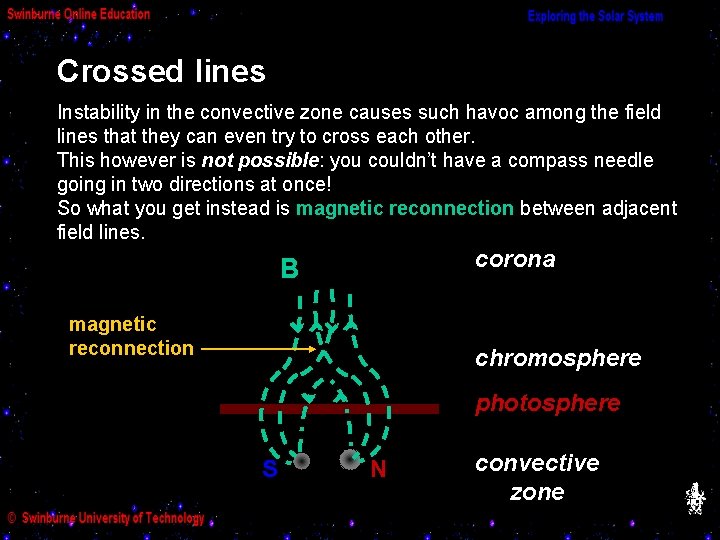
Crossed lines Instability in the convective zone causes such havoc among the field lines that they can even try to cross each other. This however is not possible: you couldn’t have a compass needle going in two directions at once! So what you get instead is magnetic reconnection between adjacent field lines. corona B magnetic reconnection chromosphere photosphere S N convective zone
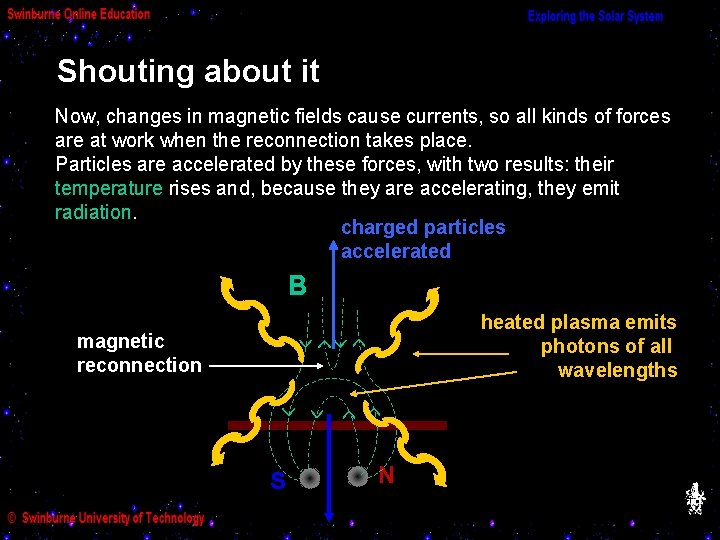
Shouting about it Now, changes in magnetic fields cause currents, so all kinds of forces are at work when the reconnection takes place. Particles are accelerated by these forces, with two results: their temperature rises and, because they are accelerating, they emit radiation. charged particles accelerated B heated plasma emits photons of all wavelengths magnetic reconnection S N
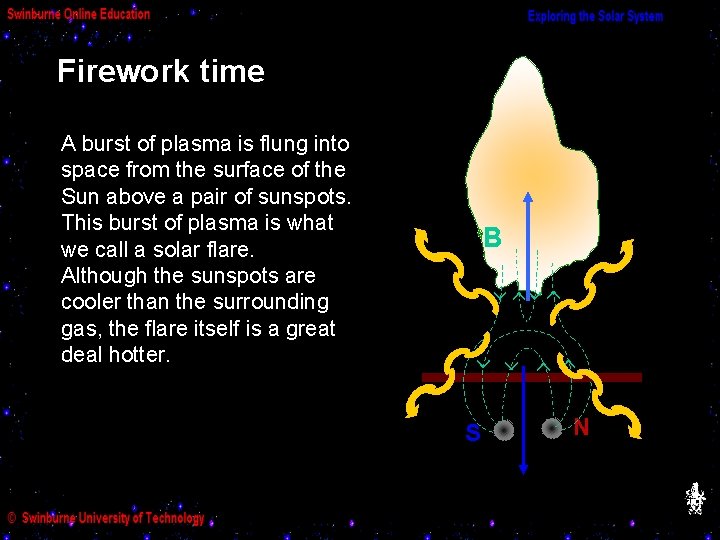
Firework time A burst of plasma is flung into space from the surface of the Sun above a pair of sunspots. This burst of plasma is what we call a solar flare. Although the sunspots are cooler than the surrounding gas, the flare itself is a great deal hotter. B S N
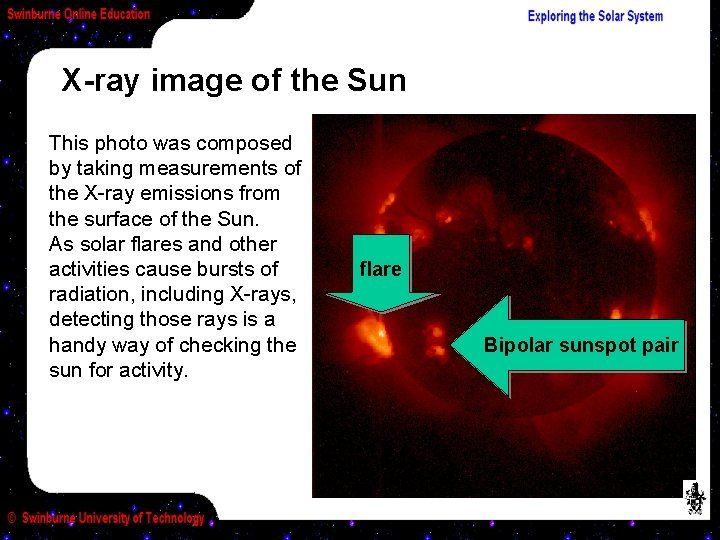
X-ray image of the Sun This photo was composed by taking measurements of the X-ray emissions from the surface of the Sun. As solar flares and other activities cause bursts of radiation, including X-rays, detecting those rays is a handy way of checking the sun for activity. flare Bipolar sunspot pair
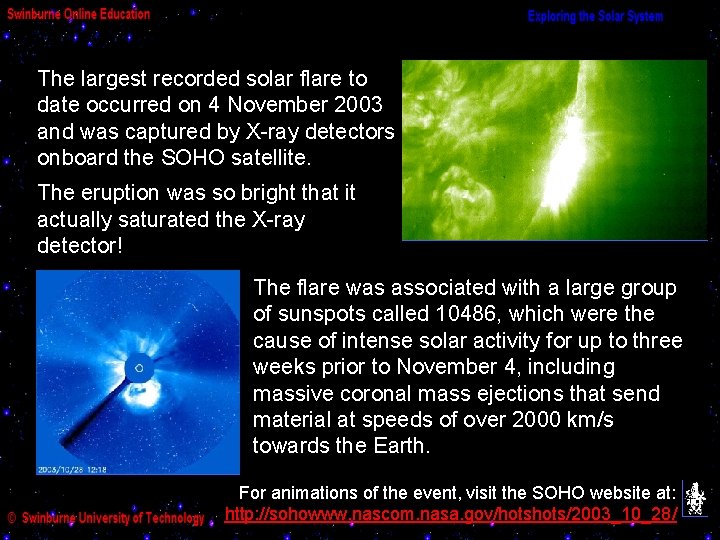
The largest recorded solar flare to date occurred on 4 November 2003 and was captured by X-ray detectors onboard the SOHO satellite. The eruption was so bright that it actually saturated the X-ray detector! The flare was associated with a large group of sunspots called 10486, which were the cause of intense solar activity for up to three weeks prior to November 4, including massive coronal mass ejections that send material at speeds of over 2000 km/s towards the Earth. For animations of the event, visit the SOHO website at: http: //sohowww. nascom. nasa. gov/hots/2003_10_28/
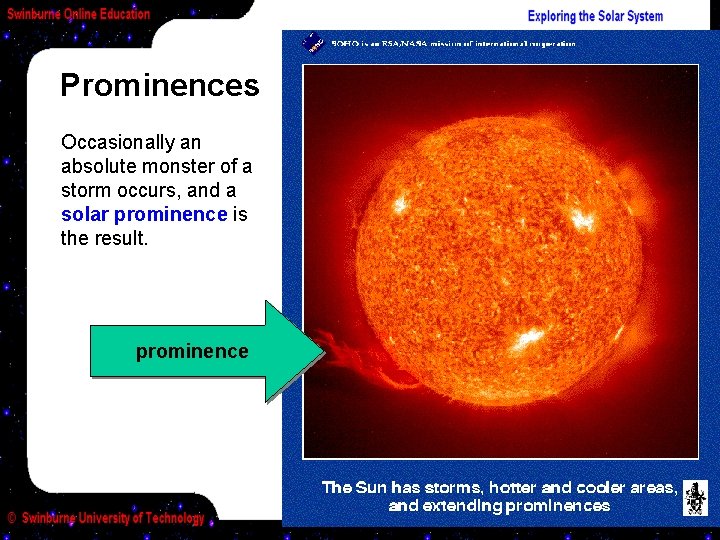
Prominences Occasionally an absolute monster of a storm occurs, and a solar prominence is the result. prominence
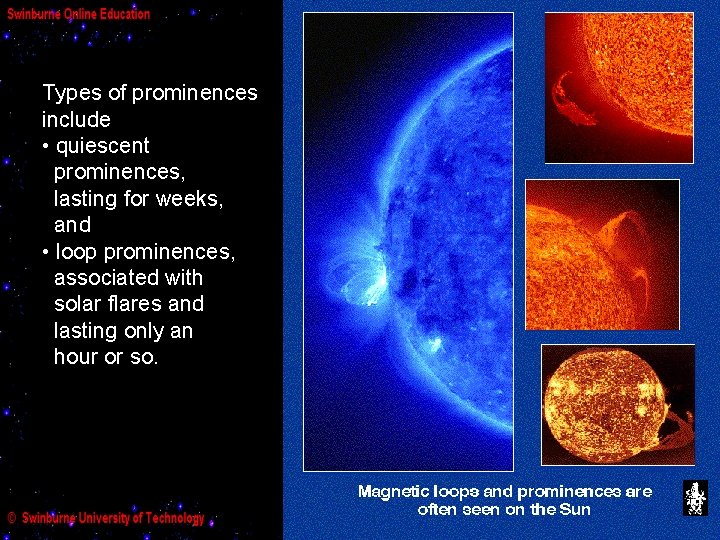
Types of prominences include • quiescent prominences, lasting for weeks, and • loop prominences, associated with solar flares and lasting only an hour or so.
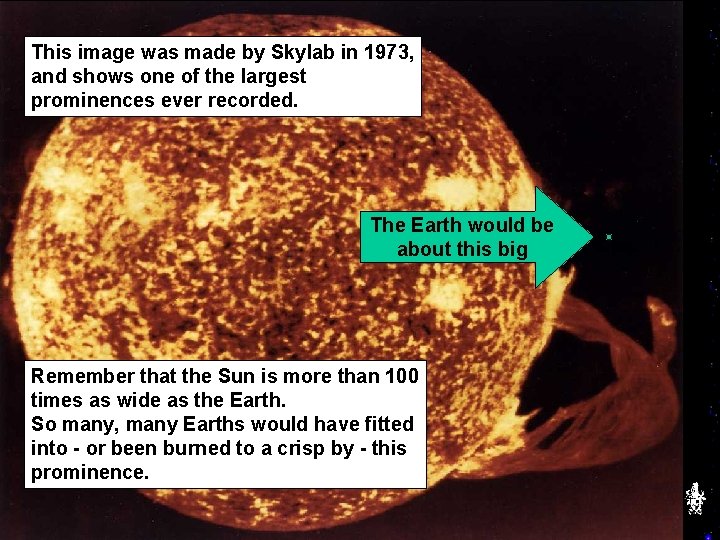
This image was made by Skylab in 1973, and shows one of the largest prominences ever recorded. The Earth would be about this big Remember that the Sun is more than 100 times as wide as the Earth. So many, many Earths would have fitted into - or been burned to a crisp by - this prominence.
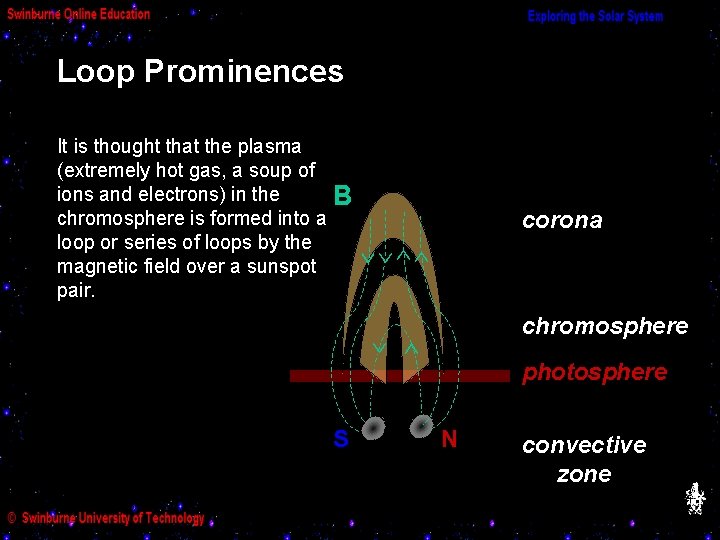
Loop Prominences It is thought that the plasma (extremely hot gas, a soup of ions and electrons) in the B chromosphere is formed into a loop or series of loops by the magnetic field over a sunspot pair. corona chromosphere photosphere S N convective zone
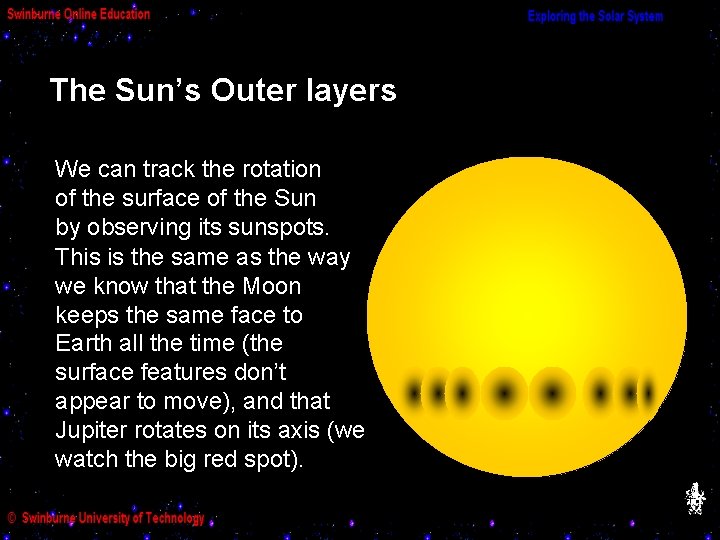
The Sun’s Outer layers We can track the rotation of the surface of the Sun by observing its sunspots. This is the same as the way we know that the Moon keeps the same face to Earth all the time (the surface features don’t appear to move), and that Jupiter rotates on its axis (we watch the big red spot).
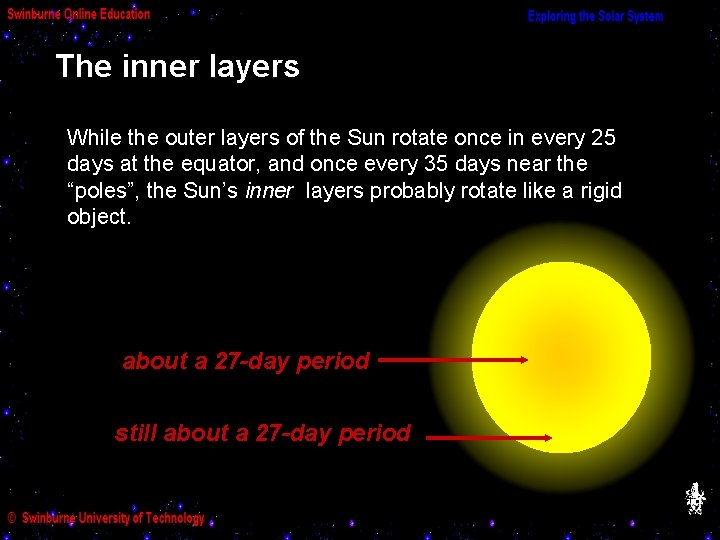
The inner layers While the outer layers of the Sun rotate once in every 25 days at the equator, and once every 35 days near the “poles”, the Sun’s inner layers probably rotate like a rigid object. about a 27 -day period still about a 27 -day period
In Conclusion: The activity on the surface of the Sun is mostly caused by the following chain of events and circumstances: • the Sun consists mostly of positively-charged ions (largely hydrogen, H+) and negatively-charged electrons; • the convective layer constantly sends currents of these particles to and from the surface; • currents create magnetic fields; • unlike the Earth (which has a pretty solid crust), the Sun is fluid and the equator, the poles and the innards rotate at different speeds; • this tangles up the magnetic field just under the surface of the Sun; • the tangles cause currents in the charged particles in the upper layers of the Sun; • We see these currents and explosions as sunspots, flares and prominences, with an 11 -year cycle in which the Sun swaps its North and South magnetic poles as well.
Image Credits Sun's Magnetic Field, Prominences, and Solar Wind http: //bang. lanl. gov/solarsys/raw/sunc. avi Sun Prominence http: //bang. lanl. gov/solarsys/raw/sun. jpg Sun - Calcium K spectral line http: //www. solar. ifa. hawaii. edu/KLine/Today/latest. jpg Sun Spots http: //bang. lanl. gov/solarsys/raw/sunspot. jpg Solar Magnetic Fields http: //bang. lanl. gov/solarsys/raw/sun 2. jpg Large solar flare and coronal mass ejection shoots tons of particles into space: http: //sohowww. nascom. nasa. gov/explore/litho/SOHOport 12. html X-Ray Sun http: //umbra. nascom. nasa. gov/images/latest_sxt. gif The Sun has storms, hotter and cooler areas, and extending prominences http: //sohowww. nascom. nasa. gov/explore/litho/SOHOport 06. html
Image Credits Magnetic loops & prominences are often seen on the Sun http: //sohowww. nascom. nasa. gov/explore/litho/SOHOport 10. html EIT closeup of massive flare, November, 2003 - SOHO/EIT (ESA & NASA) http: //sohowww. nascom. nasa. gov/hots/2003_11_04/eit 195 cw. gif Sun’s large CME, October, 2003 - SOHO/EIT (ESA & NASA) http: //spaceflightnow. com/news/n 0310/28 flare/sohoc 3. jpg
Now return to the Module 21 home page, and read more about the magnetic field and active regions of the Sun in the Textbook Readings. Hit the Esc key (escape) to return to the Module 21 Home Page