
Module 20 Phase C Application Architecture V 9
- Slides: 31
Module 20 Phase C Application Architecture V 9 Edition Copyright © January 2009 Slide 1 of 31 All rights reserved Published by The Open Group, January 2009 TM
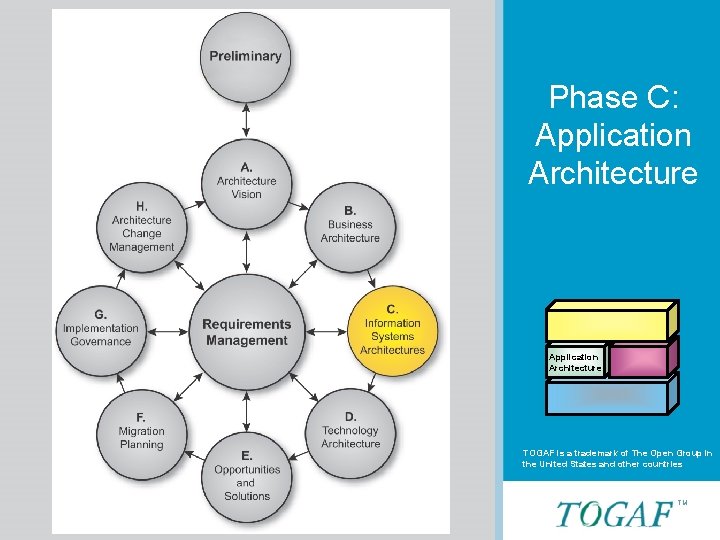
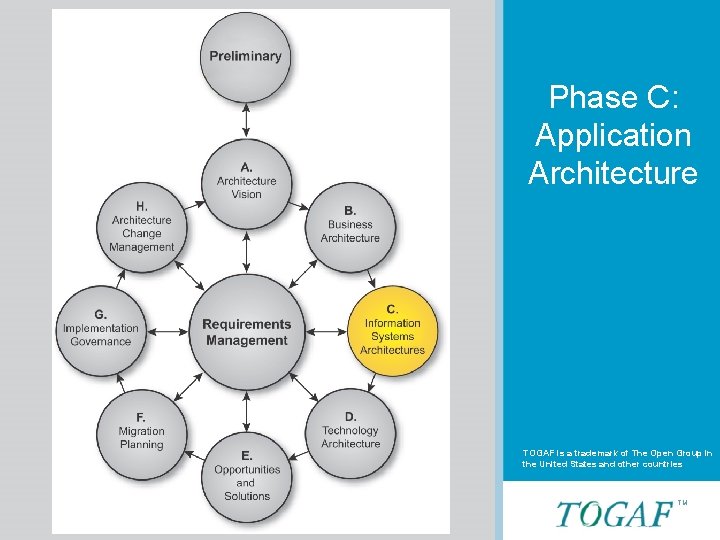
Phase C Phase A: Architecture Development Vision Method Phase C: Application Architecture TOGAF is a trademark of The Open Group in the United States and other countries Slide 2 of 31 TM TM
Module Objectives The aim of this module is to understand: • The objectives of the Application Architecture part of Phase C • What it consists of • What inputs are needed for it • What the outputs are Slide 3 of 31 TM
Application Architecture Objective • Slide 4 of 31 to define the kinds of application systems necessary to process the data and support the business. TM
Application Architecture The objective is NOT to: • Specify technologies • Design application systems Because: Applications are stable but technologies change over time, according to needs Slide 5 of 31 TM
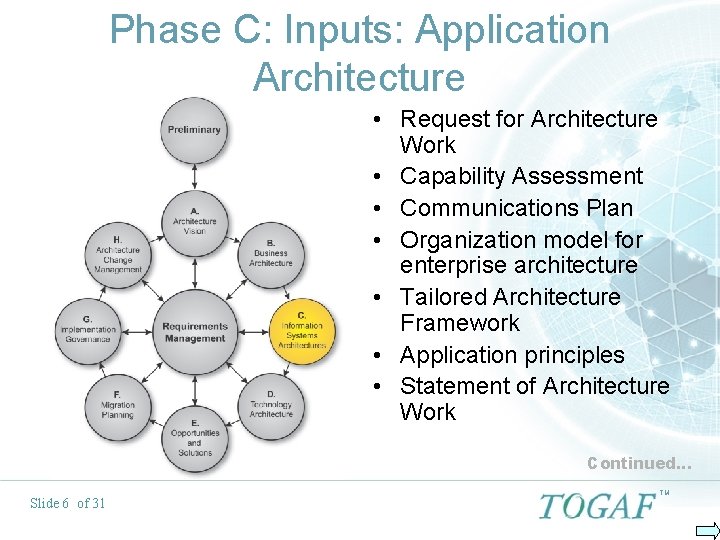
Phase C: Inputs: Application Architecture • Request for Architecture Work • Capability Assessment • Communications Plan • Organization model for enterprise architecture • Tailored Architecture Framework • Application principles • Statement of Architecture Work Continued… Slide 6 of 31 TM
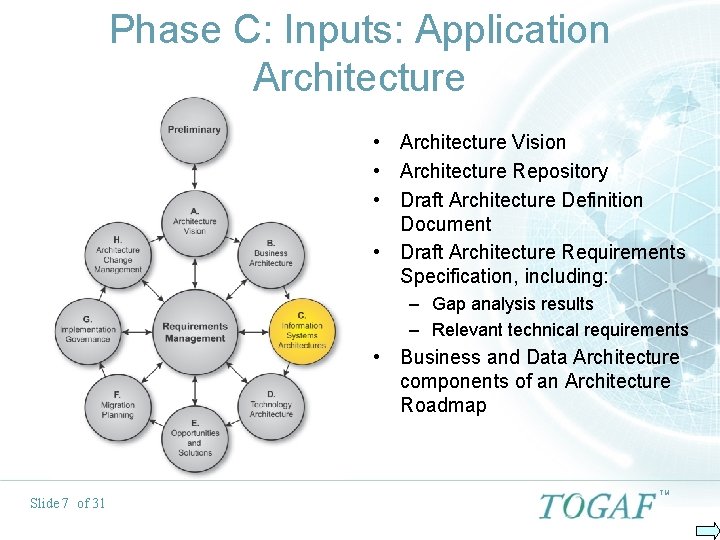
Phase C: Inputs: Application Architecture • Architecture Vision • Architecture Repository • Draft Architecture Definition Document • Draft Architecture Requirements Specification, including: – Gap analysis results – Relevant technical requirements • Business and Data Architecture components of an Architecture Roadmap Slide 7 of 31 TM
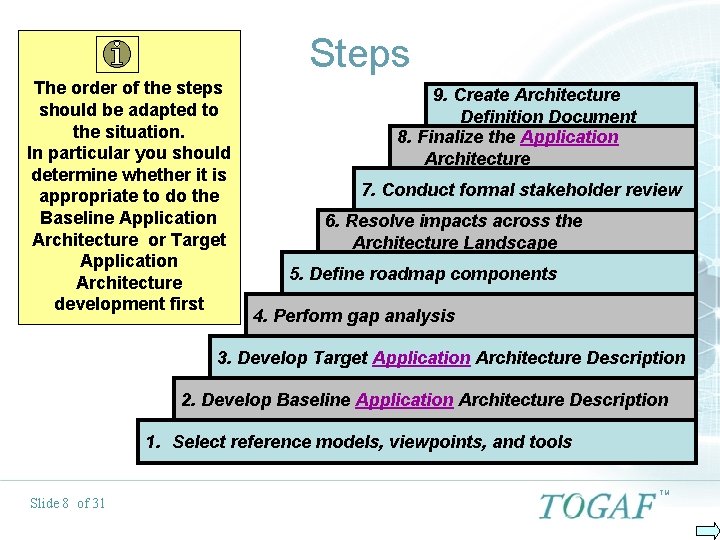
Steps The order of the steps should be adapted to the situation. In particular you should determine whether it is appropriate to do the Baseline Application Architecture or Target Application Architecture development first 9. Create Architecture Definition Document 8. Finalize the Application Architecture 7. Conduct formal stakeholder review 6. Resolve impacts across the Architecture Landscape 5. Define roadmap components 4. Perform gap analysis 3. Develop Target Application Architecture Description 2. Develop Baseline Application Architecture Description 1. Select reference models, viewpoints, and tools Slide 8 of 31 TM
Step 1: Select reference models, viewpoints, and tools • Review/generate and validate application principles – see Architecture Principles • Select Application Architecture resources (reference models, patterns, …) • Select relevant Application Architecture viewpoints • Identify appropriate tools and techniques (including forms) to be used for capture, modeling, and analysis, in association with the selected viewpoints. • Consider using platform-independent descriptions of business logic (e. g. the OMG’s MDA) • ctd. Slide 9 of 31 TM
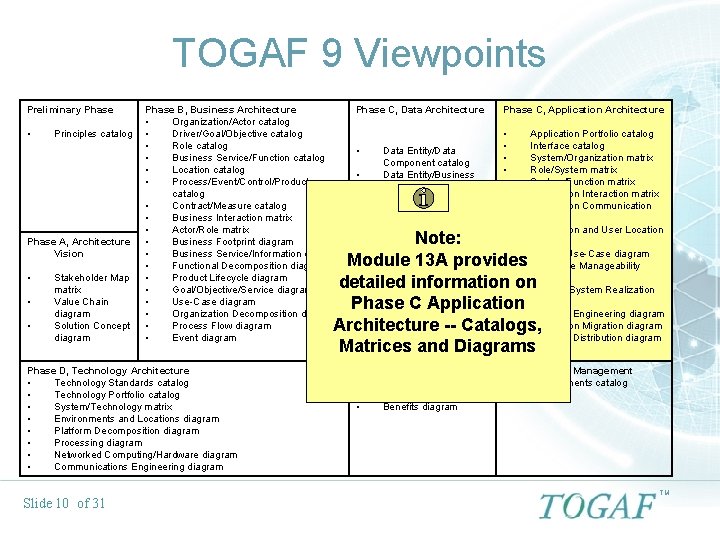
TOGAF 9 Viewpoints Preliminary Phase • Principles catalog Phase A, Architecture Vision • • • Stakeholder Map matrix Value Chain diagram Solution Concept diagram Phase B, Business Architecture • Organization/Actor catalog • Driver/Goal/Objective catalog • Role catalog • Business Service/Function catalog • Location catalog • Process/Event/Control/Product catalog • Contract/Measure catalog • Business Interaction matrix • Actor/Role matrix • Business Footprint diagram • Business Service/Information diagram • Functional Decomposition diagram • Product Lifecycle diagram • Goal/Objective/Service diagram • Use-Case diagram • Organization Decomposition diagram • Process Flow diagram • Event diagram Phase D, Technology Architecture • Technology Standards catalog • Technology Portfolio catalog • System/Technology matrix • Environments and Locations diagram • Platform Decomposition diagram • Processing diagram • Networked Computing/Hardware diagram • Communications Engineering diagram Slide 10 of 31 Phase C, Data Architecture • • • Data Entity/Data Component catalog Data Entity/Business Function matrix System/Data matrix Class diagram Data Dissemination diagram Data Security diagram Class Hierarchy diagram Data Migration diagram Data Lifecycle diagram Phase C, Application Architecture • • Application Portfolio catalog Interface catalog System/Organization matrix Role/System matrix System/Function matrix Application Interaction matrix Application Communication diagram Application and User Location diagram System Use-Case diagram Enterprise Manageability diagram Process/System Realization diagram Software Engineering diagram Application Migration diagram Software Distribution diagram Note: • • • Module 13 A provides • • detailed information • Phase C Application • • Architecture -- Catalogs, • Matrices and Diagrams Phase E. Opportunities & Solutions • Project Context diagram • Benefits diagram Requirements Management • Requirements catalog TM
Step 1: Select reference models, viewpoints, and tools • • Determine Overall Modeling Process – For each viewpoint, select the models needed to support the specific view required, using the selected tool or method. E. g. : The TMF has developed detailed applications models relevant to the Telecommunications industry. The OMG has some vertical Domain Task Forces developing models for specific vertical domains such as Healthcare, Transportation, Finance, etc. • Confirm all stakeholders’ concerns are addressed. If not, create new models to address concerns not covered, or augment existing models Identify Required Catalogs of Application Building Blocks – Slide 11 of 31 The organization’s Application portfolio is captured as a catalog within the Architecture Repository. • ctd. TM
Step 1: Select reference models, viewpoints, and tools • Identify Required Matrices – Matrices show the core relationships between related model entities. • Identify Required Diagrams – Diagrams present the Application Architecture information from a set of different viewpoints • Identify Types of Requirements to be Collected – e. g. Functional requirements, Non-functional requirements, Assumptions, Constraints, Domain-specific Business Architecture principles, Policies, Standards, Guidelines, Specifications Slide 12 of 31 TM
Example – The Integrated Information Infrastructure Model • An Applications Architecture reference model – a model of the application components and application services software essential for an integrated information infrastructure • Based on the TRM • Aimed at the helping the design of architectures to enable and support the vision of Boundaryless Information Flow Slide 13 of 31 TM
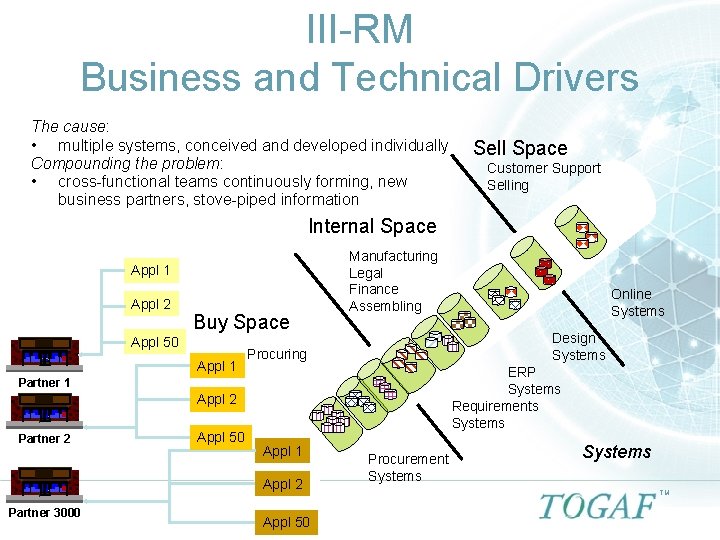
III-RM Business and Technical Drivers The cause: • multiple systems, conceived and developed individually Compounding the problem: • cross-functional teams continuously forming, new business partners, stove-piped information Sell Space Customer Support Selling Internal Space Appl 1 Appl 2 Buy Space Appl 50 Appl 1 Manufacturing Legal Finance Assembling Design Systems Procuring ERP Systems Requirements Systems Partner 1 Appl 2 Partner 2 Appl 50 Appl 1 Appl 2 Slide 14 of 31 Partner 3000 Online Systems Appl 50 Procurement Systems TM
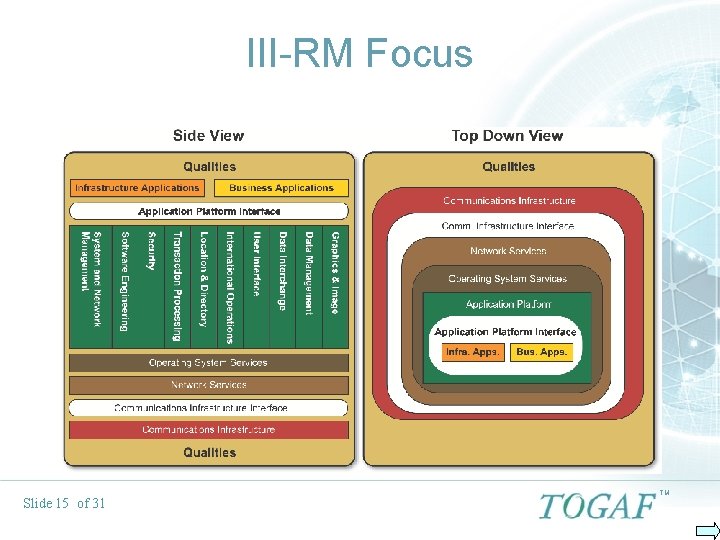
III-RM Focus Slide 15 of 31 TM
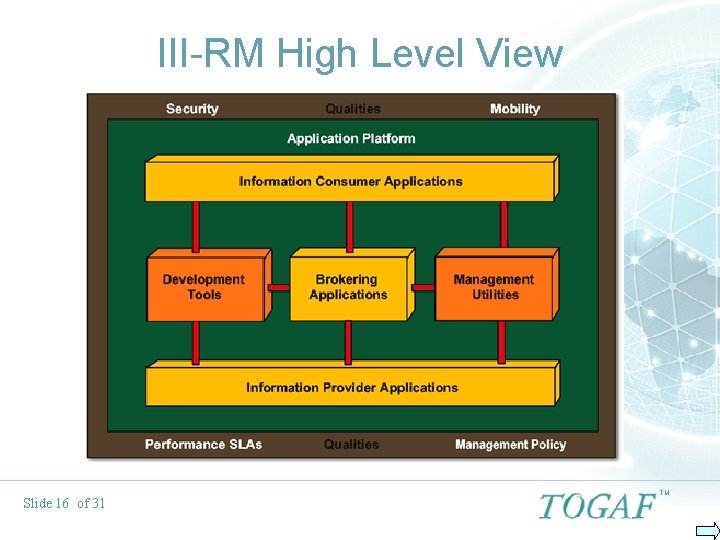
III-RM High Level View Slide 16 of 31 TM
Step 2 Develop a Baseline Application Architecture Description If possible, identify the relevant Application ABBs, drawing on the Architecture Repository. • If not, define each application in line with the Application Portfolio catalog Continued… Slide 17 of 31 TM
Step 3 Develop Target Application Architecture Description • If possible, identify the relevant Application Architecture building blocks, drawing on the Architecture Repository • If not, develop a new architecture model: – Slide 18 of 31 use the models identified within Step 1 as a guideline TM
Step 4: Perform Gap Analysis Verify the architecture models for internal consistency and accuracy Note changes to the viewpoint represented in the selected models from the Architecture Repository, and document Test architecture models for completeness against requirements Identify gaps between the baseline and target: • Create the gap matrix • Identify building blocks to be carried over, classifying them as either changed or unchanged. • Identify eliminated building blocks. • Identify new building blocks. • Identify gaps and classify as those that should be developed and those that should be procured. Slide 19 of 31 TM
Step 5: Define roadmap components • This initial Application Architecture roadmap will be used as raw material to support more detailed definition of a consolidated, cross-discipline roadmap within the Opportunities & Solutions phase. Slide 20 of 31 TM
Step 6: Resolve impacts across the Architecture Landscape • Architecture artifacts in the Architecture Landscape should be examined to identify: – Does this Application Architecture create an impact on any preexisting architectures? – Have recent changes been made that impact on the Application Architecture? – Are there any opportunities to leverage work from this Application Architecture in other areas of the organization? – Does this Application Architecture impact other projects ? – Will this Application Architecture be impacted by other projects? Slide 21 of 31 TM
Step 7 Conduct Formal Stakeholder Review Check the original motivation for the architecture project and the Statement of Architecture Work against the proposed Applicaation Architecture. Conduct an impact analysis to: • Identify any areas where the Business and Data Architecture may need to change to cater for changes in the Application Architecture. If the impact is significant revisit the Business and Data Architectures. Continued… Slide 22 of 31 TM
Step 8 Finalize the Application Architecture • • • Select standards for each of the ABBs, reusing as much as possible. Fully document each ABB. Cross check the overall architecture against the business requirements. Document the final requirements traceability report. Document the final mapping of the architecture within the Architecture repository. Identify the ABBs that might be reused and publish them via the architecture repository. Finalize all the work products, such as gap analysis Slide 23 of 31 TM
Step 9: Create Architecture Definition Document • Document the rationale for all building block decisions in the architecture definition document. • Prepare the Application Architecture sections of the architecture definition document report. • If appropriate, use reports and/or graphics generated by modeling tools to demonstrate key views of the architecture. Route the document for review by relevant stakeholders, and incorporate feedback. Slide 24 of 31 TM
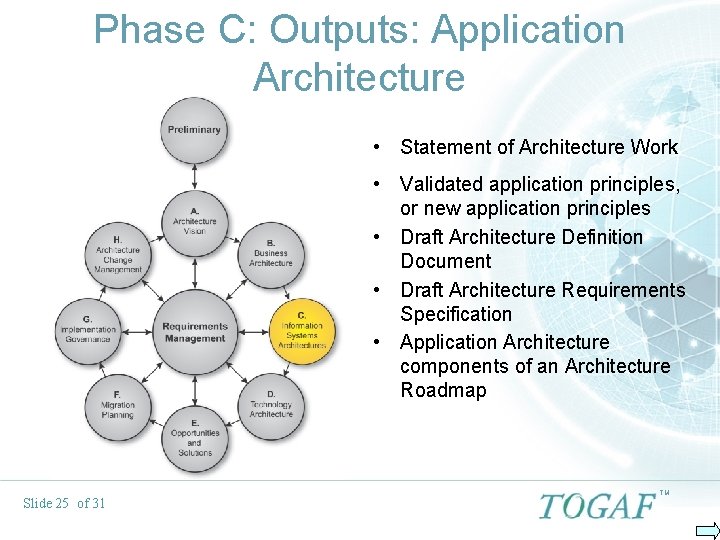
Phase C: Outputs: Application Architecture • Statement of Architecture Work • Validated application principles, or new application principles • Draft Architecture Definition Document • Draft Architecture Requirements Specification • Application Architecture components of an Architecture Roadmap Slide 25 of 31 TM
Architecture Definition Document – Application Architecture Components • Baseline Application Architecture, if appropriate • Target Application Architecture, including: – – Process systems model Place systems model Time systems model People systems model • Application Architecture views corresponding to the selected viewpoints addressing key stakeholder concerns Slide 26 of 31 TM
Architecture Requirements Specification – Application Architecture Components • Gap analysis results • Application interoperability requirements • Areas where the Business Architecture may need to change in order to comply with changes in the Application Architecture • Constraints on the Technology Architecture about to be designed • Updated business/application/data requirements, if appropriate Slide 27 of 31 TM
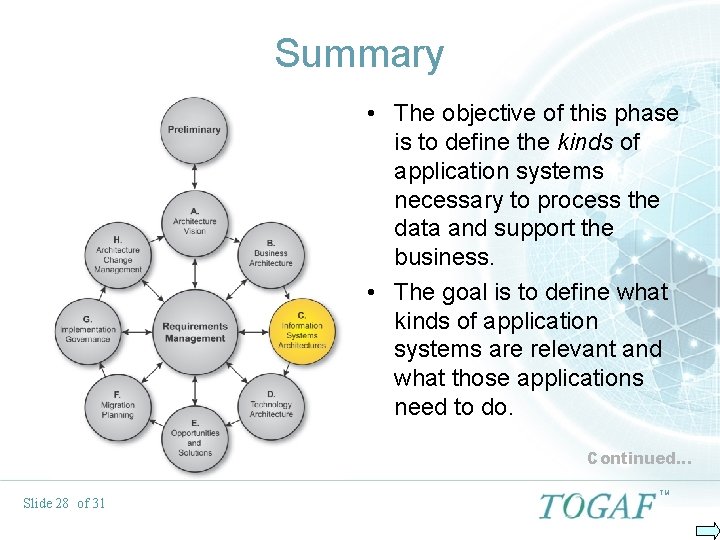
Summary • The objective of this phase is to define the kinds of application systems necessary to process the data and support the business. • The goal is to define what kinds of application systems are relevant and what those applications need to do. Continued… Slide 28 of 31 TM
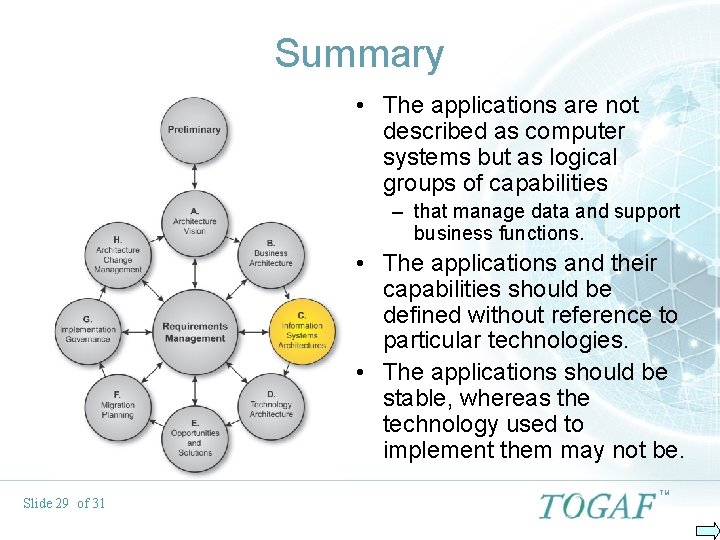
Summary • The applications are not described as computer systems but as logical groups of capabilities – that manage data and support business functions. • The applications and their capabilities should be defined without reference to particular technologies. • The applications should be stable, whereas the technology used to implement them may not be. Slide 29 of 31 TM
Test Yourself Question Q 1. How should the application systems best be described? A. B. C. D. E. As computer systems As logical groups of capabilities As schemas As data-flow diagrams As UML diagrams Slide 30 of 31 TM
Architecture Phase A: Architecture Development Method Phase C Vision Phase C: Application Architecture TOGAF is a trademark of The Open Group in the United States and other countries Slide 31 of 31 TM TM