
Module 2 WASH FIT methodology Overview 1 Revision


- Slides: 63
Module 2 WASH FIT methodology
Overview 1. Revision and brainstorming 2. Overview of the five steps of WASH FIT 3. Field visit
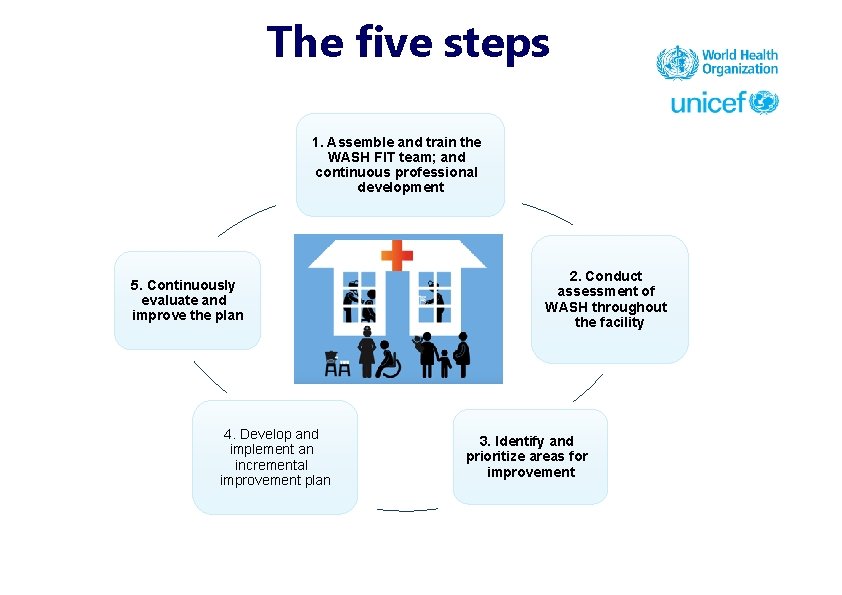
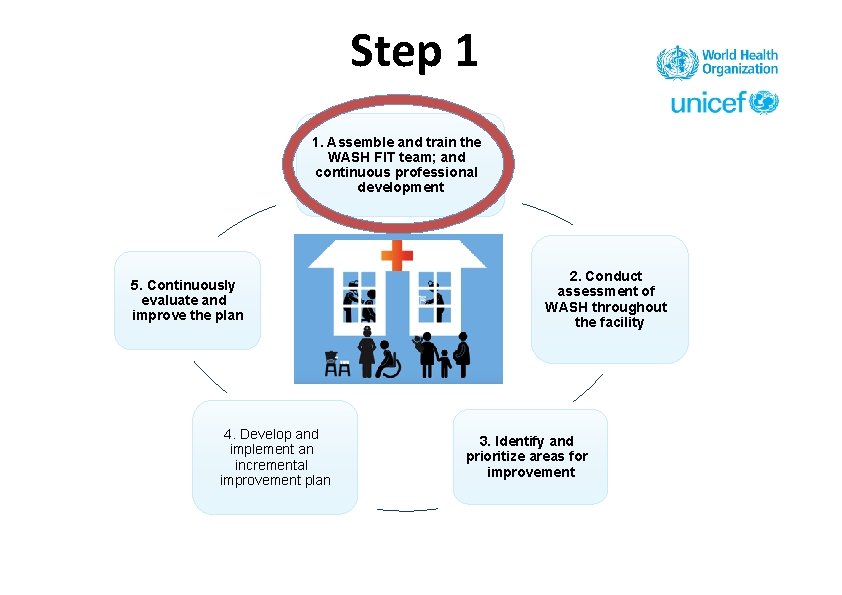
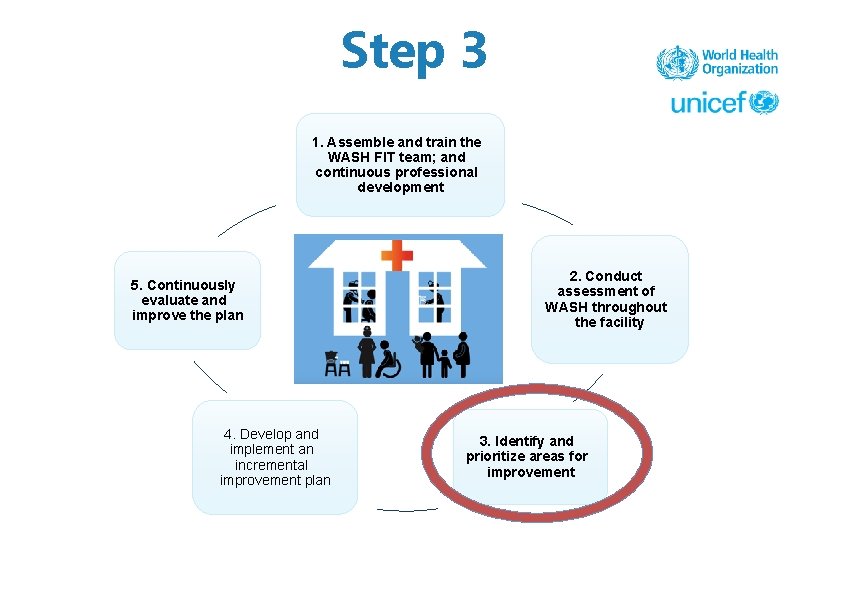
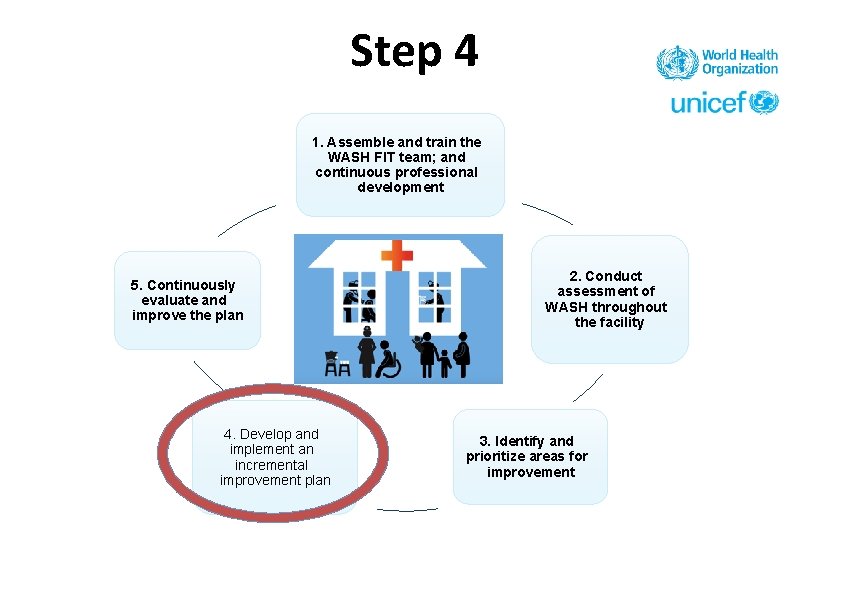
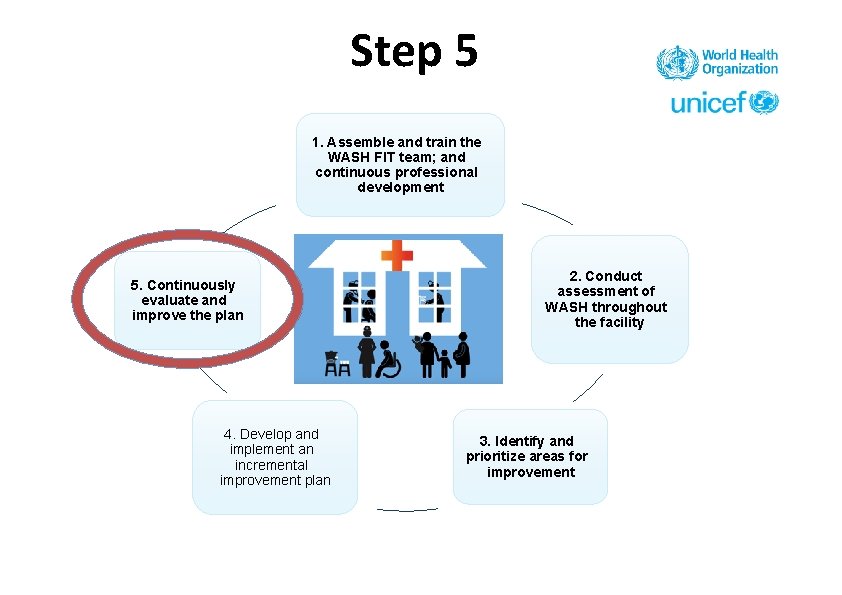
The five steps 1. Assemble and train the WASH FIT team; and continuous professional development 5. Continuously evaluate and improve the plan 4. Develop and implement an incremental improvement plan 2. Conduct assessment of WASH throughout the facility 3. Identify and prioritize areas for improvement
Step 1: Assemble the team
Step 1 1. Assemble and train the WASH FIT team; and continuous professional development 5. Continuously evaluate and improve the plan 4. Develop and implement an incremental improvement plan 2. Conduct assessment of WASH throughout the facility 3. Identify and prioritize areas for improvement
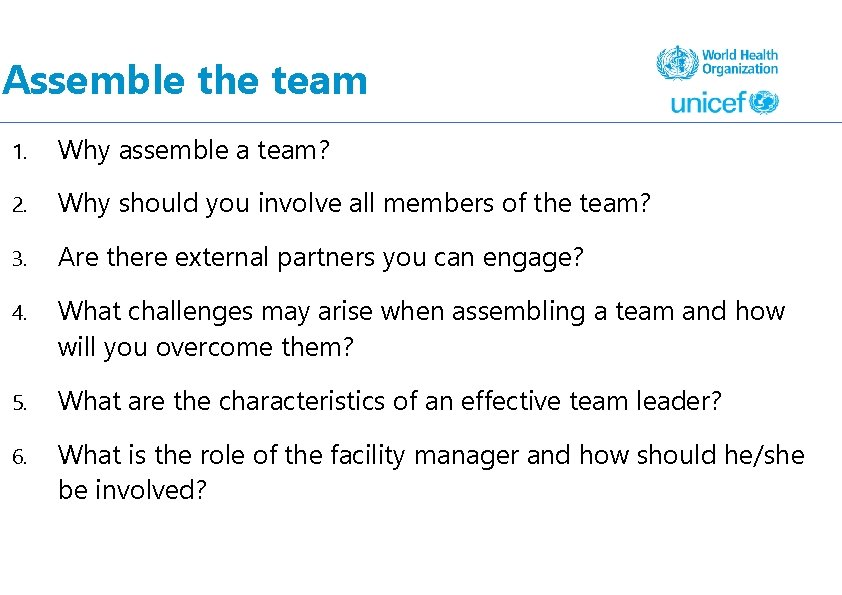
Assemble the team 1. Why assemble a team? 2. Why should you involve all members of the team? 3. Are there external partners you can engage? 4. What challenges may arise when assembling a team and how will you overcome them? 5. What are the characteristics of an effective team leader? 6. What is the role of the facility manager and how should he/she be involved?
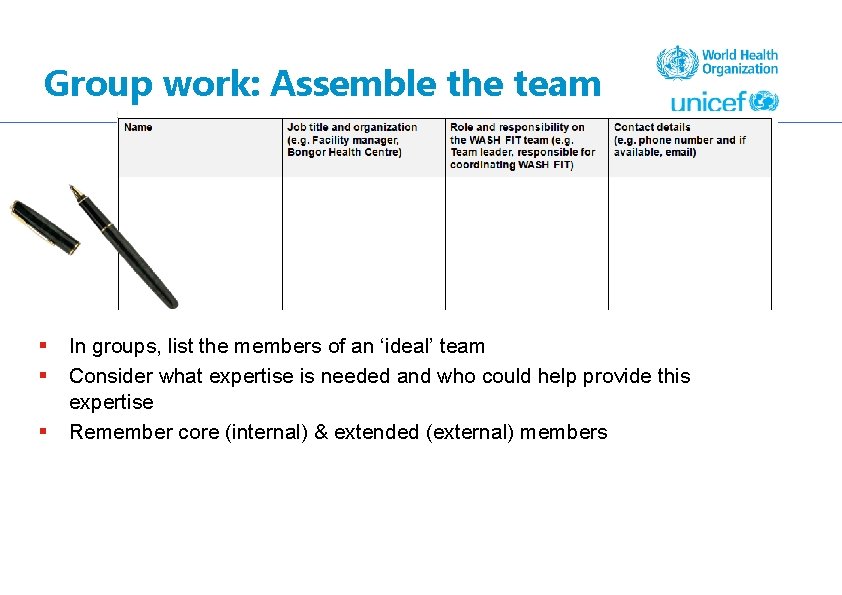
Group work: Assemble the team § In groups, list the members of an ‘ideal’ team § Consider what expertise is needed and who could help provide this expertise § Remember core (internal) & extended (external) members
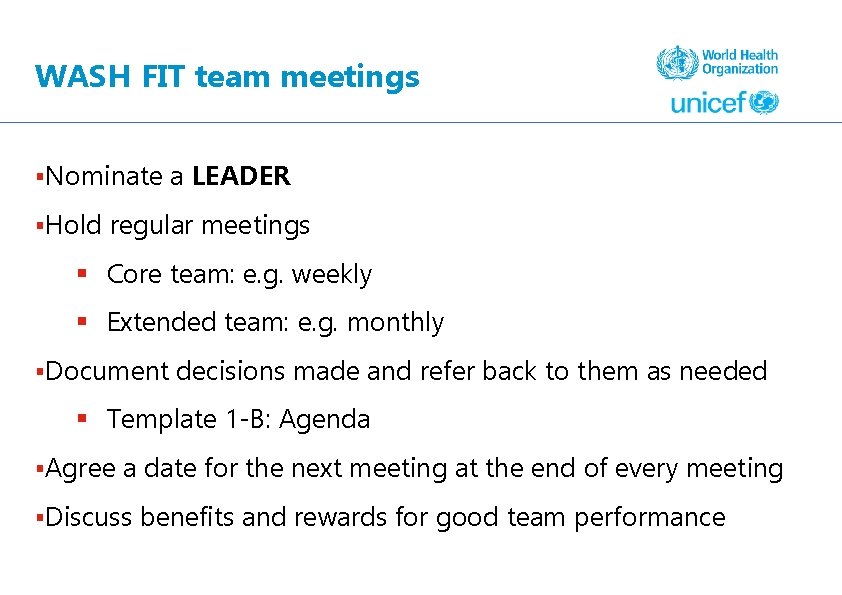
WASH FIT team meetings §Nominate §Hold a LEADER regular meetings § Core team: e. g. weekly § Extended team: e. g. monthly §Document decisions made and refer back to them as needed § Template 1 -B: Agenda §Agree a date for the next meeting at the end of every meeting §Discuss benefits and rewards for good team performance
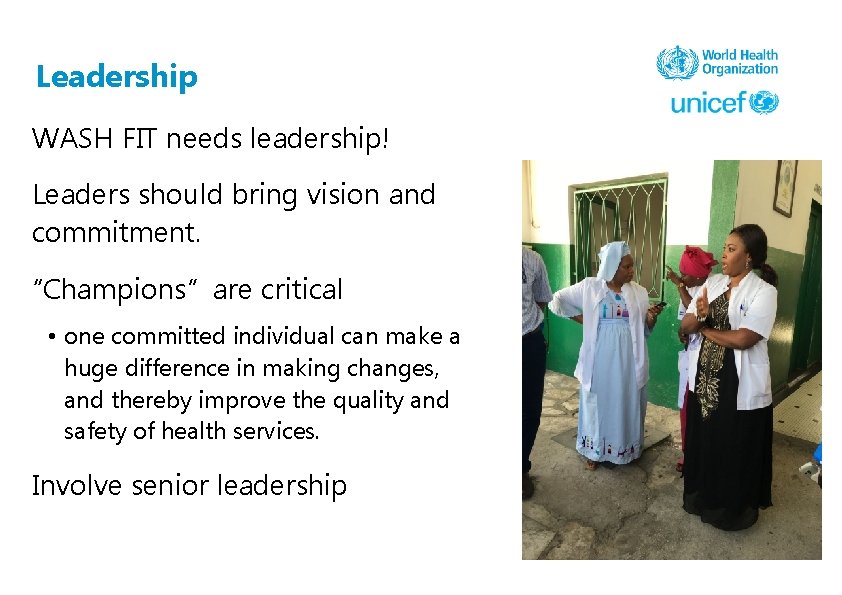
Leadership WASH FIT needs leadership! Leaders should bring vision and commitment. “Champions” are critical • one committed individual can make a huge difference in making changes, and thereby improve the quality and safety of health services. Involve senior leadership
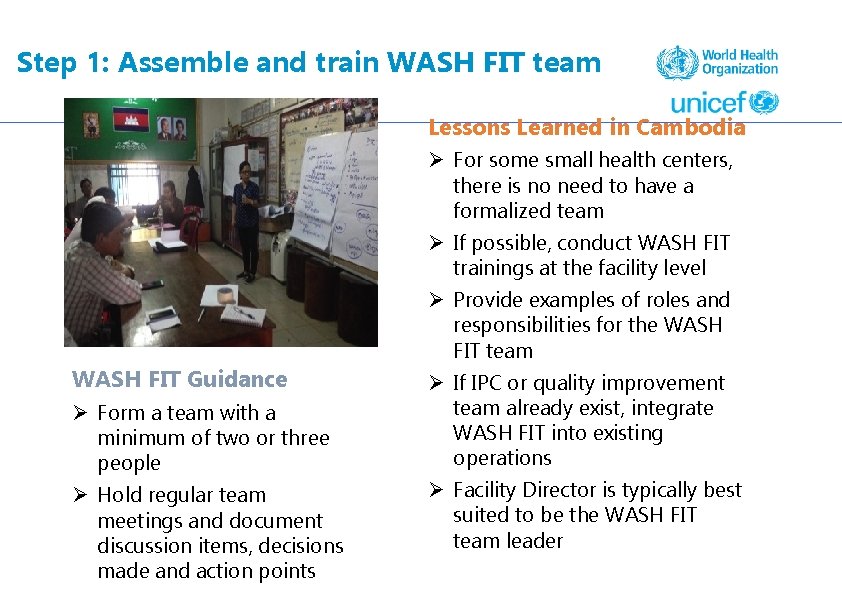
Step 1: Assemble and train WASH FIT team Lessons Learned in Cambodia WASH FIT Guidance Ø Form a team with a minimum of two or three people Ø Hold regular team meetings and document discussion items, decisions made and action points Ø For some small health centers, there is no need to have a formalized team Ø If possible, conduct WASH FIT trainings at the facility level Ø Provide examples of roles and responsibilities for the WASH FIT team Ø If IPC or quality improvement team already exist, integrate WASH FIT into existing operations Ø Facility Director is typically best suited to be the WASH FIT team leader
Step 2. Conduct an assessment of the facility
Step 2 1. Assemble and train the WASH FIT team; and continuous professional development 5. Continuously evaluate and improve the plan 4. Develop and implement an incremental improvement plan 2. Conduct assessment of WASH throughout the facility 3. Identify and prioritize areas for improvement
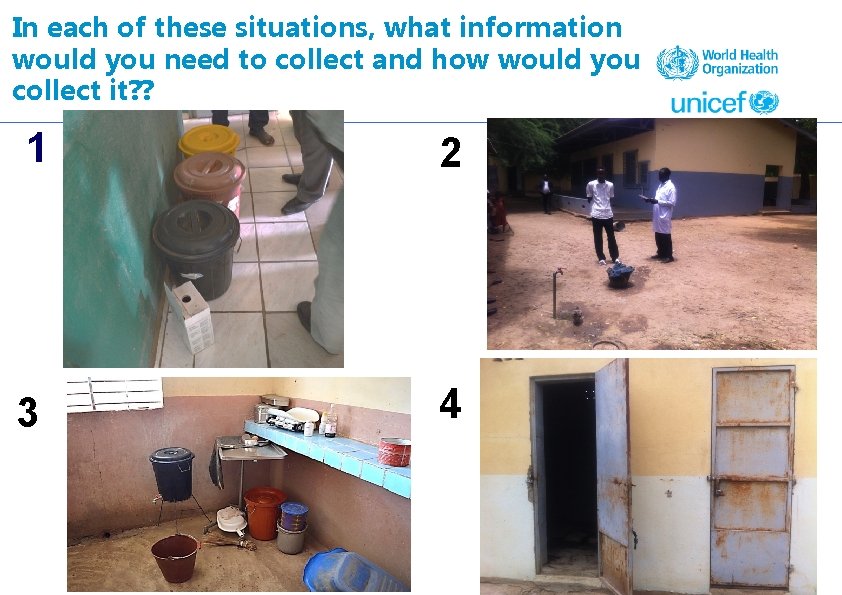
Step 2: Facility assessment § A comprehensive assessment forms the basis of WASH FIT § Look at the interior and exterior of facility § Consider infrastructure § Water supply, sanitation facilities etc. § Behaviours, knowledge, management
How to conduct an assessment § Use a range of methods § Make observations § Ask questions § Look at documents § Take photos § Verify the information that you are given § Be thorough! § Involve the whole team § Assess both inside and outside of the facility
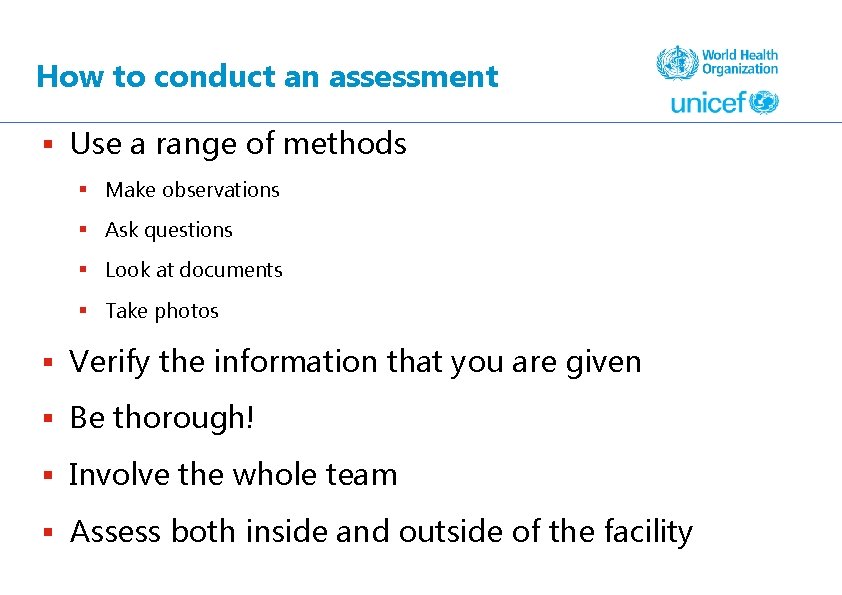
In each of these situations, what information would you need to collect and how would you collect it? ? 1 2 3 4
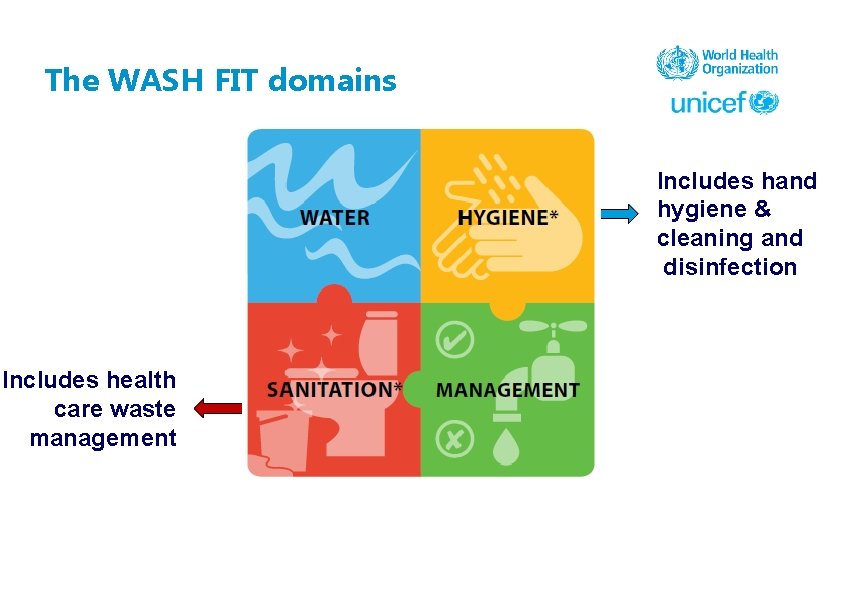
The WASH FIT domains Includes hand hygiene & cleaning and disinfection Includes health care waste management
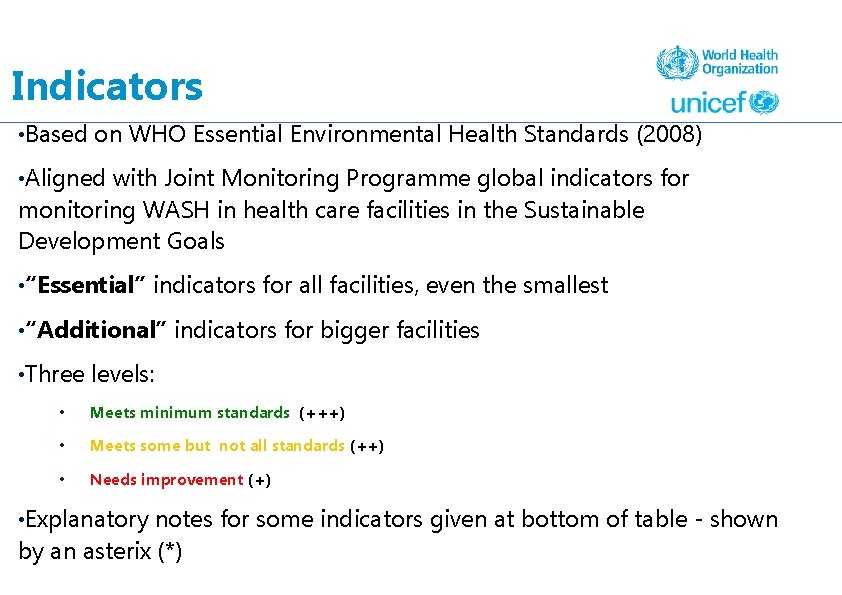
Indicators • Based on WHO Essential Environmental Health Standards (2008) • Aligned with Joint Monitoring Programme global indicators for monitoring WASH in health care facilities in the Sustainable Development Goals • “Essential” indicators for all facilities, even the smallest • “Additional” • Three indicators for bigger facilities levels: • Meets minimum standards (+++) • Meets some but not all standards (++) • Needs improvement (+) • Explanatory notes for some indicators given at bottom of table - shown by an asterix (*)
Indicators • WASH FIT indicators are based on GLOBAL standards. • They should be adapted to meet national standards • Consider if there any indicators missing which you believe are important • Consider if any indicators should be taken out (for example for small facilities without inpatient services, it is not necessary to ask about inpatient toilets)
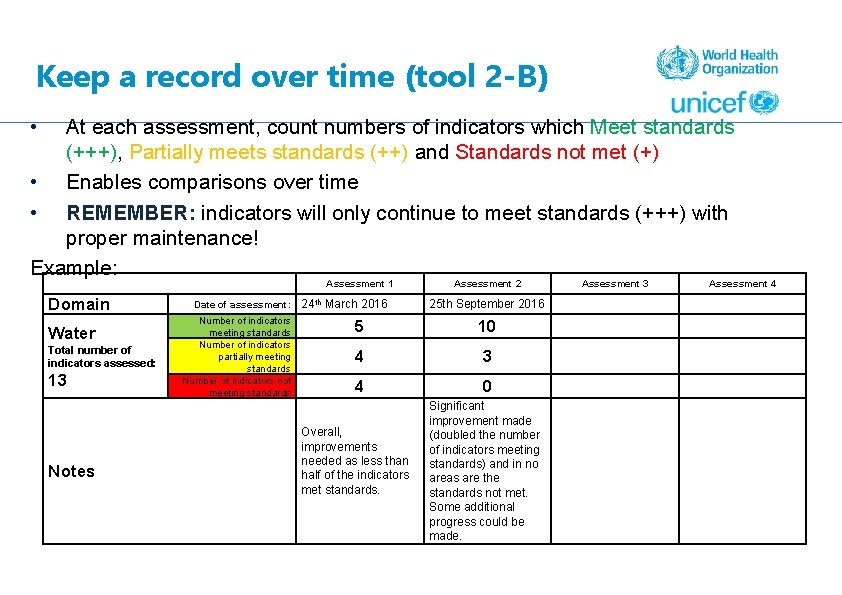
Keep a record over time (tool 2 -B) • At each assessment, count numbers of indicators which Meet standards (+++), Partially meets standards (++) and Standards not met (+) • Enables comparisons over time • REMEMBER: indicators will only continue to meet standards (+++) with proper maintenance! Example: Domain Water Total number of indicators assessed: 13 Notes Date of assessment: Assessment 1 24 th March 2016 Number of indicators meeting standards Number of indicators partially meeting standards Number of indicators not meeting standards Assessment 3 Assessment 4 25 th September 2016 5 10 4 3 4 0 Significant improvement made (doubled the number of indicators meeting standards) and in no areas are the standards not met. Some additional progress could be made. Overall, improvements needed as less than half of the indicators met standards. Assessment 2
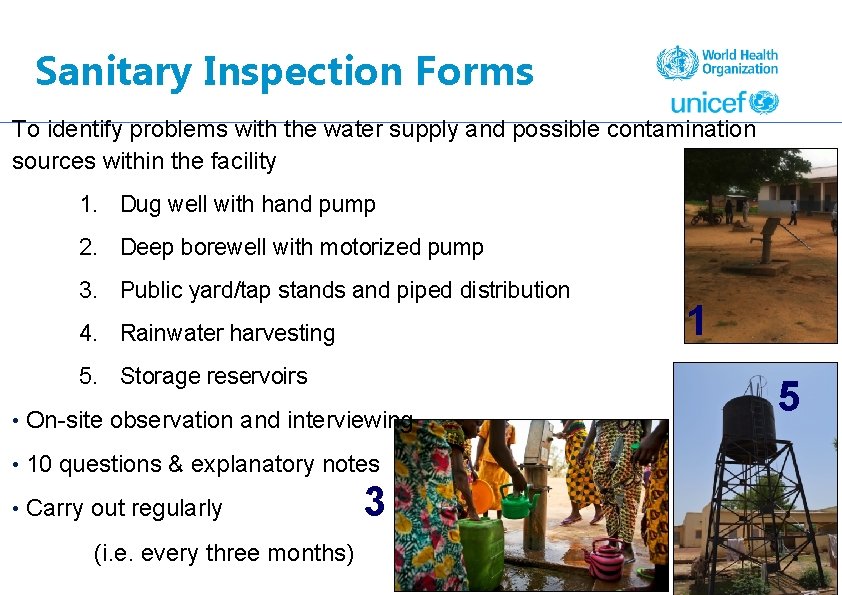
Sanitary Inspection Forms To identify problems with the water supply and possible contamination sources within the facility 1. Dug well with hand pump 2. Deep borewell with motorized pump 3. Public yard/tap stands and piped distribution 4. Rainwater harvesting 5. Storage reservoirs • On-site observation and interviewing • 10 questions & explanatory notes • Carry out regularly (i. e. every three months) 3 1 5
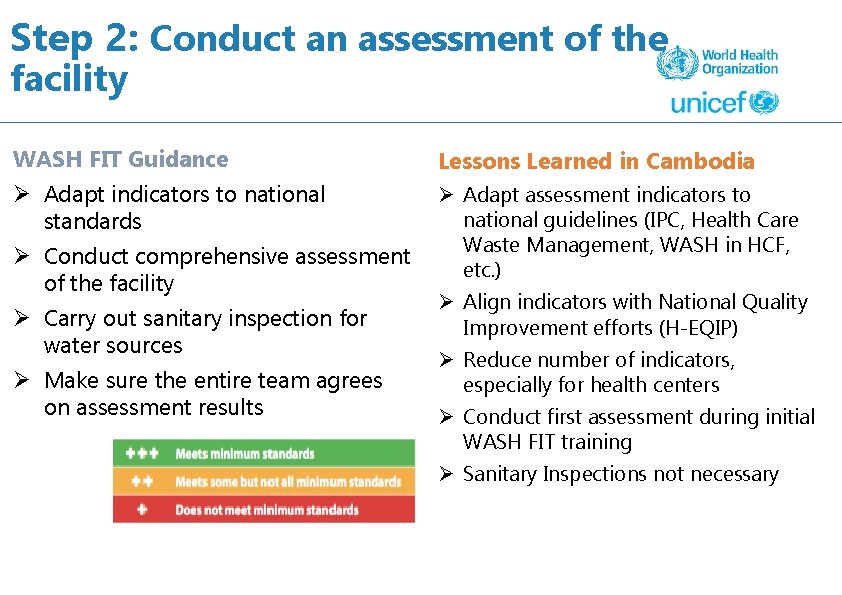
Step 2: Conduct an assessment of the facility WASH FIT Guidance Lessons Learned in Cambodia Ø Adapt indicators to national standards Ø Conduct comprehensive assessment of the facility Ø Carry out sanitary inspection for water sources Ø Make sure the entire team agrees on assessment results Ø Adapt assessment indicators to national guidelines (IPC, Health Care Waste Management, WASH in HCF, etc. ) Ø Align indicators with National Quality Improvement efforts (H-EQIP) Ø Reduce number of indicators, especially for health centers Ø Conduct first assessment during initial WASH FIT training Ø Sanitary Inspections not necessary
STEP 3. Risk Assessment: Identify strengths, hazards (PROBLEMS), risks and prioritize areas for improvement (ACTIONS)
Step 3 1. Assemble and train the WASH FIT team; and continuous professional development 5. Continuously evaluate and improve the plan 4. Develop and implement an incremental improvement plan 2. Conduct assessment of WASH throughout the facility 3. Identify and prioritize areas for improvement
Step 3: Objectives To identify what hazards (or problems) exist that prevent a facility from providing adequate WASH services and Identify what risks these hazards pose For each problem that you identify, consider the risks for staff, patients and their families Consider what the facility is doing well and what WASH infrastructure and protocols are already in place.
Definitions A hazard is defined as a "condition, event, or circumstance that could lead to or contribute to an unplanned or undesirable event. " It may also be referred to as a problem. Any indicators which do not meet the target should be considered a potential hazard. A risk is the potential a set of unwanted circumstances or events to occur as the result of the hazard. All hazards have an associated risk, however serious it may be.
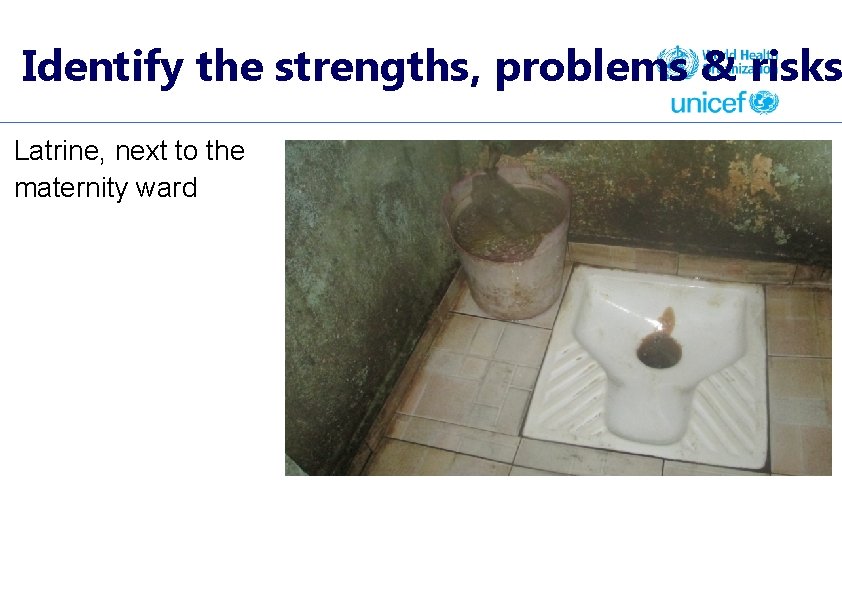
Identify the strengths, problems & risks Latrine, next to the maternity ward
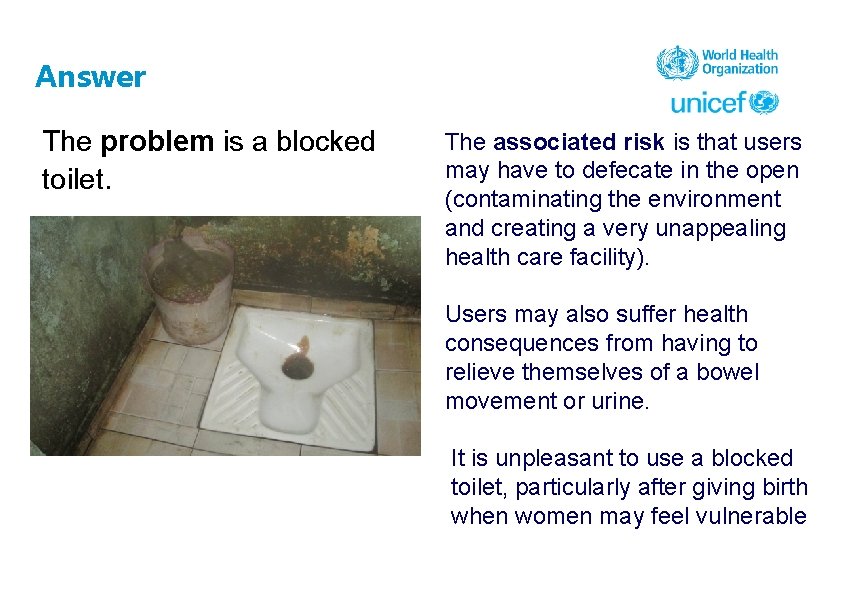
Answer The problem is a blocked toilet. The associated risk is that users may have to defecate in the open (contaminating the environment and creating a very unappealing health care facility). Users may also suffer health consequences from having to relieve themselves of a bowel movement or urine. It is unpleasant to use a blocked toilet, particularly after giving birth when women may feel vulnerable
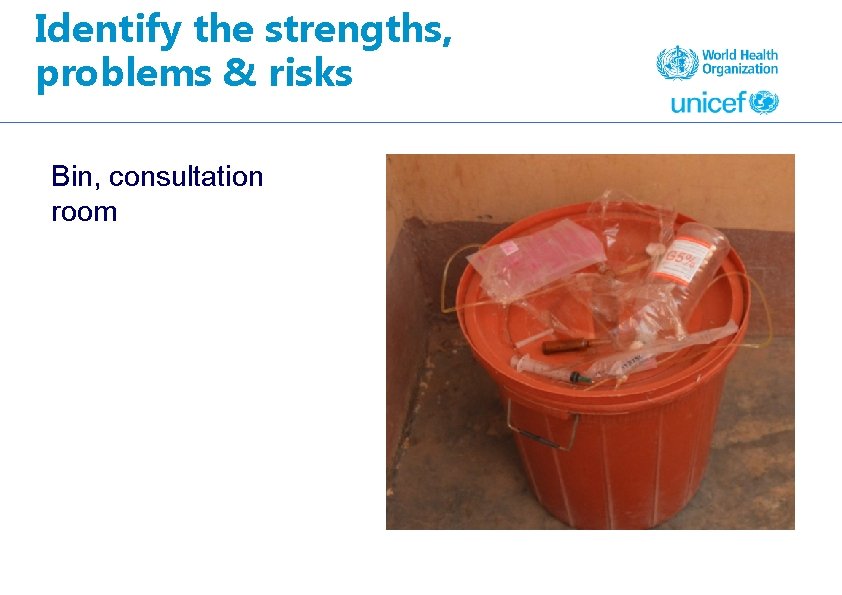
Identify the strengths, problems & risks Bin, consultation room
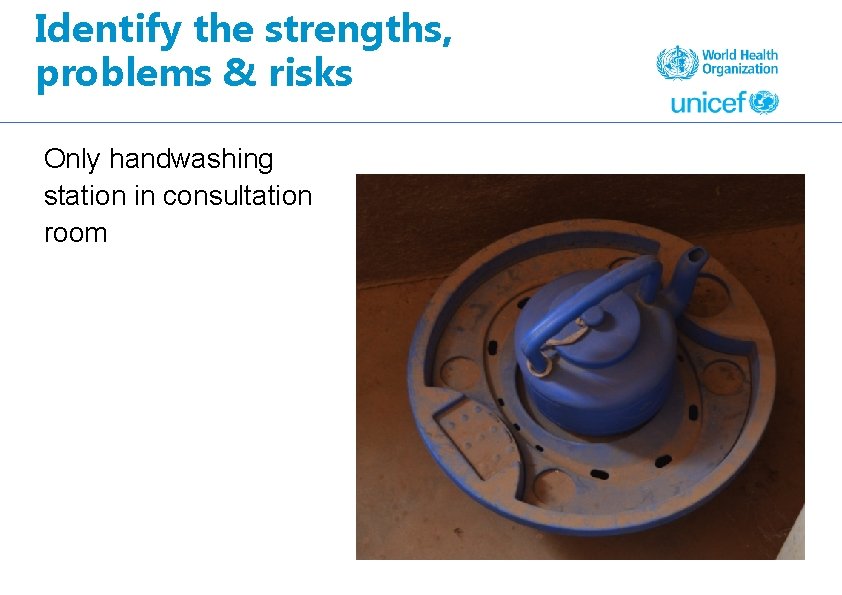
Identify the strengths, problems & risks Only handwashing station in consultation room
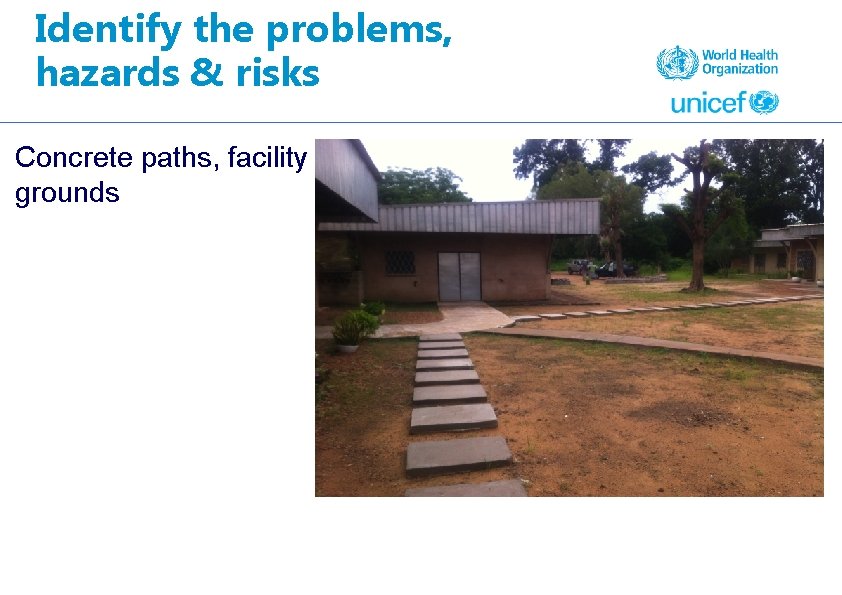
Identify the problems, hazards & risks Concrete paths, facility grounds
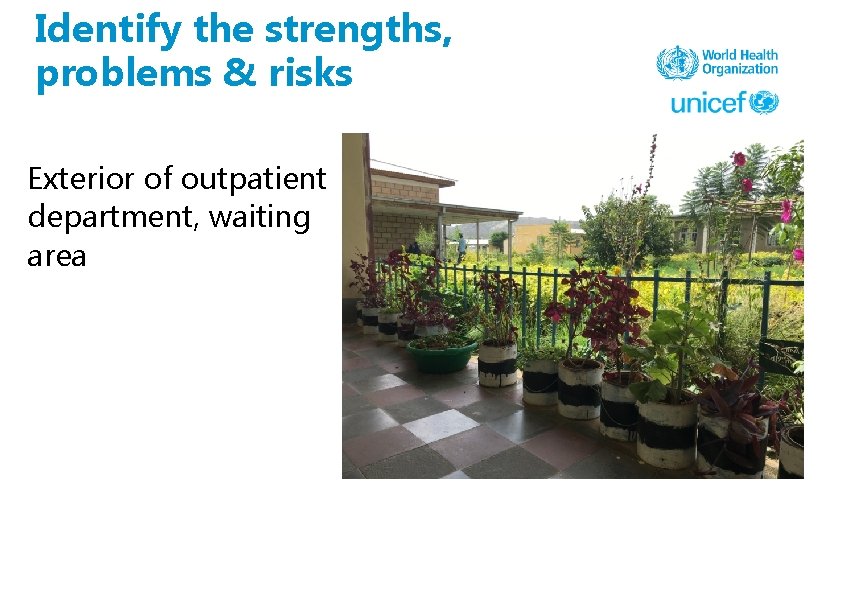
Identify the strengths, problems & risks Exterior of outpatient department, waiting area
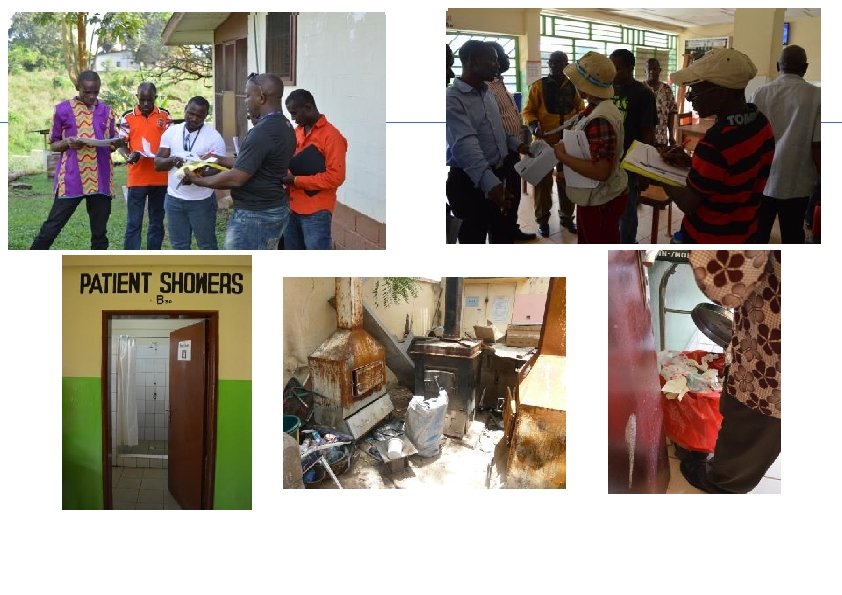
Identify the problems, hazards & risks
For each area of the facility, consider. . . • What are facility staff doing well to reach the standards? • What services and infrastructure are lacking? • What can go wrong with existing infrastructure? • Where is there an increased risk of infection in the facility? • What are the biggest constraints for staff in managing and accessing WASH services? • What are the biggest constraints for patients and their families in accessing WASH services • Is the behaviour of staff appropriate and adequate to ensure the best service is delivered? • Is there a protocol in place to ensure that each domain is managed effectively?
Step 3: Strengths, problems & risks What is the health facility currently doing well? Strengths • Existing (and functioning) infrastructure • Measures already in place (e. g. incentivisation schemes, hand hygiene campaigns) • Protocols that are implemented Recognise where health facility staff are doing well already.
Step 3: Strengths, problems & risks • Problems can relate to: • Infrastructure • Behavior, knowledge, lack of finances, lack of training • They can be: • One-off occurrences or short term • i. e. a broken incinerator or blocked latrine • Ongoing or long-term issues • i. e. no access or irregular access to water within the facility and/or facility grounds • i. e. no source of power for the incinerator
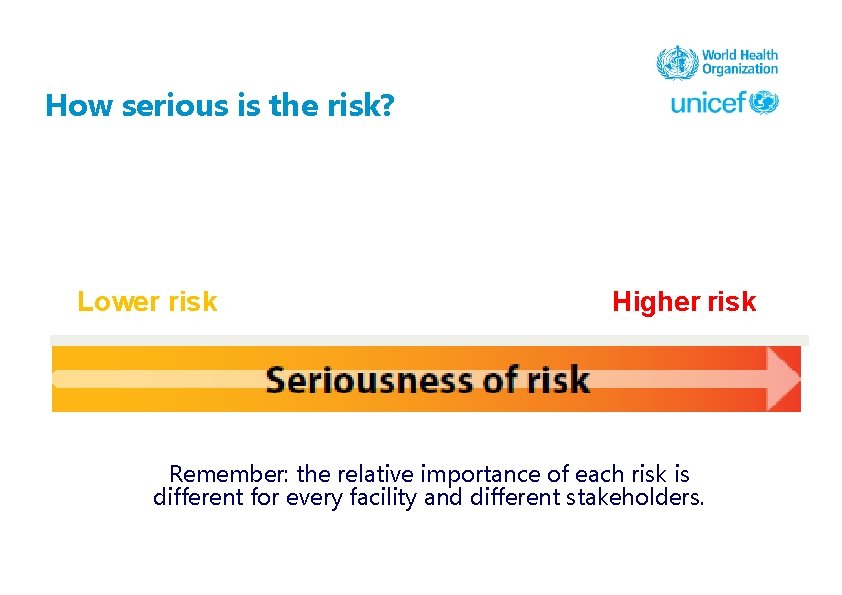
Step 3: Strengths, problems & risks § All problems have an associated risk § Risk can be to: § Staff § Patients § Visitors § Vulnerable groups § Pregnant women, § Elderly § Children § Disabled users How serious is the risk? How easy is it to address?
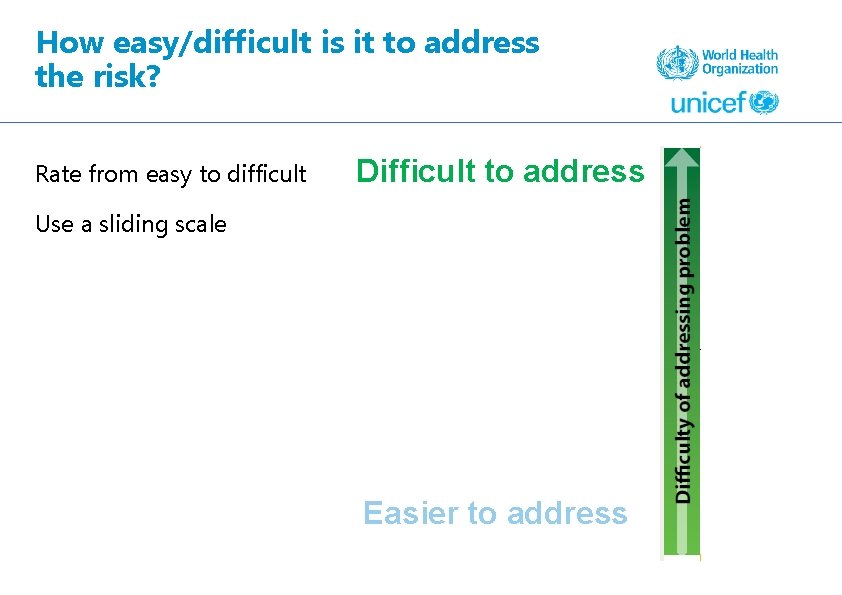
How easy/difficult is it to address the risk? Some problems are easier to address than others Some can be done within the facility (e. g. posting hand hygiene posters or cleaning the facility), others need external support (e. g. installing a water supply) Not everything can be addressed immediately so this will help you to prioritize some actions over others.
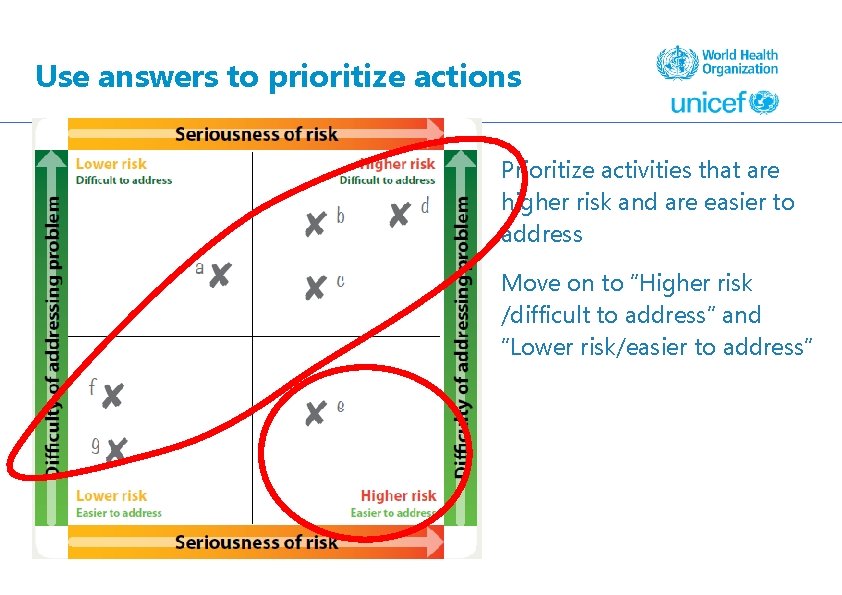
How easy/difficult is it to address the risk? Rate from easy to difficult Difficult to address Use a sliding scale Easier to address
How serious is the risk? Lower risk Higher risk Remember: the relative importance of each risk is different for every facility and different stakeholders.
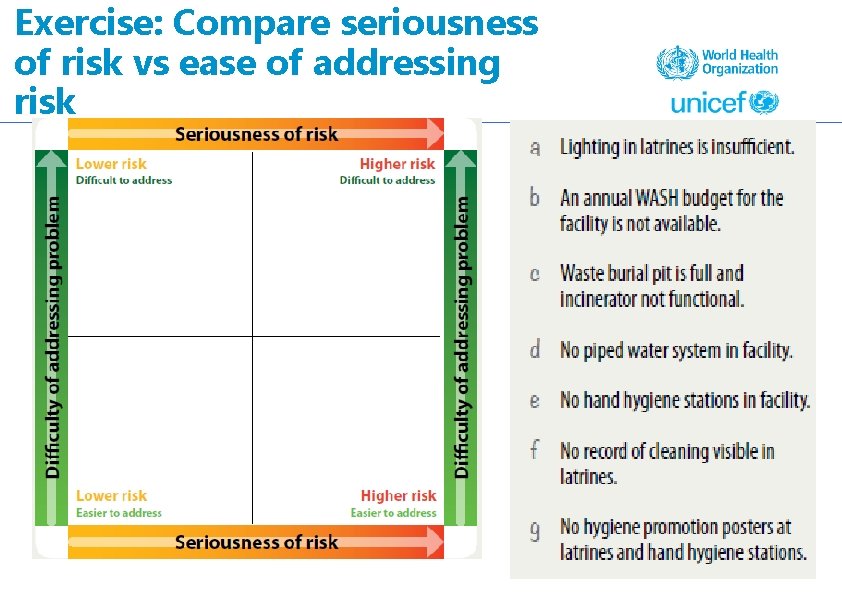
Exercise: Compare seriousness of risk vs ease of addressing risk
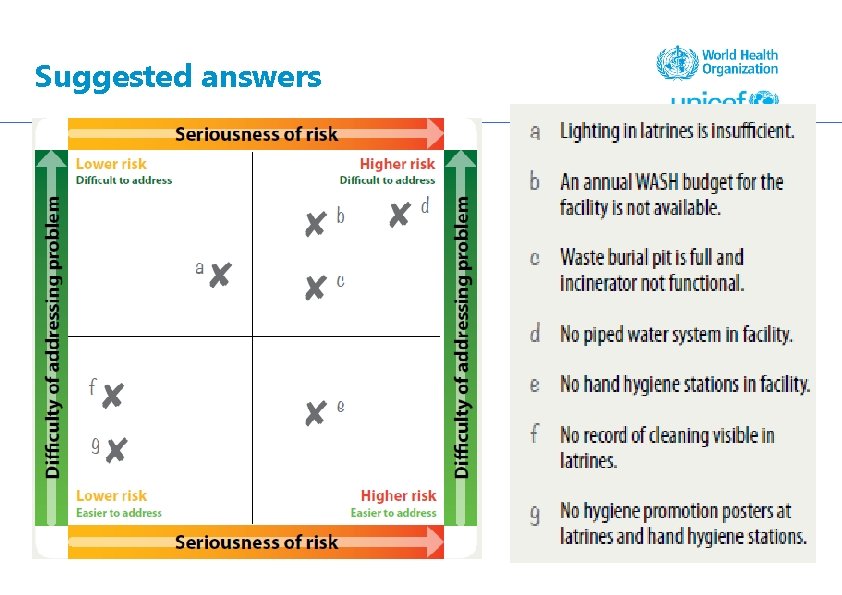
Suggested answers
Use answers to prioritize actions Prioritize activities that are higher risk and are easier to address Move on to “Higher risk /difficult to address” and “Lower risk/easier to address”
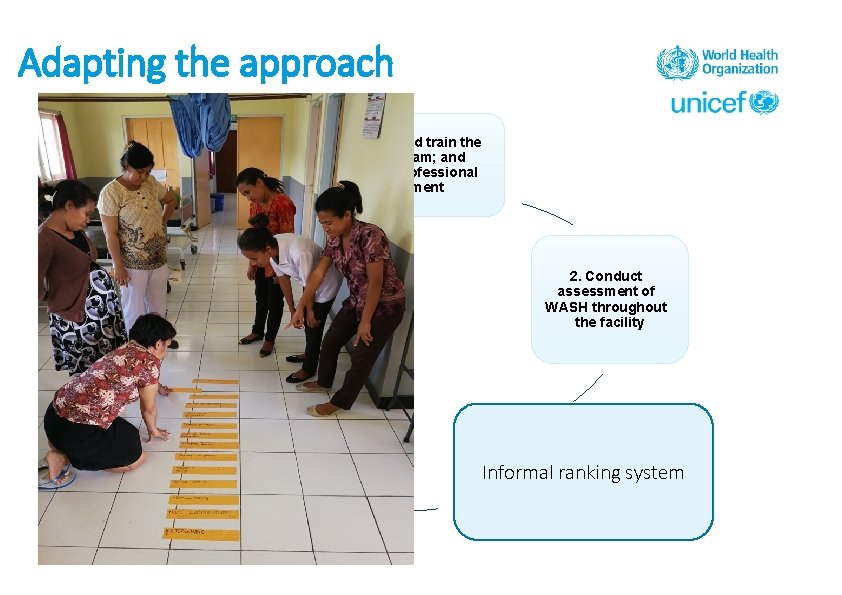
Adapting the approach 1. Assemble and train the WASH FIT team; and continuous professional development 5. Continuously evaluate and improve the plan 4. Develop and implement an incremental improvement plan 2. Conduct assessment of WASH throughout the facility 3. Identify and prioritize areas for improvement Informal ranking system
STEP 4. Develop and implement an incremental improvement plan
Step 4 1. Assemble and train the WASH FIT team; and continuous professional development 5. Continuously evaluate and improve the plan 4. Develop and implement an incremental improvement plan 2. Conduct assessment of WASH throughout the facility 3. Identify and prioritize areas for improvement
Improvement plan • Prioritise and detail the actions that will be taken Not everything can be addressed immediately • Develop a detailed plan to implement the actions
Decide… • What specific ACTIONS will be taken • WHO is responsible • What RESOURCES are required • • Technical • Human • Financial WHEN it will be done
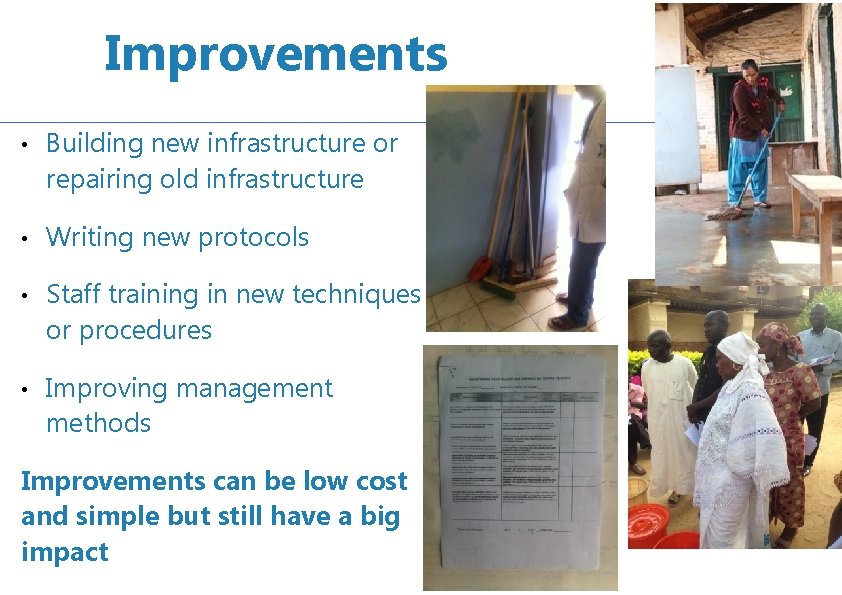
Improvements • Building new infrastructure or repairing old infrastructure • Writing new protocols • Staff training in new techniques or procedures • Improving management methods Improvements can be low cost and simple but still have a big impact
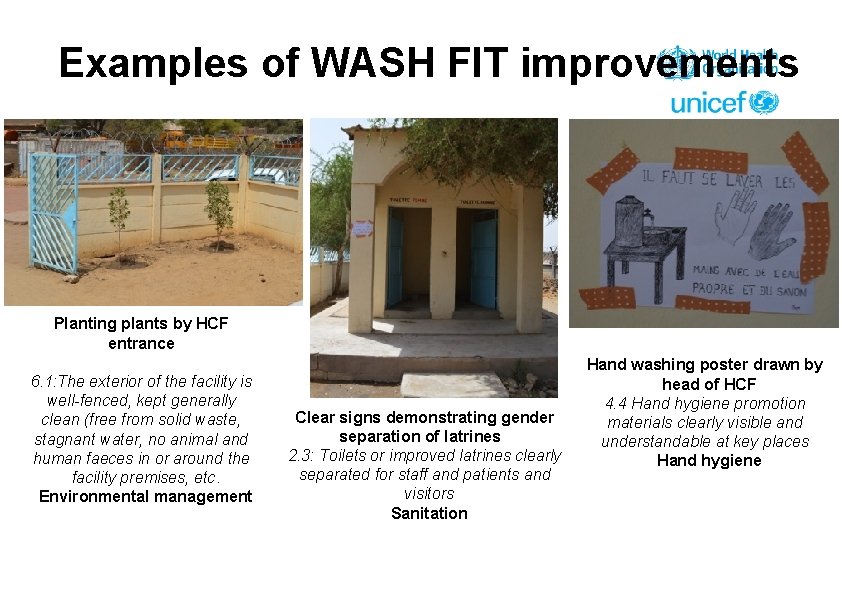
Examples of WASH FIT improvements Planting plants by HCF entrance 6. 1: The exterior of the facility is well-fenced, kept generally clean (free from solid waste, stagnant water, no animal and human faeces in or around the facility premises, etc. Environmental management Clear signs demonstrating gender separation of latrines 2. 3: Toilets or improved latrines clearly separated for staff and patients and visitors Sanitation Hand washing poster drawn by head of HCF 4. 4 Hand hygiene promotion materials clearly visible and understandable at key places Hand hygiene
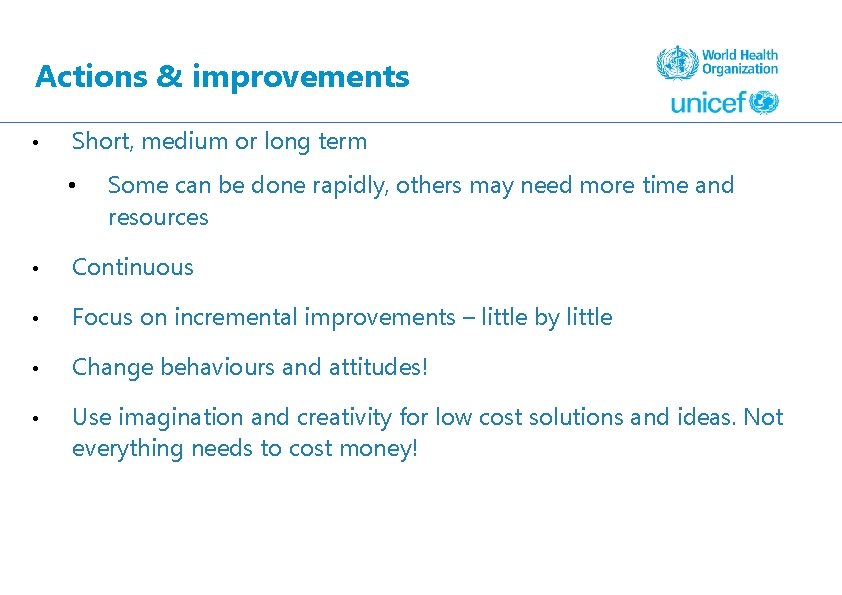
Actions & improvements • Short, medium or long term • Some can be done rapidly, others may need more time and resources • Continuous • Focus on incremental improvements – little by little • Change behaviours and attitudes! • Use imagination and creativity for low cost solutions and ideas. Not everything needs to cost money!
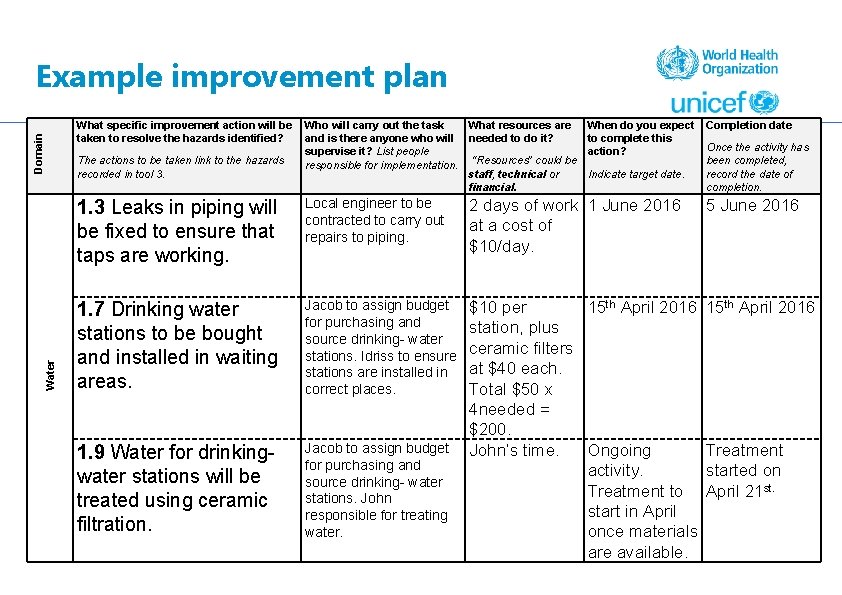
Example improvement plan Water Domain What specific improvement action will be Who will carry out the task taken to resolve the hazards identified? and is there anyone who will supervise it? List people The actions to be taken link to the hazards responsible for implementation. recorded in tool 3. 1. 3 Leaks in piping will be fixed to ensure that taps are working. Local engineer to be contracted to carry out repairs to piping. 1. 7 Drinking water stations to be bought and installed in waiting areas. Jacob to assign budget for purchasing and source drinking- water stations. Idriss to ensure stations are installed in correct places. 1. 9 Water for drinkingwater stations will be treated using ceramic filtration. What resources are needed to do it? When do you expect Completion date to complete this Once the activity has action? “Resources” could be been completed, staff, technical or Indicate target date. record the date of financial. completion. 2 days of work 1 June 2016 at a cost of $10/day. 5 June 2016 $10 per 15 th April 2016 station, plus ceramic filters at $40 each. Total $50 x 4 needed = $200. Jacob to assign budget John’s time. Ongoing Treatment for purchasing and activity. started on source drinking- water Treatment to April 21 st. stations. John start in April responsible for treating water. once materials are available.
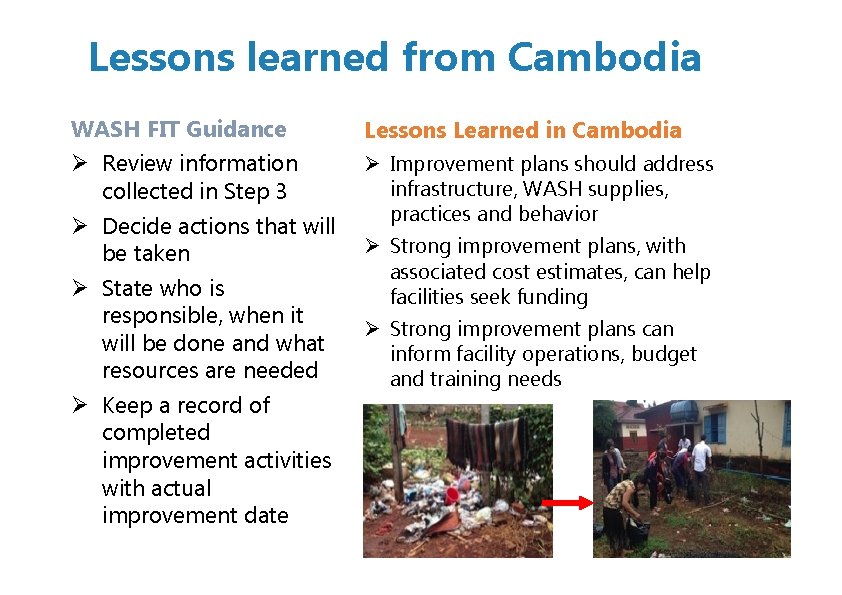
Lessons learned from Cambodia WASH FIT Guidance Lessons Learned in Cambodia Ø Review information collected in Step 3 Ø Decide actions that will be taken Ø State who is responsible, when it will be done and what resources are needed Ø Keep a record of completed improvement activities with actual improvement date Ø Improvement plans should address infrastructure, WASH supplies, practices and behavior Ø Strong improvement plans, with associated cost estimates, can help facilities seek funding Ø Strong improvement plans can inform facility operations, budget and training needs
Step 5. Continuously monitor the effectiveness of the plan and make revisions
Step 5 1. Assemble and train the WASH FIT team; and continuous professional development 5. Continuously evaluate and improve the plan 4. Develop and implement an incremental improvement plan 2. Conduct assessment of WASH throughout the facility 3. Identify and prioritize areas for improvement
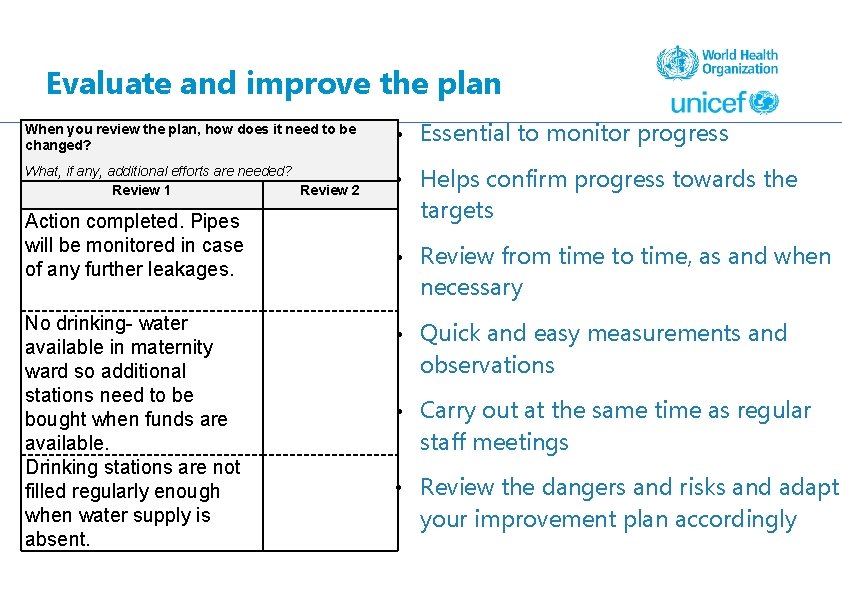
Evaluate and improve the plan When you review the plan, how does it need to be changed? • Essential to monitor progress What, if any, additional efforts are needed? Review 1 Review 2 • Helps confirm progress towards the targets • Review from time to time, as and when necessary • Quick and easy measurements and observations • Carry out at the same time as regular staff meetings • Review the dangers and risks and adapt your improvement plan accordingly Action completed. Pipes will be monitored in case of any further leakages. No drinking- water available in maternity ward so additional stations need to be bought when funds are available. Drinking stations are not filled regularly enough when water supply is absent.
How can you make WASH FIT sustainable?
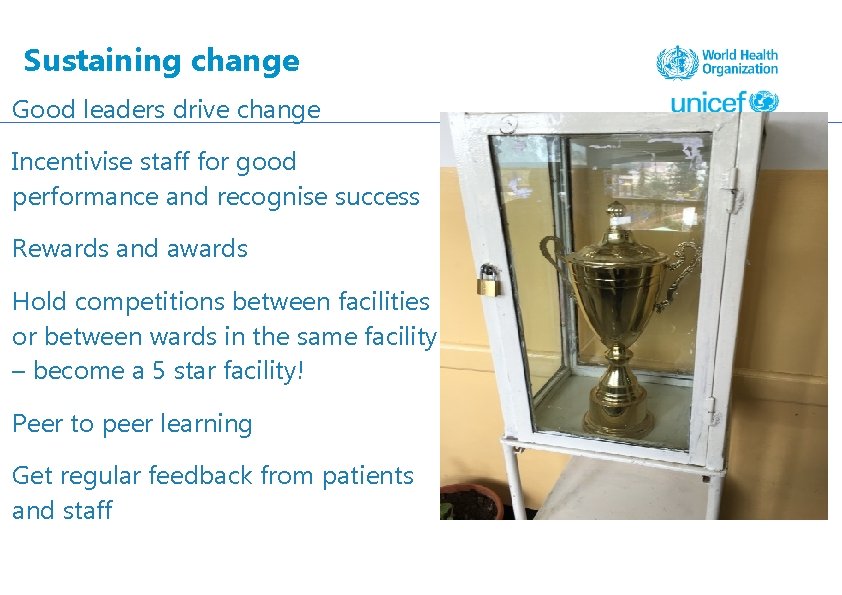
Sustaining change Good leaders drive change Incentivise staff for good performance and recognise success Rewards and awards Hold competitions between facilities or between wards in the same facility – become a 5 star facility! Peer to peer learning Get regular feedback from patients and staff
Don’t be overambitious at the start Start small, build up Don’t overload facilities with too much to start with focus on just one domain until facilities feel empowered to scale up
Consult stakeholders Seek input and ownership from key WASH and health stakeholders before implementation Engage health colleagues to ensure alignment with national quality initiatives, guidelines and standards and planning processes
Planning training Determine how the training will be rolled out before commencing Develop a timeline, roles, responsibilities & funding requirements for rolling out training, ongoing skills development and technical support, and crucially, monitoring and evaluation. Identify target trainees Adapt the training materials to suit context and needs
Budget Prepare a budget that reflects aims and available resources, with potential to scale-up Consider sustainable mechanisms of budget and financing, e. g. reinvesting revenue
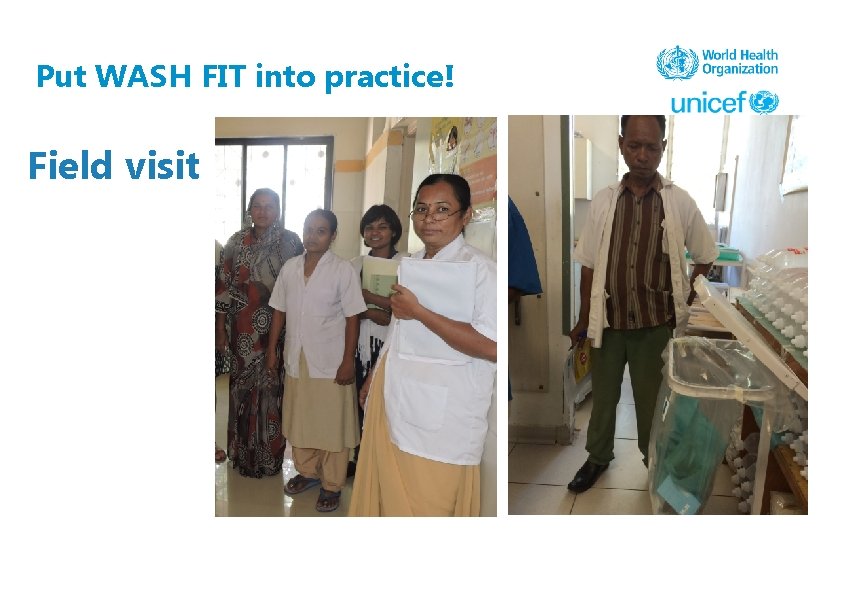
Put WASH FIT into practice! Field visit