
Module 2 The Macro Economic Environment Accredited Training


![Capital Asset Pricing Model Rp = Rf + [ßp( Rm - Rf )] Rp](https://slidetodoc.com/presentation_image_h2/4b8806af44fb26a2cfec28745c589344/image-23.jpg "Capital Asset Pricing Model Rp = Rf + [ßp( Rm - Rf )] Rp")
- Slides: 37
Module 2 – The Macro Economic Environment Accredited Training Partner
Impact of politics q Interest rates and currencies q Elections, economic cycles and inflation q International relations q Speculative fashions q Socio-economic issues q Technology. Accredited Training Partner
Globalisation Effects of globalisation: q Low skilled, labour intensive industries in developed countries are placed at a disadvantage against same industries in developing countries q Investment directly into foreign markets or multinational companies q Outsourcing of industries particularly in the service sector q Political stability of country being invested into is also important due to the effects of the political regime against the country’s economic stability. Accredited Training Partner
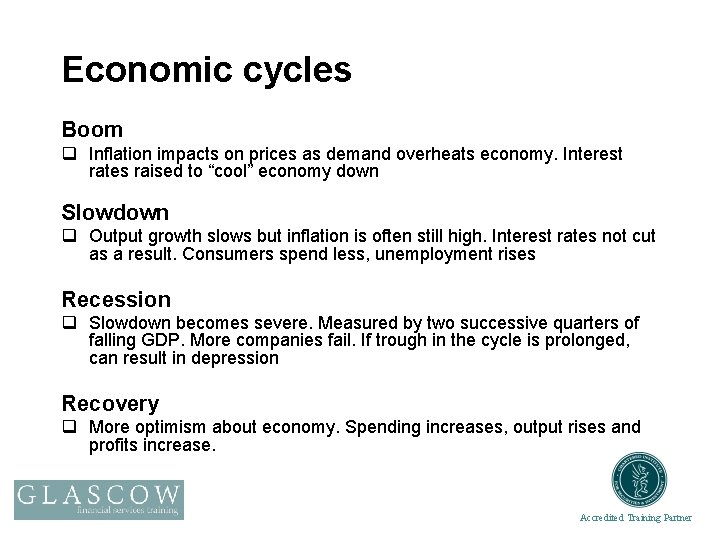
Economic cycles Boom q Inflation impacts on prices as demand overheats economy. Interest rates raised to “cool” economy down Slowdown q Output growth slows but inflation is often still high. Interest rates not cut as a result. Consumers spend less, unemployment rises Recession q Slowdown becomes severe. Measured by two successive quarters of falling GDP. More companies fail. If trough in the cycle is prolonged, can result in depression Recovery q More optimism about economy. Spending increases, output rises and profits increase. Accredited Training Partner
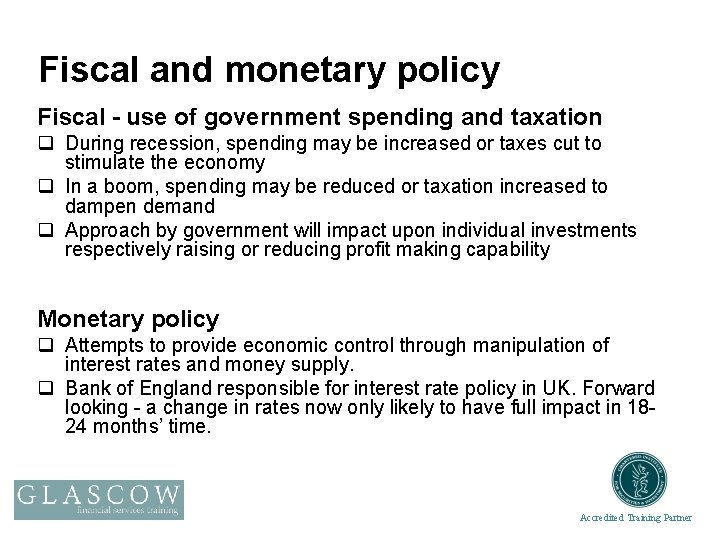
Fiscal and monetary policy Fiscal - use of government spending and taxation q During recession, spending may be increased or taxes cut to stimulate the economy q In a boom, spending may be reduced or taxation increased to dampen demand q Approach by government will impact upon individual investments respectively raising or reducing profit making capability Monetary policy q Attempts to provide economic control through manipulation of interest rates and money supply. q Bank of England responsible for interest rate policy in UK. Forward looking - a change in rates now only likely to have full impact in 1824 months’ time. Accredited Training Partner
Money supply q M 0 - Narrow money q M 4 - Broad money q Quantitative easing. Accredited Training Partner
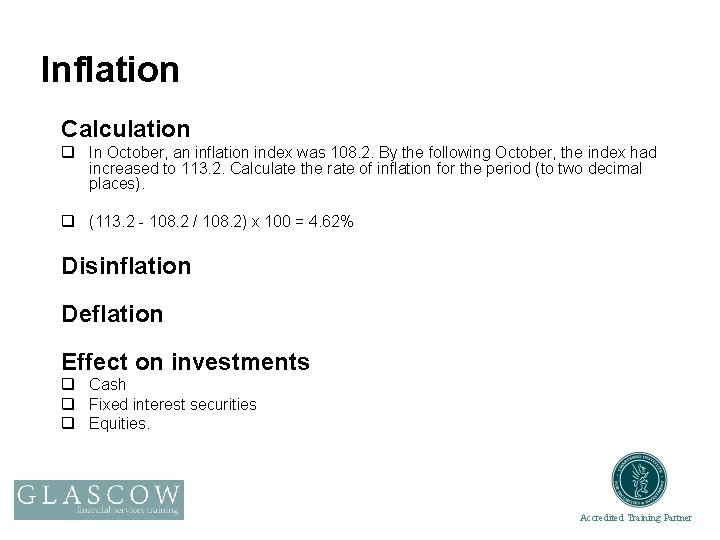
Inflation Calculation q In October, an inflation index was 108. 2. By the following October, the index had increased to 113. 2. Calculate the rate of inflation for the period (to two decimal places). q (113. 2 - 108. 2 / 108. 2) x 100 = 4. 62% Disinflation Deflation Effect on investments q Cash q Fixed interest securities q Equities. Accredited Training Partner
Interest rates Effect on investments q Cash q Fixed interest securities q Equities. Accredited Training Partner
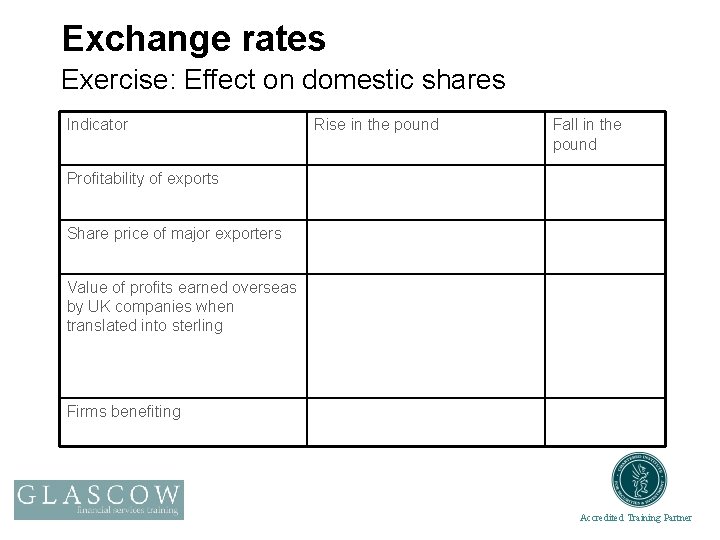
Exchange rates Exercise: Effect on domestic shares Indicator Rise in the pound Fall in the pound Profitability of exports Share price of major exporters Value of profits earned overseas by UK companies when translated into sterling Firms benefiting Accredited Training Partner
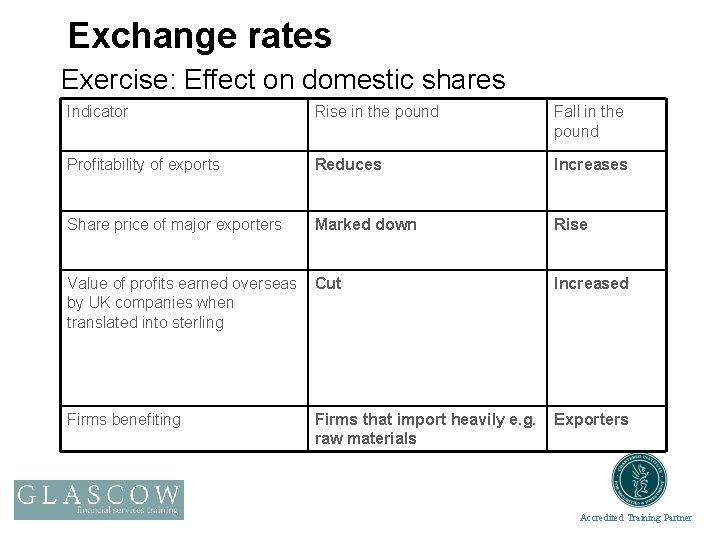
Exchange rates Exercise: Effect on domestic shares Indicator Rise in the pound Fall in the pound Profitability of exports Reduces Increases Share price of major exporters Marked down Rise Value of profits earned overseas by UK companies when translated into sterling Cut Increased Firms benefiting Firms that import heavily e. g. raw materials Exporters Accredited Training Partner
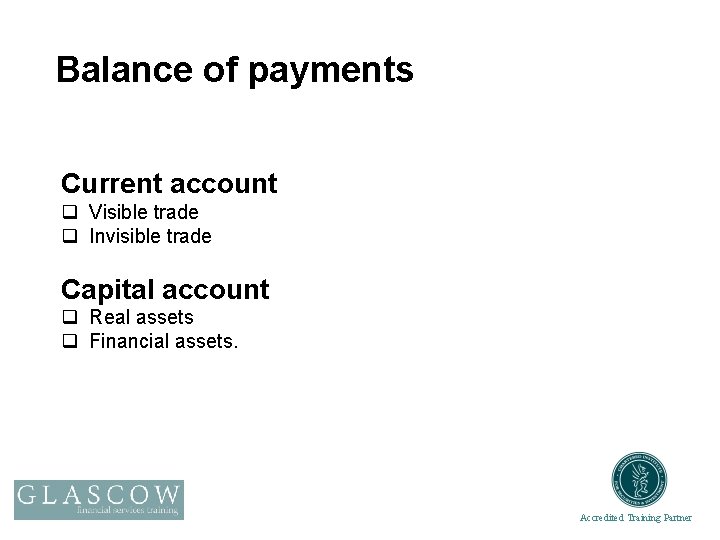
Balance of payments Current account q Visible trade q Invisible trade Capital account q Real assets q Financial assets. Accredited Training Partner
Module 3 – Investment Theories Accredited Training Partner
Modern Portfolio Theory q. Position prior to modern portfolio theory q. Markowitz’s view. Accredited Training Partner
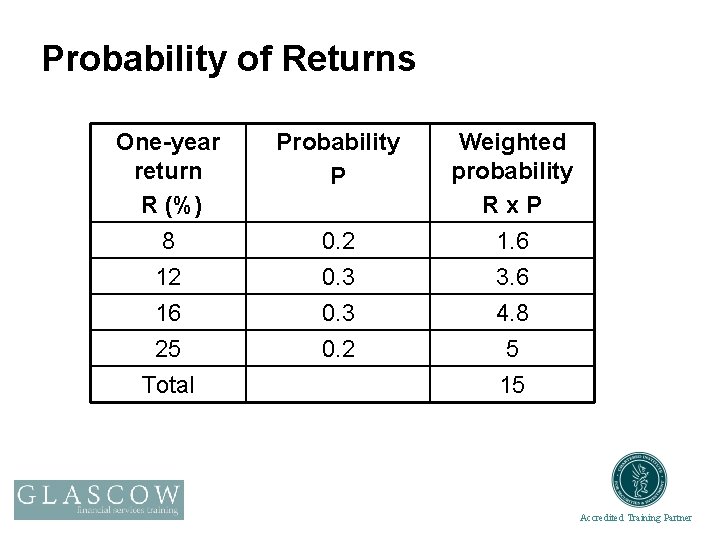
Probability of Returns One-year return R (%) Probability P Weighted probability Rx. P 8 0. 2 1. 6 12 0. 3 3. 6 16 0. 3 4. 8 25 0. 2 5 Total 15 Accredited Training Partner
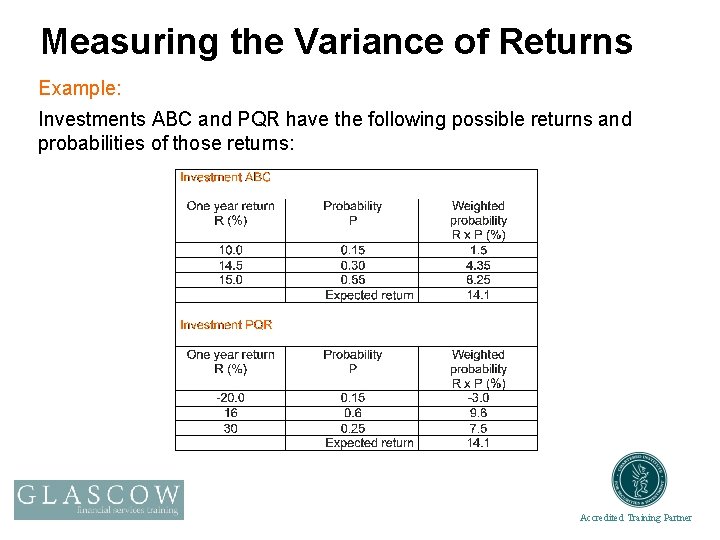
Measuring the Variance of Returns Example: Investments ABC and PQR have the following possible returns and probabilities of those returns: Accredited Training Partner
Standard Deviation (1) q The standard deviation of returns measures how widely the actual return of an investment year on year varies around the mean or expected return (as explained previously). q Where an investment has year on year returns that are close to its expected return, it is said to have a low standard deviation. q Where returns vary widely, the overall expected returns may be the same as the investment with a low standard deviation, but it will be higher risk (returns fluctuate to greater extremes). q The example on the previous slide demonstrates that investment PQR has a higher standard deviation than investment ABC Accredited Training Partner
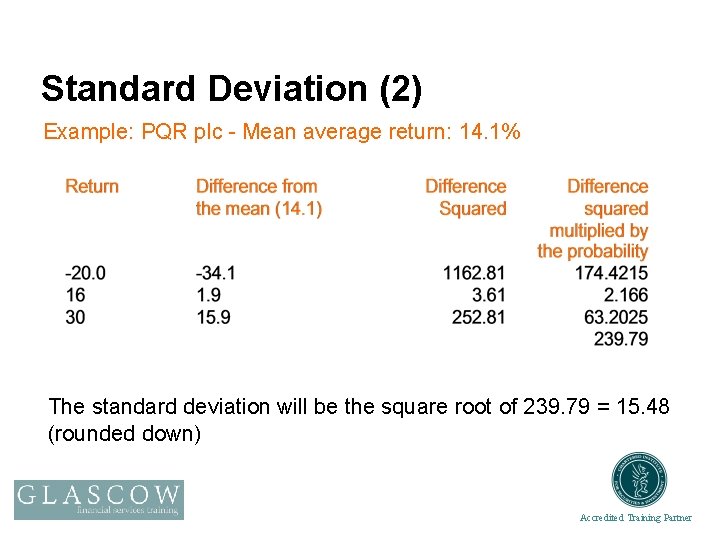
Standard Deviation (2) Example: PQR plc - Mean average return: 14. 1% The standard deviation will be the square root of 239. 79 = 15. 48 (rounded down) Accredited Training Partner
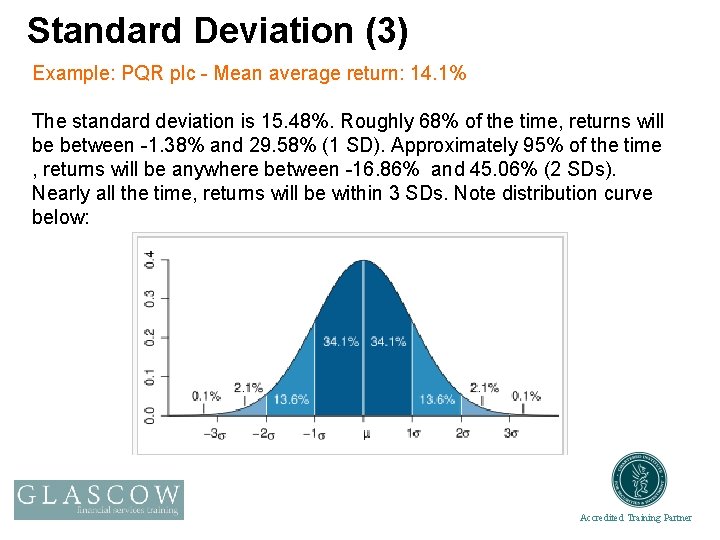
Standard Deviation (3) Example: PQR plc - Mean average return: 14. 1% The standard deviation is 15. 48%. Roughly 68% of the time, returns will be between -1. 38% and 29. 58% (1 SD). Approximately 95% of the time , returns will be anywhere between -16. 86% and 45. 06% (2 SDs). Nearly all the time, returns will be within 3 SDs. Note distribution curve below: Accredited Training Partner
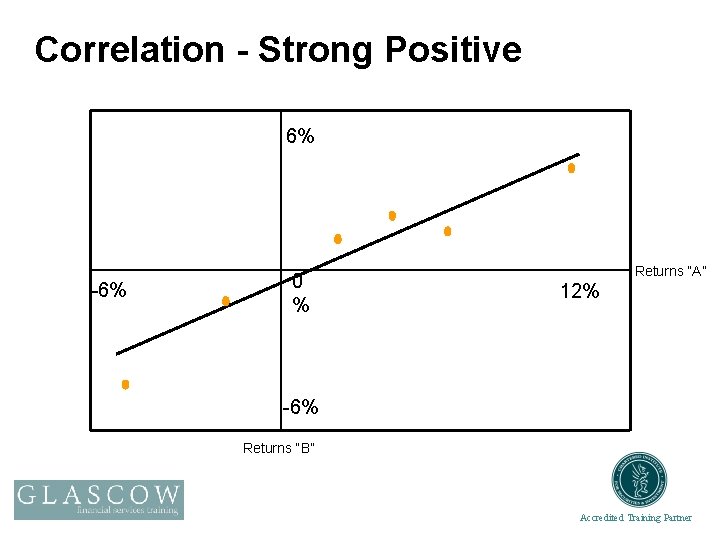
Correlation - Strong Positive 6% -6% 0 % Returns “A” 12% -6% Returns “B” Accredited Training Partner
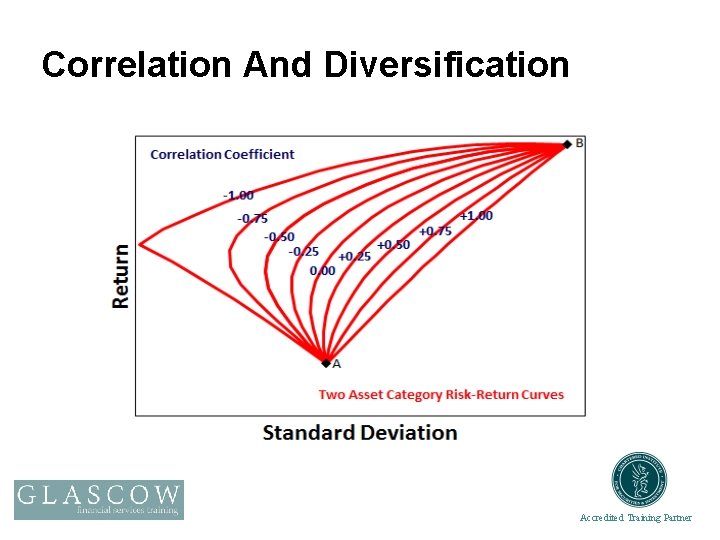
Correlation And Diversification Accredited Training Partner
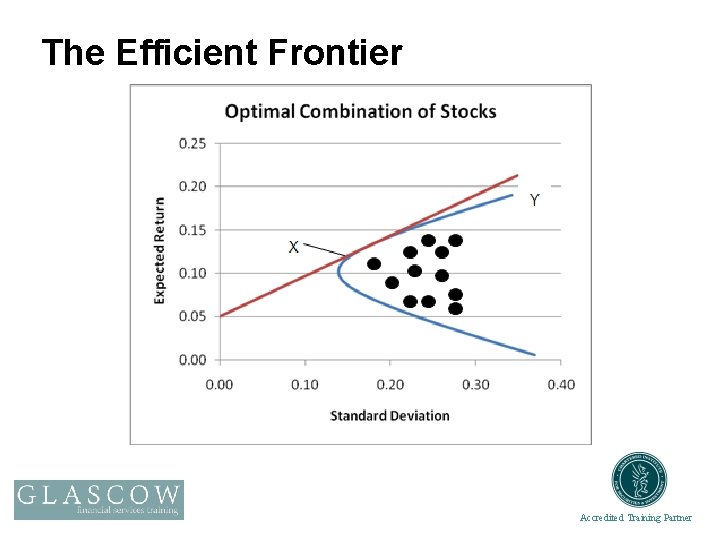
The Efficient Frontier Accredited Training Partner
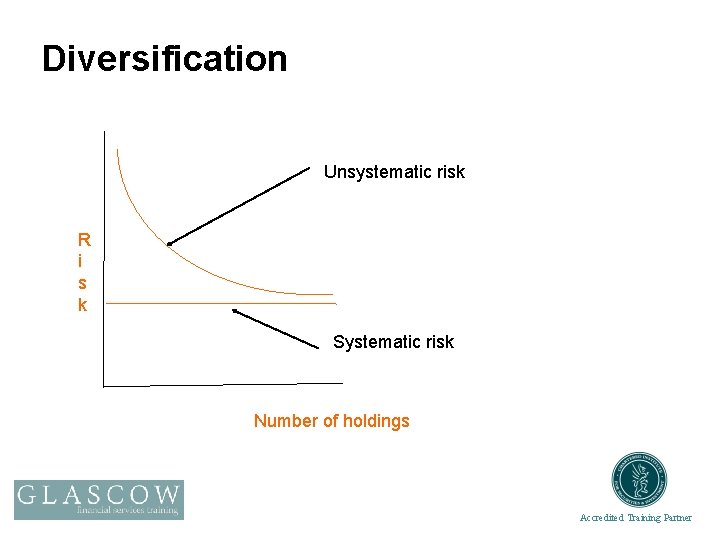
Diversification Unsystematic risk Total Risk R i s k Systematic risk 0 Number of holdings Accredited Training Partner
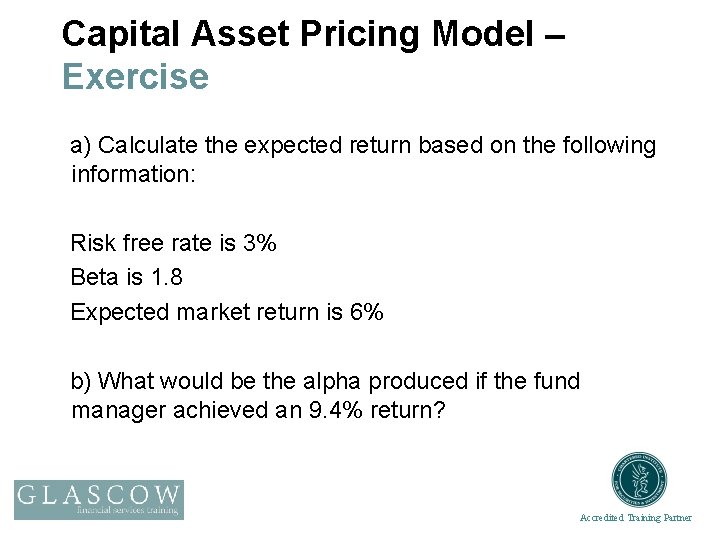
Capital Asset Pricing Model Rp = Rf + [ßp( Rm - Rf )] Rp = Return to the portfolio Rf = Risk free rate of return ßp = Beta of the portfolio Rm = Return to the market. Ref: CAPM - http: //glascow. users 40. interdns. co. uk/50 -years-onshould-we-still-be-studying-capm/ Accredited Training Partner
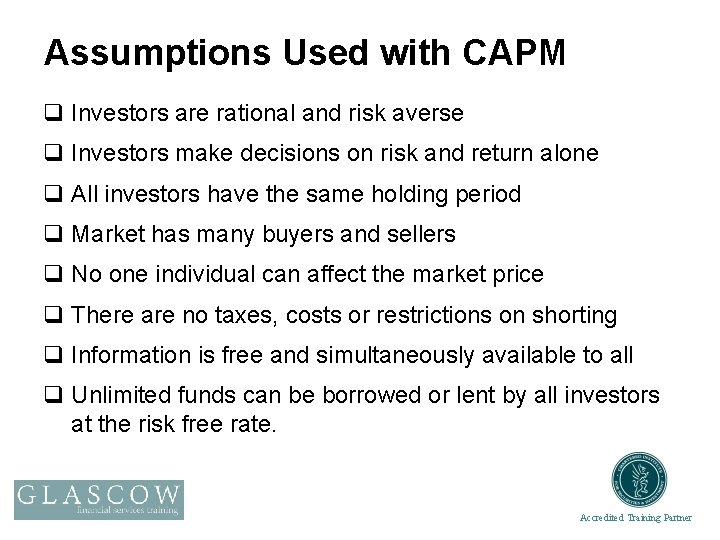
Assumptions Used with CAPM q Investors are rational and risk averse q Investors make decisions on risk and return alone q All investors have the same holding period q Market has many buyers and sellers q No one individual can affect the market price q There are no taxes, costs or restrictions on shorting q Information is free and simultaneously available to all q Unlimited funds can be borrowed or lent by all investors at the risk free rate. Accredited Training Partner
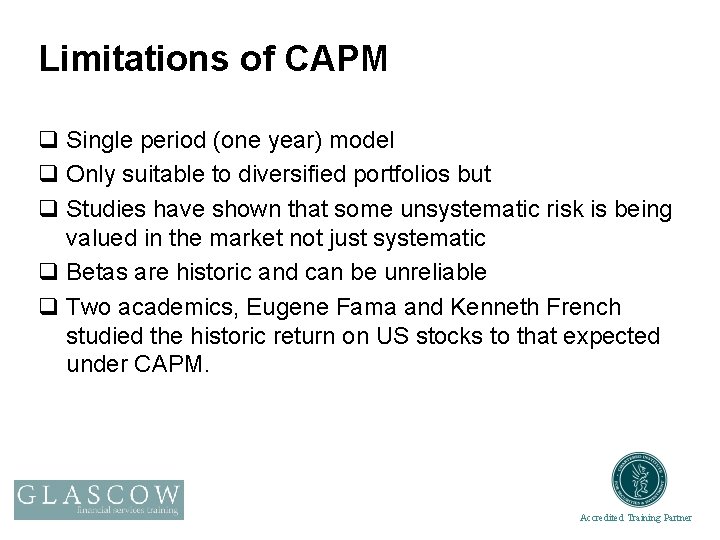
Limitations of CAPM q Single period (one year) model q Only suitable to diversified portfolios but q Studies have shown that some unsystematic risk is being valued in the market not just systematic q Betas are historic and can be unreliable q Two academics, Eugene Fama and Kenneth French studied the historic return on US stocks to that expected under CAPM. Accredited Training Partner
Capital Asset Pricing Model – Exercise a) Calculate the expected return based on the following information: Risk free rate is 3% Beta is 1. 8 Expected market return is 6% b) What would be the alpha produced if the fund manager achieved an 9. 4% return? Accredited Training Partner
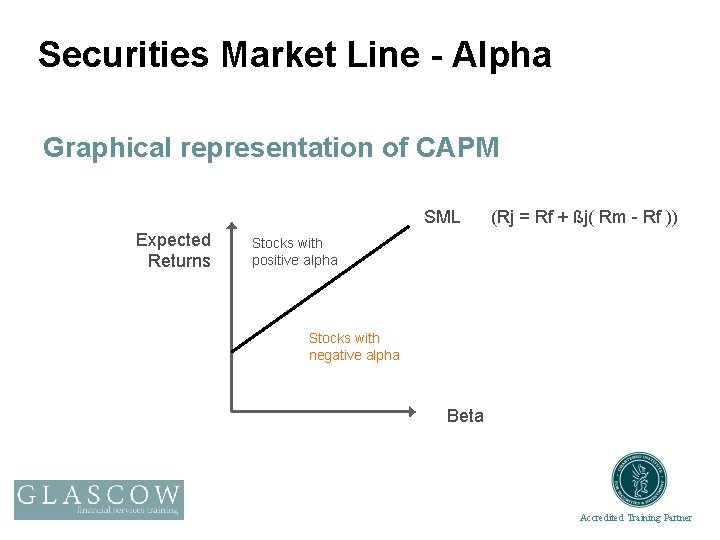
Securities Market Line - Alpha Graphical representation of CAPM SML Expected Returns (Rj = Rf + ßj( Rm - Rf )) Stocks with positive alpha Stocks with negative alpha Beta Accredited Training Partner
Efficient Markets Hypothesis “EMH” q Two main methods of stock analysis / valuation: o. Technical analysis § Chartism § Try to predict prices from past patterns o. Fundamental analysis § Try to ascertain the intrinsic values of stocks and shares. Accredited Training Partner
Efficient Markets Hypothesis “EMH” q Considers the extent to which information is priced into a share by the market q The more efficient the market, the more quickly information is priced in to the share and the less opportunity there is to find undervalued stocks q Not all markets are the same – comes in three forms. Accredited Training Partner
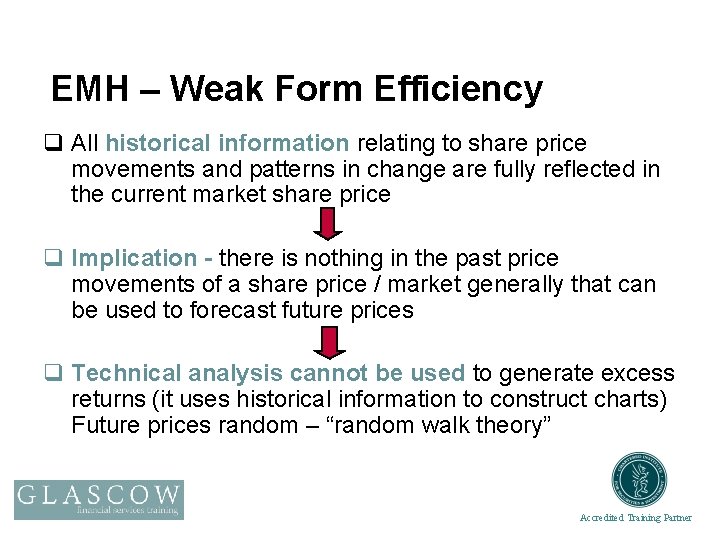
EMH – Weak Form Efficiency q All historical information relating to share price movements and patterns in change are fully reflected in the current market share price q Implication - there is nothing in the past price movements of a share price / market generally that can be used to forecast future prices q Technical analysis cannot be used to generate excess returns (it uses historical information to construct charts) Future prices random – “random walk theory” Accredited Training Partner
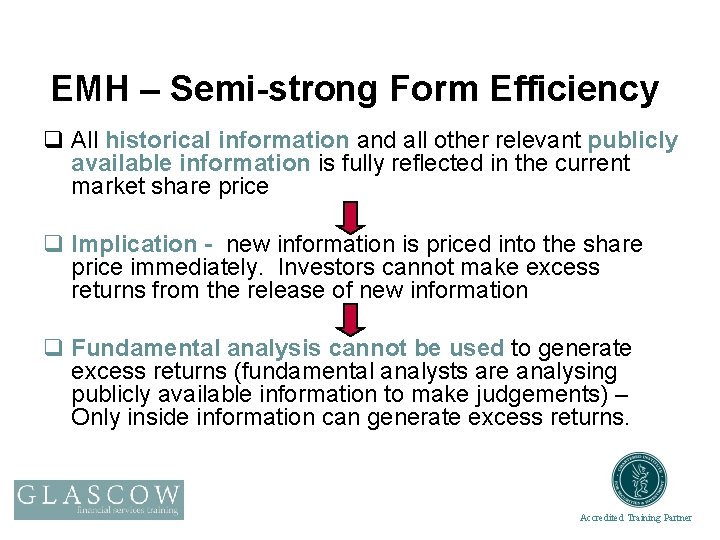
EMH – Semi-strong Form Efficiency q All historical information and all other relevant publicly available information is fully reflected in the current market share price q Implication - new information is priced into the share price immediately. Investors cannot make excess returns from the release of new information q Fundamental analysis cannot be used to generate excess returns (fundamental analysts are analysing publicly available information to make judgements) – Only inside information can generate excess returns. Accredited Training Partner
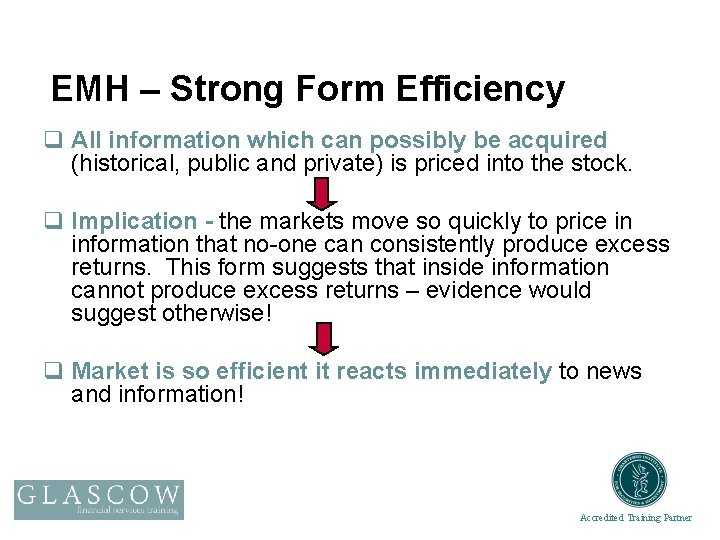
EMH – Strong Form Efficiency q All information which can possibly be acquired (historical, public and private) is priced into the stock. q Implication - the markets move so quickly to price in information that no-one can consistently produce excess returns. This form suggests that inside information cannot produce excess returns – evidence would suggest otherwise! q Market is so efficient it reacts immediately to news and information! Accredited Training Partner
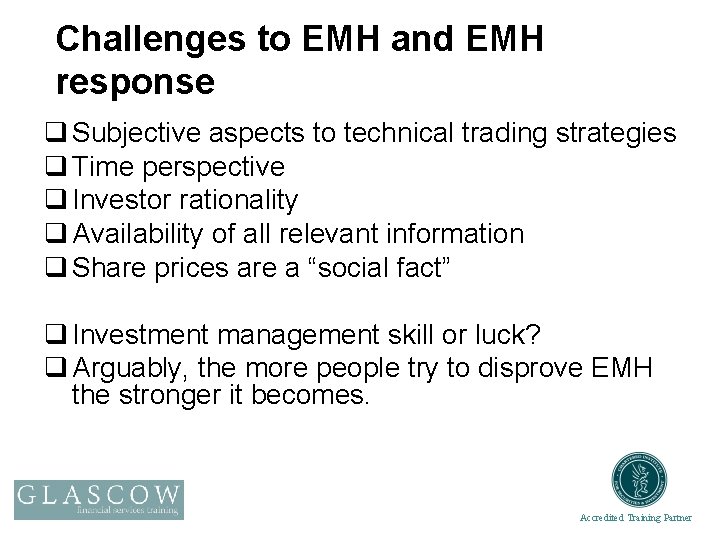
Challenges to EMH and EMH response q Subjective aspects to technical trading strategies q Time perspective q Investor rationality q Availability of all relevant information q Share prices are a “social fact” q Investment management skill or luck? q Arguably, the more people try to disprove EMH the stronger it becomes. Accredited Training Partner
Behavioural Finance q Studies have shown that investors systematically make errors in judgement known as cognitive illusions. q Two key types: illusions due to heuristic decision processes illusions caused by the adoption of mental frames or the prospect theory. Accredited Training Partner
Heuristic Decision Processes q Heuristics – “mental shortcuts” that people use to make decisions in complex situations q These often lead to poor decisions being made q Some types: Anchoring Overconfidence / familiarity Representativeness Availability bias Gamblers fallacy. Accredited Training Partner
Adoption of Mental Frames or Prospect Theory q Prospect theory describes some states of mind that can influence an individual’s decision-making processes particularly with regard to poor performance and losses incurred by investments. Key concepts include: q Regret aversion q Loss aversion q Mental accounting q Gamblers fallacy. Accredited Training Partner
Practical Application of Behavioural Finance q Outset of the client relationship q Starting out investing q During client relationship. Accredited Training Partner