
Module 2 The Diagnostic Testing Process Photo by
Module 2 The Diagnostic Testing Process
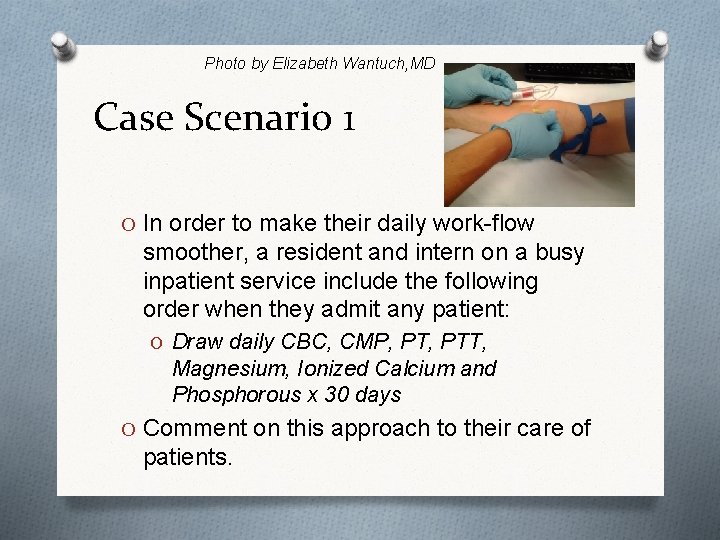
Photo by Elizabeth Wantuch, MD Case Scenario 1 O In order to make their daily work-flow smoother, a resident and intern on a busy inpatient service include the following order when they admit any patient: O Draw daily CBC, CMP, PTT, Magnesium, Ionized Calcium and Phosphorous x 30 days O Comment on this approach to their care of patients.

Case Scenario 1 Discussion O 4 major roles for laboratory tests in patient care: O Diagnosis of disease O Monitoring of disease, therapies, interventions O Screening for disease O Research
Case Scenario 1 Discussion O The resident and intern (though perhaps well- intentioned) are not properly utilizing laboratory testing and the clinical laboratory O They are not ordering specific laboratory tests based on clinical questions AND in doing so they are O Increasing the cost of healthcare O Contributing to the development of iatrogenic anemia O Leading to potentially unnecessary work-up if any errors in the diagnostic testing process occur

Laboratory testing begins and ends with patient care 1. 2. 3. 4. 5. 6. 7. 8. 9. 10. 11. Clinician develops a clinical question Specific laboratory test is selected Test is ordered Specimen is collected Image by Theresa Kristopaitis, Sample is prepared for analysis MD Sample is analyzed Result is verified Result is reported Test result is interpreted in context of clinical scenario Action is taken Patient care is affected
Diagnostic Testing – 3 Phases The diagnostic testing process can be separated into three phases: 1. 2. 3. Preanalytic phase Analytic phase Post analytic phase Variables that may affect proper interpretation of test results are present in each phase. Test result changes due to clinical factors must be interpreted in consideration of these variables.
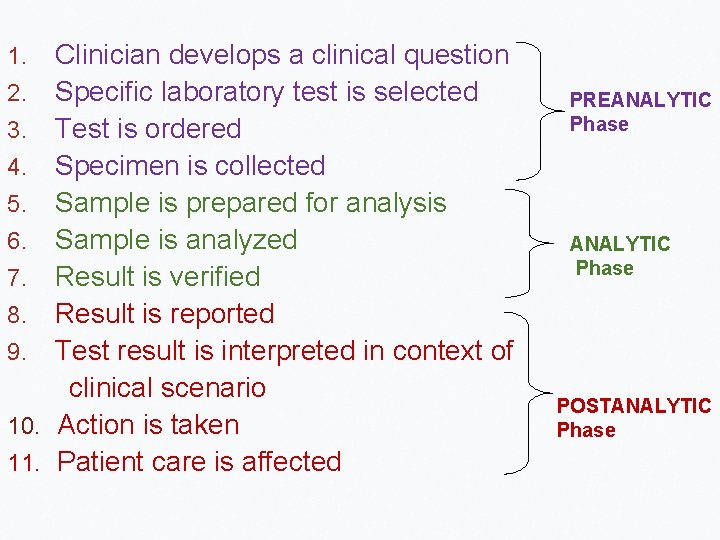
1. 2. 3. 4. 5. 6. 7. 8. 9. 10. 11. Clinician develops a clinical question Specific laboratory test is selected Test is ordered Specimen is collected Sample is prepared for analysis Sample is analyzed Result is verified Result is reported Test result is interpreted in context of clinical scenario Action is taken Patient care is affected PREANALYTIC Phase POSTANALYTIC Phase
Why is this important? O When a physician orders a lab test and receives a test result, there a multitude of factors (variables) that could (and usually should) be considered in interpreting the test result

O In the upcoming modules, we will further explore: O The Preanalytic testing phase O The Analytic testing phase O The Postanalytic testing phase O The process of establishing Reference (normal) values
O Proceed to “Module 3 - Preanalytic Phase of Laboratory Testing”
- Slides: 10