
Module 2 Testing of HIVexposed Infants Infant HIV

- Slides: 58
Module 2 Testing of HIV-exposed Infants Infant HIV Testing Training Curriculum for Healthcare Providers
Session 2. 1 Identifying HIV-exposed Infants Session Objective • Identify HIV-exposed infants in the clinical setting
Introduction • Infant HIV testing is one component of the HIV-exposed infant comprehensive package of care • That package starts at birth and extends to 3 months after breastfeeding has ended (or 18 months of age, whichever is later) • Within HIV testing services, the 4– 6 weeks test is one element in the HIV testing cascade
Testing: The Terminology • What is meant by nucleic acid testing or NAT?
Testing: The Terminology • Nucleic acid testing (NAT): • An infant virologic testing procedure that diagnoses infection by detection of HIV virus nucleic acid • NAT detects DNA, RNA or both • NAT uses polymerase chain reaction (PCR) technology, and is sometimes referred to as PCR testing
Testing: The Terminology • What is the difference between infant HIV testing and EID (or early infant diagnosis)?
Testing: The Terminology • Infant HIV testing: any HIV test included in the testing algorithm; this includes: • NAT (virologic) • Rapid diagnostic testing or RDT (serologic/antibody testing) • Early infant diagnosis (EID): a virologic test at 4– 6 weeks of age or earlier for diagnosis of HIV infection • EID is one component of the infant HIV testing cascade.
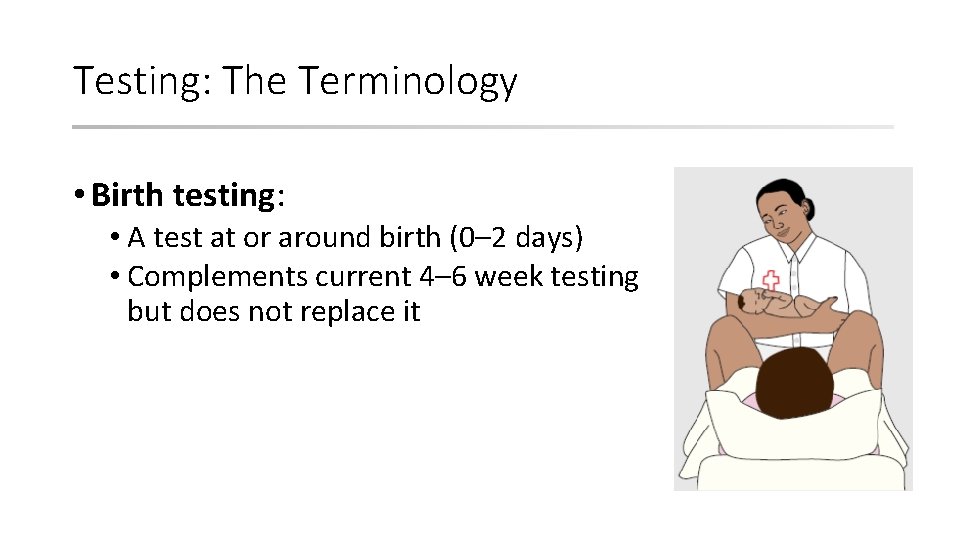
Testing: The Terminology • Birth testing: • A test at or around birth (0– 2 days) • Complements current 4– 6 week testing but does not replace it
Testing: The Terminology • What is the difference between point-of-care testing and near point-of-care testing?
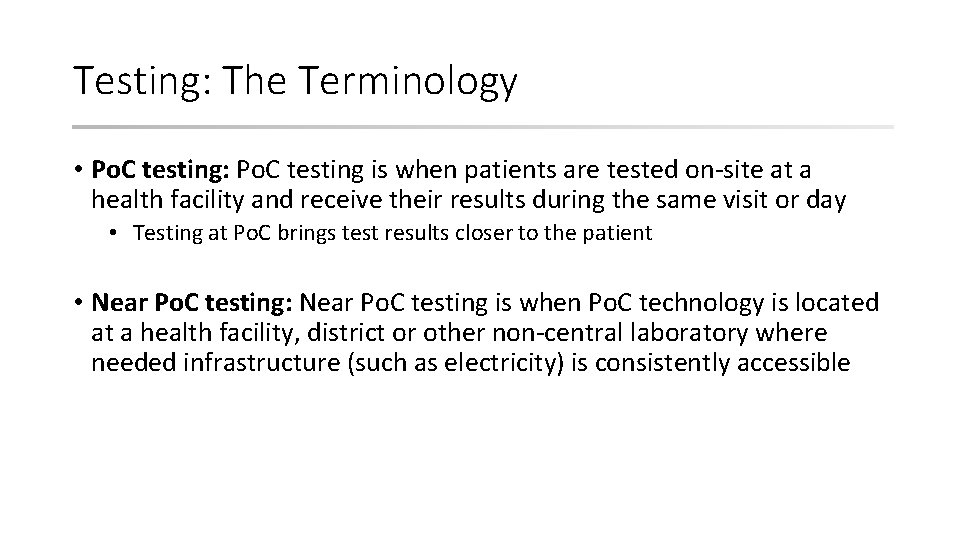
Testing: The Terminology • Po. C testing: Po. C testing is when patients are tested on-site at a health facility and receive their results during the same visit or day • Testing at Po. C brings test results closer to the patient • Near Po. C testing: Near Po. C testing is when Po. C technology is located at a health facility, district or other non-central laboratory where needed infrastructure (such as electricity) is consistently accessible
Testing: The Terminology • Conventional testing refers to conventional diagnostic technologies located in central or regional laboratories that make up the backbone of national testing services • These technologies require sophisticated laboratory infrastructure, stable electricity supply and highly trained technicians • HIV-exposed infant care: a comprehensive package of care that all HIV-exposed infants should receive • HIV testing is just one component of HIV-exposed infant care and EID is just one component of the infant HIV testing cascade
Identifying HIV-exposed Infants • How would you identify an HIV-exposed infant? • If a mother does not know her HIV status, what should you do? • How do you obtain consent/agreement for infant testing if the parent is not available? • When might you test an infant of an uninfected mother for HIV?
Identifying HIV-exposed Infants • An HIV-exposed infant is an infant whose mother was living with HIV or acquired HIV while pregnant or while breastfeeding that infant • Find HIV-exposed infants by identifying mothers with HIV • At every patient encounter in any healthcare setting: • Review the mother’s health card for HIV testing history • If no HIV status, ask mother when she was tested for HIV • If mother tested HIV-positive, ensure she is on ART and provide retesting for verification • Retesting for verification should never be a barrier to ART initiation • If mother does not have documentation of testing, offer testing as per national guidelines
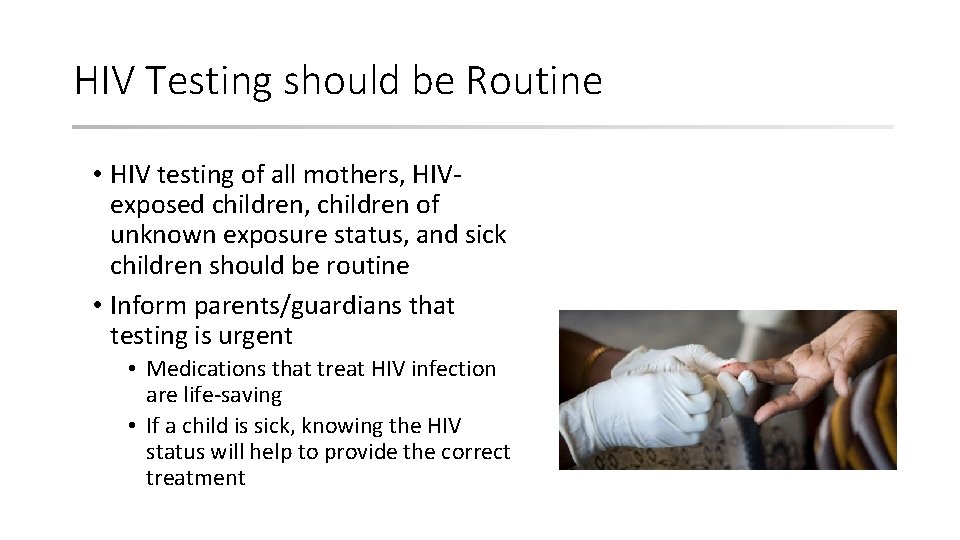
HIV Testing should be Routine • HIV testing of all mothers, HIVexposed children, children of unknown exposure status, and sick children should be routine • Inform parents/guardians that testing is urgent • Medications that treat HIV infection are life-saving • If a child is sick, knowing the HIV status will help to provide the correct treatment
Infants of Mothers of Unknown HIV Status • Provide mothers of unknown HIV status with the pre-test information and RDT • If the mother tests HIV-positive, baby is HIV-exposed (follow national guidelines on re-testing to verify maternal HIV status) • Test the mother rather than the infant to determine whether infant is HIV-exposed: • It will provide a diagnosis for the mother • Maternal testing is straight-forward and highly accurate • Refusal of routine testing is rare • If a mother declines testing and her baby is ill, ask permission to test the infant • If mother/caregiver refuses testing for self and infant: • • Provide information and reassurance; focus on benefits of testing Never withhold services because testing is refused If infant is strongly suspected of having HIV infection, follow national guidelines Document refusal in health card and discuss at next visit
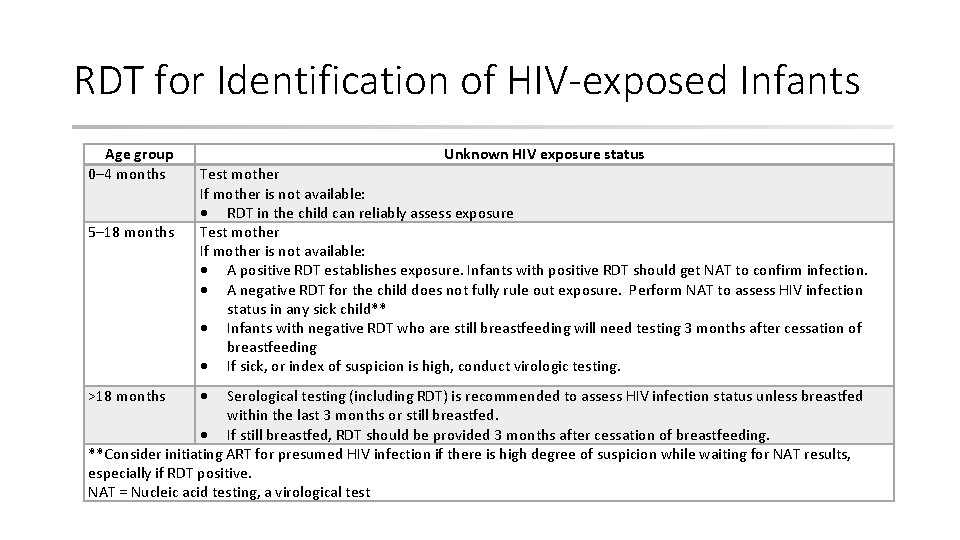
Mother Unavailable & HIV Status Unknown Infants younger than 18 months • Provide legal guardian with pre-test information • Obtain agreement to test, and • Test infant using RDT • RDT can indicate if child is HIV-exposed, • In infants over the age of 4 months, RDT is not an accurate indicator of exposure status, these infants need follow-up • RDT does not provide an HIV diagnosis See Appendix 2 A: Pre-test Counselling Session, Maternal HIV Status Unknown And in Module 5, Appendix 5 A: Post-test Counselling Session for Infants Less than 18 Months Tested by RDT
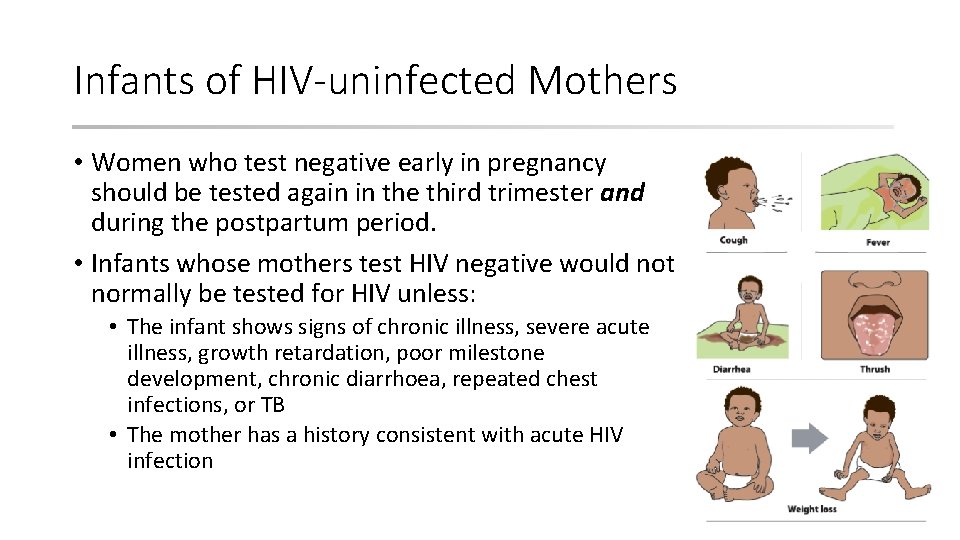
Infants of HIV-uninfected Mothers • Women who test negative early in pregnancy should be tested again in the third trimester and during the postpartum period. • Infants whose mothers test HIV negative would not normally be tested for HIV unless: • The infant shows signs of chronic illness, severe acute illness, growth retardation, poor milestone development, chronic diarrhoea, repeated chest infections, or TB • The mother has a history consistent with acute HIV infection
Session 2. 2: Recommendations on Timing of Infant HIV Testing Session Objectives • List the recommended ages for testing of HIV-exposed infants and the tests recommended at each age • Explain the importance of national testing algorithms
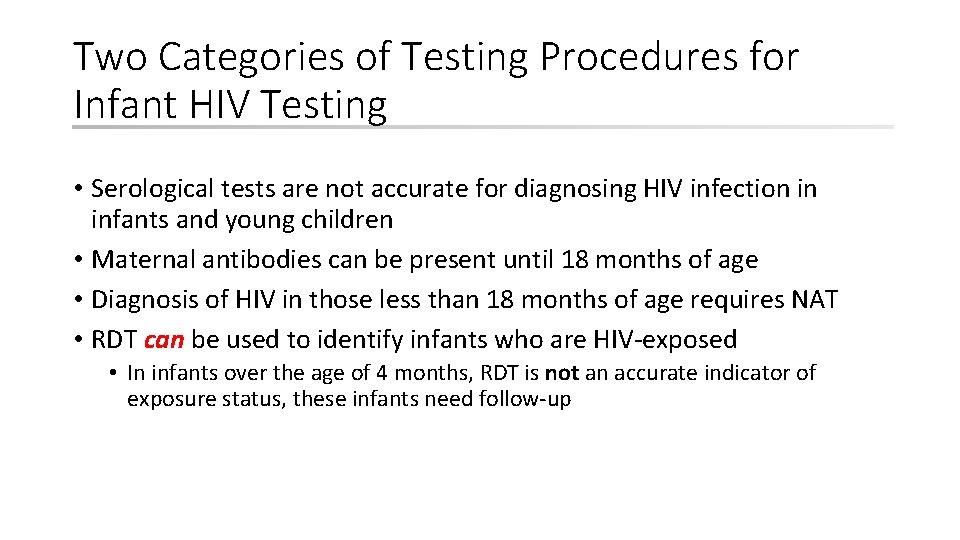
Two Categories of Testing Procedures for Infant HIV Testing • What are “maternal antibodies”?
Two Categories of Testing Procedures for Infant HIV Testing • Serological testing: • The testing procedure used to diagnose HIV in anyone 18 months of age or older • Includes RDT • Virological testing: • The diagnosis of HIV in those younger than 18 months requires virological testing using nucleic acid testing (NAT) technologies • Until recently, NAT was conducted only at central laboratories using DBS samples • With Po. C NAT technology, virological tests can be conducted in the health clinic or at local laboratories
Two Categories of Testing Procedures for Infant HIV Testing • Serological tests are not accurate for diagnosing HIV infection in infants and young children • Maternal antibodies can be present until 18 months of age • Diagnosis of HIV in those less than 18 months of age requires NAT • RDT can be used to identify infants who are HIV-exposed • In infants over the age of 4 months, RDT is not an accurate indicator of exposure status, these infants need follow-up
When and which test? • At what age are HIVexposed infants tested for HIV?
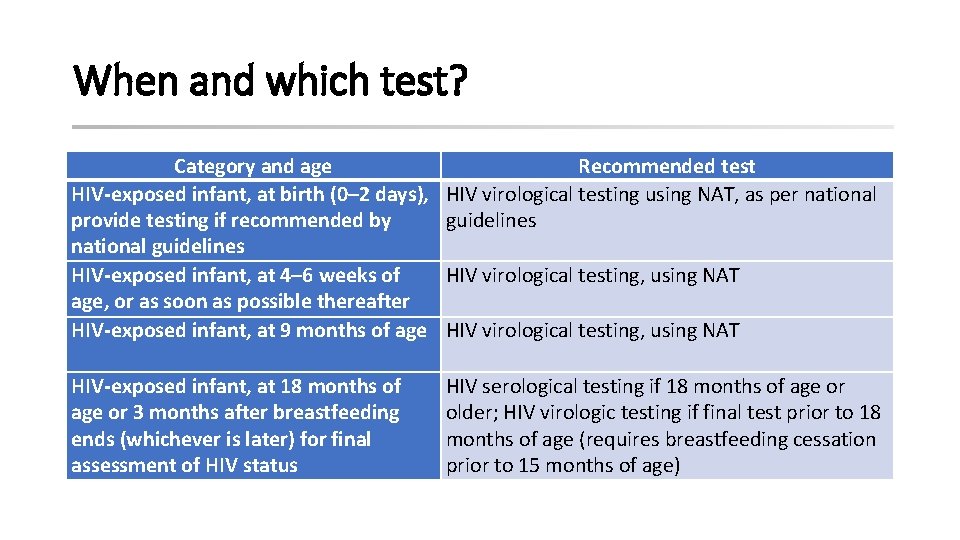
When and which test? Category and age HIV-exposed infant, at birth (0– 2 days), provide testing if recommended by national guidelines HIV-exposed infant, at 4– 6 weeks of age, or as soon as possible thereafter HIV-exposed infant, at 9 months of age Recommended test HIV virological testing using NAT, as per national guidelines HIV-exposed infant, at 18 months of age or 3 months after breastfeeding ends (whichever is later) for final assessment of HIV status HIV serological testing if 18 months of age or older; HIV virologic testing if final test prior to 18 months of age (requires breastfeeding cessation prior to 15 months of age) HIV virological testing, using NAT
Birth Testing • What do you think are the advantages of birth testing? • How about the disadvantages? • How would you minimize the disadvantages?
Birth Testing • HIV testing at birth is most likely to identify infants infected in utero • These infants are at greatest risk for early death • Birth testing will not detect infections during or shortly after delivery • 4– 6 week testing will identify infants who acquired the infection in utero, during delivery, or in the early postpartum period • NAT at birth can be added to a routine 4– 6 week test • It will not replace a 4– 6 week test • A high-functioning system for early infant diagnosis at 4– 6 weeks of age and excellent follow up is important to ensure that all HIV-exposed infants who acquired HIV in utero and during delivery are identified
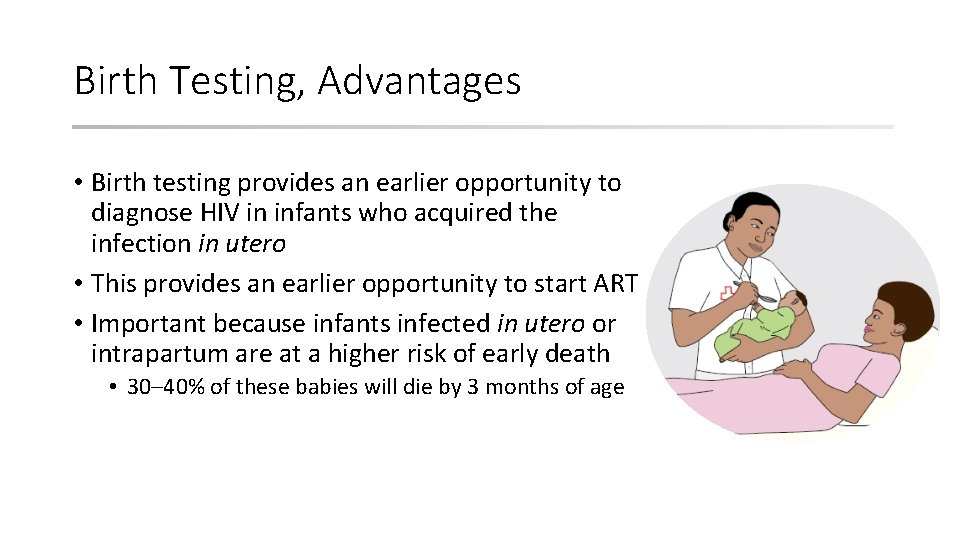
Birth Testing, Advantages • Birth testing provides an earlier opportunity to diagnose HIV in infants who acquired the infection in utero • This provides an earlier opportunity to start ART • Important because infants infected in utero or intrapartum are at a higher risk of early death • 30– 40% of these babies will die by 3 months of age
Birth Testing, Disadvantages • Potential of reducing the uptake of 4– 6 week testing • Where birth testing is established, emphasize to caregivers the importance of repeat testing as per national algorithm • Cannot detect all perinatal infections: Birth testing will only detect in utero infections • The presence of ARVs (maternal or infant) may reduce the sensitivity of the NAT to detect infant HIV infection • A study found that birth testing with NAT identifies only about 2 of every 3 infants who are infected • This highlights the importance of retention in care and repeat testing, particularly at 4– 6 weeks
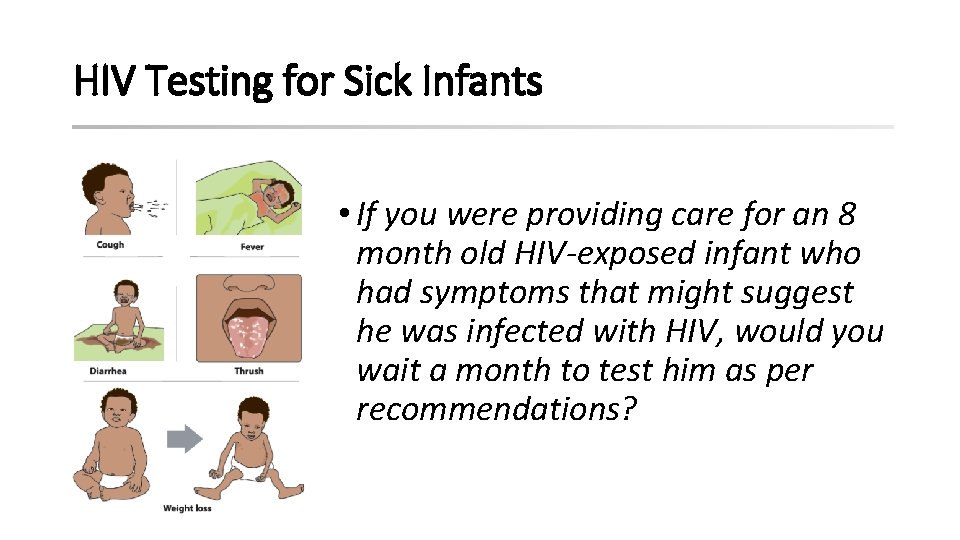
HIV Testing for Sick Infants • If you were providing care for an 8 month old HIV-exposed infant who had symptoms that might suggest he was infected with HIV, would you wait a month to test him as per recommendations?
HIV Testing for Sick Infants • Do not wait to test a sick baby. If an infant is sick before the standard age for conducting the test, test earlier! • IMPORTANT!! Retesting for Verification (also called Confirmatory Testing) • A positive virological test result should always be confirmed with a virological test using a second specimen • The second specimen should be collected before starting ART, but never delay treatment initiation pending the result of the confirmatory test! • Ideally, start ART on same day that the initial test result is given to caregiver
HIV Testing Algorithm • What is an HIV testing algorithm? • Why is it important to follow our national testing algorithm?
HIV Testing Algorithm • Algorithms: the combination and sequence of specific tests used in a given strategy • Testing algorithms are typically developed at a national level and based on global guidance • Interpretation of the algorithm for clinical use requires consideration of: HIV treatment criteria, age of the child, ongoing exposure to HIV through breastfeeding, and point of contact within the healthcare system
Advantages of National Testing Algorithms Nationally adopted algorithms facilitate: • Country-level standardization of tests: Supporting a limited number of tests is more feasible and practical than many tests • Procurement and supply management: Using standardized tests allows for bulk procurement • Training: Easier when test sites follow the same testing algorithm, and it allows trained staff to move between sites/regions without re-training • Quality assurance: National oversight of quality of testing operations is easier when test sites use the same tests and have similar operations. • It is important that programme staff adhere to the national testing algorithm See WHO infant testing algorithm in Figure 2. 1
Session 2. 3: Overview of NAT Session Objectives • Describe how and why NAT is used to diagnose HIV in infants • Interpret NAT results, whether positive or negative
Laboratory Diagnosis of HIV Infection—NAT • HIV infection in children under 18 months of age can be diagnosed only by virological testing using NAT technologies • Different manufacturers use different techniques. One of these techniques is called PCR • Two types of PCR testing: • Qualitative PCR: NAT procedure that detects presence of HIV virus • Extensive experience using DNA PCR testing for infant diagnosis • PCR works well on DBS samples • Quantitative PCR tells how much of the virus is present • Used for viral load (VL) testing
Window Period • What does “window period” refer to?
Window Period • “Window period” is the time it takes from HIV infection to detection on a diagnostic test • This can refer to: • The time it takes to develop enough antibodies to be detectable using an antibody test, or • The time it takes to develop enough virus to be detectable using NAT
Laboratory Diagnosis of HIV Infection—NAT • Once infected with HIV, it takes about 10 days for HIV to replicate so that there is enough virus in the blood to be detectable by DNA PCR • The time to detection, or window period, can vary depending on the individual and the test: • Presence of the virus using NAT: 1– 3 weeks • Presence of antibodies using serological testing: 3– 5 weeks
Analysers Validated for Infant HIV Testing High throughput, laboratory-based testing • Conventional method of infant HIV virological testing • Specimens collected in the clinic by DBS & transported to a central or regional laboratory for testing by trained laboratory technicians • Turn-around time can be 4 weeks or longer Point-of-care and near point-of-care technologies • Becoming widely available
Po. C and Near Po. C Technologies Two testing procedures have earned the CE-IVD Marking and WHO prequalification: 1. Alere™ q HIV-1/2 Detect: • Blood is collected by heel/toe or fingerstick into a sample capillary in a testing cartridge • Portable, runs on a battery for up to eight hours 2. Cepheid AB Xpert® HIV-1 Qual Assay • Blood is collected by heel/toe, fingerstick or venipuncture in a sterile tube using EDTA (lavender top) as the anticoagulant • Can be used on DBS • Runs on same technology that diagnoses tuberculosis • Not portable, considered “near Po. C” • Needs continuous power supply and temperature control • Reduced maintenance needs; few training requirements • Both tests can diagnose at point-of-care (or near to the point-of-care) in as little as an hour
Meaning of HIV Test Results, Virological Testing • HIV-positive test result: • Child has HIV and will require initiation of ART with confirmatory testing • HIV-negative test result: • In the child who has not been exposed to HIV in the past 3 months: child is not HIVinfected • In the child who has been exposed to HIV either during pregnancy, delivery, or through breastfeeding at any time in the past 3 months: child is either not infected with HIV or infected and still in the window period • Retest as per national guidelines • Retest, regardless of age, if the child is sick
Session 2. 4 Overview of Serological Testing Session Objectives • Describe when serological testing is used in the context of infant HIV testing • Interpret serological testing results, whether positive or negative, in the context of infant HIV testing
Laboratory Diagnosis of HIV Infection— Serological Testing • Detects antibodies, such as HIV antibodies, in blood or saliva • HIV antibodies are produced by the immune system in response to infection with HIV • Can diagnose HIV in adults and children 18 months of age or older • Types of serological testing procedures • RDT (Po. C or Lab-based) • Enzyme-linked immunosorbent assay (ELISA or EIA) (Lab-based) • Western blot (WB) testing (Lab-based) • ELISA requires a larger blood sample -- specimens taken by venipuncture • RDT needs only a drop of blood, samples obtained by finger, toe or heel prick • RDT results available in 20 minutes
Serological Testing, Notes • RDT does not detect the virus, it detects antibodies • In children less than 18 months, RDT cannot differentiate between the child’s own antibodies and maternal antibodies • Maternal HIV antibodies are passed to the infant through the placenta before birth, but they are not passed during breastfeeding.
Serological Testing, Notes • Usual: Most infants clear maternal antibodies between 6– 9 months of age • Maximum: It may take as long as 18 months for some infants to fully clear all maternal antibodies • HIV antibody positive result in infant less than 18 months of age, does not necessarily indicate the infant is HIV-infected • It means that the infant is HIV-exposed • Minimum: Many HIV-exposed infants will clear maternal antibody before 5 months • Some HIV-exposed infants may have a negative RDT result at this age • RDT in infants age 4– 18 months will not identify all who are HIV-exposed • A negative RDT might occur in an infant that is HIV-exposed but has lost all or most of the maternal antibodies
Window Period • It can take the body a few weeks or more to develop antibodies in response to an infection, and so it can take the RDT a similar amount of time to become reactive after HIV infection has been acquired • WHO recommends final testing of HIV-exposed infants with a serological test at 18 months of age or 3 months after breastfeeding has ended, whichever is later
Window Period • The “window period” of 3 months is different from the typical 3– 5 week window period to detect antibodies: • 3 -5 weeks is based on when most people will test HIV-positive (after infection) • 3 months is the amount of time it takes for almost everyone to test HIV-positive after infection
RDT: Interpreting the Test Result • In the context of infant HIV testing, RDT is used to identify infants and children under 18 months of age who are HIV-exposed • An HIV-positive RDT result means • Child < 18 months of age: HIV-exposed • Child ≥ 18 months of age: HIV-infected • An HIV-negative RDT result means: • Infant < 4 months of age: not HIV-exposed • Child 4– 18 months of age: HIV exposure cannot be ruled out. Child could have been HIV exposed but cleared maternal antibodies. Retest as per national guidelines • Adult or child 18 months of age or older: HIV-uninfected, unless breastfed within the past 3 months. Repeat RDT 3 months after stopping breastfeeding
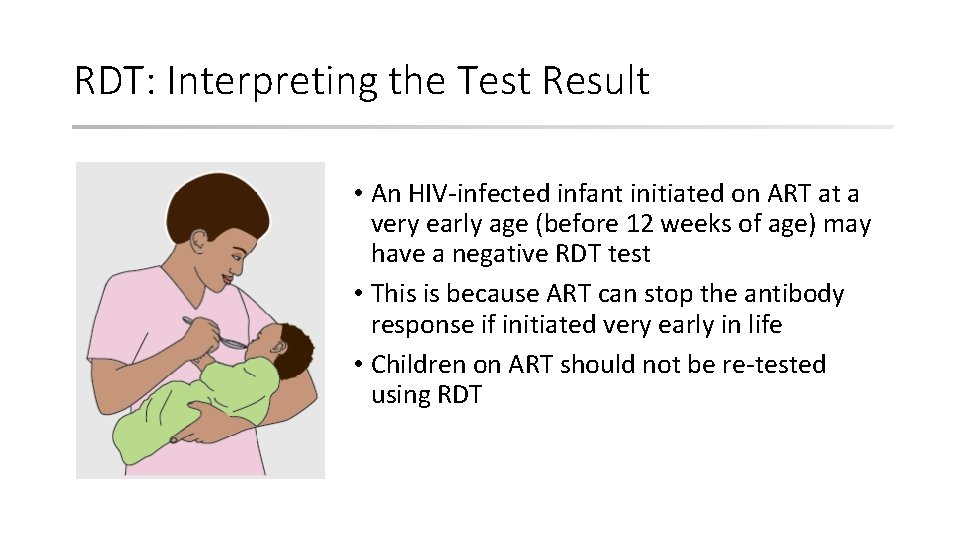
RDT: Interpreting the Test Result • An HIV-infected infant initiated on ART at a very early age (before 12 weeks of age) may have a negative RDT test • This is because ART can stop the antibody response if initiated very early in life • Children on ART should not be re-tested using RDT
RDT for Identification of HIV-exposed Infants Age group 0– 4 months 5– 18 months >18 months Unknown HIV exposure status Test mother If mother is not available: RDT in the child can reliably assess exposure Test mother If mother is not available: A positive RDT establishes exposure. Infants with positive RDT should get NAT to confirm infection. A negative RDT for the child does not fully rule out exposure. Perform NAT to assess HIV infection status in any sick child** Infants with negative RDT who are still breastfeeding will need testing 3 months after cessation of breastfeeding If sick, or index of suspicion is high, conduct virologic testing. Serological testing (including RDT) is recommended to assess HIV infection status unless breastfed within the last 3 months or still breastfed. If still breastfed, RDT should be provided 3 months after cessation of breastfeeding. **Consider initiating ART for presumed HIV infection if there is high degree of suspicion while waiting for NAT results, especially if RDT positive. NAT = Nucleic acid testing, a virological test
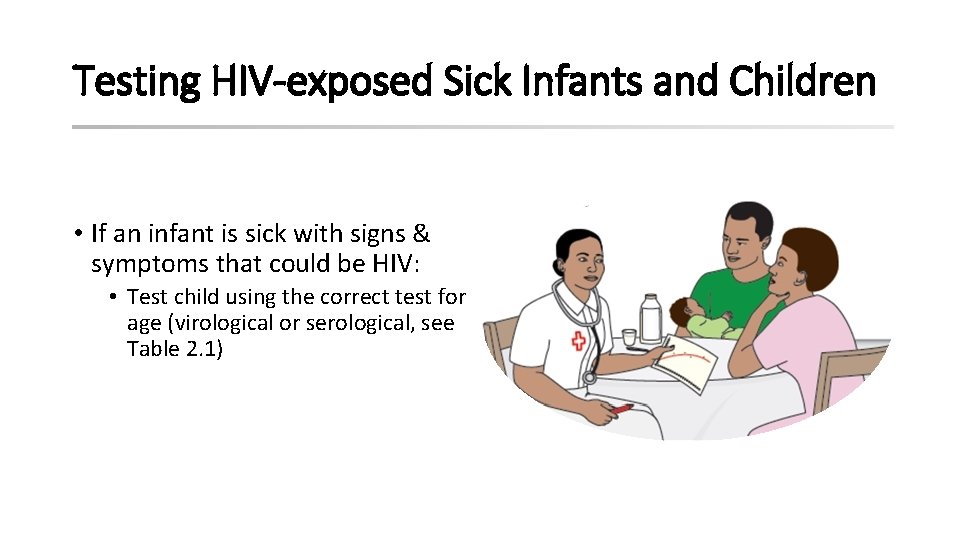
Testing HIV-exposed Sick Infants and Children • If an infant is sick with signs & symptoms that could be HIV: • Test child using the correct test for age (virological or serological, see Table 2. 1)
Exercise 1 Making sense of RDT results: Group game
Exercise 2 Making sense of virological testing results: Group game, re-match
Module 2: Key Points • Most HIV-exposed infants are identified through follow-up with the mother who is already enrolled in PMTCT services. • When screening infants in other clinical settings (OPD, hospital, immunization clinic, well child) for HIV exposure, review mother’s antenatal card or child health card, for mother’s HIV test results. • If mother’s HIV status is unknown or she has not been tested recently (according to national guidelines), she should be tested using RDT. • If mother is not available, then test the infant for HIV exposure using RDT.
Module 2: Key Points • WHO recommends that HIV-exposed infants are tested for HIV at 4– 6 weeks of age using NAT. • All HIV-exposed infants who tested HIV-negative should be retested at 9 months of age and again at 18 months or 3 months after cessation of breastfeeding (whichever is later).
Module 2: Key Points • Some countries may also recommend testing at birth of all or some HIV-exposed infants. Birth testing should only be implemented in parallel with efforts to strengthen and expand existing testing strategies for infants age 4– 6 weeks.
Module 2: Key Points • Testing algorithms define the sequence of specific HIV tests used for a particular population. • Each country will have their own HIV testing algorithm. • It is important that all health providers follow the national algorithm for infant HIV testing. • Virological testing using NAT is used to diagnose HIV infection in HIVexposed infants and children under the age of 18 months.
Module 2: Key Points • A negative RDT result in an infant less than 4 months of age means that the infant is not HIV-exposed. • However, in children, 4 -18 months of age, RDT is not reliable for determining HIV exposure. • These children should be retested according to national guidelines. • In children over the age of 18 months, RDT can be used to diagnose HIV infection.
Credits • “DNA” icon by Christopher T. Howlett from the Noun Project • Finger prick photo (slide 14) by unknown author is licensed under CC BY -NC-ND • “HIV Test” icon by Andrei Yushchenko from the Noun Project