
Module 2 Techniques of Self Awareness Johari Window
- Slides: 15
Module 2 Techniques of Self Awareness
Johari Window
What is joahari window? A model for selfawareness, personal development, group development and understanding relationship.
The Johari Window model A simple and useful tool for � understanding and training self awareness, personal development, improving communication, interpersonal relationships, group dynamics, team development and intergroup relationships.
Developed by American psychologists � Joseph Luft and Harry Ingham in the 1950's, calling it ‘Johari' after combining their first names, Joe and Harry as JOHARI
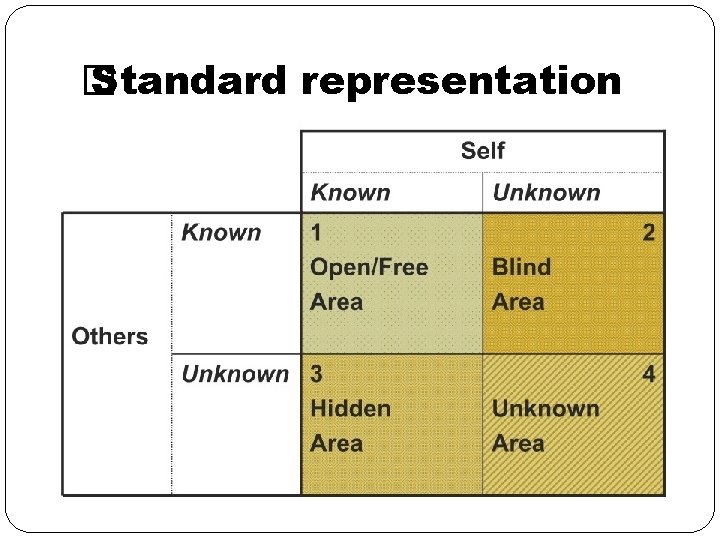
The four Johari Window perspectives Called 'regions' or 'areas' or 'quadrants'. � Each contains and represents the information feelings, motivation, etc - in terms of whether the information is known or unknown by the person and whether the information is known or unknown by others in the team The four regions, areas, quadrants, or � perspectives are as follows, showing the names
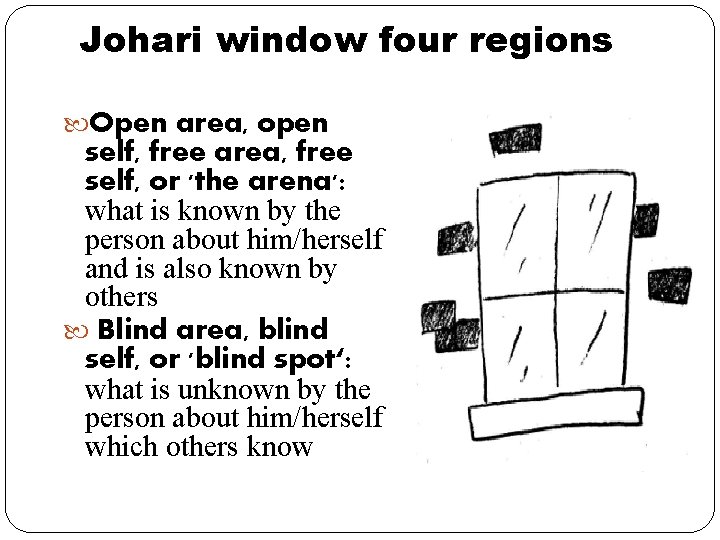
Johari window four regions Open area, open self, free area, free self, or 'the arena': what is known by the person about him/herself and is also known by others Blind area, blind self, or 'blind spot‘: what is unknown by the person about him/herself which others know
Hidden area, hidden self, avoided area , avoided self or 'facade': what the person knows avoided self about him/herself that others do not know Unknown area or unknown self: what is unknown by the person about him/herself and is also unknown by others.
� Standard representation
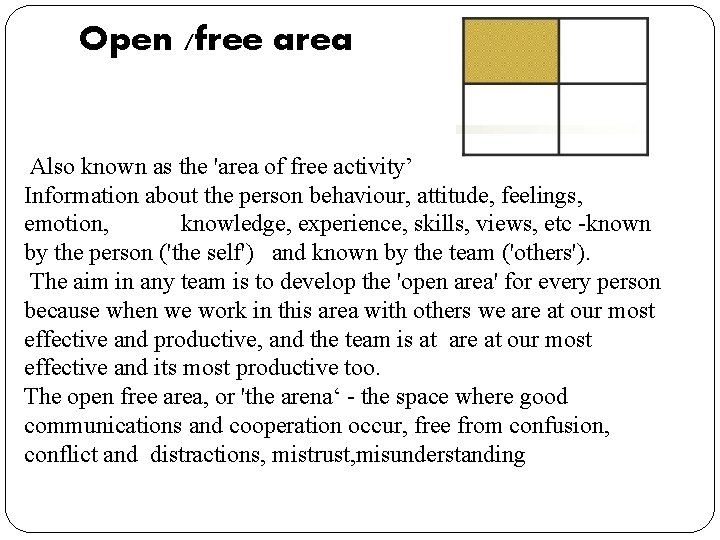
Open /free area Also known as the 'area of free activity’ Information about the person behaviour, attitude, feelings, emotion, knowledge, experience, skills, views, etc -known by the person ('the self') and known by the team ('others'). The aim in any team is to develop the 'open area' for every person because when we work in this area with others we are at our most effective and productive, and the team is at are at our most effective and its most productive too. The open free area, or 'the arena‘ - the space where good communications and cooperation occur, free from confusion, conflict and distractions, mistrust, misunderstanding
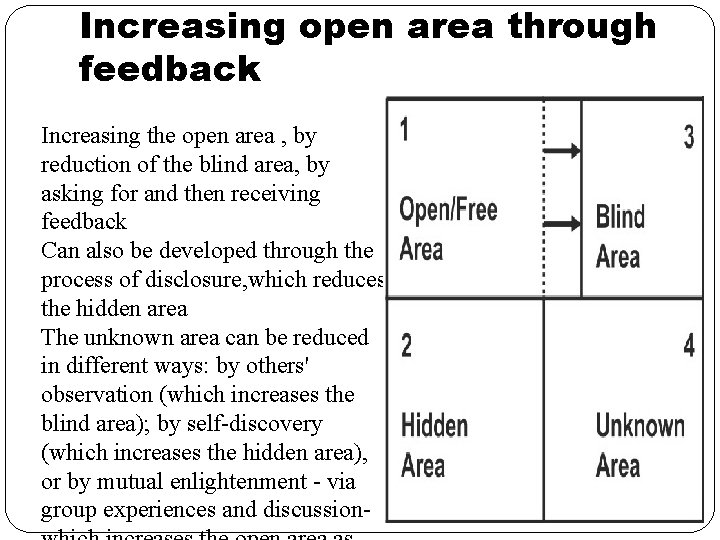
Increasing open area through feedback Increasing the open area , by reduction of the blind area, by asking for and then receiving feedback Can also be developed through the process of disclosure, which reduces the hidden area The unknown area can be reduced in different ways: by others' observation (which increases the blind area); by self-discovery (which increases the hidden area), or by mutual enlightenment - via group experiences and discussion-
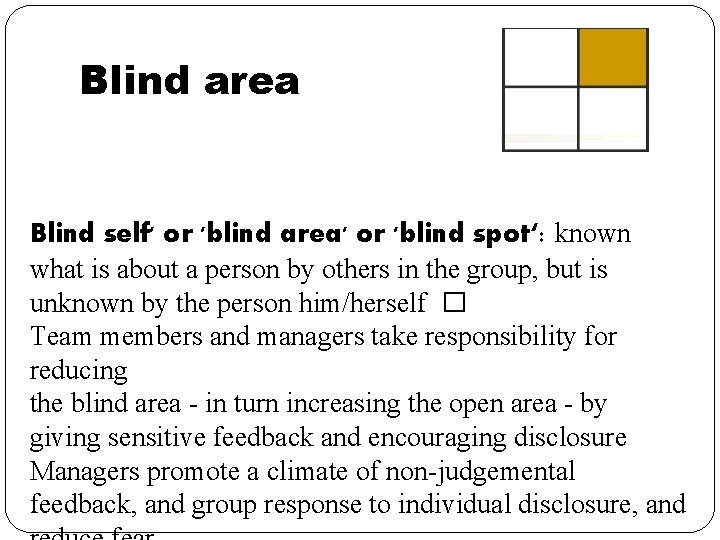
Blind area Blind self' or 'blind area' or 'blind spot‘: known what is about a person by others in the group, but is unknown by the person him/herself � Team members and managers take responsibility for reducing the blind area - in turn increasing the open area - by giving sensitive feedback and encouraging disclosure Managers promote a climate of non-judgemental feedback, and group response to individual disclosure, and
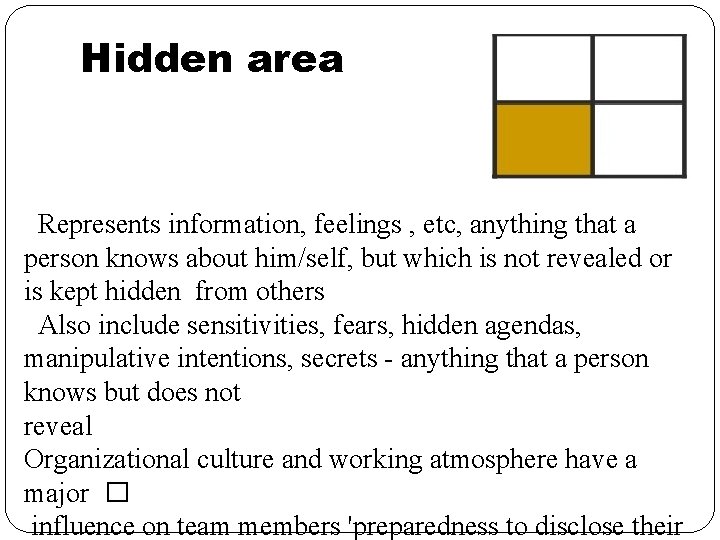
Hidden area Represents information, feelings , etc, anything that a person knows about him/self, but which is not revealed or is kept hidden from others Also include sensitivities, fears, hidden agendas, manipulative intentions, secrets - anything that a person knows but does not reveal Organizational culture and working atmosphere have a major � influence on team members 'preparedness to disclose their
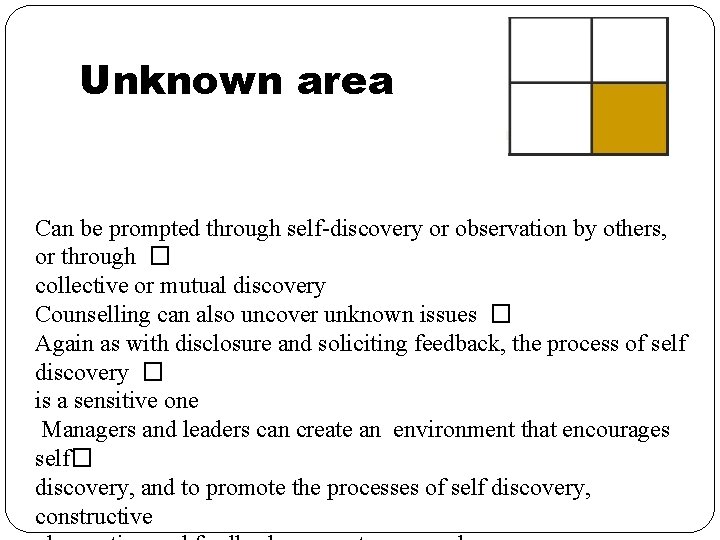
Unknown area Can be prompted through self-discovery or observation by others, or through � collective or mutual discovery Counselling can also uncover unknown issues � Again as with disclosure and soliciting feedback, the process of self discovery � is a sensitive one Managers and leaders can create an environment that encourages self� discovery, and to promote the processes of self discovery, constructive
Stages of Self Exploration 1. Self awareness 2. Self acceptance 3. Self realization