
MODULE 2 SUPERVISION AND COACHING PRACTICES AND TOOLS








- Slides: 33
MODULE 2 SUPERVISION AND COACHING PRACTICES AND TOOLS Photo: Kellie Ryan /The IRC
THE ALLIANCE FOR CHILD PROTECTION IN HUMANITARIAN ACTION
MODULE AIM AND LEARNING OUTCOMES Aim: To examine the key practices of supervision and coaching Learning Outcomes: § Know the different supervision and coaching practices that can be performed in one-on-one, group, or both settings § Know the purposes associated with the different practices § Know the duration and frequency for each practice § Understand the guidance associated with each practice and how to utilize practice tools
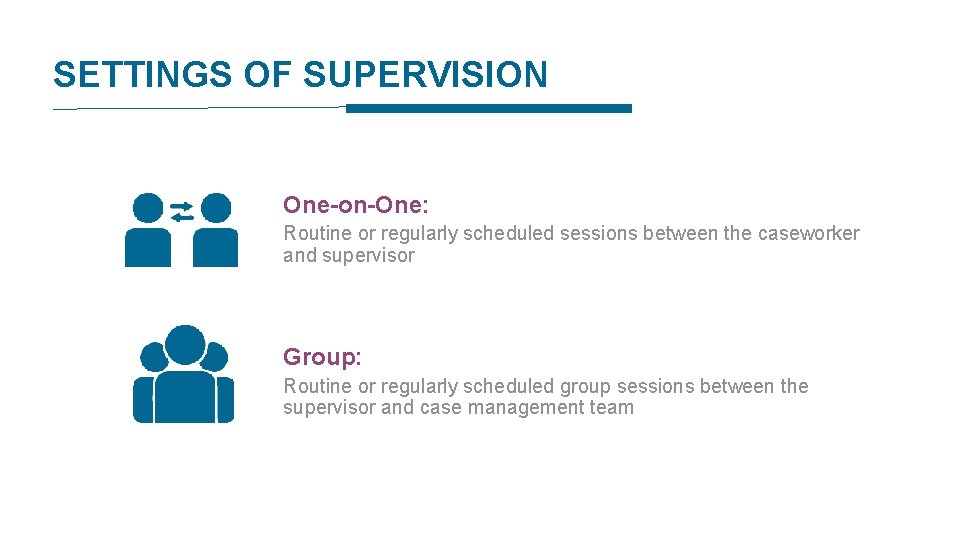
SETTINGS OF SUPERVISION One-on-One: Routine or regularly scheduled sessions between the caseworker and supervisor Group: Routine or regularly scheduled group sessions between the supervisor and case management team
Supervision should be… WHAT DO THE IA CM GUIDELINES SAY ABOUT SUPERVISION? 1. Regular and consistent 2. Collaborative 3. Safe and confidential 4. Opportunity for learning and professional growth 5. Part of ensuring effective and accountable case management procedures 6. Important to promote staff well-being
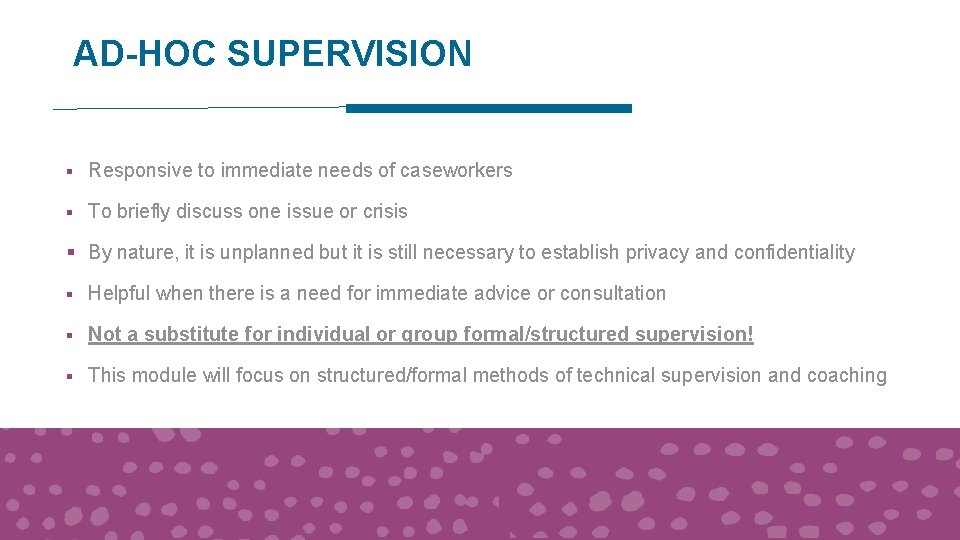
AD-HOC SUPERVISION § Responsive to immediate needs of caseworkers § To briefly discuss one issue or crisis § By nature, it is unplanned but it is still necessary to establish privacy and confidentiality § Helpful when there is a need for immediate advice or consultation § Not a substitute for individual or group formal/structured supervision! § This module will focus on structured/formal methods of technical supervision and coaching
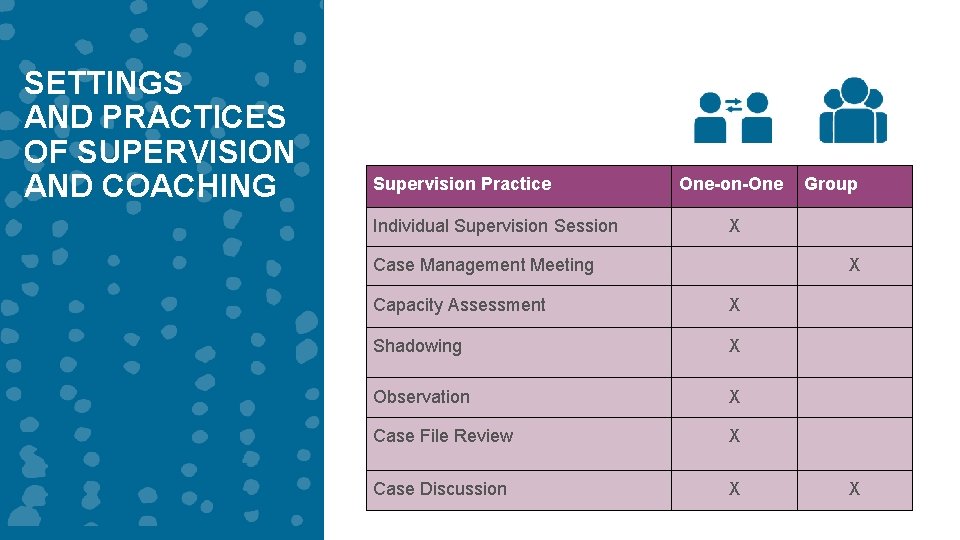
SETTINGS AND PRACTICES OF SUPERVISION AND COACHING Supervision Practice Individual Supervision Session One-on-One Group X Case Management Meeting X Capacity Assessment X Shadowing X Observation X Case File Review X Case Discussion X X
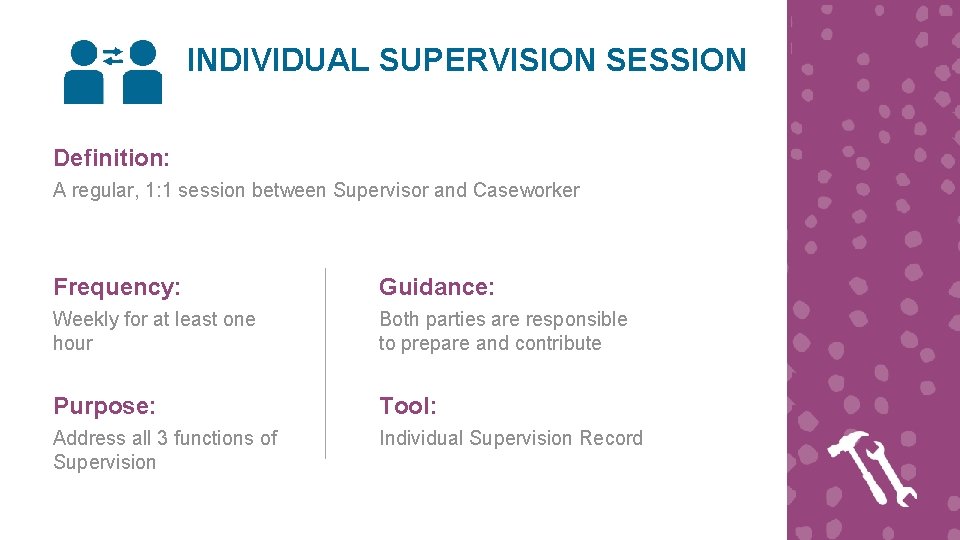
INDIVIDUAL SUPERVISION SESSION Definition: A regular, 1: 1 session between Supervisor and Caseworker Frequency: Guidance: Weekly for at least one hour Both parties are responsible to prepare and contribute Purpose: Tool: Address all 3 functions of Supervision Individual Supervision Record
QUESTIONS?
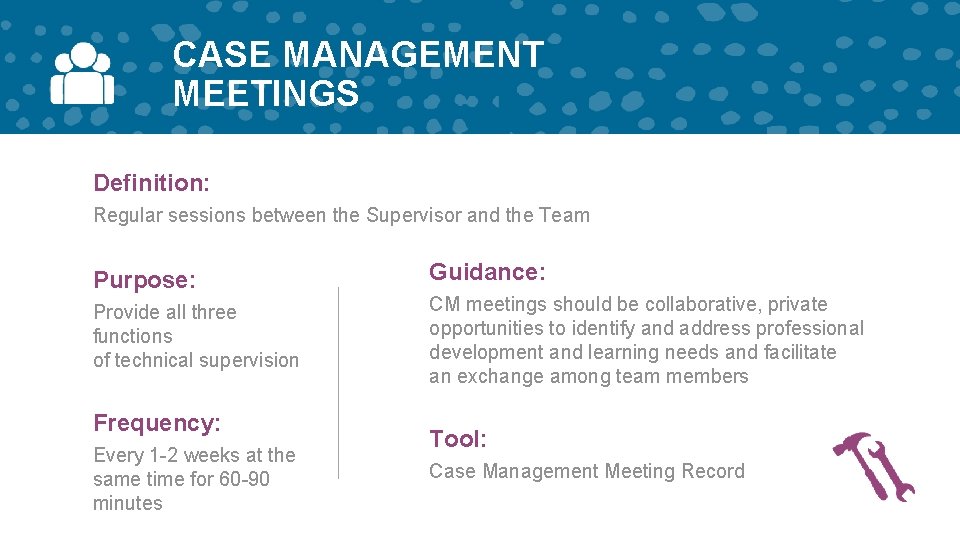
CASE MANAGEMENT MEETINGS Definition: Regular sessions between the Supervisor and the Team Purpose: Provide all three functions of technical supervision Frequency: Every 1 -2 weeks at the same time for 60 -90 minutes Guidance: CM meetings should be collaborative, private opportunities to identify and address professional development and learning needs and facilitate an exchange among team members Tool: Case Management Meeting Record
PLANNING FOR SUPERVISION MEETINGS In small groups, review the tools: • 2 groups: Individual Supervision Record • 2 groups: Case Management Meetings Discuss as a group: • What preparations should be made by a supervisor in order to facilitate a successful meeting? • How should caseworkers be expected to prepare? • What are some key tips for supervisors when leading the meeting?
QUESTIONS?
CASEWORKER CAPACITY ASSESSMENT Definition: Examines a caseworker’s skills, attitudes, and knowledge to perform effectively in the role Purpose: Guidance: Identify and acknowledge strengths and address development needs on individual as well as team levels This is intended to be a private but collaborative and supportive process leading to a capacity building plan Frequency: Tool: Upon recruitment and reviewed at least every 3 -6 months Caseworker Capacity Assessment
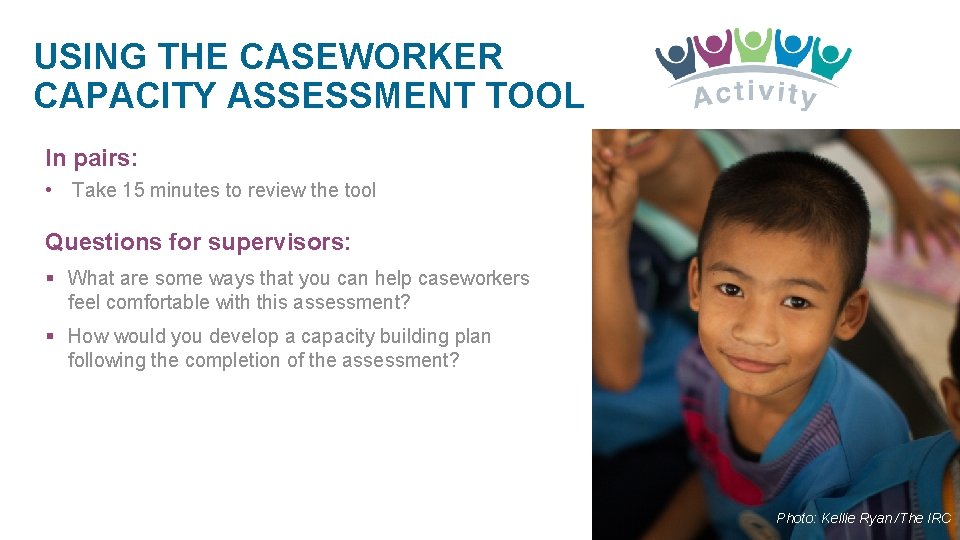
USING THE CASEWORKER CAPACITY ASSESSMENT TOOL In pairs: • Take 15 minutes to review the tool Questions for supervisors: § What are some ways that you can help caseworkers feel comfortable with this assessment? § How would you develop a capacity building plan following the completion of the assessment? Photo: Kellie Ryan /The IRC
QUESTIONS?
SHADOWING Definition: A caseworker attends a face-to-face interaction between a senior caseworker and a child/ caregiver Purpose: Guidance: To meet the caseworker’s learning and development needs by modeling good practice § Consent of the child and caregiver is necessary § Supervisor and senior caseworker should decide on appropriate cases for shadowing visits based on criteria § After the session, the caseworker has a formal opportunity to reflect on and ask questions about what they observed Frequency: 5 -10 shadowing visits during the first 12 months of employment Tool: Shadowing Tool
OBSERVATION Definition: Supervisor attends a face-to-face interaction between a caseworker and a child/caregiver Purpose: Guidance: Observe caseworker’s skills in order to provide feedback in individual sessions § Consent of the child and caregiver is necessary § Supervisor and caseworker should decide on appropriate cases for observation visits based on criteria Frequency: § Every 2 weeks as a caseworker develops skills and confidence § At least every 2 months for experienced caseworkers Tool: Observation Tool
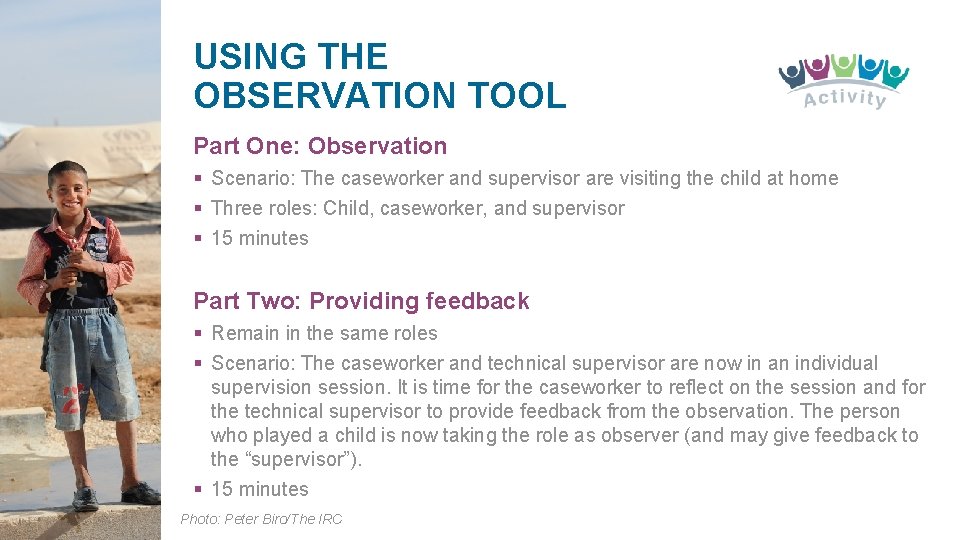
USING THE OBSERVATION TOOL Part One: Observation § Scenario: The caseworker and supervisor are visiting the child at home § Three roles: Child, caseworker, and supervisor § 15 minutes Part Two: Providing feedback § Remain in the same roles § Scenario: The caseworker and technical supervisor are now in an individual supervision session. It is time for the caseworker to reflect on the session and for the technical supervisor to provide feedback from the observation. The person who played a child is now taking the role as observer (and may give feedback to the “supervisor”). § 15 minutes Photo: Peter Biro/The IRC
QUESTIONS?
CASE FILE REVIEW Definition: Supervisor verifies a case file is being managed properly and that documentation and record -keeping meets standards Guidance: Purpose: To meet administrative/accountability function. and identify any learning or development needs related to process Frequency: A supervisor should review 2 -5 files for each caseworker on monthly basis § Review files at any stage of the case management process including closed files § Flag any issues for feedback and review § Note any trends across the team and address during supervision sessions Tool: Case File Checklist
USING THE CASE FILE CHECKLIST TOOL 1. Review an example case file together with your team/group using the checklist tool 2. Discuss with your team/group what observations can be made about the documentation As supervisors: § What concerns/questions would you have for this case? § What feedback and/or actions would you recommend for the caseworker?
QUESTIONS?
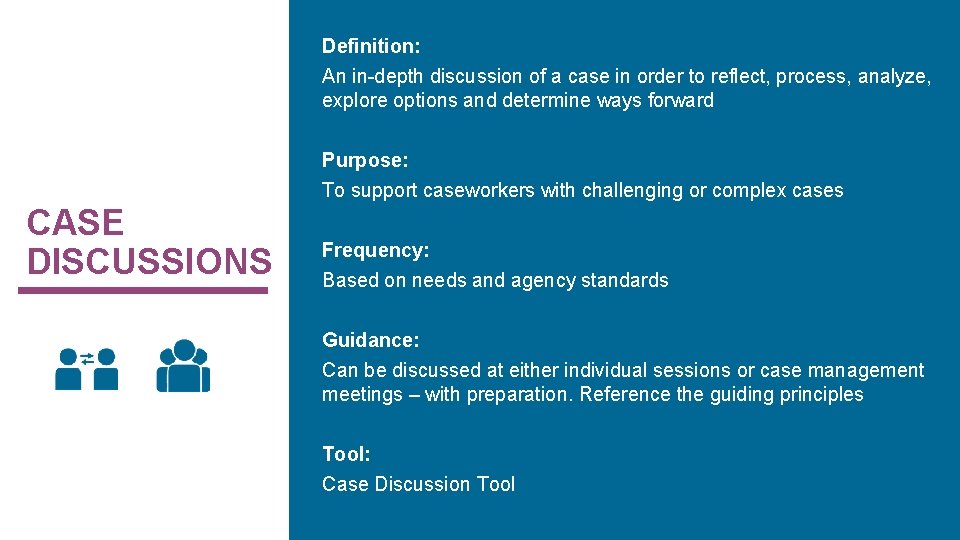
Definition: An in-depth discussion of a case in order to reflect, process, analyze, explore options and determine ways forward Purpose: To support caseworkers with challenging or complex cases CASE DISCUSSIONS Frequency: Based on needs and agency standards Guidance: Can be discussed at either individual sessions or case management meetings – with preparation. Reference the guiding principles Tool: Case Discussion Tool
USING THE CASE DISCUSSION TOOL 1. Review the case together with your group using the Case Discussion Tool 2. Discuss with your group what the options are for the case and what next steps or follow up would be recommended
QUESTIONS?
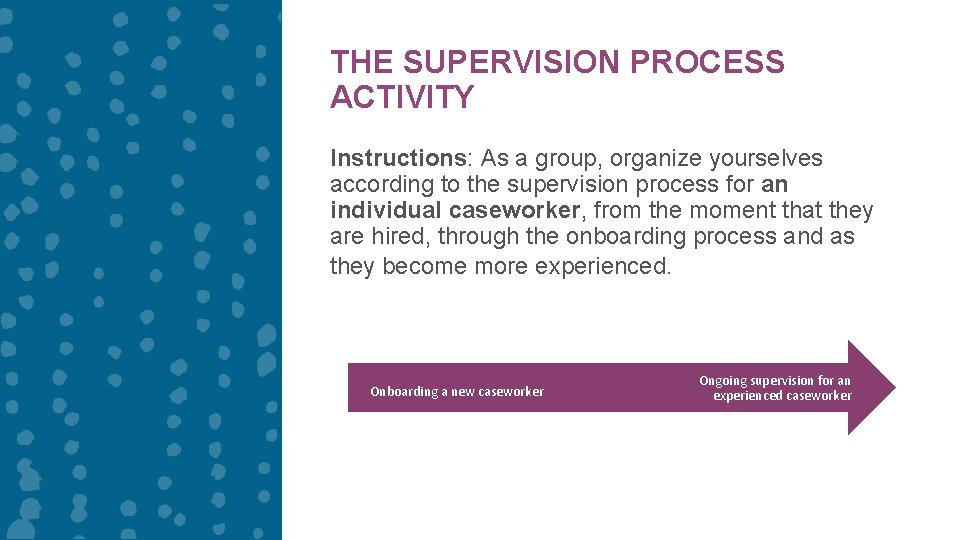
THE SUPERVISION PROCESS ACTIVITY Instructions: As a group, organize yourselves according to the supervision process for an individual caseworker, from the moment that they are hired, through the onboarding process and as they become more experienced. Onboarding a new caseworker Ongoing supervision for an experienced caseworker
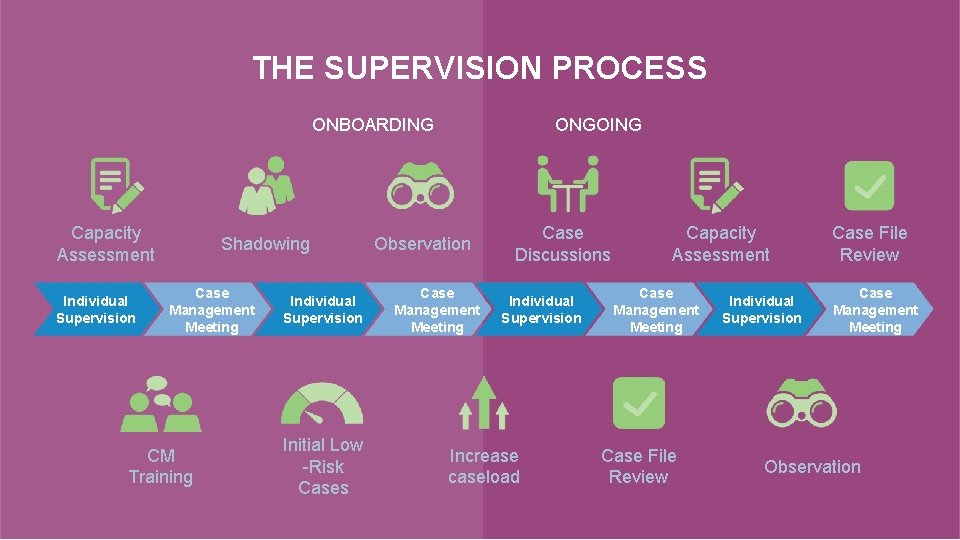
THE SUPERVISION PROCESS ONBOARDING Capacity Assessment Individual Supervision Shadowing Case Management Meeting CM Training Individual Supervision Initial Low -Risk Cases ONGOING Observation Case Management Meeting Case Discussions Individual Supervision Increase caseload Capacity Assessment Case Management Meeting Case File Review Individual Supervision Case File Review Case Management Meeting Observation
DESIGN A SUPERVISION CALENDAR Exercise: § Draft a monthly supervision calendar for 1 Supervisor and 6 caseworkers § New hire: CW 1 § Junior caseworkers: CW 2, CW 3, CW 4 § Senior caseworkers: CW 5, CW 6 § Blank calendar § Capacity Assessment card x 1 § Shadowing cards x 3 § Observation cards x 2 § Case File Review cards x 4 § Individual Supervision cards x 24 § Case Management meeting cards x 4 § Case Discussion cards x 2
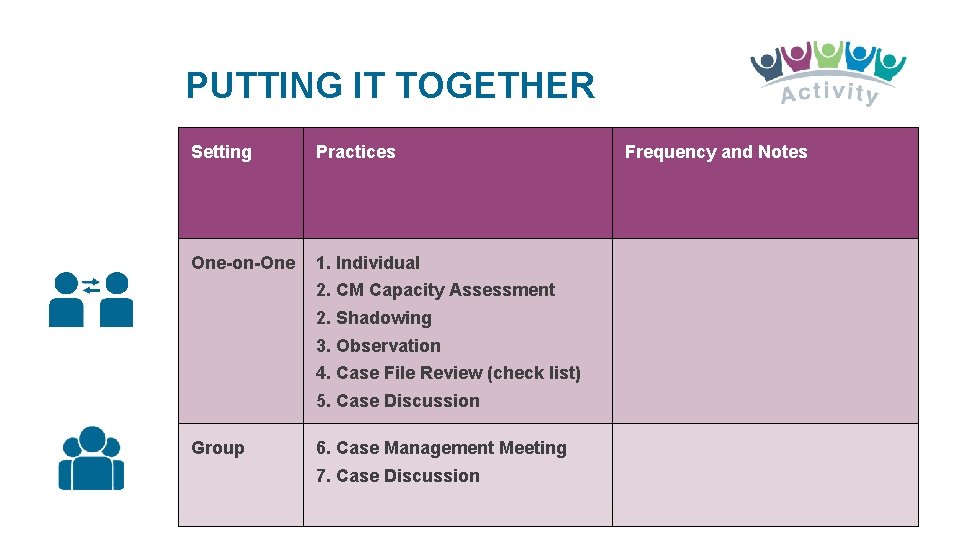
PUTTING IT TOGETHER Setting Practices One-on-One 1. Individual 2. CM Capacity Assessment 2. Shadowing 3. Observation 4. Case File Review (check list) 5. Case Discussion Group 6. Case Management Meeting 7. Case Discussion Frequency and Notes
REVIEW QUIZ 1. What are the two settings for supervision? 2. What are the 7 different practices of supervision? 3. What is the difference between the Shadowing and Observation tools? 4. When should a caseworker Capacity Assessment be completed? 5. What are the roles of a caseworker and a supervisor in an Individual Supervision Session?
MODULE AIM AND LEARNING OUTCOMES Aim: To examine the key practices of supervision and coaching Learning Outcomes: § Know the different supervision and coaching practices that can be performed in oneon-one, group, or both settings § Know the purposes associated with the different practices § Know the duration and frequency for each practice § Understand the guidance associated with each practice and how to utilize practice tools
IS THERE ANYTHING FROM THIS MODULE YOU WANT TO ADD TO YOUR ACTION PLAN?
REFERENCES • Alliance for Child Protection in Humanitarian Action. (2014). Inter-agency Guidelines for Case Management and Child Protection. Retrieved 2017, from https: //resourcecentre. savethechildren. net/library/inter-agency-guidelines-case-management -and-child-protection • Alliance for Child Protection in Humanitarian Action. (2014). Child Protection Case Management Training Manual for Caseworkers, Supervisors and Managers. Retrieved 2017 from: https: //resourcecentre. savethechildren. net/library/ia-case-management-trainingpackage • Nickerson, R. S. (1987). Why Teach Thinking? In Baron, J. B. & Sternberg, R. J. (Eds. ), Teaching Thinking Skills: Theory and Practice (pp. 27 -37). New York: W. H. Freeman & Company. • Skills for Care and Children’s Workforce Development Council UK (2007) Providing effective supervision: A workforce development tool, including a unit of competence and supporting guidance. Accessed at http: //www. skillsforcare. org. uk/Document-library/Finding-andkeeping-workers/Supervision/Providing-Effective-Supervision. pdf • Stevens, I (2015). Practicing Supervision in Child Care and Child Protection Agencies. Retrieved 2016, from www. childhub. org