
MODULE 2 PUBLIC WORKS SUPERVISION Chuck Williams PWLF
MODULE 2. PUBLIC WORKS SUPERVISION Chuck Williams, PWLF Municipal Services Director City of Lenexa
LEARNING OBJECTIVES n n Understand the different roles and functions a supervisor must perform. Be familiar with the various skills that a supervisor needs to develop/refine in order to fulfill those roles. Understand the basics of employee recruitment. Understand how culture affects supervisors

ROLE OF THE SUPERVISOR • • Hiring, motivating and retaining staff. Provide leadership and direction. Delegating responsibility and ensuring accountability. Understand departmental needs and advocate for resources. Translate general policy direction into specific work tasks and performance standards. Manage change Understand the meaning of and influence of organizational culture
SUPERVISORY SKILL SET n n n n Communication skills Coaching and mentoring Developing teams Managing change Problem solving Performance planning Conflict resolution In a high-tech workplace, it is a person’s hightouch skills that set one apart from their peers.
QUEEN ELIZABETH’S PROBLEM Ships at sea + No Contact = n Need for good selection n Need for training n Need for accountability
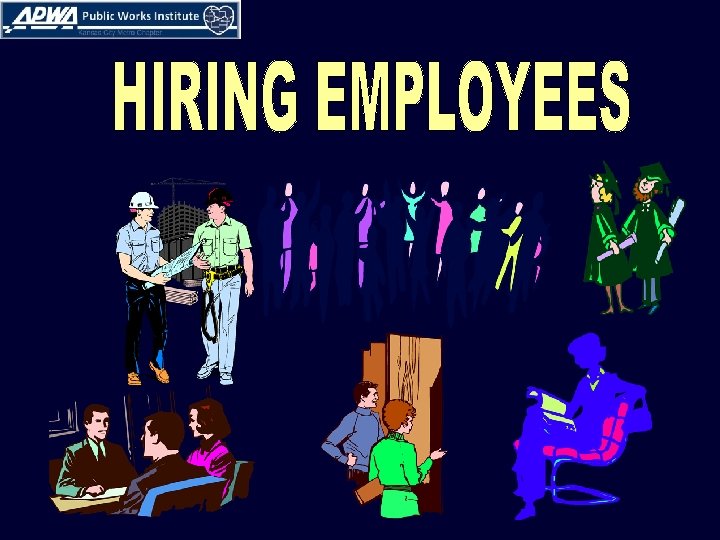
HIRING n n Knowing what you want Matching Organizational Values The best selection process Misc. issues
Group Exercise. Develop a list of 5 Questions n Maintenance Worker n Mechanic n Foreman n Superintendent n Director
THE BEST SELECTION PROCESS n n Interview -Listen Interview Panel -Listen Assessment Center -Listen Allow Applicants to Interview You
MISC. ISSUES n n n Don’t talk too much Reference check strategy Thoughts on who’s involved in selection process
Culture n n n Growth of Bacteria Cultivation of Soil Improvement of mind and manners Development by training and care The skills, personalities, collective interaction of a given group in a given period of time.
Organizational Culture n Why is it important to you as a supervisor? n n n Can limit what you as an individual can do Determines how much resistance there will be to change Affects how successful your efforts to build a team might be Affects what strategies you can employ to motivate and retain employees. Can predicate whether or not a new employee will succeed
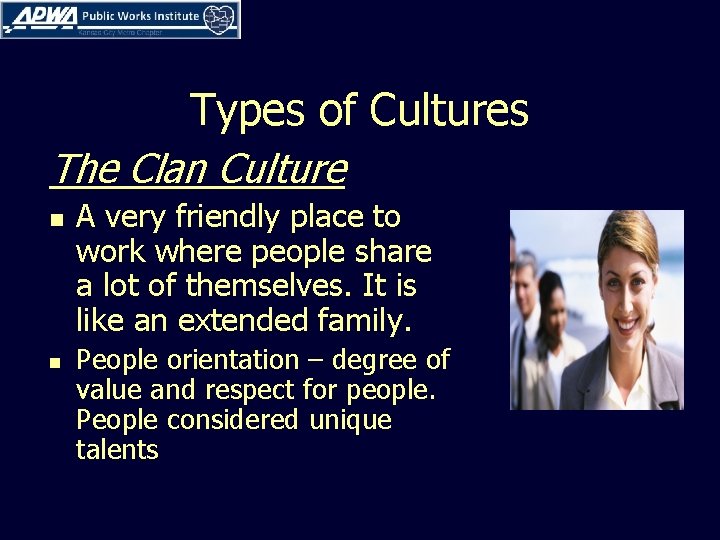
Types of Cultures The Clan Culture n n A very friendly place to work where people share a lot of themselves. It is like an extended family. People orientation – degree of value and respect for people. People considered unique talents
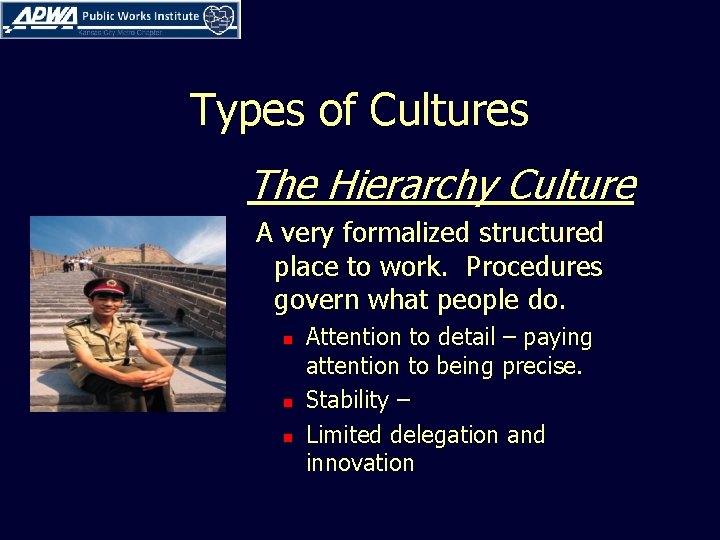
Types of Cultures The Hierarchy Culture A very formalized structured place to work. Procedures govern what people do. n n n Attention to detail – paying attention to being precise. Stability – Limited delegation and innovation
Types of Cultures The Adhocracy Culture n n n A dynamic entrepreneurial, and creative place to work. People stick their necks out and take risks. Willing to experiment, encourage innovation
Types of Cultures The Market Culture n A results oriented organization whose major concern is with getting the job done. People are competitive and goaloriented. Ends may justify the means.
What Type of Culture do you have? The Clan Culture q The Hierarchy Culture q The Adhocracy Culture q The Market Culture q
Group Exercise Every organization has a culture, either developed or acquired. n Discuss the positive aspects of your culture n Are their improvements you would like to see? n Share only what you are comfortable sharing
Changing the Culture n n n Takes time – measured in years The more tenured the staff, the less likely efforts to change the culture will succeed As long as you don’t openly challenge the culture, you can operate within it and make small changes to processes and environment under your control.
Want to be a Leader? n Confidence is the single most important attribute for leaders because without it, leadership cannot be demonstrated, argues Peter Barron Stark. You can learn to communicate, to solve problems or to make decisions, but "if you don't believe that you have the personal confidence to lead, gaining followers will be tough, or impossible, "
- Slides: 20