
MODULE 2 OUTPUTS READING ADVOCACY LIS 585 SUMMER
- Slides: 24
MODULE 2: OUTPUTS READING ADVOCACY LIS 585 SUMMER QUARTER 2015
THREE ESSENTIAL FUNCTIONS OF THE LIT PROGRAM: • Information and Technology Literacy Instruction • Reading Advocacy • Information Services and Management Courtesy of hyku/Flikr Creative Commons
READING ADVOCACY I. What is Reading Advocacy? II. Reading Advocacy Standards III. Components of a Reading Advocacy Program IV. Reading Advocacy Strategies
I. WHAT IS READING ADVOCACY? • A program that promotes, guides and champions reading! • Not the same as reading instruction “To ensure that students are effective users and producers of ideas and information. ”
II. READING ADVOCACY STANDARDS STANDARD 2: LITERATURE Literature: Uses literature to pursue personal interests, expand global understanding, and reach academic goals. • • • Share favorite literature. Participate in discussions on genres and authors. Identify characteristics of various genres. Routinely select both good fit books. Read, listen to, and view a range of resources for a variety of purposes. (example: to live the experiences of a character, to answer questions, to find out about something new, to explore personal interests. )
III. COMPONENTS OF THE READING ADVOCACY FUNCTION 1. Reading for Pleasure: Promoting a love of reading 1. Reader’s Advisory 2. Book Talks 2. School-Wide Promotions Courtesy Limbic/Flickr Creative Commons
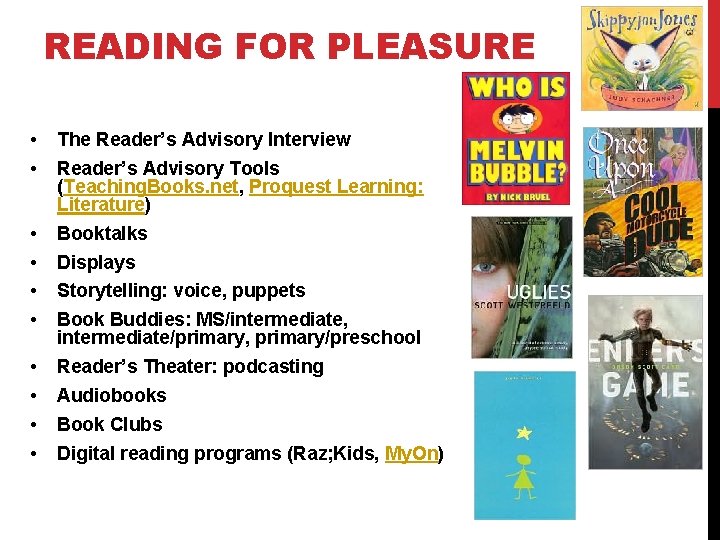
READING FOR PLEASURE • • The Reader’s Advisory Interview • • Booktalks • • Reader’s Theater: podcasting Reader’s Advisory Tools (Teaching. Books. net, Proquest Learning: Literature) Displays Storytelling: voice, puppets Book Buddies: MS/intermediate, intermediate/primary, primary/preschool Audiobooks Book Clubs Digital reading programs (Raz; Kids, My. On)
HOW TO GET STARTED IN BECOMING A WELL-READ LIBRARIAN. . . 1. Start with current award nominee lists: 1. WCCPBA 2. Sasquatch 3. Towner 4. Evergreen 5. PNLA Young Reader's Choice 6. *Caldecott/Newbery 2. Past award winners 3. Read what is in your collection 4. Use the catalog features
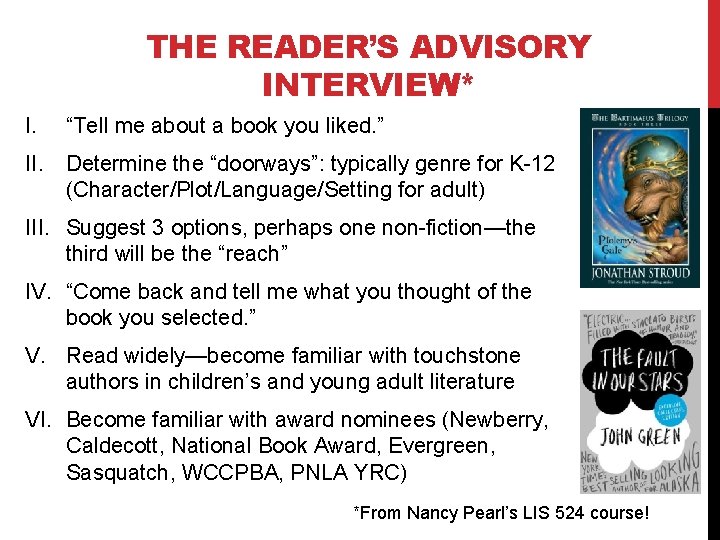
THE READER’S ADVISORY INTERVIEW* I. “Tell me about a book you liked. ” II. Determine the “doorways”: typically genre for K-12 (Character/Plot/Language/Setting for adult) III. Suggest 3 options, perhaps one non-fiction—the third will be the “reach” IV. “Come back and tell me what you thought of the book you selected. ” V. Read widely—become familiar with touchstone authors in children’s and young adult literature VI. Become familiar with award nominees (Newberry, Caldecott, National Book Award, Evergreen, Sasquatch, WCCPBA, PNLA YRC) *From Nancy Pearl’s LIS 524 course!
YOUR TURN TO PRACTICE THE READER’S ADVISORY… You will need to be confident in approaching students and conducting the reader’s advisory interview, so time to practice! In groups of 2 -3, take turns practicing*: 1. 2. 3. 4. “Tell me about a book you liked. ” Determine the “doorways”: typically genre for K-12 Suggest 3 options, perhaps one non-fiction—the third will be the reach “Come back and tell me what you thought of the book you selected. ” *You may need to call upon your own reading experiences, or books that you have only heard about—that’s ok!
THE BOOK TALK* • Inspire a love for reading • Introduce genres, styles, notable authors, literary elements Format for Book Talk: I. Frame: mention who this book would appeal to, and what makes it unique II. Hook: what caught your attention, an anecdote III. Personal Connection: tell why you personally liked it *Get comfortable with your own style, be sincere, and keep it concise! *From Nancy Pearl’s LIS 524 course!
MY TURN TO DEMO THE BOOK TALK… “List the titles that are appealing to you…” • Post-Its • Destiny Lists • Goodreads • Shelfari • Others?
YOUR TURN TO PRACTICE THE BOOK TALK… 1. 2. 3. Select one book that you would recommend. Practice an impromptu book talk with a partner. Share reflections on book talking with the class. Remember the format: I. Frame: “If you like books about…” II. Hook: “Something interesting that happens is…” III. Personal Connection: “I liked this book because…”
NON-FICTION READING Newsela “Newsela is an innovative way to build reading comprehension with nonfiction that's always relevant: daily news. It's easy and amazing. ”
BOOK TRAILERS These make great reading advocacy tools! • Public library sites • Publisher sites • Teachingbooks. net (requires subscription, but trial is free) • Web search…? Definitely preview for quality/appropriateness!
SCHOOL-WIDE READING PROMOTIONS Select from the following menu: • Banned books week: book challenges Read Across America • Blind Date with a Book • • • DEAR programs • Accelerated Reader • Workshops (ex: parent/child graphic novel creation) March Book Madness • Library as makerspace • Book Speed Dating/Book Tasting • • Battle of the Best Books Theme days/months (ex: Star Wars May 4, Great Pumpkin contest) • Participation in Sasquatch, YRC, WCCPBA, Evergreen • Poem in your pocket • “Fireside” buddy reading • Book fairs • Genre bingo • Family nights • Book clubs • Parent book club • • Summer Reading • Author visits Reading award programs (ex: Read/Lead tracking reading minutes) Courtesy Edenpictures/Flickr Creative Commons
THE HOTTEST TREND IN LIBRARIES… • Library as Makerspace* • Genre Shelving *Embrace Minecraft!!
BATTLE OF BEST PICTURE BOOKS! • District Battle Programs • Global Reading Challenge • School Battle of the Best Picture Books
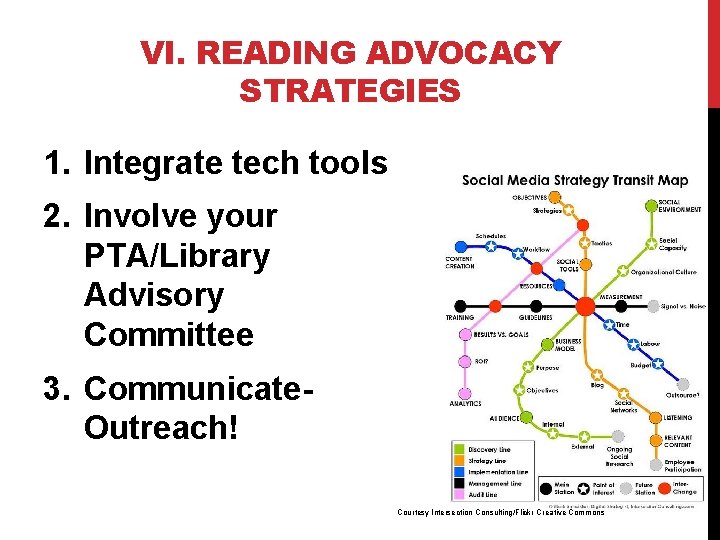
VI. READING ADVOCACY STRATEGIES 1. Integrate tech tools 2. Involve your PTA/Library Advisory Committee 3. Communicate. Outreach! Courtesy Intersection Consulting/Flickr Creative Commons
HOW DOES THE READING ADVOCACY PROGRAM PROMOTE INFORMATION LITERACY? • Author • Genre • Literary elements • Award-winning literature • Content area reading/book talks • Coordination with classroom teacher • Prep for standardized tests (Eisenberg 2004) Courtesy Clover_1/Flickr Creative Commons
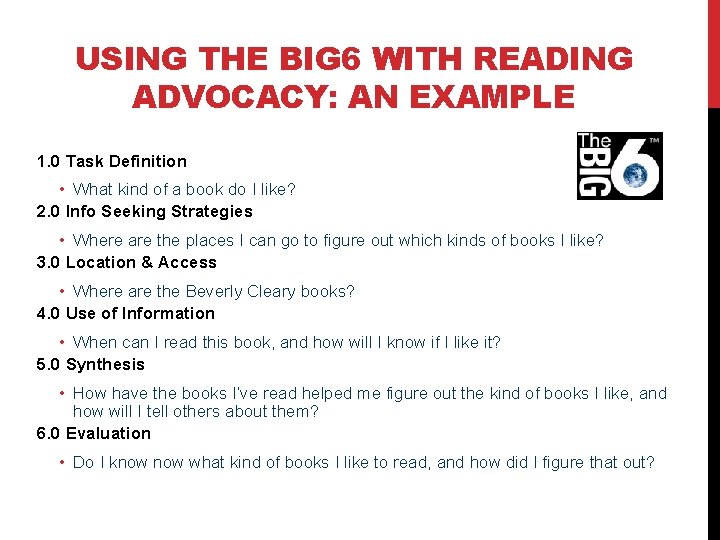
USING THE BIG 6 WITH READING ADVOCACY: AN EXAMPLE 1. 0 Task Definition • What kind of a book do I like? 2. 0 Info Seeking Strategies • Where are the places I can go to figure out which kinds of books I like? 3. 0 Location & Access • Where are the Beverly Cleary books? 4. 0 Use of Information • When can I read this book, and how will I know if I like it? 5. 0 Synthesis • How have the books I’ve read helped me figure out the kind of books I like, and how will I tell others about them? 6. 0 Evaluation • Do I know what kind of books I like to read, and how did I figure that out?
FOR MORE INFORMATION… • Children’s/YA Literature courses • Public library programs • ALA Fact Sheet #23: Recommended Reading • WLMA: Reading Advocacy • Pacific Northwest Library Association • Guys Read • Readergirlz • Reader’s Advisory Tools: Novelist, Reader’s Advisory Online, A Book and a Hug, Teachingbooks. net • Professional Groups: Puget Sound Council, WASHYARG
THE STATE OF READING? Why students don’t read what is assigned in class Discuss What is the role of the teacher-librarian in the solution?
MODULE 2 DISCUSSION 1. Which of the three functions of the LIT program is the most difficult to describe to others? Why? 2. What are some strategies for determining the right balance of these functions for a given building situation? 3. What is the best approach for teaching information literacy and technology skills? 4. How can higher-level thinking skills (e. g. Bloom's Taxonomy) be embedded into information literacy & technology instruction? 5. How do you feel about the ALA position statements on teacher-librarians, LIT programs, and reading? 6. How can advances in IT support all three functions of the LIT program?