
MODULE 2 Management and Engineering Economics Subject code
MODULE 2 Management and Engineering Economics Subject code: 17 ME 51 By Nagaraj M S, Associate Professor Dept of Mechanical Engg KSSEM, Bangalore 1
MODULE 2 ORGANIZING AND STAFFING 2
MODULE 2 Contents Nature and purpose of organization Principles of organization - Types of organization Departmentation Committees Centralization Vs Decentralization of authority and responsibility Span of control - MBO and MBE (Meaning Only) Nature and importance of staffing Process of Selection & Recruitment (in brief). Reference video: https: //www. bing. com/videos/search? q=organisation+and+staffing+videos&view=det ail&mid=69 EAD 0 DC 31 C 75 ED 8 F 695&FORM=VIRE 3
Drawbacks of MBO Stating objectives in a specific period of time is a difficult task This process demands trust in an organisation The organisation becomes very formalized which hinders further development The performance evaluation is based on present job and not on previous job which may not be true way of appraisal 4
Organisation • It is a rational coordination of the activities of a number of people for the achievement of some common explicit goals, through division of labour and function and through a hierarchy of responsibility and authority • They involve a significant amount of conscious planning, coordination and deliberate structuring 5
Characteristics Every organisation Common Objective Has a purpose and goal already indicated during planning. 2. Well defined authority and responsibility A clear concept of major duties or activities required to achieve the purpose 3. Division of Work Classification of activities into jobs 4. Co-ordination Establishment of relationships between these jobs 6
Purpose 1. Optimum utilization of Technological innovations 2. Effective Administration 3. Effective control 4. Growth and diversification 5. Co-ordination 6. Training and development of personnel 7. Initiative 8. Dynamic 9. Better human relations 10. Job satisfaction 7
Principles of organisation Objectives Specialization Span of Control Exception Scalar principle Unity of command Delegation Responsibility Authority Efficiency Simplicity Flexibility Balance Unity of direction Personal ability 8
Span of management Also referred as span of control This indicates the number of subordinates who report directly to a manager This determines the effective utilization of the managers and also the effective performance of their subordinates If the span is wider then the manager gets overstrained and the subordinates won’t get the proper guidance If the span is narrow then the manager is underutilized and the subordinates feel perturbed due to over control 9
• If the span is narrow then the organisation structure becomes tall that leads to communication problem • If the span is wide then it becomes a flat organisation The factors that govern the span of management are: • Ability of the manager • Ability of the employees • Type of work • Well defined authority and responsibility • Geographic location • Information and control system • Level of management • Economic considerations • Looking into all these many studies have suggested that a manager can control upto 20 subordinates effectively 10
Types of Organisation Formal organisation: This is the intentional structure of roles in a formally organized enterprise. But even though the relationship is formal the individual interests and talents will be recognised but in a channeled way 11
Departmentation The horizontal differentiation of tasks or activities into discrete segments is known as Departmentation There is no best single form of departmentation that is applicable to all organizations or to all situations There are several bases for departmentation 12
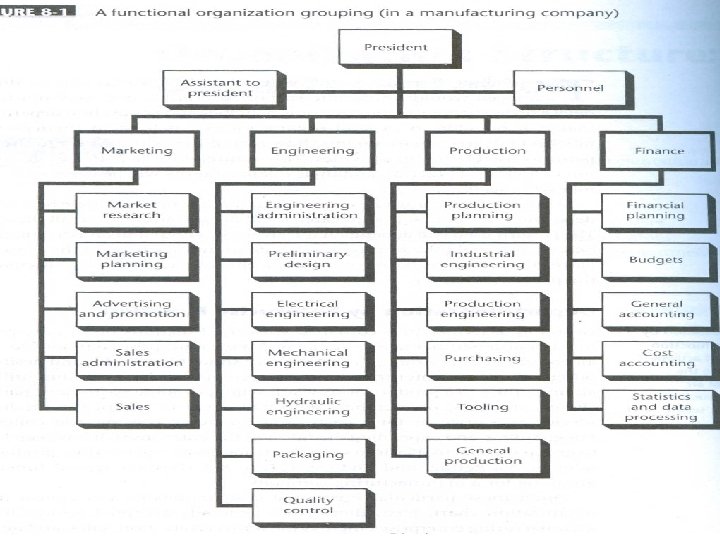
1. Departmentation by functions • Grouping of activities according to the functions of an enterprise, such as production, selling and financing • But many organisation even without the above functions can be divided based on other functions • This provides for coordination among various aspects of the organisation 13
14
Advantages • It is a simple form of grouping activities • Provides for excellence in performance through occupational specialization • Maintains power and prestige of major functions • Leads to improved planning and control of key functions • Simplifies training to various functions 15
Drawbacks It is difficult to relate one’s own task to whole task The overall development of the manager is not possible Unsuitable for very large companies spread over the globe Interpretations conflict with each manager as everyone describe in their own sense Narrows viewpoints of key personnel Slow adaptation to environmental change Difficult to judge the worth of each department 16
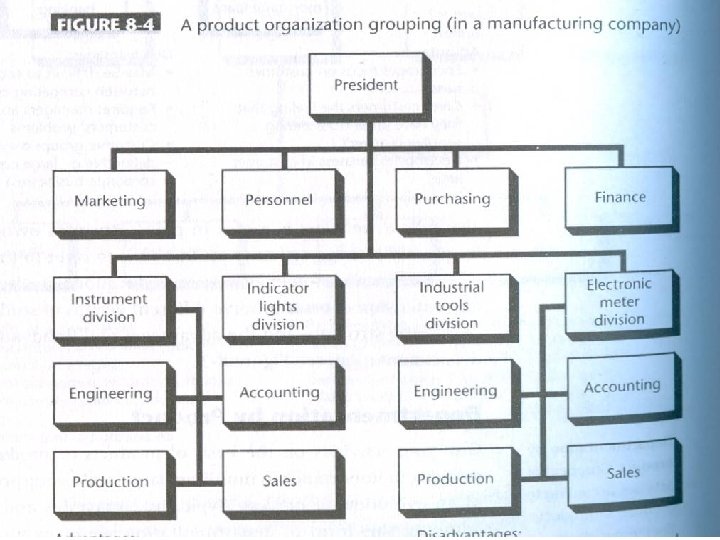
2. Departmentation by products Grouping activities based on products or product lines Suitable for large organizations This is evident when an organisation is diversified and each product need different raw materials, technology, marketing methods 17
18
Advantages Places attention to product lines Helps management to compare between the products and act accordingly Promotes excellence through specialization Relieves top management of operating task responsibility Places importance of profit at the functional level 19
Limitations • Need people with greater ability of handling • Results in duplication of staff and facilities • Under-utilization of facility in one product line while the other product line may be dearth of facilities • Increased expenditure 20
3. Departmentation by regions or territory • Most suitable for such organizations which are dispersed over the globe • Many government organisation prefer this type as they can provide similar and adoptive services to the regions 21
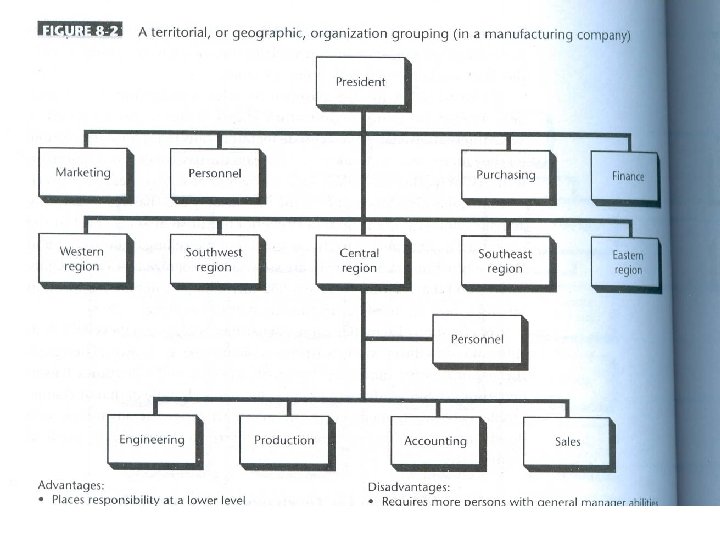
22
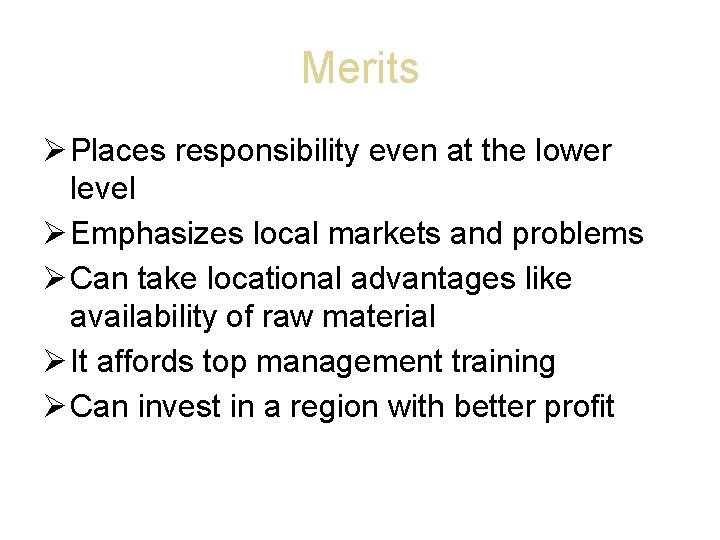
Merits Places responsibility even at the lower level Emphasizes local markets and problems Can take locational advantages like availability of raw material It affords top management training Can invest in a region with better profit 23
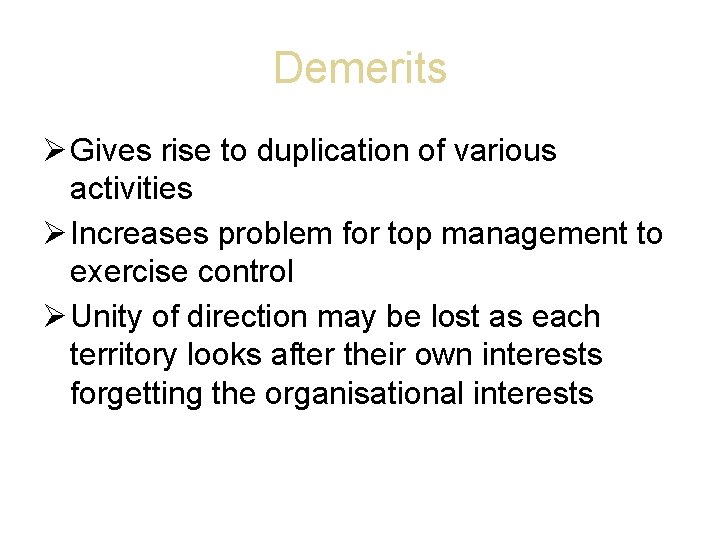
Demerits Gives rise to duplication of various activities Increases problem for top management to exercise control Unity of direction may be lost as each territory looks after their own interests forgetting the organisational interests 24
4. Departmentation by time One of the oldest method of departmentation Generally used at lower levels like shifts in working 25
Advantages Services will be rendered beyond 8 hour shift Continuing cycle processes can be used Better utilization of the equipment Encourages employees get higher degrees 26
Limitations Accidents will be carried from one shift to another that affects the product line Supervision may not be done properly in night shifts People tend to pass the work to next shift Difficult to measure the performance of a particular department May lead to communication problems if the previous shift’s worker has not conveyed the problem properly 27
5. Departmentation by process Departmentation done on the basis of some process or technologies involved This type of structure varies from organisation to organisation as the nature of industry changes Ex: Fruit industry, automobile industry, chemical industry Here the work will be done in one place due to specialised equipments 28
Merits and demerits Optimum utilization of machines Increases the efficiency of departments • Demerits are: If the process is sequential delay in one process affects the other Not easy to measure the performance of each process 29
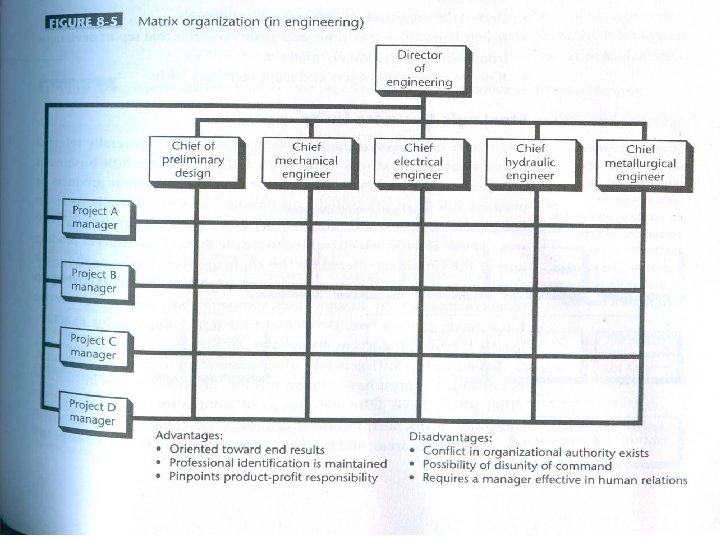
Matrix organization Also known as grid organisation It is the combination of functional and product patterns of departmentation Here the functional departments are permanent while the project departments are created as and when required The members of the project team will be chosen from functional departments and as soon as the project is completed they revert back to their original functional group 30
31
Benefits Improves communication and coordination Oriented towards end results Responsibility increases for each member as they become part of the project team This helps the employees’ self development 32
Drawbacks People know that their work in the project is temporary. Hence they may show less interest in projects Conflict in organisation authority exists Disunity of command may exist as project members will be under two superiors, one from functional group and the other in project group 33
Committees It is a group of people who have been formally assigned some task or some problem for their decision and implementation Committees can be broadly classified as Advisory and Executive committee Advisory committee is vested with only staff authority Advisory committee can only give advice and cannot enforce the implementation The executive committee is vested with line authority they not only take decisions but also enforce its implementation 34
Advantages Improves coordination as different people form a committee Helps people to share their knowledge and experience It is a way of training and developing the personnel 35
Drawbacks It is seen as a way of postponing the matter Members in the committee hesitate to take responsibility and involve themselves in it Very difficult to maintain secrecy As the chairman changes the responsibility will go to permanent secretary who may not get the same response from members Decisions are taken with compromise 36
Authority and power Authority is the right in a position to exercise discretion in making decisions affecting others Power is the ability of individuals or group to induce or influence the beliefs or actions of other persons or groups In line authority the superior exercises direct control over the subordinate But in staff authority one can only advice. A staff officer has authority ideas only. 37
Sources of authority 1. Classical view: According to this authority originates at the top and flows down to subordinates 2. Human relations view: According to this view, the authority of a superior depends on the willingness of the subordinates to accept it. A subordinate accepts the authority of superior because he feels that it is legitimate due to tradition, rationality, charisma – Max weber 38
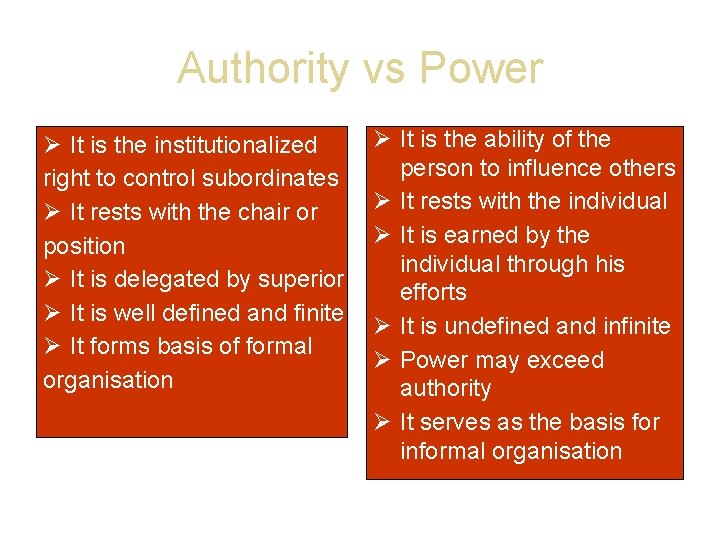
Authority vs Power It is the institutionalized right to control subordinates It rests with the chair or position It is delegated by superior It is well defined and finite It forms basis of formal organisation It is the ability of the person to influence others It rests with the individual It is earned by the individual through his efforts It is undefined and infinite Power may exceed authority It serves as the basis for informal organisation 39
Responsibility It is the obligation of a subordinate to obey the commands of superior It is two dimensions - for and to Responsibility for is the obligation of a subordinate to obey the commands of superior Responsibility to is the accountability to his superiors Responsibility cannot be delegated While the subordinate has operating responsibility, the superior has the ultimate responsibility 40
Decentralisation of authority It is the tendency to disperse decision making authority in an organised structure It is very important for the organisation to decide the amount of decision making authority in hands of different top officers In centralised set up few people take all decisions while in decentralised set up it gets delegated 41
Delegation vs Decentralisation Delegation is a process while Decentralisation is the end result In delegation the superior continues to be responsible for the delegated work while in Decentralisation, he is relieved from such responsibility Delegation is essential while Decentralisation is optional 42
Advantages of Decentralisation Reduces communication problem and redtapism Permits quick decision making Relieves top management of some burden Gives managers more autonomy Develops competition within organisation Ensures development of employees Provides for product diversification Provides for development of more managers Improves flexibility 43
Limitations of Decentralisation Difficult to have uniform policy Increases complexity of coordination May be limited due to non availability of managers Training expenses go up May result in loss of power by upper level managers 44
Advantages of centralisation Coordination is better Duplication of resources is avoided Decision is taken in the interest of entire organisation Crisis management is better 45
How much Decentralisation? While the total Decentralisation results in no coordination, total centralisation overburdens the top management The following situational factors are generally considered while determining the amount of Decentralisation 46
Factors affecting Decentralisation 1. 2. 3. 4. 5. 6. 7. 8. Size of the organisation. History and age of the organisation Philosophy of top management Abilities of lower level managers Strategy and organisation’s environment Nature of management function Available controls Significance of decisions 47
MBO It is the acronym for Management By Objectives which is a comprehensive management system that integrates many key managerial activities in a systematic manner and that is consciously directed towards effective and efficient achievement of organisational and individual objectives Peter Drucker originated this system It is a process which begins at the top of the organisation with the establishment of specific organisational objectives The process will follow the following steps The task to be accomplished by the manager The duration for accomplishment The metrics for measuring the progress 48 The above steps are repeated to achieve success
MBE Concept or policy by which management devotes its time to investigating only those situations in which actual results differ significantly from planned results. The idea is that management should spend its valuable time concentrating on the more important items (such as shaping the company's future strategic course). Attention is given only to material deviations requiring investigation. Employees work independently as long as until the limits are exceeded the tolerances or unforeseen events occur. It sets out objectives, values and standards. Furthermore, to select the criteria for success and sets the control information. Target and actual are constantly compared and 49 performed variance analysis.
Advantages and Disadvantages Benefits for the supervisors is the most extensive relief from routine tasks and low cost of control, because people make decisions independently within the areas of competence. Employees can act flexibly in their areas Drawbacks are: Flexibility of employees is called for unusual decisions on their superiors. Employees can generally do not improve their skills and may be underutilized. 50
Staffing It is the process of filling and keeping filled positions in an organisation It includes several sub-functions: Recruitment-getting applicants for the jobs as they open up Selection of the best qualified from those who seek the jobs Transfers and promotions Training to improve the effectiveness of the jobs 51
Nature of staffing Staffing is an important function of the management as this decides the jobs and persons This affects the next functions like leading and controlling Staffing requires an open system approach Factors like level of education, attitudes in society, Laws and regulations affect staffing 52
Importance of staffing It helps to obtain the talented pool It ensures improved productivity by matching people with job It helps to avoid disruption of work due to shortage of personnel It helps to prevent under-utilization of personnel or overburdening of human resource Provides information to management for internal succession in event of unanticipated turnover 53
Recruitment It is the process of attracting candidates to fill the positions in the organisation structure Recruitment can be done with many sources. They are: Re-employing former employees Friends and relatives of present employees Applicants at the gate College and technical institutions Employment exchange Advertisements Labour unions Consultants and private agencies 54
Internal recruitment This improves the security of employees Loyalty of employees increases Training cost is less Motivates the employees to perform better Employee turnover is reduced But this kind of recruitment may: Limit the choice of selection of best candidate Biasing of employees may be encouraged Unsuitable persons may get promoted Results in stagnation as this avoids new blood the organisation 55
External recruitment This kind of recruitment brings new blood the organisation which revitals the whole organisation Scope of choice becomes wide But this may result in: Increased turnover of employees Reduces the morale of employees Sense of security is lost Deteriorates the employee-employer relationship 56
Selection Choosing from among candidates, from within or outside the organisation, the most suitable person for a position While in recruitment the source of prospective candidates are found, in selection the qualification of such candidates are compared with the requirements of the job and screening will be done. 57
Steps in selection procedure 1. Application blank Here the applicants fill in the details in the application blank In this the candidate gives details about his qualification, specialization, experience, etc. 2. Initial interview of the candidate This is done to clarify the information already furnished in application blank and also to create a friendly environment for the candidates 58
3. Employment tests To test further abilities of the candidates, some tests are conducted in this step These tests can be Aptitude tests, technical tests, interest tests, performance test, personality test, intelligence test. These tests are conducted to test the traits, abilities, likes and dislikes, mental ability, adaptability, etc. 4. Checking reference If the candidate is found satisfactory, then it is very important to get his personal background, history, character, etc. For this the candidates friends, previous employer can be contacted 59
5. Physical or medical examination It is done to check the physical fitness of the candidates for the job. To prevent the unwarranted claims by the candidates To prevent communicable diseases entering the company 6. Final interview This is just an informal interview wherein the candidate will be intimated about his selection and briefed about his future prospects in the company 60
- Slides: 60