
Module 2 Leadership Chapter 4 How to Give

- Slides: 63
Module 2 – Leadership Chapter 4 – How to Give Instruction Section 1 – How to be an Effective Instructor
What You Will Learn to Do Demonstrate knowledge of the challenge of leadership, the qualities of an effective leader, how to evaluate the performance of subordinates and how to give instruction
Objectives 1. 2. 3. Describe what learning theory is 4. Explain how to prepare a lesson plan, the site where instruction will occur, and yourself as the instructor List the major factors that influence learning Describe the conditions that tend to hinder learning
Objectives 5. List the commonly used techniques for delivery of instruction 6. Describe the advantages and disadvantages of the lecture technique for presenting information
Key Terms CPS Key Term Questions 1 - 10
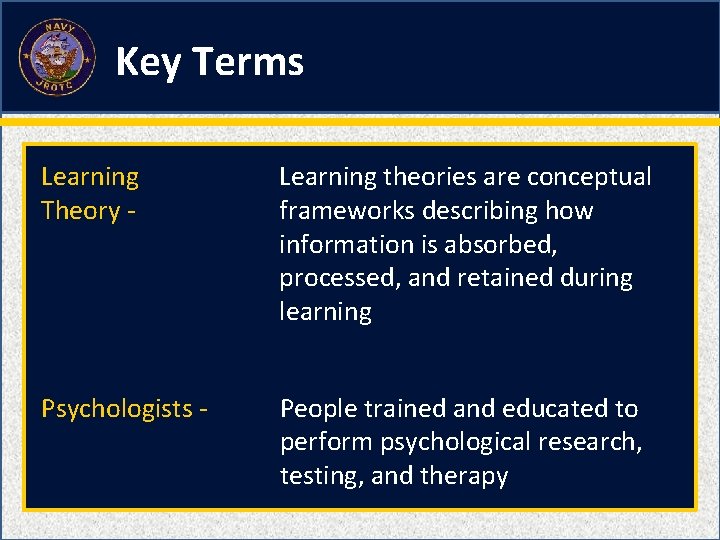
Key Terms Learning Theory - Learning theories are conceptual frameworks describing how information is absorbed, processed, and retained during learning Psychologists - People trained and educated to perform psychological research, testing, and therapy
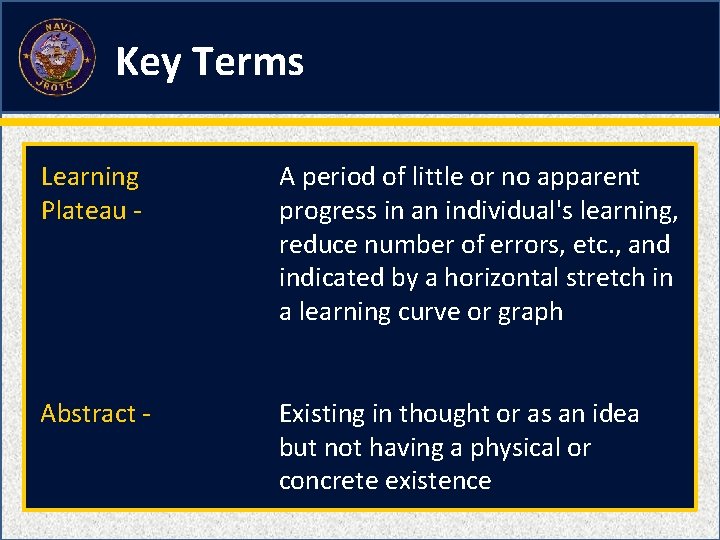
Key Terms Learning Plateau - A period of little or no apparent progress in an individual's learning, reduce number of errors, etc. , and indicated by a horizontal stretch in a learning curve or graph Abstract - Existing in thought or as an idea but not having a physical or concrete existence
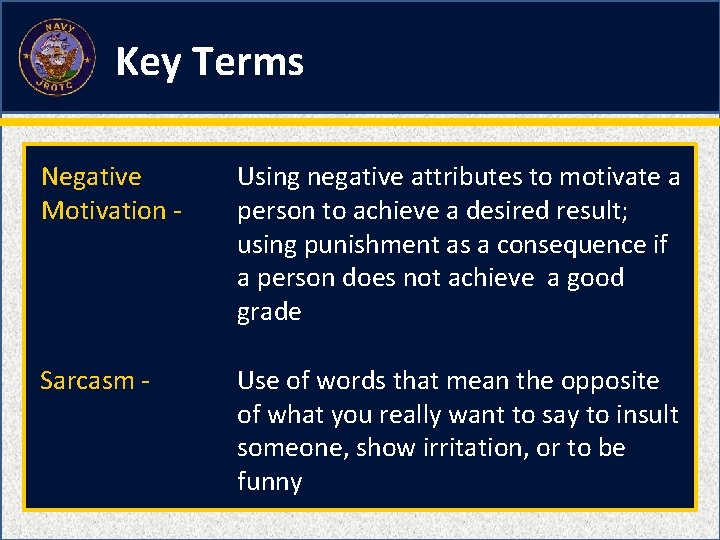
Key Terms Negative Motivation - Using negative attributes to motivate a person to achieve a desired result; using punishment as a consequence if a person does not achieve a good grade Sarcasm - Use of words that mean the opposite of what you really want to say to insult someone, show irritation, or to be funny
Key Terms Right Brain - The right hemisphere of the brain believed to be associated with creativity, music, color, images, motion, expression Left Brain - The left hemisphere of the brain believed to be associated with analytical thinking, decisionmaking, numbers, language
Key Terms Intimidation - The act instilling fear or threatening someone, usually in order to persuade the person to do something he or she does not wish to do Lesson Plan- The instructor’s road map of what students need to learn and how it will be done effectively during the class time
Opening Question Name and describe different types of learning. What method of learning do you utilize? (Use CPS “Pick a Student“ for this question. )
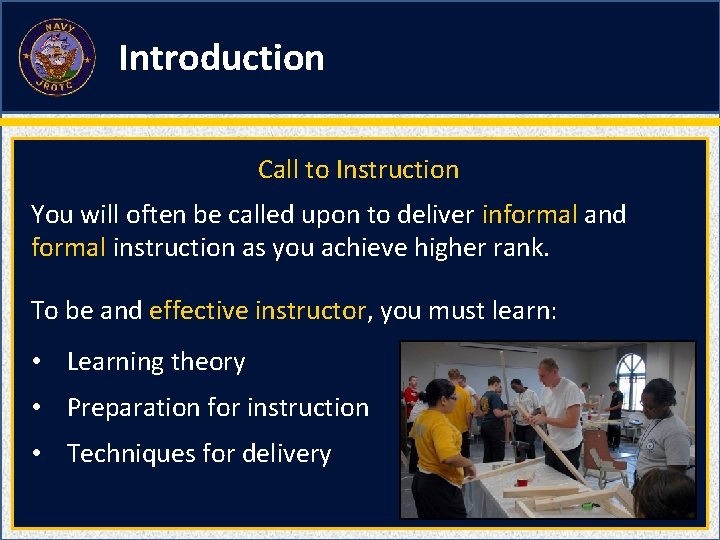
Introduction Call to Instruction You will often be called upon to deliver informal and formal instruction as you achieve higher rank. To be and effective instructor, you must learn: • Learning theory • Preparation for instruction • Techniques for delivery
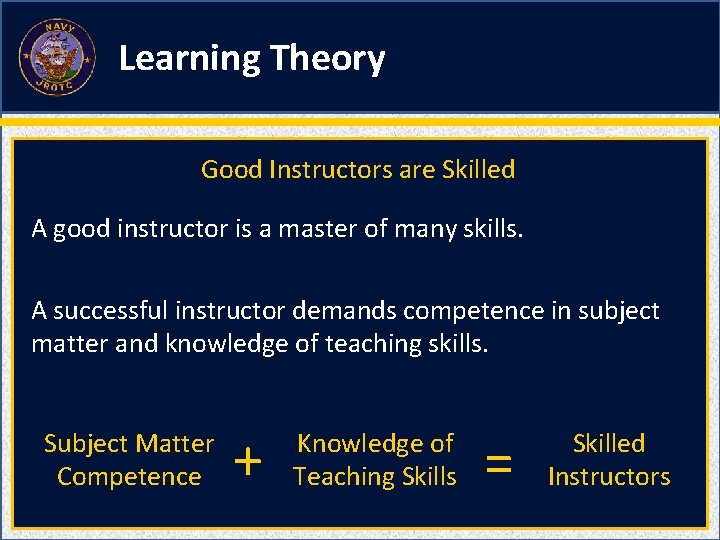
Learning Theory Good Instructors are Skilled A good instructor is a master of many skills. A successful instructor demands competence in subject matter and knowledge of teaching skills. Subject Matter Competence + Knowledge of Teaching Skills = Skilled Instructors
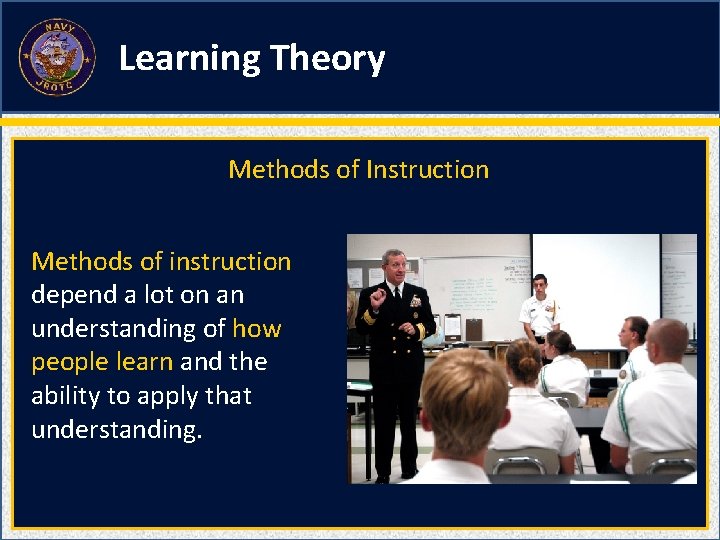
Learning Theory Methods of Instruction Methods of instruction depend a lot on an understanding of how people learn and the ability to apply that understanding.
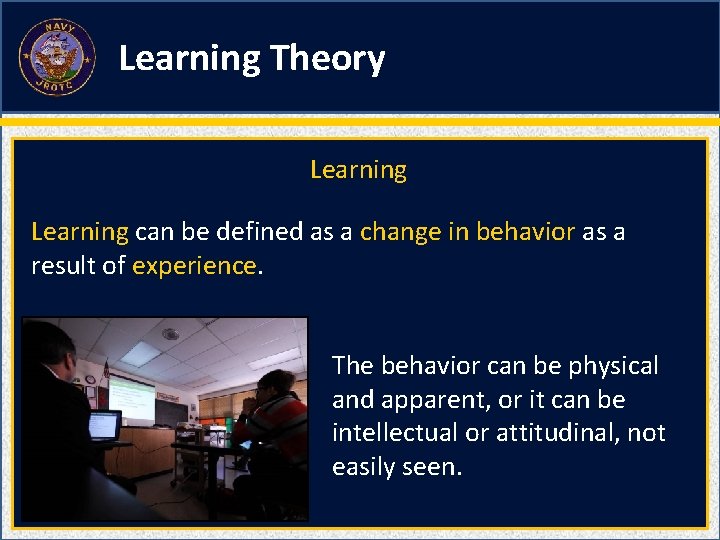
Learning Theory Learning can be defined as a change in behavior as a result of experience. The behavior can be physical and apparent, or it can be intellectual or attitudinal, not easily seen.
Learning Theory Perceptions and Responses Differ Each student sees the classroom situation differently. This is because: • He or she is a unique individual • Past experiences affect readiness to learn • Background affects understanding of the requirements involved Responses differ because each person acts in accordance with how he or she sees each situation.
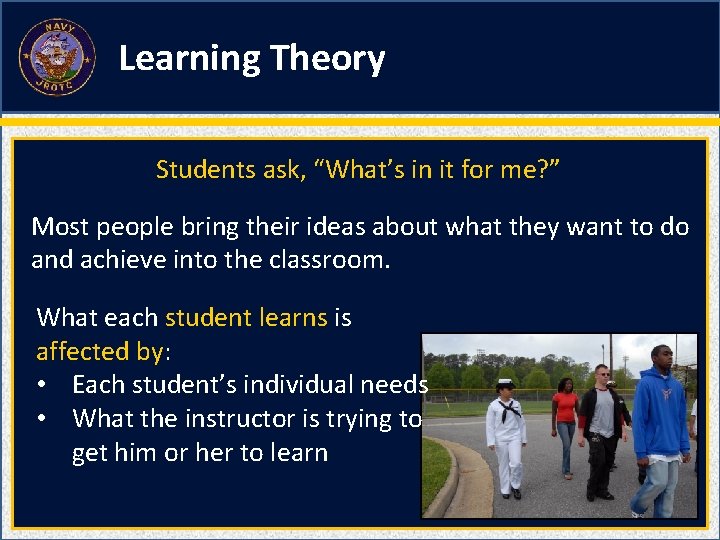
Learning Theory Students ask, “What’s in it for me? ” Most people bring their ideas about what they want to do and achieve into the classroom. What each student learns is affected by: • Each student’s individual needs • What the instructor is trying to get him or her to learn
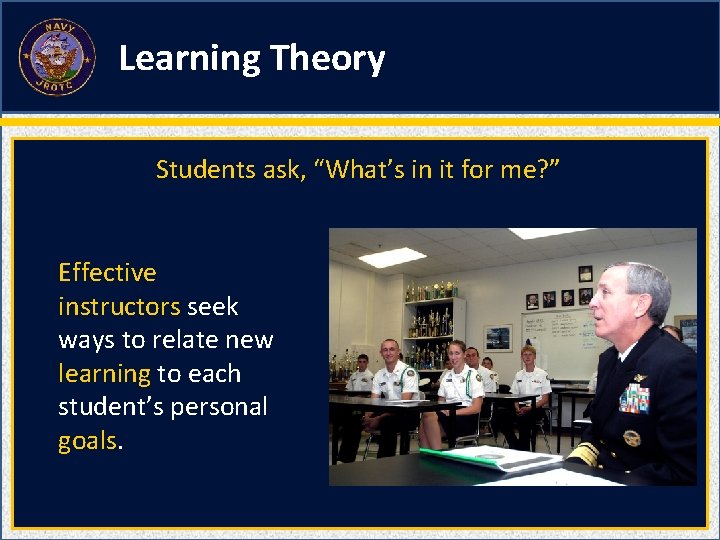
Learning Theory Students ask, “What’s in it for me? ” Effective instructors seek ways to relate new learning to each student’s personal goals.
Learning Theory Learning from Experience Learning is an individual process. The instructor cannot learn or put knowledge into the student’s head. Each student can learn only from that which is experienced.
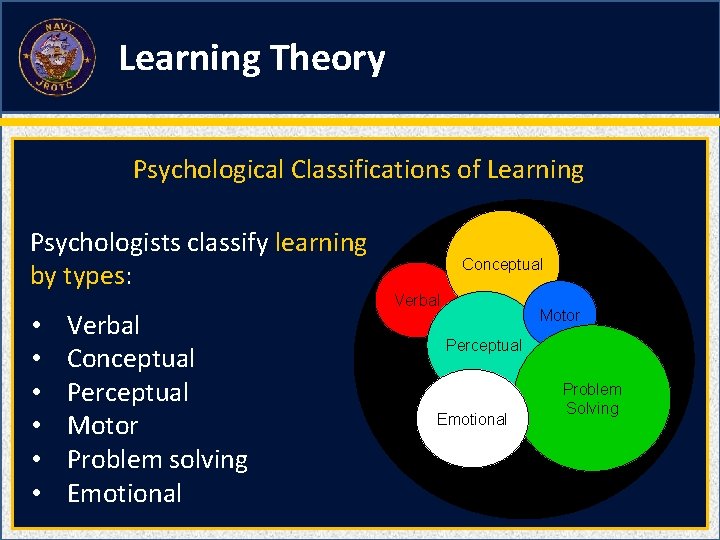
Learning Theory Psychological Classifications of Learning Psychologists classify learning by types: • • • Verbal Conceptual Perceptual Motor Problem solving Emotional Conceptual Verbal Motor Perceptual Emotional Problem Solving
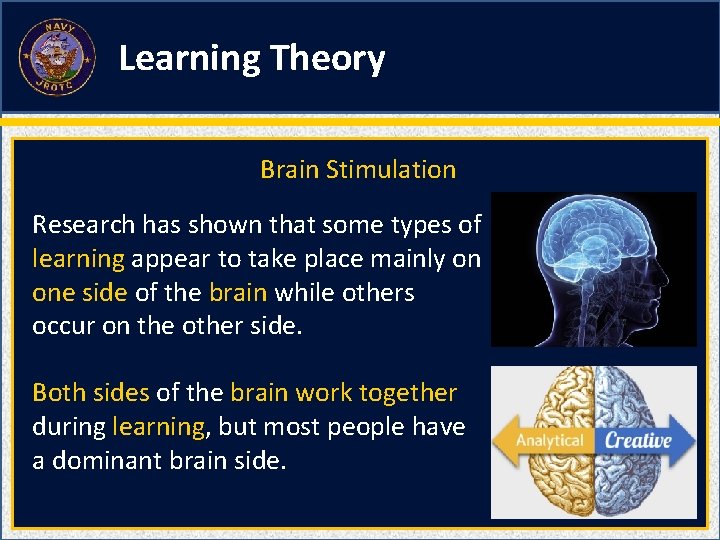
Learning Theory Brain Stimulation Research has shown that some types of learning appear to take place mainly on one side of the brain while others occur on the other side. Both sides of the brain work together during learning, but most people have a dominant brain side.
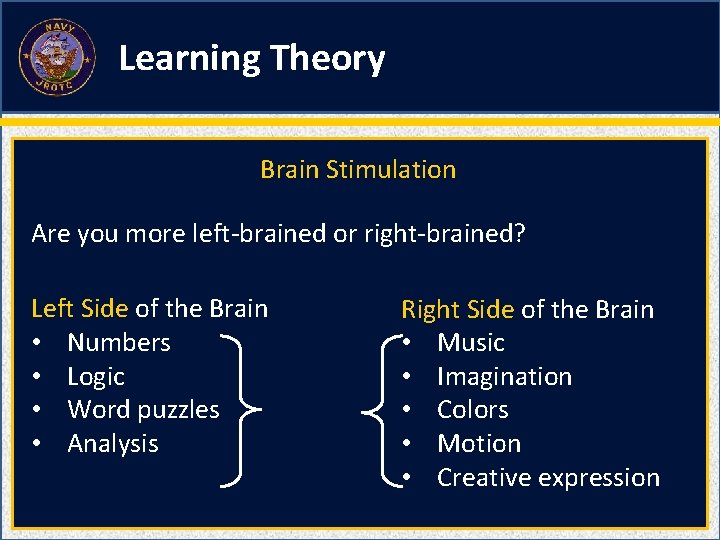
Learning Theory Brain Stimulation Are you more left-brained or right-brained? Left Side of the Brain • Numbers • Logic • Word puzzles • Analysis Right Side of the Brain • Music • Imagination • Colors • Motion • Creative expression
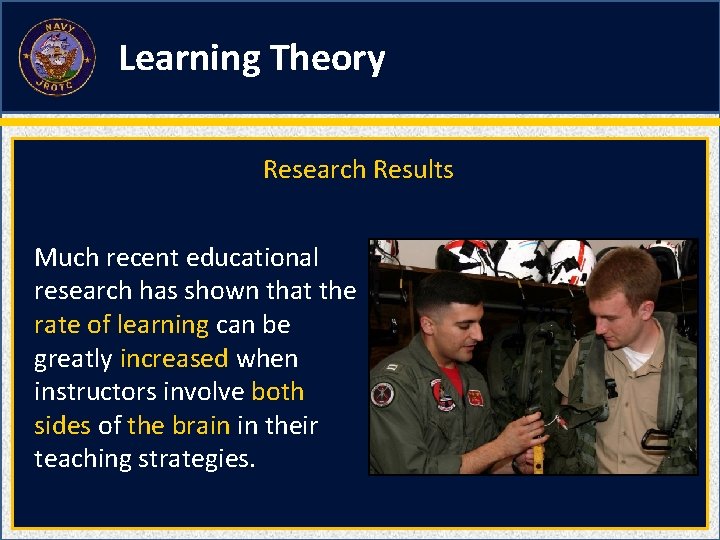
Learning Theory Research Results Much recent educational research has shown that the rate of learning can be greatly increased when instructors involve both sides of the brain in their teaching strategies.
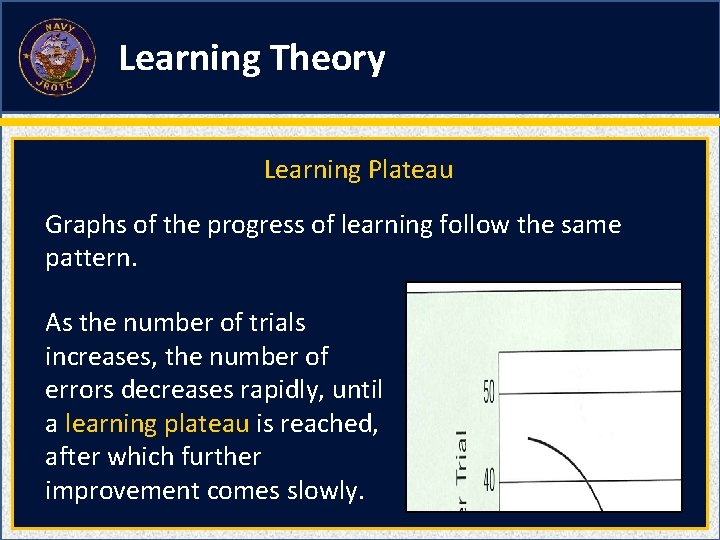
Learning Theory Learning Plateau Graphs of the progress of learning follow the same pattern. As the number of trials increases, the number of errors decreases rapidly, until a learning plateau is reached, after which further improvement comes slowly.
Learning Theory Point of Plateau Reaching a learning plateau or point of plateau signifies the learner may have: • Reached the limits of his or her capability • Consolidated the level of skill • Lost a measure of interest • Need for a different method
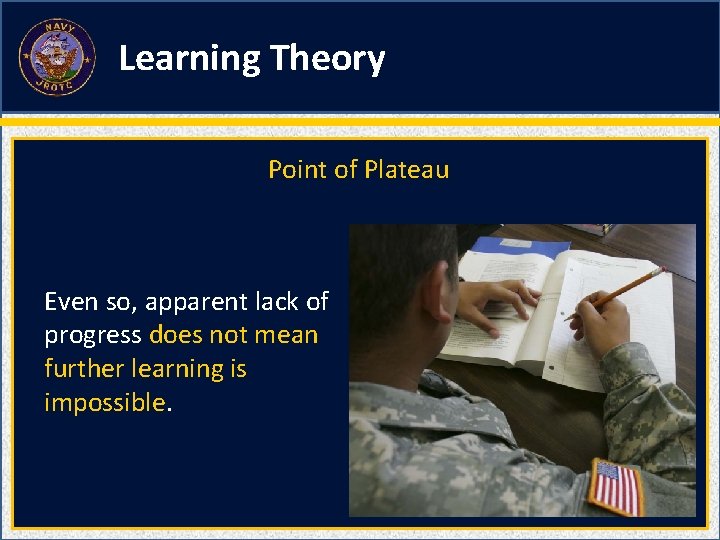
Learning Theory Point of Plateau Even so, apparent lack of progress does not mean further learning is impossible.
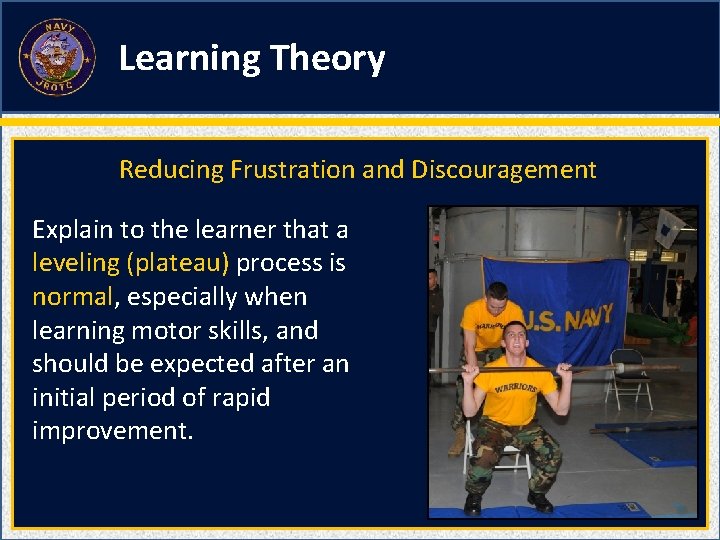
Learning Theory Reducing Frustration and Discouragement Explain to the learner that a leveling (plateau) process is normal, especially when learning motor skills, and should be expected after an initial period of rapid improvement.
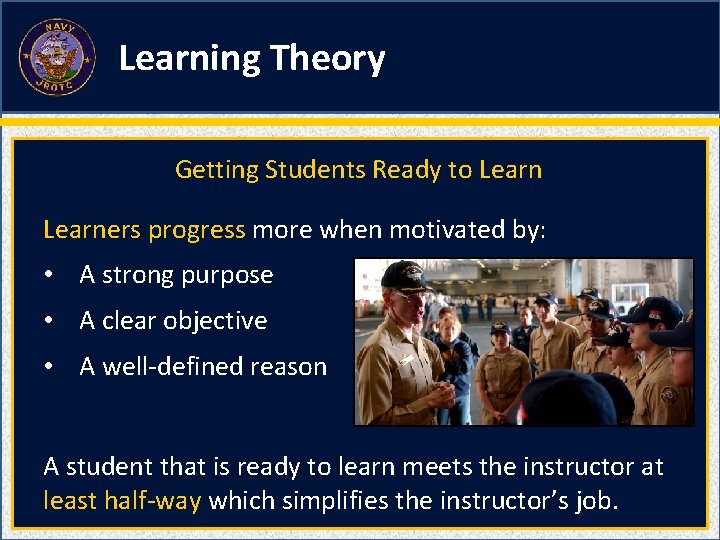
Learning Theory Getting Students Ready to Learners progress more when motivated by: • A strong purpose • A clear objective • A well-defined reason A student that is ready to learn meets the instructor at least half-way which simplifies the instructor’s job.
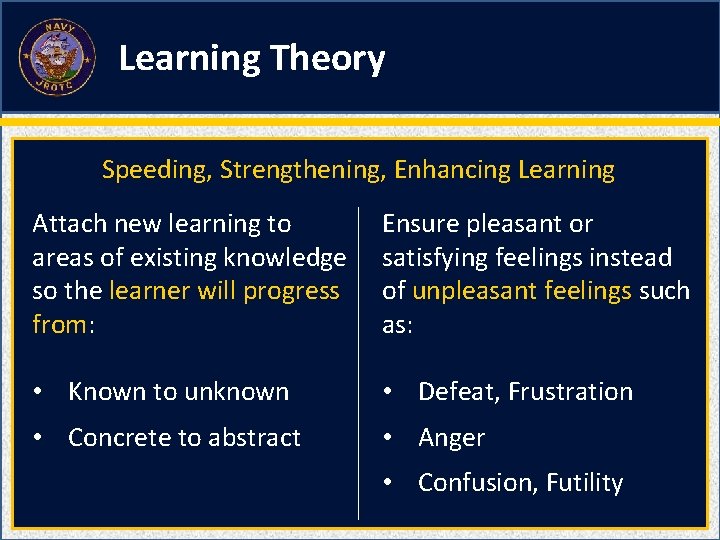
Learning Theory Speeding, Strengthening, Enhancing Learning Attach new learning to areas of existing knowledge so the learner will progress from: Ensure pleasant or satisfying feelings instead of unpleasant feelings such as: • Known to unknown • Defeat, Frustration • Concrete to abstract • Anger • Confusion, Futility
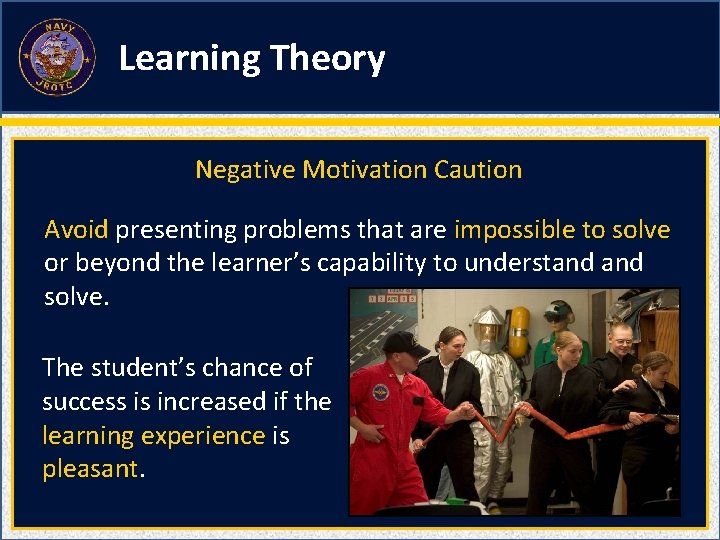
Learning Theory Negative Motivation Caution Avoid presenting problems that are impossible to solve or beyond the learner’s capability to understand solve. The student’s chance of success is increased if the learning experience is pleasant.
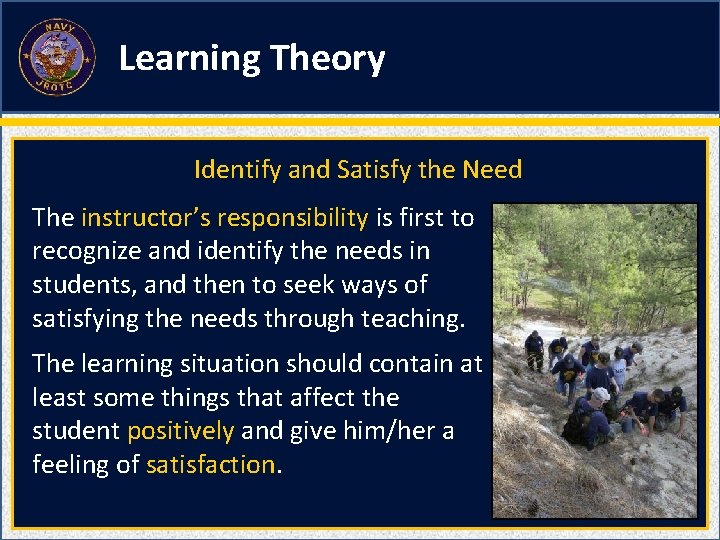
Learning Theory Identify and Satisfy the Need The instructor’s responsibility is first to recognize and identify the needs in students, and then to seek ways of satisfying the needs through teaching. The learning situation should contain at least some things that affect the student positively and give him/her a feeling of satisfaction.
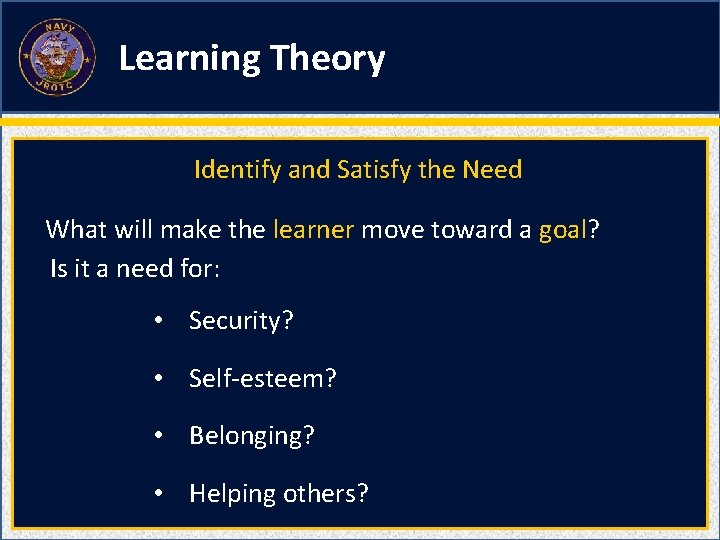
Learning Theory Identify and Satisfy the Need What will make the learner move toward a goal? Is it a need for: • Security? • Self-esteem? • Belonging? • Helping others?
Check On Learning Questions CPS Lesson Questions 3 -4
Learning Theory Nine Major Factors that Influence Learning There are nine major factors that influence learning: 1. New learning takes place in the context of past personal experience. 2. Learning is dependent upon motivation. 3. Learning is reinforced through personal exercise.
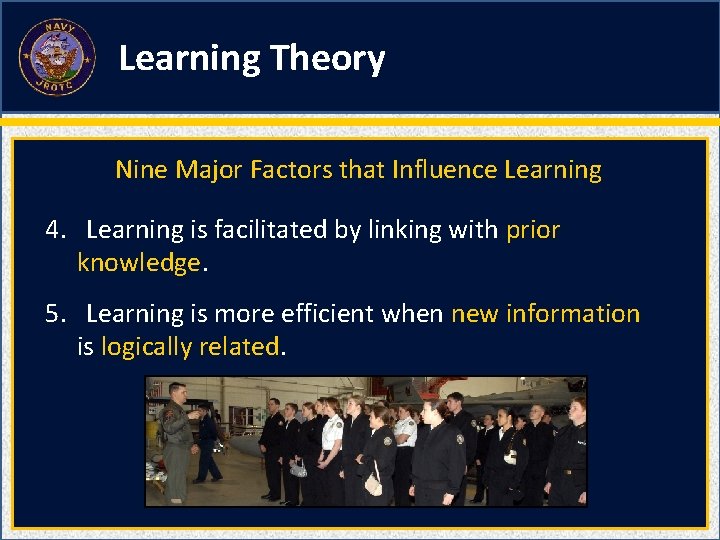
Learning Theory Nine Major Factors that Influence Learning 4. Learning is facilitated by linking with prior knowledge. 5. Learning is more efficient when new information is logically related.
Learning Theory Nine Major Factors that Influence Learning 6. Learning is enhanced by providing time for reflection. 7. Learning is enhanced by sensory and emotional involvement. 8. Learning occurs best in an environment that enables more than one kind of learning. 9. Learning requires repetition.
Interpersonal Interactions Instructor-Student Interactions Learners must feel secure, accepted, and capable of success for them to: • Pay attention • Actively participate • Participate responsibly
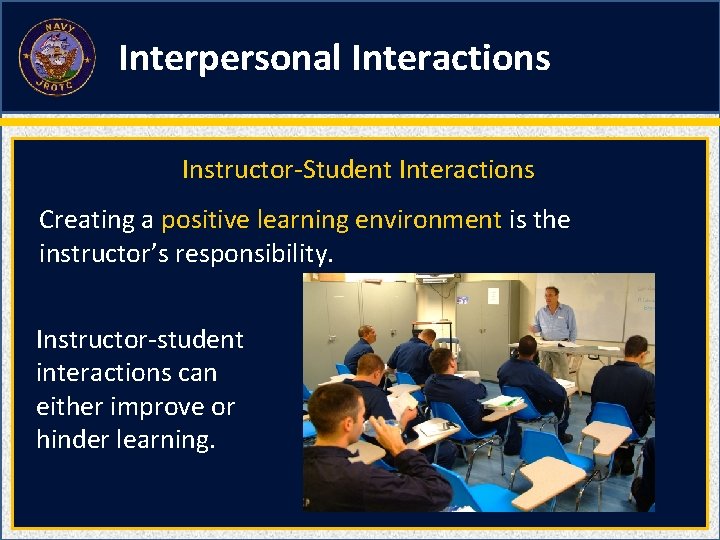
Interpersonal Interactions Instructor-Student Interactions Creating a positive learning environment is the instructor’s responsibility. Instructor-student interactions can either improve or hinder learning.
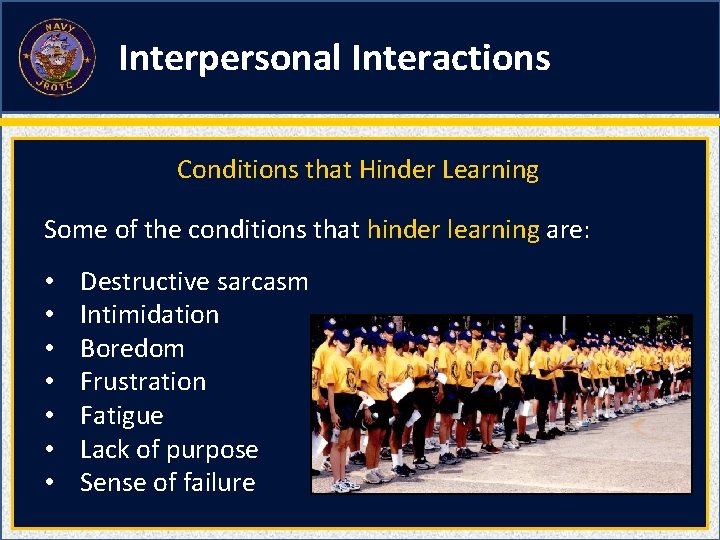
Interpersonal Interactions Conditions that Hinder Learning Some of the conditions that hinder learning are: • • Destructive sarcasm Intimidation Boredom Frustration Fatigue Lack of purpose Sense of failure
Interpersonal Interactions Error and Failure Differ Instructors must understand appreciate the fact that every classroom interaction is a potential teachable moment, which includes learning from errors. Errors can help students learn, but failures cannot.
Preparation for Instruction Prepare for Presentation Every instructor, no matter how competent or experienced, needs to prepare before giving a presentation. Adequate preparation is a must for efficient and effective instruction.
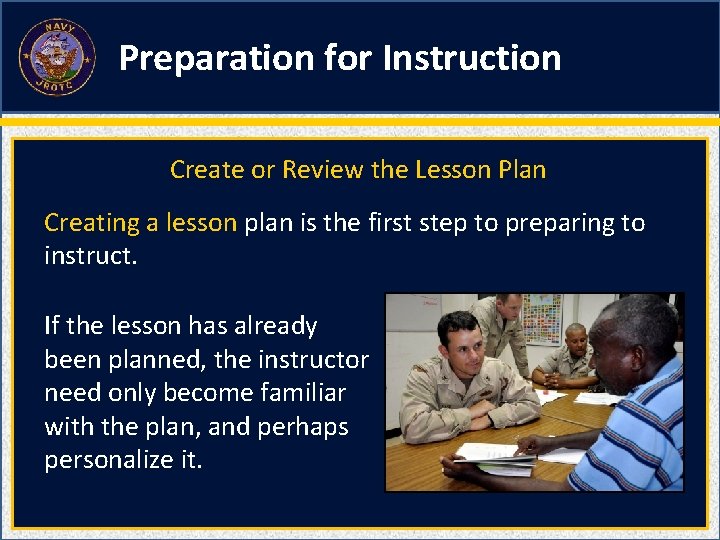
Preparation for Instruction Create or Review the Lesson Plan Creating a lesson plan is the first step to preparing to instruct. If the lesson has already been planned, the instructor need only become familiar with the plan, and perhaps personalize it.
Preparation for Instruction Format of a Lesson Plan (Part 1 of 2) For every lesson plan, ask yourself the following questions: • What is the intended objective or outcome? • Who is the intended audience? • What training aids/equipment are needed? • What technique for instruction will be used?
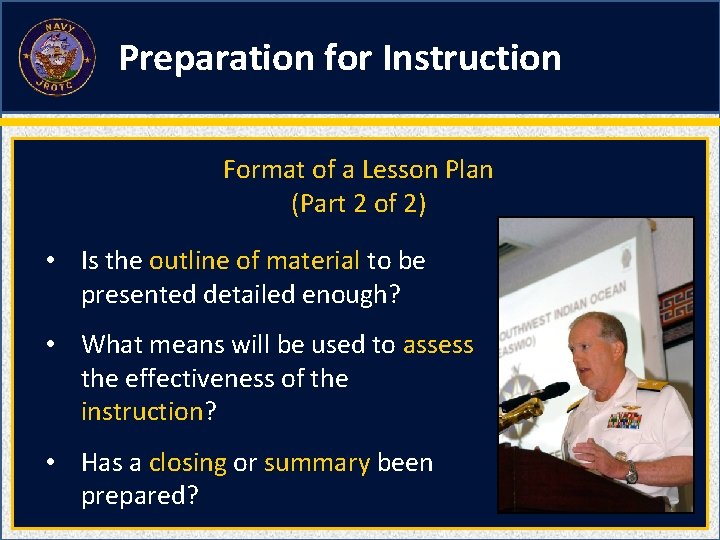
Preparation for Instruction Format of a Lesson Plan (Part 2 of 2) • Is the outline of material to be presented detailed enough? • What means will be used to assess the effectiveness of the instruction? • Has a closing or summary been prepared?
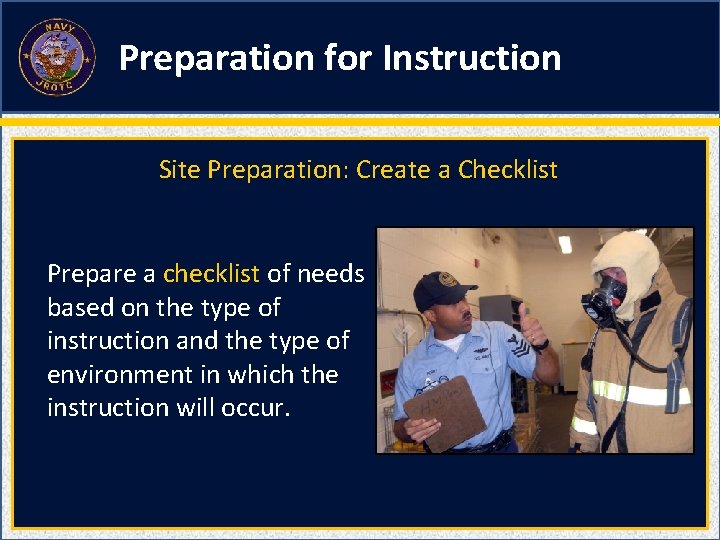
Preparation for Instruction Site Preparation: Create a Checklist Prepare a checklist of needs based on the type of instruction and the type of environment in which the instruction will occur.
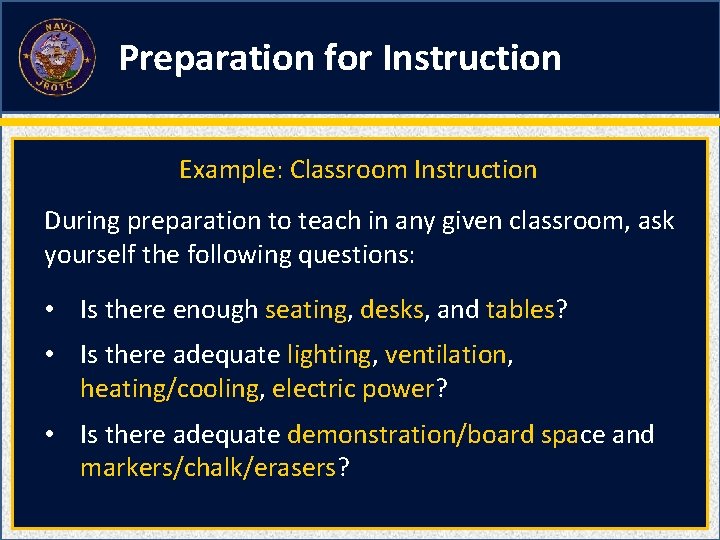
Preparation for Instruction Example: Classroom Instruction During preparation to teach in any given classroom, ask yourself the following questions: • Is there enough seating, desks, and tables? • Is there adequate lighting, ventilation, heating/cooling, electric power? • Is there adequate demonstration/board space and markers/chalk/erasers?
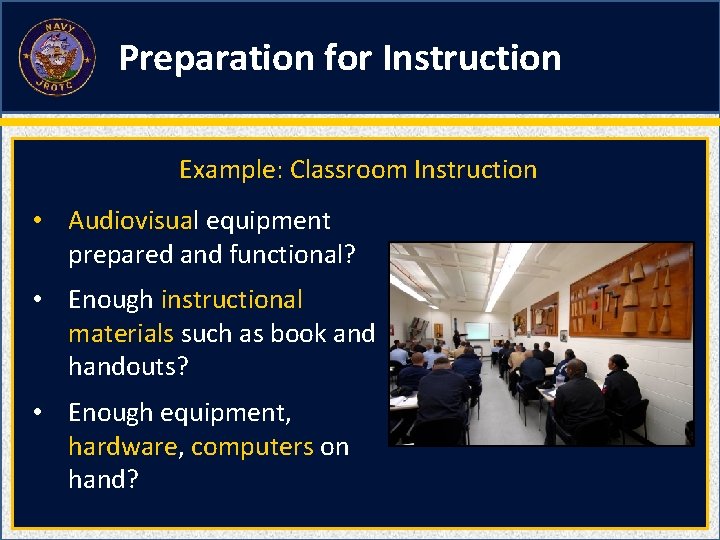
Preparation for Instruction Example: Classroom Instruction • Audiovisual equipment prepared and functional? • Enough instructional materials such as book and handouts? • Enough equipment, hardware, computers on hand?
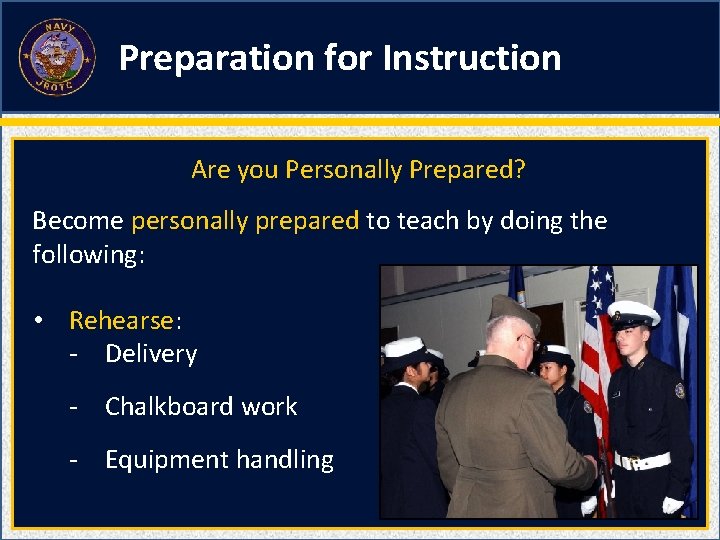
Preparation for Instruction Are you Personally Prepared? Become personally prepared to teach by doing the following: • Rehearse: - Delivery - Chalkboard work - Equipment handling
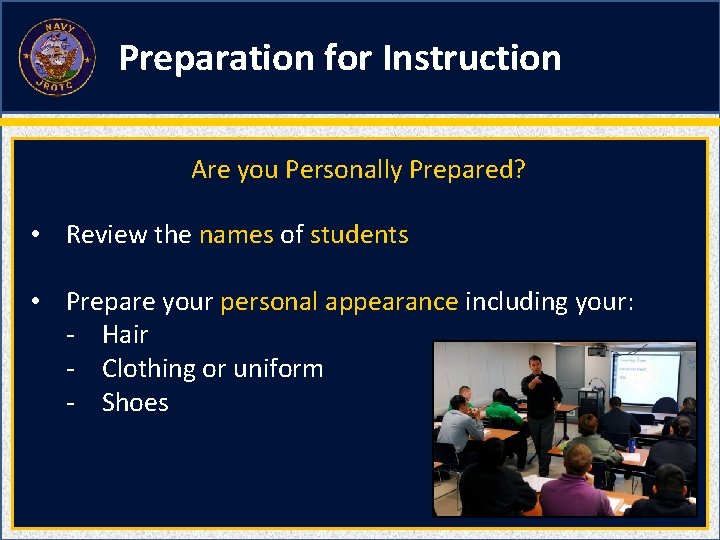
Preparation for Instruction Are you Personally Prepared? • Review the names of students • Prepare your personal appearance including your: - Hair - Clothing or uniform - Shoes
Check On Learning Questions CPS Lesson Questions 5 -6
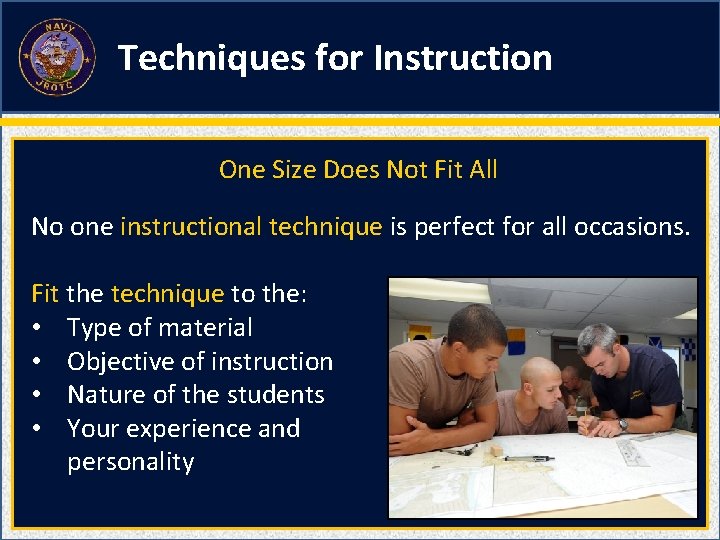
Techniques for Instruction One Size Does Not Fit All No one instructional technique is perfect for all occasions. Fit the technique to the: • Type of material • Objective of instruction • Nature of the students • Your experience and personality
Techniques for Instruction Main Methods of Instruction Here is a list of the main methods of instruction: • Lecture with audiovisual aids • Demonstration • • Role playing Case study Discussion Cooperative learning For each method of instruction there advantages, disadvantages and prescribed methods.
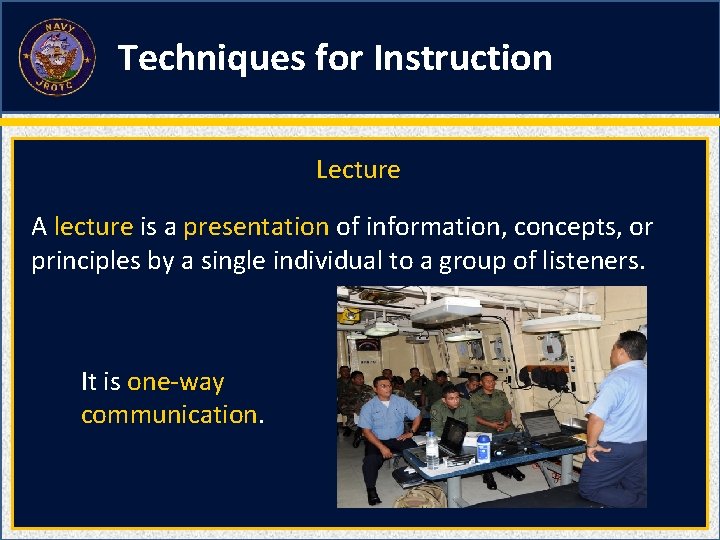
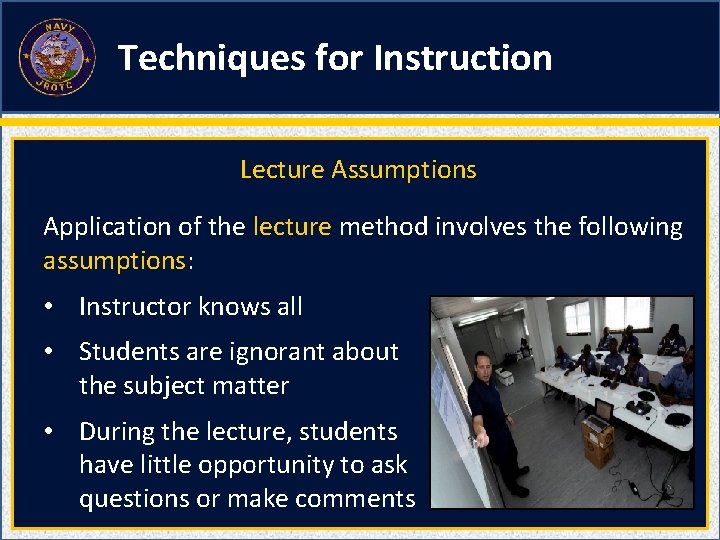
Techniques for Instruction Lecture A lecture is a presentation of information, concepts, or principles by a single individual to a group of listeners. It is one-way communication.
Techniques for Instruction Lecture Assumptions Application of the lecture method involves the following assumptions: • Instructor knows all • Students are ignorant about the subject matter • During the lecture, students have little opportunity to ask questions or make comments
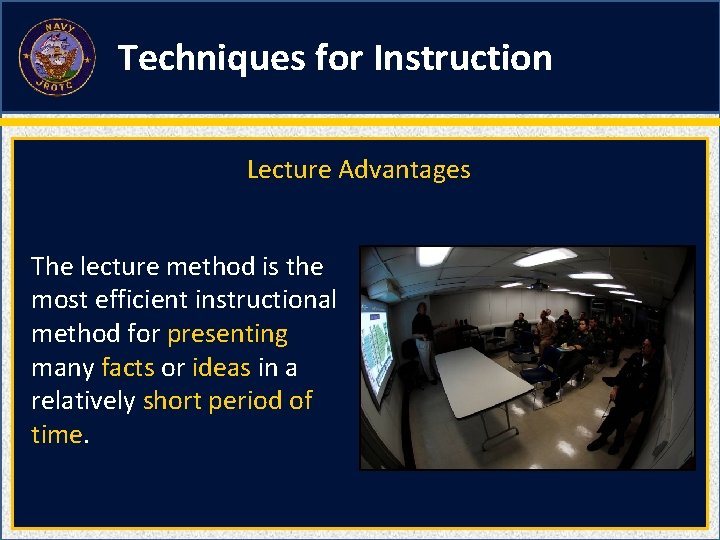
Techniques for Instruction Lecture Advantages The lecture method is the most efficient instructional method for presenting many facts or ideas in a relatively short period of time.
Techniques for Instruction Lecture Advantages Lectures are especially good for: • Introducing a subject • Ensuring all have the necessary background information • Giving direction and purpose to a demonstration • Preparing students for discussion • Delivering information when there are many students
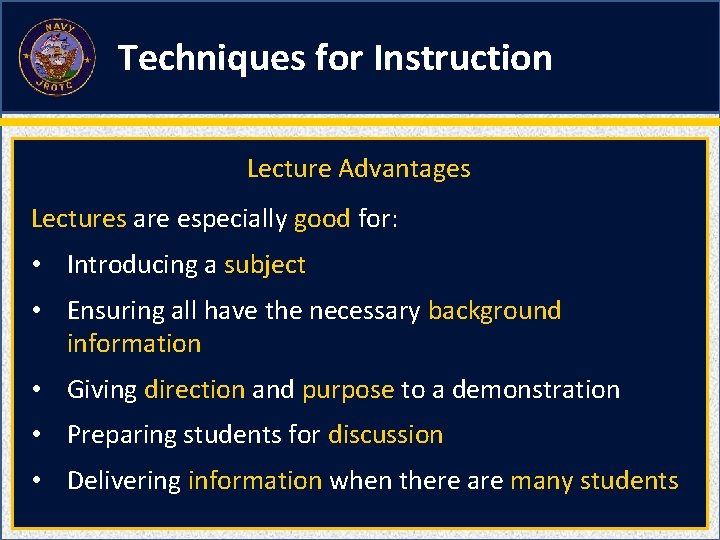
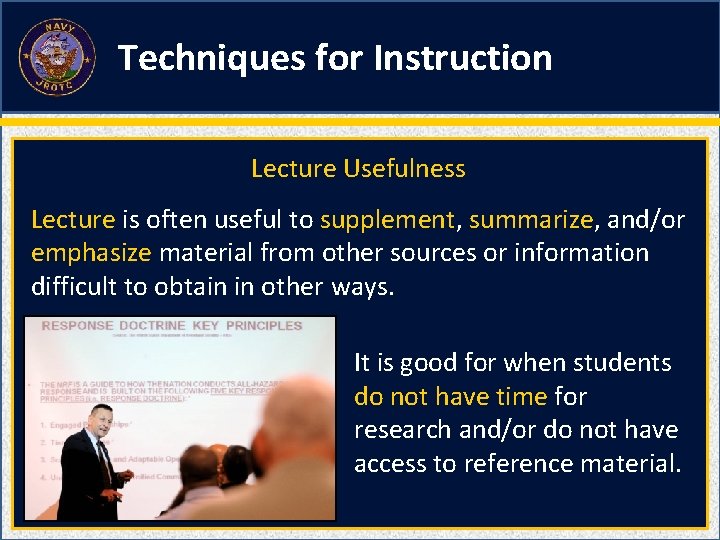
Techniques for Instruction Lecture Usefulness Lecture is often useful to supplement, summarize, and/or emphasize material from other sources or information difficult to obtain in other ways. It is good for when students do not have time for research and/or do not have access to reference material.
Techniques for Instruction Lecture Disadvantages There are disadvantages to use of the lecture method, including. . . • Too many lectures or long lectures without questioning students can cause boredom • Lectures promote student passiveness • Possibility of restating or repeating what the learner already knows from reading a textbook
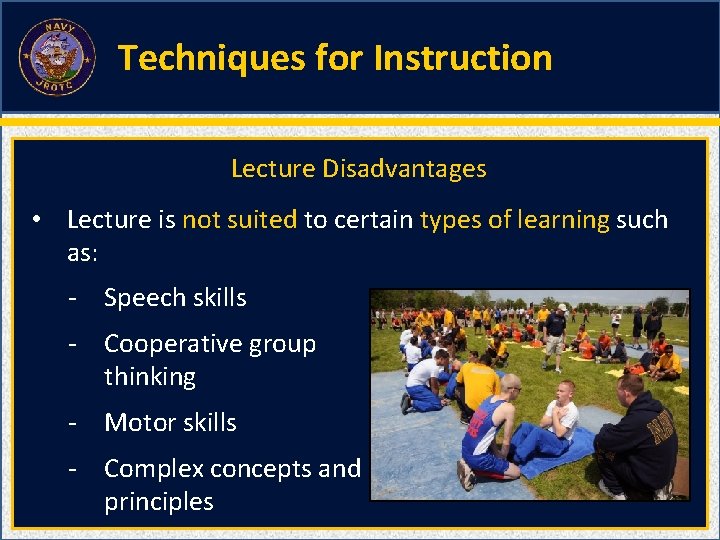
Techniques for Instruction Lecture Disadvantages • Lecture is not suited to certain types of learning such as: - Speech skills - Cooperative group thinking - Motor skills - Complex concepts and principles
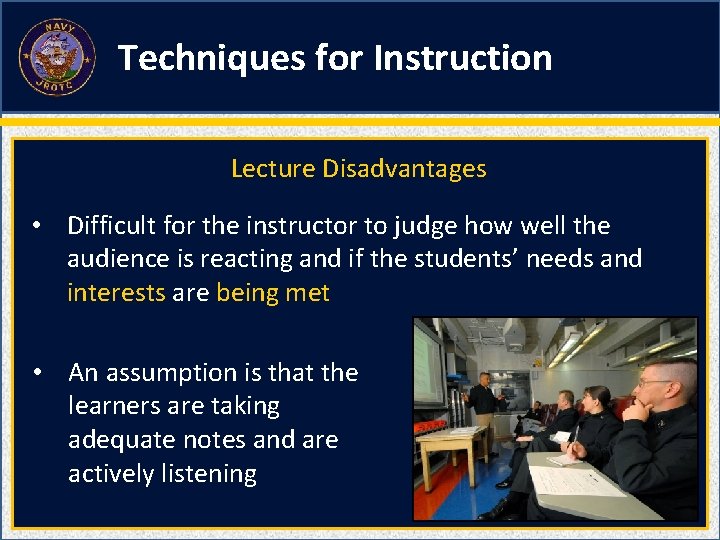
Techniques for Instruction Lecture Disadvantages • Difficult for the instructor to judge how well the audience is reacting and if the students’ needs and interests are being met • An assumption is that the learners are taking adequate notes and are actively listening
Review Question Discuss what makes a positive and productive learning environment or situation. (Use CPS “Pick a Student“ for this question. )
Closing Questions CPS Lesson Questions 7 -8
Questions?