
Module 2 Introduction to Welfare Assessment This lecture





- Slides: 27
Module 2 Introduction to Welfare Assessment This lecture was first developed for World Animal Protection by Dr David Main (University of Bristol) in 2003. It was revised by World Animal Protection scientific advisors in 2012 using updates provided by Dr Caroline Hewson. Free online resources To get free updates and additional materials, please go to www. animalmosaic. org/education/tertiary-education/ Module 2: Welfare Assessment and the Five Freedoms Concepts in Animal Welfare © World Animal Protection 2014. Unless stated otherwise, image credits are World Animal Protection.
This module will teach you The theory behind the Five Freedoms How they have influenced the development of modern assessment tools How to assess the animal’s experience in terms of welfare (inputs) and actual welfare performance (outcomes) Module 2: Welfare Assessment and the Five Freedoms Concepts in Animal Welfare © World Animal Protection 2014. Unless stated otherwise, image credits are World Animal Protection.
“How are you today? ” Module 2: Welfare Assessment and the Five Freedoms Concepts in Animal Welfare © World Animal Protection 2014. Unless stated otherwise, image credits are World Animal Protection.
Some aspects of your welfare Module 2: Welfare Assessment and the Five Freedoms Concepts in Animal Welfare © World Animal Protection 2014. Unless stated otherwise, image credits are World Animal Protection.
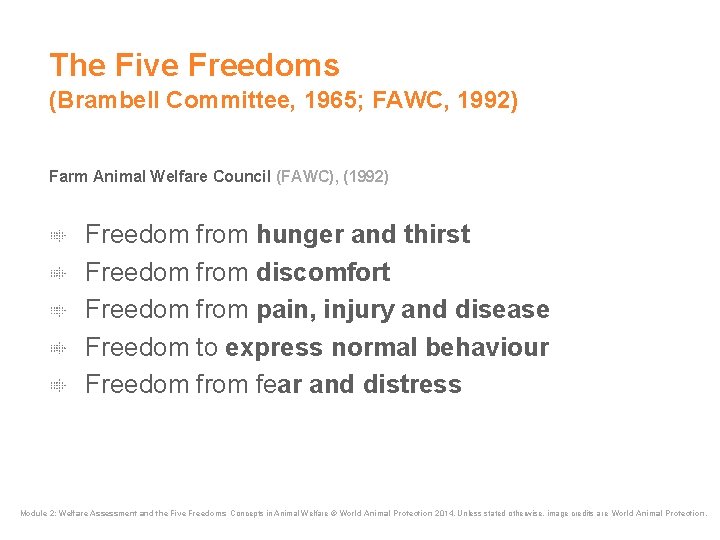
The Five Freedoms (Brambell Committee, 1965; FAWC, 1992) Farm Animal Welfare Council (FAWC), (1992) Freedom from hunger and thirst Freedom from discomfort Freedom from pain, injury and disease Freedom to express normal behaviour Freedom from fear and distress Module 2: Welfare Assessment and the Five Freedoms Concepts in Animal Welfare © World Animal Protection 2014. Unless stated otherwise, image credits are World Animal Protection.
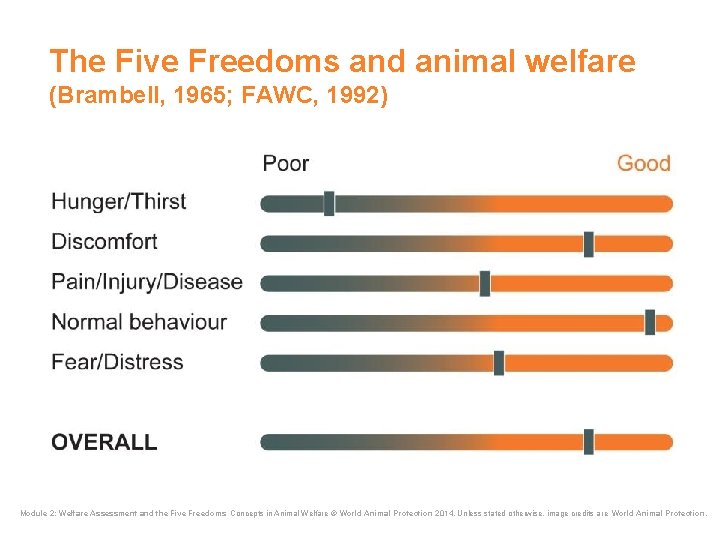
The Five Freedoms and animal welfare (Brambell, 1965; FAWC, 1992) Module 2: Welfare Assessment and the Five Freedoms Concepts in Animal Welfare © World Animal Protection 2014. Unless stated otherwise, image credits are World Animal Protection.
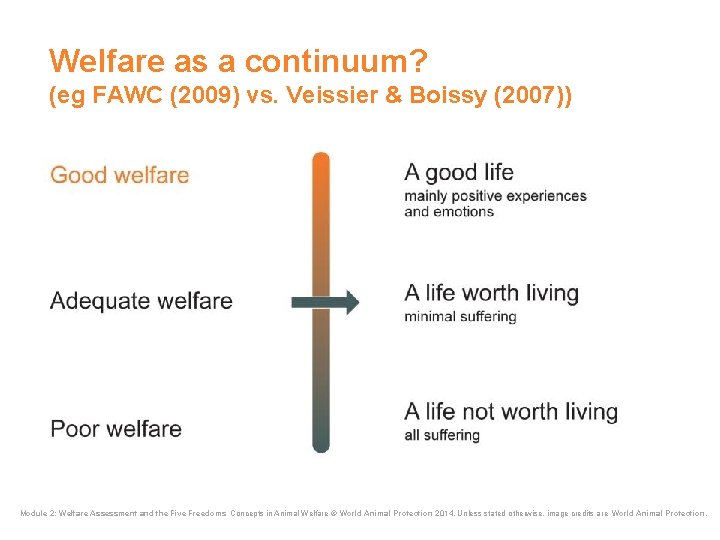
Welfare as a continuum? (eg FAWC (2009) vs. Veissier & Boissy (2007)) Module 2: Welfare Assessment and the Five Freedoms Concepts in Animal Welfare © World Animal Protection 2014. Unless stated otherwise, image credits are World Animal Protection.
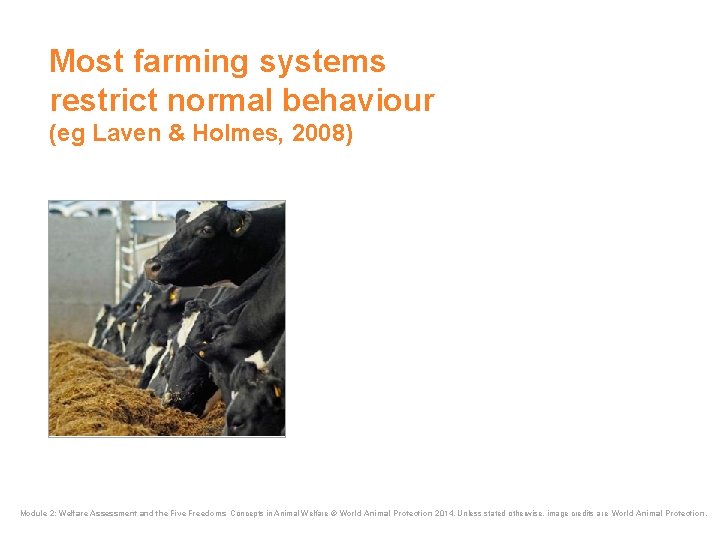
Most farming systems restrict normal behaviour (eg Laven & Holmes, 2008) Module 2: Welfare Assessment and the Five Freedoms Concepts in Animal Welfare © World Animal Protection 2014. Unless stated otherwise, image credits are World Animal Protection.
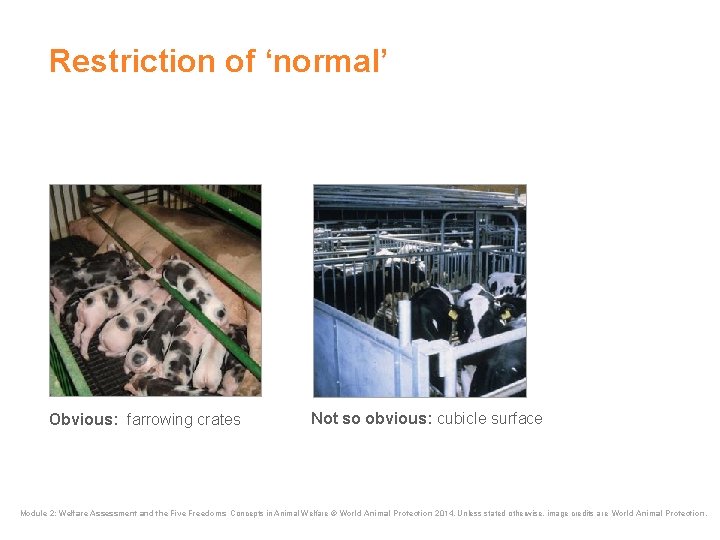
Restriction of ‘normal’ Obvious: farrowing crates Not so obvious: cubicle surface Module 2: Welfare Assessment and the Five Freedoms Concepts in Animal Welfare © World Animal Protection 2014. Unless stated otherwise, image credits are World Animal Protection.
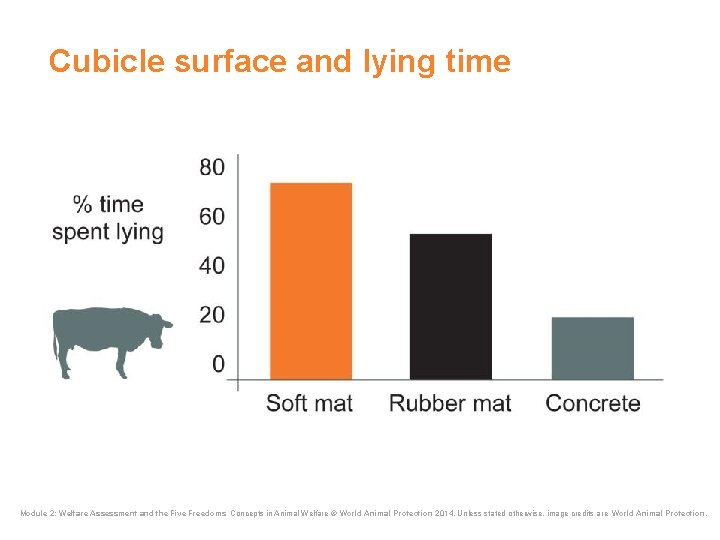
Cubicle surface and lying time Module 2: Welfare Assessment and the Five Freedoms Concepts in Animal Welfare © World Animal Protection 2014. Unless stated otherwise, image credits are World Animal Protection.
Problems with the Five Freedoms The Freedoms conflict Keeping animals ‘free from disease’ can cause them fear and distress, from handling during treatment If animals have ‘freedom to express normal behaviour’, they can suffer fear and distress during normal social interactions Emphasise avoiding negative experiences rather than promoting positive ones Module 2: Welfare Assessment and the Five Freedoms Concepts in Animal Welfare © World Animal Protection 2014. Unless stated otherwise, image credits are World Animal Protection.
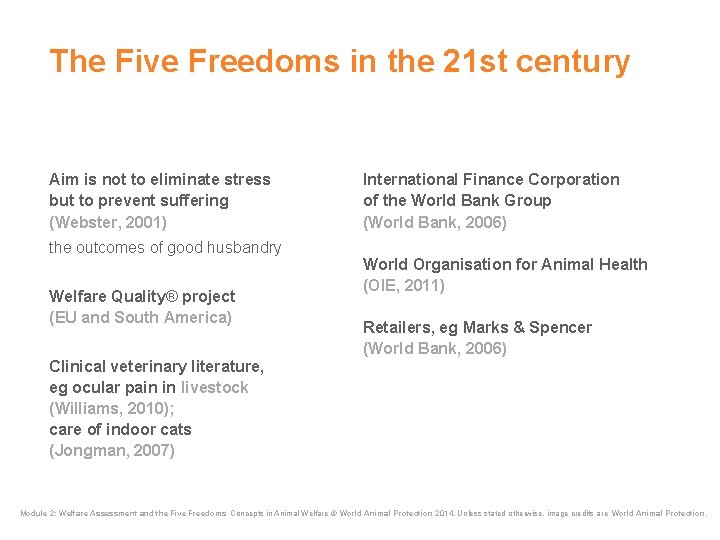
The Five Freedoms in the 21 st century Aim is not to eliminate stress but to prevent suffering (Webster, 2001) the outcomes of good husbandry Welfare Quality® project (EU and South America) Clinical veterinary literature, eg ocular pain in livestock (Williams, 2010); care of indoor cats (Jongman, 2007) International Finance Corporation of the World Bank Group (World Bank, 2006) World Organisation for Animal Health (OIE, 2011) Retailers, eg Marks & Spencer (World Bank, 2006) Module 2: Welfare Assessment and the Five Freedoms Concepts in Animal Welfare © World Animal Protection 2014. Unless stated otherwise, image credits are World Animal Protection.
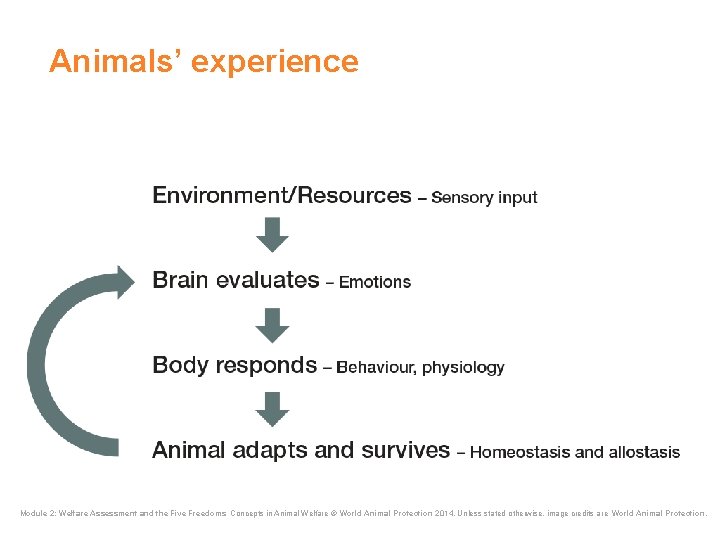
Animals’ experience Module 2: Welfare Assessment and the Five Freedoms Concepts in Animal Welfare © World Animal Protection 2014. Unless stated otherwise, image credits are World Animal Protection.
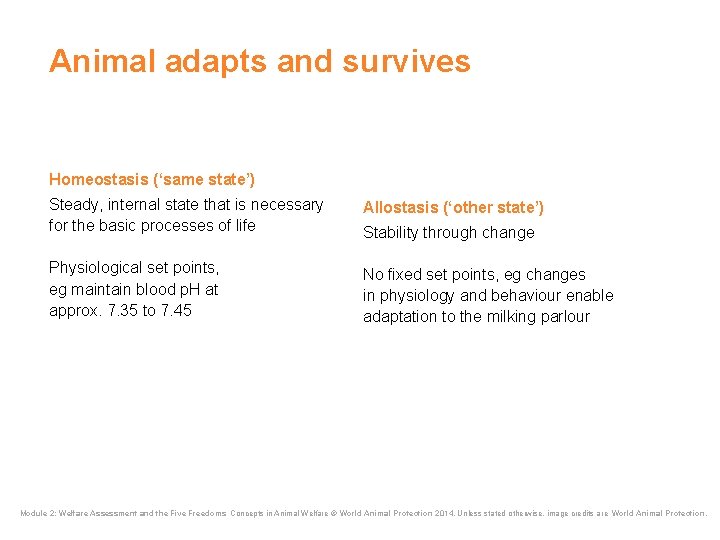
Animal adapts and survives Homeostasis (‘same state’) Steady, internal state that is necessary for the basic processes of life Allostasis (‘other state’) Physiological set points, eg maintain blood p. H at approx. 7. 35 to 7. 45 No fixed set points, eg changes in physiology and behaviour enable adaptation to the milking parlour Stability through change Module 2: Welfare Assessment and the Five Freedoms Concepts in Animal Welfare © World Animal Protection 2014. Unless stated otherwise, image credits are World Animal Protection.
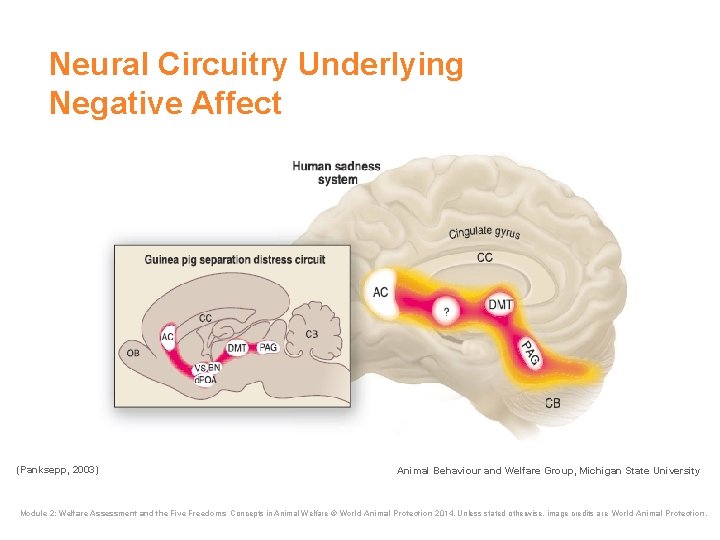
Neural Circuitry Underlying Negative Affect (Panksepp, 2003) Animal Behaviour and Welfare Group, Michigan State University Module 2: Welfare Assessment and the Five Freedoms Concepts in Animal Welfare © World Animal Protection 2014. Unless stated otherwise, image credits are World Animal Protection.
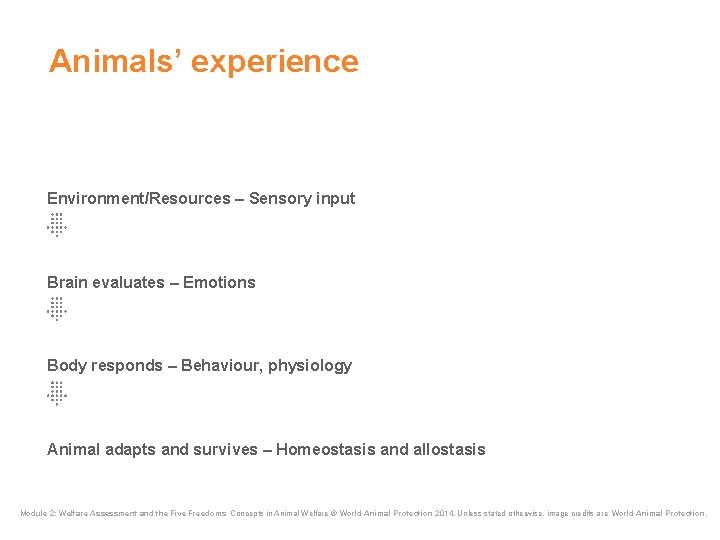
Animals’ experience Environment/Resources – Sensory input Brain evaluates – Emotions Body responds – Behaviour, physiology Animal adapts and survives – Homeostasis and allostasis Module 2: Welfare Assessment and the Five Freedoms Concepts in Animal Welfare © World Animal Protection 2014. Unless stated otherwise, image credits are World Animal Protection.
Animals’ experience Environment and resources create sensory input Brain evaluates sensory input (novelty, pleasantness etc. ), which results in daily, eg night/day, feeding, handling, urinating emotions, eg fear, pleasure, physical feelings, eg nausea, pain occasional, eg clinical examination, transport (disease) Body responds to feelings and emotions physiological and behavioural responses enables the animal to adapt and survive Module 2: Welfare Assessment and the Five Freedoms Concepts in Animal Welfare © World Animal Protection 2014. Unless stated otherwise, image credits are World Animal Protection.
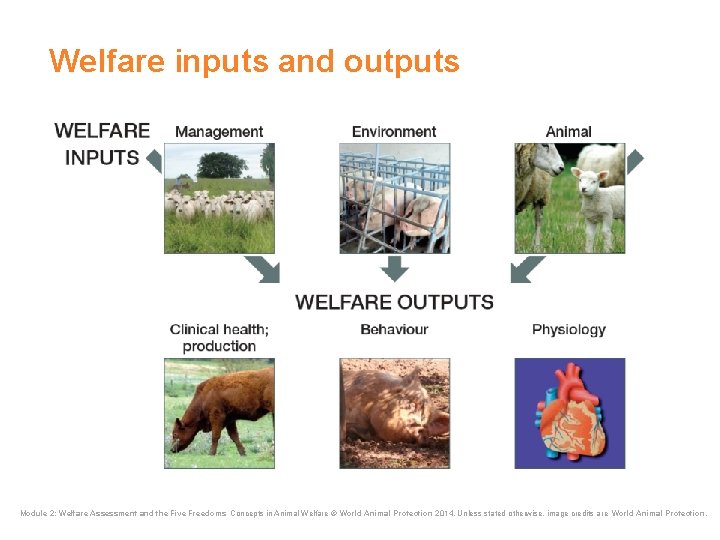
What to assess Measures of the environment and resources – ‘welfare inputs’ Measures of the animal’s responses – ‘welfare outputs’ Module 2: Welfare Assessment and the Five Freedoms Concepts in Animal Welfare © World Animal Protection 2014. Unless stated otherwise, image credits are World Animal Protection.
Welfare inputs and outputs Module 2: Welfare Assessment and the Five Freedoms Concepts in Animal Welfare © World Animal Protection 2014. Unless stated otherwise, image credits are World Animal Protection.
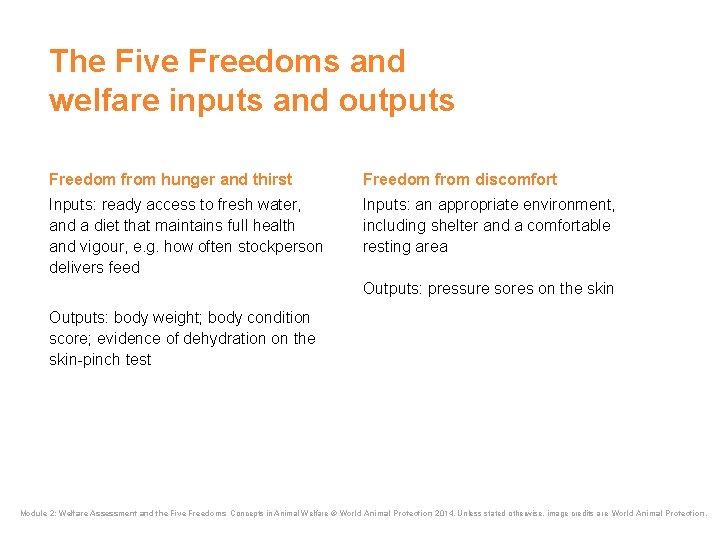
The Five Freedoms and welfare inputs and outputs Freedom from hunger and thirst Freedom from discomfort Inputs: ready access to fresh water, and a diet that maintains full health and vigour, e. g. how often stockperson delivers feed Inputs: an appropriate environment, including shelter and a comfortable resting area Outputs: pressure sores on the skin Outputs: body weight; body condition score; evidence of dehydration on the skin-pinch test Module 2: Welfare Assessment and the Five Freedoms Concepts in Animal Welfare © World Animal Protection 2014. Unless stated otherwise, image credits are World Animal Protection.
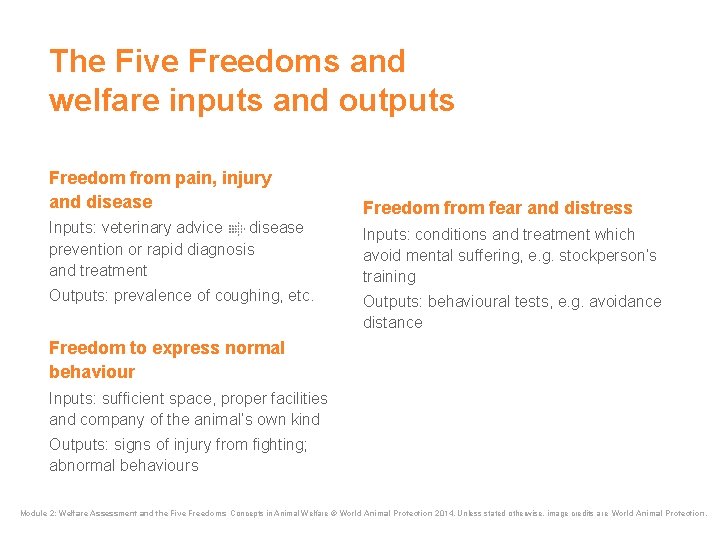
The Five Freedoms and welfare inputs and outputs Freedom from pain, injury and disease Freedom from fear and distress Inputs: veterinary advice disease prevention or rapid diagnosis and treatment Inputs: conditions and treatment which avoid mental suffering, e. g. stockperson’s training Outputs: prevalence of coughing, etc. Outputs: behavioural tests, e. g. avoidance distance Freedom to express normal behaviour Inputs: sufficient space, proper facilities and company of the animal’s own kind Outputs: signs of injury from fighting; abnormal behaviours Module 2: Welfare Assessment and the Five Freedoms Concepts in Animal Welfare © World Animal Protection 2014. Unless stated otherwise, image credits are World Animal Protection.
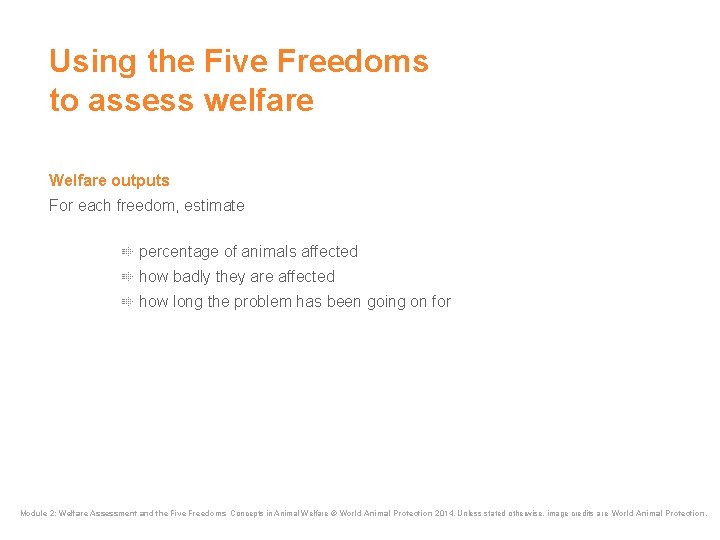
Using the Five Freedoms to assess welfare Welfare outputs For each freedom, estimate percentage of animals affected how badly they are affected how long the problem has been going on for Module 2: Welfare Assessment and the Five Freedoms Concepts in Animal Welfare © World Animal Protection 2014. Unless stated otherwise, image credits are World Animal Protection.
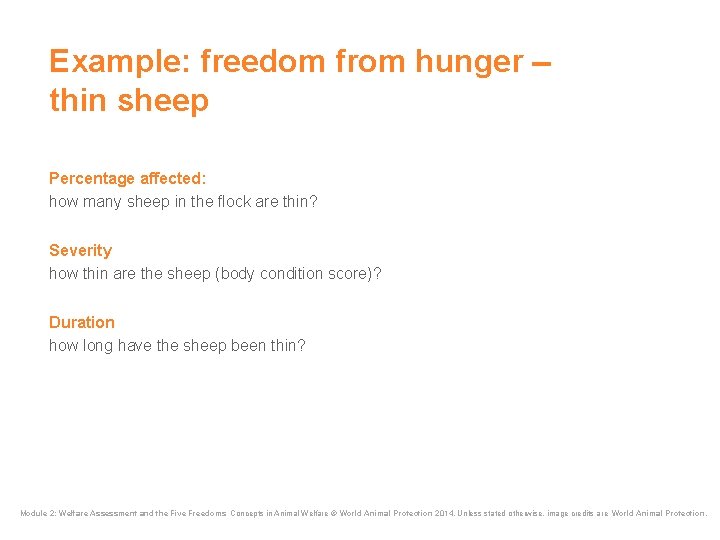
Example: freedom from hunger thin sheep Percentage affected: how many sheep in the flock are thin? Severity how thin are the sheep (body condition score)? Duration how long have the sheep been thin? Module 2: Welfare Assessment and the Five Freedoms Concepts in Animal Welfare © World Animal Protection 2014. Unless stated otherwise, image credits are World Animal Protection.
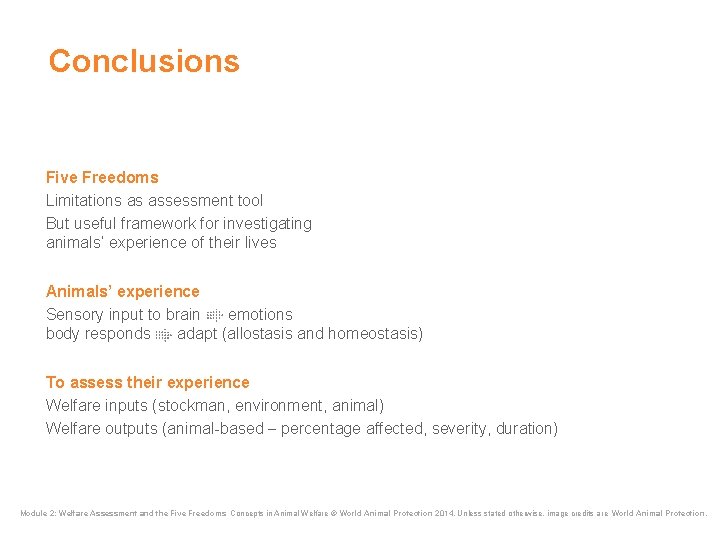
Conclusions Five Freedoms Limitations as assessment tool But useful framework for investigating animals’ experience of their lives Animals’ experience Sensory input to brain emotions W body responds adapt (allostasis and homeostasis) W To assess their experience Welfare inputs (stockman, environment, animal) Welfare outputs (animal-based percentage affected, severity, duration) Module 2: Welfare Assessment and the Five Freedoms Concepts in Animal Welfare © World Animal Protection 2014. Unless stated otherwise, image credits are World Animal Protection.
Feedback: Please let us know what you think How have you used this module? What did you like about it? What did you not like? Do you have any tips to share? Please take part in our 10 minute survey here: https: //www. surveymonkey. com/s/BKP 3 D 6 H Your feedback will help other teachers like you Module 2: Welfare Assessment and the Five Freedoms Concepts in Animal Welfare © World Animal Protection 2014. Unless stated otherwise, image credits are World Animal Protection.
References Jongman, E. C. (2007). Adaptation of domestic cats to confinement. Balcombe, J. , Barnard, N. , & Sandusky, C. (2004). Laboratory Journal of Veterinary Behavior, 2, 193 -196. routines cause animal stress. Contemporary Topics in Laboratory Animal Science, 43, 42 -51. Retrieved from Laven, R. A. , & Holmes, C. W. (2008). A review of the potential impact http: //www. animalexperiments. info/studies/impacts/stress_balcombe_e of increased use of housing on the health and welfare of dairy cattle in t_al_2004. html New Zealand Veterinary Journal, 56, 151 -157. Brambell Committee. (1965). Report of the Technical Committee to Enquire into the Welfare of Animals Kept under Intensive Livestock Husbandry Systems. Command report 2836. London: the Stationery Office. Farm Animal Welfare Council. (1992). FAWC updates the Five Freedoms. Veterinary Record 131, 357. Farm Animal Welfare Council. (2009). Farm animal welfare in Great Britain: Past, present and future (p. 1). London: FAWC. Module 2: Welfare Assessment and the Five Freedoms Concepts in Animal Welfare © World Animal Protection 2014. Unless stated otherwise, image credits are World Animal Protection.
References Office International des Epizooties (OIE) (2011). Terrestrial Animal Health Code, Article 7. 1. 2. Retrieved from http: //www. oie. int/index. php? id=169&L=0&htmfile=chapitre_1. 7. 1. htm Panksepp, J. (2003). Feeling the pain of social loss. Science, 302, 237 -239. Veissier, I. , & Boissy, A. (2007). Stress and welfare: Two complementary concepts that are intrinsically related to the animal's point of view. Physiology and Behavior, 92, 429 -433. Webster, A. J. F. (2001). Farm animal welfare: The Five Freedoms and the free market. The Veterinary Journal, 161, 229 -237. Williams, D. L. (2010). Welfare issues in farm animal ophthalmology veterinary clinics. Food Animal, 26, 427 -435. World Bank (2006). Creating business opportunity through improved animal welfare. Good Practice Note no. 6. Washington, DC: International Finance Corporation, World Bank Group. Module 2: Welfare Assessment and the Five Freedoms Concepts in Animal Welfare © World Animal Protection 2014. Unless stated otherwise, image credits are World Animal Protection.