
MODULE 2 INTERPESONAL RELATIONSHIPS AND SOCIAL INTERACTION 1

- Slides: 13
MODULE 2: • INTERPESONAL RELATIONSHIPS AND SOCIAL INTERACTION
1. SELF-IMAGE 1. 1 DEFINITION OF SELF-IMAGE: Self-image is your view of who you are and the perception of what other people think of you.
1. 2 ELEMENTS OF SELF-IMAGE There are THREE main elements of self-image: • The way you see yourself (what you think of yourself) • How you interpret what others think of you • How you would like to be (your ideal self-image) Note: Students should be able to: • Identify and explain the various elements of self-image
1. 3 DIMENSIONS OF SELF-IMAGE Self-image can be classified into FIVE categories: • Physical dimension: how you view your body • Intellectual dimension: how you evaluate your intellect and compare it with the intellect of others • Psychological dimension: how you evaluate certain characteristics, e. g. introvert vs extrovert; tolerant vs intolerant, etc. • Sexual dimension: your view of how popular you are with opposite sex • Dexterity or skills dimension: how you evaluate your skills and compare them to other people’s skills. Note: The students must be able to: Identify and explain various dimensions of self-image
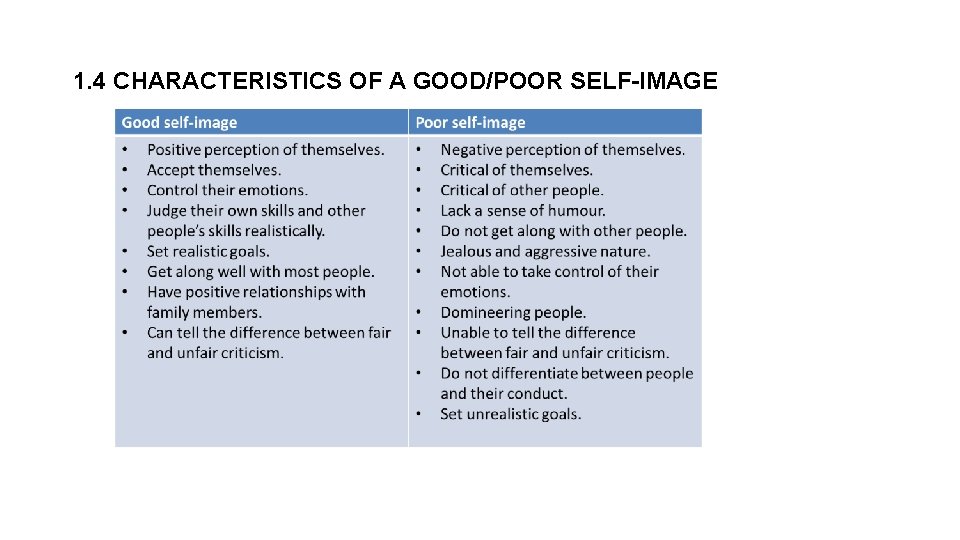
1. 4 CHARACTERISTICS OF A GOOD/POOR SELF-IMAGE
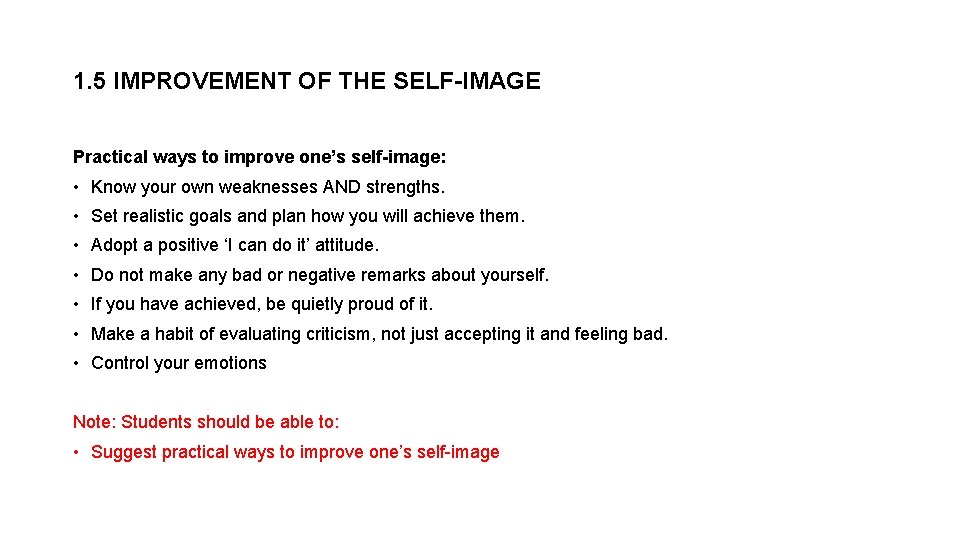
1. 5 IMPROVEMENT OF THE SELF-IMAGE Practical ways to improve one’s self-image: • Know your own weaknesses AND strengths. • Set realistic goals and plan how you will achieve them. • Adopt a positive ‘I can do it’ attitude. • Do not make any bad or negative remarks about yourself. • If you have achieved, be quietly proud of it. • Make a habit of evaluating criticism, not just accepting it and feeling bad. • Control your emotions Note: Students should be able to: • Suggest practical ways to improve one’s self-image
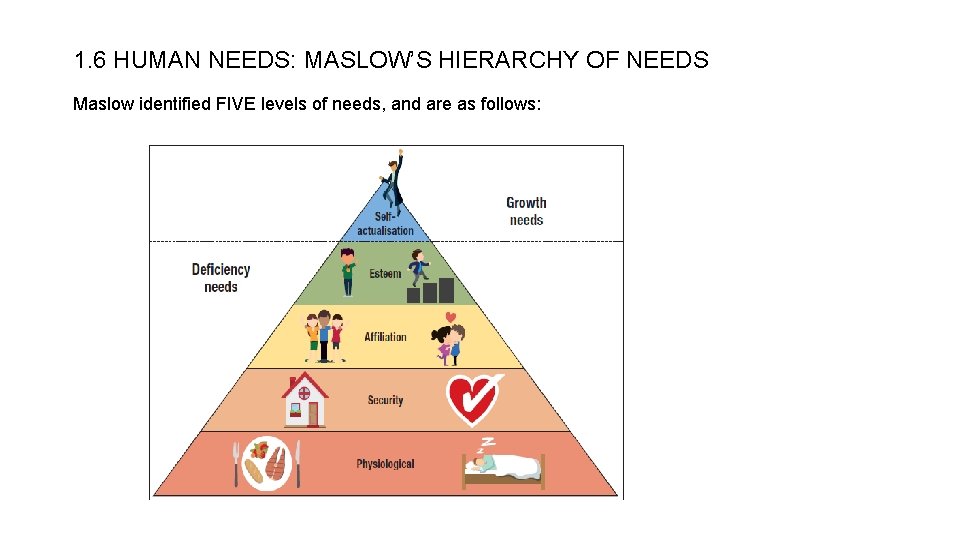
1. 6 HUMAN NEEDS: MASLOW’S HIERARCHY OF NEEDS Maslow identified FIVE levels of needs, and are as follows:
NOTES ON MASLOW’S NEEDS The student must be able to: • Illustrate Maslow’s theory of needs diagrammatically. • Explain each level of the Maslow’s needs. • Explain how these needs are satisfied in the workplace.
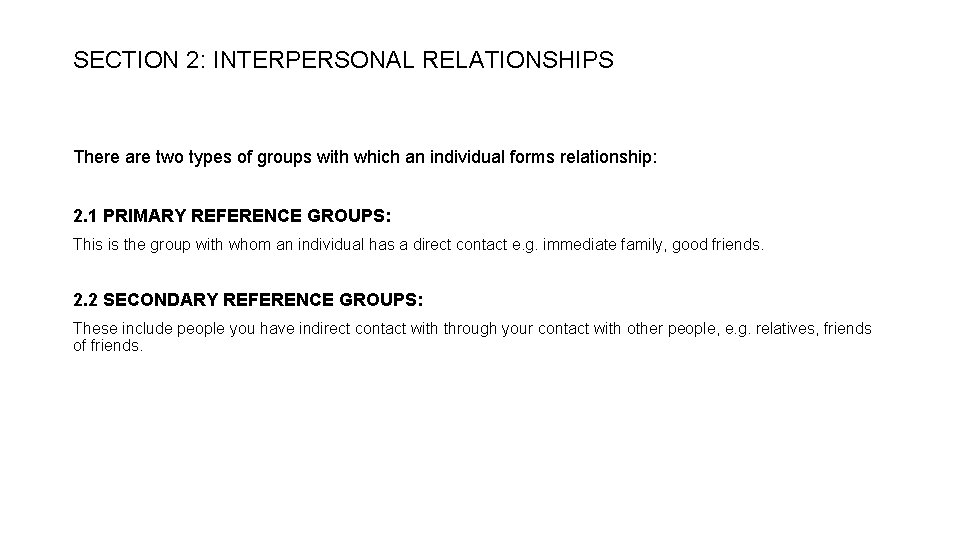
SECTION 2: INTERPERSONAL RELATIONSHIPS There are two types of groups with which an individual forms relationship: 2. 1 PRIMARY REFERENCE GROUPS: This is the group with whom an individual has a direct contact e. g. immediate family, good friends. 2. 2 SECONDARY REFERENCE GROUPS: These include people you have indirect contact with through your contact with other people, e. g. relatives, friends of friends.
3. BARRIERS TO INTERPERSONAL COMMUNICATION 3. 1 DEFINITION OF A COMMUNICATION BARRIER • A barrier is any factor that interferes with the message or prevents it from being transmitted or received.
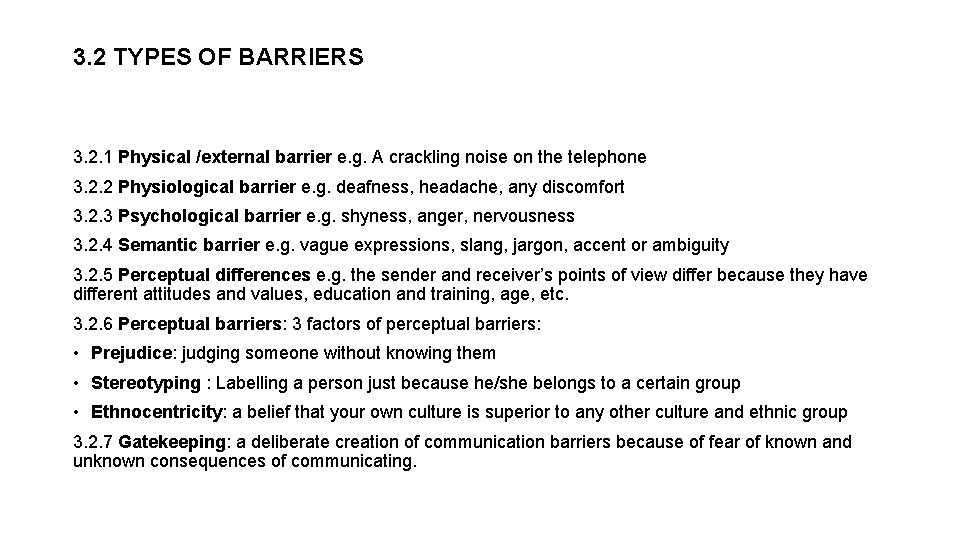
3. 2 TYPES OF BARRIERS 3. 2. 1 Physical /external barrier e. g. A crackling noise on the telephone 3. 2. 2 Physiological barrier e. g. deafness, headache, any discomfort 3. 2. 3 Psychological barrier e. g. shyness, anger, nervousness 3. 2. 4 Semantic barrier e. g. vague expressions, slang, jargon, accent or ambiguity 3. 2. 5 Perceptual differences e. g. the sender and receiver’s points of view differ because they have different attitudes and values, education and training, age, etc. 3. 2. 6 Perceptual barriers: 3 factors of perceptual barriers: • Prejudice: judging someone without knowing them • Stereotyping : Labelling a person just because he/she belongs to a certain group • Ethnocentricity: a belief that your own culture is superior to any other culture and ethnic group 3. 2. 7 Gatekeeping: a deliberate creation of communication barriers because of fear of known and unknown consequences of communicating.
NOTE ON BARRIERS Students should be able to: • Give an explanation and examples of each barrier in particular • Recognise specific barriers which harm the communication process in given case studies.