
Module 2 How to design Computer Language Huma
- Slides: 25
Module 2 How to design Computer Language Huma Ayub Software Construction Lecture 9
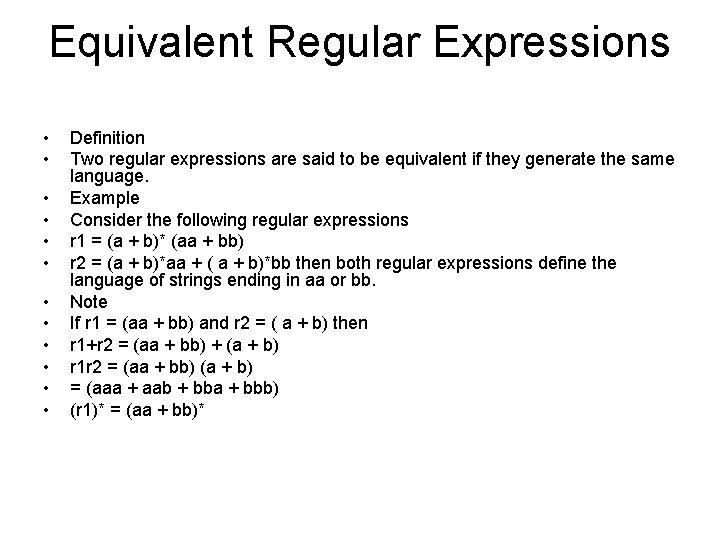
Equivalent Regular Expressions • • • Definition Two regular expressions are said to be equivalent if they generate the same language. Example Consider the following regular expressions r 1 = (a + b)* (aa + bb) r 2 = (a + b)*aa + ( a + b)*bb then both regular expressions define the language of strings ending in aa or bb. Note If r 1 = (aa + bb) and r 2 = ( a + b) then r 1+r 2 = (aa + bb) + (a + b) r 1 r 2 = (aa + bb) (a + b) = (aaa + aab + bba + bbb) (r 1)* = (aa + bb)*
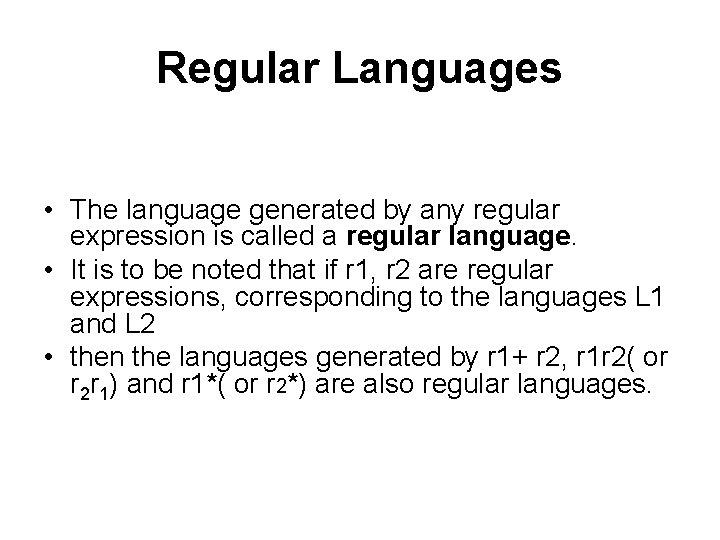
Regular Languages • The language generated by any regular expression is called a regular language. • It is to be noted that if r 1, r 2 are regular expressions, corresponding to the languages L 1 and L 2 • then the languages generated by r 1+ r 2, r 1 r 2( or r 2 r 1) and r 1*( or r 2*) are also regular languages.
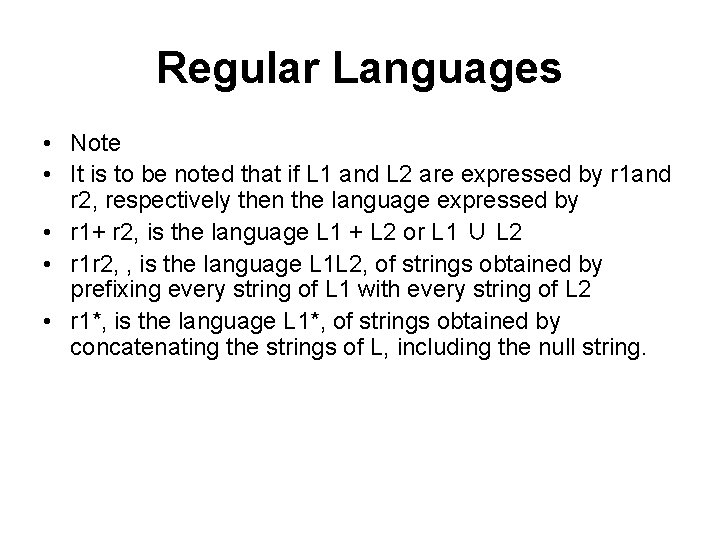
Regular Languages • Note • It is to be noted that if L 1 and L 2 are expressed by r 1 and r 2, respectively then the language expressed by • r 1+ r 2, is the language L 1 + L 2 or L 1 ∪ L 2 • r 1 r 2, , is the language L 1 L 2, of strings obtained by prefixing every string of L 1 with every string of L 2 • r 1*, is the language L 1*, of strings obtained by concatenating the strings of L, including the null string.
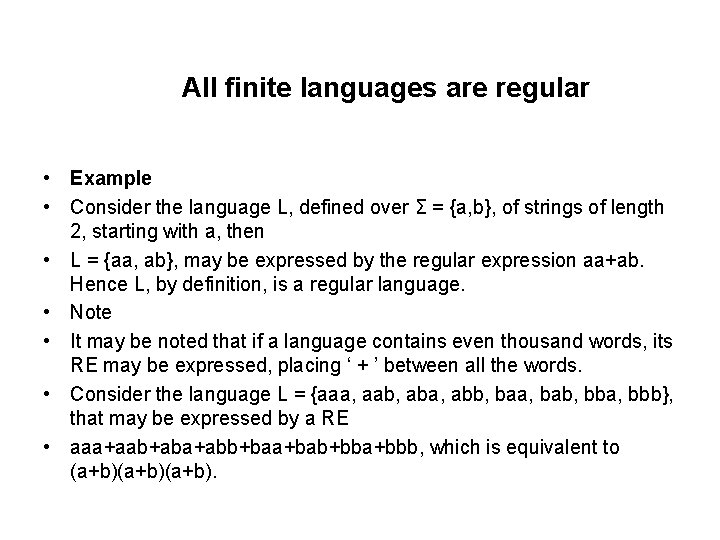
All finite languages are regular • Example • Consider the language L, defined over Σ = {a, b}, of strings of length 2, starting with a, then • L = {aa, ab}, may be expressed by the regular expression aa+ab. Hence L, by definition, is a regular language. • Note • It may be noted that if a language contains even thousand words, its RE may be expressed, placing ‘ + ’ between all the words. • Consider the language L = {aaa, aab, aba, abb, baa, bab, bba, bbb}, that may be expressed by a RE • aaa+aab+aba+abb+baa+bab+bba+bbb, which is equivalent to (a+b)(a+b).
Defining Languages (Revisited) • The languages can be defined in different ways, such as • Descriptive definition • Recursive definition • Regular Expressions(RE) • Finite Automaton(FA) 6
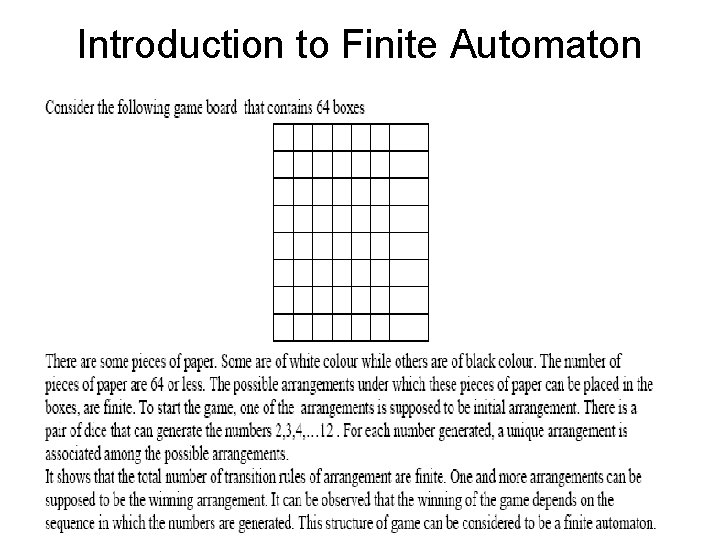
Introduction to Finite Automaton
Finite Automaton • A Finite automaton (FA), is a collection of the followings • Finite number of states, having one initial and some (maybe none) final states. [e. g: arrangements] • Finite set of input letters (Σ) from which input strings are formed. . [e. g: pair of dice generated numbers 2, 3, 4 …. . ] • Finite set of transitions i. e. for each state and for each input letter there is a transition showing how to move from one state to another. [e. g rule how to move form arrangement to another on particular number]
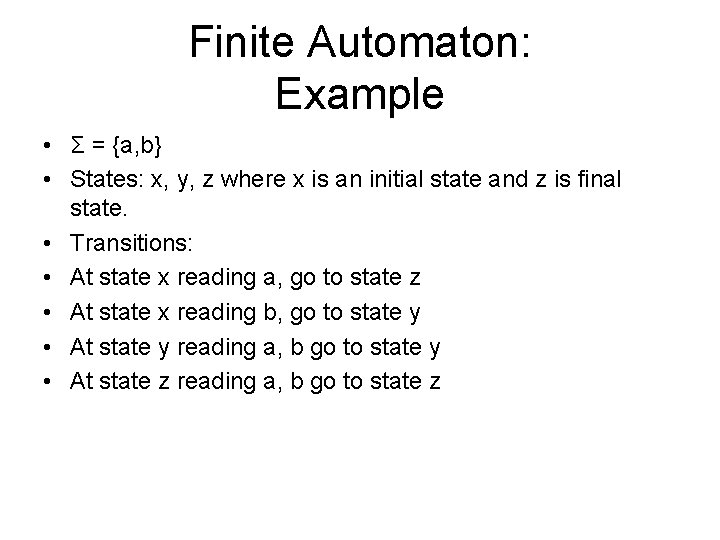
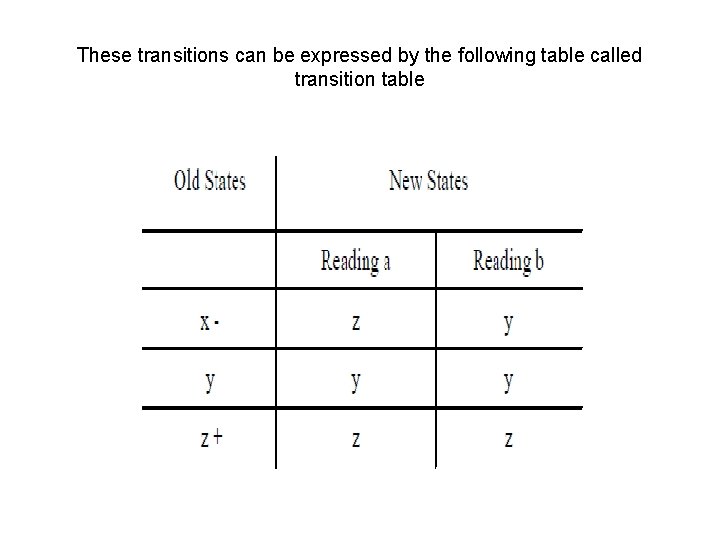
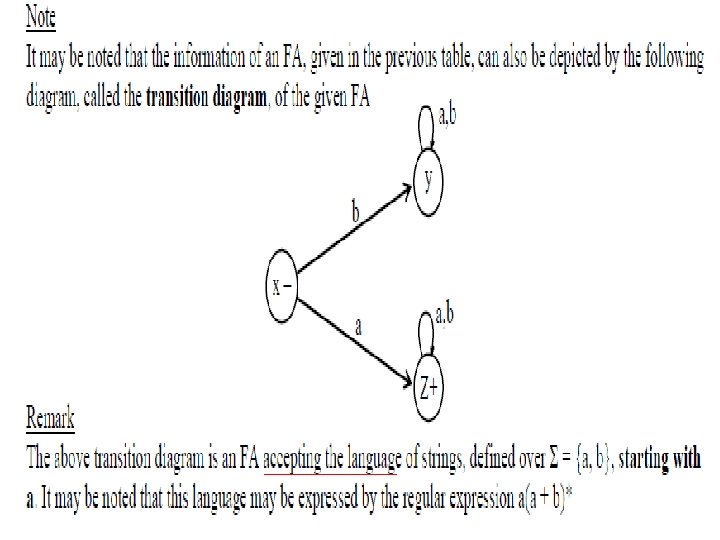
Finite Automaton: Example • Σ = {a, b} • States: x, y, z where x is an initial state and z is final state. • Transitions: • At state x reading a, go to state z • At state x reading b, go to state y • At state y reading a, b go to state y • At state z reading a, b go to state z
These transitions can be expressed by the following table called transition table
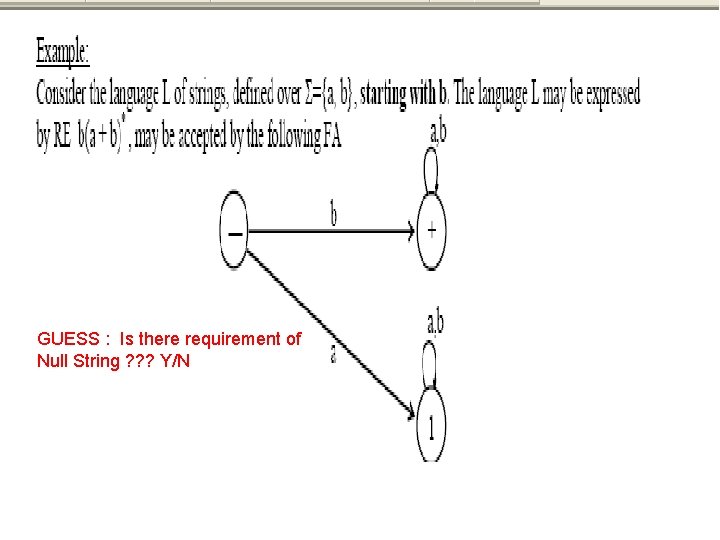
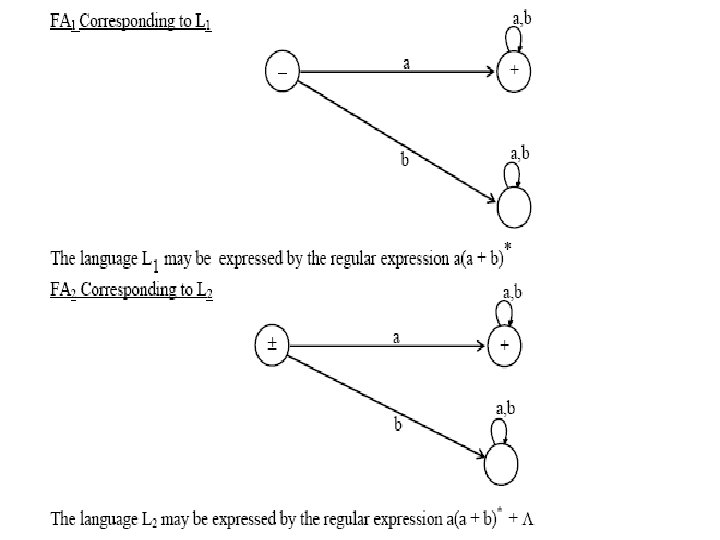
Summary Different notations of transition diagrams, languages of strings of even length, Odd length, starting with b, ending in a, beginning with b, not beginning with b, beginning and ending in same letters.
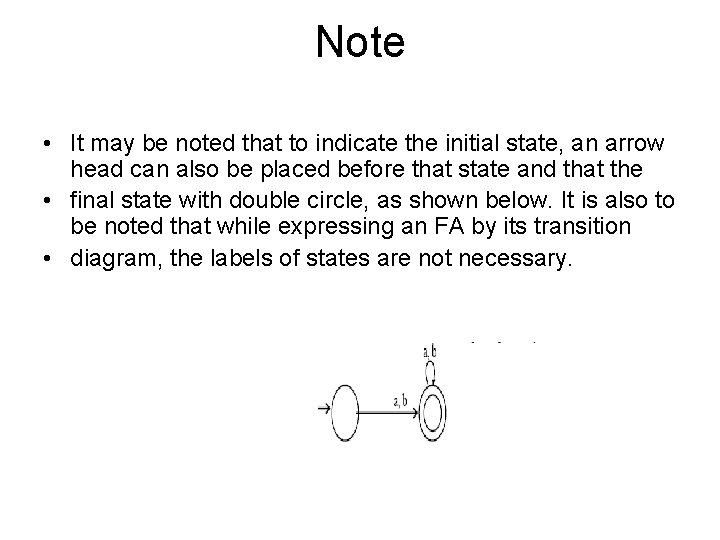
Note • It may be noted that to indicate the initial state, an arrow head can also be placed before that state and that the • final state with double circle, as shown below. It is also to be noted that while expressing an FA by its transition • diagram, the labels of states are not necessary.
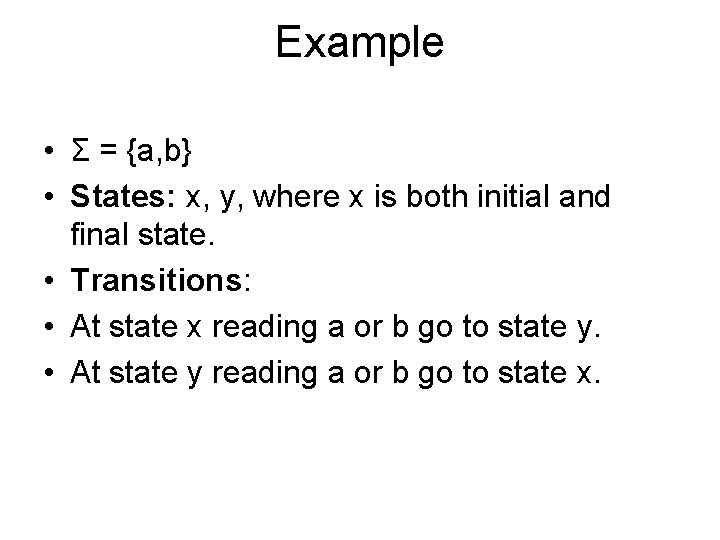
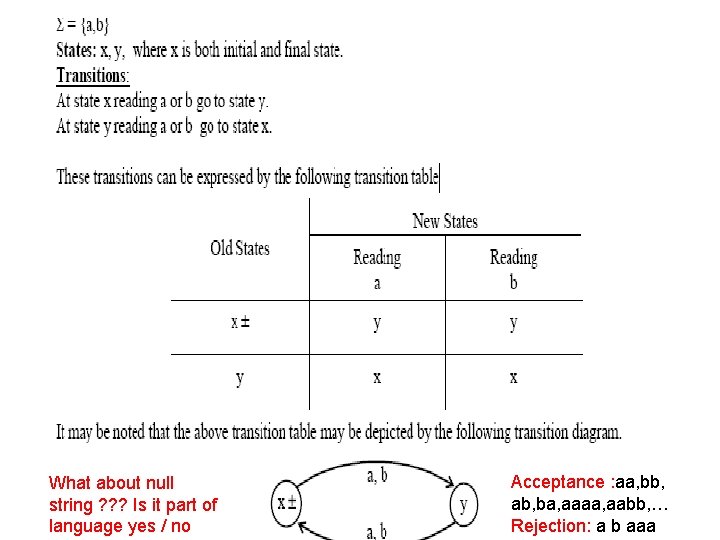
Example • Σ = {a, b} • States: x, y, where x is both initial and final state. • Transitions: • At state x reading a or b go to state y. • At state y reading a or b go to state x.
What about null string ? ? ? Is it part of language yes / no Acceptance : aa, bb, ab, ba, aaaa, aabb, … Rejection: a b aaa
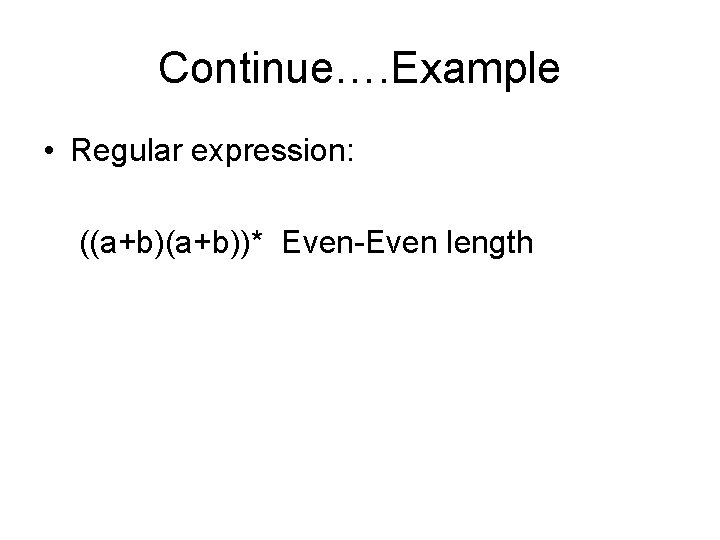
Continue…. Example • Regular expression: ((a+b))* Even-Even length
GUESS : Is there requirement of Null String ? ? ? Y/N
Example • Consider the language L of strings, defined over Σ={a, b}, ending in a. The language L may be expressed by • RE (a+b)*a.
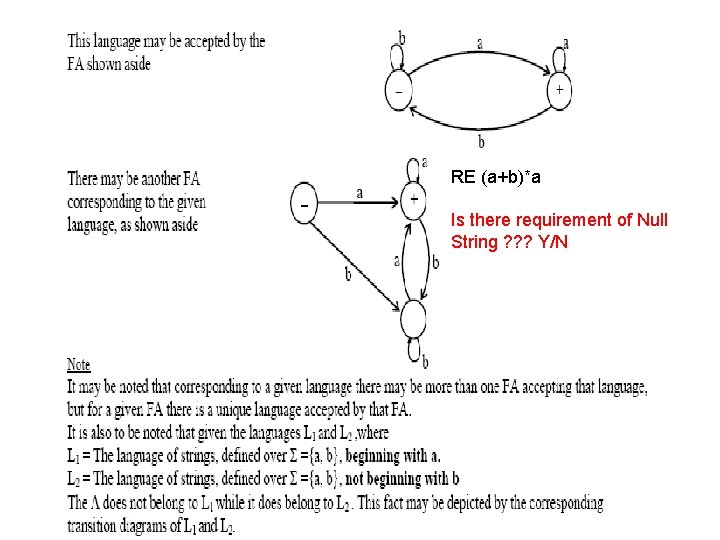
RE (a+b)*a Is there requirement of Null String ? ? ? Y/N
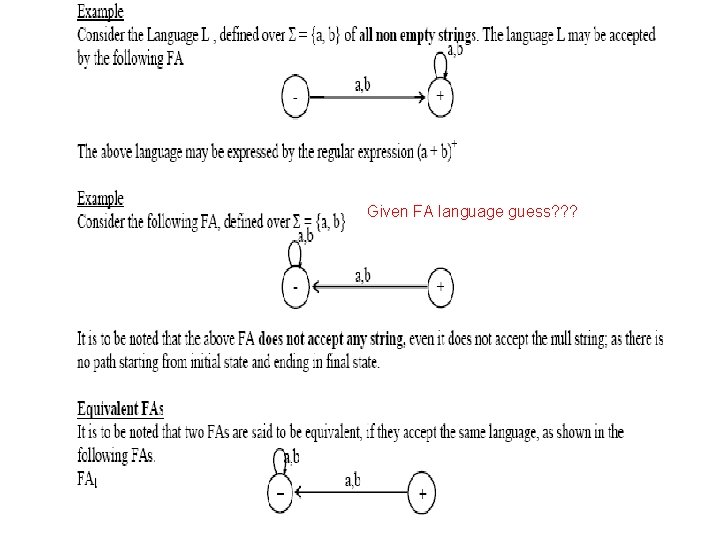
Given FA language guess? ? ?