
Module 2 Exchange and transport 1 2 1

- Slides: 15
Module 2 Exchange and transport 1. 2. 1 Special surfaces for exchange
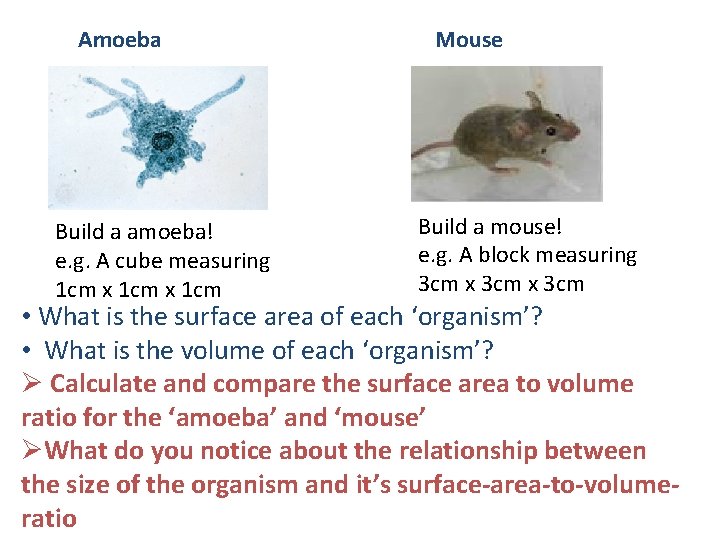
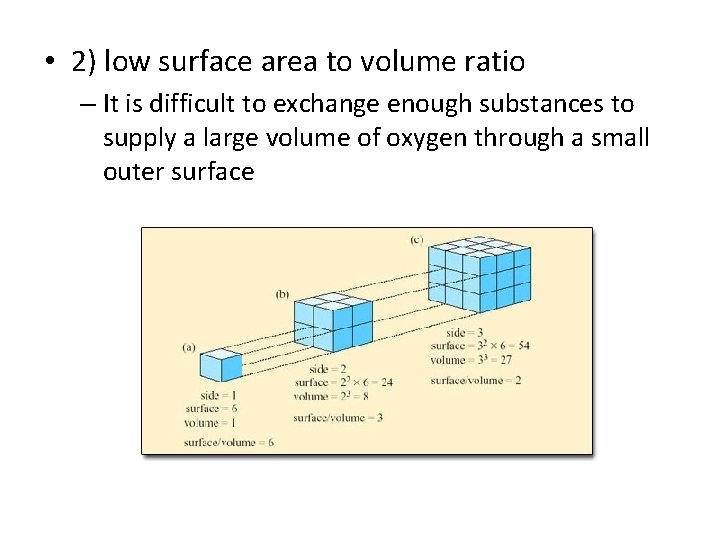
Amoeba Build a amoeba! e. g. A cube measuring 1 cm x 1 cm Mouse Build a mouse! e. g. A block measuring 3 cm x 3 cm • What is the surface area of each ‘organism’? • What is the volume of each ‘organism’? Ø Calculate and compare the surface area to volume ratio for the ‘amoeba’ and ‘mouse’ ØWhat do you notice about the relationship between the size of the organism and it’s surface-area-to-volumeratio
Learning Objectives • Explain in terms of surfacearea-to-volume-ratio, why multicellular organisms have specialised exchange surfaces and single celled organisms do not Success Criteria • List why organisms need special exchange surfaces (Grade E - D) • Describe and explain the features that make an exchange surface efficient (Grade C –B) • Explain in terms of surface area to volume ratio how multicellular organisms are different to unicellular organisms (Grade B – A)
Why organisms need special exchange surfaces • Living cells must be able to take up simple substances from their environment. • They also need to remove waste products from metabolic activities. • Task - On your post it write down one of these substances /products - Stick your post it on the board and explain why it is important Looking at your model of a single-celled and multicellular organism describe how they exchange these important substances/products use keyword surface • List why organisms need special area-volume-ratio exchange surfaces (Grade D – C)
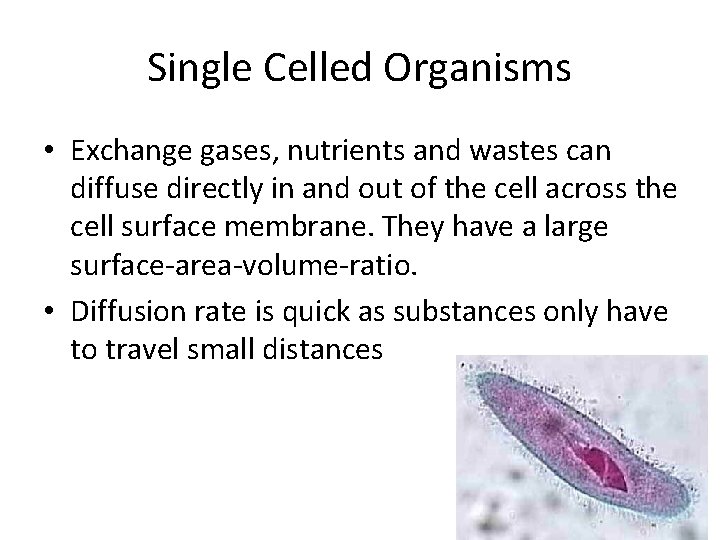
Single Celled Organisms • Exchange gases, nutrients and wastes can diffuse directly in and out of the cell across the cell surface membrane. They have a large surface-area-volume-ratio. • Diffusion rate is quick as substances only have to travel small distances
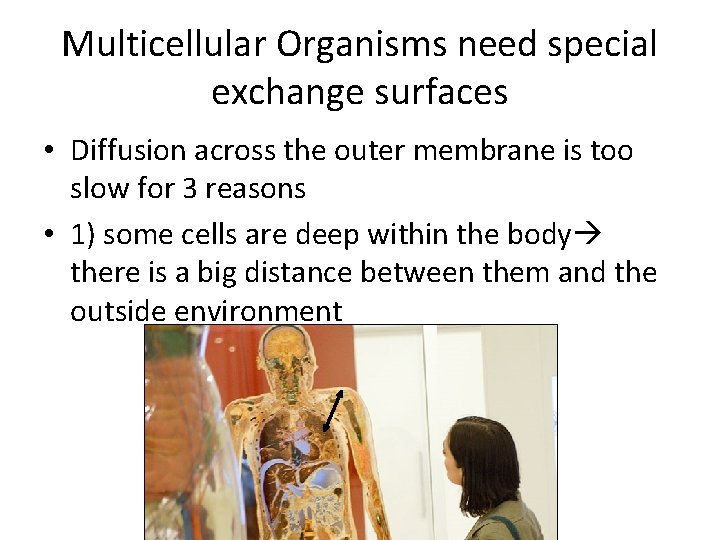
Multicellular Organisms need special exchange surfaces • Diffusion across the outer membrane is too slow for 3 reasons • 1) some cells are deep within the body there is a big distance between them and the outside environment
• 2) low surface area to volume ratio – It is difficult to exchange enough substances to supply a large volume of oxygen through a small outer surface
• 3) Multicellular organisms are often very active which means a lot of cells are respiring very quickly need a constant, rapid supply of glucose and O 2
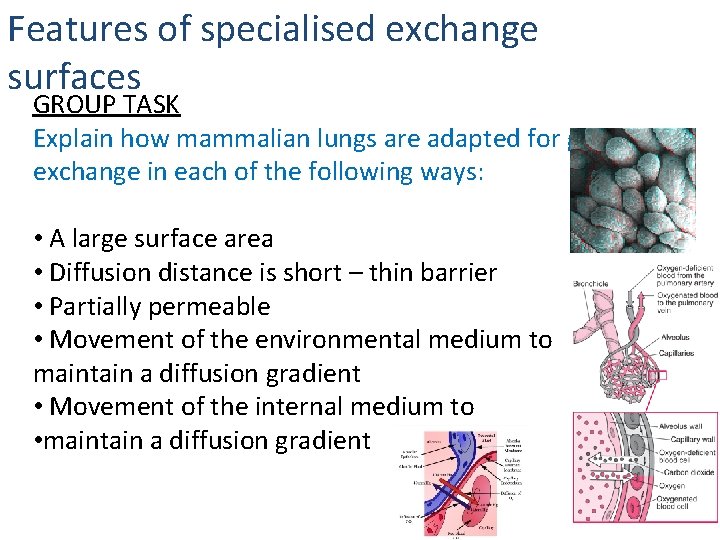
Features of specialised exchange surfaces GROUP TASK Explain how mammalian lungs are adapted for gas exchange in each of the following ways: • A large surface area • Diffusion distance is short – thin barrier • Partially permeable • Movement of the environmental medium to maintain a diffusion gradient • Movement of the internal medium to • maintain a diffusion gradient
Job Advert • Create a job advert for an exchange surface. Include all the feature necessary to make a good exchange surface. • Describe and explain the features that make an exchange surface efficient (Grade C –B)
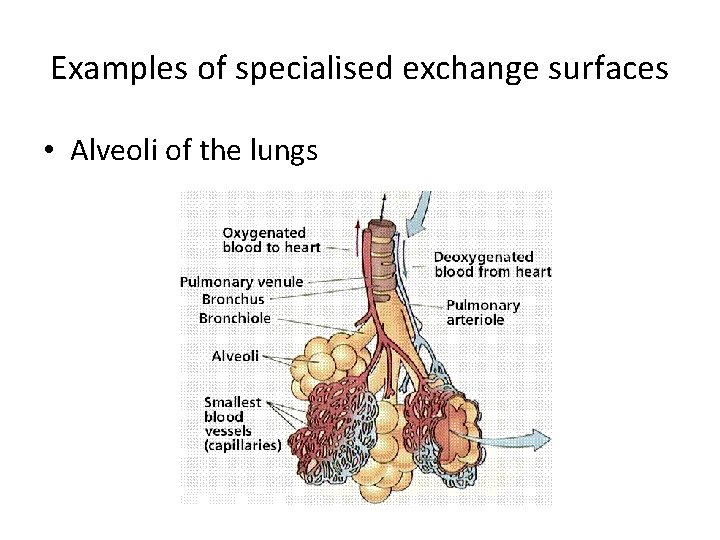
Examples of specialised exchange surfaces • Alveoli of the lungs
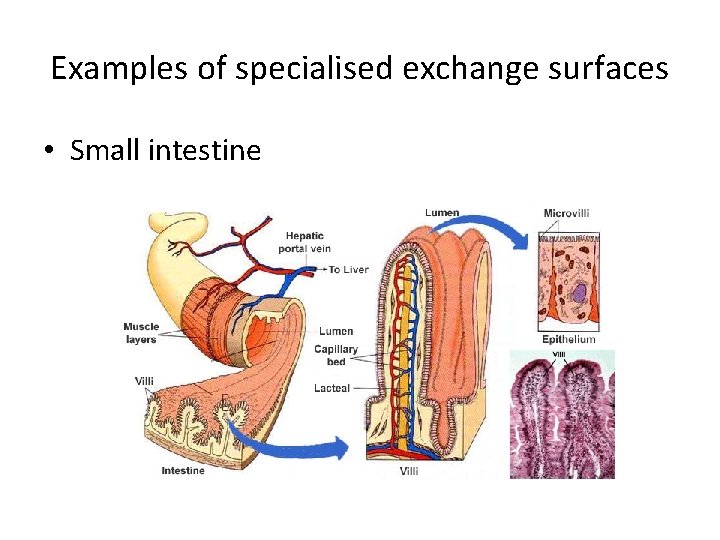
Examples of specialised exchange surfaces • Small intestine
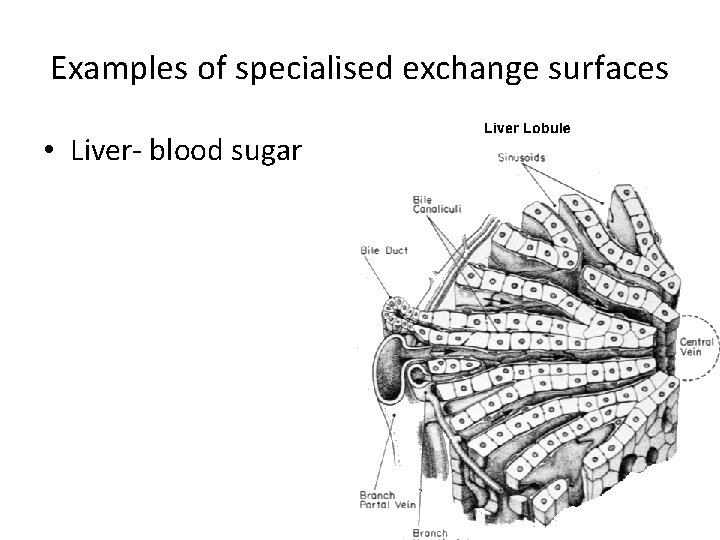
Examples of specialised exchange surfaces • Liver- blood sugar
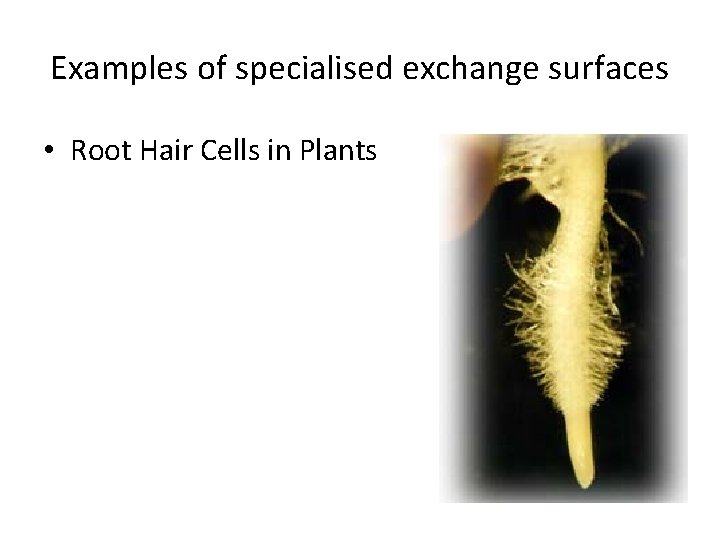
Examples of specialised exchange surfaces • Root Hair Cells in Plants
Plenary • Explain why large, active organisms need specialised surfaces for exchange. (3 marks) • Large mammals have a high demand for oxygen for respiration, which can’t be met by diffusion alone as their surface area : volume ratio is too low. A specialised exchange surface gives a greater area, so more oxygen can be absorbed and more carbon dioxide can be removed. • Explain in terms of surface area to volume ratio how multicellular organisms are different to unicellular organisms (Grade B – A)