
Module 2 Electrical Electronic Systems Unit 3 General

- Slides: 34
Module 2: Electrical/ Electronic Systems Unit 3: General Electrical System Diagnosis Lesson 1: Basic Testing Information Module 2: Electrical/ Electronic Systems
Safety precautions • It is important to take careful safety precautions when servicing electrical/electronic systems. Module 2: Electrical/ Electronic Systems Unit 3: General Electrical System Diagnosis Vehicle batteries produce more than 700 amps of current. Harmful by-products of this current flow are heat, hydrogen, and acid outgassing. Consider the following when working on or around a battery. • High-current discharge within an electrical/electronic system can overheat conductors and create a fire hazard. • The battery contains sulfuric acid, which can burn flesh. Also, clothing and vehicle paint can be damaged by sulfuric acid. Wear personal protective equipment (PPE) to protect eyes, skin, and clothing. Take precautions to protect the vehicle. • High battery activity causes the escape of hydrogen gas, which is highly explosive. An exploding battery throws debris and sulfuric acid in all directions. Lesson 1: Basic Testing Information
Safety precautions Electrical arcing can occur anywhere high-potential voltage contacts a source of low-potential voltage. Electrical arcing can cause fuel or hydrogen vapor to burn or explode. Module 2: Electrical/ Electronic Systems Unit 3: General Electrical System Diagnosis Lesson 1: Basic Testing Information CAUTION: When opening an electrical circuit, disconnect the negative battery cable or ground cable first. To prevent electrical arcing, connect the negative battery cable last. • Many of the hazards technicians face when servicing electrical/electronic systems can severely damage a vehicle. The following precautions should be taken before service or repair. • Inspect under the hood for exposed wiring, heat damage, or the presence of fuel and acid.
Safety precautions Module 2: Electrical/ Electronic Systems • Consider whether the service or repair involves heavy current flow or electrical arcing and develop a prevention plan for each hazard. • Plan a test sequence. The following precautions should be taken during service or repair. Unit 3: General Electrical System Diagnosis • Use a grounding wrist strap to maintain equivalent ground potential when working with sensitive electronic components. Lesson 1: Basic Testing Information • Avoid unintentional grounding or shorting of circuit components. • Avoid testing unprotected circuits. • Avid loading sensitive circuits with test lights or other load-test equipment.
Safety precautions The following precautions should be taken after service or repair. Module 2: Electrical/ Electronic Systems Unit 3: General Electrical System Diagnosis Lesson 1: Basic Testing Information • Inspect repaired systems for defective wiring insulation. • Inspect for proper routing of wires. • Activate the repaired circuit and all circuits related to it to ensure all are fully operational.
Importance of service information • Vehicles have become so technologically advanced that service information is used on every job. Service information is the most comprehensive and best source of information for a specific vehicle. Module 2: Electrical/ Electronic Systems Service information includes vehicle specifications, diagnostic and service/repair procedures, wiring diagrams, parts diagrams, and special tools required. Unit 3: General Electrical System Diagnosis Because so many technical changes occur after service information is published, manufacturers provide technical service bulletins (TSBs) to update service information. The information in the TSBs also appears in the next edition of the service information. Lesson 1: Basic Testing Information
Importance of service information Module 2: Electrical/ Electronic Systems Unit 3: General Electrical System Diagnosis Lesson 1: Basic Testing Information • Service information contains specific information needed to diagnose and service electrical/electronic systems, including wiring diagrams, diagrams of system ground points, brief descriptions of how a circuit works, and troubleshooting hints. Also, most service information includes a list of electrical symbols used in the wiring diagrams and an explanation of color-code abbreviations. The two types of wiring diagrams are the pictorial and the schematic.
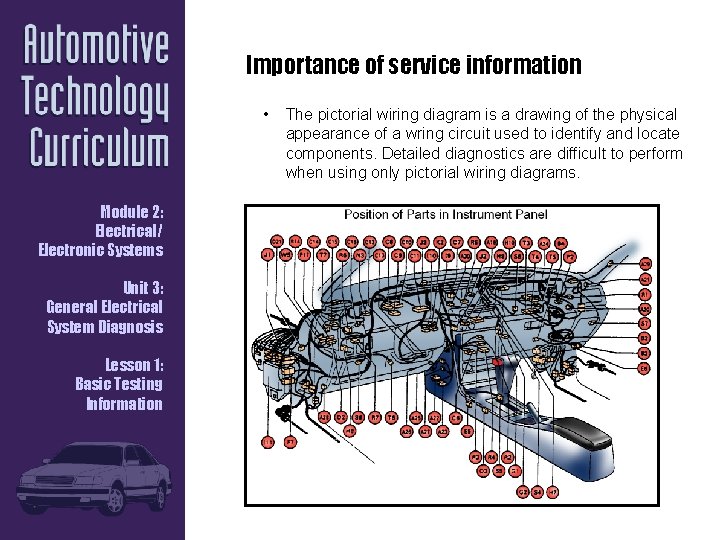
Importance of service information • Module 2: Electrical/ Electronic Systems Unit 3: General Electrical System Diagnosis Lesson 1: Basic Testing Information The pictorial wiring diagram is a drawing of the physical appearance of a wring circuit used to identify and locate components. Detailed diagnostics are difficult to perform when using only pictorial wiring diagrams.
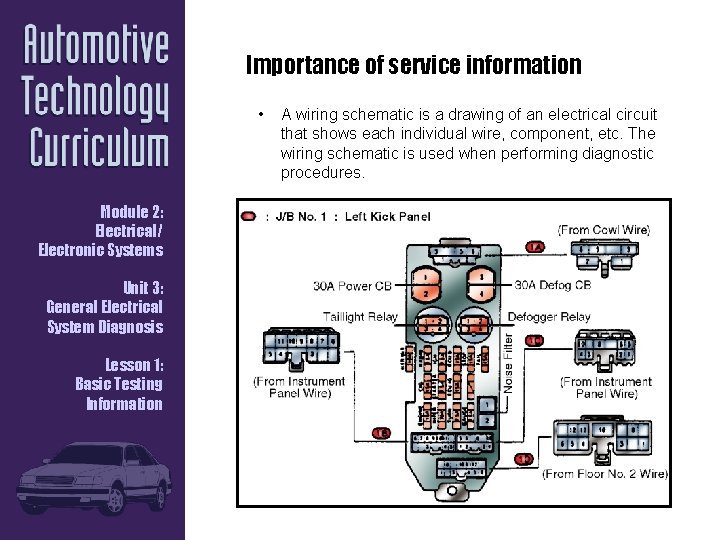
Importance of service information • Module 2: Electrical/ Electronic Systems Unit 3: General Electrical System Diagnosis Lesson 1: Basic Testing Information A wiring schematic is a drawing of an electrical circuit that shows each individual wire, component, etc. The wiring schematic is used when performing diagnostic procedures.
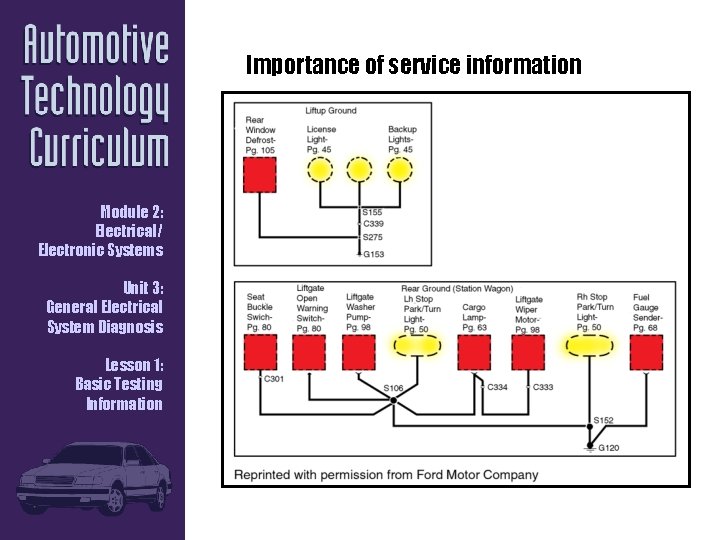
Importance of service information Module 2: Electrical/ Electronic Systems Unit 3: General Electrical System Diagnosis Lesson 1: Basic Testing Information • A wiring schematic does not represent an actual length of wires or the distance between components. Some components may be separated by 2 inches of wire while others are separated by 10 feet. • Symbols are used to identify components. Common electrical symbols used in wiring diagrams Service information includes an individual wiring diagram for almost every electrical/electronic system in the vehicle. • For each system, only the circuits and components of that specific system are included, making it easier to identify potential trouble spots. The following is a wring diagram of an interval wiper/washer system.
Importance of service information Module 2: Electrical/ Electronic Systems Unit 3: General Electrical System Diagnosis Lesson 1: Basic Testing Information
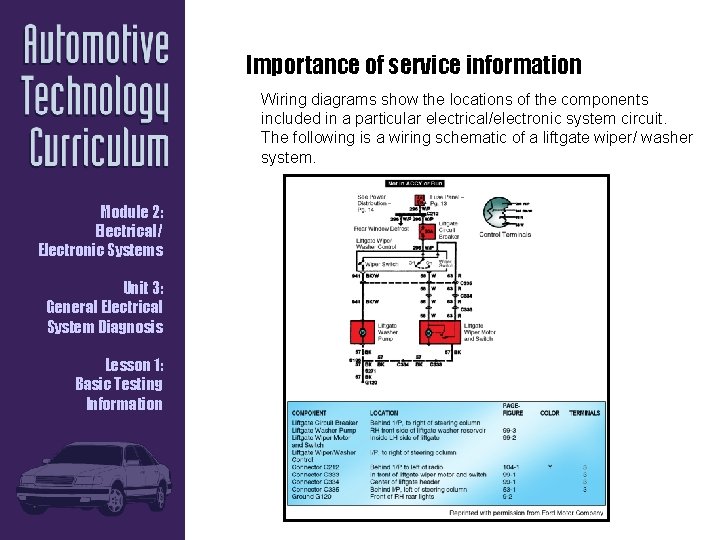
Importance of service information Wiring diagrams show the locations of the components included in a particular electrical/electronic system circuit. The following is a wiring schematic of a liftgate wiper/ washer system. Module 2: Electrical/ Electronic Systems Unit 3: General Electrical System Diagnosis Lesson 1: Basic Testing Information
Importance of service information Module 2: Electrical/ Electronic Systems Unit 3: General Electrical System Diagnosis Lesson 1: Basic Testing Information Service information includes a list of electrical symbols to help interpret the wiring diagram. This list uses abbreviations for the component or connection being symbolized. For example, the splice/crimp connection symbol is designated as S 100. The letter S stands for splice/crimp, and the number 100 indicates that it is the 100 th splice/crimp in the entire electrical/electronic system. In most electrical/electronic systems, wires and connectors are color coded to make identifications easier. When troubleshooting a circuit, the technician will test for voltage at various points in a particular conductor or wire.
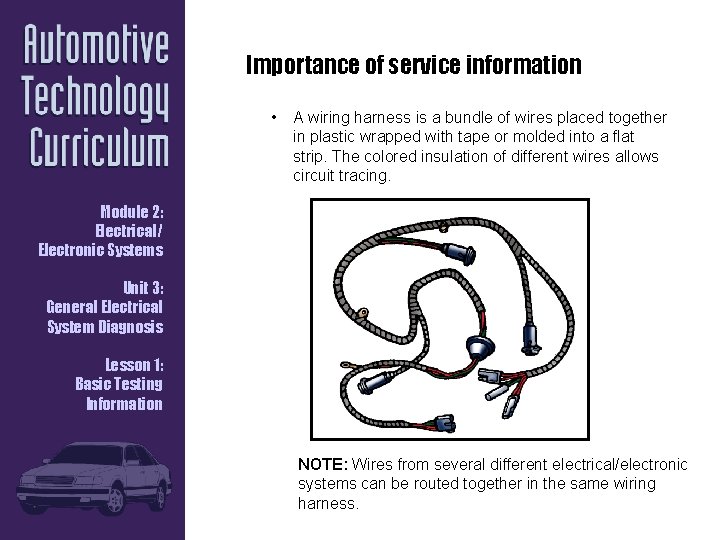
Importance of service information • A wiring harness is a bundle of wires placed together in plastic wrapped with tape or molded into a flat strip. The colored insulation of different wires allows circuit tracing. Module 2: Electrical/ Electronic Systems Unit 3: General Electrical System Diagnosis Lesson 1: Basic Testing Information NOTE: Wires from several different electrical/electronic systems can be routed together in the same wiring harness.
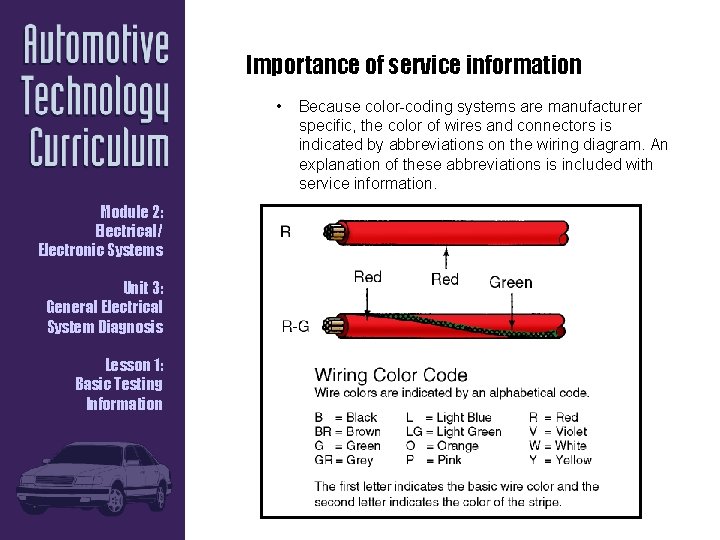
Importance of service information • Module 2: Electrical/ Electronic Systems Unit 3: General Electrical System Diagnosis Lesson 1: Basic Testing Information Because color-coding systems are manufacturer specific, the color of wires and connectors is indicated by abbreviations on the wiring diagram. An explanation of these abbreviations is included with service information.
Importance of service information Some wiring diagrams include an end view of component connectors showing the color of the wire connected to each matching terminal in a connector. This helps locate the proper terminals to probe when performing tests. Module 2: Electrical/ Electronic Systems Unit 3: General Electrical System Diagnosis Lesson 1: Basic Testing Information NOTE: This type of wiring diagram is valuable when bench testing a component. Wiring diagrams begin at the fuse or circuit breaker. A current flow path is shown from the fuse through switches controlling current flow to the load unit and on to ground. The current flow path is usually located at the bottom of the wiring diagram. When system ground is suspected, locating the ground point using a wiring diagram can be a time saver. Ground points usually are found on a separate wiring diagram. NOTE: Two or more circuits often share one ground point.
Test equipment NOTE: A technician uses different equipment to test electrical circuits. This equipment determines how well a circuit or component performs. Module 2: Electrical/ Electronic Systems Unit 3: General Electrical System Diagnosis Lesson 1: Basic Testing Information CAUTION: Always follow the test equipment manufacturer’s instructions for using the equipment and observe all safety precautions. • Digital multimeter (DMM) The DMM is one of the most commonly used pieces of test equipment because of its versatility in making various electrical measurements. The DMM is a voltmeter, ohmmeter, and ammeter all in one unit and is used in place of these separate meters. • The DMM’s voltmeter function is used to measure the electromotive force (EMF), also known as pressure or voltage difference, between two points in a circuit. The difference is measured in volts.
Test equipment Module 2: Electrical/ Electronic Systems Unit 3: General Electrical System Diagnosis • The ohmmeter function measures the electrical resistance of a component or portion of the circuit. Its unit of measurement is ohms. • The ammeter function measures the amount of electrical current through a circuit. Its unit of measurement is amperes or amps. Meter independence • A DMM has high meter impedance, usually a minimum of 10 megaohms (10 million ohms). Meter impedance is the combined resistance to current created by the resistance, capacitance, and inductance of the meter. • High meter impedance keeps the amount of current coming through the meter low and thus minimizes any adverse effect on electrical circuits. Lesson 1: Basic Testing Information
Test equipment • Module 2: Electrical/ Electronic Systems Unit 3: General Electrical System Diagnosis Lesson 1: Basic Testing Information Standard analog meters have lower meter impedance values, usually 20, 000 to 30, 000 ohms per volt. This lower impedance decreases the total resistance of the hookup and allows more current through the circuit. CAUTION: Using low-impedance meters on some electronic systems and components like oxygen sensors can cause damage or inaccurate results.
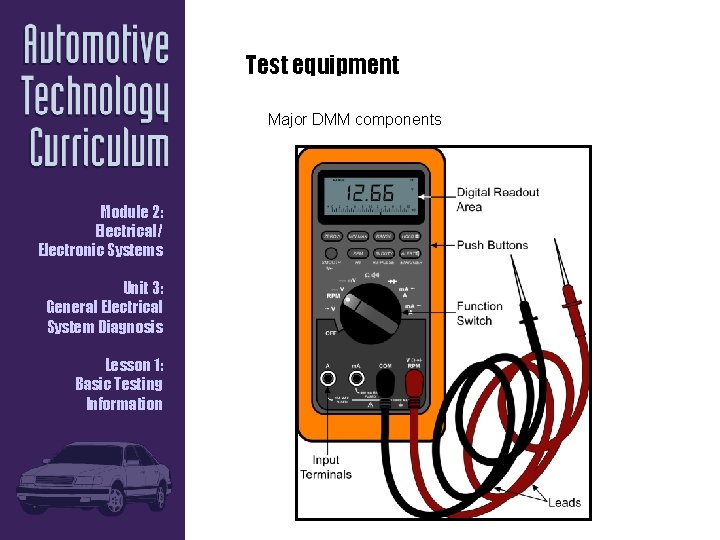
Test equipment Major DMM components Module 2: Electrical/ Electronic Systems Unit 3: General Electrical System Diagnosis Lesson 1: Basic Testing Information
Test equipment NOTE: DMMs vary somewhat depending on the manufacturer, but many DMMs will have the following features. • Module 2: Electrical/ Electronic Systems Unit 3: General Electrical System Diagnosis Lesson 1: Basic Testing Information The top part of the DMM has the digital readout area where the readings are displayed. Some DMMs have needles similar to older analog meters. The digital reading is displayed in numerical values with decimal points along with prefixes and symbols. The decimal point, prefixes, and symbols must all be properly interpreted to get an accurate reading. Symbols displayed on the meter include the following: M – means mega or million k – means kilo or thousand m – means milli or one-thousandth
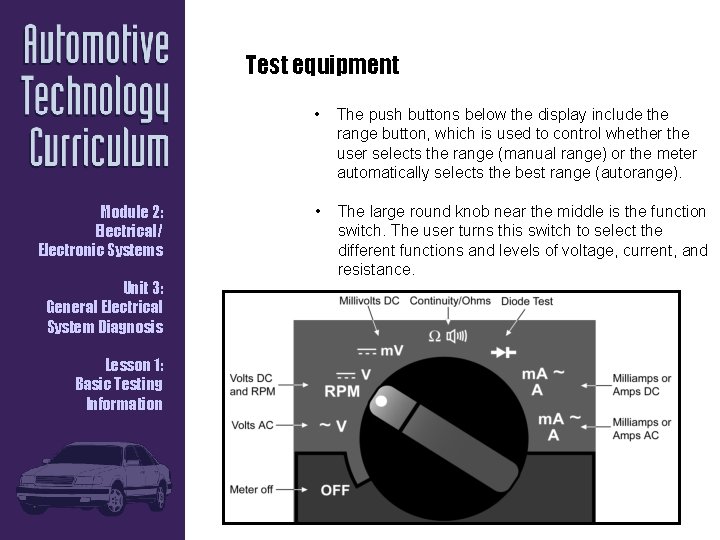
Test equipment Module 2: Electrical/ Electronic Systems Unit 3: General Electrical System Diagnosis Lesson 1: Basic Testing Information • The push buttons below the display include the range button, which is used to control whether the user selects the range (manual range) or the meter automatically selects the best range (autorange). • The large round knob near the middle is the function switch. The user turns this switch to select the different functions and levels of voltage, current, and resistance.
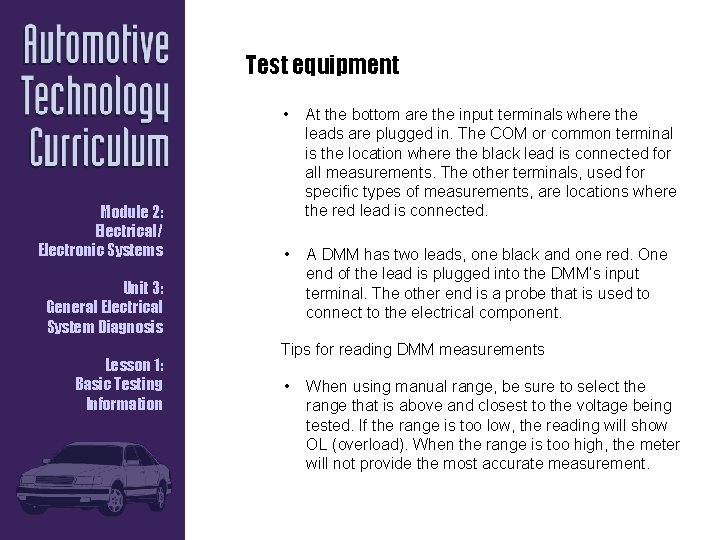
Test equipment Module 2: Electrical/ Electronic Systems • At the bottom are the input terminals where the leads are plugged in. The COM or common terminal is the location where the black lead is connected for all measurements. The other terminals, used for specific types of measurements, are locations where the red lead is connected. • A DMM has two leads, one black and one red. One end of the lead is plugged into the DMM’s input terminal. The other end is a probe that is used to connect to the electrical component. Unit 3: General Electrical System Diagnosis Lesson 1: Basic Testing Information Tips for reading DMM measurements • When using manual range, be sure to select the range that is above and closest to the voltage being tested. If the range is too low, the reading will show OL (overload). When the range is too high, the meter will not provide the most accurate measurement.
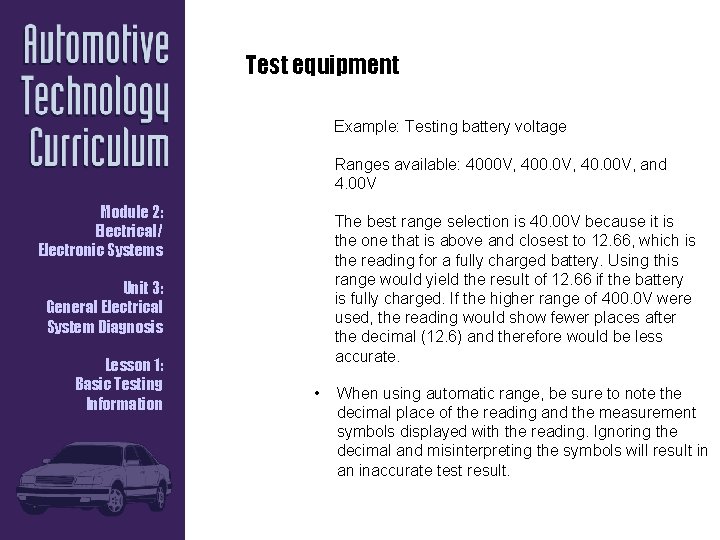
Test equipment Example: Testing battery voltage Ranges available: 4000 V, 400. 0 V, 40. 00 V, and 4. 00 V Module 2: Electrical/ Electronic Systems The best range selection is 40. 00 V because it is the one that is above and closest to 12. 66, which is the reading for a fully charged battery. Using this range would yield the result of 12. 66 if the battery is fully charged. If the higher range of 400. 0 V were used, the reading would show fewer places after the decimal (12. 6) and therefore would be less accurate. Unit 3: General Electrical System Diagnosis Lesson 1: Basic Testing Information • When using automatic range, be sure to note the decimal place of the reading and the measurement symbols displayed with the reading. Ignoring the decimal and misinterpreting the symbols will result in an inaccurate test result.
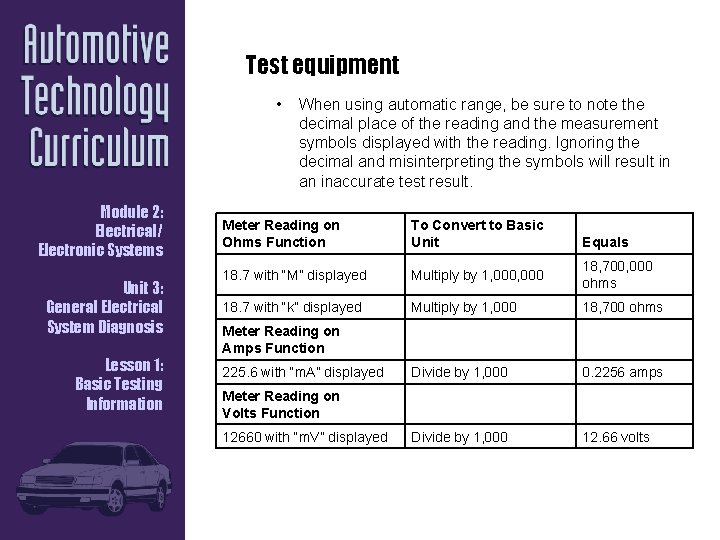
Test equipment • Module 2: Electrical/ Electronic Systems Unit 3: General Electrical System Diagnosis Lesson 1: Basic Testing Information When using automatic range, be sure to note the decimal place of the reading and the measurement symbols displayed with the reading. Ignoring the decimal and misinterpreting the symbols will result in an inaccurate test result. Meter Reading on Ohms Function To Convert to Basic Unit 18. 7 with “M” displayed Multiply by 1, 000 18, 700, 000 ohms 18. 7 with “k” displayed Multiply by 1, 000 18, 700 ohms Divide by 1, 000 0. 2256 amps Divide by 1, 000 12. 66 volts Equals Meter Reading on Amps Function 225. 6 with “m. A” displayed Meter Reading on Volts Function 12660 with “m. V” displayed
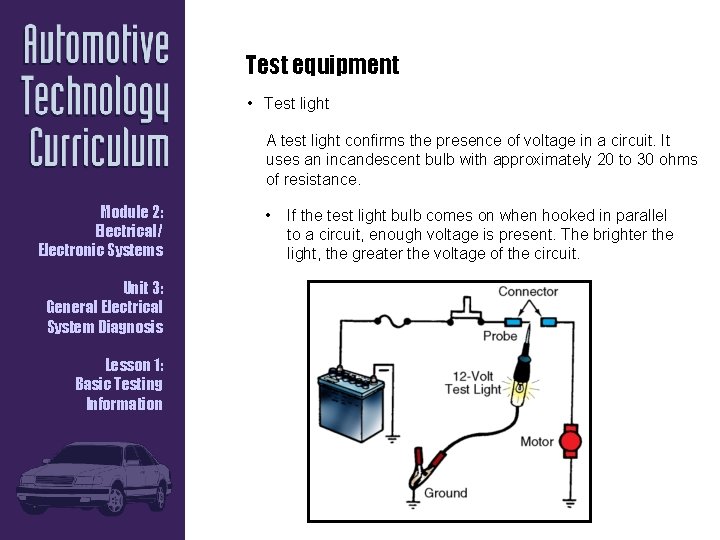
Test equipment • Test light A test light confirms the presence of voltage in a circuit. It uses an incandescent bulb with approximately 20 to 30 ohms of resistance. Module 2: Electrical/ Electronic Systems Unit 3: General Electrical System Diagnosis Lesson 1: Basic Testing Information • If the test light bulb comes on when hooked in parallel to a circuit, enough voltage is present. The brighter the light, the greater the voltage of the circuit.
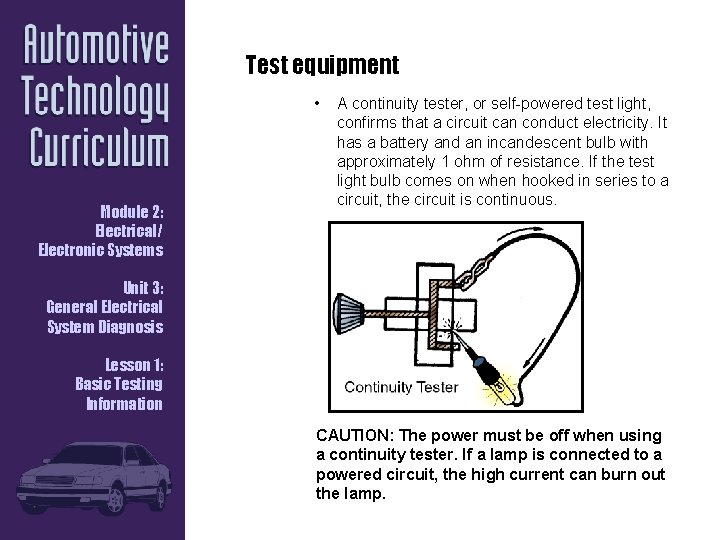
Test equipment • Module 2: Electrical/ Electronic Systems A continuity tester, or self-powered test light, confirms that a circuit can conduct electricity. It has a battery and an incandescent bulb with approximately 1 ohm of resistance. If the test light bulb comes on when hooked in series to a circuit, the circuit is continuous. Unit 3: General Electrical System Diagnosis Lesson 1: Basic Testing Information CAUTION: The power must be off when using a continuity tester. If a lamp is connected to a powered circuit, the high current can burn out the lamp.
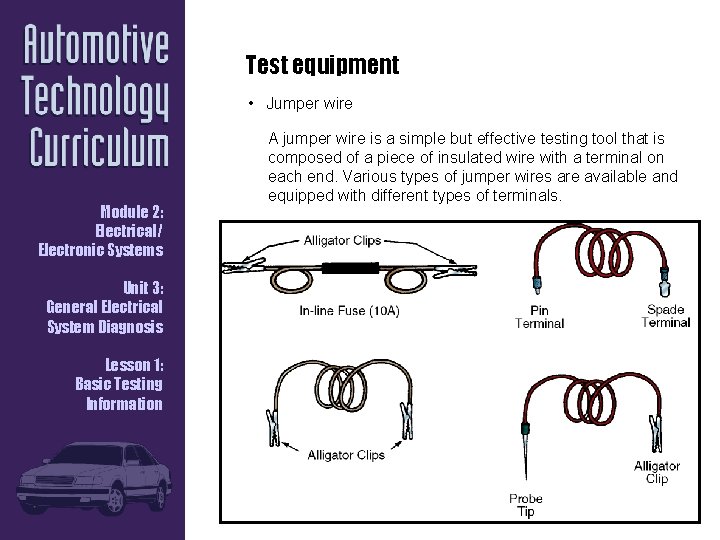
Test equipment • Jumper wire Module 2: Electrical/ Electronic Systems Unit 3: General Electrical System Diagnosis Lesson 1: Basic Testing Information A jumper wire is a simple but effective testing tool that is composed of a piece of insulated wire with a terminal on each end. Various types of jumper wires are available and equipped with different types of terminals.
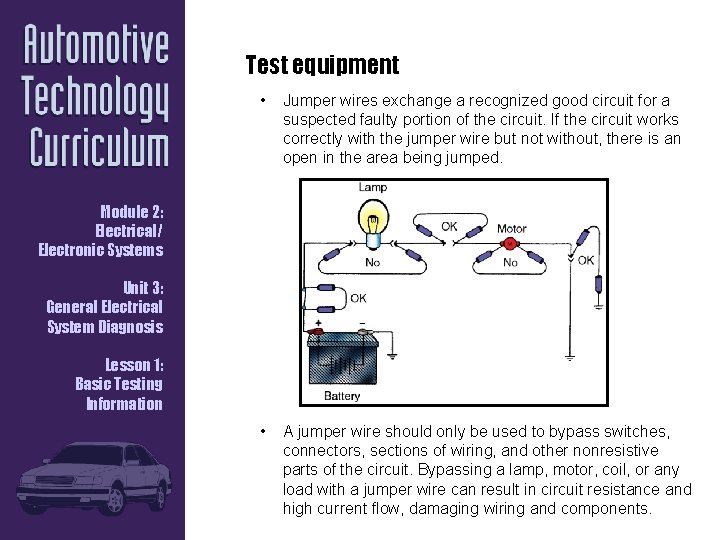
Test equipment • Jumper wires exchange a recognized good circuit for a suspected faulty portion of the circuit. If the circuit works correctly with the jumper wire but not without, there is an open in the area being jumped. • A jumper wire should only be used to bypass switches, connectors, sections of wiring, and other nonresistive parts of the circuit. Bypassing a lamp, motor, coil, or any load with a jumper wire can result in circuit resistance and high current flow, damaging wiring and components. Module 2: Electrical/ Electronic Systems Unit 3: General Electrical System Diagnosis Lesson 1: Basic Testing Information
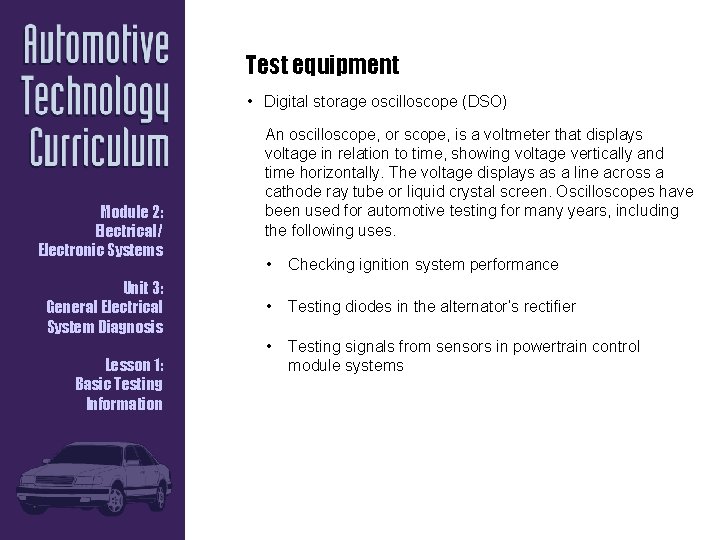
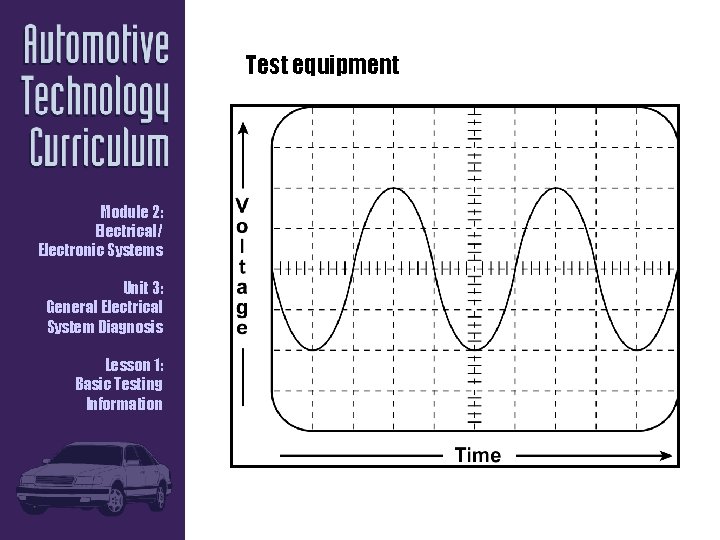
Test equipment • Digital storage oscilloscope (DSO) Module 2: Electrical/ Electronic Systems Unit 3: General Electrical System Diagnosis Lesson 1: Basic Testing Information An oscilloscope, or scope, is a voltmeter that displays voltage in relation to time, showing voltage vertically and time horizontally. The voltage displays as a line across a cathode ray tube or liquid crystal screen. Oscilloscopes have been used for automotive testing for many years, including the following uses. • Checking ignition system performance • Testing diodes in the alternator’s rectifier • Testing signals from sensors in powertrain control module systems
Test equipment Module 2: Electrical/ Electronic Systems Unit 3: General Electrical System Diagnosis Lesson 1: Basic Testing Information
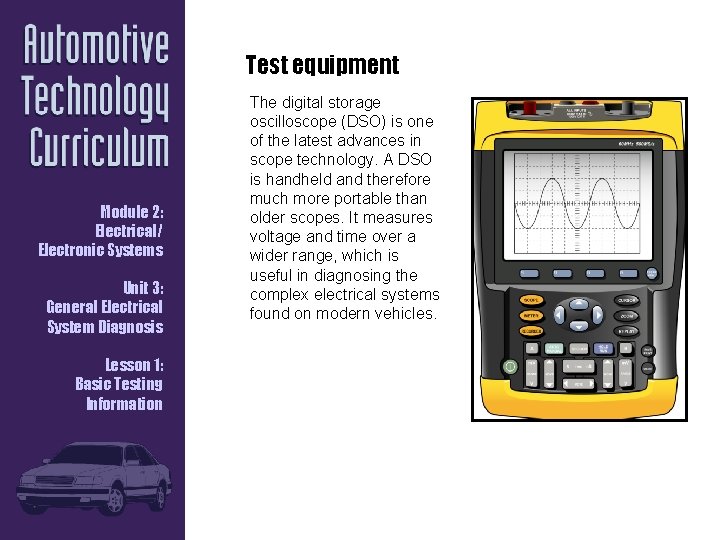
Test equipment Module 2: Electrical/ Electronic Systems Unit 3: General Electrical System Diagnosis Lesson 1: Basic Testing Information The digital storage oscilloscope (DSO) is one of the latest advances in scope technology. A DSO is handheld and therefore much more portable than older scopes. It measures voltage and time over a wider range, which is useful in diagnosing the complex electrical systems found on modern vehicles.
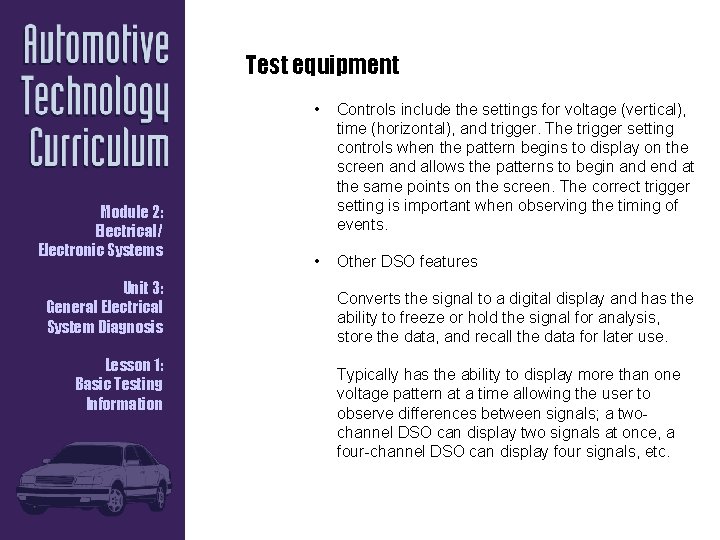
Test equipment Module 2: Electrical/ Electronic Systems Unit 3: General Electrical System Diagnosis Lesson 1: Basic Testing Information • Controls include the settings for voltage (vertical), time (horizontal), and trigger. The trigger setting controls when the pattern begins to display on the screen and allows the patterns to begin and end at the same points on the screen. The correct trigger setting is important when observing the timing of events. • Other DSO features Converts the signal to a digital display and has the ability to freeze or hold the signal for analysis, store the data, and recall the data for later use. Typically has the ability to display more than one voltage pattern at a time allowing the user to observe differences between signals; a twochannel DSO can display two signals at once, a four-channel DSO can display four signals, etc.
Test equipment May provide sample good patterns for common automotive tests, such as the correct pattern for an alternator under full load, that can be used to compare to the signal being tested. Module 2: Electrical/ Electronic Systems Unit 3: General Electrical System Diagnosis Lesson 1: Basic Testing Information May have a feature that identifies and stores abnormal readings, called glitches.