
Module 2 Differential Diagnosis Part 4 Selective Tissue
- Slides: 17
Module 2 Differential Diagnosis Part 4: Selective Tissue Tension Tests Neurological Dural Special CCMT/jm/08/01 1
Neurological Tests Examine the function of: • • • cortex spinal cord cerebellum brain stem spinal nerve/root peripheral nerve CCMT/jm/08/01 2
Tests • myotome • dermatome • reflexes CCMT/jm/08/01 3
Motor (Myotome/Key Muscles) • strength – paresis – paralysis • fatigability – non-fatigable – fatigable • distribution – segmental – non-segmental CCMT/jm/08/01 4
Sensory (Dermatome) Light Touch and/or Pinprick – hypoaesthesia – anaesthesia – dysethesia – hyperesthesia – allodynia – etc • distribution – segmental – non-segmental CCMT/jm/08/01 5
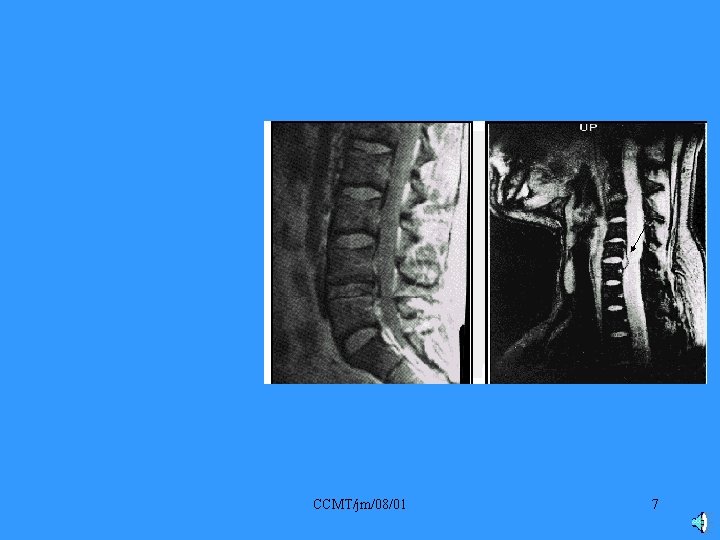
Distributions of Sensory Loss CCMT/jm/08/01 6
CCMT/jm/08/01 7
Reflexes • reflexes – deep tendon – clonus – Babinski – Hoffman – Oppenheimer – Shimizu CCMT/jm/08/01 8
Deep Tendon and Clonus Reflexes Essentially the same reflex - dynamic stretch • Response – hyporeflexia – areflexia – excessively brisk – hyperreflexive – recruitment or overflow – paradoxical • Distribution – segmental – non-segmental CCMT/jm/08/01 9
Babinski and Oppenheimer Also essentially the same reflex - flexor withdrawal • Response – normal - downgoing or none – abnormal - upgoing with toe splaying CCMT/jm/08/01 10
Hoffman’s Flexor withdrawal Reflex • Response – minimal positive = flexion of terminal phalanx of thumb – maximal positive = complete flexion of the hand arm – negative = none CCMT/jm/08/01 11
Hoffman’s This is probably the most sensitive test for cervical disc herniations compressing the cord. One study found this to be at least twice as sensitive as other upper motor neuron tests. Roger D, Sung, MD, and Jeffrey C. Wang, MD. Correlation Between a Positive Hoffmann's Reflex and Cervical Pathology in Asymptomatic Individuals. SPINE 26, 1, pp 67‑ 410 CCMT/jm/08/01 12
Shimizu Probably a trapezius DTR • Test – tap acromion or spine of scapular with reflex hammer • Response – shoulder abduction or girdle elevation • Indicates – cord lesion above C 5 CCMT/jm/08/01 13
Other Neurological Tests • cranial nerves • other long tract tests (eg. vibration, graphesthesia etc) • Rhomberg’s • dysmetric tests • etc. CCMT/jm/08/01 14
Dural Mobility Tests Test dural mobility and irritability centrally and peripherally • • • SLR and adjunctive tests PKF and adjunctive tests Scapular Retraction Neck Flexion Coughing Slump CCMT/jm/08/01 15
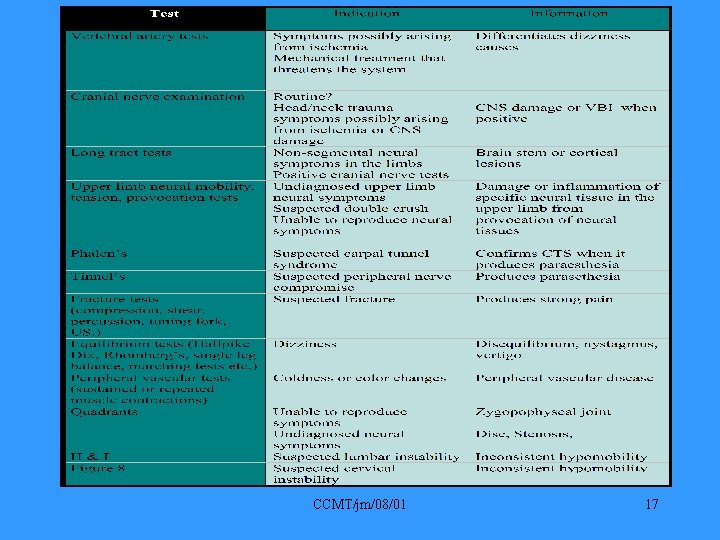
Special Tests None routine tests carried out when there is an indication to do them either from the examination or because of a particular treatment you are planning on doing. CCMT/jm/08/01 16
CCMT/jm/08/01 17