
Module 2 Concepts of Server Clusters Introduction to
- Slides: 4
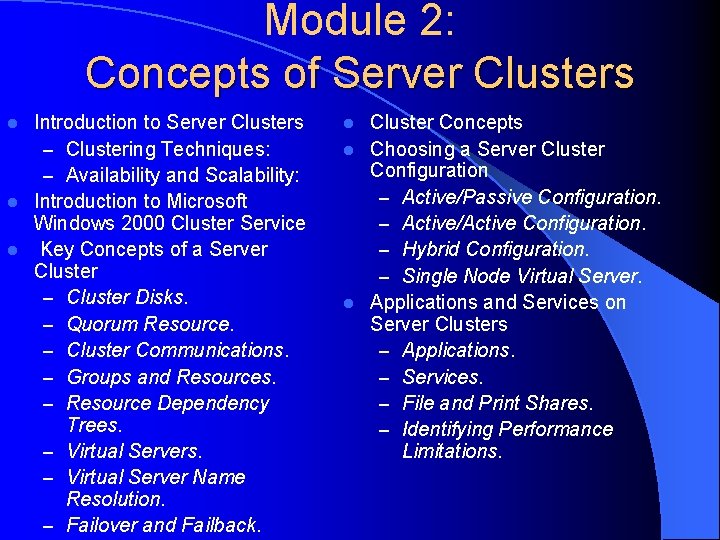
Module 2: Concepts of Server Clusters Introduction to Server Clusters – Clustering Techniques: – Availability and Scalability: l Introduction to Microsoft Windows 2000 Cluster Service l Key Concepts of a Server Cluster – Cluster Disks. – Quorum Resource. – Cluster Communications. – Groups and Resources. – Resource Dependency Trees. – Virtual Server Name Resolution. – Failover and Failback. l Cluster Concepts l Choosing a Server Cluster Configuration – Active/Passive Configuration. – Active/Active Configuration. – Hybrid Configuration. – Single Node Virtual Server. l Applications and Services on Server Clusters – Applications. – Services. – File and Print Shares. – Identifying Performance Limitations. l
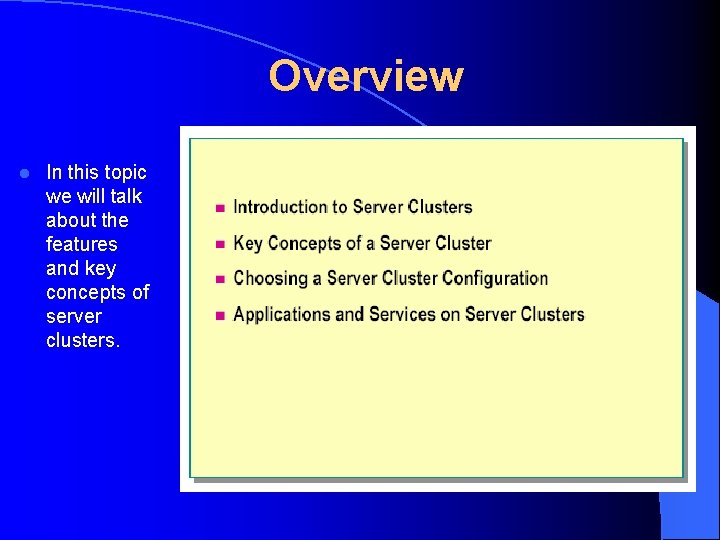
Overview l In this topic we will talk about the features and key concepts of server clusters.
l This module provides an explanation of server cluster terms and key concepts. Topics include considerations for choosing cluster configuration options and determining which applications and services will be included in the server cluster. Information that is unique to the installation of Microsoft® Cluster service is covered, such as naming and addressing conventions and how resources and groups function within a server cluster.
l After completing this module, you will be able to: – Explain the features of clustering technologies. – Define the key terms and concepts of a server cluster. – Choose a server cluster configuration. – Describe how Cluster service supports applications and services.