
MODULE 2 Biology of Earthworms Biology Biology is
MODULE 2 Biology of Earthworms
Biology • Biology is the study of living organisms, divided into many specialized fields that cover their morphology, physiology, anatomy, behavior, origin, and distribution.
Biology of Earthworm Morphology of Earthworms have a tube-like arrangement or cylindrical shaped and reddish-brown segmented body. • The body is divided into small segments. • The dorsal side is characterized by a dark line of blood vessels and ventral side is characterized by the genital openings. • The mouth and the prostomium (an organ helps in burrowing) distinguish the anterior end.
Contd… • The segments 14 -16 of a matured earthworm consist of a glandular tissue called clitellum which helps us to distinguish the mouth and tail ends. The body is divided into three segments with respect to clitellum- pre clitellar, clitellar and post clitellar.
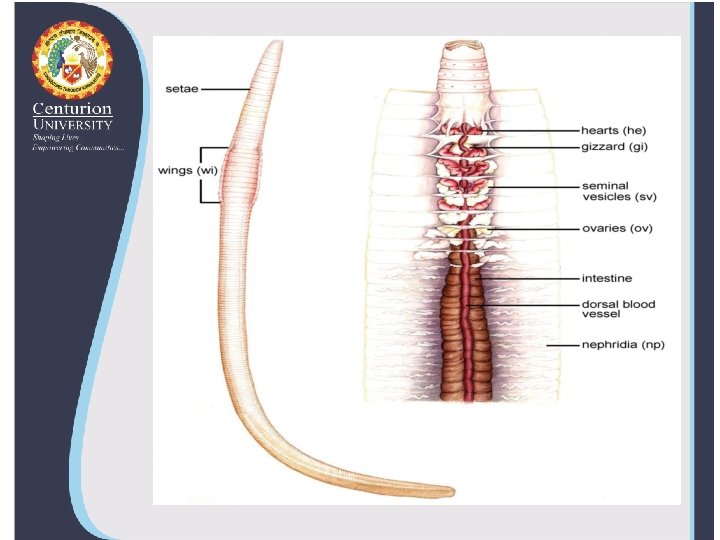
• Earthworms are hermaphrodites i. e. , they carry both male and female sex organs. Segments 5 -9 accommodate four pairs of spermathecal apertures. • The female genital pore is situated at the 14 thsegment and a pair of male genital pores is situated at the 18 th segment. • The body consists of S-shaped setae, which help in locomotion in the earthworm. Setae are present in each segment except in the first, last and clitellum segments.
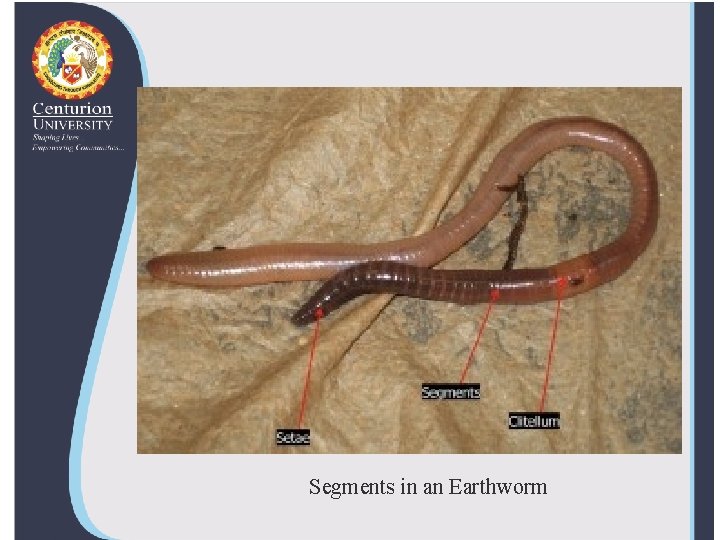
Segments in an Earthworm
Anatomy • Externally, a thin non-cellular cuticle covers the body wall of the earthworm. • Underneath this cuticle, a layer of the epidermis, followed by two muscle layers and coelomic epithelium (inner layer) is sheathed. • The epithelium consists of a single layer of glandular columnar epithelium.
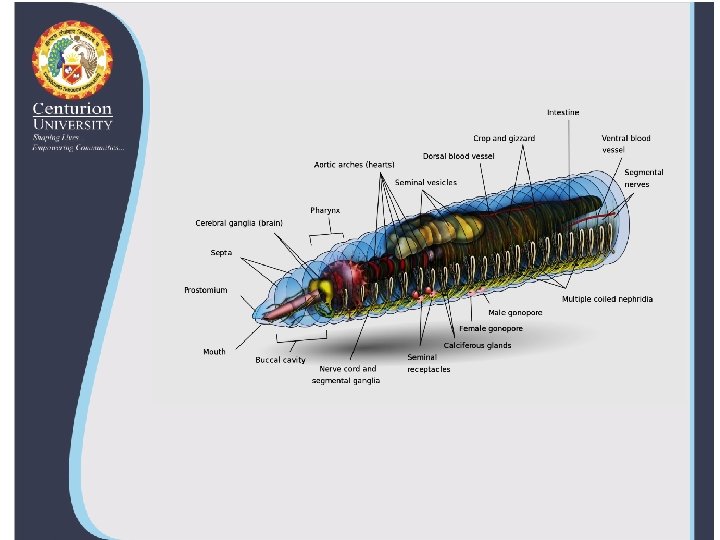
Digestive System • The alimentary canal is a long tube running from first to the last segment of the body. The food of earthworms is the leaves and decaying organic matters which are mixed with soil.
§ According to the diet, the parts of the alimentary canal and their secretion differ from other organisms. § The alimentary canal begins at the mouth (buccal or oral cavity) (1 -3 segments), passes through the pharynx, esophagus (5 -7 segments), muscular gizzards (8 -9 segments), stomach (9 -14 segments), intestines, and finally ends at the anus
§ The food particles get digested gradually as they travel through various compartments of the alimentary canal. § The muscular gizzards grind the soil particles and other matters and at the stomach, the humic acid of the hummus gets neutralized by the calciferous glands present in them. § The typhlosole (26 -35 segments) present in the intestine increases the surface area for absorption.
Circulatory System Earthworms have a closed circulatory system, constituting a heart, blood vessels, and capillaries. The segments 4 -6 consist of blood glands that help in the production of blood cells and hemoglobin.
Respiratory System Earthworms lack a well-developed structure for respiration. They respire through their moist skin by diffusion.
Excretory System • Nephridium is coiled tubules that regulate the volume and composition of the body fluids and thus, act as the excretory organ in earthworms. Nephridia are arranged in three segments- septal (15 -last segments), integumentary (3 -last segments) and pharyngeal nephridia (4 -6 segments). • A funnel that is connected to nephridia delivers wastes and excess fluid and is excreted out via the digestive tube.
Nervous System § The sensory input and muscular responses are controlled by the ganglia which are arranged segment-wise in the organism. § These ganglia, on the paired nerve cord, make up the nervous system of the earthworms
Sensory System Although earthworms lack eyes they have specialized receptor cells to recognize the changes around them. • Specialized sensory organs and chemoreceptors help them to respond to stimuli perfectly. • The sensory system of the earthworms is present in the anterior portion of the body.
Reproductive System • Earthworms are bisexual. Hence, each individual carries both male and female reproductive systems in them. • The male reproductive system consists of two pairs of testes (10 -11 segments), vasa deferentia (till 18 thsegment), and two pairs of accessory glands (17 th and 19 th segments).
• The prostate and spermatic ducts open by a pair of male genital pores (18 th segment). The spermatozoa are stored in the four pairs of spermathecae (6 -9 segments).
• The female reproductive system consists of one pair of ovaries and oviduct. Ovaries open into an ovarian funnel running below the ovaries and join the oviduct and open at female genital pore (14 thsegment).
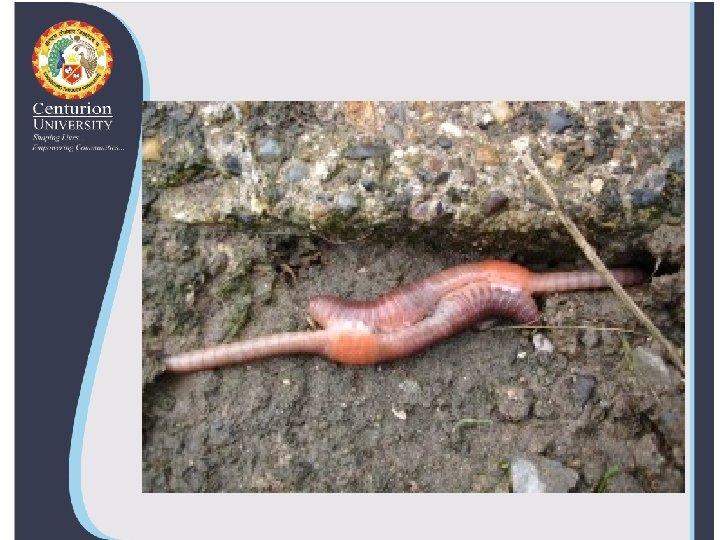
During copulation, two earthworms exchange their sperms. Then, the collected sperm and egg and the nutritive fluids are deposited in the cocoon, which is later deposited into the soil.
Earthworm multiplication Cocoons A cocoon is the small, yellow, lemon-shaped object that is produced by red wiggler mating. According to C. A. Edwards and P. J. Bohlen in Biology and Ecology of Earthworms, red wigglers can produce as many as 198 cocoons per year.
• Gestation occurs over a period of 11 weeks. The cocoon is hardened mucus and, like a bird egg, contains all the necessary nutrients for the development of the hatchlings. Each cocoon contains between two and twenty potential hatchlings. On average, three will emerge
• Climate conditions directly offset cocoon production; for example, when there is too little moisture, the worms will cease reproduction. • Peak production occurs when ambient ground air temperatures are between 65º-85ºF (18º-27ºC) and the environmental moisture content within the bin is between 80 -90%. • That means moist to the touch but not dripping (like a wrung-out sponge).
• When environmental conditions are not appropriate for survival, the cocoons will lie dormant awaiting more favourable conditions. Cocoons have been known to survive for up to three years under extremely dry conditions without being adversely affected.
Hatchlings § It takes five to 11 weeks for the cocoon to mature and hatch. § The newly hatched worms first appear as tiny white, thread-like creatures. § In approximately eight hours they gain their haemoglobin and change colour from white to pale pink to brick red.
• Depending on bin conditions, temperature and moisture, hatchlings can take from 53 to 75 days to become sexually mature — two to two and one -half months. • The complete generational cycle from one adult worm to the next is anywhere from three to five months
Juveniles § Adolescence is a short-lived phase for red wigglers. The length of the worm increases almost daily as their principal function during this phase is to eat, eat! § Like many creatures, sexual maturity in red wigglers is delayed by cold weather, but not growth rate.
• Juvenile worms are distinguishable from adult worms because they look the same from head to tail and do not have the band indicating the clitellum. • They are the same colour as adults and may be just as large. • Red wigglers spend an average of 56 to 72 days or about 8 to 11 weeks in this development stage
Adults • Adult red wigglers are characterized by the formation of their bulbous clitellum. • The presence of the clitellum means they are sexually mature.
• Diet plays a key role in the worm's size, which may vary from four to seven inches. • Smaller size does not mean that something is wrong, but smaller worms produce smaller cocoons and fewer offspring.
- Slides: 32