
Module 2 Active Labour Market Policies ILO 2013

Module 2: Active Labour Market Policies ILO, 2013
Topics to be covered Background The difference between active and passive policies Objectives Types Advantages Functioning of ALMPs in developed and developing economies • Benazir Income Support Programme, Pakistan • Expanded Public Works Programme, South Africa • • •
Background Universal Declaration of Human Rights, 1948: “Everyone has the right to work, to free choice of employment, to just and favourable conditions of work and to protection against unemployment. “ Employment Policy Convention, 1964 (No. 122): “With a view to stimulating economic growth and development, raising levels of living, meeting manpower requirements and overcoming unemployment and underemployment, each Member shall declare and pursue, as a major goal, an active policy designed to promote full, productive and freely chosen employment. ”
Background Definition: “Government programmes that intervene in the labour market to help the unemployed find work. ” They are part of policy and practice: ILO’s Decent Work Agenda, adopted in 1999 Combination of ALMPs and UI exist in Europe, America and some countries of Asia

Active and passive policies Active labour market policies Passive labour market policies Provide active support for labour market integration Contingent upon participation in training and work programmes Provide income replacement during periods of unemployment or job search Typical measures include training, PWPs, enterprise creation, employment subsidies Typical programmes include unemployment insurance, unemployment assistance, early retirement For everyone May target special vulnerable groups who are hard to place, e. g. the youth, women, long-term unemployed, elderly, disabled Not contingent upon participation in training and work programmes (though job search is usually included)
Objectives Ø To improve the functioning of the labour market by matching demand supply; Ø To encourage decent work, improve employability of the unemployed, underemployed, poor and vulnerable groups; Ø To provide goods and services, such as public infrastructure in rural areas.
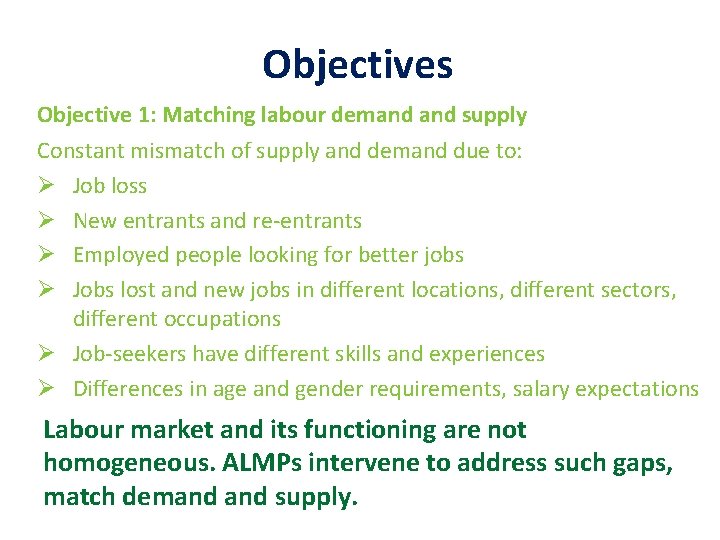
Objectives Objective 1: Matching labour demand supply Constant mismatch of supply and demand due to: Ø Job loss Ø New entrants and re-entrants Ø Employed people looking for better jobs Ø Jobs lost and new jobs in different locations, different sectors, different occupations Ø Job-seekers have different skills and experiences Ø Differences in age and gender requirements, salary expectations Labour market and its functioning are not homogeneous. ALMPs intervene to address such gaps, match demand supply.
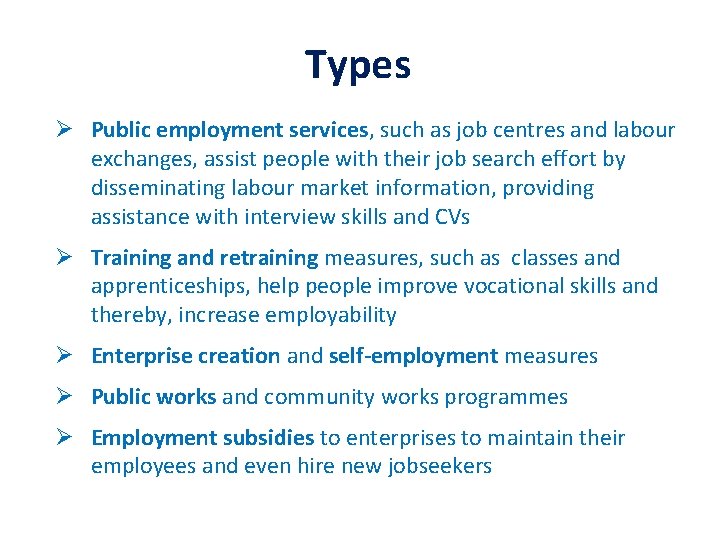
Types Ø Public employment services, such as job centres and labour exchanges, assist people with their job search effort by disseminating labour market information, providing assistance with interview skills and CVs Ø Training and retraining measures, such as classes and apprenticeships, help people improve vocational skills and thereby, increase employability Ø Enterprise creation and self-employment measures Ø Public works and community works programmes Ø Employment subsidies to enterprises to maintain their employees and even hire new jobseekers
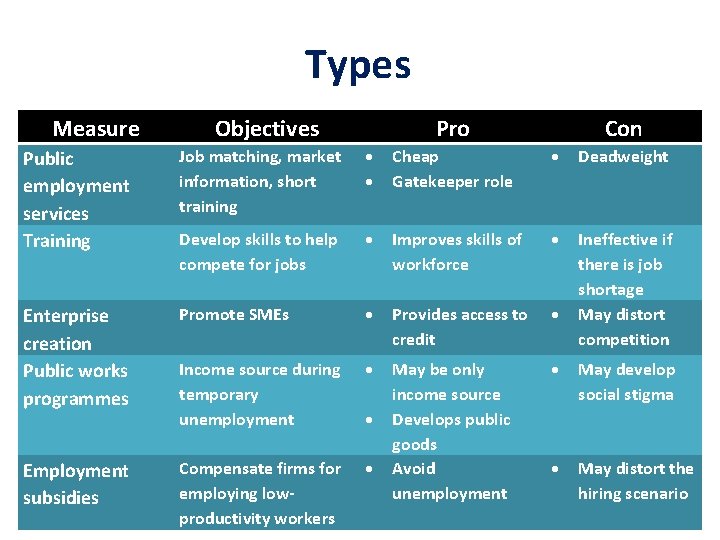
Types Measure Objectives Pro Con Public employment services Training Job matching, market information, short training Cheap Gatekeeper role Deadweight Develop skills to help compete for jobs Improves skills of workforce Enterprise creation Public works programmes Promote SMEs Provides access to credit Ineffective if there is job shortage May distort competition Income source during temporary unemployment May develop social stigma Employment subsidies Compensate firms for employing lowproductivity workers May be only income source Develops public goods Avoid unemployment May distort the hiring scenario
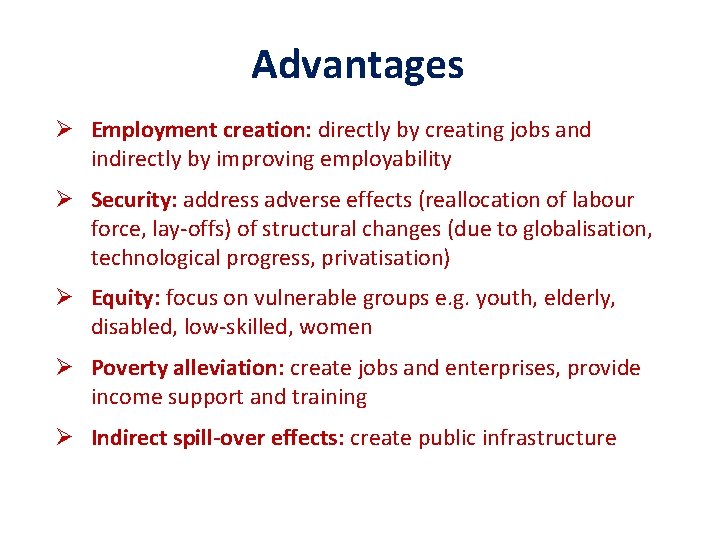
Advantages Ø Employment creation: directly by creating jobs and indirectly by improving employability Ø Security: address adverse effects (reallocation of labour force, lay-offs) of structural changes (due to globalisation, technological progress, privatisation) Ø Equity: focus on vulnerable groups e. g. youth, elderly, disabled, low-skilled, women Ø Poverty alleviation: create jobs and enterprises, provide income support and training Ø Indirect spill-over effects: create public infrastructure
Functioning in developed and developing economies Ø Developing economies: vast informal economy consumes many new labour market entrants directly Ø Developed economies: greater role in placing job-seekers in formal enterprises Ø Developed economies: protect workers exiting from shrinking private sector enterprises
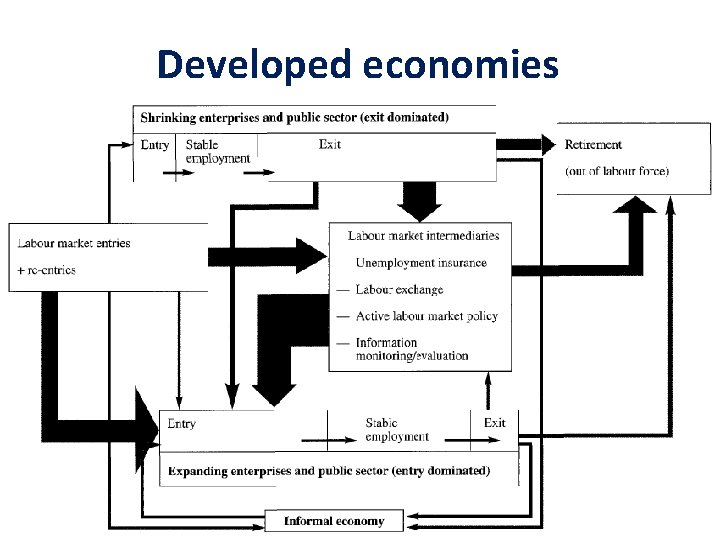
Developed economies
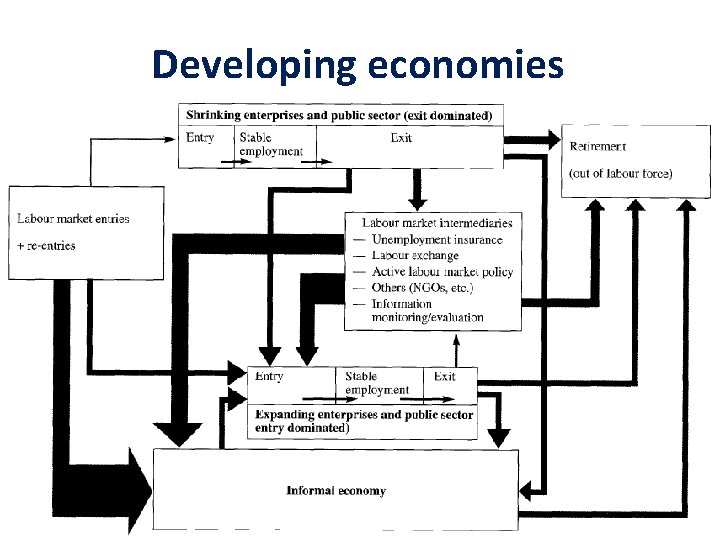
Developing economies
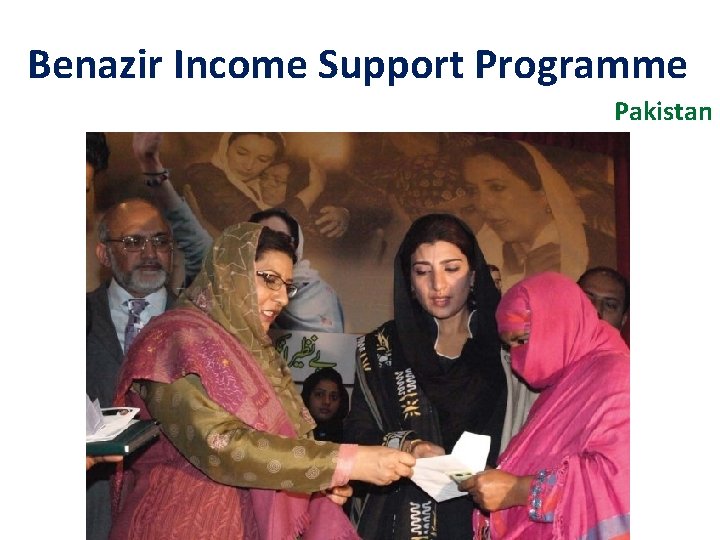
Benazir Income Support Programme Pakistan
Benazir Income Support Programme Pakistan Provides a cash transfer (US$10 / month) & integrated package: Ø Waseela-e-Haq: interest-free loans of up to US$ 3, 000 to women for self-ventures Ø Waseela-e-Rozgar: 1 year of vocational training to women Ø Waseela-e-Sehat: life insurance coverage of about US$1, 000, family health insurance up to US$250 / year Ø Waseela-e-Taleem: monthly cash transfer of US$2 / child, conditional on primary school enrolment and 70% attendance
Benazir Income Support Programme Pakistan Ø Targets women, very poor households, remote areas Ø To empower households, improve living standards, invest in human capital formation, especially among women and children Ø Complementary interventions to help families graduate out of poverty Ø Movement from unconditional to co-responsibility cash transfers (with linkages to training, entrepreneurship) Ø Women are central focus of cash transfers and benefits
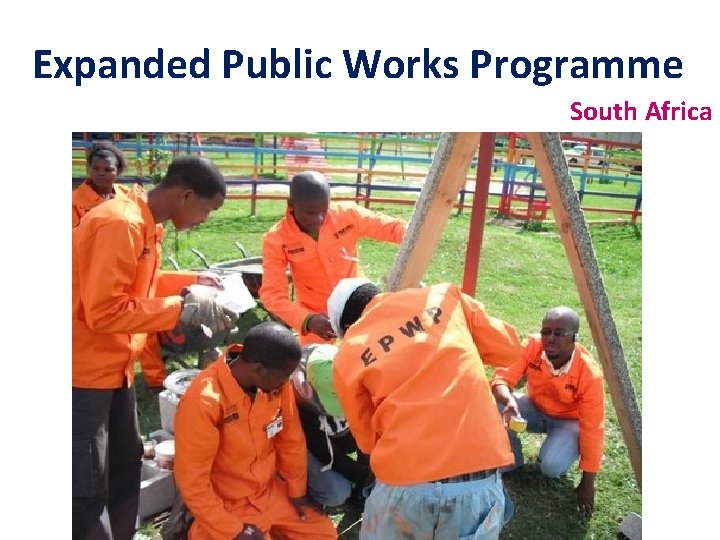
Expanded Public Works Programme South Africa
Expanded Public Works Programme South Africa Ø Growing labour force, high unemployment Ø Challenges: reduce unemployment, alleviate poverty, strengthen skills, improve social services Ø An element of the government strategy to reduce poverty through temporary work, provide work exposure Ø Wages set lower than minimum formal sector wages Ø No UI obligated, 2 days of training / 22 days of work, OSH standards, compensation for work-related injuries, sickness and maternity leaves
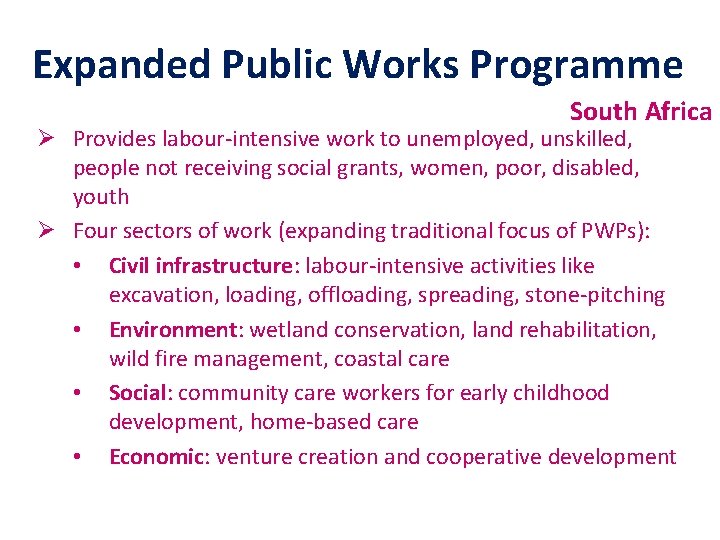
Expanded Public Works Programme South Africa Ø Provides labour-intensive work to unemployed, unskilled, people not receiving social grants, women, poor, disabled, youth Ø Four sectors of work (expanding traditional focus of PWPs): • Civil infrastructure: labour-intensive activities like excavation, loading, offloading, spreading, stone-pitching • Environment: wetland conservation, land rehabilitation, wild fire management, coastal care • Social: community care workers for early childhood development, home-based care • Economic: venture creation and cooperative development
- Slides: 19