
Module 2 4 Distributed Systems Motivation Types of
Module 2. 4: Distributed Systems • • • Motivation Types of Distributed Operating Systems Distributed Coordination – Event Ordering – Mutual Exclusion – Deadlock Handling – Election Algorithms K. Salah 1 Operating Systems
Motivation • Distributed system is collection of loosely coupled processors interconnected by a communications network • Processors variously called nodes, computers, machines, hosts – Site is location of the processor • Reasons for distributed systems – Resource sharing T sharing and printing files at remote sites T processing information in a distributed database T using remote specialized hardware devices – Computation speedup – load sharing – Reliability – detect and recover from site failure, function transfer, reintegrate failed site – Communication – message passing K. Salah 2 Operating Systems
Types of Network-Oriented OSes • Network Operating Systems – Users are aware of multiplicity of machines. Access to resources of various machines is done explicitly by: T Remote logging into the appropriate remote machine (telnet, ssh) T Transferring data from remote machines to local machines, via the File Transfer Protocol (FTP) mechanism • Distributed Operating Systems – Users not aware of multiplicity of machines T Access to remote resources similar to access to local resources – Data Migration – transfer data by transferring entire file, or transferring only those portions of the file necessary for the immediate task – Computation Migration – transfer the computation, rather than the data, across the system T via RPC T via requests in messages (http requests) T via process miagration K. Salah 3 Operating Systems
Distributed-Operating Systems (Cont. ) • Process Migration – execute an entire process, or parts of it, at different sites – Load balancing – distribute processes across network to even the workload – Computation speedup – subprocesses can run concurrently on different sites – Hardware preference – process execution may require specialized processor – Software preference – required software may be available at only a particular site – Data access – run process remotely, rather than transfer all data locally K. Salah 4 Operating Systems
Distributed Coordination • Event Ordering • Mutual Exclusion • Deadlock Handling • Election Algorithms K. Salah 5 Operating Systems
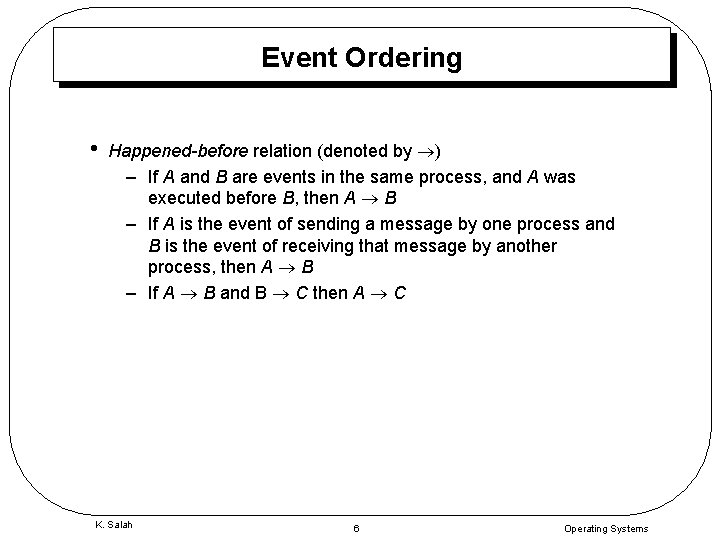
Event Ordering • Happened-before relation (denoted by ) – If A and B are events in the same process, and A was executed before B, then A B – If A is the event of sending a message by one process and B is the event of receiving that message by another process, then A B – If A B and B C then A C K. Salah 6 Operating Systems
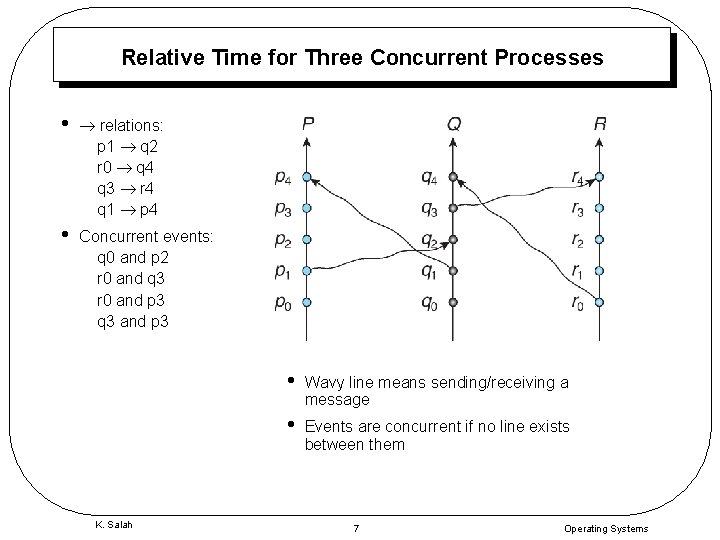
Relative Time for Three Concurrent Processes • relations: p 1 q 2 r 0 q 4 q 3 r 4 q 1 p 4 • Concurrent events: q 0 and p 2 r 0 and q 3 r 0 and p 3 q 3 and p 3 K. Salah • Wavy line means sending/receiving a message • Events are concurrent if no line exists between them 7 Operating Systems

Unique Timestamp • Why needed? – To do serialization of requests, i. e. implement relation – To guarantee never having same TS by two or more processes T For example in DME, which request to honor if we get same TS for 3 processes! • Centralized – Use NTP protocol – To synchronize, periodically update the clock from centralized server • Distributed – Each site generates a unique local timestamp T Local clock T Logical counter • The global unique timestamp is obtained by concatenation of the unique local timestamp with the unique site identifier in the LSB – Why LSB? • To synchronize, advance timestamp if a site receives a request with a larger timestamp. K. Salah 8 Operating Systems
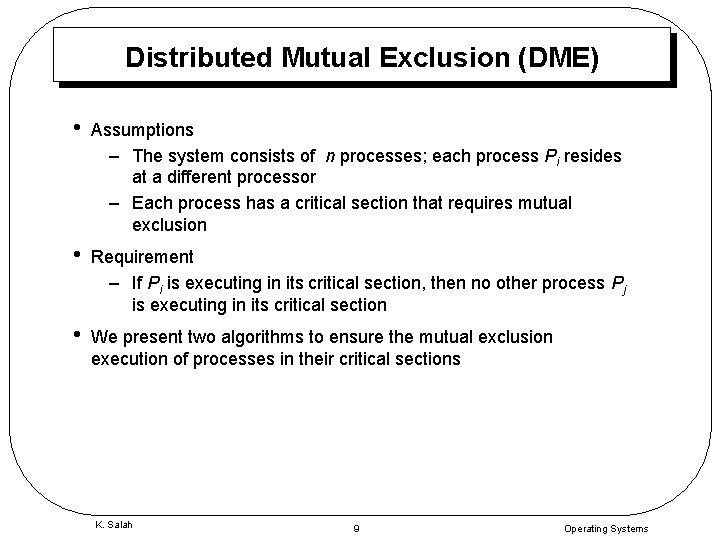
Distributed Mutual Exclusion (DME) • Assumptions – The system consists of n processes; each process Pi resides at a different processor – Each process has a critical section that requires mutual exclusion • Requirement – If Pi is executing in its critical section, then no other process Pj is executing in its critical section • We present two algorithms to ensure the mutual exclusion execution of processes in their critical sections K. Salah 9 Operating Systems
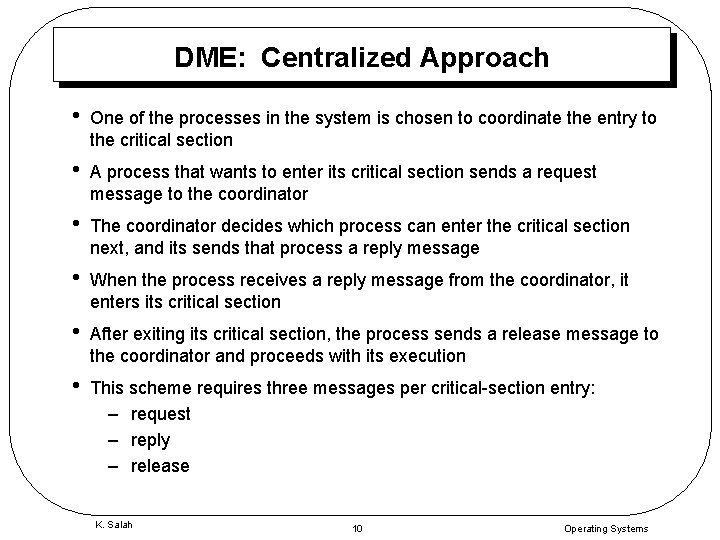
DME: Centralized Approach • One of the processes in the system is chosen to coordinate the entry to the critical section • A process that wants to enter its critical section sends a request message to the coordinator • The coordinator decides which process can enter the critical section next, and its sends that process a reply message • When the process receives a reply message from the coordinator, it enters its critical section • After exiting its critical section, the process sends a release message to the coordinator and proceeds with its execution • This scheme requires three messages per critical-section entry: – request – reply – release K. Salah 10 Operating Systems
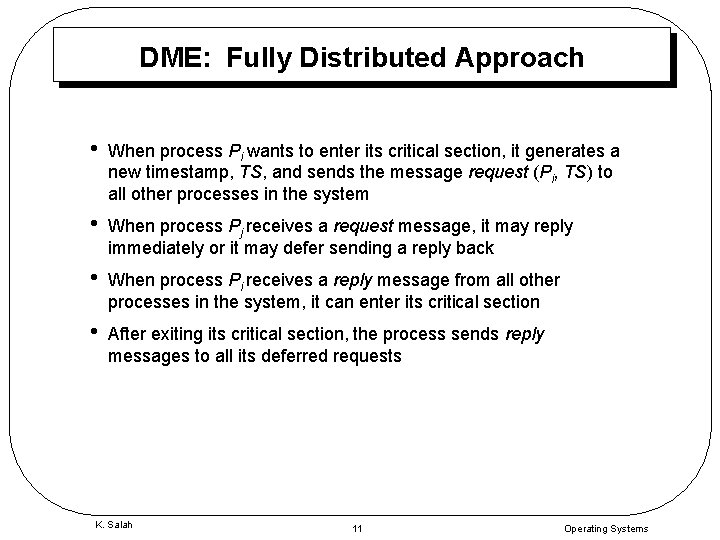
DME: Fully Distributed Approach • When process Pi wants to enter its critical section, it generates a new timestamp, TS, and sends the message request (Pi, TS) to all other processes in the system • When process Pj receives a request message, it may reply immediately or it may defer sending a reply back • When process Pi receives a reply message from all other processes in the system, it can enter its critical section • After exiting its critical section, the process sends reply messages to all its deferred requests K. Salah 11 Operating Systems
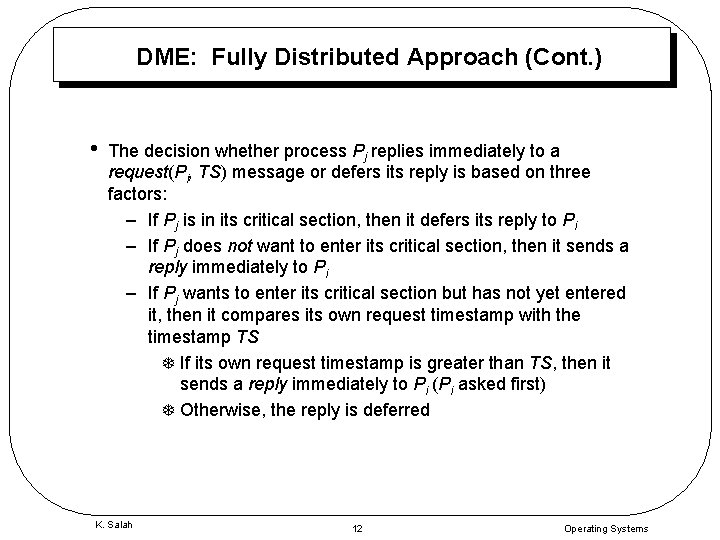
DME: Fully Distributed Approach (Cont. ) • The decision whether process Pj replies immediately to a request(Pi, TS) message or defers its reply is based on three factors: – If Pj is in its critical section, then it defers its reply to Pi – If Pj does not want to enter its critical section, then it sends a reply immediately to Pi – If Pj wants to enter its critical section but has not yet entered it, then it compares its own request timestamp with the timestamp TS T If its own request timestamp is greater than TS, then it sends a reply immediately to Pi (Pi asked first) T Otherwise, the reply is deferred K. Salah 12 Operating Systems
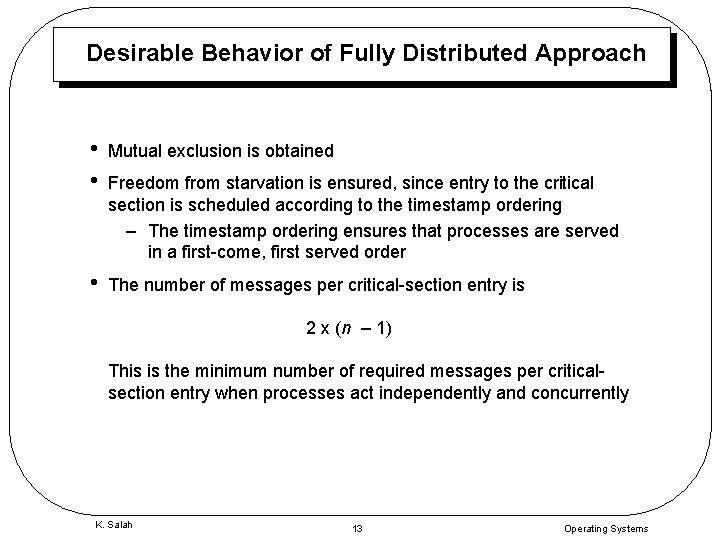
Desirable Behavior of Fully Distributed Approach • • Mutual exclusion is obtained • The number of messages per critical-section entry is Freedom from starvation is ensured, since entry to the critical section is scheduled according to the timestamp ordering – The timestamp ordering ensures that processes are served in a first-come, first served order 2 x (n – 1) This is the minimum number of required messages per criticalsection entry when processes act independently and concurrently K. Salah 13 Operating Systems
Three Undesirable Consequences • The processes need to know the identity of all other processes in the system, which makes the dynamic addition and removal of processes more complex • If one of the processes fails, then the entire scheme collapses – This can be dealt with by continuously monitoring the state of all the processes in the system • Processes that have not entered their critical section must pause frequently to process request messages – This protocol is therefore suited for small, stable sets of cooperating processes K. Salah 14 Operating Systems
Token-Passing Approach • Circulate a token among processes in system – Token is special type of message – Possession of token entitles holder to enter critical section • • Processes logically organized in a ring structure • • Unidirectional ring guarantees freedom from starvation Algorithm similar to P(S) and V(S) semaphore operations, but token substituted for shared variable Two types of failures – Lost token – election must be called – Failed processes – new logical ring established K. Salah 15 Operating Systems
Topics for Deadlocks in Distributed Systems • Deadlock Avoidance – Banker’s Algorithm • Deadlock Prevention – Using total resource ordering – No-cycle using priority of processes T Starvation occurs for static priority – Solution » Wait-Die » Wound-Wait • Deadlock Detection – Centralized Approach – Fully Distributed Approach K. Salah 16 Operating Systems
Deadlock Avoidance • Banker’s algorithm – designate one of the processes in the system as the process that maintains the information necessary to carry out the Banker’s algorithm – Simple to implement, but requires too much overhead K. Salah 17 Operating Systems
Deadlock Prevention • Using resource-ordering – define a global ordering among the system resources – Assign a unique number to all system resources – A process may request a resource with unique number i only if it is not holding a resource with a unique number grater than i – Simple to implement; requires little overhead K. Salah 18 Operating Systems
Deadlock Prevention • No Circular Wait by rolling back lower priority process • Each process Pi is assigned a unique priority number • Priority numbers are used to decide whether a process Pi should wait for a process Pj; otherwise Pi is rolled back or restarted – The easiest way for rollback is restarting the whole process to minimize overhead in saving process contexts • The scheme prevents deadlocks – For every edge Pi Pj in the wait-for graph, Pi has a higher priority than Pj T i. e. , the higher can wait for the lower, but the lower can not, it has to be restarted. – Thus a cycle cannot exist T We have Pi Pj T But not Pi Pj • With this starvation is possible for low-priority processes – Solution timestamp processes at genesis (and not at restart!!) T Wait-Die (wait if older, rollback if younger) T Wound-Wait (wound (and let younger rollback) if older, wait if younger, ) K. Salah 19 Operating Systems
Wait-Die Scheme • Based on a nonpreemptive technique • If Pi requests a resource currently held by Pj, Pi is allowed to wait only if it has a smaller timestamp than does Pj (Pi is older than Pj) – Otherwise, Pi is rolled back (dies) • Example: Suppose that processes P 1, P 2, and P 3 have timestamps 5, 10, and 15 respectively – if P 1 request a resource held by P 2, then P 1 will wait – If P 3 requests a resource held by P 2, then P 3 will be rolled back K. Salah 20 Operating Systems
Wound-Wait Scheme • Based on a preemptive technique; counterpart to the wait-die system • If Pi requests a resource currently held by Pj, Pi is allowed to wait only if it has a larger timestamp than does Pj (Pi is younger than Pj). Otherwise Pj is rolled back (Pj is wounded by Pi) – Older will wound younger, and the younger will die – Younger is allowed to wait • Example: Suppose that processes P 1, P 2, and P 3 have timestamps 5, 10, and 15 respectively – If P 1 requests a resource held by P 2, then the resource will be preempted from P 2 and P 2 will be rolled back – If P 3 requests a resource held by P 2, then P 3 will wait K. Salah 21 Operating Systems
• How is starvation is resolved? • Which scheme has fewer rollbacks and why? • What is the main problem with both schemes? K. Salah 22 Operating Systems
Deadlock Detection • We need to solve the problem of unnecessary preemption in deadlock prevention and avoidance • Do with deadlock detection • We assume: – Processes are global – Wait-graphs are local (per site) K. Salah 23 Operating Systems
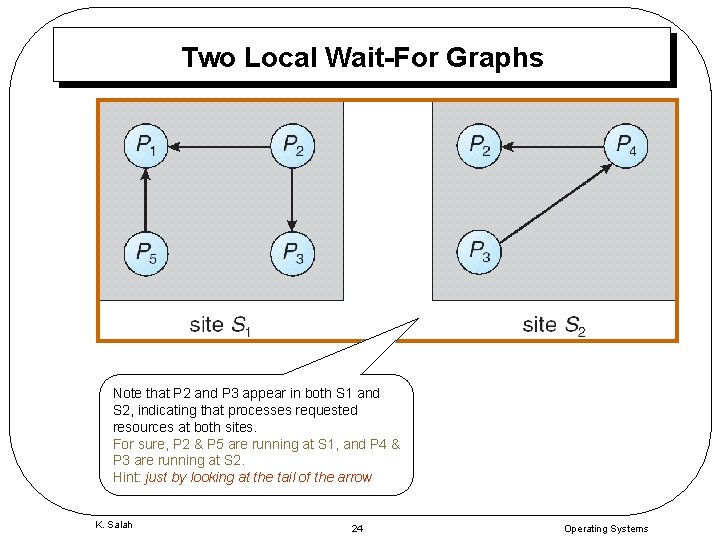
Two Local Wait-For Graphs Note that P 2 and P 3 appear in both S 1 and S 2, indicating that processes requested resources at both sites. For sure, P 2 & P 5 are running at S 1, and P 4 & P 3 are running at S 2. Hint: just by looking at the tail of the arrow K. Salah 24 Operating Systems
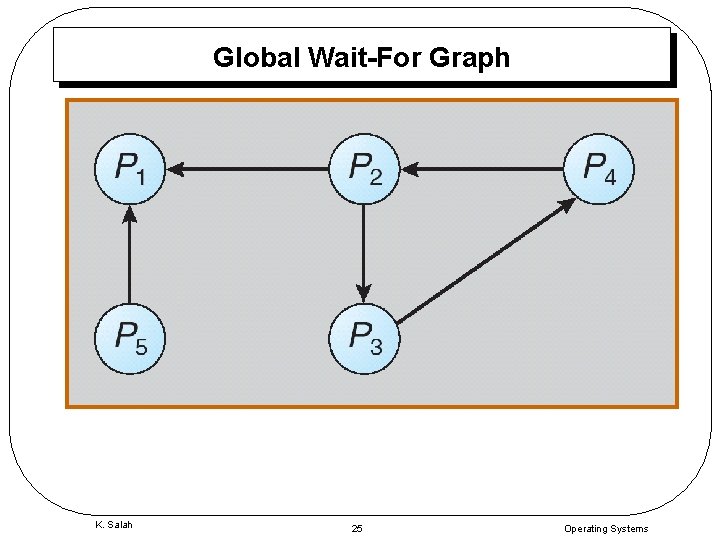
Global Wait-For Graph K. Salah 25 Operating Systems
Deadlock Detection – Centralized Approach • Each site keeps a local wait-for graph – The nodes of the graph correspond to all the processes that are currently either holding or requesting any of the resources local to that site • A global wait-for graph is maintained in a single coordination process; this graph is the union of all local wait-for graphs • There are three different options (points in time) when the wait-for graph may be constructed: 1. Whenever a new edge is inserted or removed in one of the local wait-for graphs 2. Periodically, when a number of changes have occurred in a wait-for graph 3. Whenever the coordinator needs to invoke the cycle-detection algorithm • Unnecessary rollbacks may occur as a result of false cycles – i. e. , the global wait-for graph has not been updated fast enough – Deadlock recovery started by the coordinator after wait-for cycle was broken at some site. – Example T P 2 release resources, and then P 2 request resource held by P 3 T Remove of request received after insert request – Solution is to report requests/releases with timestamp to coordinator, and do deadlock detection at a specific point in time and ignoring all requests that happened after this point. K. Salah 26 Operating Systems
Fully Distributed Approach • All controllers share equally the responsibility for detecting deadlock • Every site constructs a wait-for graph that represents a part of the total graph • • We add one additional node Pex to each local wait-for graph • A cycle involving Pex implies the possibility of a deadlock – To ascertain whether a deadlock does exist, a distributed deadlock-detection algorithm must be invoked If a local wait-for graph contains a cycle that does not involve node Pex, then the system is in a deadlock state K. Salah 27 Operating Systems
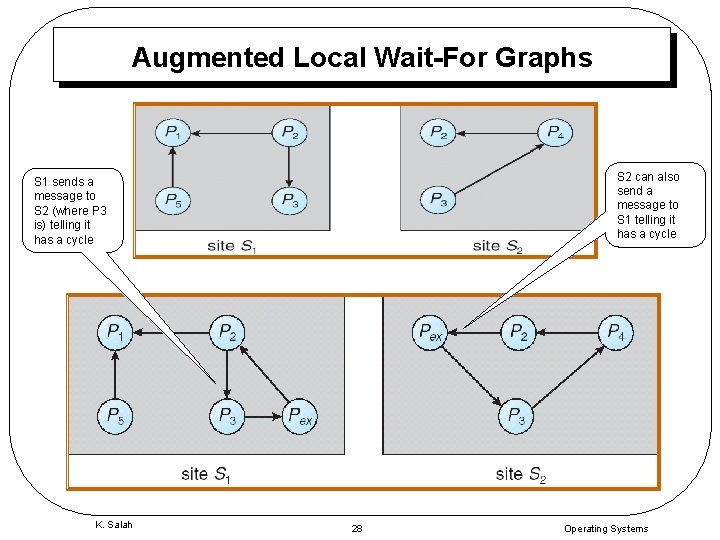
Augmented Local Wait-For Graphs S 2 can also send a message to S 1 telling it has a cycle S 1 sends a message to S 2 (where P 3 is) telling it has a cycle K. Salah 28 Operating Systems
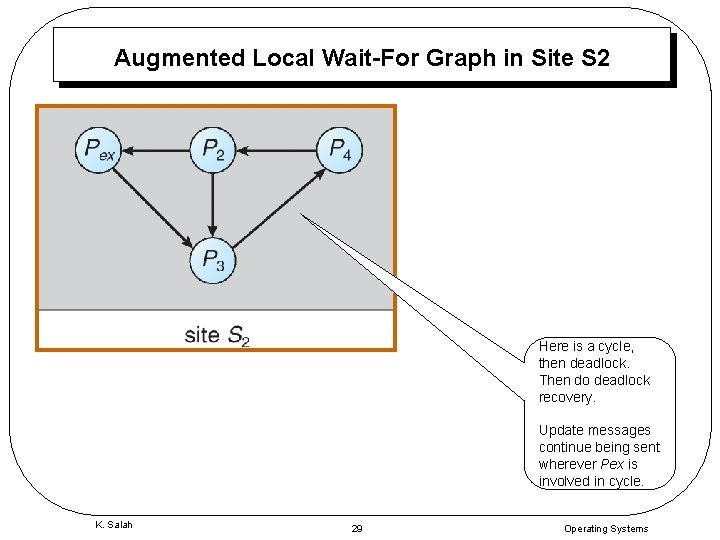
Augmented Local Wait-For Graph in Site S 2 Here is a cycle, then deadlock. Then do deadlock recovery. Update messages continue being sent wherever Pex is involved in cycle. K. Salah 29 Operating Systems
Failure of Coordinator • Coordinator needed for – Centralized ME resolution – Global deadlock detection – Replacing a lost token • What happens if coordinator (residing at some site) fails or the site crashes? – We need a new coordinator K. Salah 30 Operating Systems
Election Algorithms • • Determine where a new copy of the coordinator should be restarted • Assume a one-to-one correspondence between processes and sites • The coordinator is always the process with the largest priority number. When a coordinator fails, the algorithm must elect that active process with the largest priority number • Two algorithms can be used to elect a new coordinator in case of failures – the bully algorithm – the ring algorithm Assume that a unique priority number is associated with each active process in the system, and assume that the priority number of process Pi is i K. Salah 31 Operating Systems
Bully Algorithm • Higher process is cruel or abusing (or bullying) lower ones • Applicable to systems where every process can send a message to every other process in the system • If process Pi sends a request that is not answered by the coordinator within a time interval T, assume that the coordinator has failed; Pi tries to elect itself as the new coordinator • Pi sends an election message to every process with a higher priority number, Pi then waits for any of these processes to answer within T K. Salah 32 Operating Systems
Bully Algorithm (Cont. ) • If no response within T, assume that all processes with numbers greater than i have failed; Pi elects itself the new coordinator • If answer is received, Pi begins time interval T´, waiting to receive a message that a process with a higher priority number has been elected • If no message is sent within T´, assume the process with a higher number has failed; Pi should restart the algorithm K. Salah 33 Operating Systems
Bully Algorithm (Cont. ) • If Pi is not the coordinator, then, at any time during execution, Pi may receive one of the following two messages from process Pj – Pj is the new coordinator (j > i). Pi, in turn, records this information – Pj started an election (j < i). Pi, sends a response to Pj and begins its own election algorithm, provided that Pi has not already initiated such an election • After a failed process recovers, it immediately begins execution of the same algorithm • If there are no active processes with higher numbers, the recovered process forces all processes with lower number to let it become the coordinator process, even if there is a currently active coordinator with a lower number K. Salah 34 Operating Systems
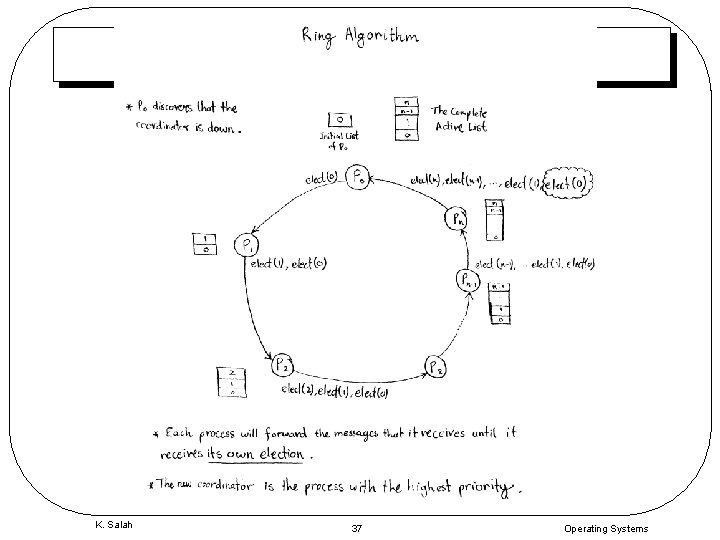
Ring Algorithm • Applicable to systems organized as a ring (logically or physically) • Assumes that the links are unidirectional, and that processes send their messages to their right neighbors • Each process maintains an active list, consisting of all the priority numbers of all active processes in the system when the algorithm ends • If process Pi detects a coordinator failure, Pi creates a new active list that is initially empty. It then sends a message elect(i) to its right neighbor, and adds the number i to its active list K. Salah 35 Operating Systems
Ring Algorithm (Cont. ) • • We assume messages are sent in order If Pi receives a message elect(j) from the process on the left, it must respond in one of three ways: 1. If this is the first elect message it has seen or sent, Pi creates a new active list with the numbers i and j F It then sends the message elect(i) first, followed by the message elect(j) F Why? This way new elects are placed ahead and will be seen before own elects. For example Pi+3 will send elect(i+3), elect(i+2), elect(i+1), elect(i). Pi will stop after seeing new ones before its own. 2. If i j, then j is added to the active list for Pi and forwards the message to the right neighbor. 3. If i = j, then Pi receives the message elect(i) F The active list for Pi contains all the active processes in the system F Pi can now determine the new coordinator process. K. Salah 36 Operating Systems
K. Salah 37 Operating Systems
- Slides: 37