
Module 18 Adolescence Adulthood INTRODUCTION Adolescence Developmental period


- Slides: 43
Module 18 Adolescence & Adulthood
INTRODUCTION • Adolescence – Developmental period, lasting from about ages __________, during which many biological, cognitive, social, and personality traits change from ________________
PUBERTY AND SEXUAL BEHAVIOR • Puberty – Developmental period between the ages of _______ – Individual experiences significant biological changes – Results in developing ___________ – _____________
PUBERTY AND SEXUAL BEHAVIOR (CONT’D) • Girls during puberty – Puberty sets off physical growth • starts 9. 6 years • begins 6 to 12 months before breast development – Puberty triggers a physiological process: female sexual maturity – Menarche • _________________ • estrogen levels increase ___________ • stimulates the development of both primary and secondary sexual characteristics
PUBERTY AND SEXUAL BEHAVIOR (CONT’D) • Menarche triggered by – Hypothalamus • releases hormone called ______(stimulates pituitary gland) – Pituitary gland • produces hormones that travel through the bloodstream and stimulate the ovaries to greatly increase production of female hormones
PUBERTY AND SEXUAL BEHAVIOR (CONT’D) • Girls during puberty – Estrogen • one of the major female hormones • stimulates both primary and secondary sexual characteristics – Female secondary sexual characteristics • triggered by increase of estrogen secretion • includes growth of pubic hair, development of breasts, and widening of hips • begins about 10. 5 years, continues for about 4 to 5 years
PUBERTY AND SEXUAL BEHAVIOR (CONT’D) • Boys during puberty – Increase in physical growth (height) age 13 to 14 – Male sexual maturity, includes growth of genital organs • begins around age 11 and continues for approximately three years • sperm production begins around age 12 to 14 – Testosterone • major male hormone • stimulates growth of genital organs • development of secondary sexual characteristics
PUBERTY AND SEXUAL BEHAVIOR (CONT’D) – Male secondary characteristics • triggered by increased secretion of testosterone; includes growth of pubic hair, facial hair, development of muscles, and a change (deepening) in voice • _________________
ADOLESCENTS: SEXUALLY MATURE • Bio. Psycho. Social approach – Adolescent development as a process that occurs simultaneously on many levels – Includes • • __________________ ___________________
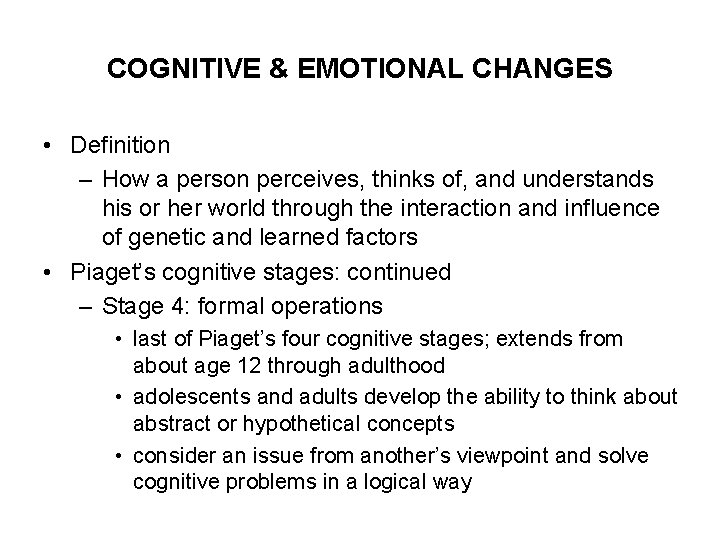
COGNITIVE & EMOTIONAL CHANGES • Definition – How a person perceives, thinks of, and understands his or her world through the interaction and influence of genetic and learned factors • Piaget’s cognitive stages: continued – Stage 4: formal operations • last of Piaget’s four cognitive stages; extends from about age 12 through adulthood • adolescents and adults develop the ability to think about abstract or hypothetical concepts • consider an issue from another’s viewpoint and solve cognitive problems in a logical way
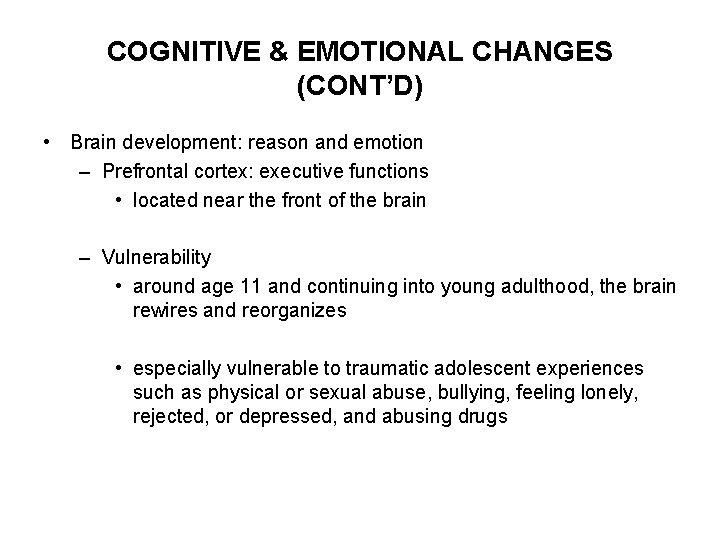
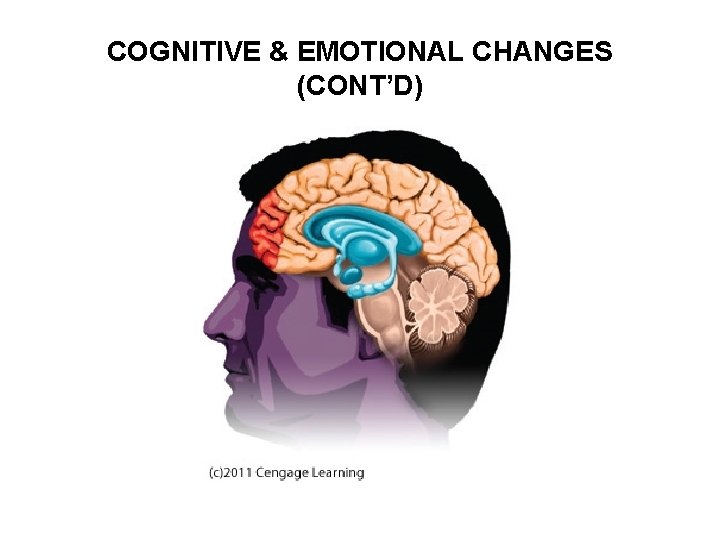
COGNITIVE & EMOTIONAL CHANGES (CONT’D) • Brain development: reason and emotion – Prefrontal cortex: executive functions • located near the front of the brain – Vulnerability • around age 11 and continuing into young adulthood, the brain rewires and reorganizes • especially vulnerable to traumatic adolescent experiences such as physical or sexual abuse, bullying, feeling lonely, rejected, or depressed, and abusing drugs
COGNITIVE & EMOTIONAL CHANGES (CONT’D) • Brain development: reason and emotion – Prefrontal cortex: executive functions • _________________ • explains why the adolescent’s brain (not being fully developed) allows for risky or irresponsible behavior • ___________________
COGNITIVE & EMOTIONAL CHANGES (CONT’D) • Brain development: reason and emotion – Limbic system: _____________ • teenagers have less control over their ____________________ • moody, emotional, and impulsive behaviors • display a wide range of emotion – being ecstatic over getting a date – feeling depressed when failing a test – getting angry when being insulted • increased structure and function of the limbic system accounts for irritability and aggression
COGNITIVE & EMOTIONAL CHANGES (CONT’D)
COGNITIVE & EMOTIONAL CHANGES • Kohlberg’s theory of moral reasoning – Three levels of moral reasoning 1. Self-interest: preconventional level • lowest level of moral reasoning • stage 1, moral decisions are based primarily on _______________________ • stage 2, moral reasoning is guided most _______________________ – __________________
COGNITIVE & EMOTIONAL CHANGES • Kohlberg’s theory of moral reasoning – Three levels of moral reasoning 2. Social approval: conventional level • represents an intermediate level of moral reasoning • stage 3, moral decisions are guided most by _______________________ • stage 4, moral reasoning is determined most by _______________________
COGNITIVE & EMOTIONAL CHANGES (CONT’D) • Kohlberg’s theory of moral reasoning – Three levels of moral reasoning 3. Abstract ideas: postconventional level • stage 5, moral decisions are made after ________ about all the alternatives and striking a balance between _____ and _______ • stage 6, has been omitted because few people have reached it
COGNITIVE & EMOTIONAL CHANGES (CONT’D) • Parenting styles and effects • Different styles of parenting – Authoritarian parents • attempt to shape, control, and evaluate the behavior and attitudes of their children in accordance with a set standard of conduct • ________________________________________
COGNITIVE & EMOTIONAL CHANGES (CONT’D) • Parenting styles and effects • Different styles of parenting – Authoritative parents • attempt to _____________________________________ • supportive, loving, committed, encourage verbal give and take, and discuss their rules and policies with their children
COGNITIVE & EMOTIONAL CHANGES (CONT’D) • Parenting styles and effects • Different styles of parenting – Permissive parents • less controlling and behave with a non-punishing and accepting attitude toward their children’s impulses, desires, and actions • consult with their children about policy decisions, make few demands, and tend to use reason rather than direct power
COGNITIVE & EMOTIONAL CHANGES (CONT’D) • Beyond adolescence – Changes in cognitive speed • 20 to 40, cognitive skills remain relatively stable • 40 to 80, general slowing of some cognitive processes • late 50 s, slowing in processing speed, perceptual speed, and reaction time – Changes in memory • 40 s and continuing into old age, most people complain about not remembering things
COGNITIVE & EMOTIONAL CHANGES • Resiliency – As we age, ________________________ – Connections to other brain cells multiply and form meaningful connections as a result of life experiences – ________________________________________________ ___ • Emotions – “Positivity bias” • ______________________________________________
PERSONALITY & SOCIAL CHANGES • Personality and social development – Refers to how a person develops a sense of self or self-identity, develops relationships with others, and develops the skills useful in social interactions • Personal identity or self-identity – Refers to how we describe ourselves and includes our values, goals, traits, perceptions, interests, and motivations
PERSONALITY & SOCIAL CHANGES (CONT’D) • Development of self-esteem – Self-esteem • how much we like ourselves and how much we value our self-worth, importance, attractiveness, and social competence – High self-esteem: develop and maintain high levels • 60% of adolescents develop and maintain a strong sense of self-esteem through junior high school • do well in school, develop rewarding friendships, participate in social activities, and are described as cheerful, assertive, warm, and unwilling to give up
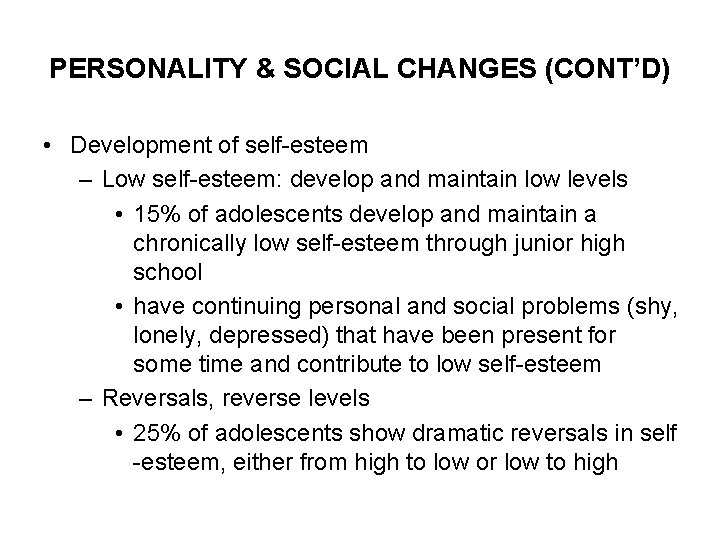
PERSONALITY & SOCIAL CHANGES (CONT’D) • Development of self-esteem – Low self-esteem: develop and maintain low levels • 15% of adolescents develop and maintain a chronically low self-esteem through junior high school • have continuing personal and social problems (shy, lonely, depressed) that have been present for some time and contribute to low self-esteem – Reversals, reverse levels • 25% of adolescents show dramatic reversals in self -esteem, either from high to low or low to high
PERSONALITY & SOCIAL CHANGES (CONT’D) • Adulthood: Erikson’s psychosocial stages – Stage 5: identity versus role confusion • ____________ (12 to 20) • adolescents need to leave behind the ______________________________________________ ______________________ • ______________________________________________ ___________________________________
PERSONALITY & SOCIAL CHANGES (CONT’D) • Adulthood: Erikson’s psychosocial stages – Stage 6: intimacy versus isolation • ______________________________________________ ______________________________________________ • ______________________________________________
PERSONALITY & SOCIAL CHANGES (CONT’D) • Adulthood: Erikson’s psychosocial stages – Stage 7: __________________________________ • ______________________________________________ • positive: ___________________ – also by mentoring at work and helping others • negative: ______________________________________________
PERSONALITY & SOCIAL CHANGES (CONT’D) • Adulthood: Erikson’s psychosocial stages – Stage 8: __________________________________ • time for reflecting on and reviewing how we met previous challenges and lived our lives • positive : if ______________________________________________ • negative: ______________________________________________
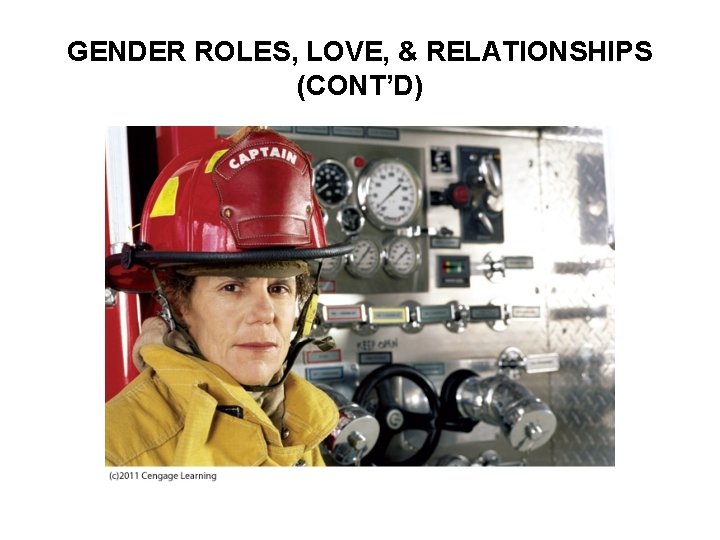
GENDER ROLES, LOVE, & RELATIONSHIPS • Definition: gender roles – Gender roles • traditional or stereotypical behaviors, attitudes, values, and personality traits that society says are how males and females are to think and behave – US gender roles • female gender role includes being caring, insecure, helpful, emotional, social, and shy • male gender role includes being arrogant, selfconfident, aggressive, ambitious, unemotional, and dominant
GENDER ROLES, LOVE, & RELATIONSHIPS (CONT’D)
GENDER ROLES, LOVE, & RELATIONSHIPS (CONT’D) • Definition: gender roles – Worldwide gender roles • male gender roles include being ambitious, dominant, and independent • female gender roles include being submissive, affectionate, and emotional • differences in gender roles are clearly defined because society (family, peers, bosses, and colleagues) encourages and rewards behaviors and thoughts that match expected gender roles and discriminates against those who don’t fit
GENDER ROLES, LOVE, & RELATIONSHIPS (CONT’D) • Gender roles: development and function – Evolutionary psychology theory • emphasizes genetic and biological forces and says that current gender differences are a continuation of the behaviors that evolved from early men and women who adapted these different behaviors in their attempts to survive the problems of their time – Social role theory • emphasizes social and cultural influences and states that gender differences between males and females arise from different divisions of labor
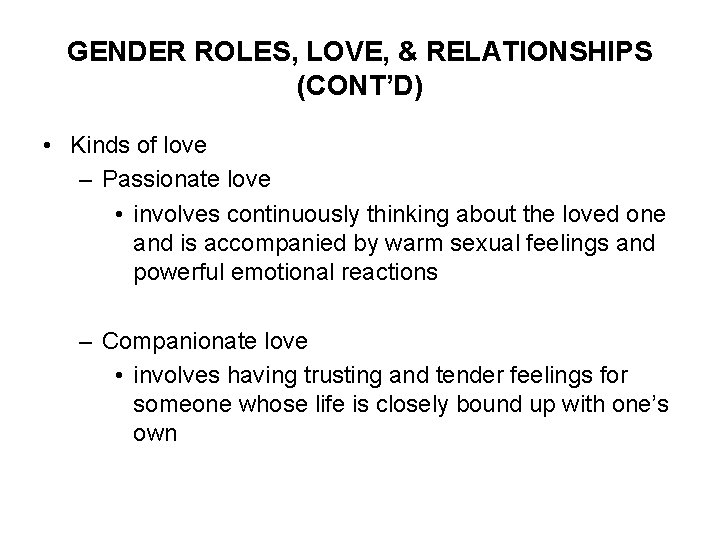
GENDER ROLES, LOVE, & RELATIONSHIPS (CONT’D) • Kinds of love – Passionate love • involves continuously thinking about the loved one and is accompanied by warm sexual feelings and powerful emotional reactions – Companionate love • involves having trusting and tender feelings for someone whose life is closely bound up with one’s own
GENDER ROLES, LOVE, & RELATIONSHIPS (CONT’D)
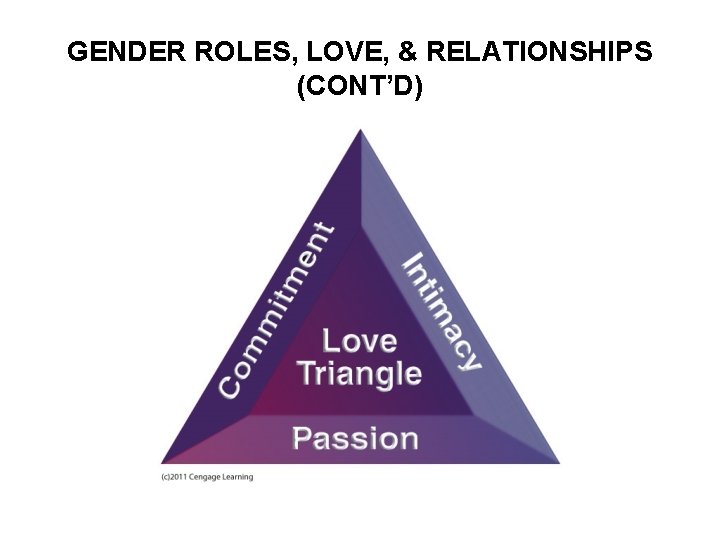
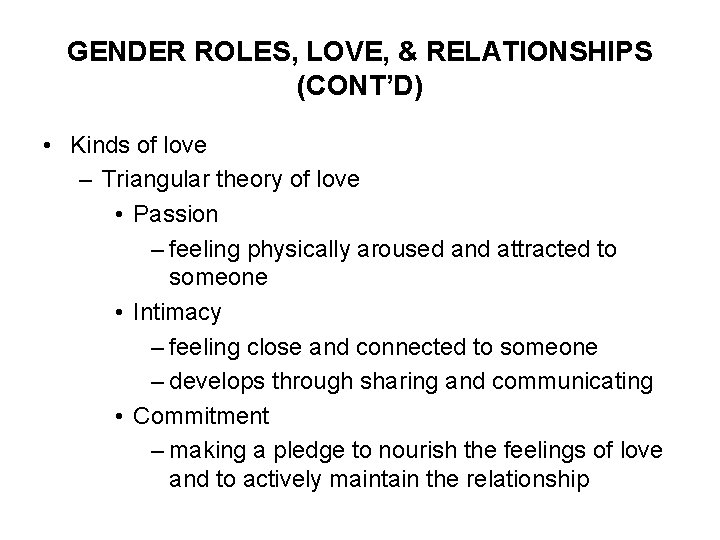
GENDER ROLES, LOVE, & RELATIONSHIPS (CONT’D) • Kinds of love – Triangular theory of love • Passion – feeling physically aroused and attracted to someone • Intimacy – feeling close and connected to someone – develops through sharing and communicating • Commitment – making a pledge to nourish the feelings of love and to actively maintain the relationship
GENDER ROLES, LOVE, & RELATIONSHIPS (CONT’D)
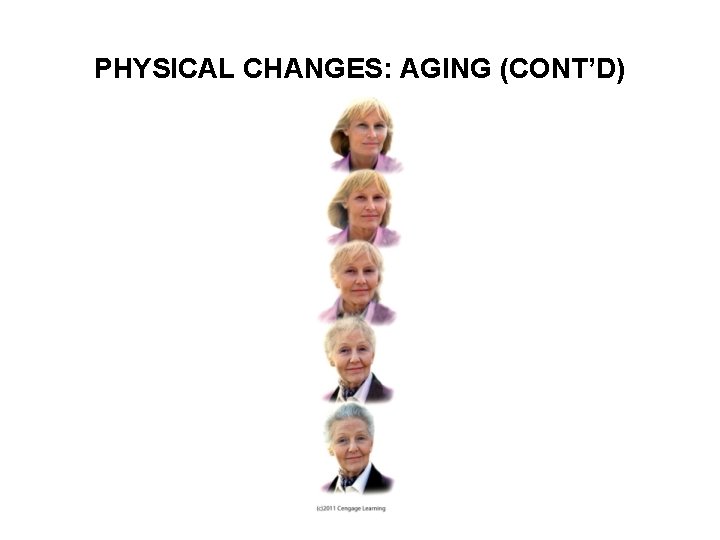
PHYSICAL CHANGES: AGING • Kinds of aging – Normal aging • gradual and natural slowing of our physical and psychological processes from middle through late adulthood – Pathological aging • caused by genetic defects, physiological problems, or diseases, such as Alzheimer’s – Gerontology • study of aging
PHYSICAL CHANGES: AGING (CONT’D) • Aging and physiological changes – Aging process • caused by combination of certain genes and proteins that interfere with organ functioning and the natural production of toxic molecules (free radicals) • causes random damage to body organs and DNA • damage eventually exceeds the body’s ability to repair itself • results in grater susceptibility to diseases and death
PHYSICAL CHANGES: AGING (CONT’D)
PHYSICAL CHANGES: AGING (CONT’D) • Sexual changes with aging: women • Menopause – Average 50 (range 35 to 60) – Involves gradual stoppage of secretion of the major female hormone (estrogen) – Results in cessation of both ovulation and menstrual cycle – Physical symptoms • hot flashes, some sleep disturbance, and dryness of the vagina, which results from a decrease and eventual stoppage in the secretion of estrogen
PHYSICAL CHANGES: AGING (CONT’D) • Menopause – Psychological symptoms • moodiness, depression, anxiety, and anger – Sexual activities • women who experienced sexual activity as fulfilling and enriching before menopause will likely continue to enjoy sexual activity after menopause and into late adulthood
PHYSICAL CHANGES: AGING (CONT’D) • Sexual changes with aging: men – Sexual response • older men may require more time and stimulation to have an erection • healthy men usually have no difficulty in becoming sexually aroused or reaching orgasm – Physiological problems • some men see their decreased sexual abilities as a threat to their self-esteem