
Module 17 Vision Sensory and Perceptual Processing Josef
- Slides: 31
Module 17 Vision: Sensory and Perceptual Processing Josef F. Steufer/Getty Images
Vision: Sensory and Perceptual Processing Light Energy and Eye Structures 17 -1: WHAT ARE THE CHARACTERISTICS OF THE ENERGY THAT WE SEE AS VISIBLE LIGHT? WHAT STRUCTURES IN THE EYE HELP FOCUS THAT ENERGY? The Stimulus Input: Light Energy Wavelength—Distance from the peak of one light wave or sound wave to the peak of the next. Electromagnetic wavelengths vary from the short blips of cosmic rays to the long pulses of radio transmission. Intensity—Amount of energy in a light wave or sound wave, which influences what we perceive as brightness or loudness. Intensity is determined by the wave’s amplitude (height). Hue—Dimension of color that is determined by the wavelength of light; what we know as the color names blue, green, and so forth.
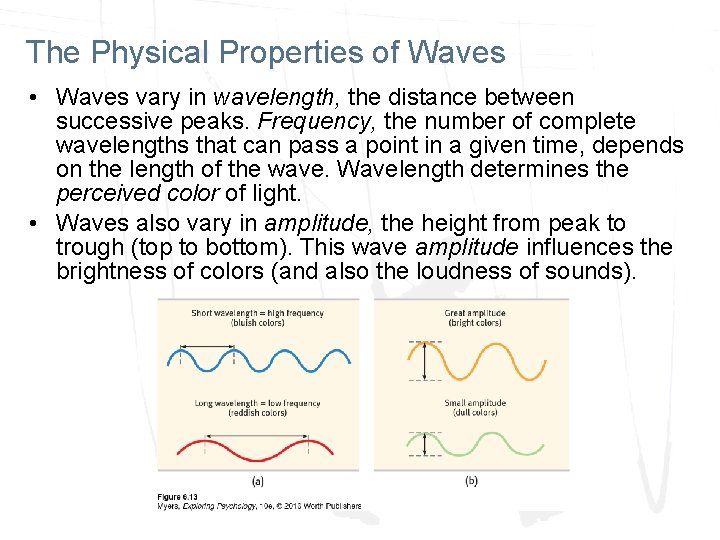
The Physical Properties of Waves • Waves vary in wavelength, the distance between successive peaks. Frequency, the number of complete wavelengths that can pass a point in a given time, depends on the length of the wave. Wavelength determines the perceived color of light. • Waves also vary in amplitude, the height from peak to trough (top to bottom). This wave amplitude influences the brightness of colors (and also the loudness of sounds).
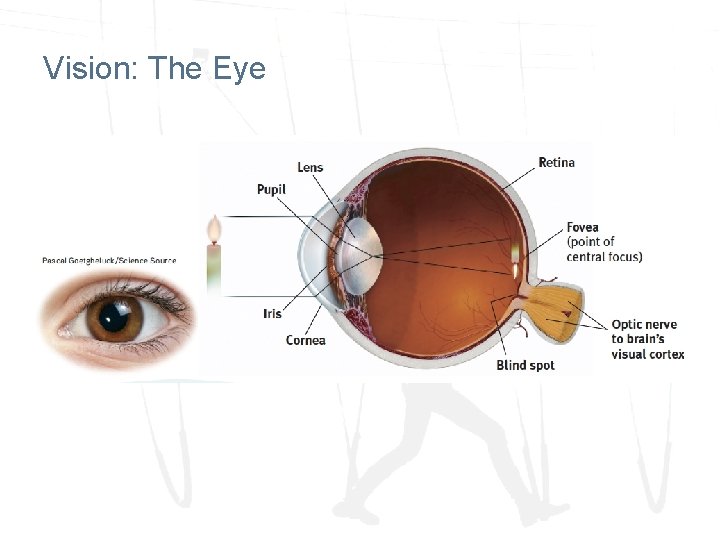
Light Energy and Eye Structures The Eye – Cornea: portion of the eye through which light passes (to the pupil and lens) and is bent to help provide focus – Pupil: a small adjustable opening through which the light then passes – Iris: a colored muscle surrounding the pupil that controls its size – Lens: focuses incoming light rays onto an image on the retina on the eyeball’s sensitive inner surface – After entering the eye and being focused by a lens, light energy particles strike the eye’s inner surface, the retina.
Light Energy and Eye Structures The Retina – Retina contains receptors rods and cones. – Retina has layers of neurons that begin the processing of visual information. Accommodation – The process by which the eye’s lens changes shape to focus near or far objects on the retina.
Light Energy and Eye Structures The Stimulus: Light Energy What is seen as light is only a thin slice of the broad spectrum of electromagnetic energy. – The portion visible to humans extends from the shorter waves of blue-violet light to the longer waves of red light. – Other organisms are sensitive to differing portions of the spectrum; bees, for instance, cannot see what we perceive as red but can see ultraviolet light. – The perceived hue in a light depends on its wavelength, and its brightness depends on its intensity.
Vision: The Eye
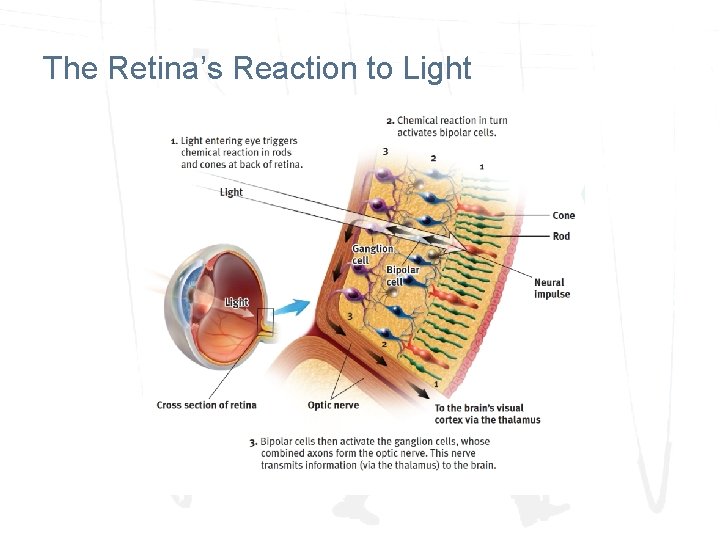
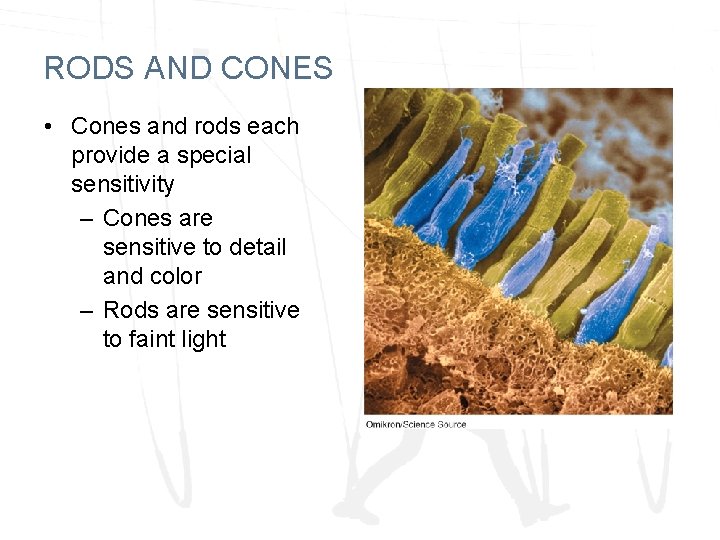
Information Processing in the Eye and Brain Retinal Processing 17 -2: HOW DO THE RODS AND CONES PROCESS INFORMATION, AND WHAT IS THE PATH INFORMATION TRAVELS FROM THE EYE TO THE BRAIN? – Light-energy particles trigger chemical reactions in receptor cells, rods and cones, an outer layer of cells of the retina at the back of the eye – Rods: retinal receptors that detect black, white, and gray; sensitive to movement; necessary for peripheral and twilight vision (when cones don’t respond) – Cones: concentrated near the center of the retina; function in daylight or well-lit conditions; detect fine detail and color
The Retina’s Reaction to Light
RODS AND CONES • Cones and rods each provide a special sensitivity – Cones are sensitive to detail and color – Rods are sensitive to faint light
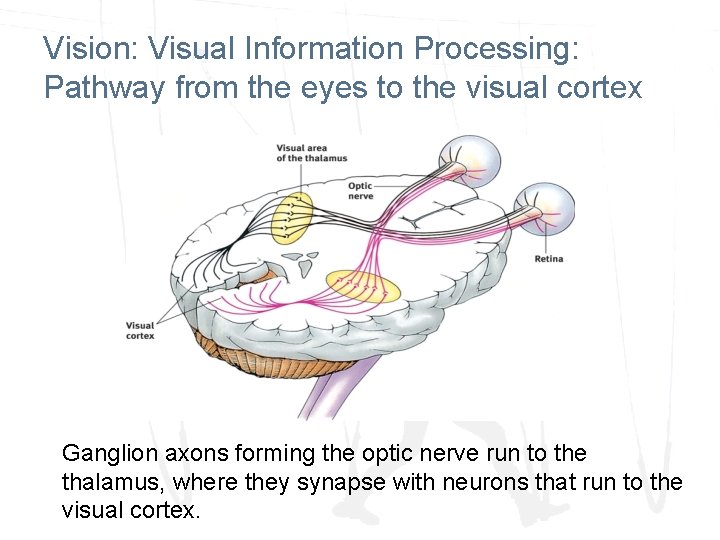
Information Processing in the Eye and Brain Retinal Processing – Light-energy particles trigger chemical reactions in receptor cells, rods and cones, and outer layer of cells of the retina at the back of the eye – Chemical reaction in turn activates bipolar cells – Bipolar cells then activate the ganglion cells, whose combined axons form the optic nerve, which transmits the neural impulses from the eye to the brain
Information Processing in the Eye and Brain Retinal Processing – Optic nerve: carries neural impulses from the eye to the brain – Blind spot: the point at which the optic nerve leaves the eye, creating a “blind” spot because no receptor cells are located here – Fovea: the central focal point in the retina, around which the eye’s cones cluster
Vision: Visual Information Processing: Pathway from the eyes to the visual cortex Ganglion axons forming the optic nerve run to the thalamus, where they synapse with neurons that run to the visual cortex.
Information Processing in the Eye and Brain Color Processing 17 -3: HOW DO WE PERCEIVE COLOR IN THE WORLD AROUND US? Color processing is a two-stage process: – Retina’s red, green, and blue cones respond in varying degrees to different color stimuli, as the Young-Helmholtz trichromatic theory suggested. – Cones’ responses are then processed by opponentprocess cells, as Hering’s opponent-process theory proposed.
Information Processing in the Eye and Brain Feature Detection 17 -4: WHERE ARE FEATURE DETECTORS LOCATED, AND WHAT DO THEY DO? – Feature detectors: specialized nerve cells in the brain that respond to specific features of the stimulus, such as shape, angle, or movement – These cells receive information from the ganglion cells in the retina, and then pass it to other cortical areas, where teams of cells (supercell clusters) respond to more complex patterns
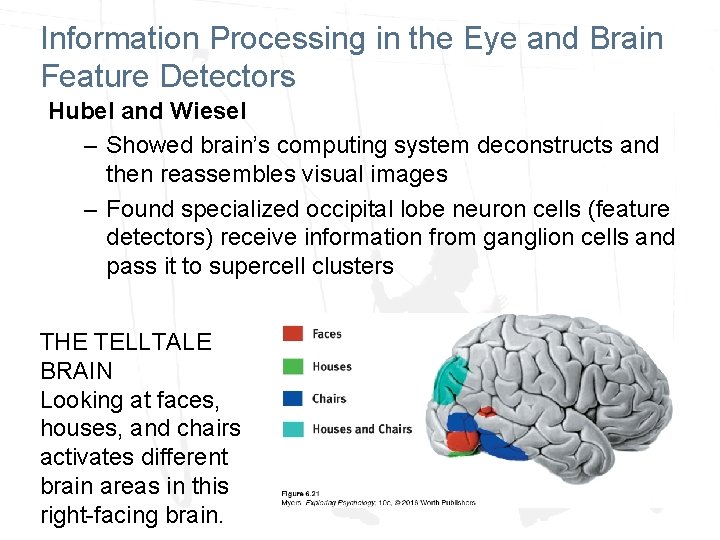
Information Processing in the Eye and Brain Feature Detectors Hubel and Wiesel – Showed brain’s computing system deconstructs and then reassembles visual images – Found specialized occipital lobe neuron cells (feature detectors) receive information from ganglion cells and pass it to supercell clusters THE TELLTALE BRAIN Looking at faces, houses, and chairs activates different brain areas in this right-facing brain.
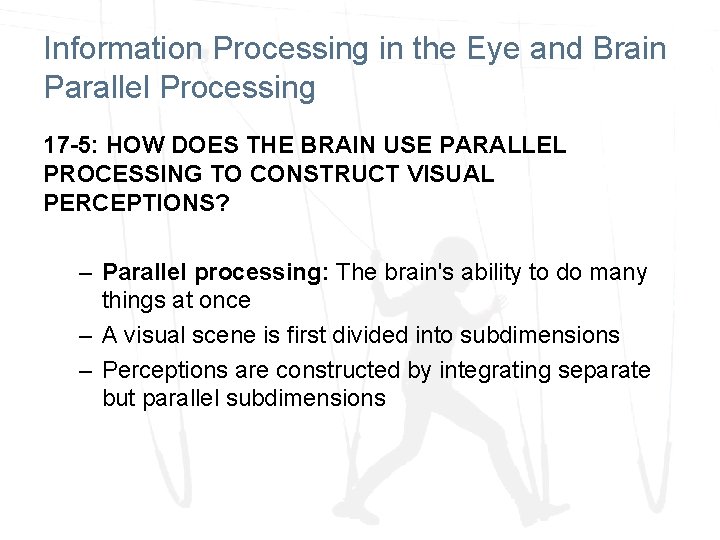
Information Processing in the Eye and Brain Parallel Processing 17 -5: HOW DOES THE BRAIN USE PARALLEL PROCESSING TO CONSTRUCT VISUAL PERCEPTIONS? – Parallel processing: The brain's ability to do many things at once – A visual scene is first divided into subdimensions – Perceptions are constructed by integrating separate but parallel subdimensions
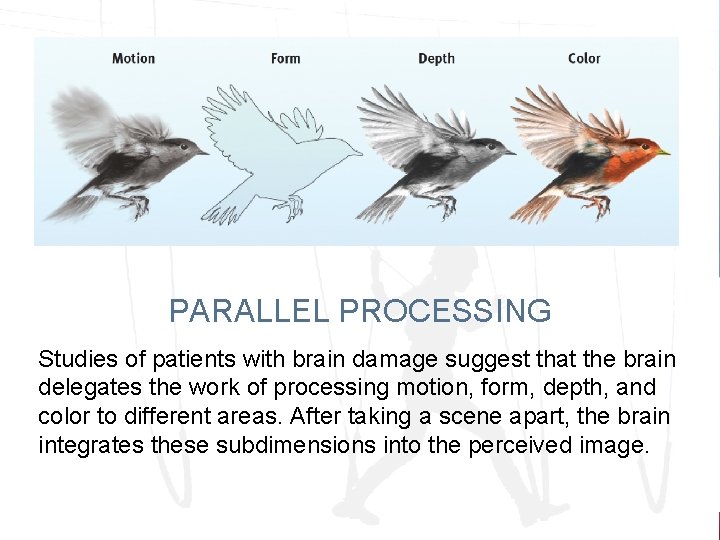
PARALLEL PROCESSING Studies of patients with brain damage suggest that the brain delegates the work of processing motion, form, depth, and color to different areas. After taking a scene apart, the brain integrates these subdimensions into the perceived image.
Perceptual Organization 17 -6: HOW DID THE GESTALT PSYCHOLOGISTS UNDERSTAND PERCEPTUAL ORGANIZATION, AND HOW DO FIGURE-GROUND AND GROUPING PRINCIPLES CONTRIBUTE TO OUR PERCEPTIONS? Gestalt: an organized whole • Gestalt psychologists propose principles used to organize sensations into meaningful wholes • In perception, the whole may exceed the sum of its parts • We filter incoming information and construct perceptions
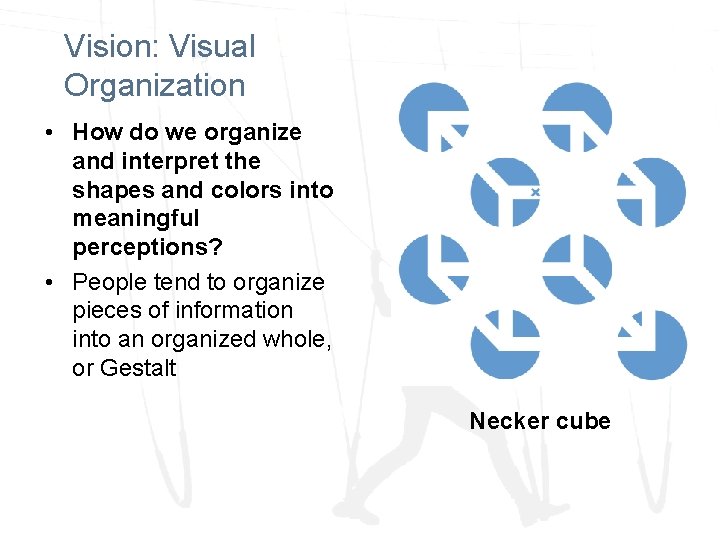
Vision: Visual Organization • How do we organize and interpret the shapes and colors into meaningful perceptions? • People tend to organize pieces of information into an organized whole, or Gestalt Necker cube
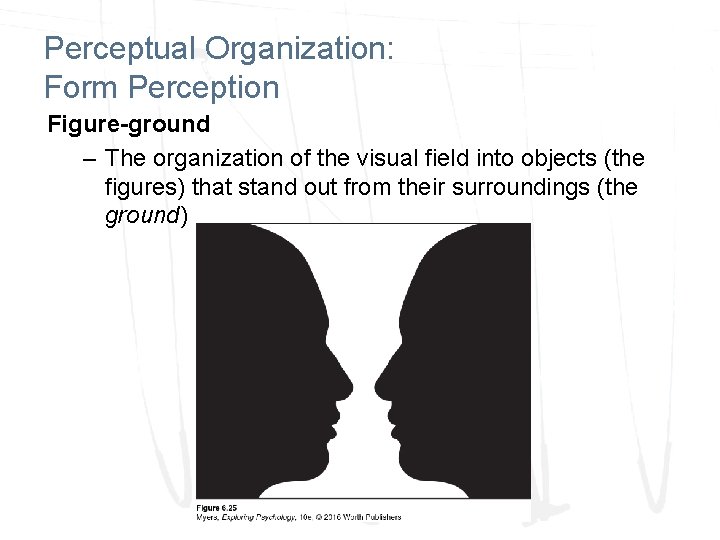
Perceptual Organization: Form Perception Figure-ground – The organization of the visual field into objects (the figures) that stand out from their surroundings (the ground)
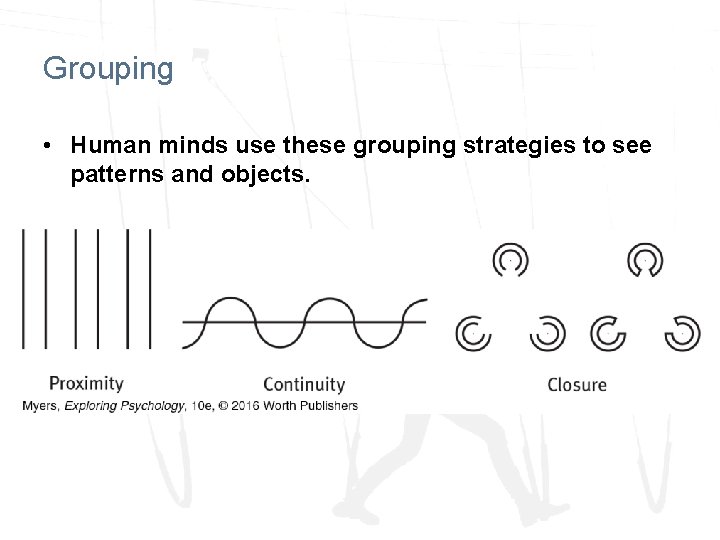
Perceptual Organization: Form Perception Grouping • The perceptual tendency to organize stimuli into coherent groups: – Proximity: grouping nearby figures together – Continuity: perceiving smooth, continuous patterns, rather than discontinuous ones – Closure: Filling in gaps to create a complete, whole object
Grouping • Human minds use these grouping strategies to see patterns and objects.
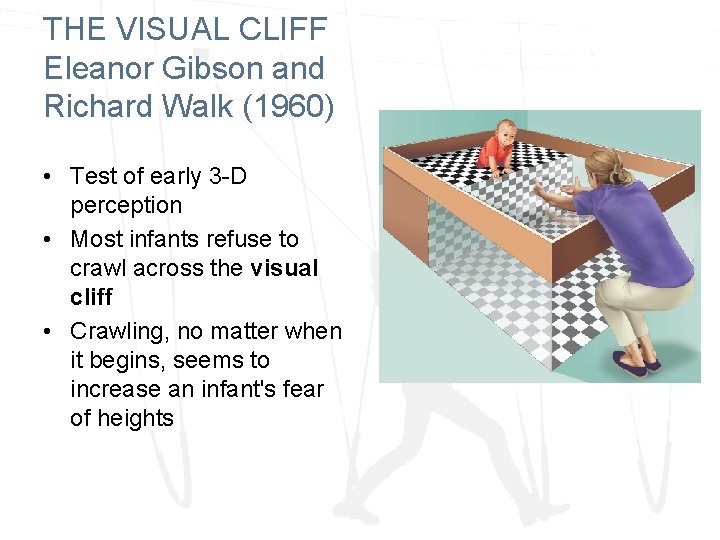
Perceptual Organization: Depth Perception 17 -7: HOW DO WE USE BINOCULAR AND MONOCULAR CUES TO PERCEIVE THE WORLD IN THREE DIMENSIONS? Depth perception – Represents ability to see objects in three dimensions, although the images that strike the retina are two dimensional – Allows us to judge distance – Is present, at least in part, at birth in humans and other animals
THE VISUAL CLIFF Eleanor Gibson and Richard Walk (1960) • Test of early 3 -D perception • Most infants refuse to crawl across the visual cliff • Crawling, no matter when it begins, seems to increase an infant's fear of heights
Perceptual Organization: Depth Perception Binocular cues – Two eyes help perception of depth Retinal disparity – Binocular cue for perceiving depth – By comparing images from the retinas in the two eyes, the brain calculates distance – Used by 3 -D film makers
Perceptual Organization: Depth Perception Monocular cues – Depth cue, such as interposition or linear perspective, available to either eye alone • Relative height • Relative size • Interposition • Linear perspective • Light and shadow • Relative motion
Perceptual Organization: Perceptual Constancy 17 -8: HOW DO PERCEPTUAL CONSTANCIES HELP US CONSTRUCT MEANINGFUL PERCEPTIONS? • Perceptual constancy: Objects are perceived as unchanging (having consistent color, brightness, shape, and size), even as illumination and retinal images change.
Perceptual Organization: Perceptual Constancy Color and brightness constancies – Color constancy: Perceiving familiar objects as having consistent color, even if changing illumination alters the wavelengths reflected by the objects – Brightness constancy similarly depends on context.
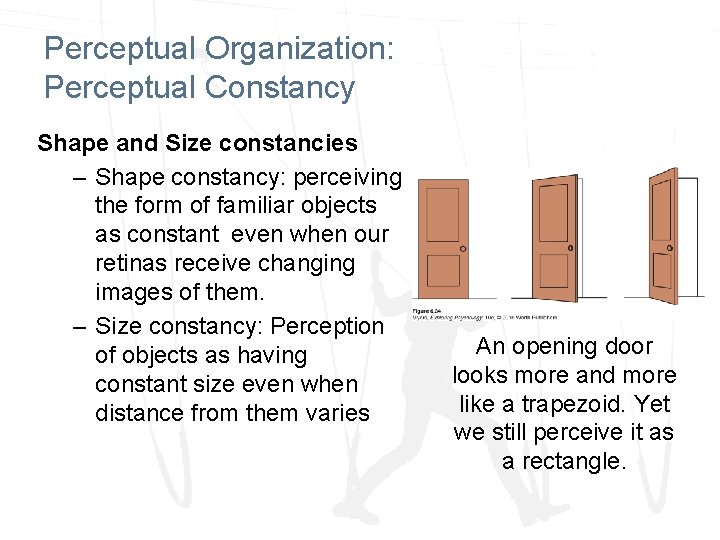
Perceptual Organization: Perceptual Constancy Shape and Size constancies – Shape constancy: perceiving the form of familiar objects as constant even when our retinas receive changing images of them. – Size constancy: Perception of objects as having constant size even when distance from them varies An opening door looks more and more like a trapezoid. Yet we still perceive it as a rectangle.
Perceptual Organization: Perceptual Interpretation Experience and Visual Perception 17 -9: WHAT DOES RESEARCH ON RESTORED VISION, SENSORY RESTRICTION, AND PERCEPTUAL ADAPTATION REVEAL ABOUT THE EFFECTS OF EXPERIENCE ON PERCEPTION? Restored vision and sensory restriction – Effect of sensory restriction on infant cats, monkeys, and humans suggests there is a critical period for normal sensory and perceptual development – Without stimulation, normal connections do not develop Perceptual adaptation – Ability to adjust to an artificially displaced or even inverted visual field