
Module 15 UNFCCC international IPCC negotiations Key messages

- Slides: 48
Module 15: UNFCCC & international IPCC negotiations
Key messages in Module 15 • The United Nations Framework on Climate Change (UNFCCC) is an international process for negotiating agreements on climate change • A series of agreements have been reached on promoting adaptation, including establishing international funding for adaptation • Health has been poorly represented in the agreements & adaptation funding • The Intergovernmental Panel on Climate Change (IPCC) provides comprehensive scientific assessments to inform the negotiations 2
Module 15 outline 1 UNFCCC 2 3 4 Adaptation activities in the UNFCCC WHO support IPCC 3
1 THE UNITED NATIONS FRAMEWORK CONVENTION ON CLIMATE CHANGE 4
United Nations Framework Convention on Climate Change • The science & politics of climate change are more than 100 years old. Historically important conferences include: – Toronto Conference on The Changing Atmosphere: Implications for Global Security in 1988 – UN Conference on Human Environment held in 1972 • The United Nations Framework Convention on Climate Change (UNFCCC) was adopted at the UN Conference on Environment & Development in Rio de Janeiro in 1992 5
UNFCCC • International treaty to address challenges of climate change • 192 countries have ratified • Entered into force on 21 March 1994 The Convention: Recognizes the global, shared problem Provides a framework for discussion Supports first steps: reporting, assessment, planning Establishes principle of "common but differentiated responsibilities" • Covers mitigation & adaptation • • 6
Article 2 “The ultimate objective of this Convention & any related legal instruments that the Conference of the Parties may adopt is to achieve, in accordance with the relevant provisions of the Convention, stabilisation of greenhouse gas concentrations in the atmosphere at a level that would prevent dangerous anthropogenic interference with the climate system. Such a level should be achieved within a time frame sufficient to allow ecosystems to adapt naturally to climate change, to ensure that food production is not threatened, & to enable economic development to proceed in a sustainable manner. ” 7
UNFCCC on health UNFCCC text definition “Adverse effects of climate change: changes in the physical environment or biota resulting from climate change which have significant deleterious effects on the composition, resilience or productivity of natural & managed ecosystems or on the operation of socio-economic systems or on human health & welfare. ” UNFCC commitments Paragraph 1 (f): All Parties…shall “take climate change considerations into account, to the extent feasible, in their relevant social, economic & environmental policies & actions, & employ appropriate methods, for example impact assessments, formulated & determined nationally, with a view to minimizing adverse effects on the economy, on public health & on the quality of the environment, of projects or measures undertaken by them to mitigate or adapt to climate change. ”
UNFCCC on health Paragraphs 4, 8 & 9: Developed countries’ responsibilities to assist developing countries to adapt to climate change, with particular attention to the LDCs. Article 4. 1 (f) Takes climate change considerations into account, to the extent feasible, in their relevant social, economic & environmental policies & actions, & employ appropriate methods, for example impact assessments, formulated & determined nationally, with a view to minimizing adverse effects on the economy, on public health & on the quality of the environment, of projects or measures undertaken by them to mitigate or adapt to climate change.
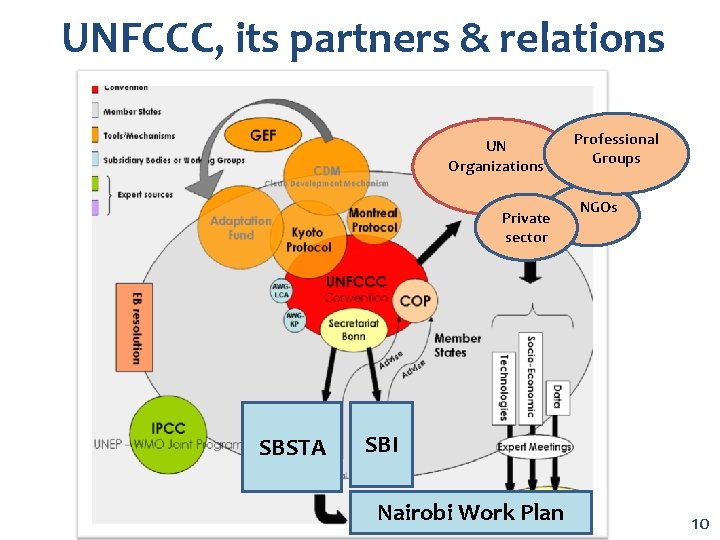
UNFCCC, its partners & relations UN Organizations Private sector Professional Groups NGOs AWG -DP SBSTA SBI Nairobi Work Plan 10
Subsidiary Body for Scientific & Technological Advice (SBSTA) • SBSTA supports the work of the COP & the MOP through the provision of timely information & advice on scientific & technological matters as they relate to the Convention or its Kyoto Protocol • Key areas of work for SBSTA are: • Impacts, vulnerability, & adaptation to climate change • Emissions from deforestation & forest degradation in developing countries • Promoting the development & transfer of environmentfriendly technologies • Technical work to improve the guidelines for preparing & reviewing greenhouse gas emission inventories from Annex I Parties 11
Subsidiary Body for Implementation (SBI) • SBI & SBSTA work together on cross-cutting issues that touch on their areas of expertise, including: – Capacity building – Vulnerability of developing countries to climate change & response measures – The Kyoto Protocol mechanisms • SBI and SBSTA meet in parallel, at least twice a year. When they are not meeting in conjunction with the COP, the subsidiary bodies usually convene at the seat of the secretariat in Bonn, Germany. 12
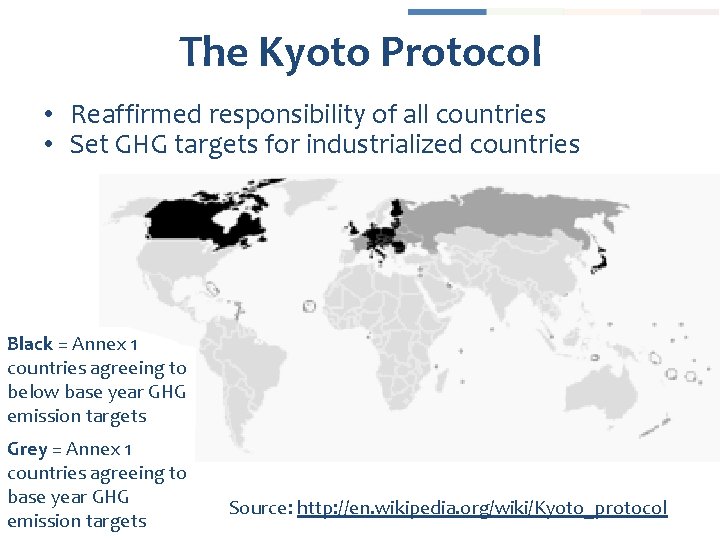
The Kyoto Protocol • Reaffirmed responsibility of all countries • Set GHG targets for industrialized countries Black = Annex 1 countries agreeing to below base year GHG emission targets Grey = Annex 1 countries agreeing to base year GHG emission targets Source: http: //en. wikipedia. org/wiki/Kyoto_protocol
2 ACTIVITIES UNDER THE UNFCCC RELATED TO ADAPTATION 14
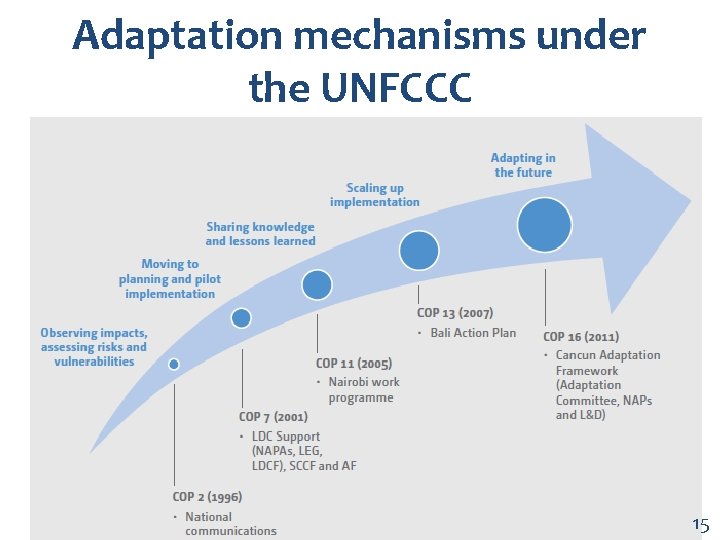
Adaptation mechanisms under the UNFCCC 15
Activities under the UNFCCC related to adaptation 1. The Nairobi Work Program (NWP) & other adaptation agreements 2. National Adaptation Programmes of Action (NAPAs) 3. National Communications 4. Adaptation funds – Global Environment Facility (GEF) 16
1. The Nairobi Work Programme (NWP) The Nairobi work program on impacts, vulnerability, & adaptation to climate change assists all Parties, in particular developing countries including LDCs & SIDS, to: • Improve their understanding & assessment of impacts, vulnerability & adaptation; & • Make informed decisions on practical adaptation actions
The Nairobi Work Programme 9 areas of work: • • • Climate-related risks & extreme events Adaptation planning & practices Socio-economic information Methods & tools Data & observations Economic diversification Research Climate modeling, scenarios & downscaling Technology for adaptation
NWP implementation 3 modes of implementation • Activities mandated by the SBSTA • Furthering the reach of mandated activities • Catalyzing new & innovative action • NWP Partner organizations, institutions, experts, & communities • Action Pledges - action by partners to engage with & enhance the work of the program
NWP implementation Adaptation priorities for health • Carry out research, surveys & outreach • Develop a general health strategy across agencies • Greater campaign on climate change & health for children • Develop programmes & training to empower the health community • Develop strategy for climate-related risks in the health sector • Utilize traditional knowledge
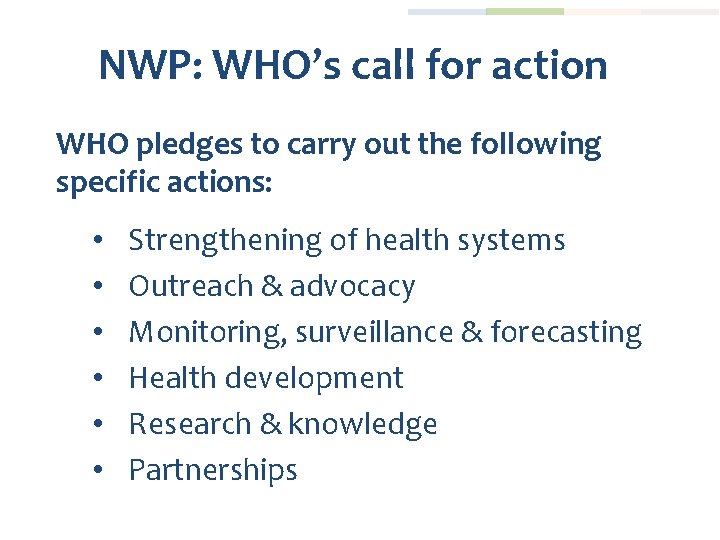
NWP: WHO’s call for action WHO pledges to carry out the following specific actions: • • • Strengthening of health systems Outreach & advocacy Monitoring, surveillance & forecasting Health development Research & knowledge Partnerships
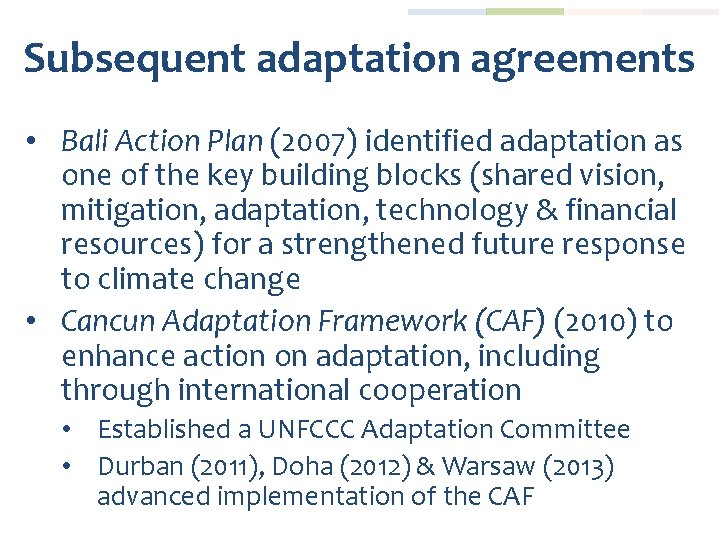
Subsequent adaptation agreements • Bali Action Plan (2007) identified adaptation as one of the key building blocks (shared vision, mitigation, adaptation, technology & financial resources) for a strengthened future response to climate change • Cancun Adaptation Framework (CAF) (2010) to enhance action on adaptation, including through international cooperation • Established a UNFCCC Adaptation Committee • Durban (2011), Doha (2012) & Warsaw (2013) advanced implementation of the CAF
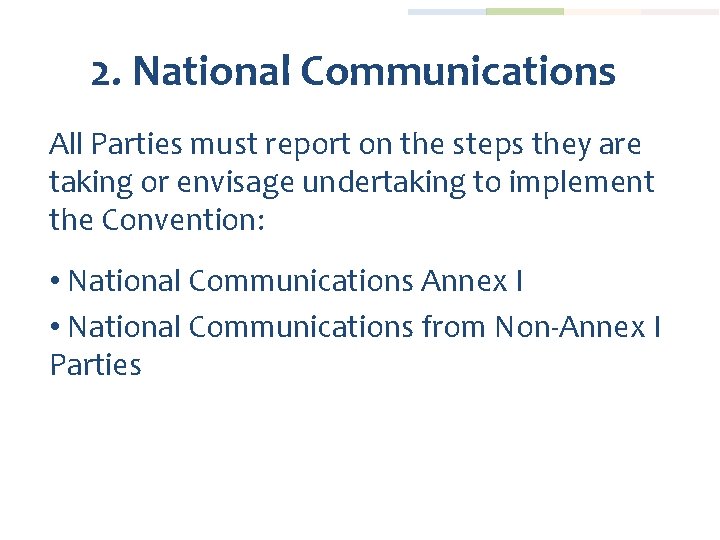
2. National Communications All Parties must report on the steps they are taking or envisage undertaking to implement the Convention: • National Communications Annex I • National Communications from Non-Annex I Parties
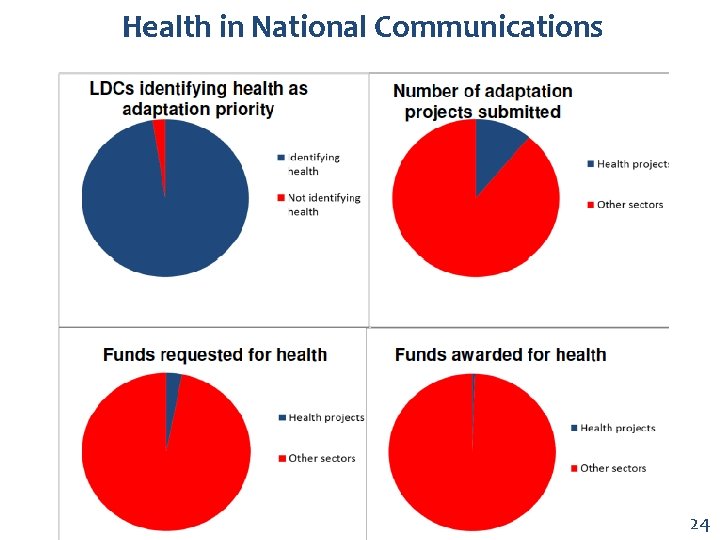
Health in National Communications 24
3. National Adaptation Programmes of Action (or NAPAs) • NAPAs provided an important way to prioritize urgent adaptation needs for Least Developed Countries • They drew on existing information & community-level input to identify adaptation projects required now in order to enable these countries to cope with the immediate impacts of climate change
4. Adaptation funds • Least developed country fund • Special climate change fund – Set up to finance projects relating to adaptation; technology transfer & capacity building; energy, transport, industry, agriculture, forestry & waste management; & economic diversification • Adaptation fund – Set up under the Kyoto Protocol to finance the full costs of adaptation in developing countries that are parties to the Kyoto Protocol. It may be replaced by the Green Climate Fund. • Green climate fund 26
Global Environment Facility (GEF) • A global partnership among 178 countries to address global environmental issues while supporting national sustainable development initiatives • The designated financial mechanism for the UNFCCC (among others) • GEF supports projects in climate change mitigation & climate change adaptation
Memory challenge! Name 2 different activities related to adaptation under the UNFCCC 28
Activities under the UNFCCC related to adaptation 1. The Nairobi Work Program (NWP) & other adaptation agreements 2. National Adaptation Programmes of Action (NAPAs) 3. National Communications 4. Adaptation funds – Global Environment Facility (GEF) 29
International climate change agreements are critical, but…. . • • Limitations on mitigation actions Kyoto Protocol inadequate to meaningfully reduce climate change Possible mitigation measures have very different health implications No obligations for developing nations that will become large emitters in near future Problems with adaptation Funding from rich nations is voluntary & complex to access Health is poorly represented
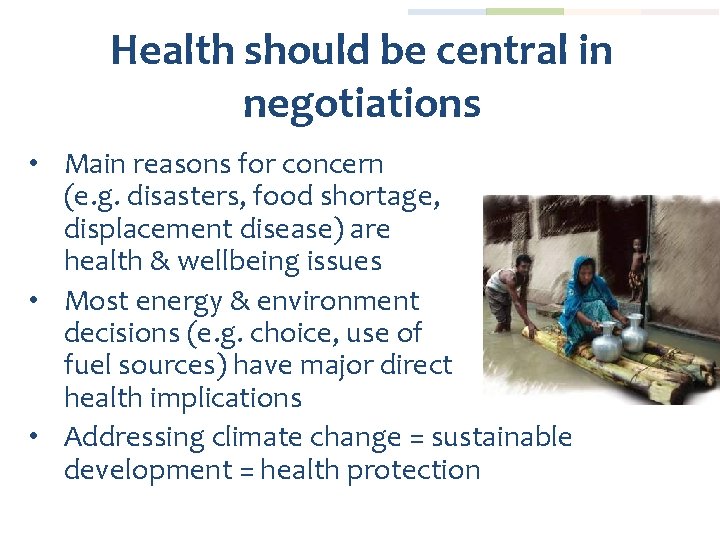
Health should be central in negotiations • Main reasons for concern (e. g. disasters, food shortage, displacement disease) are health & wellbeing issues • Most energy & environment decisions (e. g. choice, use of fuel sources) have major direct health implications • Addressing climate change = sustainable development = health protection
3 WHO support for global action on climate change & health 32
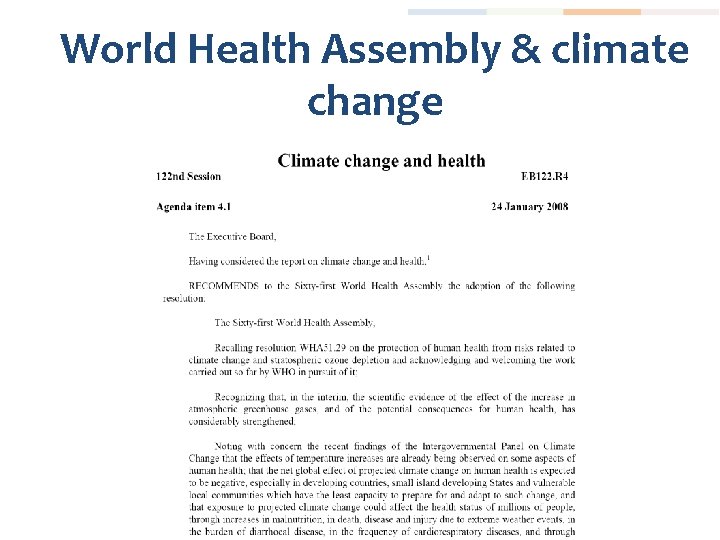
World Health Assembly & climate change
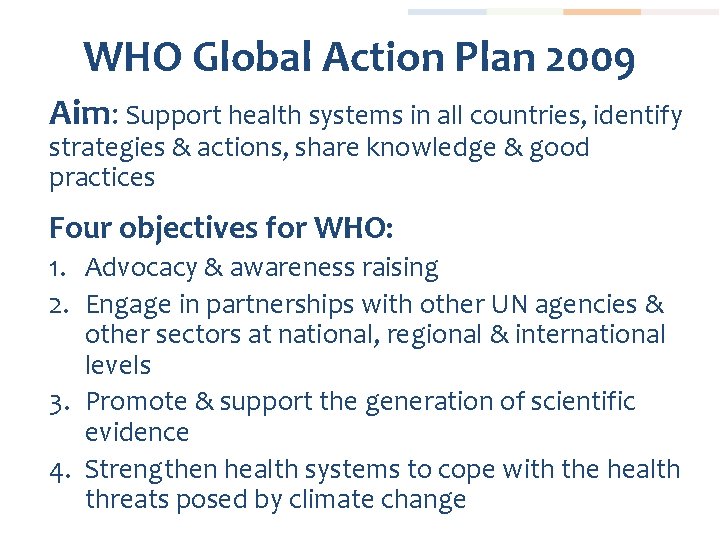
WHO Global Action Plan 2009 Aim: Support health systems in all countries, identify strategies & actions, share knowledge & good practices Four objectives for WHO: 1. Advocacy & awareness raising 2. Engage in partnerships with other UN agencies & other sectors at national, regional & international levels 3. Promote & support the generation of scientific evidence 4. Strengthen health systems to cope with the health threats posed by climate change
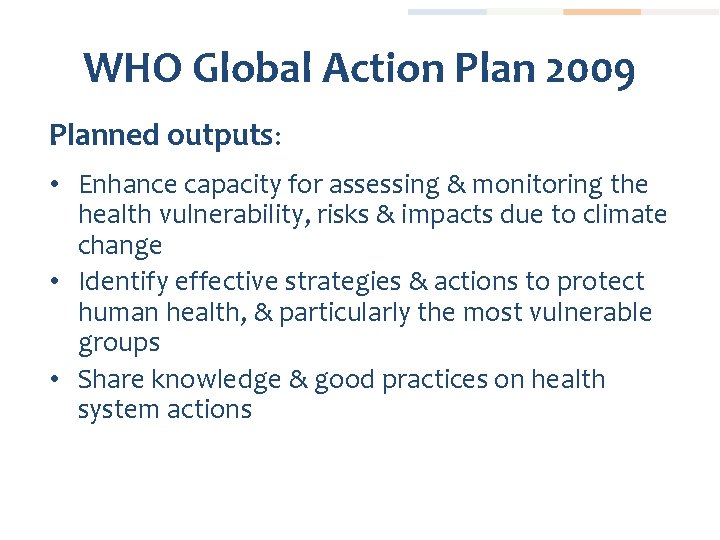
WHO Global Action Plan 2009 Planned outputs: • Enhance capacity for assessing & monitoring the health vulnerability, risks & impacts due to climate change • Identify effective strategies & actions to protect human health, & particularly the most vulnerable groups • Share knowledge & good practices on health system actions
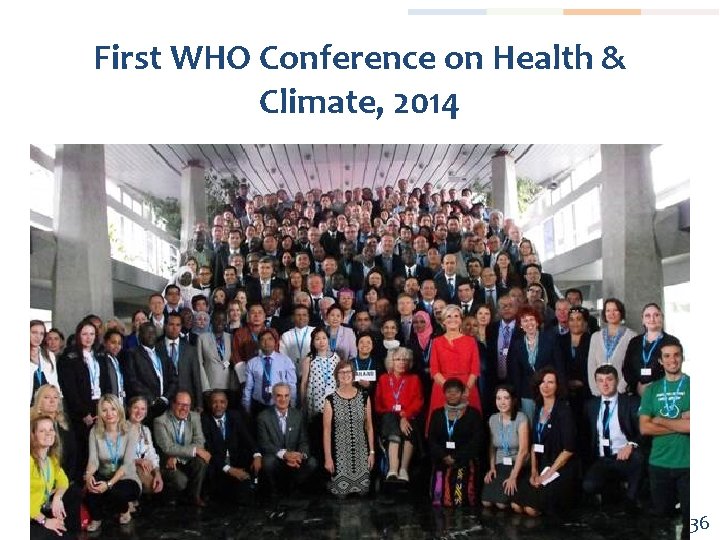
First WHO Conference on Health & Climate, 2014 36
4 The Intergovernmental Panel on Climate Change (IPCC) 37
IPCC overview • Formed in 1988 by the United Nations Environment Programme & the World Meteorological Organization to conduct assessments of the state of knowledge of climate change, the vulnerabilities to & consequences of any changes, & the options to avoid, prepare for, & respond to changes • All governments that signed either the UNEP or WMO convention are members of the IPCC 38
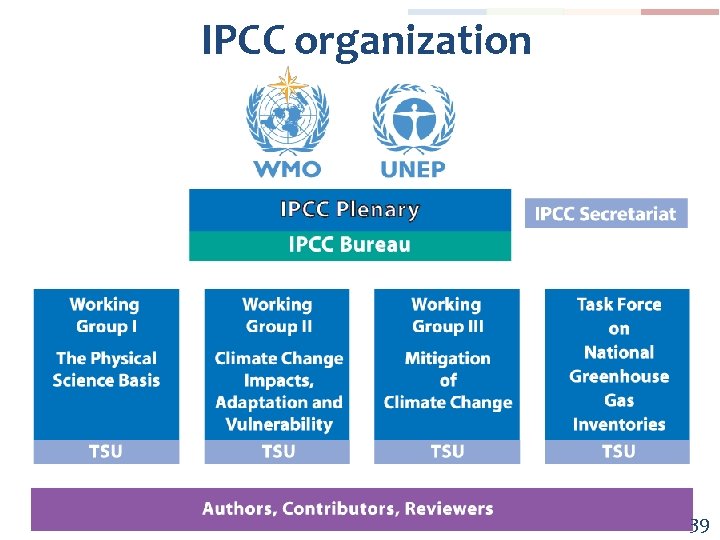
IPCC organization 39
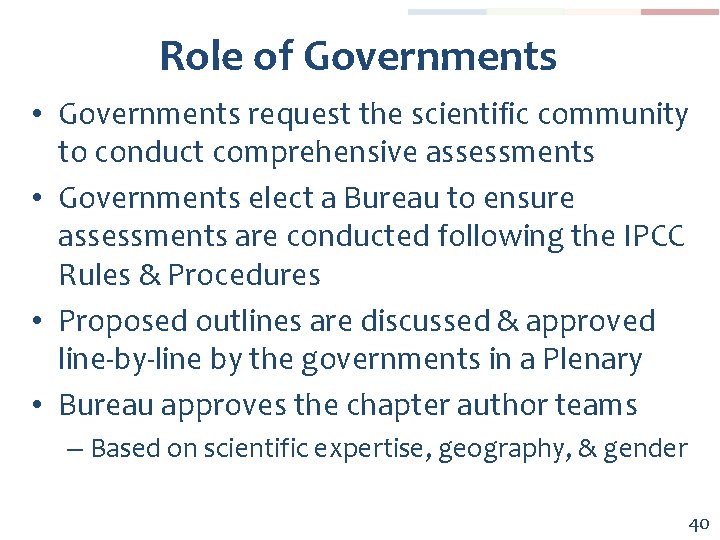
Role of Governments • Governments request the scientific community to conduct comprehensive assessments • Governments elect a Bureau to ensure assessments are conducted following the IPCC Rules & Procedures • Proposed outlines are discussed & approved line-by-line by the governments in a Plenary • Bureau approves the chapter author teams – Based on scientific expertise, geography, & gender 40
Role of Governments • Governments participate in the review process & in the IPCC Plenary sessions, where main decisions about the IPCC work program are taken & reports are accepted, adopted, & approved • Summary for Policymakers approved line-byline by the governments in a final Plenary 41
IPCC: correcting misperceptions • Does not conduct research or monitor trends • Does conduct comprehensive assessments • Does provide statements that are policyrelevant & policy-neutral • Review is an essential part of the IPCC process, to ensure an objective & comprehensive assessment • Differing viewpoints existing within the scientific community are reflected in the IPCC reports 42
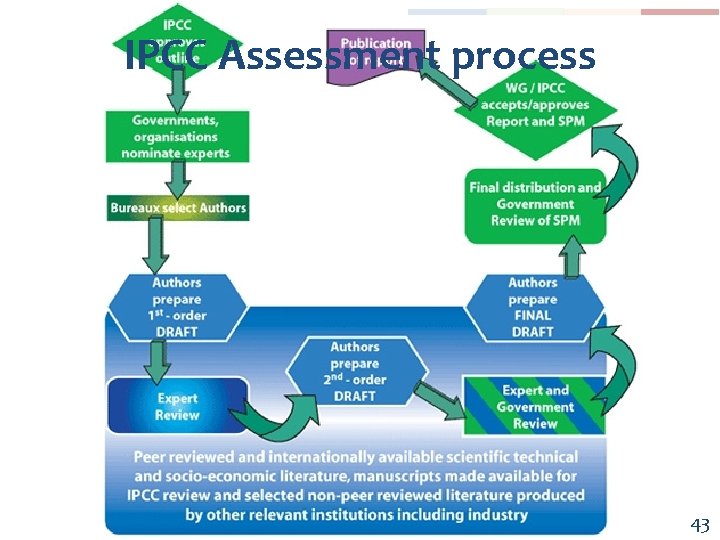
IPCC Assessment process 43
Any questions on the IPCC? 44
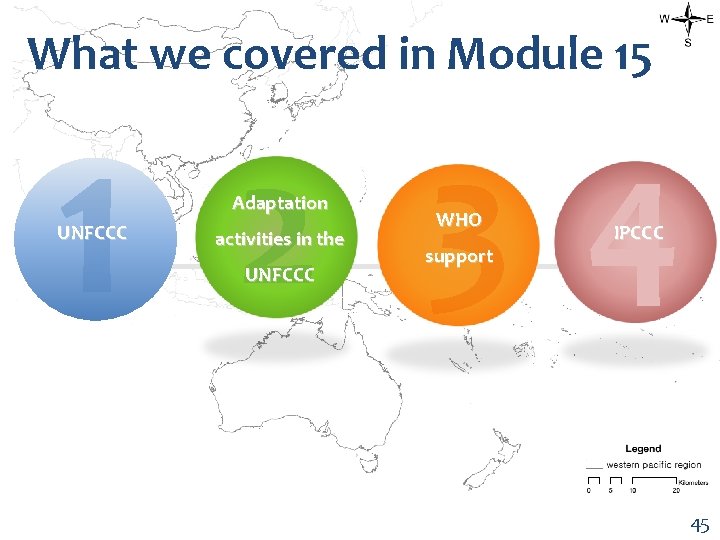
What we covered in Module 15 1 UNFCCC 2 3 4 Adaptation activities in the UNFCCC WHO support IPCCC 45
Learning from Module 15 • The United Nations Framework on Climate Change (UNFCCC) is an international process for negotiating agreements on climate change • A series of agreements have been reached on promoting adaptation, including establishing international funding for adaptation • Health has been poorly represented in the agreements & adaptation funding • The Intergovernmental Panel on Climate Change (IPCC) provides comprehensive scientific assessments to inform the negotiations 46
What action might you take in your work, given what you learnt in Module 15?
Coming up next… Module 16: Mitigation &co-benefits 48