
Module 15 Planning for Best First Instruction BFI
Module 15: Planning for Best, First Instruction (BFI) Understanding and Applying High Impact Instructional Strategies for Standards-Based Learning
Goals and Objectives Educators will be able to: • Discuss high impact instructional strategies in relation to Best, First Instruction (BFI). • Consider their students as they identify high impact instructional strategies when planning for BFI. • Apply the design principles of BFI to instructional planning.
Introduction Best, First Instruction includes deliberate planning, enactment, and reflection. These elements are high impact instruction. Planning high impact instruction means teachers develop accessible, equitable, and flexible learning opportunities to meet the changing needs of a diverse student population. High impact instruction includes: ● Culturally Responsive Teaching ● High Impact Planning ● Student Learning Considerations ● Teacher Instructional Practices
High Impact Instructional Planning Today, ofyou will ask yourself andisothers: The second element high impact instruction to intentionally plan for teaching and student learning. Resources you can use include: W here are your gap s? Your o 1. The Colorado Academic Standards; ve and rlaps? 2. District or school curriculum maps; and/or 3. Content level instructional materials Why?
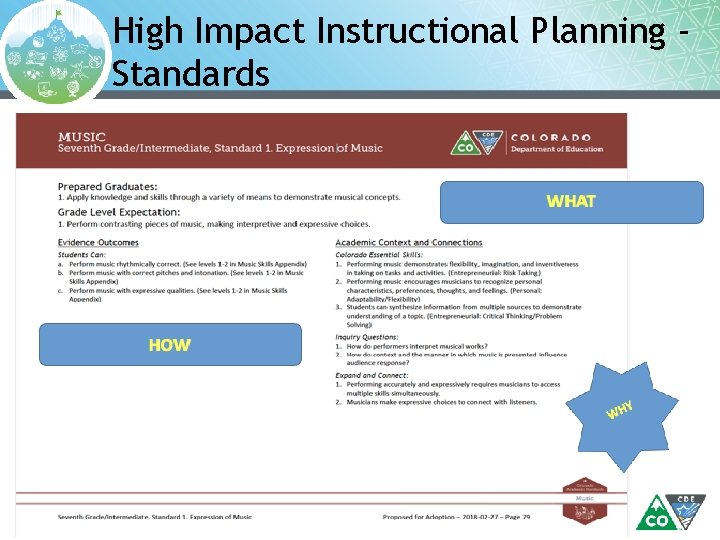
High Impact Instructional Planning Standards Today, you will ask yourself and others: Where a re your g aps? You r overlap s? Why ?
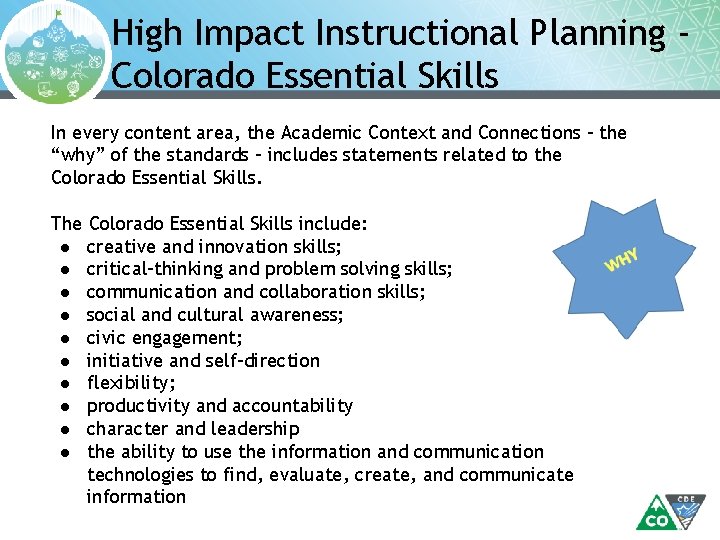
High Impact Instructional Planning Colorado Essential Skills In every content Today, area, theyou Academic and Connections - the will Context ask yourself and others: “why” of the standards - includes statements related to the Colorado Essential Skills. The Colorado Essential Skills include: W ere aand ●h creative innovation skills; r e y andurproblem ● critical-thinking o skills; gapssolving ? our over ● communication and collaboration Y skills; laps? ● social and cultural awareness; ● ● ● civic engagement; initiative and self-direction flexibility; productivity and accountability character and leadership the ability to use the information and communication technologies to find, evaluate, create, and communicate information Why?
High Impact Instructional Planning Curriculum Maps and Other Resources ● Consult district or school curriculum maps that may assist in your instructional planning. ● Double check to make sure that curriculum maps include all of the standards. ● Instructional materials and teaching guides can also provide assistance to planning, as long as they are learning focused.
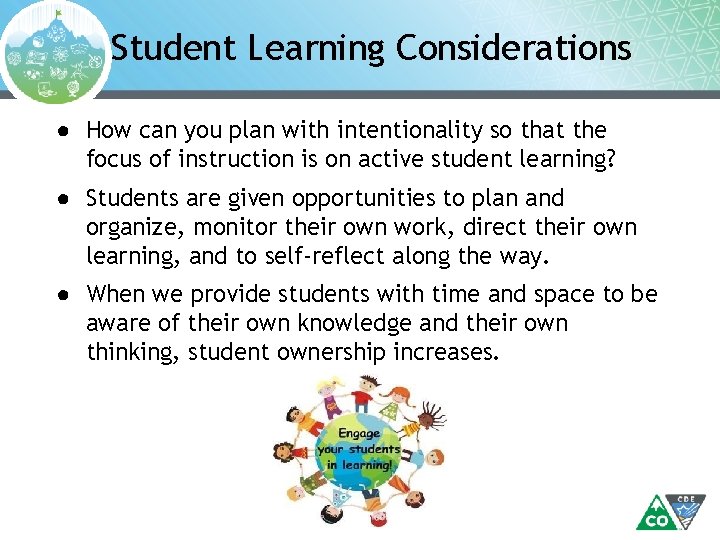
Student Learning Considerations ● How can you plan with intentionality so that the focus of instruction is on active student learning? ● Students are given opportunities to plan and organize, monitor their own work, direct their own learning, and to self-reflect along the way. ● When we provide students with time and space to be aware of their own knowledge and their own thinking, student ownership increases.
High Impact Instructional Strategies are tools to increase active learning in every content area. Most strategies may fall into these categories (Knight, 2013): ● Thinking prompts (cues, advanced organizers, nonlinguistic representations) ● Questioning (posing problems) ● Stories (to clarify and reinforce learning; allow students to express their point of view) ● Cooperative learning (learning is mediated through peers) ● Authentic learning (relevant applications of learning) ● Disciplinary Literacy (engaging in the academic discipline through reading and writing)
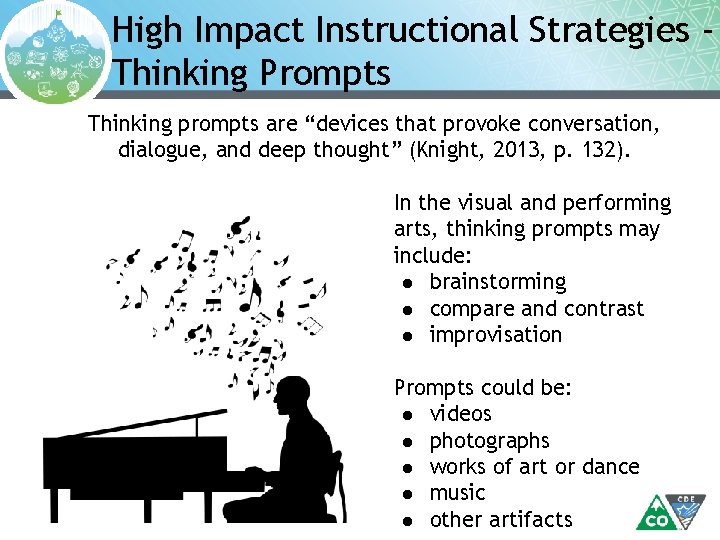
High Impact Instructional Strategies Thinking Prompts Thinking prompts are “devices that provoke conversation, dialogue, and deep thought” (Knight, 2013, p. 132). In the visual and performing arts, thinking prompts may include: ● brainstorming ● compare and contrast ● improvisation Prompts could be: ● videos ● photographs ● works of art or dance ● music ● other artifacts

High Impact Instructional Strategies Questioning is “asking the right question at the right time” (Knight, 2013, p. 154). This includes the type (open or closed), kind (opinion or right/wrong), and level (idea, skill, or knowledge) of question. In the visual and performing arts, questioning may include (Marzano & Pickering, 2011): ● calling on students randomly ● paired responses ● providing wait time ● building on student responses ● simultaneous individual response
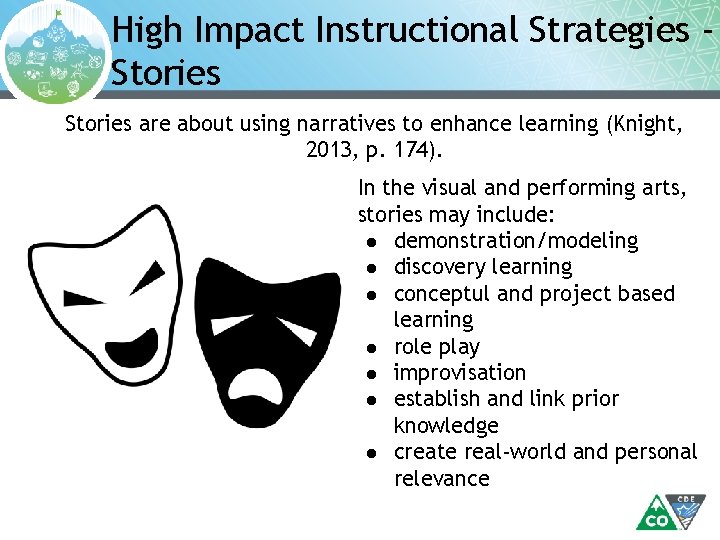
High Impact Instructional Strategies Stories are about using narratives to enhance learning (Knight, 2013, p. 174). In the visual and performing arts, stories may include: ● demonstration/modeling ● discovery learning ● conceptul and project based learning ● role play ● improvisation ● establish and link prior knowledge ● create real-world and personal relevance
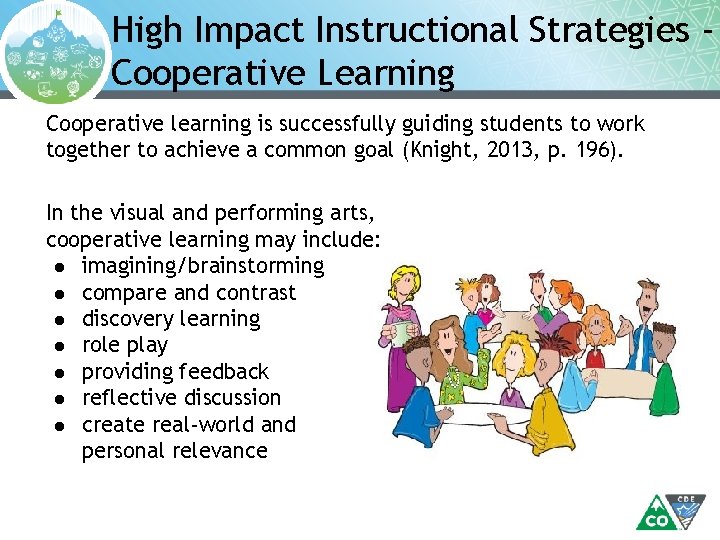
High Impact Instructional Strategies Cooperative Learning Cooperative learning is successfully guiding students to work together to achieve a common goal (Knight, 2013, p. 196). In the visual and performing arts, cooperative learning may include: ● imagining/brainstorming ● compare and contrast ● discovery learning ● role play ● providing feedback ● reflective discussion ● create real-world and personal relevance
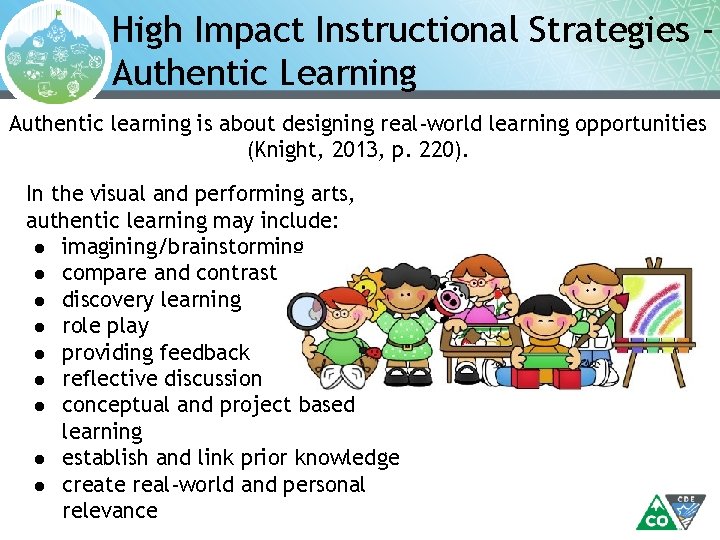
High Impact Instructional Strategies Authentic Learning Authentic learning is about designing real-world learning opportunities (Knight, 2013, p. 220). In the visual and performing arts, authentic learning may include: ● imagining/brainstorming ● compare and contrast ● discovery learning ● role play ● providing feedback ● reflective discussion ● conceptual and project based learning ● establish and link prior knowledge ● create real-world and personal relevance
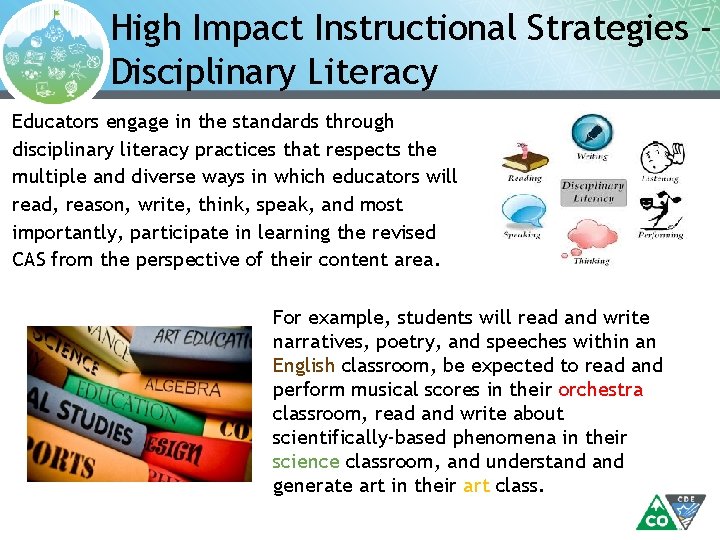
High Impact Instructional Strategies Disciplinary Literacy Educators engage in the standards through disciplinary literacy practices that respects the multiple and diverse ways in which educators will read, reason, write, think, speak, and most importantly, participate in learning the revised CAS from the perspective of their content area. For example, students will read and write narratives, poetry, and speeches within an English classroom, be expected to read and perform musical scores in their orchestra classroom, read and write about scientifically-based phenomena in their science classroom, and understand generate art in their art class.
High Impact Instructional Strategies Application How can you plan to use high-impact instructional strategies in your content area? 1. Think of a lesson you teach. 2. Keeping your students needs in mind, identify how students will be engaged. 3. Consider the high-impact instructional strategies that will engaged your students. 4. Write down your ideas and think about how you might implement these different strategies. (e. g. , Do you need a different amount of time? Do you need more resources? Do you need to configure your classroom environment differently? Do you need professional development? )
Assessment: Exit Ticket List 5 strategies that you consider to be high impact strategies in your content area. Add at least 2 skills that match each high impact strategy that you listed.
Questions, Comments, & Concerns Please contact the Office of Standards and Instructional Support for additional information. Refer to the Standards Implementation guide for contact information.
- Slides: 18