
Module 15 Documents and Records The Lab Quality
Module 15: Documents and Records
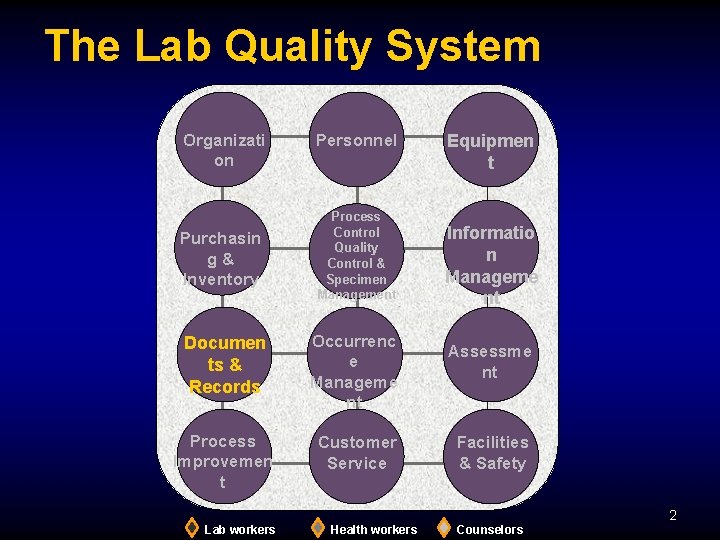
The Lab Quality System Organizati on Purchasin g& Inventory Personnel Process Control Quality Control & Specimen Management Documen ts & Records Occurrenc e Manageme nt Process Improvemen t Customer Service Equipmen t Informatio n Manageme nt Assessme nt Facilities & Safety 2 Lab workers Health workers Counselors
Learning Objectives At the end of this module, you will be able to: • Tell the difference between a document and a record • Explain the rationale for maintaining documents and records • Provide examples of documents and records kept at a test site • Follow the procedures as prescribed in SOPs • Describe how to properly keep and maintain test site documents and records • Describe the types of information typically not found in a manufacturer’s product insert 3 Lab workers Health workers Counselors
Content Overview • What are documents and records? • Documents § § Why are they important? What documents should you keep? Why is it important to follow SOPs? What is the proper way to keep and maintain documents? • Records § § § Why are they important? What records should you keep? What is the proper way to keep and maintain records? 4 Lab workers Health workers Counselors

What Are Documents and Records? Documents § § Records WRITTEN policies, process descriptions, procedures, and blank forms Used to communicate information § Information captured on worksheets, forms, and charts RECORDS 5 Lab workers Health workers Counselors
Exercise: Differentiate Between Documents and Records Country testing algorithm Safety manual Client test results Standard operation procedures (SOPs) for an approved HIV rapid test • Manufacturer test kit inserts • Summary of findings form on-site evaluation visit • • • Report of corrective actions • Temperature log (blank form) • Quality control record (blank form) • Daily maintenance log (completed) • Stock cards and stock book (completed) • EQA specimen transfer log (completed) 6 Lab workers Health workers Counselors
Exercise: Differentiate Between Documents and Records Country testing algorithm Safety manual Client test results Standard operation procedures (SOPs) for an approved HIV rapid test • Manufacturer test kit inserts • Summary of findings form on-site evaluation visit • • • Report of corrective actions • Temperature log (blank form) • Quality control record (blank form) • Daily maintenance log (completed) • Stock cards and stock book (completed) • EQA specimen transfer log (completed) 7 Lab workers Health workers Counselors
Documents Are the Backbone of the Quality System Verbal instructions often are: • Not heard • Misunderstood • Quickly forgotten • Ignored Policies, standards, processes, and procedures must be written down, approved, and communicated to all concerned. 8 Lab workers Health workers Counselors
Standard Operating Procedures (SOPs) Are Documents that… • Describe how to perform various operations in a testing site • Provide step-by-step instructions • Assure: § § § Consistency Accuracy Quality 9 Lab workers Health workers Counselors
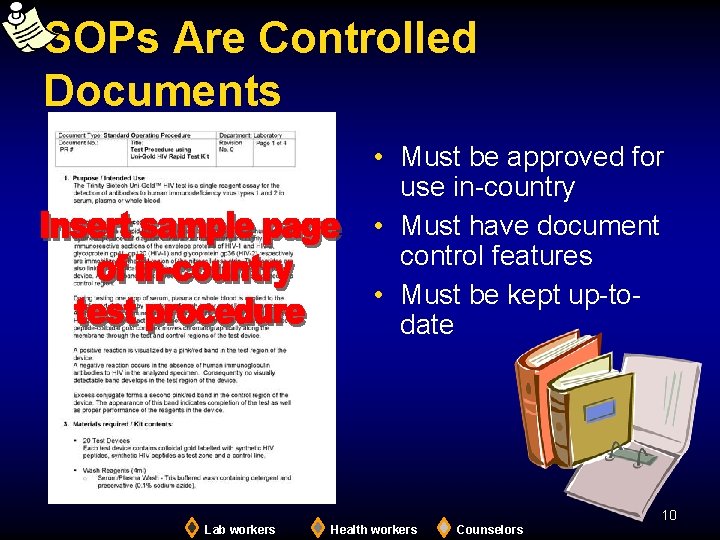
SOPs Are Controlled Documents • Must be approved for use in-country • Must have document control features • Must be kept up-todate 10 Lab workers Health workers Counselors
What SOPs Should You Keep at a Test Site? • Daily routine schedule • Country policies and algorithm • Safety manuals § § § Safety Precautions Preparation of 10% bleach solution Post-HIV exposure prophylaxis management and treatment guidelines • Blood collection: § Fingerprick, venipuncture, DBS 11 Lab workers Health workers Counselors
What SOPs Should You Keep at a Test Site? – Cont’d • Test procedures • EQA § § Submission of EQA specimens to reference lab Internal assessments • Reordering of supplies and kits • Equipment use and maintenance 12 Lab workers Health workers Counselors
SOPs Must Be Followed • Why is it important to follow SOPs? • What are the consequences if you don’t? 13 Lab workers Health workers Counselors
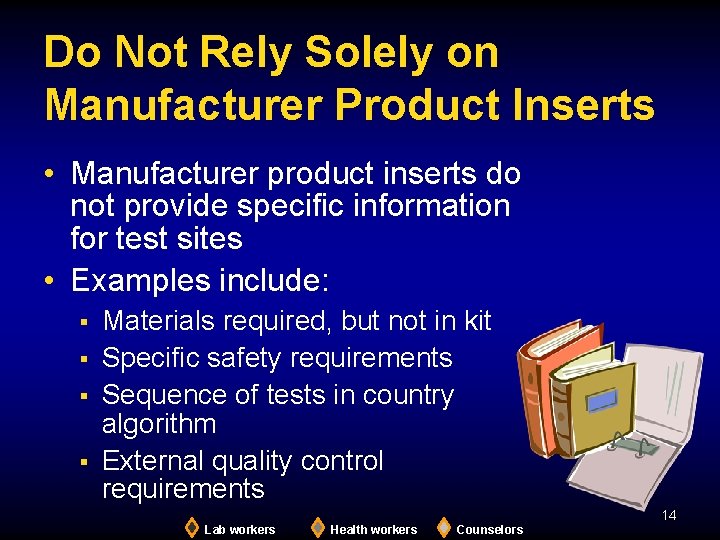
Do Not Rely Solely on Manufacturer Product Inserts • Manufacturer product inserts do not provide specific information for test sites • Examples include: § § Materials required, but not in kit Specific safety requirements Sequence of tests in country algorithm External quality control requirements 14 Lab workers Health workers Counselors
Proper Record-Keeping Makes Quality Management Possible Record-keeping allows a test site to: • Communicate accurately and effectively • Minimize error • Monitor quality system • Assist management in: RECORDS § § Developing policy & plans Monitoring and evaluating programs 15 Lab workers Health workers Counselors
What Records Should You Keep at a Test Site? • • • Specimen transfer logs HIV request / client test result Lab / Test register Temperature logs Equipment maintenance logs Inventory records RECORDS 16 Lab workers Health workers Counselors
Tips for Good Record Keeping • Understand the information to be collected • Record the information every time • Record all the information • Record the information in the same way every time RECORDS * PMTCT Generic Curriculum 17 Lab workers Health workers Counselors
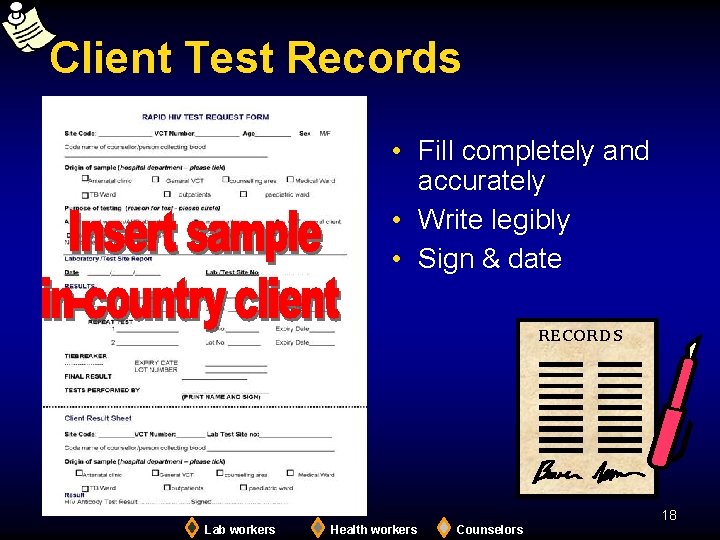
Client Test Records • Fill completely and accurately • Write legibly • Sign & date RECORDS 18 Lab workers Health workers Counselors
How Long Should You Retain Client Test Records? It depends on several factors: • National policies • Secure storage space at test site RECORDS 19 Lab workers Health workers Counselors
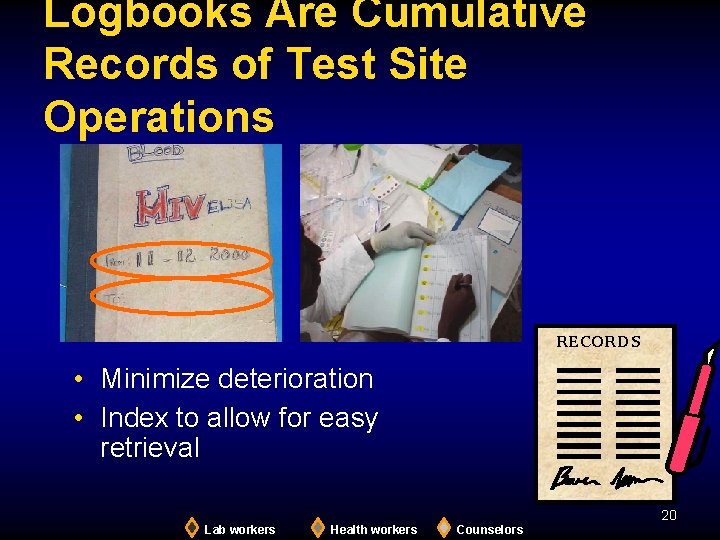
Logbooks Are Cumulative Records of Test Site Operations RECORDS • Minimize deterioration • Index to allow for easy retrieval 20 Lab workers Health workers Counselors
Records Should be Permanent, Secure, Traceable • Permanent: § § • Traceable: Keep books bound Number pages Use permanent ink Control storage § Sign and date every record • Secure: § § § RECORDS Maintain confidentiality Limit access Protect from environmental hazards 21 Lab workers Health workers Counselors
Information Recorded will Feed Into Monitoring and Evaluation Systems • Provide in-country information: § § When will what be reported? How will it be reported? Whom will it be reported to? How will the data be used? RECORDS 22 Lab workers Health workers Counselors
Summary • What is the difference between a document and a record? • What are some examples of documents and records? • Name examples of information not found in a manufacturer product insert. • What are some key features of SOPs? • What are some tips for good record-keeping? • How should records be maintained? • How are test site records reported in your country? 23 Lab workers Health workers Counselors
Key Messages • Written policies and procedures are the backbone of the quality system • Complete quality assurance records make quality management possible • Keeping records facilitates meeting program reporting requirements 24 Lab workers Health workers Counselors
- Slides: 24