
Module 14 Overview of Best First Instruction Building
Module 14: Overview of Best, First Instruction Building positive student relationships for accessible, equitable, and flexible instruction
Goals and Objectives Educators will be able to: • Define Best, First Instruction. • Identify the 4 principles of significant relationship building with their students in order to shift to a more equitable and responsive environment. • Explain the importance of being a culturally responsive educator.
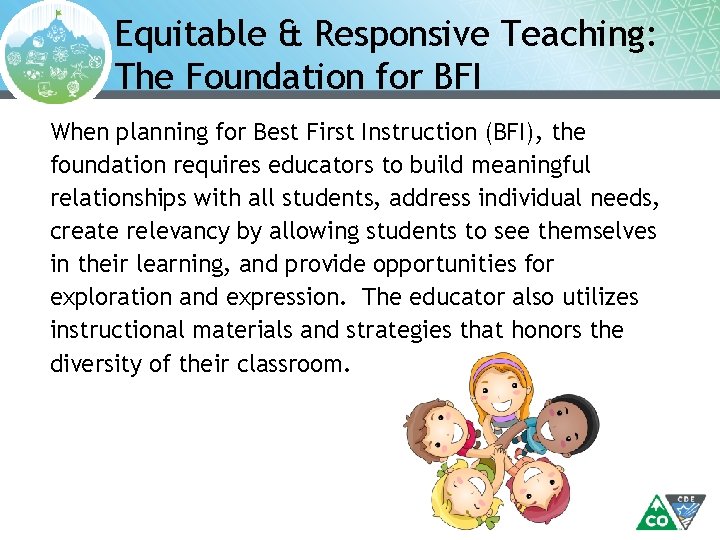
Equitable & Responsive Teaching: The Foundation for BFI When planning for Best First Instruction (BFI), the foundation requires educators to build meaningful relationships with all students, address individual needs, create relevancy by allowing students to see themselves in their learning, and provide opportunities for exploration and expression. The educator also utilizes instructional materials and strategies that honors the diversity of their classroom.
Cultural Responsiveness Creating classroom environments that foster a sense of belonging ● Students with a sense of belonging in school ○ Feel socially connected, supported, and respected. ○ They trust their teachers and their peers, and they feel like they fit in at school. ○ They are not worried about being treated as a stereotype and are confident that they are seen as a person of value. (Romero, 2015)
Culturally Responsive Educators ● Create a classroom learning community of trust, ownership, and belonging. ● Know their students well academically, socially, and emotionally. ● Build on their students’ life experiences. ● Hold high academic standards and expectations for all their students. Source: https: //blog. nationalequityproject. org/2012/08/22/5 -ways-to-create-a-culturally-responsiveclassroom/
Characteristics of “Best, First Instruction? ” Best, First Instruction is: ● Designed to meet the needs of all students ● Deliberate planning, enactment, and reflection ● The assurance of safe and equitable learning culture ● High-quality, effective, and engaging ● Students’ first opportunity to learn standards and meet grade-level expectations ● Aligned to the Colorado Academic Standards ● Grounded in research-based methodology
The 4 Pillars of Best, First Instruction (BFI) All Students, All Standards 4 Instructional Pillars • Building Relationships: Deepening student agency through caring, positive and authentic connections. • Meeting the needs of ALL students: Developing accessible, equitable and flexible instruction in meeting the changing needs of a diverse populations and closing learning gaps. • Creating Relevancy: Authentic, meaningful, real-world and engaging work. • Fostering Disciplinary Literacy: Working, thinking, talking, and planning through multiple content areas & processes.
Building Relationships & Meeting the Needs of All students • Best, first instructional planning: • builds on student strengths and cultures to appropriately challenge and develop students who will be competing in a rapidly changing global society. • engages teachers in ongoing critical reflection and learning in order to create a productive learning environment that meets the needs of all students. (Edwards, S. & Edick, N. 2013)
Building Relationships & Meeting the Needs of All students The four principles of relationship building are: 1. Interaction 2. Accommodation 3. Ownership 4. Opportunity
Relationship Building is the Foundation of a Culturally Responsive Classroom 1. Form groups of 5. 2. In the center of your table is an article with 5 individual sections. 3. Each individual in the group takes one section and reads it silently. 4. When group is finished reading, summarize your portion of the article to your group and capture the following questions on poster paper.
Post Reading Questions 1. Do you disagree with any statements in the sections? If so, what and why? 2. What components do you see implemented in your classrooms already? Provide examples worth sharing with the group. List specific lesson plans, activities and/or ideas? 3. List areas for improvement based on each section. 4. Be prepared to share with whole group.
Reflection Make a prediction: In what ways should your instructional planning reflect the characteristics of a culturally responsive educator?
Questions, Comments, & Concerns Please contact the Office of Standards and Instructional Support for additional information. Refer to the Standards Implementation guide for contact information.
- Slides: 13