
Module 12 Operational Amplifiers Part II 1 Review

- Slides: 17
Module 12 Operational Amplifiers – Part II 1
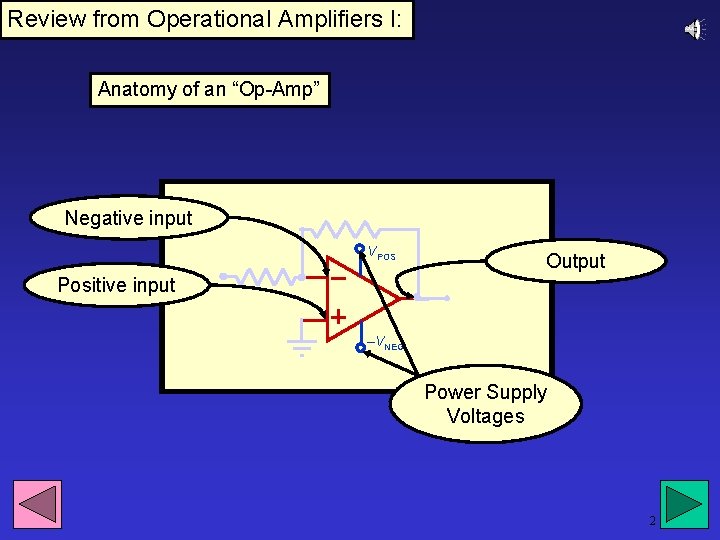
Review from Operational Amplifiers I: Anatomy of an “Op-Amp” Negative input VPOS Output Positive input –VNEG Power Supply Voltages 2
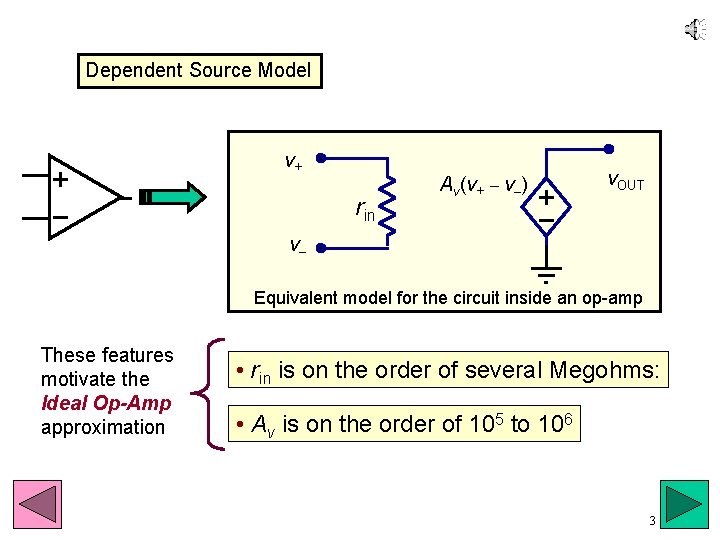
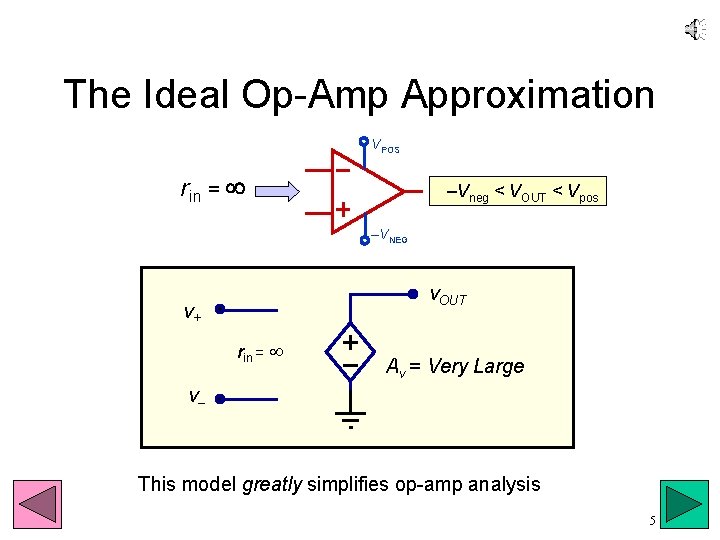
Dependent Source Model v+ rin Av(v+ – v–) v. OUT v– Equivalent model for the circuit inside an op-amp These features motivate the Ideal Op-Amp approximation • rin is on the order of several Megohms: • Av is on the order of 105 to 106 3
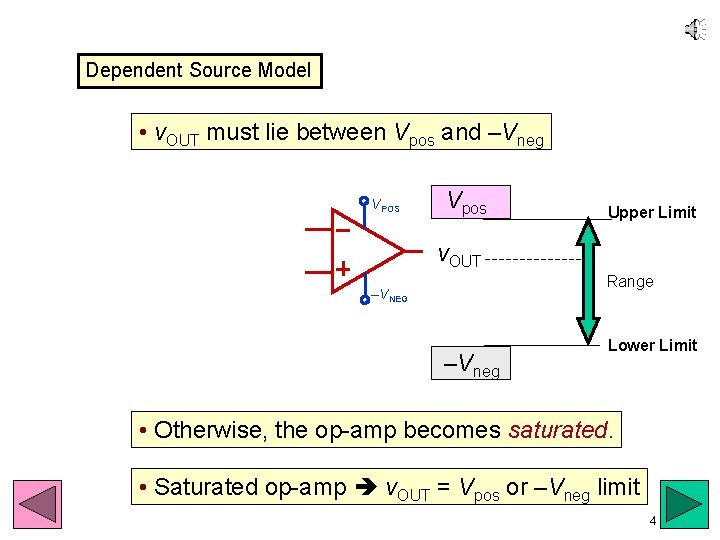
Dependent Source Model • v. OUT must lie between Vpos and –Vneg VPOS Vpos Upper Limit v. OUT Range –VNEG –Vneg Lower Limit • Otherwise, the op-amp becomes saturated. • Saturated op-amp v. OUT = Vpos or –Vneg limit 4
The Ideal Op-Amp Approximation VPOS rin = –Vneg < VOUT < Vpos –VNEG v. OUT v+ rin = Av = Very Large v– This model greatly simplifies op-amp analysis 5
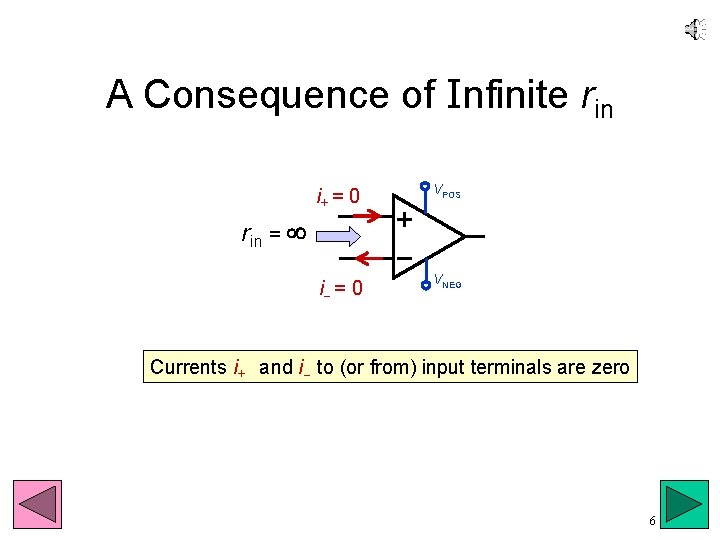
A Consequence of Infinite rin i+ = 0 VPOS i = 0 VNEG rin = Currents i+ and i to (or from) input terminals are zero 6
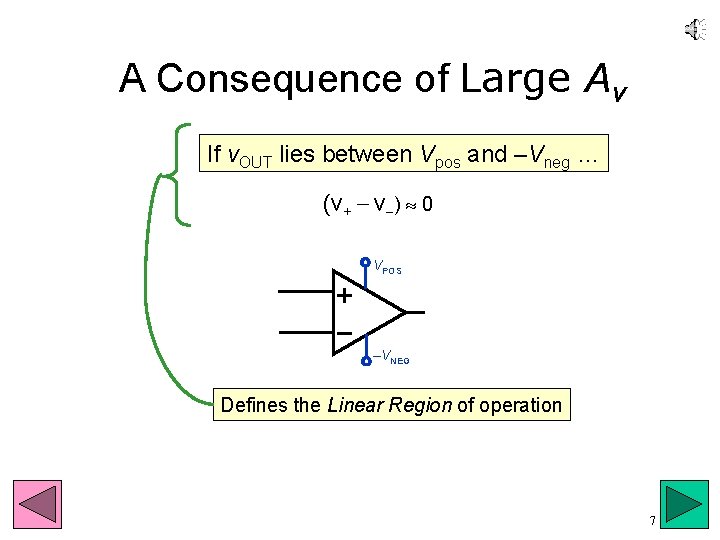
A Consequence of Large Av If v. OUT lies between Vpos and –Vneg … (v+ v–) 0 VPOS –VNEG Defines the Linear Region of operation 7
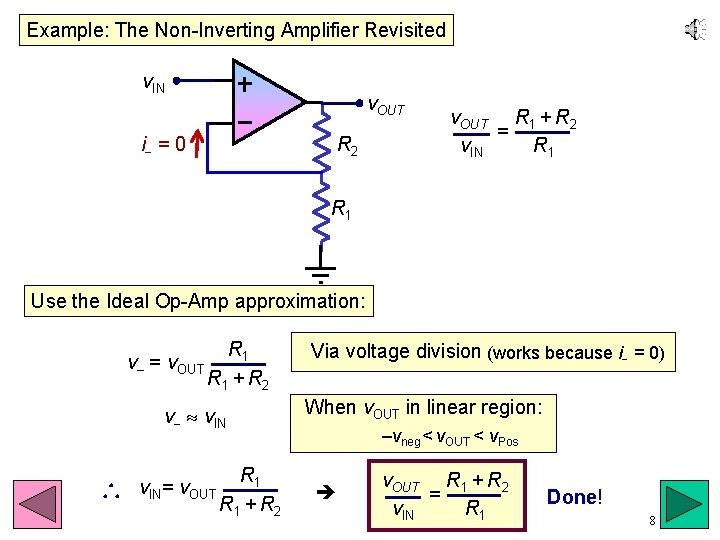
Example: The Non-Inverting Amplifier Revisited v. IN v. OUT R 2 i = 0 v. OUT R 1 + R 2 = v. IN R 1 Use the Ideal Op-Amp approximation: v– = v. OUT R 1 + R 2 v v. IN= v. OUT R 1 + R 2 Via voltage division (works because i = 0) When v. OUT in linear region: –vneg< v. OUT < v. Pos v. OUT R 1 + R 2 = v. IN R 1 Done! 8
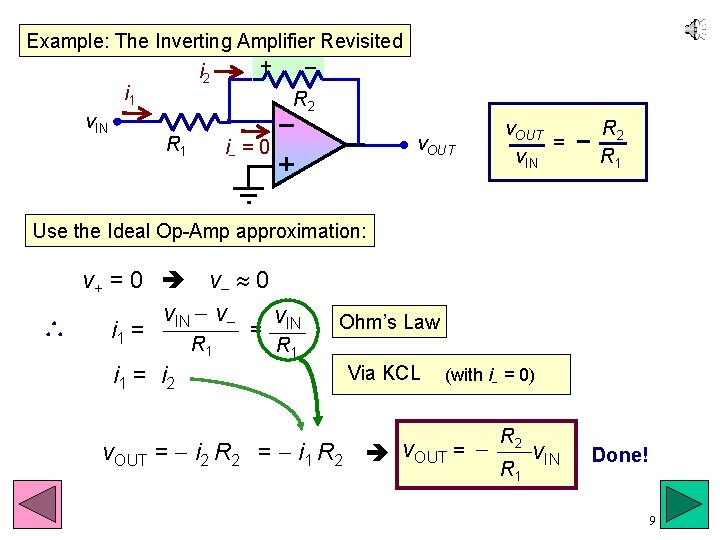
Example: The Inverting Amplifier Revisited + – i 2 i 1 R 2 v. IN v. OUT R 1 i = 0 v. OUT = v. IN R 2 R 1 Use the Ideal Op-Amp approximation: v+ = 0 v 0 v. IN v v. IN = i 1 = R 1 i 1 = i 2 Ohm’s Law R 1 Via KCL (with i = 0) v. OUT = i 2 R 2 = i 1 R 2 v. OUT = R 2 R 1 v. IN Done! 9
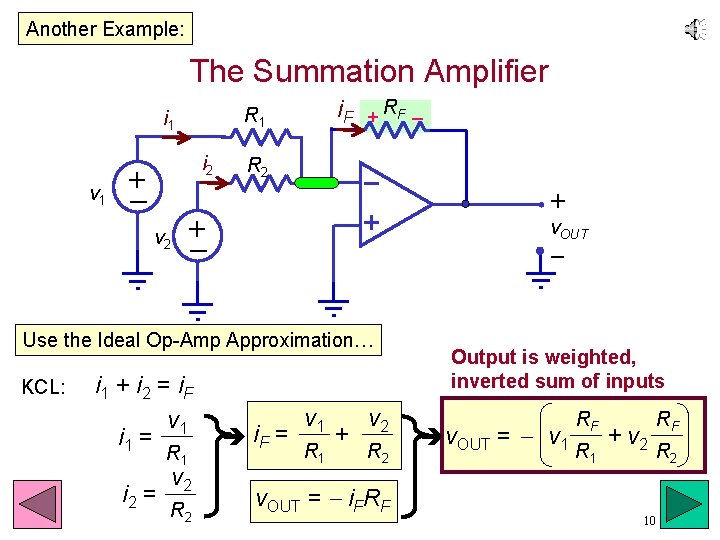
Another Example: The Summation Amplifier v 1 i 2 +_ v 2 i. F + RF – R 1 i 1 R 2 + +_ v. OUT – Use the Ideal Op-Amp Approximation… KCL: i 1 + i 2 = i. F v 1 i 1 = R 1 i 2 = v 2 R 2 i. F = v 1 R 1 + v 2 R 2 v. OUT = i. FRF Output is weighted, inverted sum of inputs v. OUT = v 1 RF R 1 + v 2 10 RF R 2
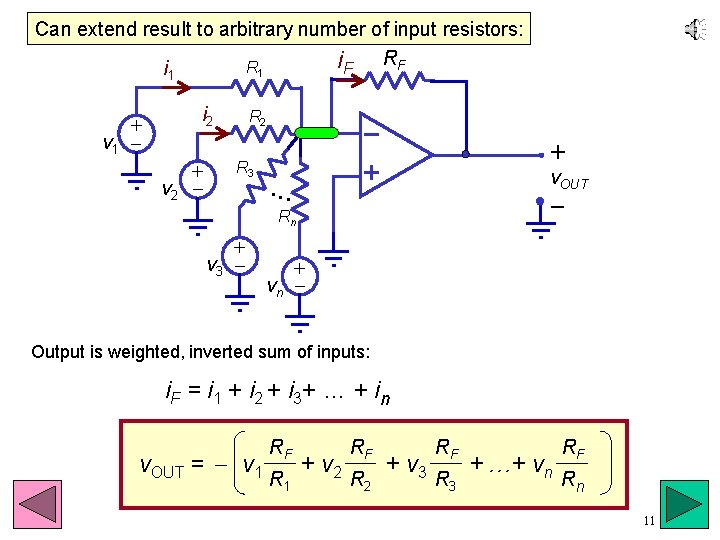
Can extend result to arbitrary number of input resistors: i. F RF R i 1 1 i 2 + v 1 _ v 2 + _ R 2 R 3 + . . . v. OUT – Rn + v 3 _ + vn _ Output is weighted, inverted sum of inputs: i F = i 1 + i 2 + i 3+ … + i n v. OUT = v 1 RF R 1 + v 2 RF R 2 + v 3 RF R 3 + …+ vn RF Rn 11
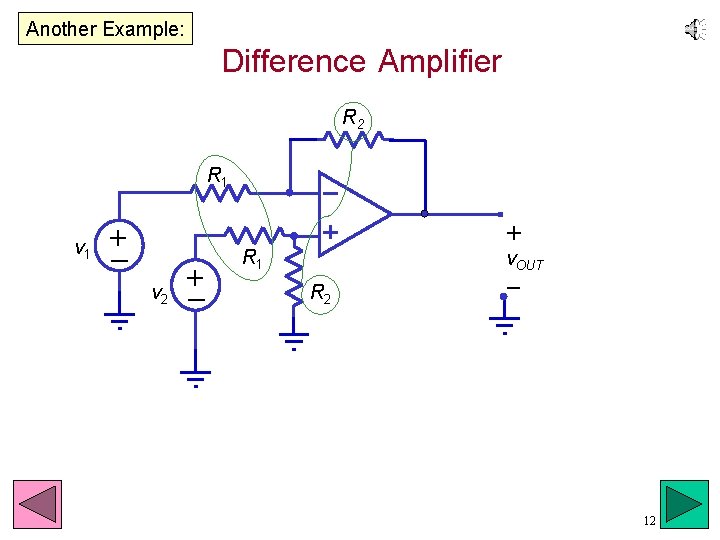
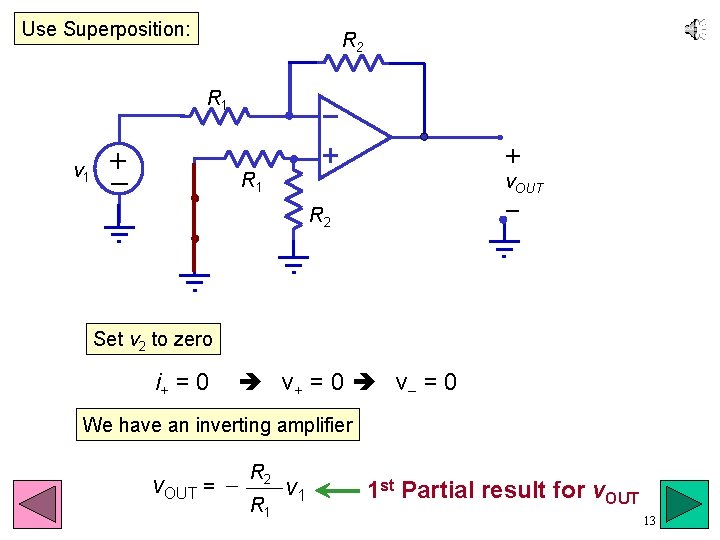
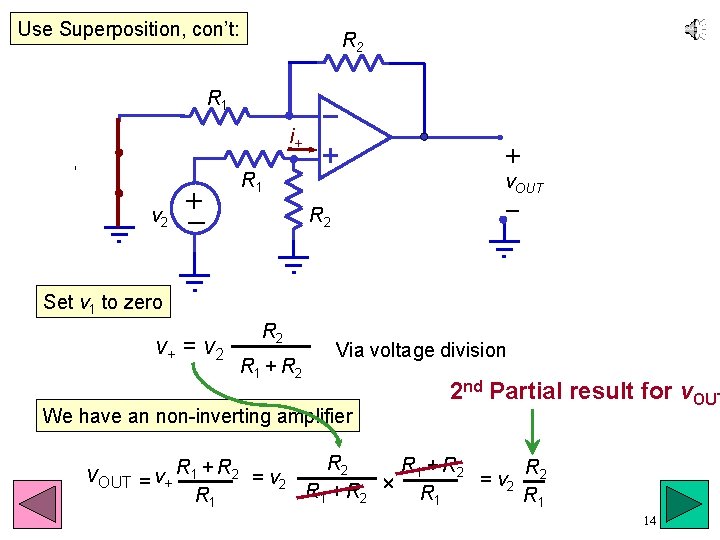
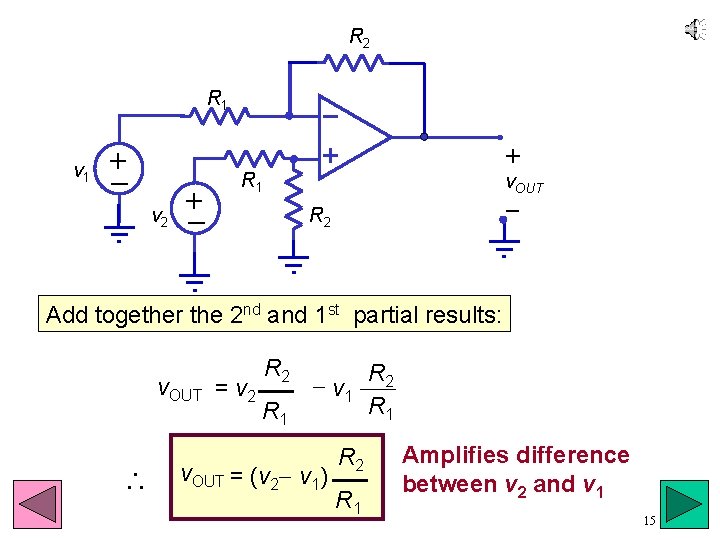
Another Example: Difference Amplifier R 2 R 1 v 1 +_ v 2 +_ + R 1 v. OUT R 2 – 12
Use Superposition: R 2 R 1 v 1 +_ v 2 + R 1 +_ v. OUT – R 2 Set v 2 to zero i+ = 0 v = 0 We have an inverting amplifier v. OUT = R 2 R 1 v 1 1 st Partial result for v. OUT 13
Use Superposition, con’t: R 2 R 1 v 1 i+ +_ v 2 +_ + R 1 v. OUT – R 2 Set v 1 to zero v+ = v 2 R 1 + R 2 Via voltage division We have an non-inverting amplifier v. OUT = v+ R 1 + R 2 = v 2 R 1 2 nd Partial result for v. OUT R 2 R 1 + R 2 = v 2 R 1 + R 2 R 1 14
R 2 R 1 v 1 +_ v 2 +_ + R 1 v. OUT – R 2 Add together the 2 nd and 1 st partial results: v. OUT = v 2 R 1 v 1 v. OUT = (v 2 v 1) R 2 R 1 Amplifies difference between v 2 and v 1 15
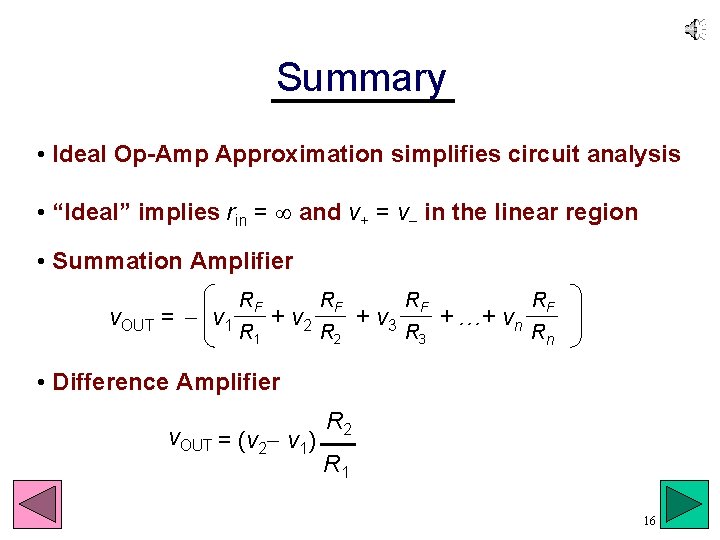
Summary • Ideal Op-Amp Approximation simplifies circuit analysis • “Ideal” implies rin = and v+ = v in the linear region • Summation Amplifier v. OUT = v 1 RF R 1 + v 2 RF R 2 + v 3 RF R 3 + …+ vn RF Rn • Difference Amplifier v. OUT = (v 2 v 1) R 2 R 1 16
End of This Module Homework 17