
MODULE 12 COMMUNITY ASSESSMENT OUTLINE FOR THIS MODULE
- Slides: 25
MODULE 12: COMMUNITY ASSESSMENT
OUTLINE FOR THIS MODULE Community Diagnosis Review and Assessment Service Learning
REVIEW What did we learn last week? What stands out from the last few modules? What has been reinforced through your Service Learning experiences?
COMMUNITY DIAGNOSIS
LEARNING OBJECTIVES By the end of this section, you will be able to: Define community diagnosis and Discuss the role of the CHW in community diagnosis. discuss key concepts and methods related to community diagnosis. Identify and develop effective research tools for gathering information for the Explain how community diagnosis is used to guide public health diagnosis. programs and efforts to advocate Summarize and analyze research for social change. findings. Describe and apply seven key steps in Explain how research findings are a community diagnosis process. used to develop an action plan. Participate in the design and execution of a community-centered and strengthbased community diagnosis.
WORDS TO KNOW Assessment of community strengths and assets Content analysis Leading questions Needs assessment Institutional review boards (IRBS) Qualitative data Quantitative data Root causes Sample
GROUP ACTIVITY 22. 1 INTRODUCTION TO COMMUNITY DIAGNOSIS
COMMUNITY DIAGNOSIS The art and the process that identifies community concerns or problems, uncovers the root causes and develops a clear plan to overcome them. Common names: Community-based participatory research (CBPR). Participatory action research (PAR). Action research. Participatory research.
CHW ROLE IN DIAGNOSIS Client-centered. Assist in development. Conduct assessments / surveys. Support community. What other ways would a CHW be involved?
IS IT COMMUNITY DRIVEN? Did community identify the research focus? How involved were local community members? How will the information be used? How will it be shared with the community? What are the records of the lead researchers?
COMMUNITY DIAGNOSIS CONCEPTS Educates. Seeks participation of community. Values knowledge. Exposes / examines power Prioritizes community issues. Values collaboration. Starts from community needs. dynamics. Seeks political or social change or action.
SEVEN STEPS TO CONDUCT A COMMUNITY DIAGNOSIS 1. Identify and bring the community together. 2. Choose a focus. 3. Select research tools. 4. Conduct research. 5. Summarize research findings. 6. Analyze research findings. 7. Develop an action plan.
STEP 1 — IDENTIFY AND BRING THE COMMUNITY TOGETHER Identify the group — nationality, language, risk factors and interests are ways to bring a community together. Promote and advertise meetings to ensure that the entire community learns what is going on. Use local media, schools, faith-based organizations, service organizations, businesses and unions to get the word out.
STEP 2 — CHOOSING A FOCUS The research focus should meet these criteria: Meaningful. Reach. High need. Public support. Political will. Practical. Clear target.
STEP 3 — SELECT RESEARCH TOOLS AND TYPE Qualitative data — In-depth understanding of how people experience a problem. Examples: Interviews and focus groups. Quantitative data — number of times something is happening. Examples: Surveys and public health data records.
STEP 3 — SELECT RESEARCH TOOLS AND TYPE Existing program data. Mapping Epidemiologic data. Focus groups. Evaluation of program(s). Surveys. Pre- / Post-tests. Visual. Interviews.
STEP 4 — CONDUCT RESEARCH Tools to conduct research: Library — visit a local library and work with a librarian to research a problem. Internet — use search engines like Google to get data or to network. Community forums — organize community meetings to get community input. Surveys — conduct individual or group surveys to find out people’s opinions on a problem.
HOW DOES BIAS SHOW UP IN RESEARCH? Determining who participates. Asking leading questions. Summarizing to highlight your desired outcome. Guiding the analysis and data explanation. Guiding the action plan development and implementation.
STEP 5 — SUMMARIZE RESEARCH FINDINGS Edit research findings so that everyone can understand the results. Make sure participants aren’t left out because they’re not comfortable talking about statistics. Highlight important findings related to the problem.
STEP 6 — ANALYZE RESEARCH FINDINGS Present information and research findings to the community for them to analyze and interpret. As the community is reviewing information and findings, ask questions such as: What are the solutions to the problem? Who in the community is affected by the problem? What does the community think are the causes and consequences of the problem?
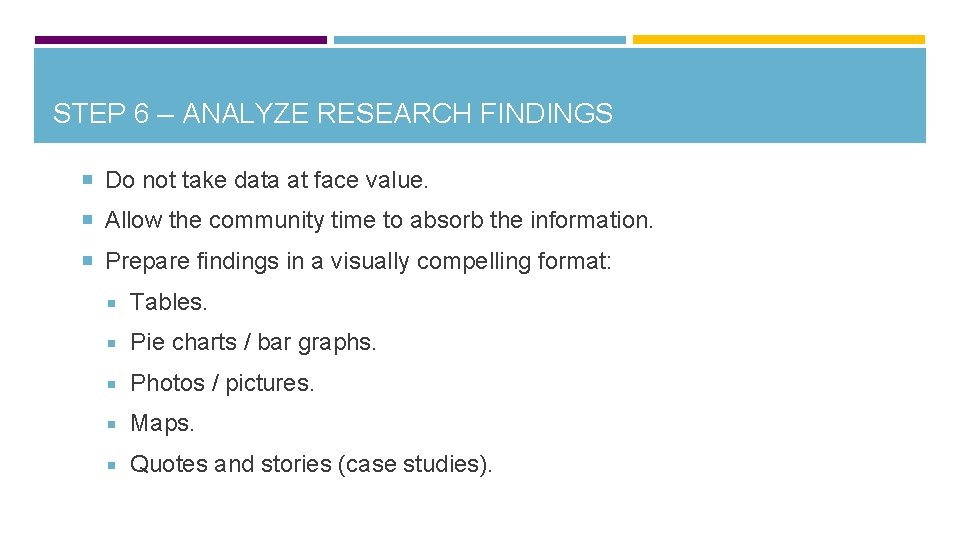
STEP 6 — ANALYZE RESEARCH FINDINGS Do not take data at face value. Allow the community time to absorb the information. Prepare findings in a visually compelling format: Tables. Pie charts / bar graphs. Photos / pictures. Maps. Quotes and stories (case studies).
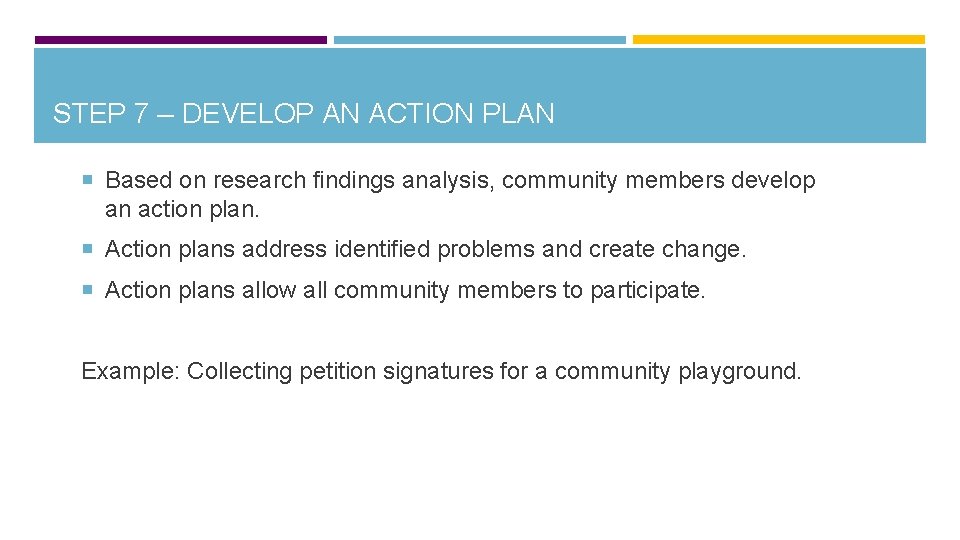
STEP 7 — DEVELOP AN ACTION PLAN Based on research findings analysis, community members develop an action plan. Action plans address identified problems and create change. Action plans allow all community members to participate. Example: Collecting petition signatures for a community playground.
GROUP ACTIVITY 23. 3 OVERVIEW OF COMMUNITY MAPPING
REVIEW – WHAT HAVE WE LEARNED TODAY?
SERVICE LEARNING