
Module 12 Analyzing Financial Statements Learning Objectives Explain
Module 12 Analyzing Financial Statements
Learning Objectives Explain the purpose of analysis. Identify the building blocks of analysis. Describe standards for comparisons in analysis. Identify the tools of analysis. Explain and apply methods of horizontal analysis. Describe and apply methods of horizontal analysis. Define and apply ratio analysis. Run an SAP demonstration. Practise preparing Cash Flow statements in SAP 2007 / SAP University Alliances Introductory Accounting

Purpose of Analysis Financial statement analysis helps users make better decisions. Internal Users External Users Managers Officers Internal Auditors Shareholders Lenders Customers SAP 2007 / SAP University Alliances Introductory Accounting

Building Blocks of Analysis Ability to meet short-term obligations and to efficiently generate revenues Ability to provide financial rewards sufficient to attract and retain financing SAP 2007 / SAP University Alliances 1. Liquidity and Efficiency 2. Solvency 3. Profitability 4. Market Introductory Accounting Ability to generate future revenues and meet long-term obligations Ability to generate positive market expectations
Standards for Comparison To help interpret financial statements, several standards of comparison are used. ŒIntracompany Competitor Industry Guidelines SAP 2007 / SAP University Alliances Introductory Accounting
Tools of Analysis Horizontal Analysis • Comparison of a company’s financial condition and performance across time. SAP 2007 / SAP University Alliances Introductory Accounting
Tools of Analysis Horizontal Analysis Vertical Analysis Comparison of a company’s financial condition and performance to a base amount. SAP 2007 / SAP University Alliances Introductory Accounting
Tools of Analysis Horizontal Analysis Vertical Analysis Ratio Analysis Determination of key relations among financial statement items. SAP 2007 / SAP University Alliances Introductory Accounting
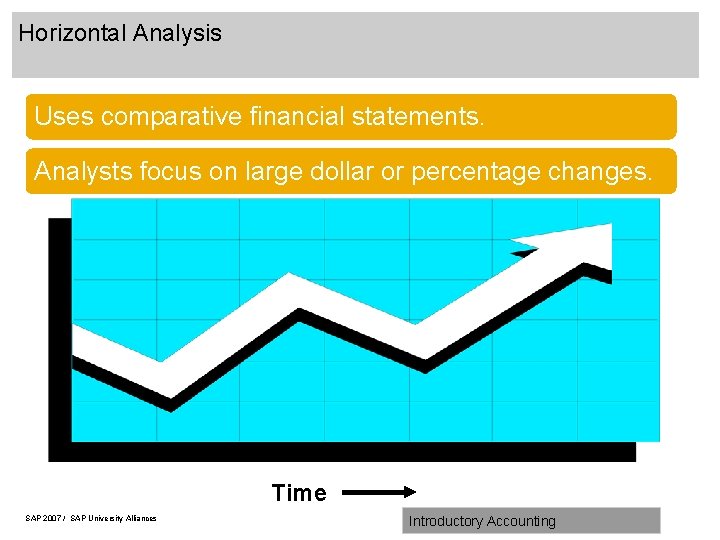
Horizontal Analysis Uses comparative financial statements. Analysts focus on large dollar or percentage changes. Time SAP 2007 / SAP University Alliances Introductory Accounting
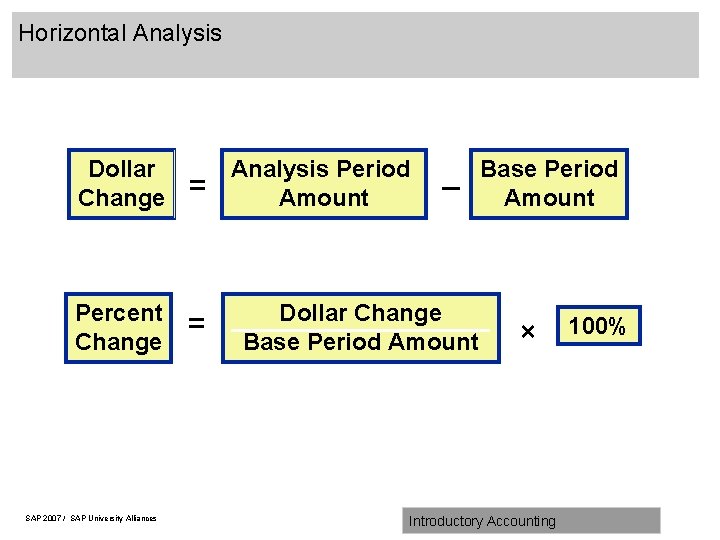
Horizontal Analysis Dollar Change = Percent Change = SAP 2007 / SAP University Alliances Analysis Period Amount – Dollar Change Base Period Amount × Introductory Accounting 100%
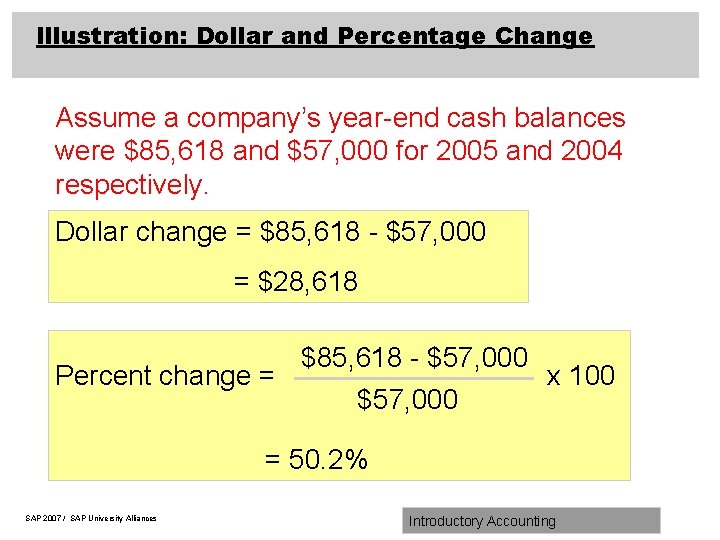
Illustration: Dollar and Percentage Change Assume a company’s year-end cash balances were $85, 618 and $57, 000 for 2005 and 2004 respectively. Dollar change = $85, 618 - $57, 000 = $28, 618 $85, 618 - $57, 000 Percent change = x 100 $57, 000 = 50. 2% SAP 2007 / SAP University Alliances Introductory Accounting
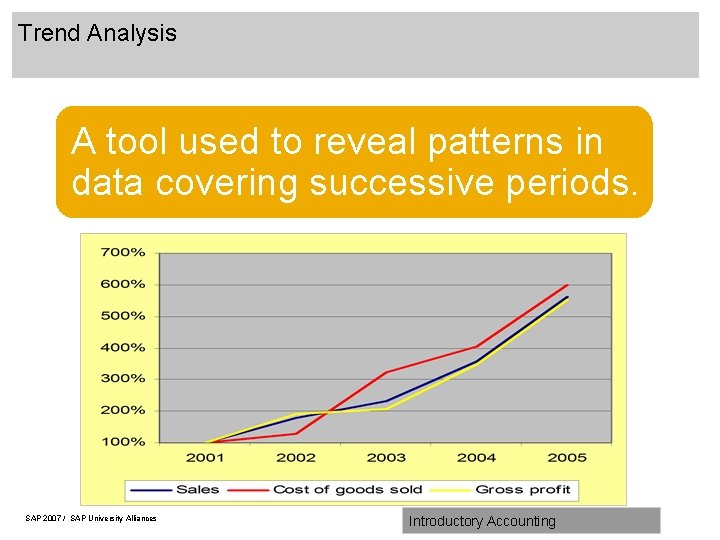
Trend Analysis A tool used to reveal patterns in data covering successive periods. SAP 2007 / SAP University Alliances Introductory Accounting
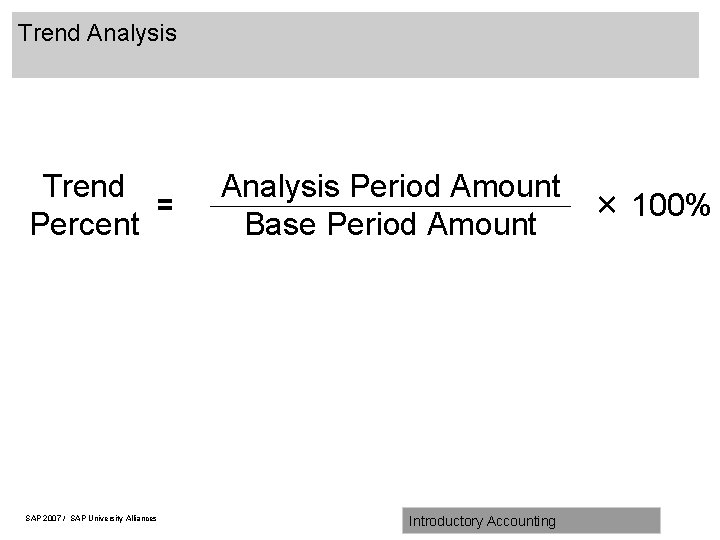
Trend Analysis Trend = Percent SAP 2007 / SAP University Alliances Analysis Period Amount Base Period Amount Introductory Accounting × 100%

Vertical or Common Size Analysis Income statement items are expressed as a percentage of revenues. Balance sheet items are expressed as a percentage of total assets. SAP 2007 / SAP University Alliances Introductory Accounting
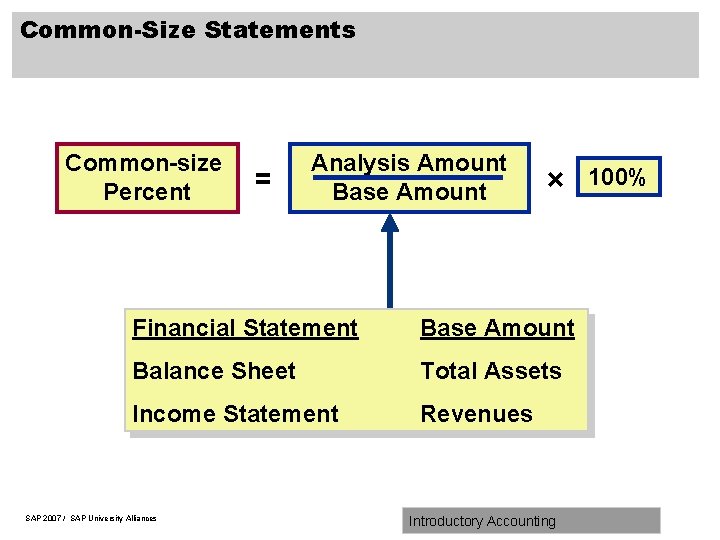
Common-Size Statements Common-size Percent = Analysis Amount Base Amount × Financial Statement Base Amount Balance Sheet Total Assets Income Statement Revenues SAP 2007 / SAP University Alliances Introductory Accounting 100%
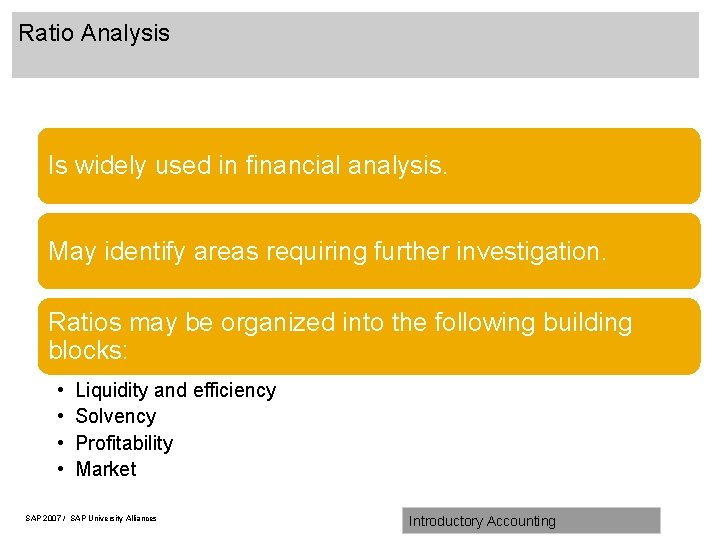
Ratio Analysis Is widely used in financial analysis. May identify areas requiring further investigation. Ratios may be organized into the following building blocks: • • Liquidity and efficiency Solvency Profitability Market SAP 2007 / SAP University Alliances Introductory Accounting
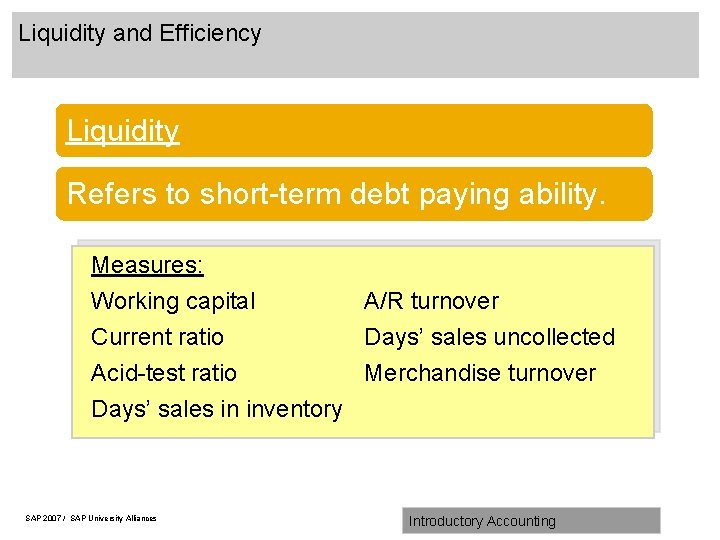
Liquidity and Efficiency Liquidity Refers to short-term debt paying ability. Measures: Working capital Current ratio Acid-test ratio A/R turnover Days’ sales uncollected Merchandise turnover Days’ sales in inventory SAP 2007 / SAP University Alliances Introductory Accounting
Liquidity and Efficiency Measures a company’s productivity in using its assets. Measured by: Total asset turnover ratio SAP 2007 / SAP University Alliances Introductory Accounting
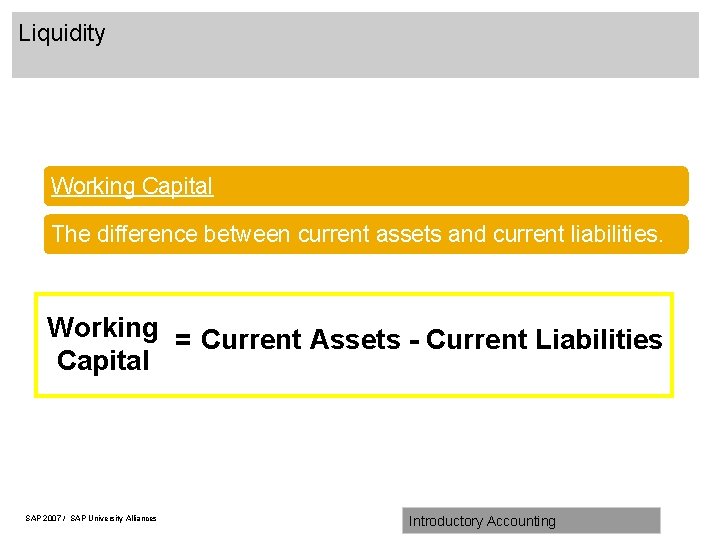
Liquidity Working Capital The difference between current assets and current liabilities. Working = Current Assets - Current Liabilities Capital SAP 2007 / SAP University Alliances Introductory Accounting
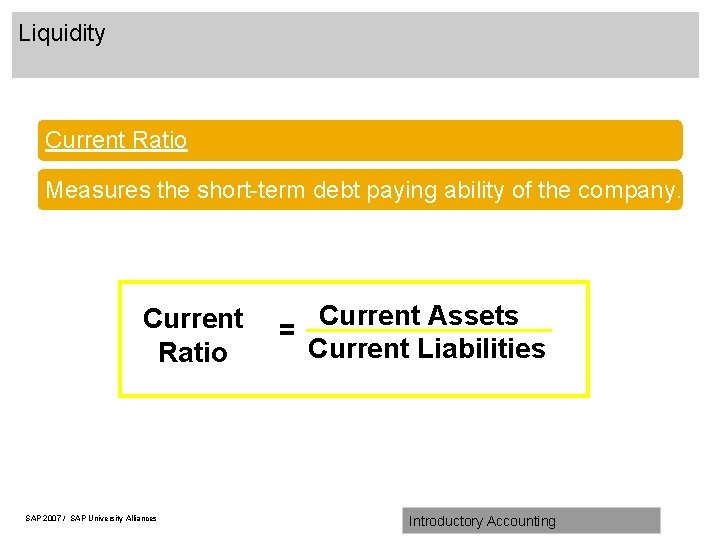
Liquidity Current Ratio Measures the short-term debt paying ability of the company. Current Ratio SAP 2007 / SAP University Alliances = Current Assets Current Liabilities Introductory Accounting
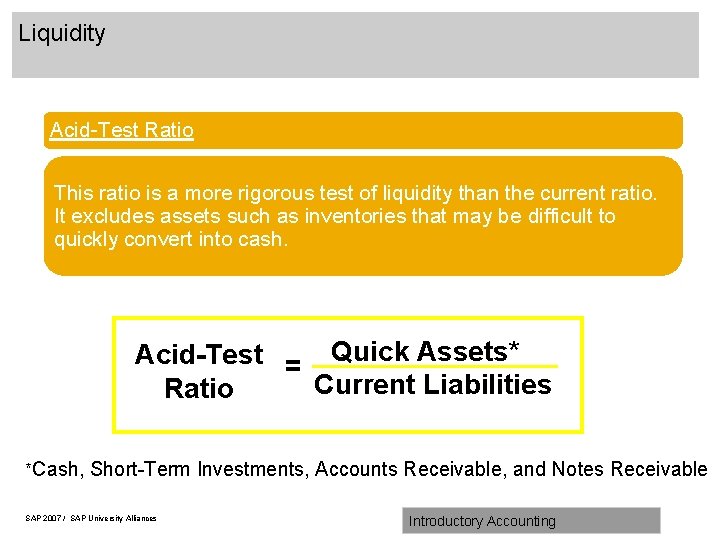
Liquidity Acid-Test Ratio This ratio is a more rigorous test of liquidity than the current ratio. It excludes assets such as inventories that may be difficult to quickly convert into cash. Acid-Test = Quick Assets* Current Liabilities Ratio *Cash, Short-Term Investments, Accounts Receivable, and Notes Receivable SAP 2007 / SAP University Alliances Introductory Accounting
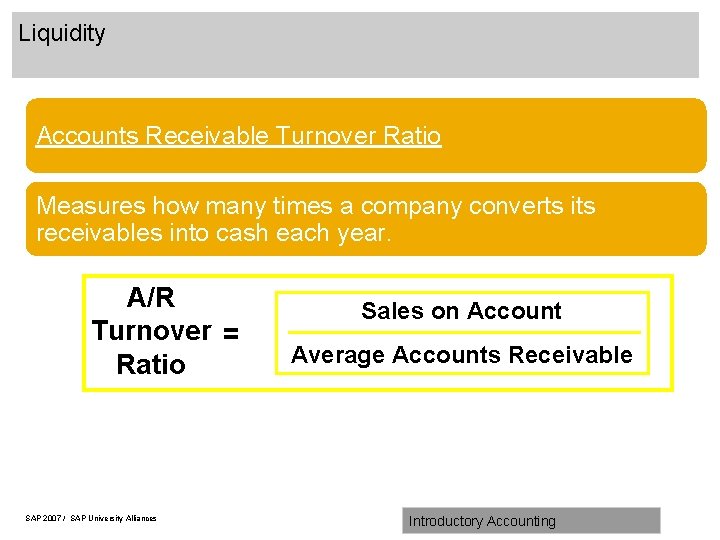
Liquidity Accounts Receivable Turnover Ratio Measures how many times a company converts its receivables into cash each year. A/R Turnover = Ratio SAP 2007 / SAP University Alliances Sales on Account Average Accounts Receivable Introductory Accounting
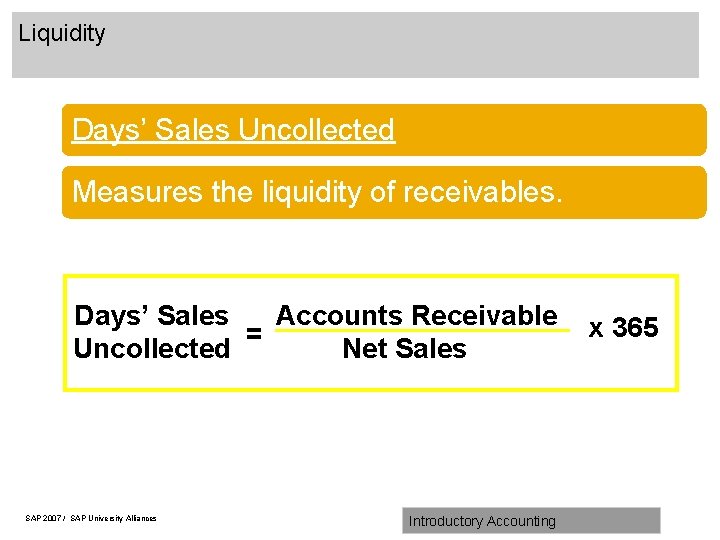
Liquidity Days’ Sales Uncollected Measures the liquidity of receivables. Days’ Sales Accounts Receivable = Uncollected Net Sales SAP 2007 / SAP University Alliances Introductory Accounting x 365
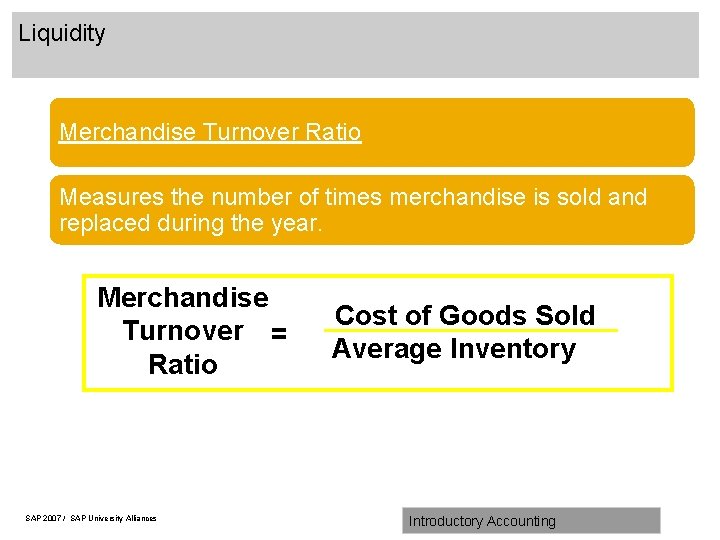
Liquidity Merchandise Turnover Ratio Measures the number of times merchandise is sold and replaced during the year. Merchandise Turnover = Ratio SAP 2007 / SAP University Alliances Cost of Goods Sold Average Inventory Introductory Accounting
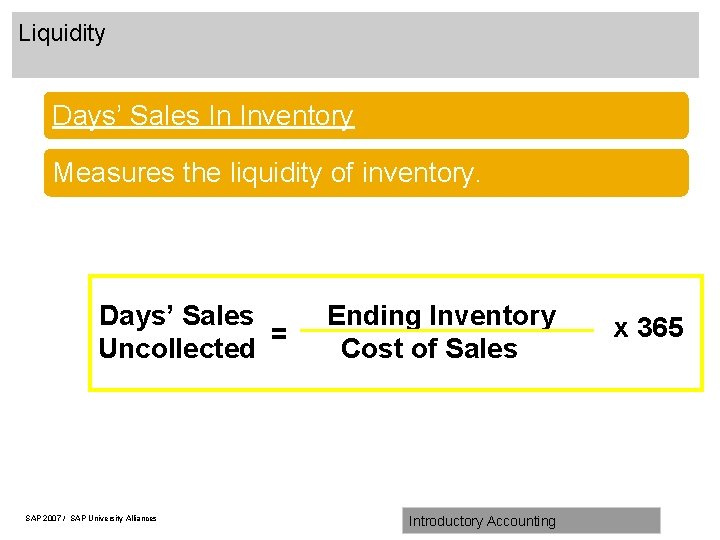
Liquidity Days’ Sales In Inventory Measures the liquidity of inventory. Days’ Sales = Uncollected SAP 2007 / SAP University Alliances Ending Inventory Cost of Sales Introductory Accounting x 365
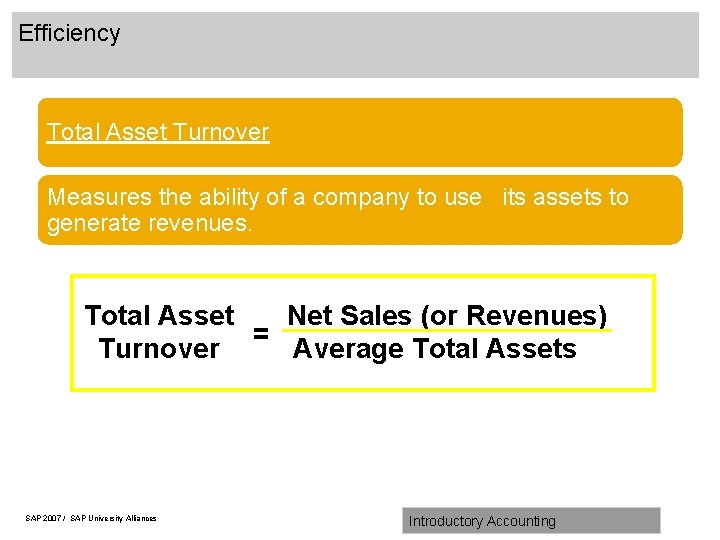
Efficiency Total Asset Turnover Measures the ability of a company to use its assets to generate revenues. Total Asset Net Sales (or Revenues) = Turnover Average Total Assets SAP 2007 / SAP University Alliances Introductory Accounting
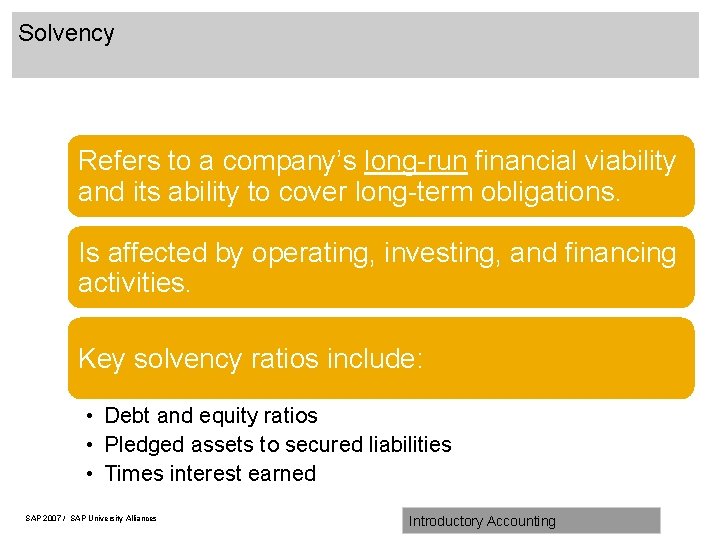
Solvency Refers to a company’s long-run financial viability and its ability to cover long-term obligations. Is affected by operating, investing, and financing activities. Key solvency ratios include: • Debt and equity ratios • Pledged assets to secured liabilities • Times interest earned SAP 2007 / SAP University Alliances Introductory Accounting
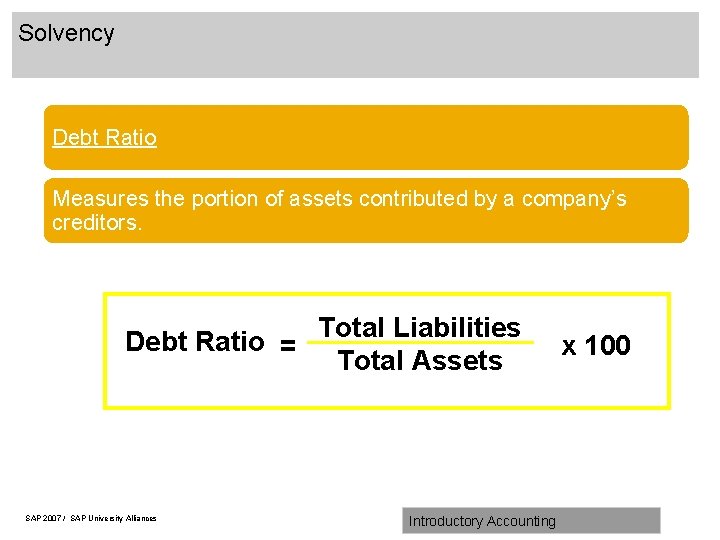
Solvency Debt Ratio Measures the portion of assets contributed by a company’s creditors. Debt Ratio = SAP 2007 / SAP University Alliances Total Liabilities Total Assets Introductory Accounting x 100
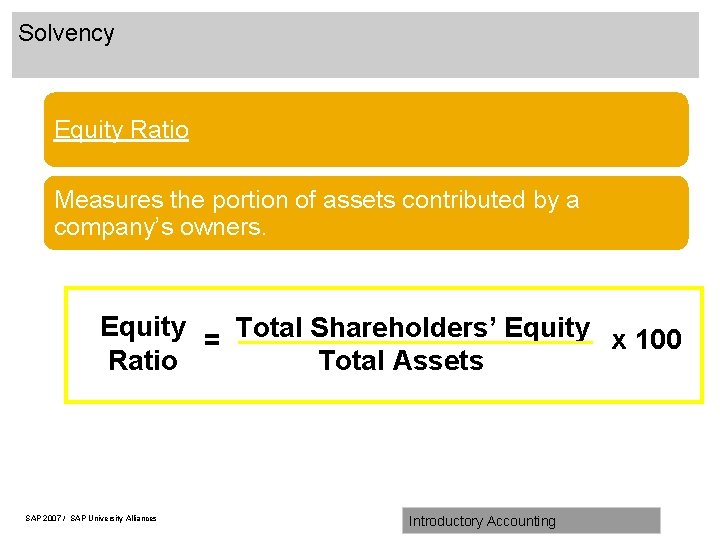
Solvency Equity Ratio Measures the portion of assets contributed by a company’s owners. Equity = Total Shareholders’ Equity x 100 Ratio Total Assets SAP 2007 / SAP University Alliances Introductory Accounting
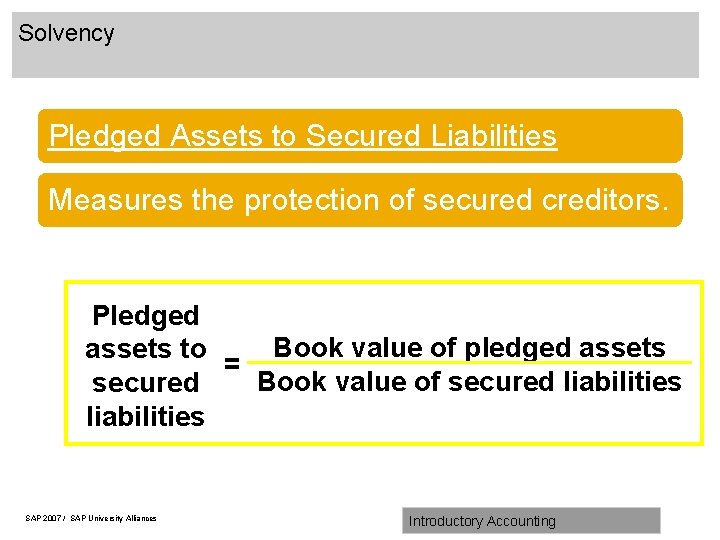
Solvency Pledged Assets to Secured Liabilities Measures the protection of secured creditors. Pledged Book value of pledged assets to = Book value of secured liabilities SAP 2007 / SAP University Alliances Introductory Accounting
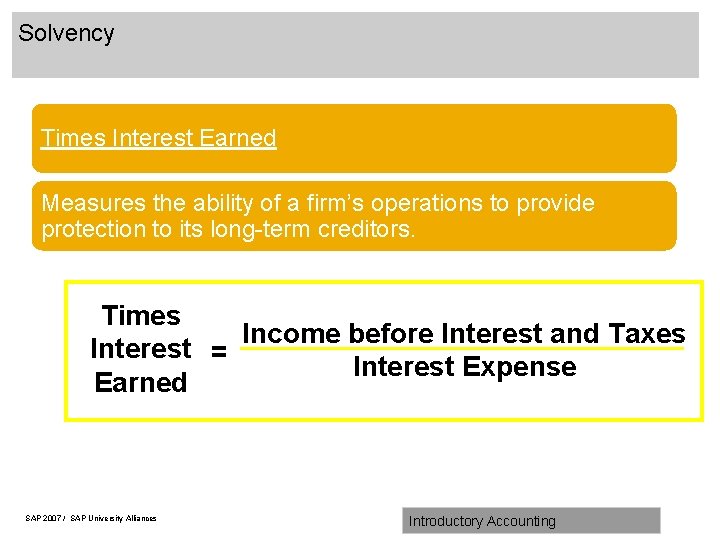
Solvency Times Interest Earned Measures the ability of a firm’s operations to provide protection to its long-term creditors. Times Income before Interest and Taxes Interest = Interest Expense Earned SAP 2007 / SAP University Alliances Introductory Accounting
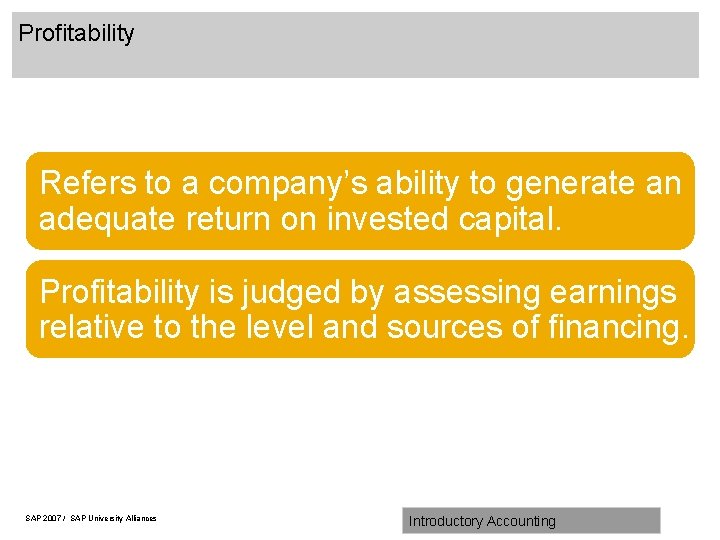
Profitability Refers to a company’s ability to generate an adequate return on invested capital. Profitability is judged by assessing earnings relative to the level and sources of financing. SAP 2007 / SAP University Alliances Introductory Accounting
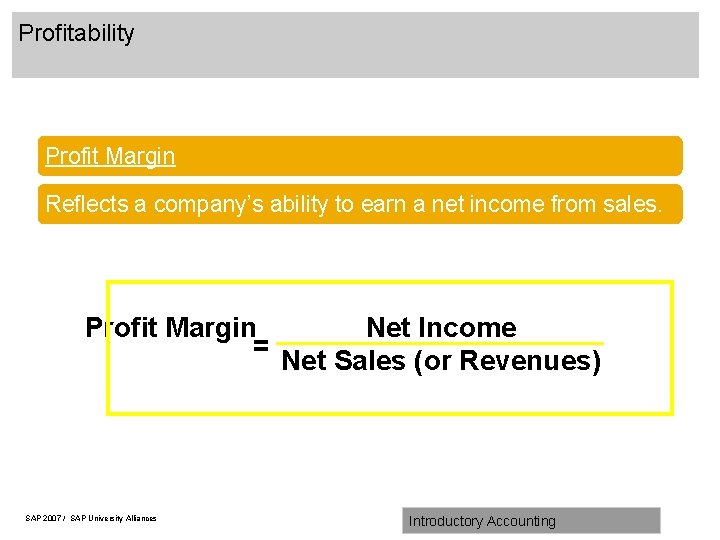
Profitability Profit Margin Reflects a company’s ability to earn a net income from sales. Profit Margin = SAP 2007 / SAP University Alliances Net Income Net Sales (or Revenues) Introductory Accounting
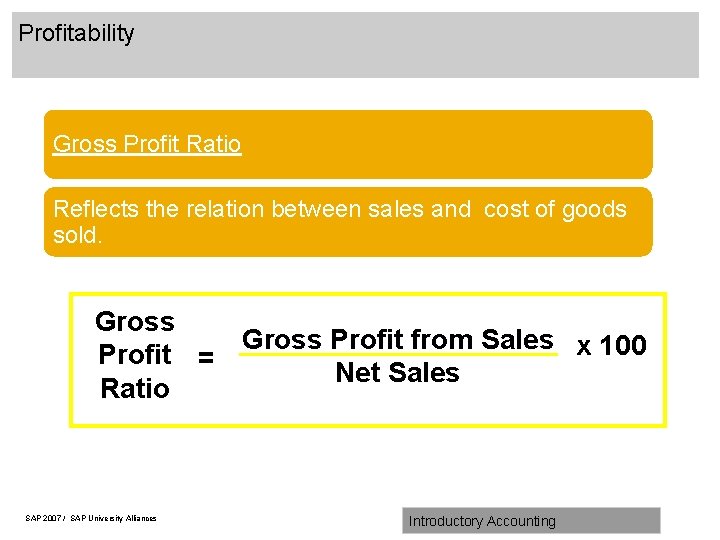
Profitability Gross Profit Ratio Reflects the relation between sales and cost of goods sold. Gross Profit from Sales x 100 Profit = Net Sales Ratio SAP 2007 / SAP University Alliances Introductory Accounting
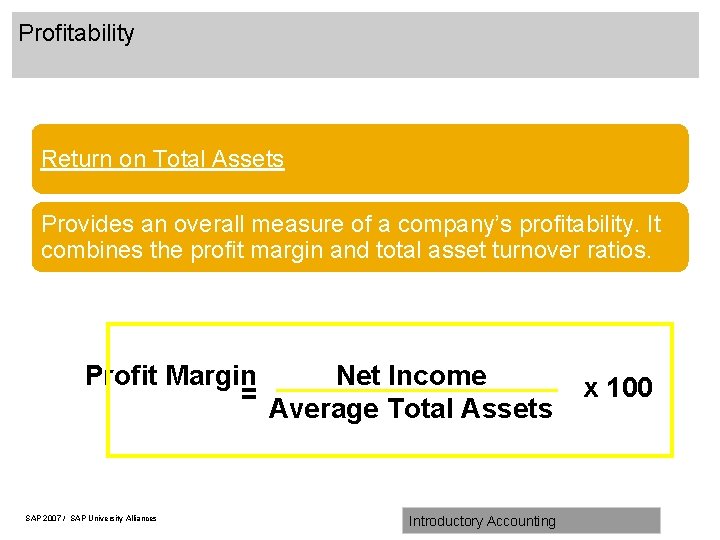
Profitability Return on Total Assets Provides an overall measure of a company’s profitability. It combines the profit margin and total asset turnover ratios. Profit Margin = SAP 2007 / SAP University Alliances Net Income Average Total Assets Introductory Accounting x 100
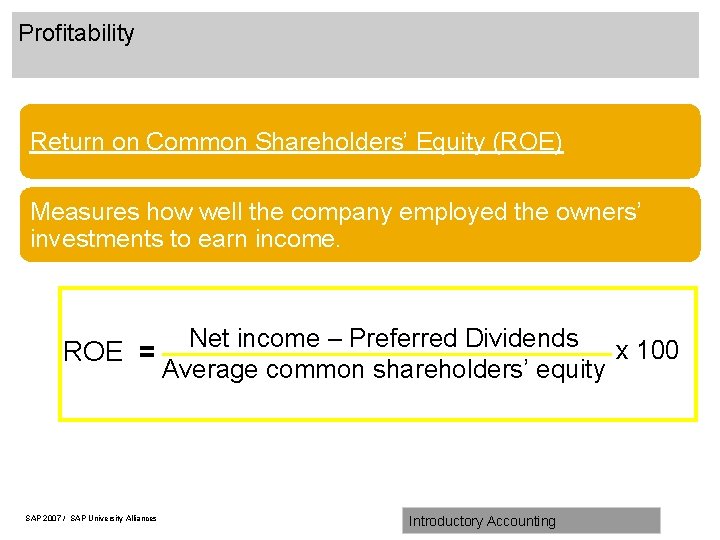
Profitability Return on Common Shareholders’ Equity (ROE) Measures how well the company employed the owners’ investments to earn income. Net income – Preferred Dividends x 100 ROE = Average common shareholders’ equity SAP 2007 / SAP University Alliances Introductory Accounting
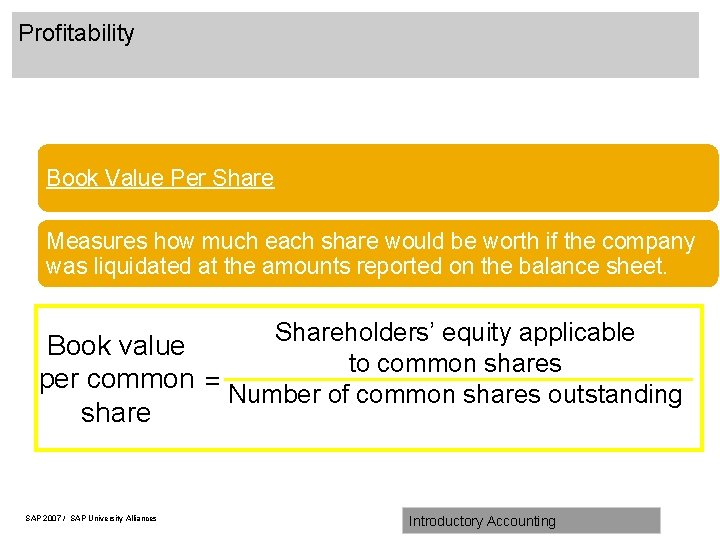
Profitability Book Value Per Share Measures how much each share would be worth if the company was liquidated at the amounts reported on the balance sheet. Shareholders’ equity applicable Book value to common shares per common = Number of common shares outstanding share SAP 2007 / SAP University Alliances Introductory Accounting
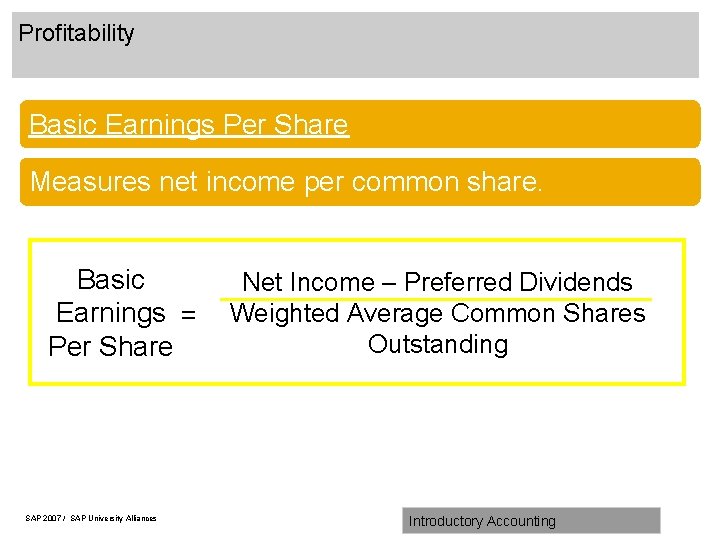
Profitability Basic Earnings Per Share Measures net income per common share. Basic Earnings = Per Share SAP 2007 / SAP University Alliances Net Income – Preferred Dividends Weighted Average Common Shares Outstanding Introductory Accounting
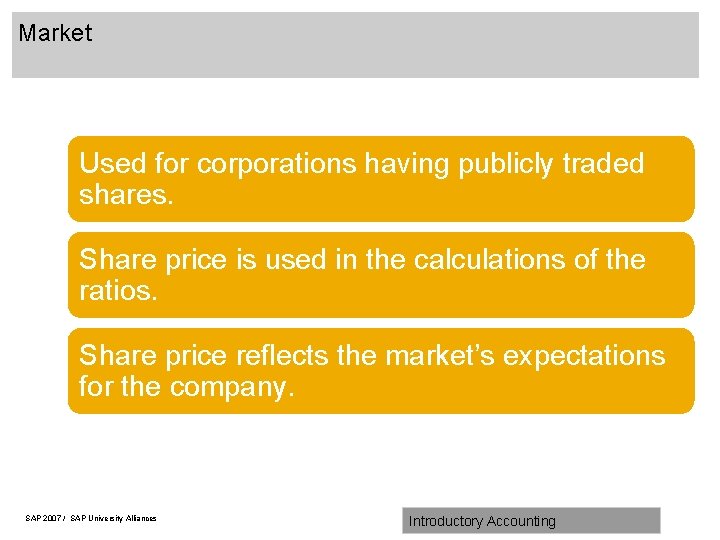
Market Used for corporations having publicly traded shares. Share price is used in the calculations of the ratios. Share price reflects the market’s expectations for the company. SAP 2007 / SAP University Alliances Introductory Accounting
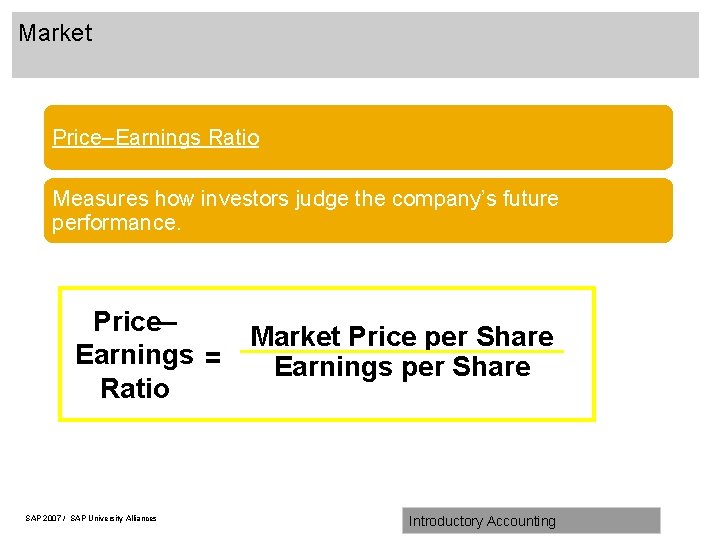
Market Price–Earnings Ratio Measures how investors judge the company’s future performance. Price– Earnings = Ratio SAP 2007 / SAP University Alliances Market Price per Share Earnings per Share Introductory Accounting
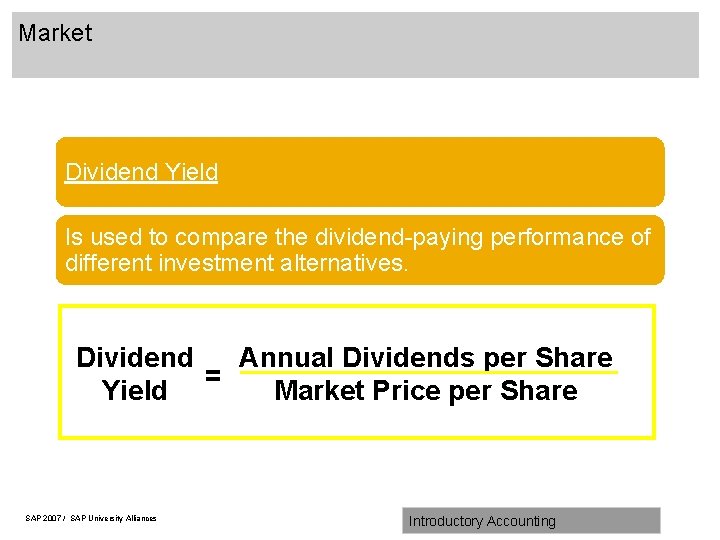
Market Dividend Yield Is used to compare the dividend-paying performance of different investment alternatives. Dividend Annual Dividends per Share = Yield Market Price per Share SAP 2007 / SAP University Alliances Introductory Accounting
- Slides: 41