
Module 11 STEPS 4 5 Conduct Reconnaissance Study



- Slides: 29
Module 11 STEPS 4 & 5 Conduct Reconnaissance Study & Report Certification Civil Works Orientation Course - FY 11
OBJECTIVES: The module will discuss the following: Ø Goals and purposes of the – Reconnaissance (recon) Phase. Ø What is involved in the recon phase? Ø Results and products
Reconnaissance Study GOAL: Reconnaissance Phase: ? Determine whether the Corps should investigate the problems in more detail during the second phase of the study (the feasibility study) Study is 100% Federally funded!
PURPOSES OF RECONNAISSANCE STUDY: 1. Define water resources problems and identify potential solutions 2. Decide whethere is a Federal interest in continuing into feasibility studies 3. Identify a local sponsor 4. Prepare a Project Management Plan (PMP)
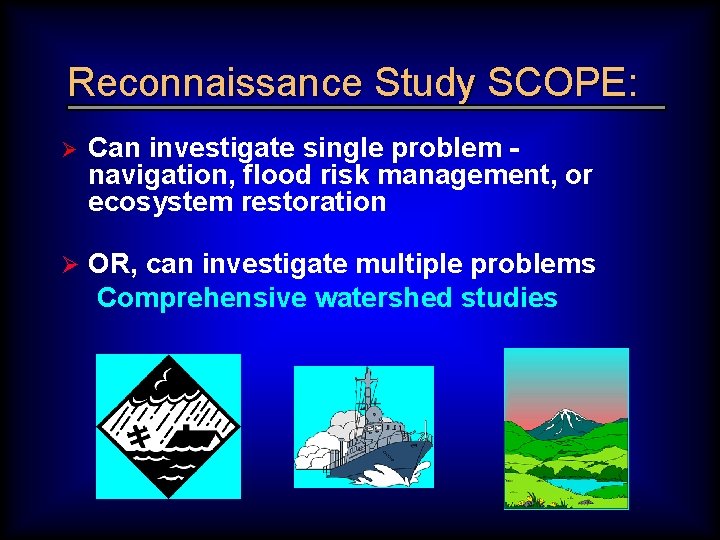
Reconnaissance Study SCOPE: Ø Can investigate single problem navigation, flood risk management, or ecosystem restoration Ø OR, can investigate multiple problems Comprehensive watershed studies
Establishment of Study Team: Study Team Leader (Planner) Local Sponsor Project Manager Environmental Specialist Economist Real Estate Specialist Hydraulics/Hydrology Engineer Geotechnical Engineer Cost Estimator And others as needed to prepare PMP…. .
Reconnaissance Studies: —Planning Guidance Notebook: ER 1105 -2 -100 Appendix G – – Principles and Guidelines (P&G) Policy Digest (EP 1165 -2 -1) ER 1105 -2 -100 All Corps civil works guidance is under review per WRDA 2007 and is subject to change
Guidance: What it says! — Most effort is devoted to preparation of PMP — Goal is to execute Feasibility Cost Sharing Agreement (FCSA) within 12 months — Generally, $150 k+ in cost (except for watershed studies) — Recon recommendation shall be based on professional and technical judgment — No detailed tasks (utilize existing readily available data) — A Section 905(b) Analysis is prepared
— — — Verify/understand water resources problem(s). Use existing, readily available data. Coordinate with sponsor(s) and Federal, State, and local agencies NGOs, and Local Stakeholders
— Identify potential solution(s) using professional & technical judgment. — Identify a Federal interest: – – – Consistent with Army/Corps implementation and budgetary policies. High likelihood of economic justification High likelihood of environmental acceptability/sustainability
Non-structural measures (Operational) Various channel depths or widths Various channel alignments Jetties/Breakwaters Locks and Dams
Dams Levees Floodwalls Channelization Non-structural measures Look for multi-purpose opportunities
Create and/or restore wetlands Restore/create fish passage Restore/create habitat Restore riverine functions Re-establish native vegetation communities Eradicate invasive species
It means…benefits of project are greater than the project cost! — Average annual benefits ($ or ER units) > average annual costs ($). — No calculation during recon study, just judgment.
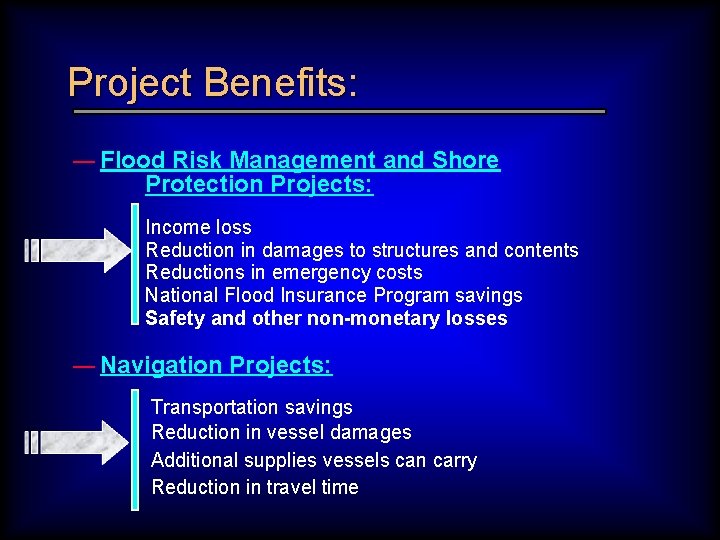
Project Benefits: — Flood Risk Management and Shore Protection Projects: Income loss Reduction in damages to structures and contents Reductions in emergency costs National Flood Insurance Program savings Safety and other non-monetary losses — Navigation Projects: Transportation savings Reduction in vessel damages Additional supplies vessels can carry Reduction in travel time
Project Benefits (cont. ): — Ecosystem Restoration Projects: Non-monetary benefits Must discuss outputs, such as habitat units
– Local, state, or regional entity must support the project. – Sponsor must be willing and able to cost share 50% of the feasibility phase. – Sponsor must provide letter of intent (LOI) stating their willingness to cost-share feasibility studies.
Will most likely be accomplished through a site visit, one or two meetings, and close coordination with local sponsor(s). Consider collaboration with stakeholder groups.
— — — — Study Authority Study Purpose Project Location/Congressional District Prior Studies & Reports/Existing Water Projects Plan Formulation Federal Interest Preliminary Financial Analysis and….
— — — — (continued) Summary of Feasibility Assumptions (the unusual ones!) Feasibility Milestones Feasibility Costs Recommendations Potential Issues Affecting Feasibility Phase Views of Other Agencies Project Area map
— — — — Detailed Cost Estimate (MCACES) Detailed Engineering/Design Studies/Data Gathering Detailed Environmental Evaluations Detailed BCR analyses Detailed Real Estate Detailed Report - See 905(b) examples Formal Coordination w/Federal & State Agencies (i. e. FWCA, SHPO) - No money!!
Study Team must prepare the PMP (PMP must have a Review Plan) — Includes tasks and corresponding costs for conducting the feasibility study — Most effort during the reconnaissance phase will be spent preparing the PMP —
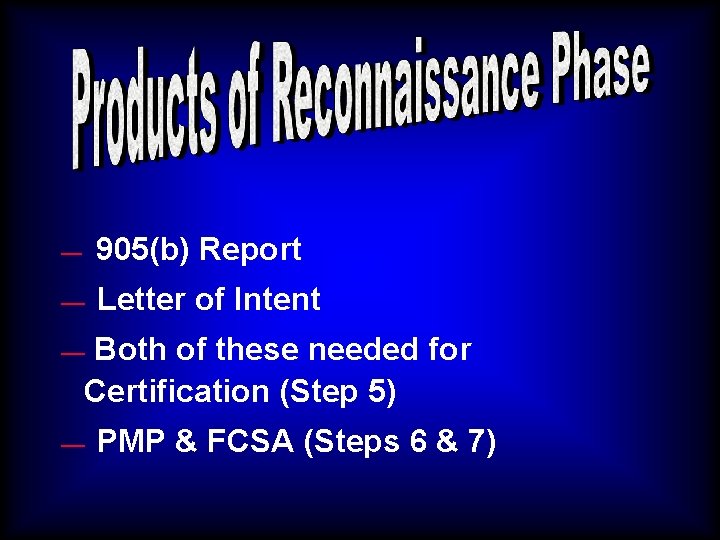
— 905(b) Report — Letter of Intent Both of these needed for Certification (Step 5) — — PMP & FCSA (Steps 6 & 7)
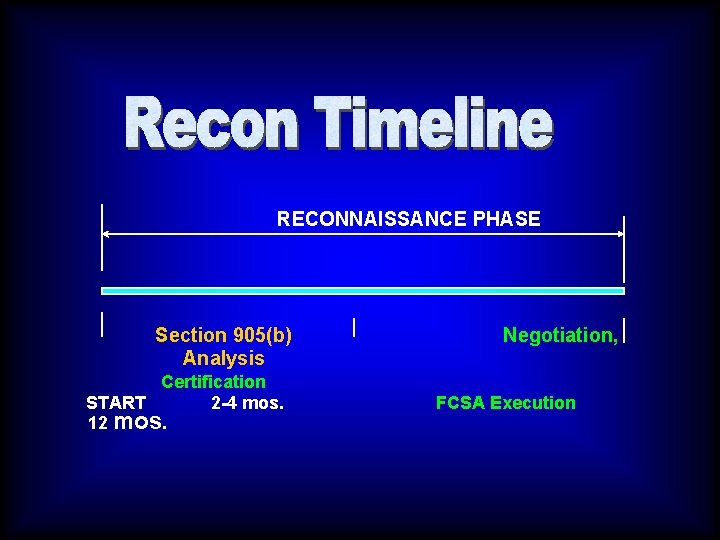
RECONNAISSANCE PHASE Section 905(b) Analysis Certification START 2 -4 mos. 12 mos. Negotiation, FCSA Execution
Note TEMPLATE
STEP 5 - Certification of 905(b) Analysis Ø Determines that there is a federal (Corps) interest in proceeding to the feasibility phase Ø Division Approval and Certification of 905(b) Analysis
Reconnaissance Certification Means Ø Consistent with Administration Policy Ø Administration would support if economically, environmentally and technically feasible Ø Meets existing Corps of Engineers criteria and guidelines
SUMMARY: Ø 4 Purposes of Recon Study: 1. 2. 3. 4. Identify Problem Determine Potential Federal Interest Identify Sponsor Prepare PMP/FCSA Ø Cost of Recon = $150, 000 + Ø Most effort spent on PMP/ FCSA Negotiations Ø Use experienced staff and professional judgment! Ø Division certification required to proceed to next phase