
Module 11 Lesson 11 1 Solving Quadratic Equations

- Slides: 8
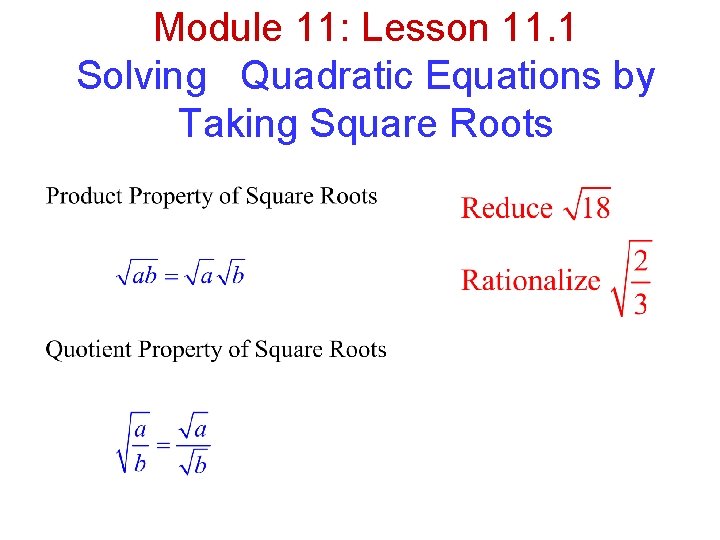
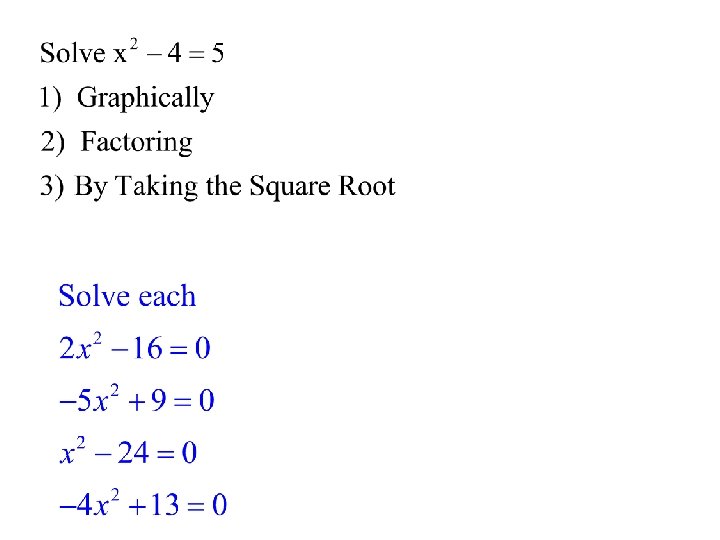
Module 11: Lesson 11. 1 Solving Quadratic Equations by Taking Square Roots
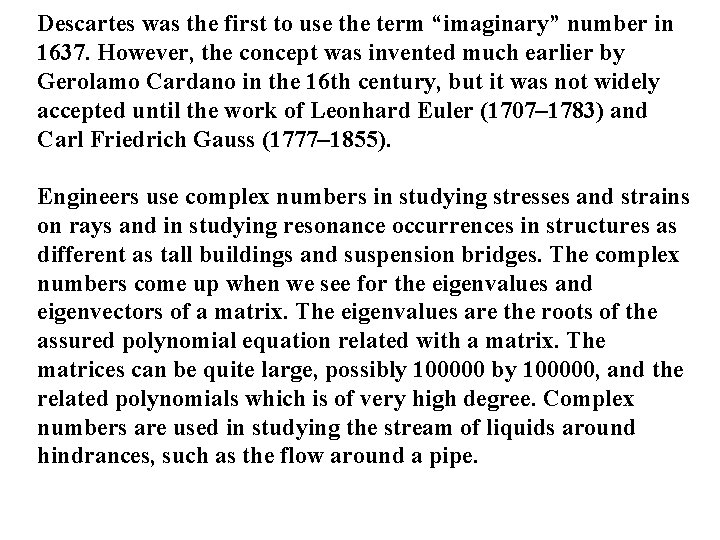
Descartes was the first to use the term “imaginary” number in 1637. However, the concept was invented much earlier by Gerolamo Cardano in the 16 th century, but it was not widely accepted until the work of Leonhard Euler (1707– 1783) and Carl Friedrich Gauss (1777– 1855). Engineers use complex numbers in studying stresses and strains on rays and in studying resonance occurrences in structures as different as tall buildings and suspension bridges. The complex numbers come up when we see for the eigenvalues and eigenvectors of a matrix. The eigenvalues are the roots of the assured polynomial equation related with a matrix. The matrices can be quite large, possibly 100000 by 100000, and the related polynomials which is of very high degree. Complex numbers are used in studying the stream of liquids around hindrances, such as the flow around a pipe.
Application to electrical/electronics engineering Resistance (Real) Reactance (Imaginary) Impedance (Complex) See page 539 Real Power (Real) Reactive Power (Imaginary) Complex Power (Complex)
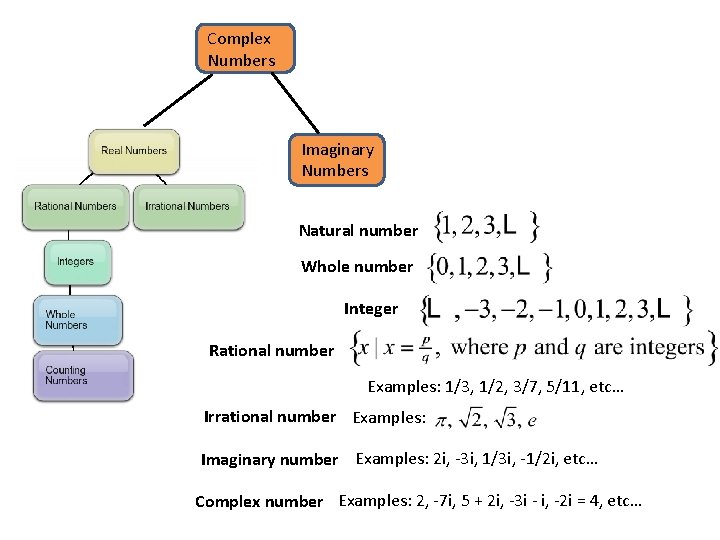
Complex Numbers Imaginary Numbers Natural number Whole number Integer Rational number Examples: 1/3, 1/2, 3/7, 5/11, etc… Irrational number Examples: Imaginary number Examples: 2 i, -3 i, 1/3 i, -1/2 i, etc… Complex number Examples: 2, -7 i, 5 + 2 i, -3 i - i, -2 i = 4, etc…
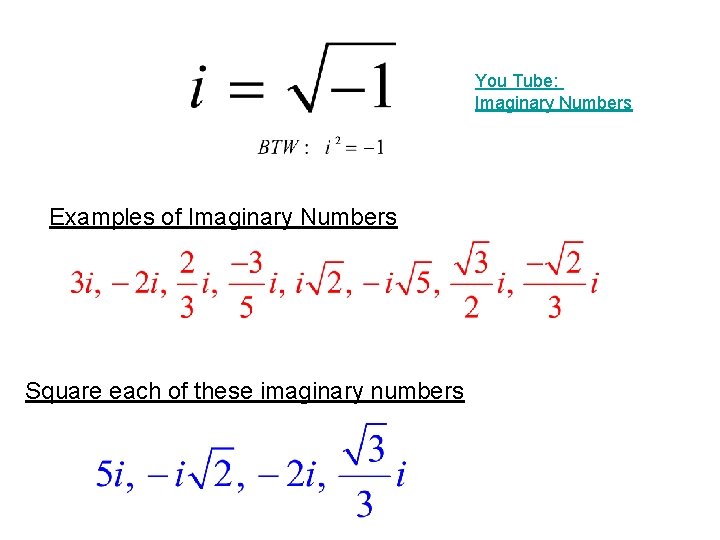
You Tube: Imaginary Numbers Examples of Imaginary Numbers Square each of these imaginary numbers
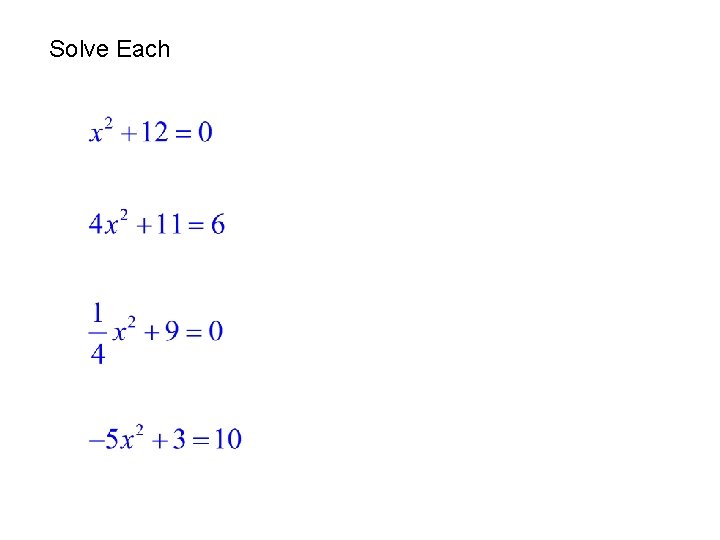
Solve Each