
Module 11 Bridging the Gaps Creating an Effective
Module 11: Bridging the Gaps Creating an Effective Plan to Address Curriculum Gaps
Goals and Objectives Educators will be able to, both in writing and through discussion: 1. Create an ideal vision of aligning curriculum and standards in your classroom and/or school. 2. Revisit gaps that exist and consider available curriculum resources, time allocation for each content area, and any additional solutions to eliminate gaps. 3. Create a proposed plan of action to successfully implement the 2020 Colorado Academic Standards and close gaps.

Warm-up Take 2 minutes to imagine the following: Without considering time or money as limitations, what would an ideal standards-aligned curriculum look like for your classroom or school?
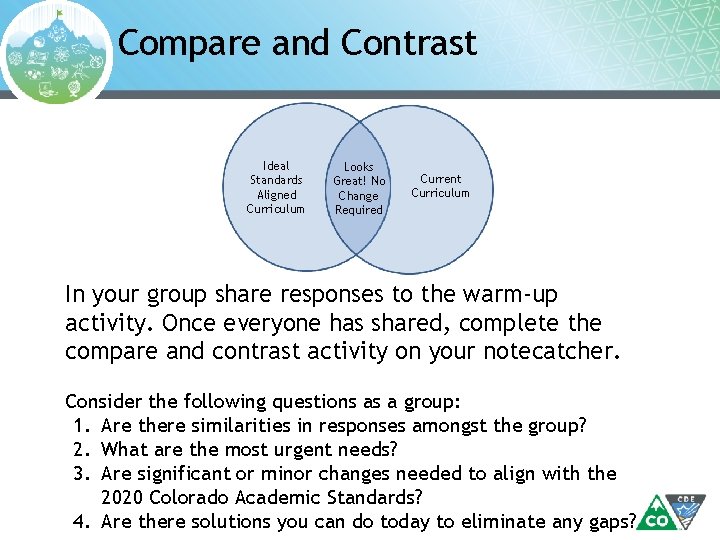
Compare and Contrast Ideal Standards Aligned Curriculum Looks Great! No Change Required Current Curriculum In your group share responses to the warm-up activity. Once everyone has shared, complete the compare and contrast activity on your notecatcher. Consider the following questions as a group: 1. Are there similarities in responses amongst the group? 2. What are the most urgent needs? 3. Are significant or minor changes needed to align with the 2020 Colorado Academic Standards? 4. Are there solutions you can do today to eliminate any gaps?
Quick Win or Long-Term Plan Not all solutions will require a lengthy process or financial investment. Consider solutions you and your team can do today. Proposed solutions which require district, administrator, or budget approval will require a longerterm plan to execute.
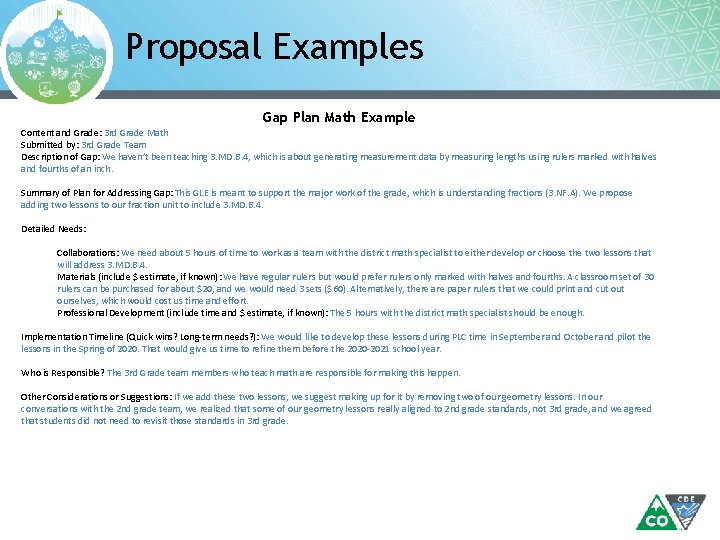
Proposal Examples Gap Plan Math Example Content and Grade: 3 rd Grade Math Submitted by: 3 rd Grade Team Description of Gap: We haven’t been teaching 3. MD. B. 4, which is about generating measurement data by measuring lengths using rulers marked with halves and fourths of an inch. Summary of Plan for Addressing Gap: This GLE is meant to support the major work of the grade, which is understanding fractions (3. NF. A). We propose adding two lessons to our fraction unit to include 3. MD. B. 4. Detailed Needs: Collaborations: We need about 5 hours of time to work as a team with the district math specialist to either develop or choose the two lessons that will address 3. MD. B. 4. Materials (include $ estimate, if known): We have regular rulers but would prefer rulers only marked with halves and fourths. A classroom set of 30 rulers can be purchased for about $20, and we would need 3 sets ($60). Alternatively, there are paper rulers that we could print and cut ourselves, which would cost us time and effort. Professional Development (include time and $ estimate, if known): The 5 hours with the district math specialist should be enough. Implementation Timeline (Quick wins? Long-term needs? ): We would like to develop these lessons during PLC time in September and October and pilot the lessons in the Spring of 2020. That would give us time to refine them before the 2020 -2021 school year. Who is Responsible? The 3 rd Grade team members who teach math are responsible for making this happen. Other Considerations or Suggestions: If we add these two lessons, we suggest making up for it by removing two of our geometry lessons. In our conversations with the 2 nd grade team, we realized that some of our geometry lessons really aligned to 2 nd grade standards, not 3 rd grade, and we agreed that students did not need to revisit those standards in 3 rd grade.
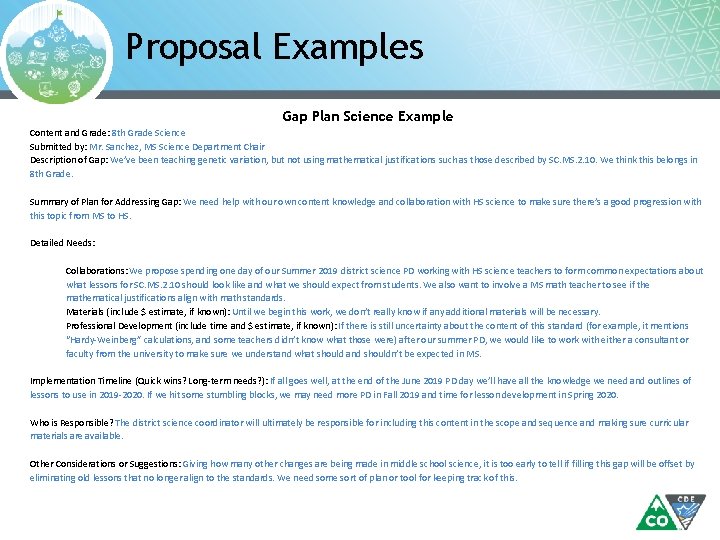
Proposal Examples Gap Plan Science Example Content and Grade: 8 th Grade Science Submitted by: Mr. Sanchez, MS Science Department Chair Description of Gap: We’ve been teaching genetic variation, but not using mathematical justifications such as those described by SC. MS. 2. 10. We think this belongs in 8 th Grade. Summary of Plan for Addressing Gap: We need help with our own content knowledge and collaboration with HS science to make sure there’s a good progression with this topic from MS to HS. Detailed Needs: Collaborations: We propose spending one day of our Summer 2019 district science PD working with HS science teachers to form common expectations about what lessons for SC. MS. 2. 10 should look like and what we should expect from students. We also want to involve a MS math teacher to see if the mathematical justifications align with math standards. Materials (include $ estimate, if known): Until we begin this work, we don’t really know if any additional materials will be necessary. Professional Development (include time and $ estimate, if known): If there is still uncertainty about the content of this standard (for example, it mentions “Hardy-Weinberg” calculations, and some teachers didn’t know what those were) after our summer PD, we would like to work with either a consultant or faculty from the university to make sure we understand what should and shouldn’t be expected in MS. Implementation Timeline (Quick wins? Long-term needs? ): If all goes well, at the end of the June 2019 PD day we’ll have all the knowledge we need and outlines of lessons to use in 2019 -2020. If we hit some stumbling blocks, we may need more PD in Fall 2019 and time for lesson development in Spring 2020. Who is Responsible? The district science coordinator will ultimately be responsible for including this content in the scope and sequence and making sure curricular materials are available. Other Considerations or Suggestions: Giving how many other changes are being made in middle school science, it is too early to tell if filling this gap will be offset by eliminating old lessons that no longer align to the standards. We need some sort of plan or tool for keeping track of this.
Create a Proposal ● Using the template provided in your notecatcher, complete proposals for necessary changes as a group. ● Groups should be by grade level or content area ● Refer to notes from modules 7, 8, 9 & 10 to design your proposals
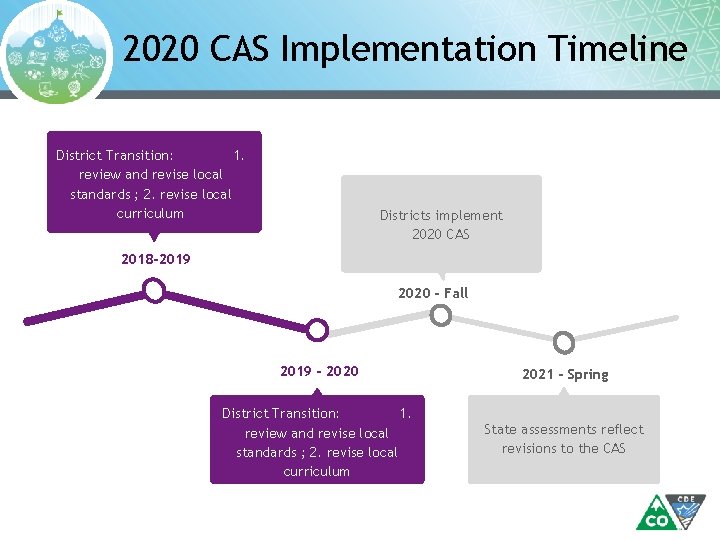
2020 CAS Implementation Timeline District Transition: 1. review and revise local standards ; 2. revise local curriculum Districts implement 2020 CAS 2018 -2019 2020 - Fall 2019 - 2020 2021 - Spring District Transition: 1. review and revise local standards ; 2. revise local curriculum State assessments reflect revisions to the CAS
Next Steps As a group, set expectations and assign tasks to ensure all proposed changes are reviewed, planned, and implemented. 1. What needs to happen between now and Fall 2020 to ensure alignment with revised 2020 Colorado Academic Standards? 2. Schedule PD time for set of Classroom Instructional Shifts modules 3. By what date could you reasonable acquire curriculum if needed
Before You Take the Post Assessment, Are There Any. . . Please contact the Office of Standards and Instructional Support for additional information. Refer to the Standards Implementation guide for contact information.
- Slides: 11