
Module 11 ACTIVITY BASED COSTING Dr Varadraj Bapat
Module 11 ACTIVITY BASED COSTING Dr. Varadraj Bapat
Activity Based Costing (ABC) 2 • Concept of ABC • Traditional Costing V/s ABC • Treatment of cost under ABC • Steps of ABC • Benefits • Limitations • Activity Based Management: ABM • Relation between ABC & ABM Dr. Varadraj Bapat
Reasons to choose the right way of costing 3 In business, arriving at the correct cost is very important, because it: • identifies money-makers and money losers; • finds an economic break-even point; Dr. Varadraj Bapat
4 • facilitates opportunities for cost control. • permits comparison of different options; and • enables strategic decision making. Dr. Varadraj Bapat
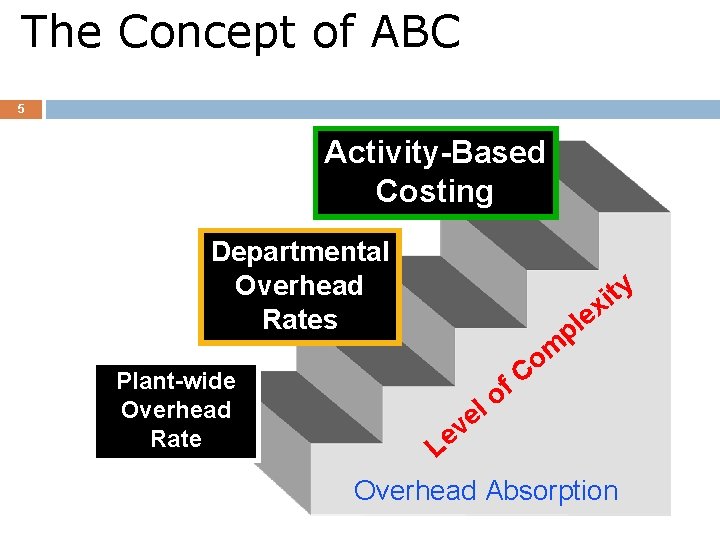
The Concept of ABC 5 Activity-Based Costing Departmental Overhead Rates Plant-wide Overhead Rate ty i x e l p f o l e v e m o C L Overhead Absorption Dr. Varadraj Bapat
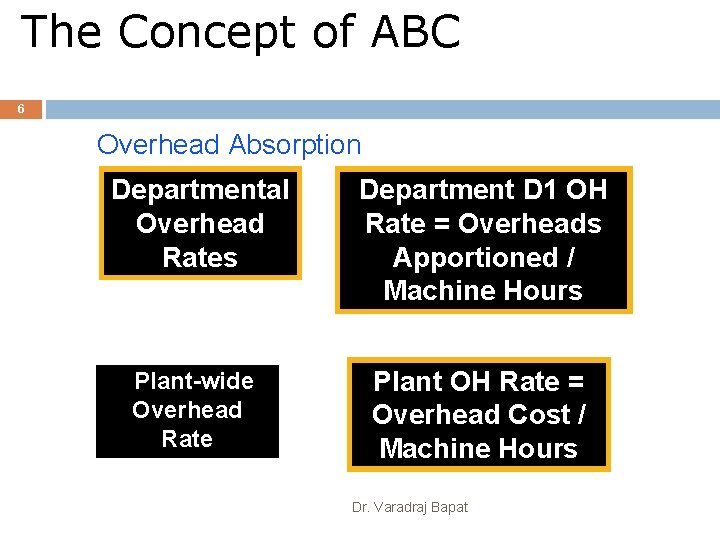
The Concept of ABC 6 Overhead Absorption Departmental Overhead Rates Plant-wide Overhead Rate Department D 1 OH Rate = Overheads Apportioned / Machine Hours Plant OH Rate = Overhead Cost / Machine Hours Dr. Varadraj Bapat
Introduction 7 ABC is a costing system, which focuses on activities performed to produce products. ü ABC relates cost (resources consumed) to work accomplished (outputs produced). ü Dr. Varadraj Bapat
8 ABC is a management tool that provides better allocation of resources. ü The ABC or unit cost goal is a benchmark that represents an expectation of the cost incurred for the production of an output. ü Dr. Varadraj Bapat
9 ü ABC aligns costs to outputs thereby increasing cost visibility, and is useful in forecasting financial baselines. Dr. Varadraj Bapat
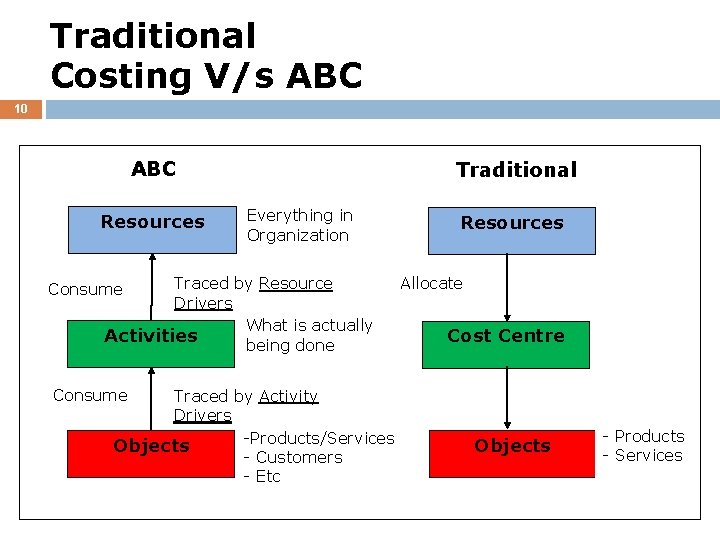
Traditional Costing V/s ABC 10 ABC Resources Traditional Everything in Organization Traced by Resource Drivers What is actually Activities being done Consume Resources Allocate Cost Centre Consume Traced by Activity Drivers -Products/Services Objects - Customers - Etc Objects - Products - Services
ABC’s Basic Premise 11 Cost objects consume activities. ü Activities consume resources. ü This consumption of resources is what drives costs. ü Understanding this relationship is critical to successful budget management. ü Dr. Varadraj Bapat
Treatment of Costs under ABC 12 In ABC, products are assigned the overhead costs that are supposed to be related to the allocation base. Non-manufacturing costs Manufacturing costs Plant wide Overhead Rate Departmental Overhead Rates Costs of idle capacity Dr. Varadraj Bapat
ABC’s Basic Steps 13 1 2 3 4 5 . . . Analyze activities. Gather cost data. Trace costs to activities. Establish output measures. Analyze costs. Dr. Varadraj Bapat
ABC’s Basic Benefits 14 Makes it possible to determine production cost traced to outputs. ü Targets areas needing management attention. ü Encourages the consideration of alternative methods of production. ü Highlights operational efficiency. ü Dr. Varadraj Bapat
15 Identifies financial benchmarks for activity performance. ü Generates more information to measure and reward performance, and prioritizes activities for cost reductions. ü Provides a common managerial framework among support activities. ü Dr. Varadraj Bapat
Limitations of ABC 16 Trade-off between expense and accuracy. Need for more precise data Need of full support of top level management, and support of ABC based performance review. Dr. Varadraj Bapat
17 Cases of overstated costs and under-stated margins and mistakes in pricing and other critical decisions. Dr. Varadraj Bapat
18 Activity Based Management 18 Activity based management involves any use of ABC information to support the organization’s strategy, improve operations, or manage activities and their resulting costs. Dr. Varadraj Bapat
19 19 Activity Based Costing establishes relationships between overhead costs and activities so that we can better allocate overhead costs. Activity-based management focuses on managing activities to reduce costs. Dr. Varadraj Bapat
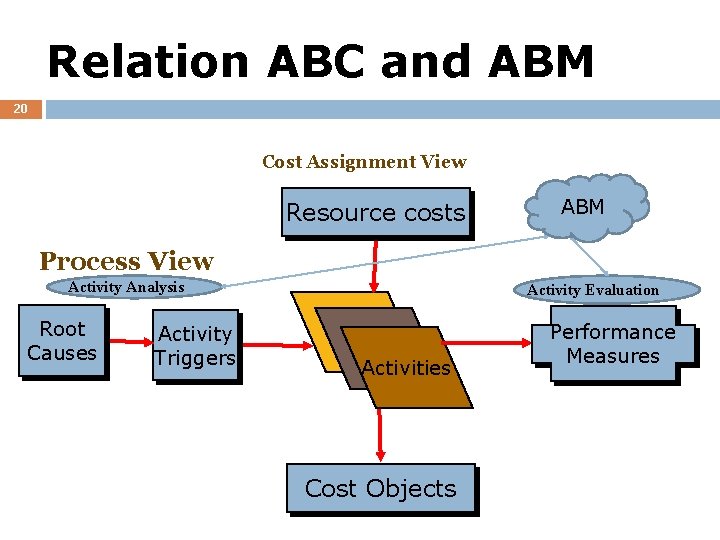
20 Relation ABC and ABM 20 Cost Assignment View Resource costs ABM Process View Activity Analysis Root Causes Activity Triggers Activity Evaluation Activities Cost Objects Dr. Varadraj Bapat Performance Measures
21 21 Eliminating nonvalue added costs using ABM • Identifying Activities • Identifying non-value added activities • Understanding activity linkage, root causes and triggers • Establishing performance measures • Reporting non value added costs Dr. Varadraj Bapat
22 22 ABM seeks to satisfy following customers needs • Lower costs • Higher quality • Faster response time • Greater innovation Dr. Varadraj Bapat
23 23 Customer Profitability Analysis Customer profitability analysis uses activity-based costing to determine the activities, costs and, profit associated with serving particular customers. Dr. Varadraj Bapat
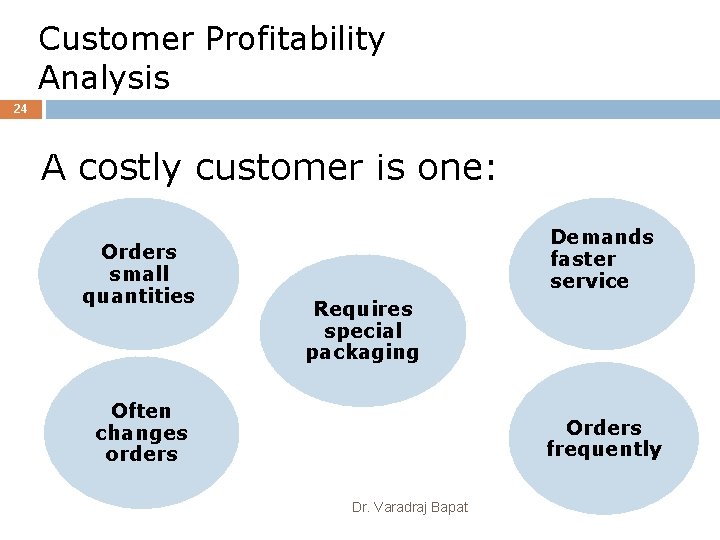
24 Customer Profitability Analysis 24 A costly customer is one: Orders small quantities Demands faster service Requires special packaging Often changes orders Orders frequently Dr. Varadraj Bapat
- Slides: 24