
Module 10 Understanding Laboratory Data Image courtesy of
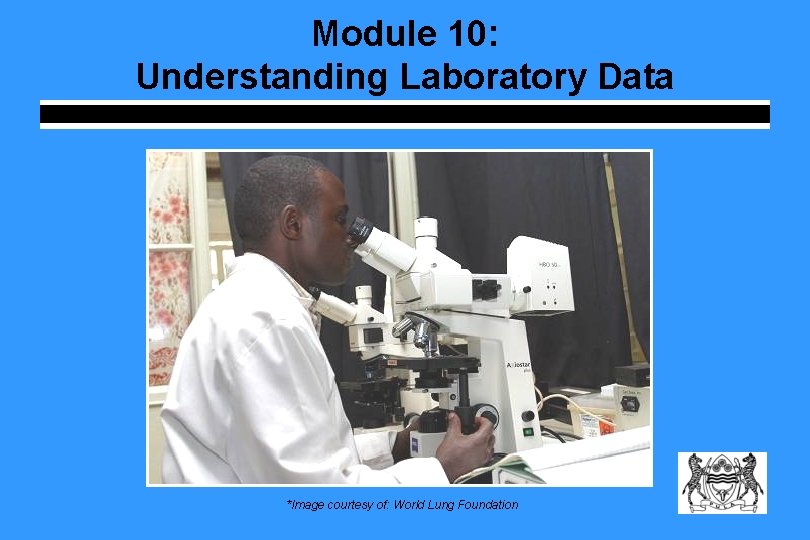
Module 10: Understanding Laboratory Data *Image courtesy of: World Lung Foundation
Learning Objectives • Describe how to monitor lab services - Proper reporting and recording • How to analyze data for - quality - effectiveness
Monitoring Laboratory Services

How do I work in the laboratory? 1. Communication between the laboratory and the clinic is the most important issue to look at 2. You can also collect some basic indicators on overall lab performance
What you probably can’t do 1. You won’t be able to assess the quality of smears / microscopy 2. Lab experts need to advise on safety protocols and correct use of equipment
These are the tools at your disposal Talk Observe Analyse Attitudes Actions Consistency Understanding Processes Accuracy Morale Conditions Effectiveness
Benefit for BNTP § Measure key indicators related to quality of diagnosis § Accurate § Verifiable § Timely § Identify problems in implementing TB control activities (e. g. , laboratory reporting delays) § Improve lab / program linkages and accountability § Influence laboratory practice
Cross-Checking for Quality § Sputum Dispatch Register § Facility TB Register § Lab Register
Key Elements for Quality • Quality begins with DATA – Proper registration of • Suspects • Specimens • Results – Three Key Tools • Suspect and Sputum Dispatch Register (SSD) • Laboratory Register • TB Facility Register (for confirmed cases)
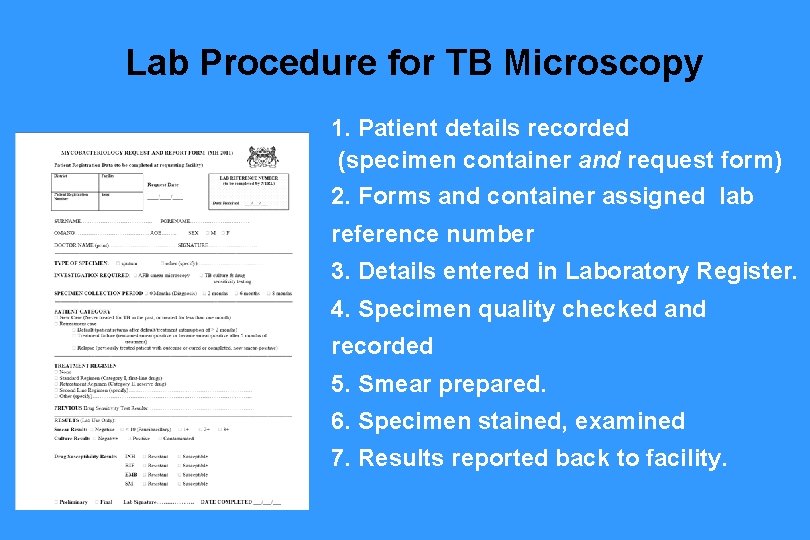
Lab Procedure for TB Microscopy 1. Patient details recorded (specimen container and request form) 2. Forms and container assigned lab reference number 3. Details entered in Laboratory Register. 4. Specimen quality checked and recorded 5. Smear prepared. 6. Specimen stained, examined 7. Results reported back to facility.
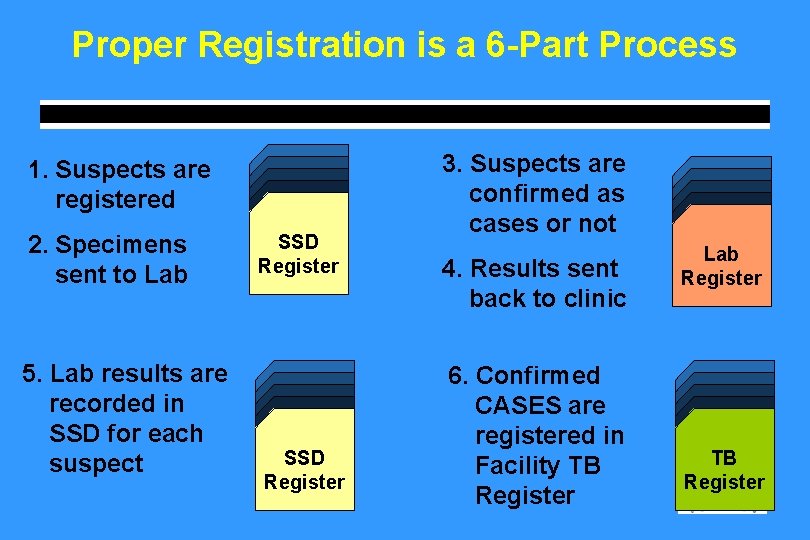
Proper Registration is a 6 -Part Process 1. Suspects are registered 2. Specimens sent to Lab 5. Lab results are recorded in SSD for each suspect SSD Register 3. Suspects are confirmed as cases or not 4. Results sent back to clinic 6. Confirmed CASES are registered in Facility TB Register Lab Register TB Register
Register Cross-checks • • What is cross-checking? Why is it important? Who should do it? How is it done?
What are Cross-checks? Cross-checking is a simple task used to reveal many basic workflow and communications problems between the program and the laboratory. It should be done regularly, and in conjunction with laboratory staff.
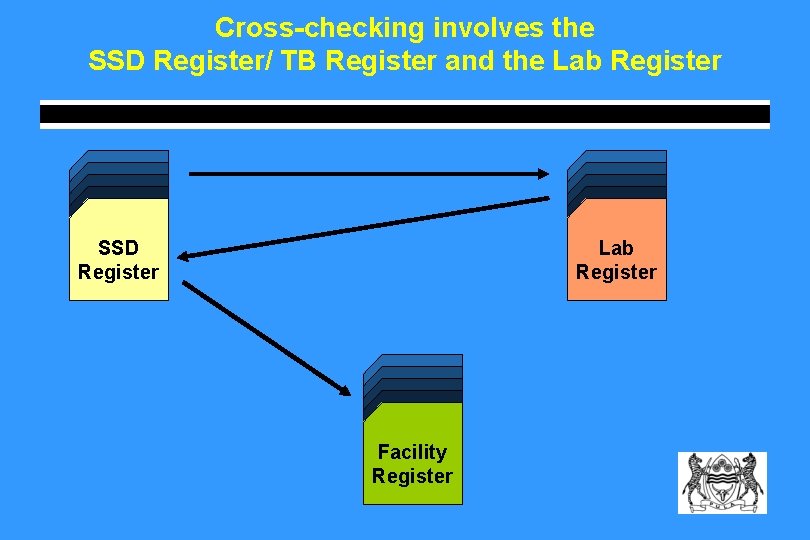
Cross-checking involves the SSD Register/ TB Register and the Lab Register SSD Register Lab Register Facility Register
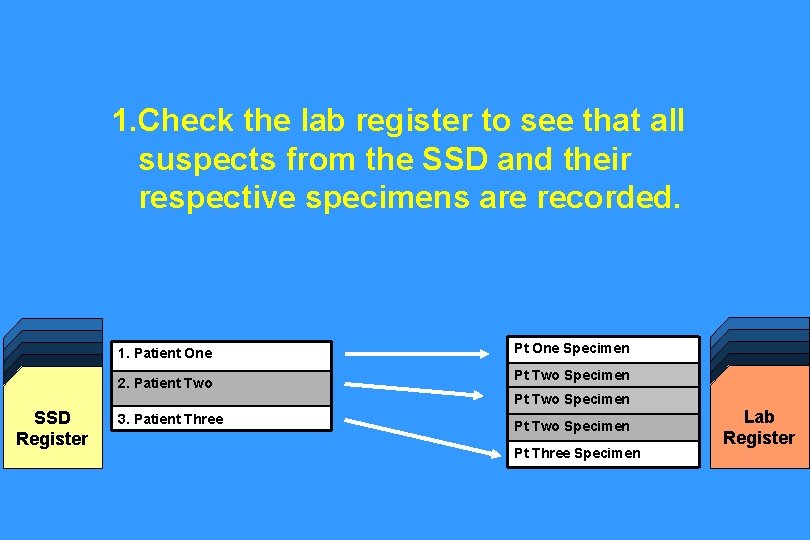
1. Check the lab register to see that all suspects from the SSD and their respective specimens are recorded. 1. Patient One 2. Patient Two Pt One Specimen Pt Two Specimen SSD Register 3. Patient Three Pt Two Specimen Pt Three Specimen Lab Register
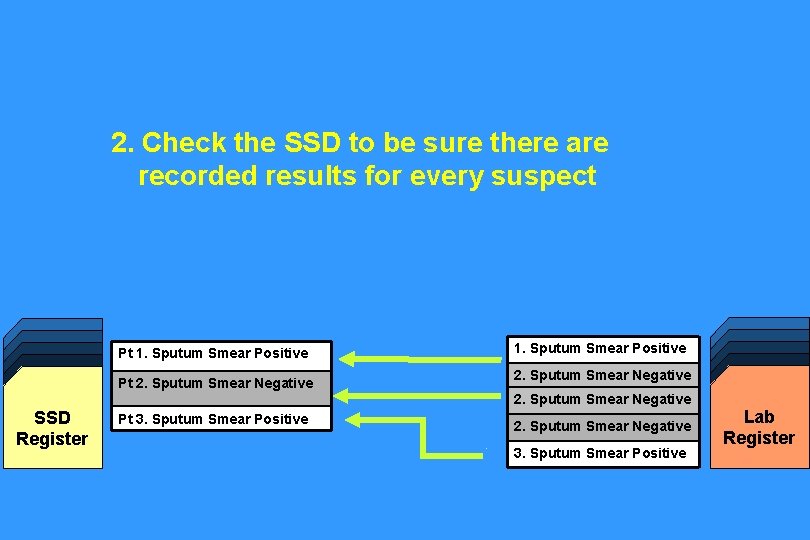
2. Check the SSD to be sure there are recorded results for every suspect Pt 1. Sputum Smear Positive Pt 2. Sputum Smear Negative 1. Sputum Smear Positive 2. Sputum Smear Negative SSD Register Pt 3. Sputum Smear Positive 2. Sputum Smear Negative 3. Sputum Smear Positive Lab Register
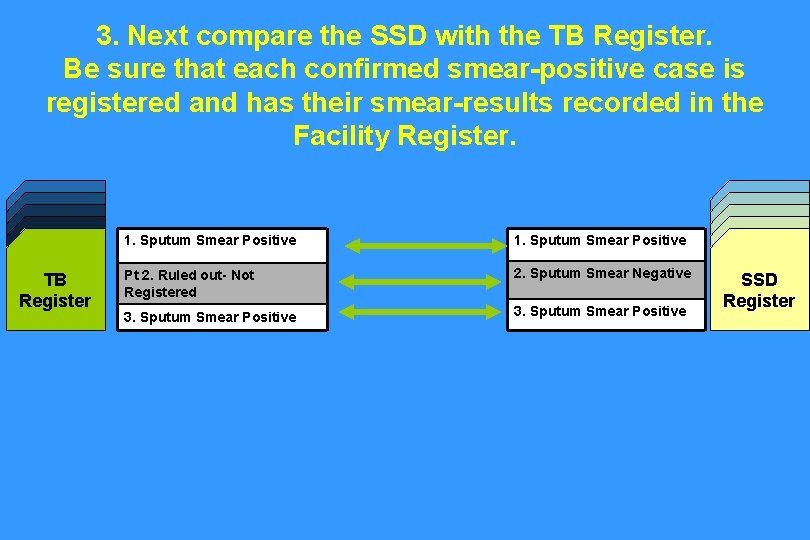
3. Next compare the SSD with the TB Register. Be sure that each confirmed smear-positive case is registered and has their smear-results recorded in the Facility Register. TB Register 1. Sputum Smear Positive Pt 2. Ruled out- Not Registered 2. Sputum Smear Negative 3. Sputum Smear Positive SSD Register
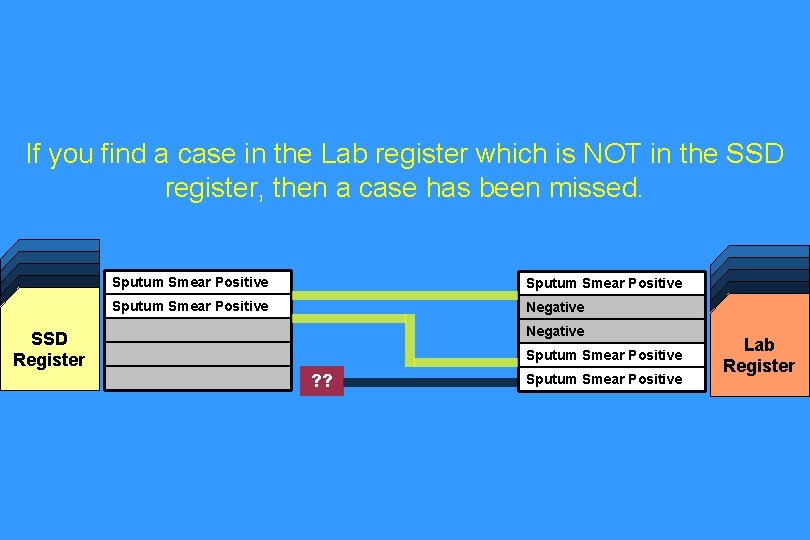
If you find a case in the Lab register which is NOT in the SSD register, then a case has been missed. Sputum Smear Positive Negative SSD Register Sputum Smear Positive ? ? Sputum Smear Positive Lab Register
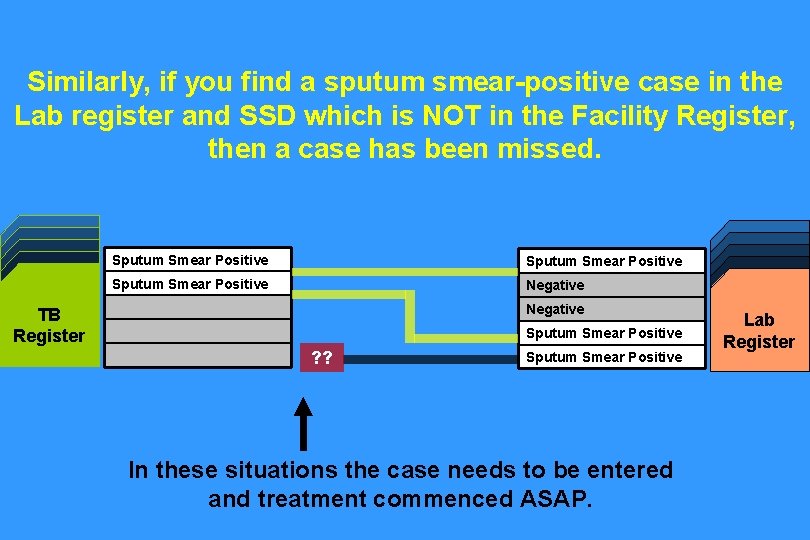
Similarly, if you find a sputum smear-positive case in the Lab register and SSD which is NOT in the Facility Register, then a case has been missed. Sputum Smear Positive Negative TB Register Sputum Smear Positive ? ? Sputum Smear Positive In these situations the case needs to be entered and treatment commenced ASAP. Lab Register
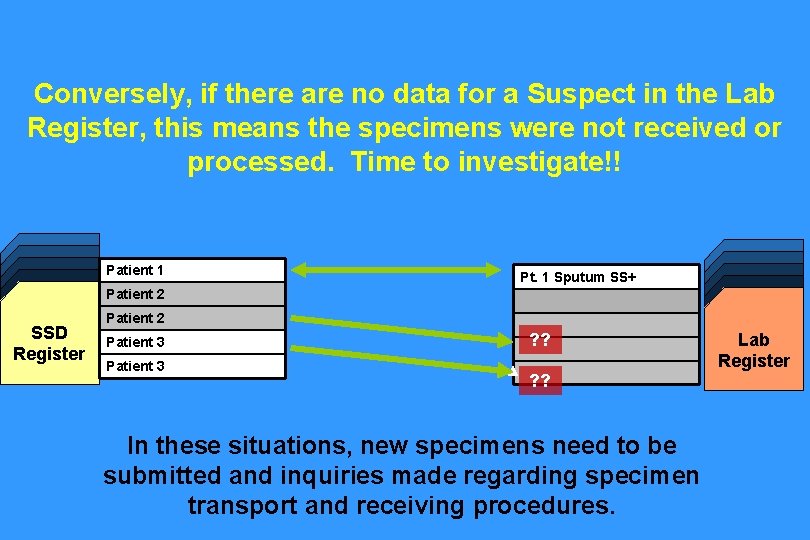
Conversely, if there are no data for a Suspect in the Lab Register, this means the specimens were not received or processed. Time to investigate!! Patient 1 Pt. 1 Sputum SS+ Patient 2 SSD Register Patient 2 Patient 3 ? ? In these situations, new specimens need to be submitted and inquiries made regarding specimen transport and receiving procedures. Lab Register
Exercises § Divide into pairs. Using the handout conduct a lab and patient register crosscheck DISCUSSION § What problems did you find? § What are the underlying issues? § How would you deal with them?
Communicating about Lab Issues § The Laboratory Manager § The District Coordinator
The Lab and the District Coordinator § Talking to the laboratory manager can be interesting. § Listen carefully and identify issues for followup. § A good tip: Make sure that you speak with the Lab Manager and Clinic Matrons separately, at least once per M&E Visit – even if it is just an informal conversation.
Key Questions to Report on § § § Are there recording and reporting issues? Are TB patients being lost? Are AFB results received from the lab within 24 hours of specimen collection? Are all TB smear and culture results reported by laboratories? Is the lab receiving a good quality specimen that is well labeled?
What are we trying to achieve? Through communication we can: Test level of knowledge Gauge attitude and morale Seek guidance on priority areas
Exercise - 20 mins 1. Divide into pairs. Using the handout as a guide, act out a typical discussion between a District TB Coordinator and a Lab Manager. The person doing the monitoring should take notes. After a 5 minute discussion, discuss findings. 2. Now start again, this time with your NTP Supervisor. Again, discuss your findings.
Analyzing Quality of Diagnosis - Advanced § Positivity rate amongst TB suspects § Positivity rate amongst follow-up examinations § Proportion of low-positive suspects § Consistency within series of smears from TB suspects

Evaluating a Laboratory Register ACKNOWLEDGEMENT: Mycobacterium Reference Laboratory Infectious Diseases Laboratories South Australia
Introduction § The Laboratory Register provides a wealth of information – should be reviewed regularly – is an internal Quality Control activity – findings are directly relevant to program management § Provides a simple, easy & rapid method of summarising the work conducted in a laboratory
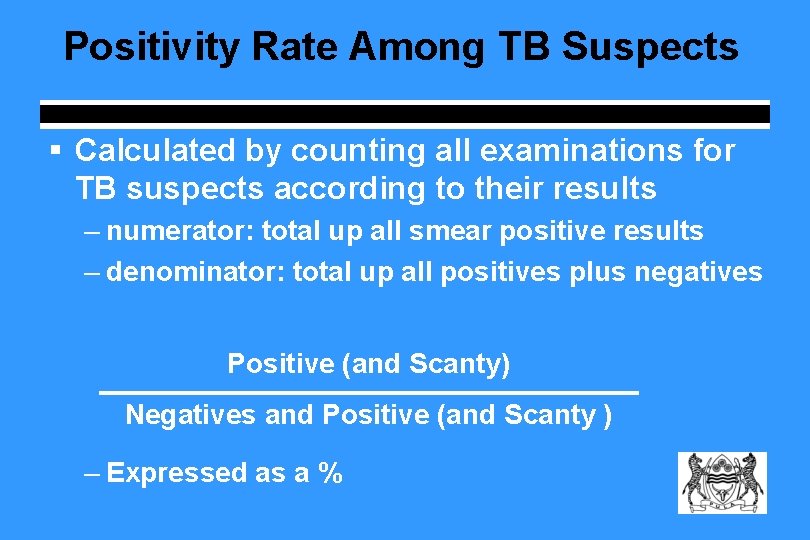
Positivity Rate Among TB Suspects § Calculated by counting all examinations for TB suspects according to their results – numerator: total up all smear positive results – denominator: total up all positives plus negatives Positive (and Scanty) Negatives and Positive (and Scanty ) – Expressed as a %
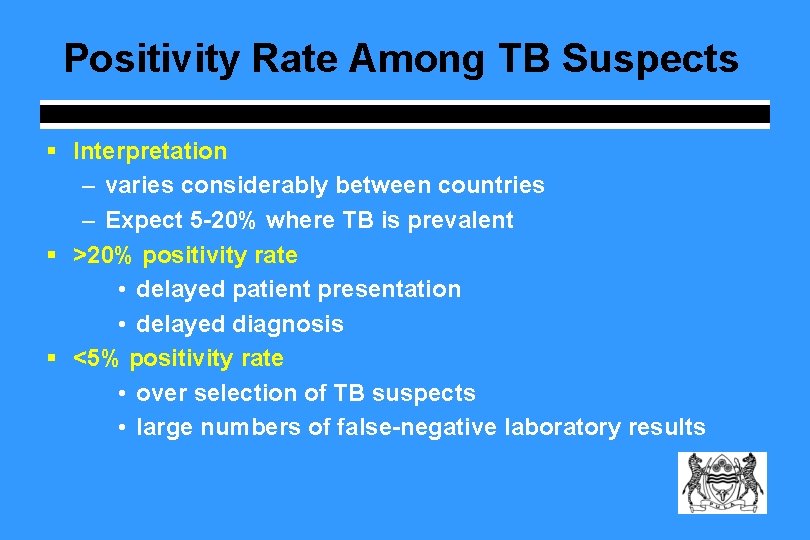
Positivity Rate Among TB Suspects § Interpretation – varies considerably between countries – Expect 5 -20% where TB is prevalent § >20% positivity rate • delayed patient presentation • delayed diagnosis § <5% positivity rate • over selection of TB suspects • large numbers of false-negative laboratory results
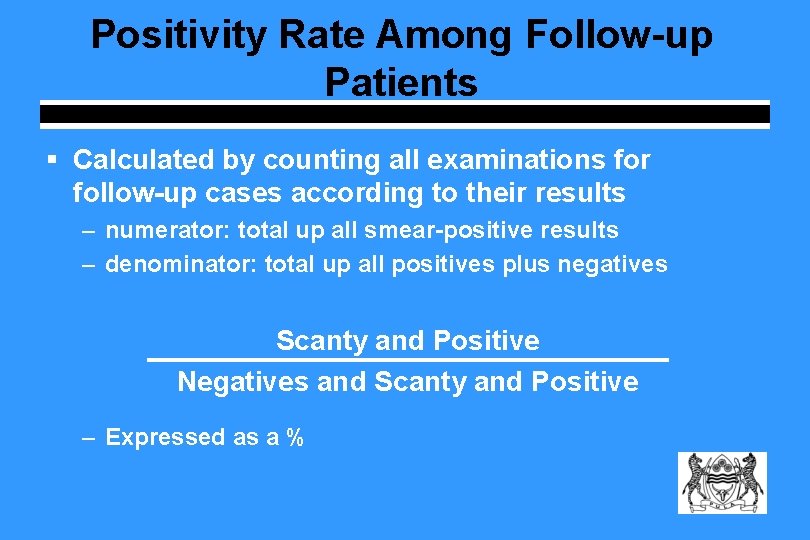
Positivity Rate Among Follow-up Patients § Calculated by counting all examinations for follow-up cases according to their results – numerator: total up all smear-positive results – denominator: total up all positives plus negatives Scanty and Positive Negatives and Scanty and Positive – Expressed as a %
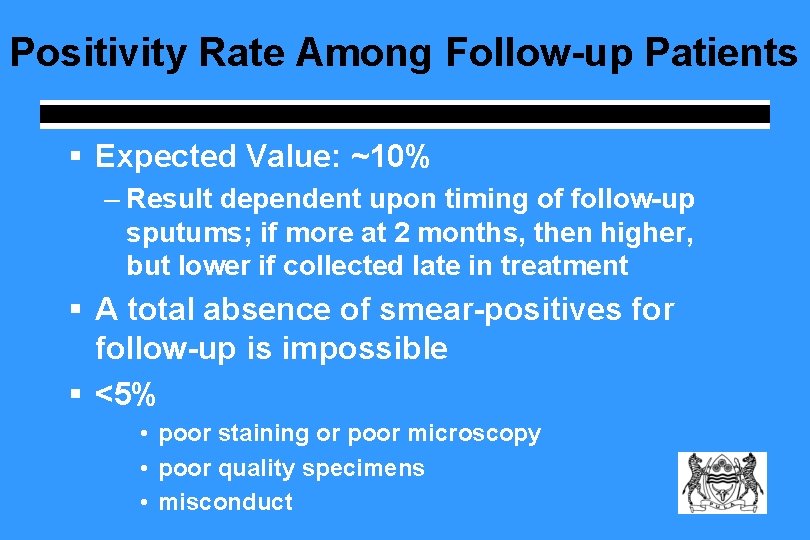
Positivity Rate Among Follow-up Patients § Expected Value: ~10% – Result dependent upon timing of follow-up sputums; if more at 2 months, then higher, but lower if collected late in treatment § A total absence of smear-positives for follow-up is impossible § <5% • poor staining or poor microscopy • poor quality specimens • misconduct
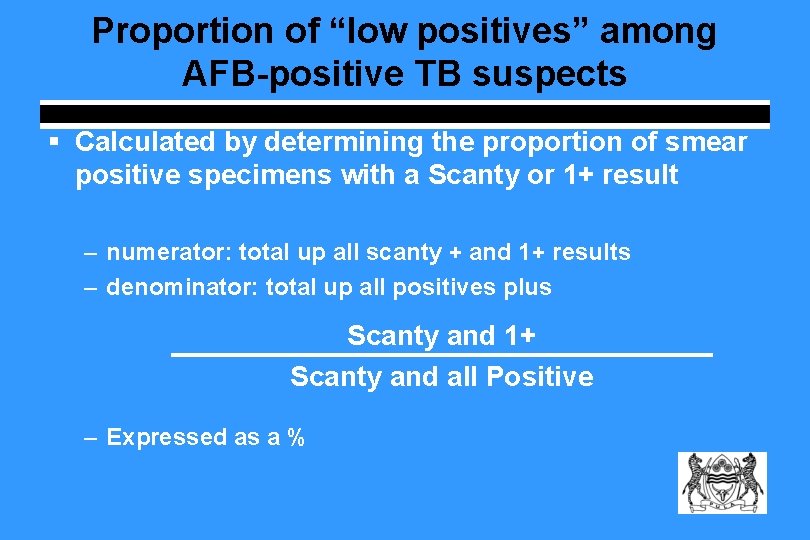
Proportion of “low positives” among AFB-positive TB suspects § Calculated by determining the proportion of smear positive specimens with a Scanty or 1+ result – numerator: total up all scanty + and 1+ results – denominator: total up all positives plus Scanty and 1+ Scanty and all Positive – Expressed as a %
Proportion of “low positives” among AFB-positive TB suspects § Expected Value ~ 40% § Lower result: – good quality staining but poor microscopy (detection requires time and high quality work) § Higher result – poor quality staining (fewer 3+) – poor quality microscope – contamination of CF with environmental mycobacteria
Concluding Comments § Evaluating a Laboratory Register in this way is a very useful tool contributing to Internal Quality Control of the laboratory § May be done monthly or quarterly § May be graphed to display long term trends in performance
- Slides: 36