
Module 10 Fatigue Monitoring and Management Technologies Module



- Slides: 68
Module 10: Fatigue Monitoring and Management Technologies
Module 10 Overview • The Why, What, & How of Fatigue Management Technologies • Sample of Current Technologies • Deployment Considerations & Operational Guidelines • Review & Summary NAFMP | North American Fatigue Management Program Copyright © 2012 2
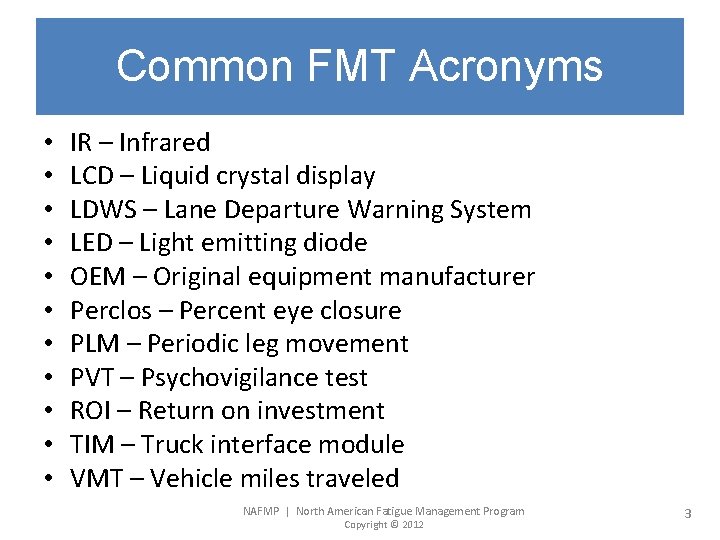
Common FMT Acronyms • • • IR – Infrared LCD – Liquid crystal display LDWS – Lane Departure Warning System LED – Light emitting diode OEM – Original equipment manufacturer Perclos – Percent eye closure PLM – Periodic leg movement PVT – Psychovigilance test ROI – Return on investment TIM – Truck interface module VMT – Vehicle miles traveled NAFMP | North American Fatigue Management Program Copyright © 2012 3
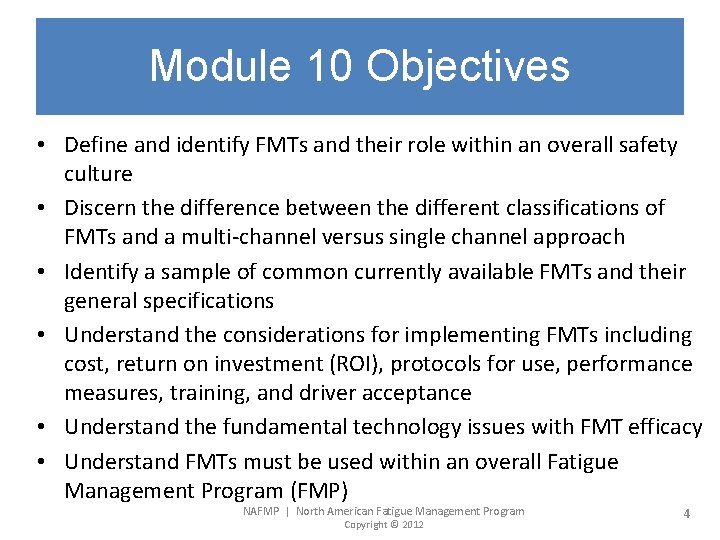
Module 10 Objectives • Define and identify FMTs and their role within an overall safety culture • Discern the difference between the different classifications of FMTs and a multi-channel versus single channel approach • Identify a sample of common currently available FMTs and their general specifications • Understand the considerations for implementing FMTs including cost, return on investment (ROI), protocols for use, performance measures, training, and driver acceptance • Understand the fundamental technology issues with FMT efficacy • Understand FMTs must be used within an overall Fatigue Management Program (FMP) NAFMP | North American Fatigue Management Program Copyright © 2012 4
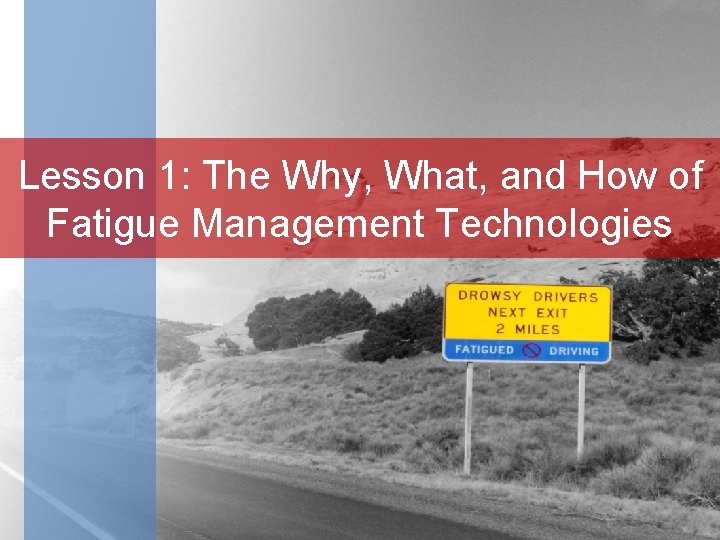
Lesson 1: The Why, What, and How of Fatigue Management Technologies
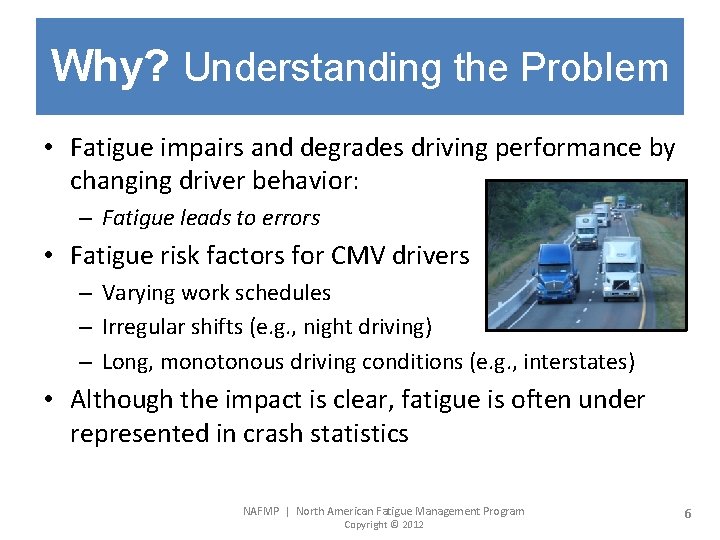
Why? Understanding the Problem • Fatigue impairs and degrades driving performance by changing driver behavior: – Fatigue leads to errors • Fatigue risk factors for CMV drivers – Varying work schedules – Irregular shifts (e. g. , night driving) – Long, monotonous driving conditions (e. g. , interstates) • Although the impact is clear, fatigue is often under represented in crash statistics NAFMP | North American Fatigue Management Program Copyright © 2012 6
Why? The Statistics • Statistics suggest fatigue is an important safety issue – Large Truck Crash Causation Study • ~4% of truck crashes have primary cause by driver asleep-at-thewheel • ~13% of truck crashes involved driver fatigue as associated factor – Of 182 fatal-to-the-driver truck crashes investigated in 1990 by the National Transportation Safety Board, fatigue was the primary factor in 31% of the crashes – Australian research revealed truck drivers with less than six hours of sleep were three times more likely to have a hazardous incident NAFMP | North American Fatigue Management Program Copyright © 2012 7
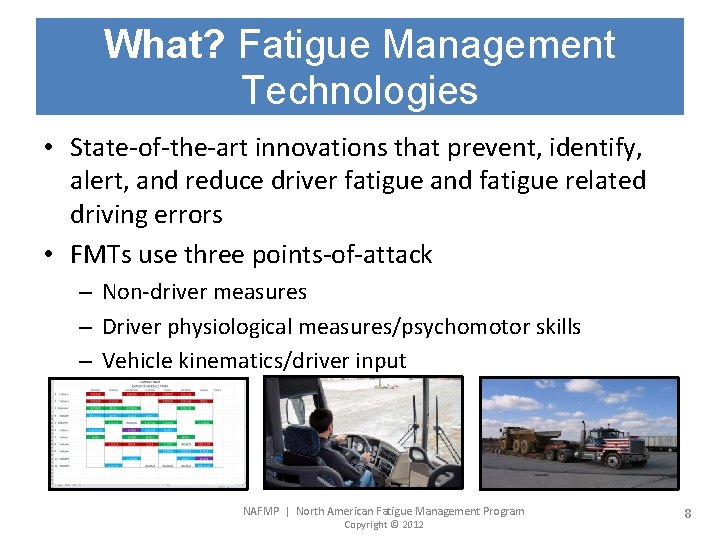
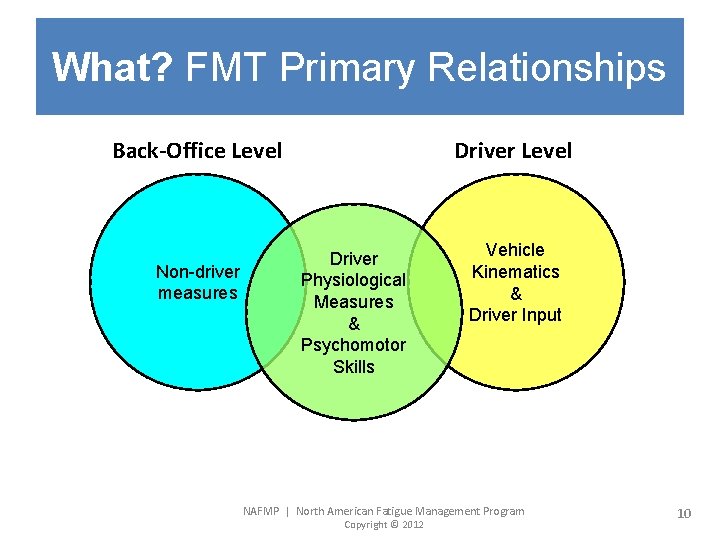
What? Fatigue Management Technologies • State-of-the-art innovations that prevent, identify, alert, and reduce driver fatigue and fatigue related driving errors • FMTs use three points-of-attack – Non-driver measures – Driver physiological measures/psychomotor skills – Vehicle kinematics/driver input NAFMP | North American Fatigue Management Program Copyright © 2012 8
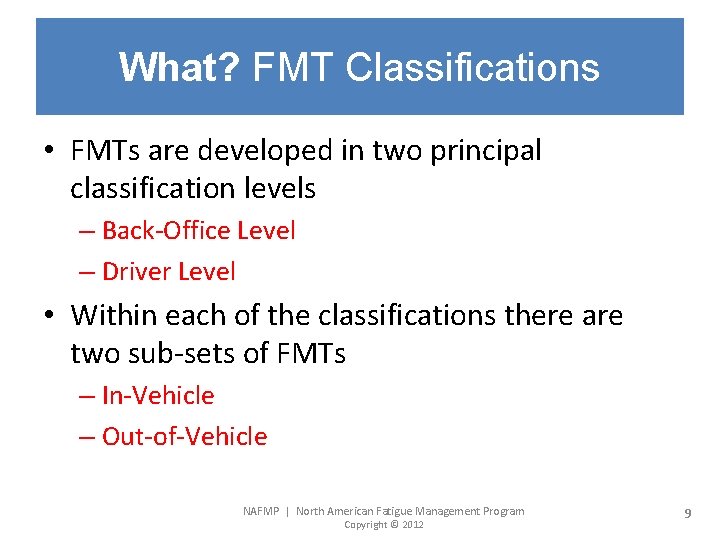
What? FMT Classifications • FMTs are developed in two principal classification levels – Back-Office Level – Driver Level • Within each of the classifications there are two sub-sets of FMTs – In-Vehicle – Out-of-Vehicle NAFMP | North American Fatigue Management Program Copyright © 2012 9
What? FMT Primary Relationships Back-Office Level Non-driver measures Driver Level Driver Physiological Measures & Psychomotor Skills Vehicle Kinematics & Driver Input NAFMP | North American Fatigue Management Program Copyright © 2012 10
What? Back-Office Level FMTs (1 of 3) • The first line of defense against driver fatigue – Aimed at prevention • Key personnel involved – Transportation directors – Safety managers – Dispatchers – Driver trainers – Medical staff – Office personnel NAFMP | North American Fatigue Management Program Copyright © 2012 11
What? Back-Office Level FMTs (2 of 3) • Out-of-vehicle FMTs – Occur prior to a driver beginning a shift – Non-driver measures (e. g. , scheduling) – Driver physiological measures/psychomotor skills • Out-of-vehicle FMT descriptions – Driver scheduling software – Trip planning/routing software – Fit-for-duty testing NAFMP | North American Fatigue Management Program Copyright © 2012 12
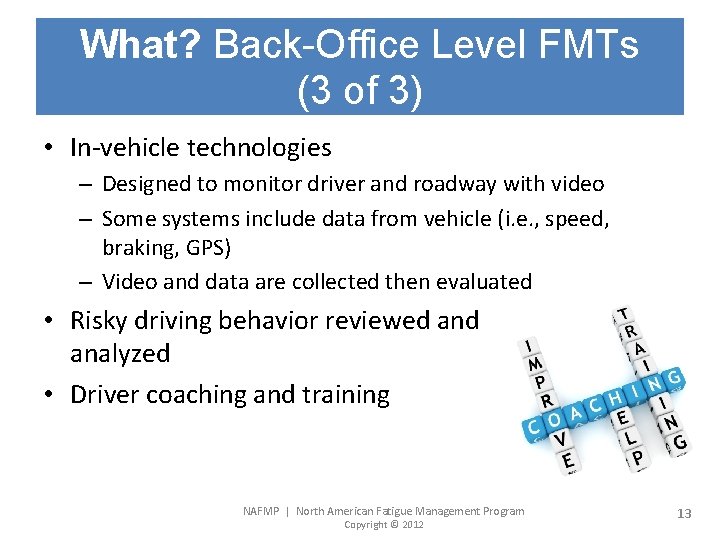
What? Back-Office Level FMTs (3 of 3) • In-vehicle technologies – Designed to monitor driver and roadway with video – Some systems include data from vehicle (i. e. , speed, braking, GPS) – Video and data are collected then evaluated • Risky driving behavior reviewed analyzed • Driver coaching and training NAFMP | North American Fatigue Management Program Copyright © 2012 13
What? Driver Level FMTs (1 of 3) • The final line of defense against driver fatigue – Identify and alert driver of impending fatigue • Pre-drive monitoring – Driver physiological measures/psychomotor skills • Real time driver monitoring – Last stop-gap countermeasure – Driver physiological measures/psychomotor skills – Vehicle kinematics/driver input NAFMP | North American Fatigue Management Program Copyright © 2012 14
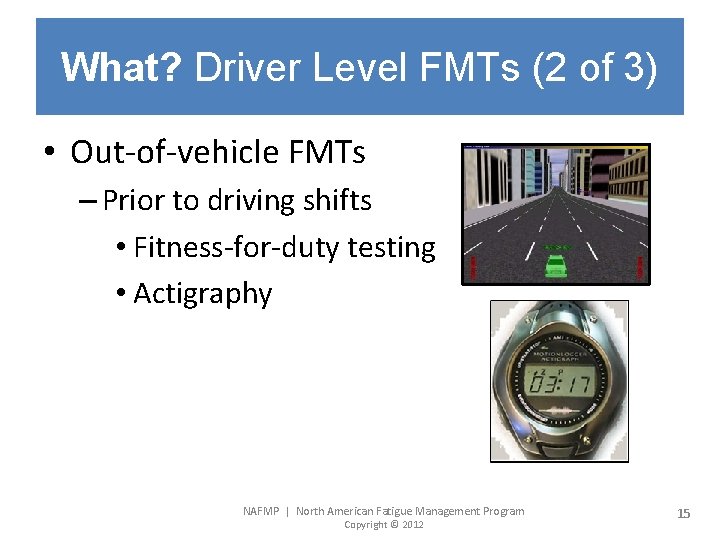
What? Driver Level FMTs (2 of 3) • Out-of-vehicle FMTs – Prior to driving shifts • Fitness-for-duty testing • Actigraphy NAFMP | North American Fatigue Management Program Copyright © 2012 15
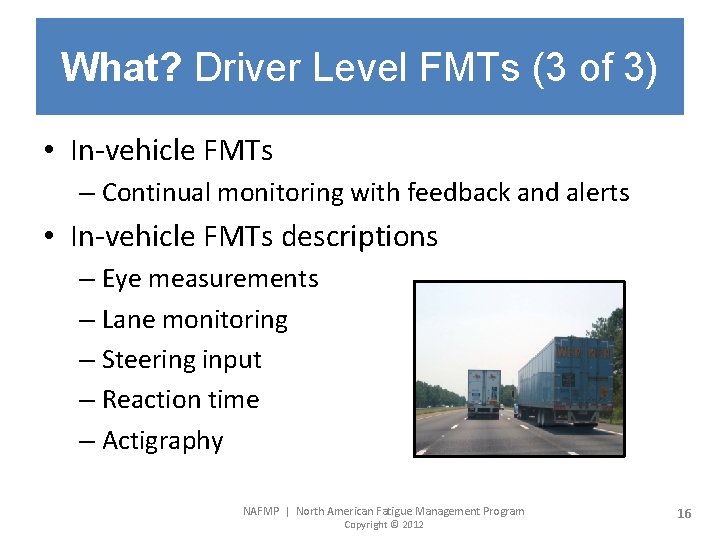
What? Driver Level FMTs (3 of 3) • In-vehicle FMTs – Continual monitoring with feedback and alerts • In-vehicle FMTs descriptions – Eye measurements – Lane monitoring – Steering input – Reaction time – Actigraphy NAFMP | North American Fatigue Management Program Copyright © 2012 16
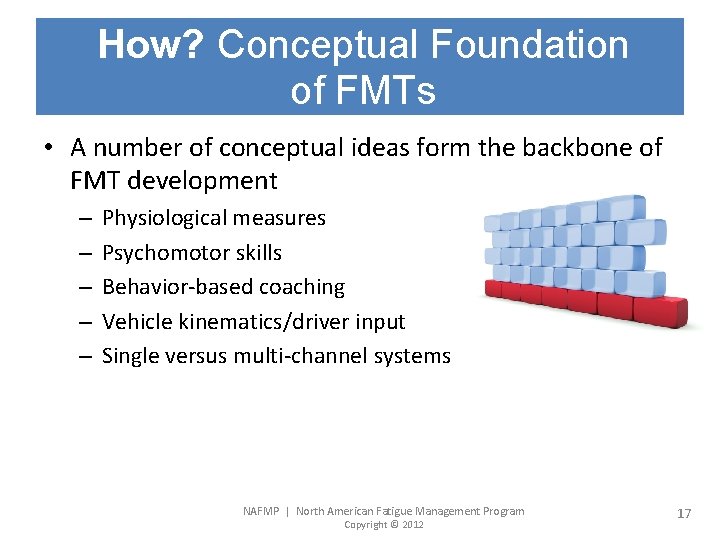
How? Conceptual Foundation of FMTs • A number of conceptual ideas form the backbone of FMT development – – – Physiological measures Psychomotor skills Behavior-based coaching Vehicle kinematics/driver input Single versus multi-channel systems NAFMP | North American Fatigue Management Program Copyright © 2012 17
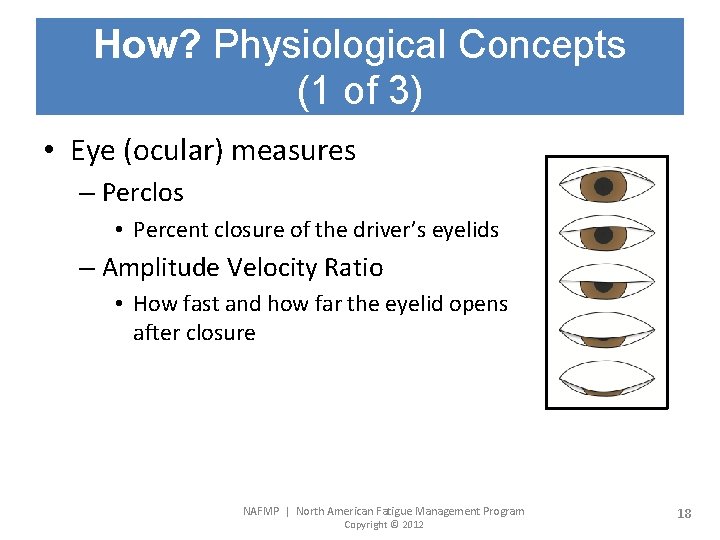
How? Physiological Concepts (1 of 3) • Eye (ocular) measures – Perclos • Percent closure of the driver’s eyelids – Amplitude Velocity Ratio • How fast and how far the eyelid opens after closure NAFMP | North American Fatigue Management Program Copyright © 2012 18
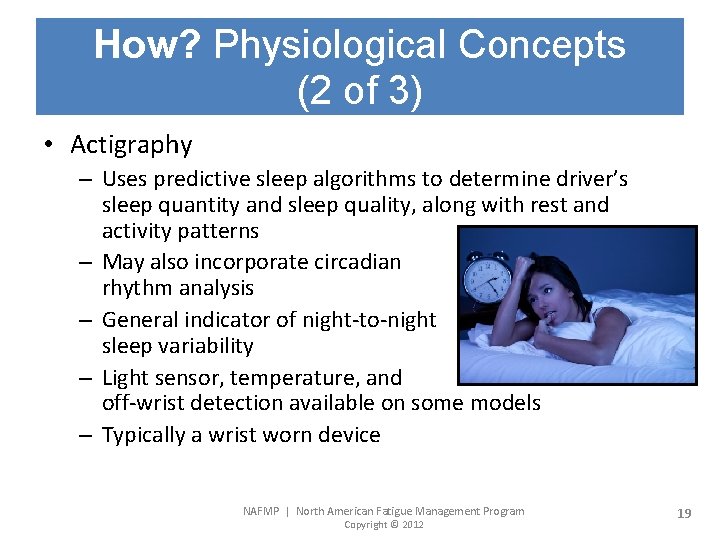
How? Physiological Concepts (2 of 3) • Actigraphy – Uses predictive sleep algorithms to determine driver’s sleep quantity and sleep quality, along with rest and activity patterns – May also incorporate circadian rhythm analysis – General indicator of night-to-night sleep variability – Light sensor, temperature, and off-wrist detection available on some models – Typically a wrist worn device NAFMP | North American Fatigue Management Program Copyright © 2012 19
How? Physiological Concepts (3 of 3) • Potential limitations to consider… – Eye measures • Potential false alarms for mirror and in-cab device glances • Sensitivity of camera and Infrared (IR) with respect to different lighting conditions • Driver resistance to systems that require glasses to be worn – Actigraphy • Predictive technology and not real time • Does not take into account individual differences • Driver must wear device NAFMP | North American Fatigue Management Program Copyright © 2012 20
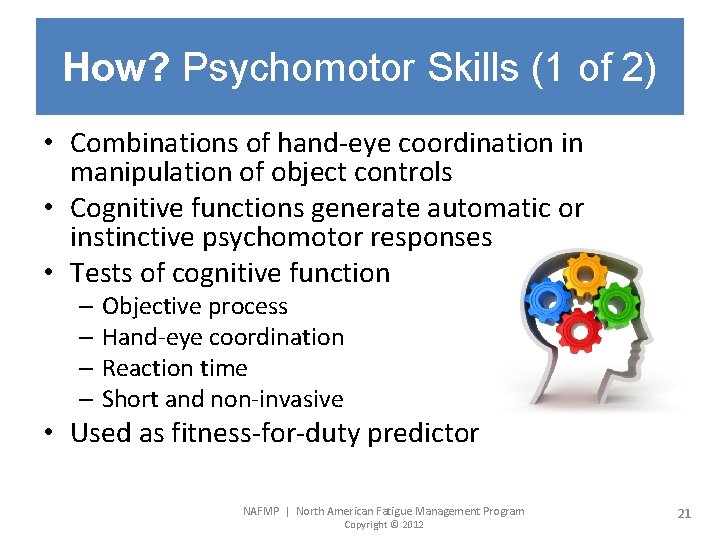
How? Psychomotor Skills (1 of 2) • Combinations of hand-eye coordination in manipulation of object controls • Cognitive functions generate automatic or instinctive psychomotor responses • Tests of cognitive function – Objective process – Hand-eye coordination – Reaction time – Short and non-invasive • Used as fitness-for-duty predictor NAFMP | North American Fatigue Management Program Copyright © 2012 21
How? Psychomotor Skills (2 of 2) • Potential limitations to consider… – Prior to driving • Must be administered by back-office personnel • Does not take into account possible onset of fatigue at a later time during driving shift • Possibility of beating the system – During driving • Additional task for driver to perform while driving • Added cost of possible inattention NAFMP | North American Fatigue Management Program Copyright © 2012 22
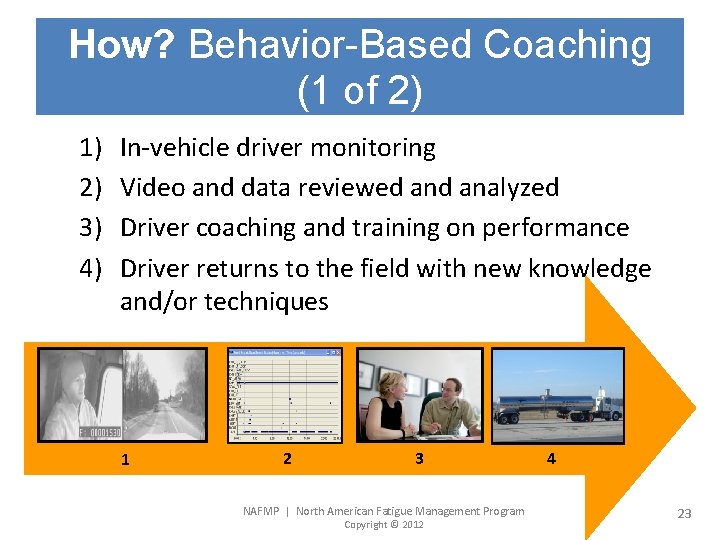
How? Behavior-Based Coaching (1 of 2) 1) 2) 3) 4) In-vehicle driver monitoring Video and data reviewed analyzed Driver coaching and training on performance Driver returns to the field with new knowledge and/or techniques 1 2 3 NAFMP | North American Fatigue Management Program Copyright © 2012 4 23
How? Behavior-Based Coaching (2 of 2) • Potential limitations to consider… – Coaching takes place after risky driving behavior occurs – Drivers may view required coaching as punishment – Drivers must be willing to listen and learn – Some systems may require monthly fee to access recorded video and/or data NAFMP | North American Fatigue Management Program Copyright © 2012 24
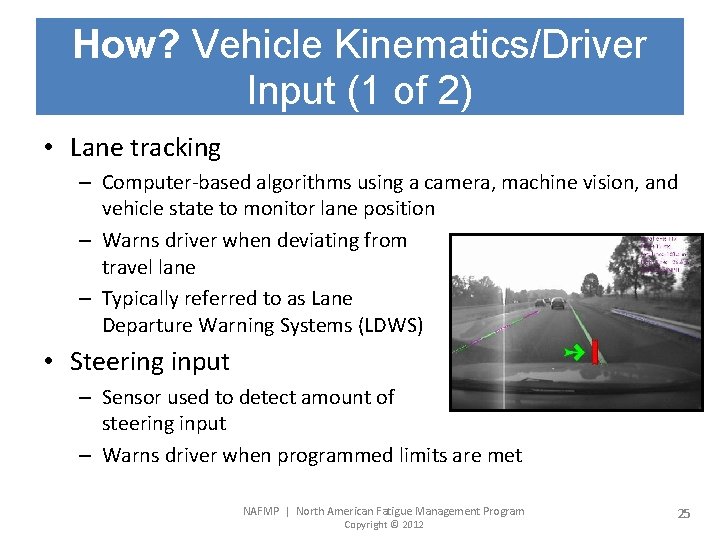
How? Vehicle Kinematics/Driver Input (1 of 2) • Lane tracking – Computer-based algorithms using a camera, machine vision, and vehicle state to monitor lane position – Warns driver when deviating from travel lane – Typically referred to as Lane Departure Warning Systems (LDWS) • Steering input – Sensor used to detect amount of steering input – Warns driver when programmed limits are met NAFMP | North American Fatigue Management Program Copyright © 2012 25
How? Vehicle Kinematics/Driver Input (2 of 2) • Potential limitations to consider… – Lane tracking • Requires visible lane markings; night, adverse weather (e. g. , snow), and faded lane markings may render the system ineffective at times – Steering input • Potential false alarms during driving conditions which require rapid and/or multiple steering inputs (e. g. , off highway driving) NAFMP | North American Fatigue Management Program Copyright © 2012 26
Single Vs. Multi-Channel FMT Systems • Single channel system relies on one predictor of fatigue – Potential for intermittent data loss • Multi-channel system combines two or more predictors of fatigue – Creates a more robust system • Few off-the-shelf multi-channel systems currently available NAFMP | North American Fatigue Management Program Copyright © 2012 27
Making Sense of FMTs • • Must be scientifically and operationally sound Not all FMT concepts will work for every fleet All FMT concepts contain limitations Some FMT concepts overlap – Occur both at the driver level and back-office level – Occur both out-of-vehicle and in-vehicle • All systems are not created equal • Designed to aid the driver, not solve the problem NAFMP | North American Fatigue Management Program Copyright © 2012 28
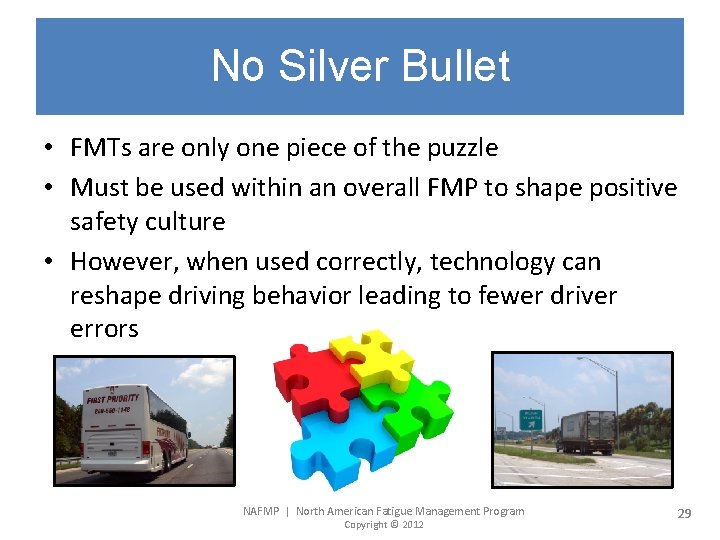
No Silver Bullet • FMTs are only one piece of the puzzle • Must be used within an overall FMP to shape positive safety culture • However, when used correctly, technology can reshape driving behavior leading to fewer driver errors NAFMP | North American Fatigue Management Program Copyright © 2012 29
Lesson 2: Sample of Current Technologies
Snapshot In Time • Technology is on a continual path of evolution • FMTs available today may not be available in the future • Intended as a guide as undoubtedly future generations of FMTs will become available NAFMP | North American Fatigue Management Program Copyright © 2012 31
Inform Not Endorse • This lesson is not meant as a recommendation or endorsement of any FMT • Rather, this lesson is meant to provide a broad overview of FMTs on the market purported to address fatigued driving • Must be aware that not all vendor claims and/or system specifications have been validated • Providing the information in this module gives fleet managers and decision makers with a broad overview of specific systems • Costs for specific FMTs vary widely and may be impractical for your fleet • Information meant to inform, not endorse NAFMP | North American Fatigue Management Program Copyright © 2012 32
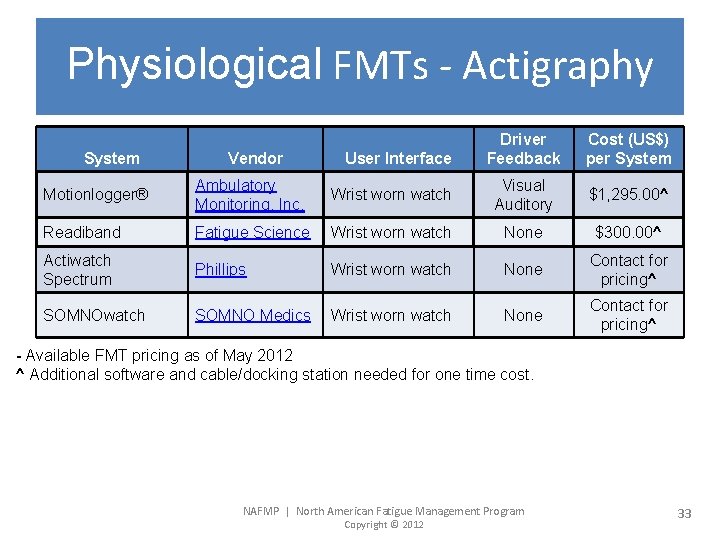
Physiological FMTs - Actigraphy System Vendor User Interface Driver Feedback Cost (US$) per System Motionlogger® Ambulatory Monitoring, Inc. Wrist worn watch Visual Auditory $1, 295. 00^ Readiband Fatigue Science Wrist worn watch None $300. 00^ Actiwatch Spectrum Phillips Wrist worn watch None Contact for pricing^ SOMNOwatch SOMNO Medics Wrist worn watch None Contact for pricing^ - Available FMT pricing as of May 2012 ^ Additional software and cable/docking station needed for one time cost. NAFMP | North American Fatigue Management Program Copyright © 2012 33
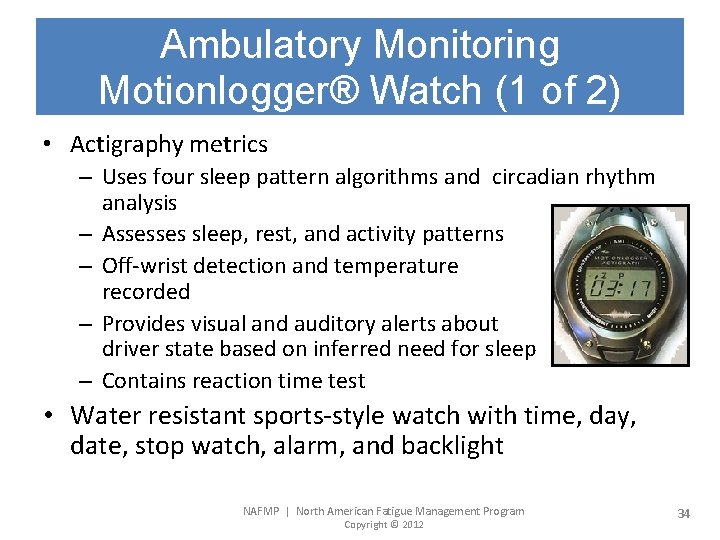
Ambulatory Monitoring Motionlogger® Watch (1 of 2) • Actigraphy metrics – Uses four sleep pattern algorithms and circadian rhythm analysis – Assesses sleep, rest, and activity patterns – Off-wrist detection and temperature recorded – Provides visual and auditory alerts about driver state based on inferred need for sleep – Contains reaction time test • Water resistant sports-style watch with time, day, date, stop watch, alarm, and backlight NAFMP | North American Fatigue Management Program Copyright © 2012 34
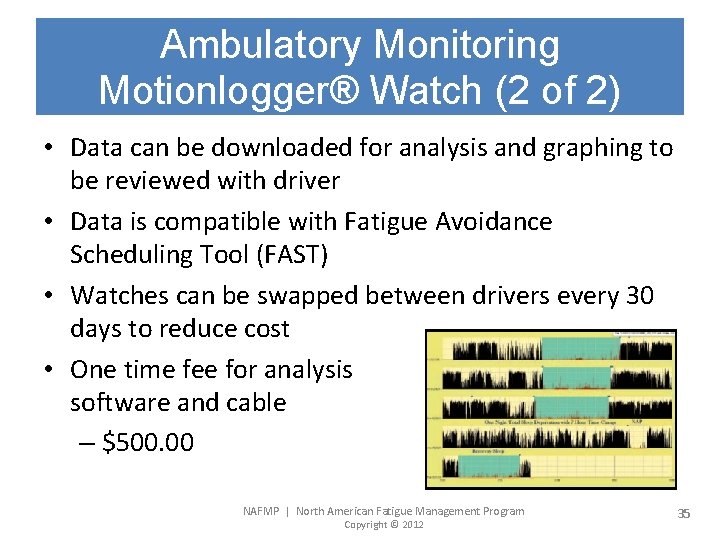
Ambulatory Monitoring Motionlogger® Watch (2 of 2) • Data can be downloaded for analysis and graphing to be reviewed with driver • Data is compatible with Fatigue Avoidance Scheduling Tool (FAST) • Watches can be swapped between drivers every 30 days to reduce cost • One time fee for analysis software and cable – $500. 00 NAFMP | North American Fatigue Management Program Copyright © 2012 35
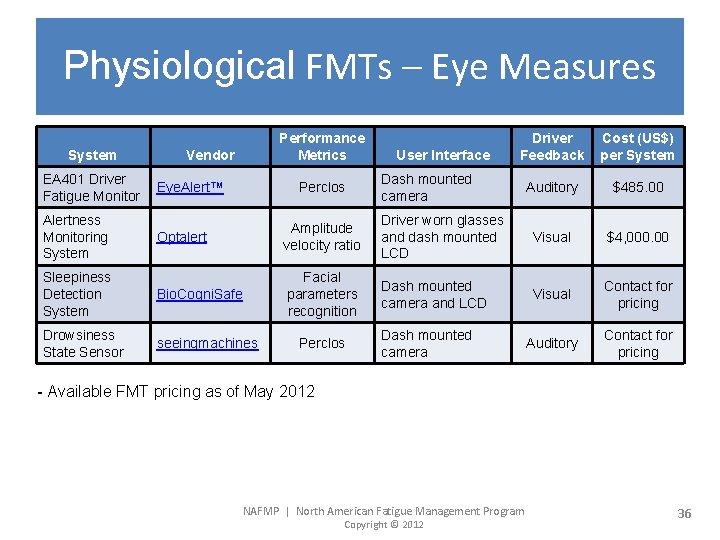
Physiological FMTs – Eye Measures System EA 401 Driver Fatigue Monitor Alertness Monitoring System Performance Metrics Vendor Eye. Alert™ Perclos User Interface Driver Feedback Cost (US$) per System Auditory $485. 00 Dash mounted camera Optalert Amplitude velocity ratio Driver worn glasses and dash mounted LCD Visual $4, 000. 00 Sleepiness Detection System Bio. Cogni. Safe Facial parameters recognition Dash mounted camera and LCD Visual Contact for pricing Drowsiness State Sensor seeingmachines Auditory Contact for pricing Perclos Dash mounted camera - Available FMT pricing as of May 2012 NAFMP | North American Fatigue Management Program Copyright © 2012 36
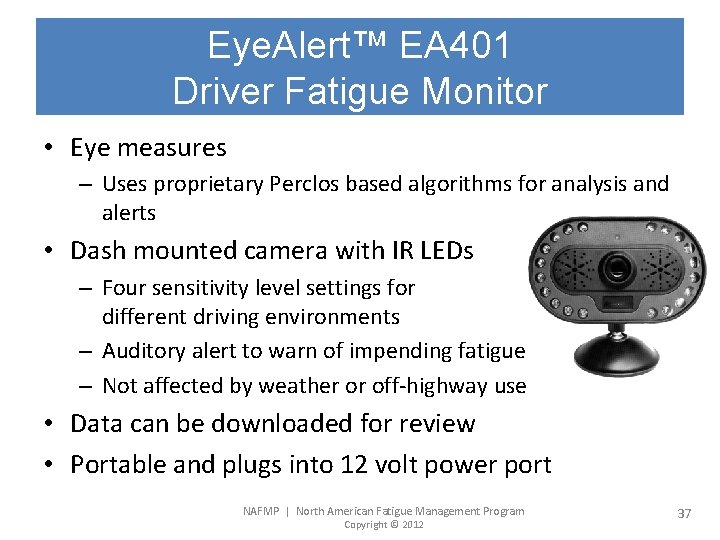
Eye. Alert™ EA 401 Driver Fatigue Monitor • Eye measures – Uses proprietary Perclos based algorithms for analysis and alerts • Dash mounted camera with IR LEDs – Four sensitivity level settings for different driving environments – Auditory alert to warn of impending fatigue – Not affected by weather or off-highway use • Data can be downloaded for review • Portable and plugs into 12 volt power port NAFMP | North American Fatigue Management Program Copyright © 2012 37
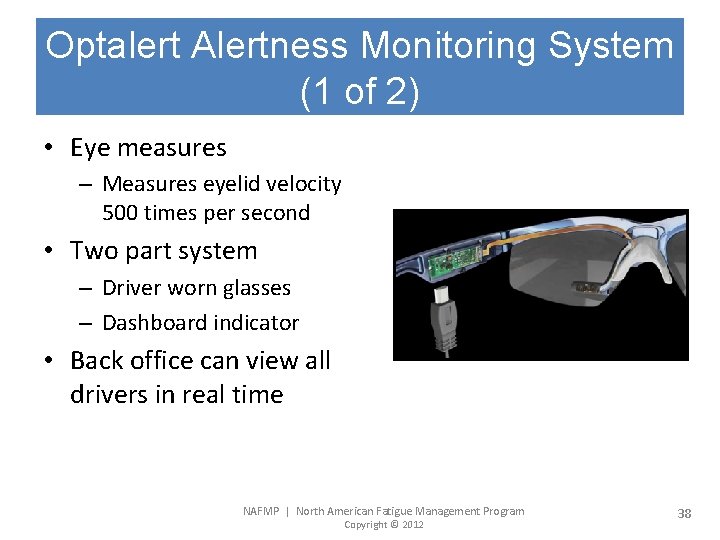
Optalert Alertness Monitoring System (1 of 2) • Eye measures – Measures eyelid velocity 500 times per second • Two part system – Driver worn glasses – Dashboard indicator • Back office can view all drivers in real time NAFMP | North American Fatigue Management Program Copyright © 2012 38
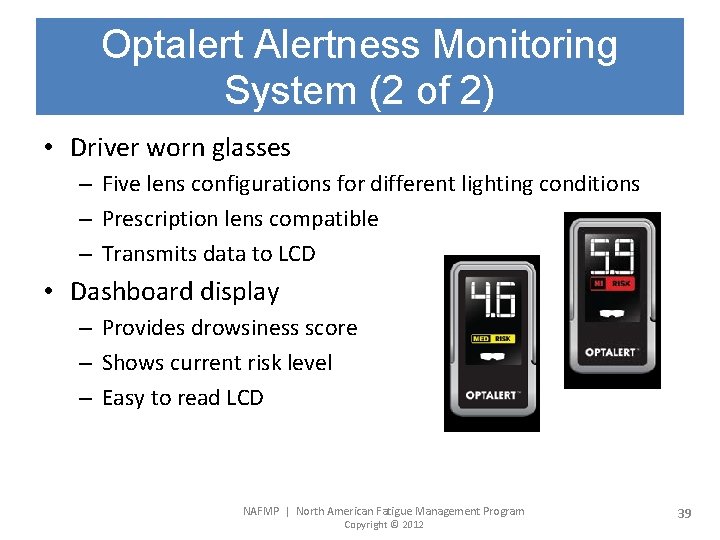
Optalert Alertness Monitoring System (2 of 2) • Driver worn glasses – Five lens configurations for different lighting conditions – Prescription lens compatible – Transmits data to LCD • Dashboard display – Provides drowsiness score – Shows current risk level – Easy to read LCD NAFMP | North American Fatigue Management Program Copyright © 2012 39
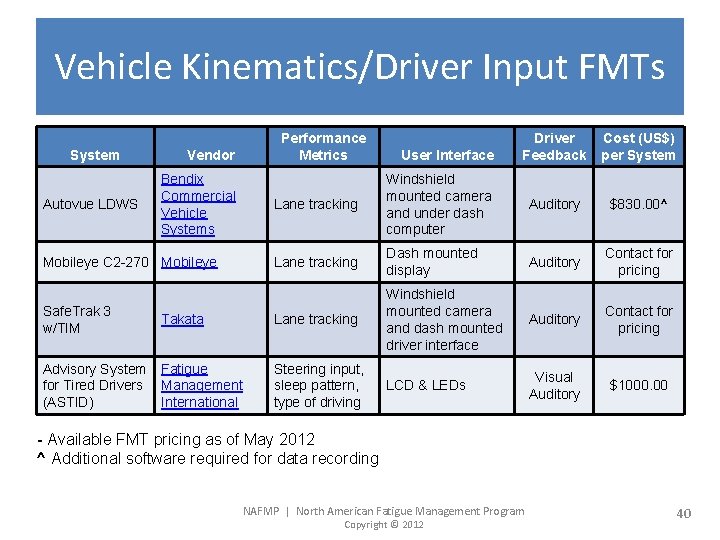
Vehicle Kinematics/Driver Input FMTs System Autovue LDWS Performance Metrics Vendor Bendix Commercial Vehicle Systems Mobileye C 2 -270 Mobileye Driver Feedback Cost (US$) per System Lane tracking Windshield mounted camera and under dash computer Auditory $830. 00^ Lane tracking Dash mounted display Auditory Contact for pricing Visual Auditory $1000. 00 User Interface Safe. Trak 3 w/TIM Takata Lane tracking Windshield mounted camera and dash mounted driver interface Advisory System for Tired Drivers (ASTID) Fatigue Management International Steering input, sleep pattern, type of driving LCD & LEDs - Available FMT pricing as of May 2012 ^ Additional software required for data recording NAFMP | North American Fatigue Management Program Copyright © 2012 40
Bendix Commercial Vehicle Systems, LLC Autovue LDWS • Vehicle kinematics/driver input metrics – Detects lane departures using proprietary algorithms and software using machine vision – Detects both solid and dashed lines – Provides auditory rumble strip sound warning – Signal usage disengages alert – Automatically disabled below 37 mph (60 kph) • Windshield mounted camera • Computer with proprietary software mounted under dash • Safety. Direct software must be purchased to add data recording capability NAFMP | North American Fatigue Management Program Copyright © 2012 41
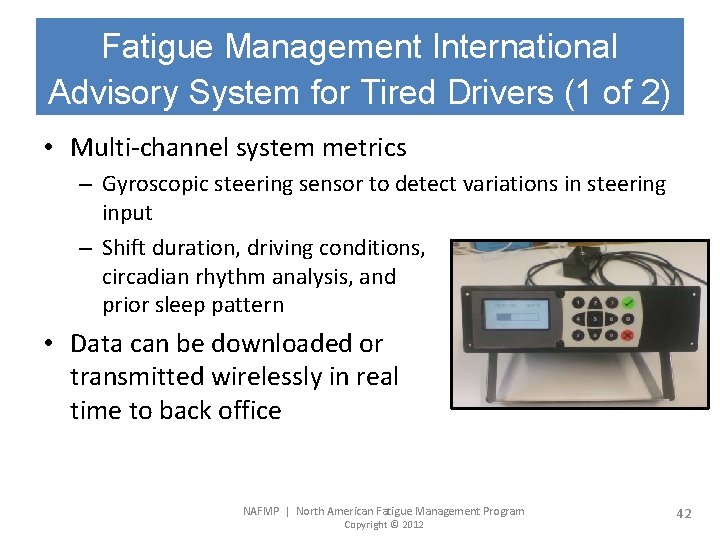
Fatigue Management International Advisory System for Tired Drivers (1 of 2) • Multi-channel system metrics – Gyroscopic steering sensor to detect variations in steering input – Shift duration, driving conditions, circadian rhythm analysis, and prior sleep pattern • Data can be downloaded or transmitted wirelessly in real time to back office NAFMP | North American Fatigue Management Program Copyright © 2012 42
Fatigue Management International Advisory System for Tired Drivers (2 of 2) • Dash mounted in-cab display – Proprietary algorithm combines all metrics and produces tiredness score each minute – Tiredness score visually displayed for driver – Auditory warning when threshold score is met • Available as original equipment manufacturer (OEM) and aftermarket application NAFMP | North American Fatigue Management Program Copyright © 2012 43
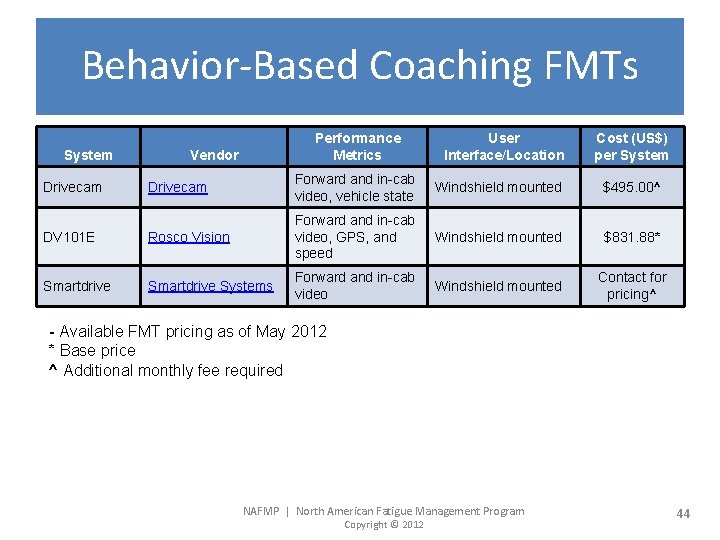
Behavior-Based Coaching FMTs System Performance Metrics Vendor User Interface/Location Cost (US$) per System Drivecam Forward and in-cab video, vehicle state Windshield mounted $495. 00^ DV 101 E Rosco Vision Forward and in-cab video, GPS, and speed Windshield mounted $831. 88* Smartdrive Systems Forward and in-cab video Windshield mounted Contact for pricing^ Drivecam - Available FMT pricing as of May 2012 * Base price ^ Additional monthly fee required NAFMP | North American Fatigue Management Program Copyright © 2012 44
Drive. Cam • Behavior-based safety – Windshield mounted forward looking and in-cab camera provide continuous video – Vehicle state (i. e. , speed, braking, etc. ) are used in tandem with video to record triggered events • Driver auditory alert • Recorded data transmitted to third party for analysis and review • User accesses data through third party NAFMP | North American Fatigue Management Program Copyright © 2012 45
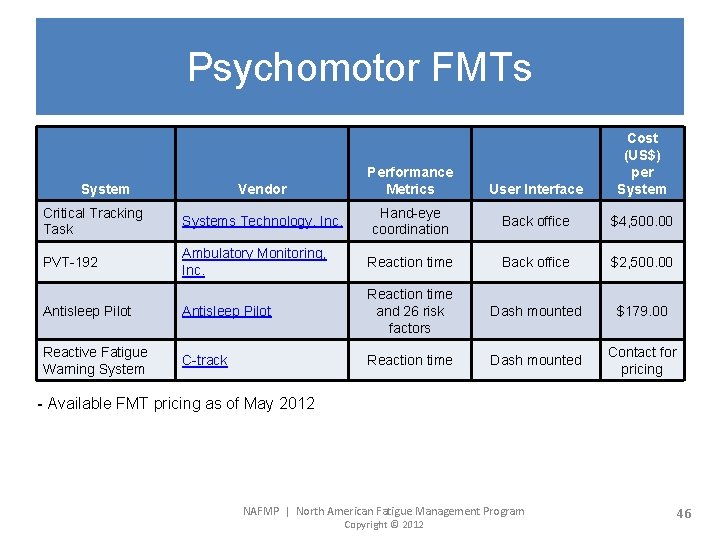
Psychomotor FMTs System Vendor User Interface Cost (US$) per System Hand-eye coordination Back office $4, 500. 00 Performance Metrics Critical Tracking Task Systems Technology, Inc. PVT-192 Ambulatory Monitoring, Inc. Reaction time Back office $2, 500. 00 Antisleep Pilot Reaction time and 26 risk factors Dash mounted $179. 00 Reactive Fatigue Warning System C-track Reaction time Dash mounted Contact for pricing - Available FMT pricing as of May 2012 NAFMP | North American Fatigue Management Program Copyright © 2012 46
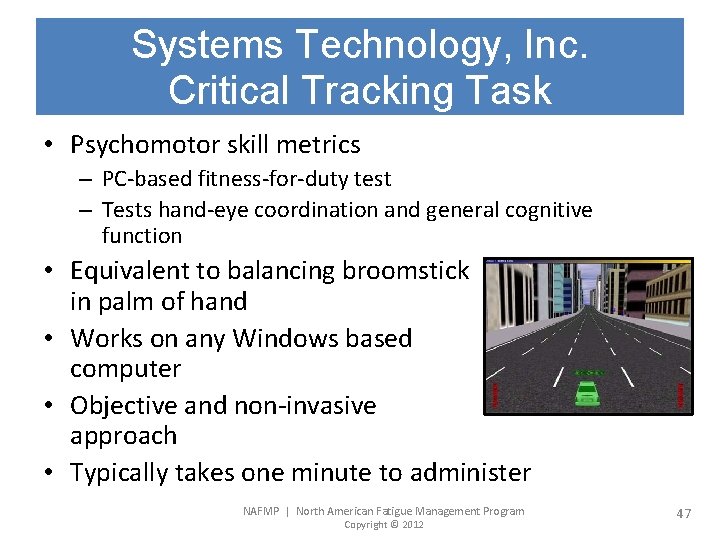
Systems Technology, Inc. Critical Tracking Task • Psychomotor skill metrics – PC-based fitness-for-duty test – Tests hand-eye coordination and general cognitive function • Equivalent to balancing broomstick in palm of hand • Works on any Windows based computer • Objective and non-invasive approach • Typically takes one minute to administer NAFMP | North American Fatigue Management Program Copyright © 2012 47
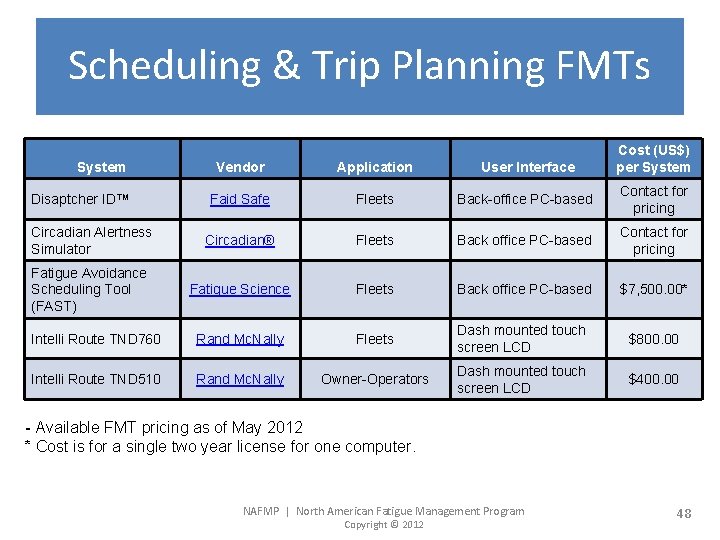
Scheduling & Trip Planning FMTs System Cost (US$) per System Vendor Application User Interface Faid Safe Fleets Back-office PC-based Contact for pricing Circadian Alertness Simulator Circadian® Fleets Back office PC-based Contact for pricing Fatigue Avoidance Scheduling Tool (FAST) Fatigue Science Fleets Back office PC-based $7, 500. 00* Intelli Route TND 760 Rand Mc. Nally Fleets Dash mounted touch screen LCD $800. 00 Intelli Route TND 510 Rand Mc. Nally Owner-Operators Dash mounted touch screen LCD $400. 00 Disaptcher ID™ - Available FMT pricing as of May 2012 * Cost is for a single two year license for one computer. NAFMP | North American Fatigue Management Program Copyright © 2012 48
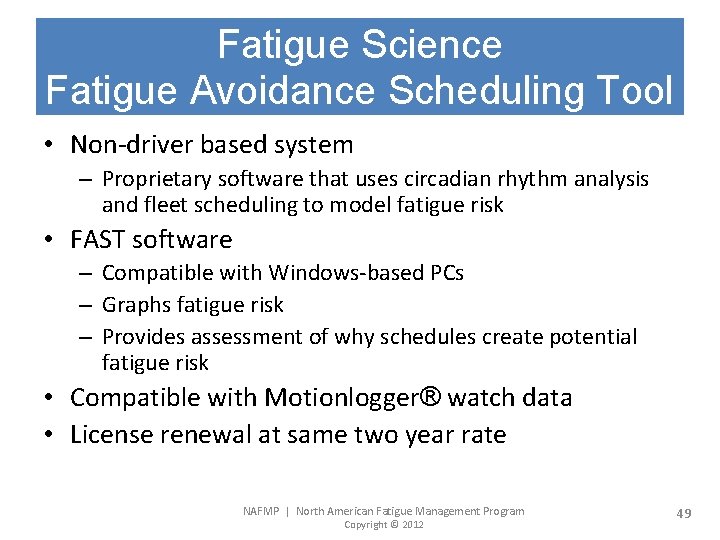
Fatigue Science Fatigue Avoidance Scheduling Tool • Non-driver based system – Proprietary software that uses circadian rhythm analysis and fleet scheduling to model fatigue risk • FAST software – Compatible with Windows-based PCs – Graphs fatigue risk – Provides assessment of why schedules create potential fatigue risk • Compatible with Motionlogger® watch data • License renewal at same two year rate NAFMP | North American Fatigue Management Program Copyright © 2012 49
Lesson 3: Deployment Considerations and Operational Guidelines
FMT Cost • Often a limiting factor when determining use – – Initial purchase price Return on investment Fleet size and locations Training • Financing vs. outright purchase • Must look at the big picture NAFMP | North American Fatigue Management Program Copyright © 2012 51
Return On Investment • May be viewed as the most important aspect for FMT fleet integration – Impact of avoiding just one fatigue-related crash per year • Indirect cost benefits should also be considered – CSA score, cost of driver replacement, environmental clean up, etc. • Other factors that play a role on ROI – Fleet size – Self insured vs. non-self insured – Type of operation NAFMP | North American Fatigue Management Program Copyright © 2012 52
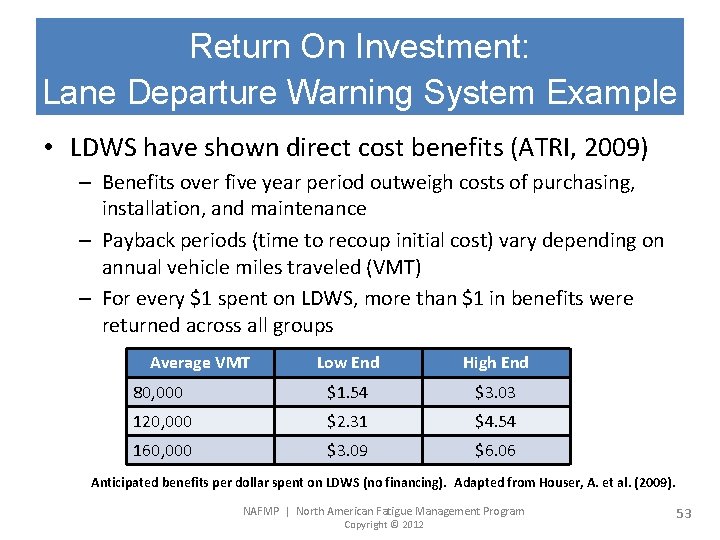
Return On Investment: Lane Departure Warning System Example • LDWS have shown direct cost benefits (ATRI, 2009) – Benefits over five year period outweigh costs of purchasing, installation, and maintenance – Payback periods (time to recoup initial cost) vary depending on annual vehicle miles traveled (VMT) – For every $1 spent on LDWS, more than $1 in benefits were returned across all groups Average VMT Low End High End 80, 000 $1. 54 $3. 03 120, 000 $2. 31 $4. 54 160, 000 $3. 09 $6. 06 Anticipated benefits per dollar spent on LDWS (no financing). Adapted from Houser, A. et al. (2009). NAFMP | North American Fatigue Management Program Copyright © 2012 53
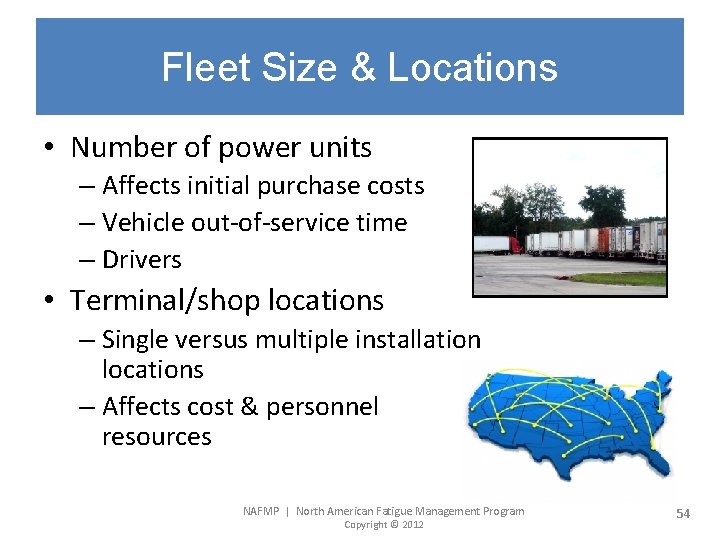
Fleet Size & Locations • Number of power units – Affects initial purchase costs – Vehicle out-of-service time – Drivers • Terminal/shop locations – Single versus multiple installation locations – Affects cost & personnel resources NAFMP | North American Fatigue Management Program Copyright © 2012 54
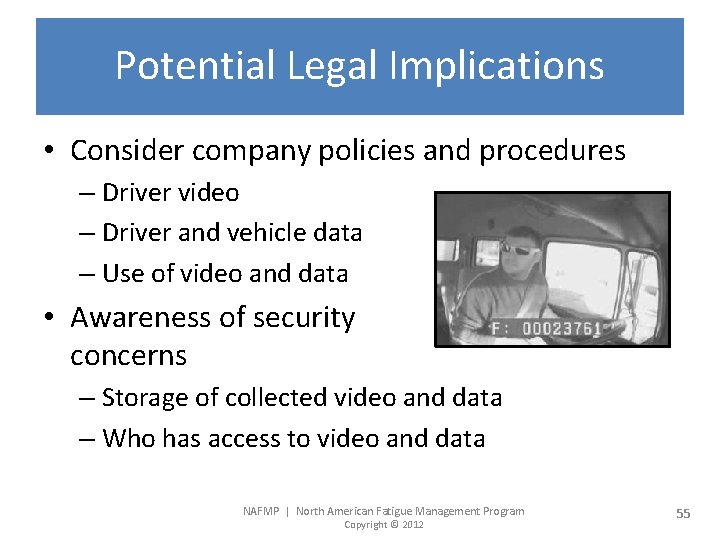
Potential Legal Implications • Consider company policies and procedures – Driver video – Driver and vehicle data – Use of video and data • Awareness of security concerns – Storage of collected video and data – Who has access to video and data NAFMP | North American Fatigue Management Program Copyright © 2012 55
Driver Behavior: Possible Influences • Potential for creating positive OR negative effects – Both cannot occur concurrently • The positive – Promotes greater self awareness – Reshapes driving habits and routines – Encourages safety conscious work environment • The negative – Reliance on FMT to prevent crashes and near crashes – Complacency in driving • Reinforces the need for an overall positive safety culture to eliminate the negative side of the coin NAFMP | North American Fatigue Management Program Copyright © 2012 56
Policies for Driver Compliance • Constructed by the fleet FMP Steering Committee • Establish before FMT installation • Clear and concise – What are the compliance standards? – Penalties for non-compliance • Thoroughly discussed with all drivers – Safety meetings – Posted in terminals/dispatch office • Maintain the standard – Do not selectively enforce – Drivers must be held accountable for their actions NAFMP | North American Fatigue Management Program Copyright © 2012 57
Driver Performance Measures • FMTs that record data or transmit in real time • Goes hand-in-hand with driver compliance – Performance measures must be reasonable – Driver has sufficient knowledge and training to meet the minimum performance level • Back-office – Analysis and review in a timely manner – Driver training/coaching to meet minimum performance level NAFMP | North American Fatigue Management Program Copyright © 2012 58
Driver Acceptance • • Critical ingredient to successful FMT implementation Set the example from the top down Provide validity, facts, and benefits Emphasize driver assistance and not continual supervision – Not “big brother” • Remain open minded to questions, apprehension, and suggestions • Ensure drivers do not view FMTs as punishment NAFMP | North American Fatigue Management Program Copyright © 2012 59
FMT Training • Shop technicians (in-vehicle FMTs) – Proper installation techniques – Routine FMT inspection • Drivers – – – How the FMT functions What to expect Type(s) of alerts if applicable What to do when alerted Observing the FMT in action Avoiding negative driver responses • Keep in mind that without driver acceptance, not likely to be successful NAFMP | North American Fatigue Management Program Copyright © 2012 60
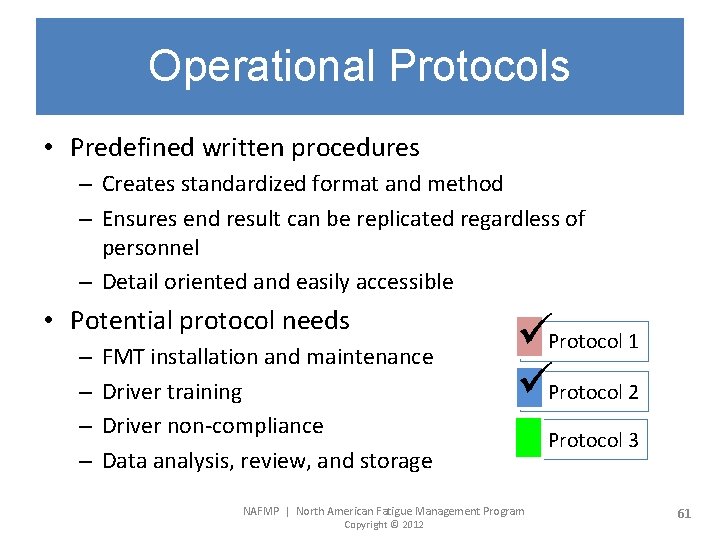
Operational Protocols • Predefined written procedures – Creates standardized format and method – Ensures end result can be replicated regardless of personnel – Detail oriented and easily accessible • Potential protocol needs – – FMT installation and maintenance Driver training Driver non-compliance Data analysis, review, and storage Protocol 1 Protocol 2 NAFMP | North American Fatigue Management Program Copyright © 2012 Protocol 3 61
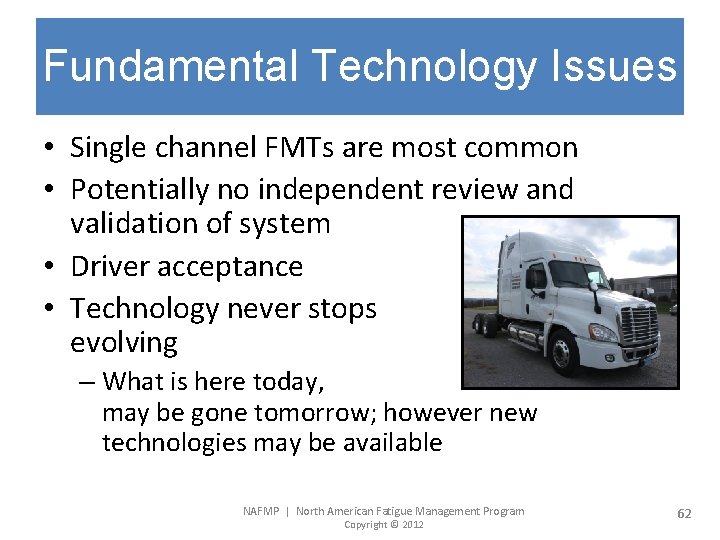
Fundamental Technology Issues • Single channel FMTs are most common • Potentially no independent review and validation of system • Driver acceptance • Technology never stops evolving – What is here today, may be gone tomorrow; however new technologies may be available NAFMP | North American Fatigue Management Program Copyright © 2012 62
FMT Evaluation • Research the new technology – University and government studies – Current testing • Contact vendor for specifications and cost – FMT classification and concept – Technical documentation – Expected service life • Create benchmarks for comparison to current FMTs of same concept • Determine projected cost-benefit of new FMT NAFMP | North American Fatigue Management Program Copyright © 2012 63
Conclusion: Review & Summary
FMT Definition & Classifications • Systems designed to recognize and mitigate driver fatigue with the goal of warning drivers and reducing fatigue related driving errors FMTs Driver Level Back-office Level Vehicle Kinematics Physiological & Psychomotor Non-driver Measures In-vehicle Out-of-vehicle Classifications and relationships of FMTs NAFMP | North American Fatigue Management Program Copyright © 2012 65
FMT Concepts • Concepts forming the foundation of FMTs – Physiological Measures (eye measures & actigraphy) – Psychomotor Skills (cognitive function) – Behavioral-based (coaching) – Vehicle Kinematics/Driver Input (lane and steering) – Single vs. Multi-Channel systems NAFMP | North American Fatigue Management Program Copyright © 2012 66
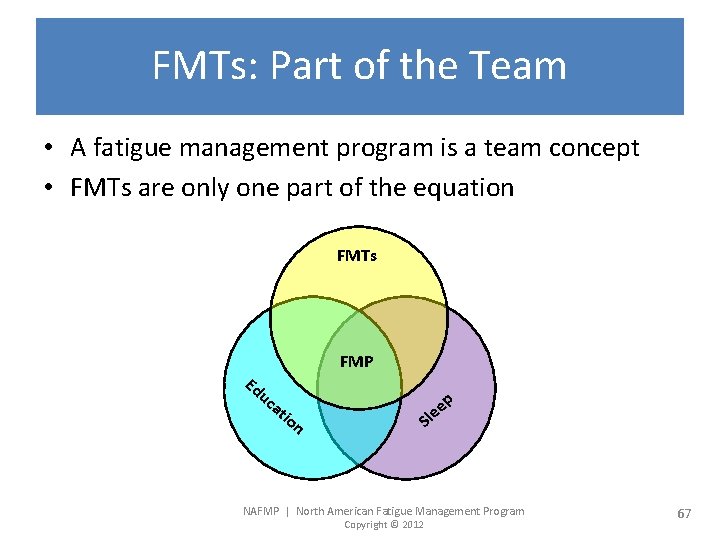
FMTs: Part of the Team • A fatigue management program is a team concept • FMTs are only one part of the equation FMTs FMP Ed uc a e le tio S n p NAFMP | North American Fatigue Management Program Copyright © 2012 67
Best Practices 1) 2) 3) 4) 5) 6) 7) 8) Must be integrated into overall FMP Take full advantage of the FMT capabilities Develop well-defined protocols Explain the role of FMTs with drivers Create meaningful driver expectations Present consistent and detailed feedback for drivers Maintain a positive atmosphere Reinforce that safety is everyone’s responsibility NAFMP | North American Fatigue Management Program Copyright © 2012 68