
Module 1 What is Argumentation Bridging Math Practices
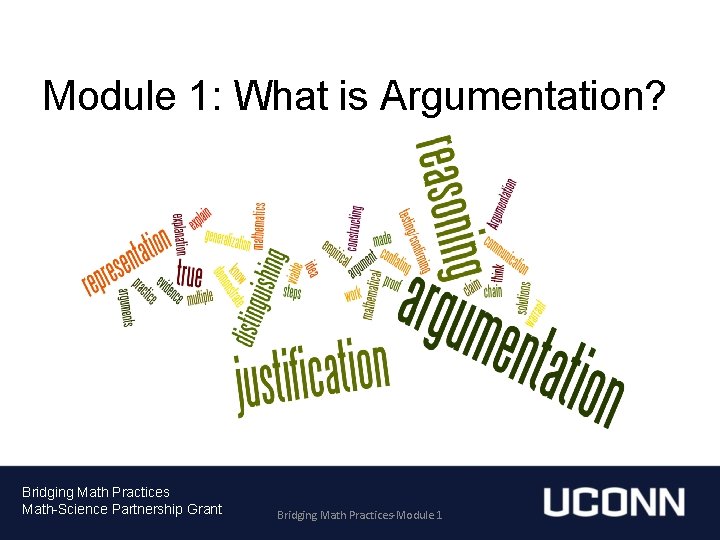
Module 1: What is Argumentation? Bridging Math Practices Math-Science Partnership Grant Bridging Math Practices-Module 1
Opening Activities: Getting to Know Our Group Bridging Math Practices- Module 1
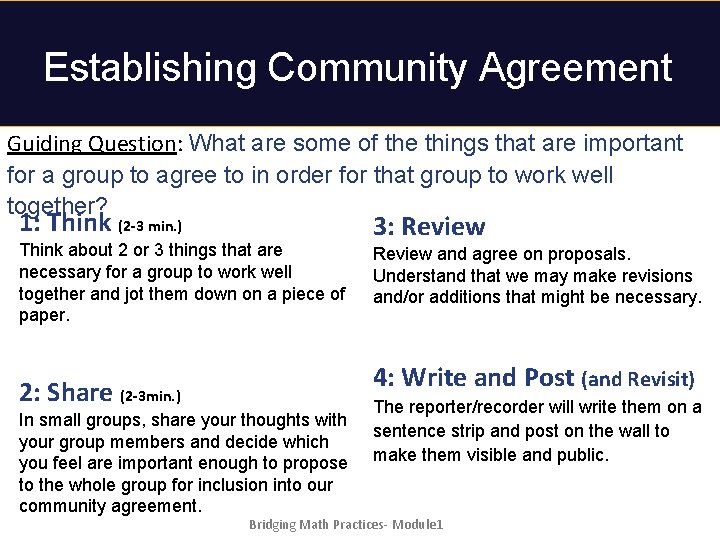
Establishing Community Agreement Guiding Question: What are some of the things that are important for a group to agree to in order for that group to work well together? 1: Think (2 -3 min. ) Think about 2 or 3 things that are necessary for a group to work well together and jot them down on a piece of paper. 3: Review and agree on proposals. Understand that we may make revisions and/or additions that might be necessary. 4: Write and Post (and Revisit) 2: Share (2 -3 min. ) In small groups, share your thoughts with your group members and decide which you feel are important enough to propose to the whole group for inclusion into our community agreement. The reporter/recorder will write them on a sentence strip and post on the wall to make them visible and public. Bridging Math Practices- Module 1
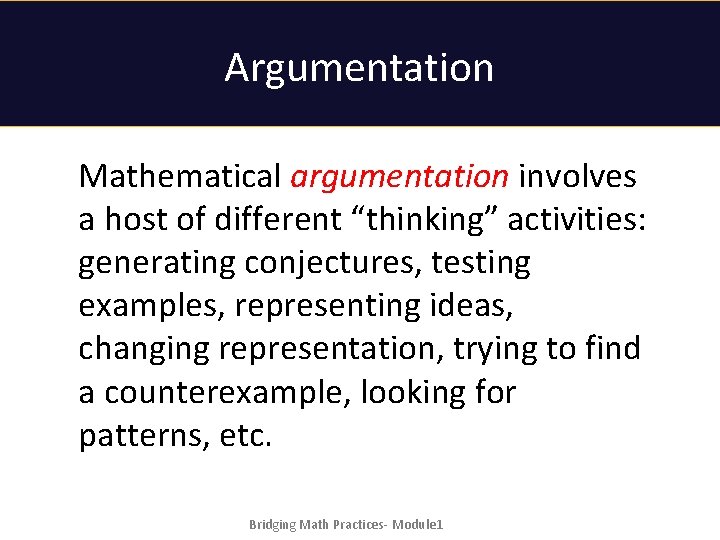
Argumentation Mathematical argumentation involves a host of different “thinking” activities: generating conjectures, testing examples, representing ideas, changing representation, trying to find a counterexample, looking for patterns, etc. Bridging Math Practices- Module 1
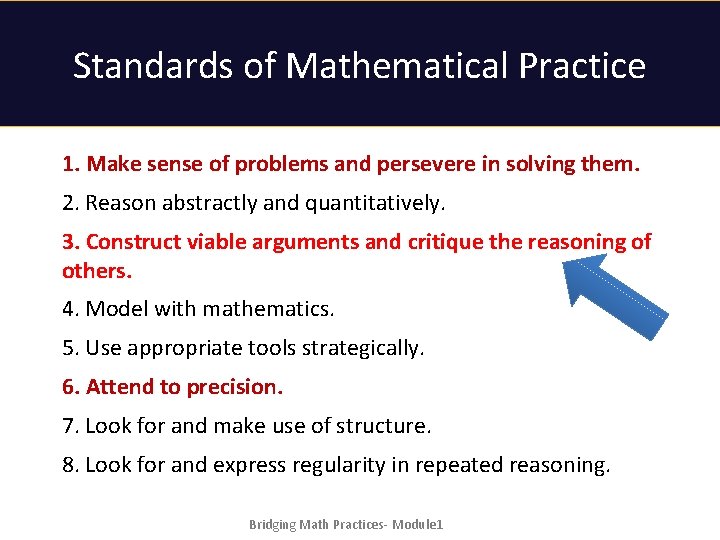
Standards of Mathematical Practice 1. Make sense of problems and persevere in solving them. 2. Reason abstractly and quantitatively. 3. Construct viable arguments and critique the reasoning of others. 4. Model with mathematics. 5. Use appropriate tools strategically. 6. Attend to precision. 7. Look for and make use of structure. 8. Look for and express regularity in repeated reasoning. Bridging Math Practices- Module 1
How do mathematical practices relate to student reasoning? • CCCSM MP 3 – Construct viable arguments and critique the reasoning of others. The practice begins, “Mathematically proficient students understand use stated assumptions, definitions, and previously established results in constructing arguments …” Bridging Math Practices- Module 1
Thinking is the hardest work there is, which is probably the reason why so few engage in it. - Henry Ford Teachers Will Be Able To: ✓ Develop a deeper understanding of argumentation and its potential in the math classroom. ✓ Analyze mathematical arguments within the three components of an argument. Bridging Math Practices- Module 1
Overarching Guiding Questions: • What is a mathematical argument? What “counts” as an argument? • What is the purpose(s) of argumentation in mathematics? In the math classroom? • What does student argumentation look like at different levels of proficiency? Bridging Math Practices- Module 1
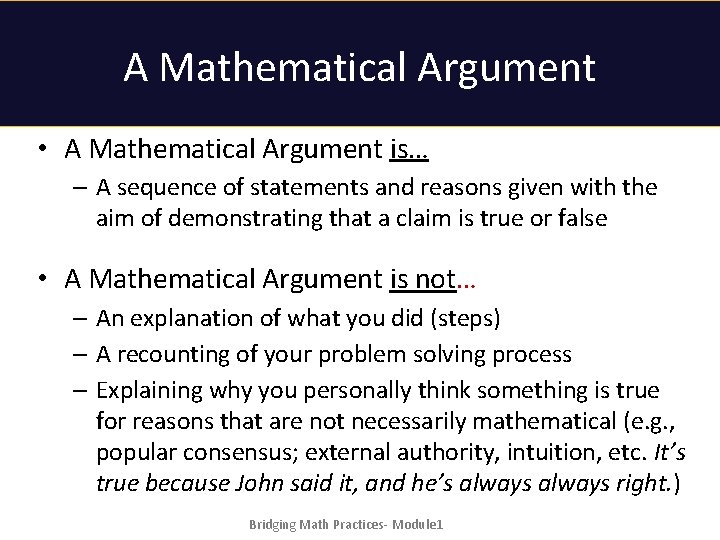
A Mathematical Argument • A Mathematical Argument is… – A sequence of statements and reasons given with the aim of demonstrating that a claim is true or false • A Mathematical Argument is not… – An explanation of what you did (steps) – A recounting of your problem solving process – Explaining why you personally think something is true for reasons that are not necessarily mathematical (e. g. , popular consensus; external authority, intuition, etc. It’s true because John said it, and he’s always right. ) Bridging Math Practices- Module 1
Let’s take a look… Abbott & Costello: 7 x 13 = 28 https: //www. youtube. com/watch? v=xkb. QDEXJy 2 k Bridging Math Practices- Module 1
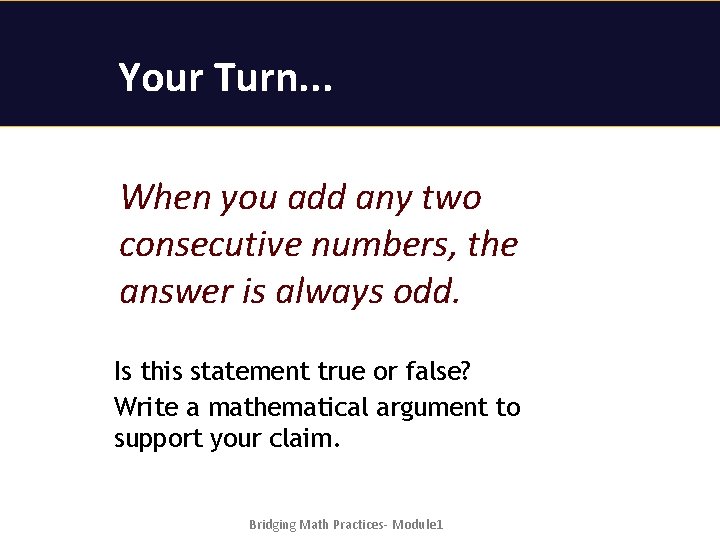
Your Turn. . . When you add any two consecutive numbers, the answer is always odd. Is this statement true or false? Write a mathematical argument to support your claim. Bridging Math Practices- Module 1
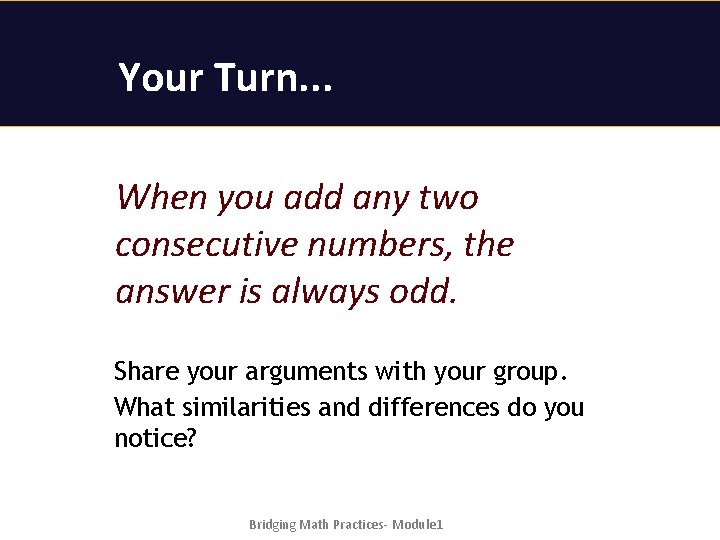
Your Turn. . . When you add any two consecutive numbers, the answer is always odd. Share your arguments with your group. What similarities and differences do you notice? Bridging Math Practices- Module 1
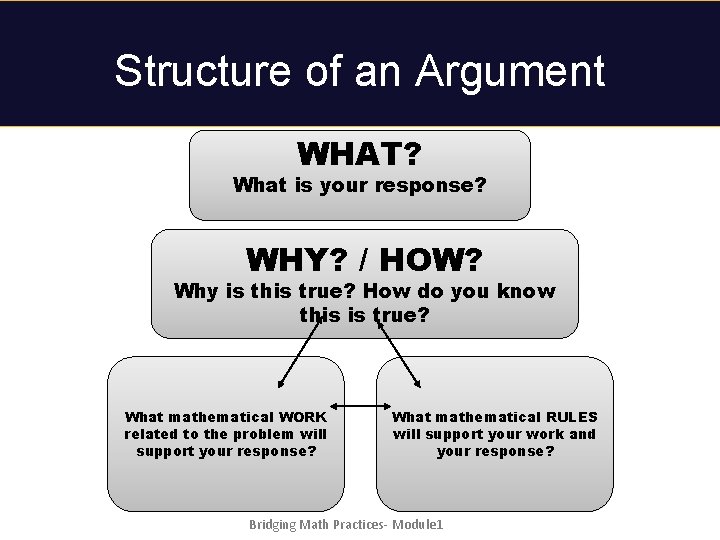
Structure of an Argument WHAT? What is your response? WHY? / HOW? Why is this true? How do you know this is true? What mathematical WORK related to the problem will support your response? What mathematical RULES will support your work and your response? Bridging Math Practices- Module 1
Analyzing Student Arguments on the Consecutive Sums Task You have 4 sample student responses to the Consecutive Sums Task. For each student argument: (1) Discuss the student’s argument. (2) Determine if the argument shows the claim is true. Bridging Math Practices- Module 1
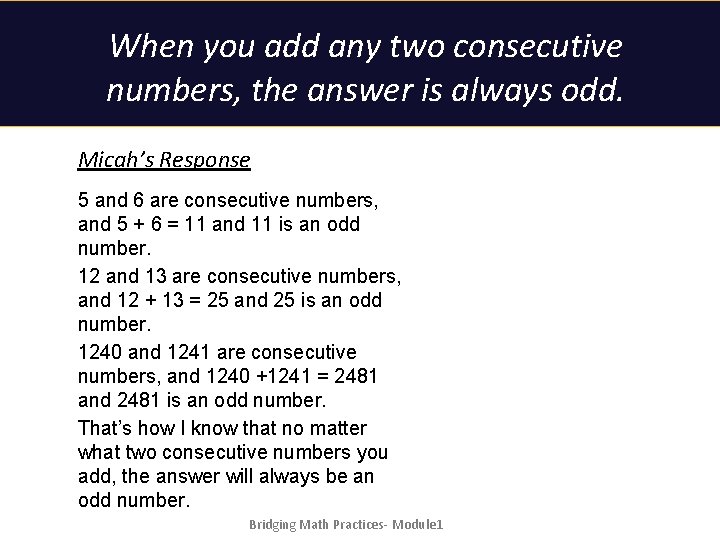
When you add any two consecutive numbers, the answer is always odd. Micah’s Response 5 and 6 are consecutive numbers, and 5 + 6 = 11 and 11 is an odd number. 12 and 13 are consecutive numbers, and 12 + 13 = 25 and 25 is an odd number. 1240 and 1241 are consecutive numbers, and 1240 +1241 = 2481 and 2481 is an odd number. That’s how I know that no matter what two consecutive numbers you add, the answer will always be an odd number. Bridging Math Practices- Module 1
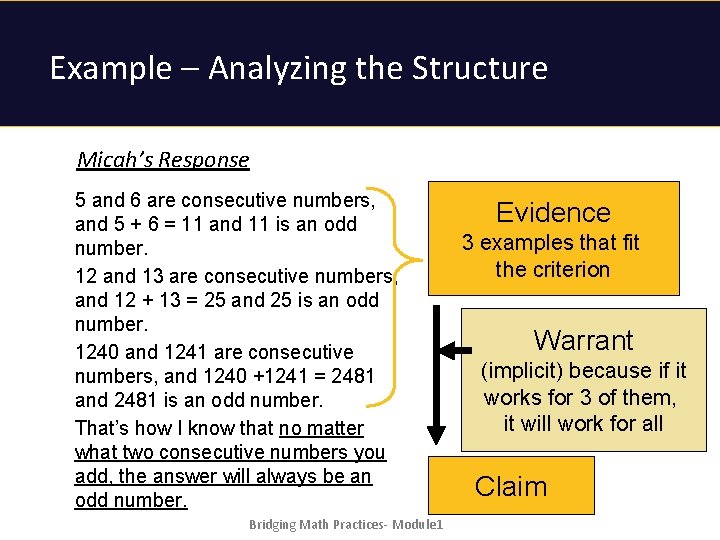
Example – Analyzing the Structure Micah’s Response 5 and 6 are consecutive numbers, and 5 + 6 = 11 and 11 is an odd number. 12 and 13 are consecutive numbers, and 12 + 13 = 25 and 25 is an odd number. 1240 and 1241 are consecutive numbers, and 1240 +1241 = 2481 and 2481 is an odd number. That’s how I know that no matter what two consecutive numbers you add, the answer will always be an odd number. Bridging Math Practices- Module 1 Evidence 3 examples that fit the criterion Warrant (implicit) because if it works for 3 of them, it will work for all Claim
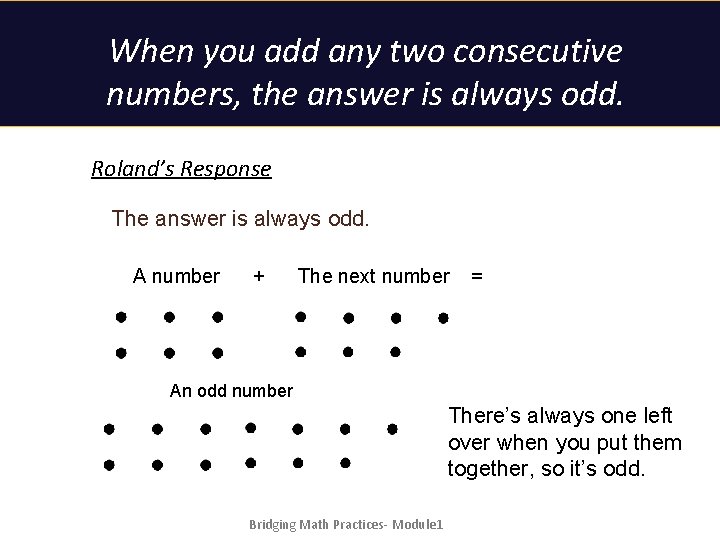
When you add any two consecutive numbers, the answer is always odd. Roland’s Response The answer is always odd. A number + The next number = An odd number There’s always one left over when you put them together, so it’s odd. Bridging Math Practices- Module 1
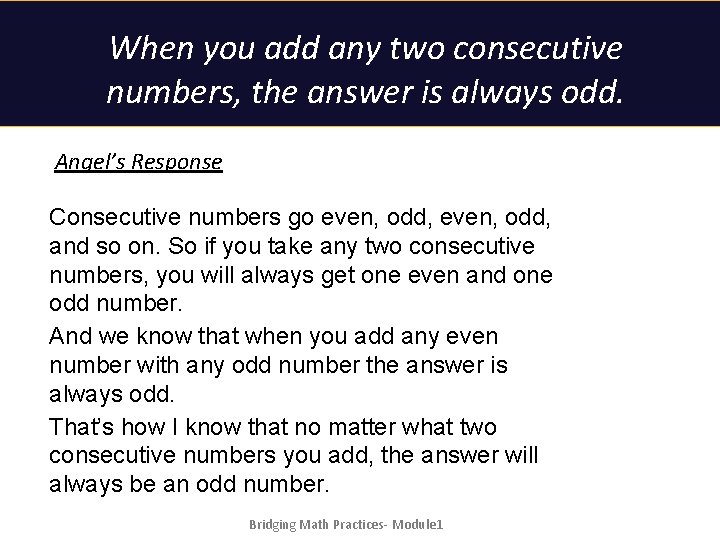
When you add any two consecutive numbers, the answer is always odd. Angel’s Response Consecutive numbers go even, odd, and so on. So if you take any two consecutive numbers, you will always get one even and one odd number. And we know that when you add any even number with any odd number the answer is always odd. That’s how I know that no matter what two consecutive numbers you add, the answer will always be an odd number. Bridging Math Practices- Module 1
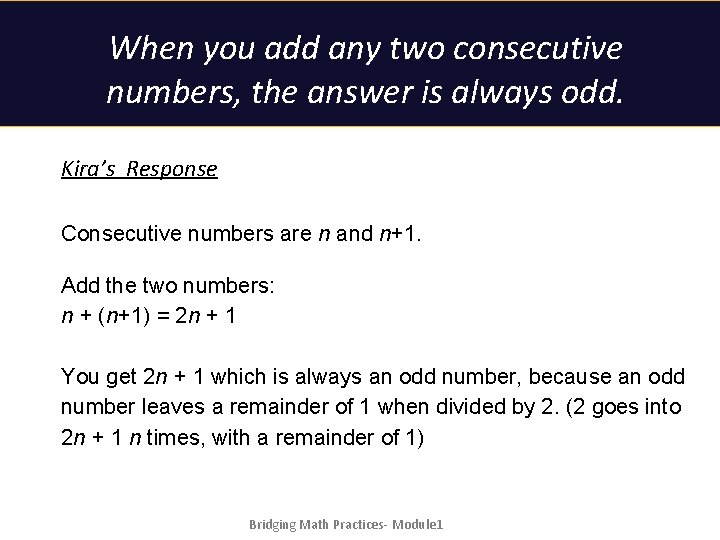
When you add any two consecutive numbers, the answer is always odd. Kira’s Response Consecutive numbers are n and n+1. Add the two numbers: n + (n+1) = 2 n + 1 You get 2 n + 1 which is always an odd number, because an odd number leaves a remainder of 1 when divided by 2. (2 goes into 2 n + 1 n times, with a remainder of 1) Bridging Math Practices- Module 1
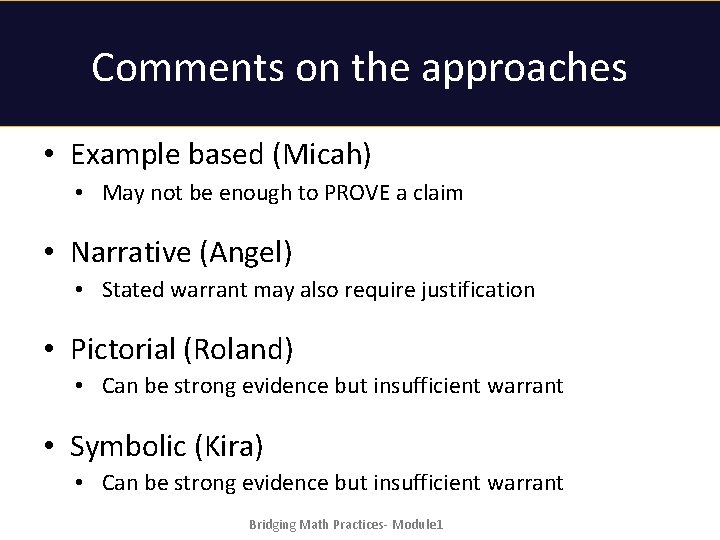
Comments on the approaches • Example based (Micah) • May not be enough to PROVE a claim • Narrative (Angel) • Stated warrant may also require justification • Pictorial (Roland) • Can be strong evidence but insufficient warrant • Symbolic (Kira) • Can be strong evidence but insufficient warrant Bridging Math Practices- Module 1
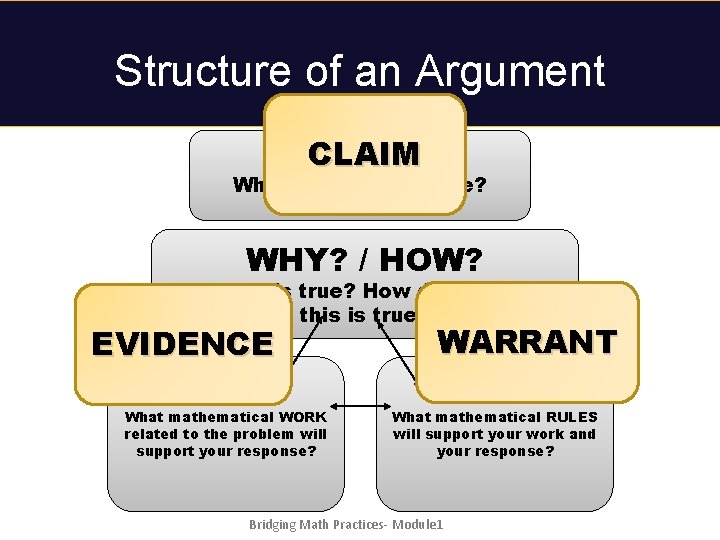
Structure of an Argument WHAT? CLAIM What is your response? WHY? / HOW? Why is this true? How do you know this is true? EVIDENCE What mathematical WORK related to the problem will support your response? WARRANT What mathematical RULES will support your work and your response? Bridging Math Practices- Module 1
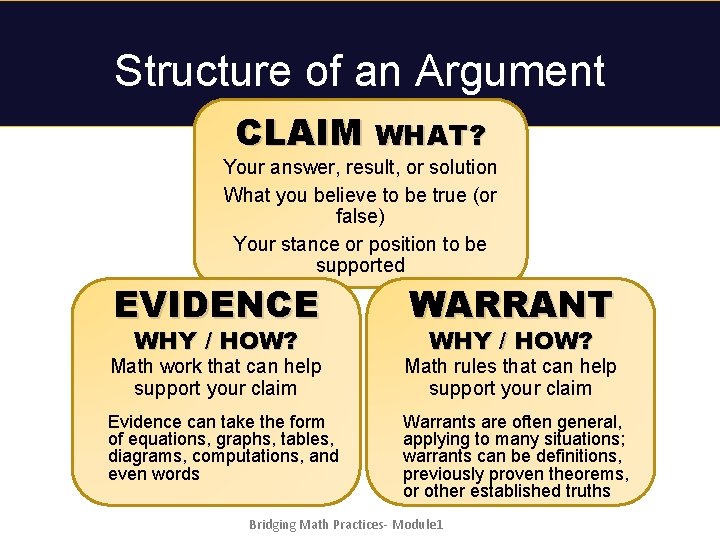
Structure of an Argument CLAIM WHAT? Your answer, result, or solution What you believe to be true (or false) Your stance or position to be supported EVIDENCE WARRANT Math work that can help support your claim Math rules that can help support your claim Evidence can take the form of equations, graphs, tables, diagrams, computations, and even words Warrants are often general, applying to many situations; warrants can be definitions, previously proven theorems, or other established truths WHY / HOW? Bridging Math Practices- Module 1
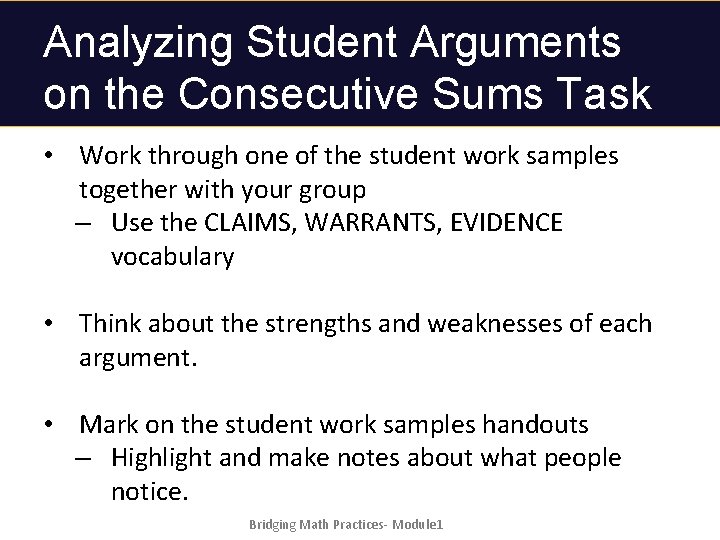
Analyzing Student Arguments on the Consecutive Sums Task • Work through one of the student work samples together with your group – Use the CLAIMS, WARRANTS, EVIDENCE vocabulary • Think about the strengths and weaknesses of each argument. • Mark on the student work samples handouts – Highlight and make notes about what people notice. Bridging Math Practices- Module 1
Reflection Questions How does your argument compare to the student samples? How would you modify your work to make a stronger argument? Bridging Math Practices- Module 1
Bridging to Practice Bridging Math Practices- Module 1
Closure Bridging Math Practices- Module 1
Acknowledgements • Bridging Math Practices Project was supported by a Math-Science Partnership Continuation Grant from the Connecticut State Department of Education, 2015 -2016 UConn: Megan Staples (PI), Jillian Cavanna (Project Manager) Lead Teachers: Catherine Mazzotta (Manchester), Michelle Mc. Knight (Manchester), Belinda Pérez (Hartford), and Teresa Rodriguez (Manchester) • The initial 2014 -2015 Bridges project was a collaborative project among UConn, Manchester Public Schools, Mansfield Public Schools, and Hartford Public Schools We appreciate greatly the CT State Department of Education for supporting this work and would like to thank all our participants, across cohorts, whose contributions to these materials are many. Bridging Math Practices- Module 1
- Slides: 27