
MODULE 1 UNIT 2 LESSON 4 Using Routines

- Slides: 25
MODULE 1: UNIT 2: LESSON 4 Using Routines for Discussing A Long Walk to Water and Introducing Juxtaposition (Chapters 9 and 10)
OPENING: VOCABULARY ENTRY TASK (5 MINUTES) �Vocabulary Entry Task: �“What does relentless (page 52) mean? How did you figure it out? �“Why does the author use the phrase ‘spark of hope’ (page 61)? What does this mean? Why didn’t she just write ‘hope’? ” �Share your thinking �Notice that “spark of hope” provides a visual image of a small light in the darkness. ◦ It is a metaphor, which authors sometimes use to help their readers understand the emotions of their characters. ◦ Authors sometimes choose a sensory image to represent an emotion, since we cannot see or hear emotions directly
OPENING: Reviewing Reader’s Dictionary and Introducing Learning Targets (10 minutes) �Look at the word Refugee �Do you see a prefix you recognize? ◦ prefix re◦ “Re-” means again, back, or from, as in rewind (wind again), retrace (trace again), or revert (turn back to the way it was before) �Do you recognize a root in the word? ◦ The root of this word, like the root of desperate, is from Latin. ◦ The root is fug, from fugere, which means “to flee or run away. ”
OPENING CONTINUED… �“Given this prefix and this root, what do you think this word means? What is a refugee camp? Why might they be set up? ” ◦ A refugee is someone who has fled home �Can you think of other words that have the same root? ◦ fugitive and refuge �Review Reader’s Notes for Chapters 9 and 10 and correct as necessary.
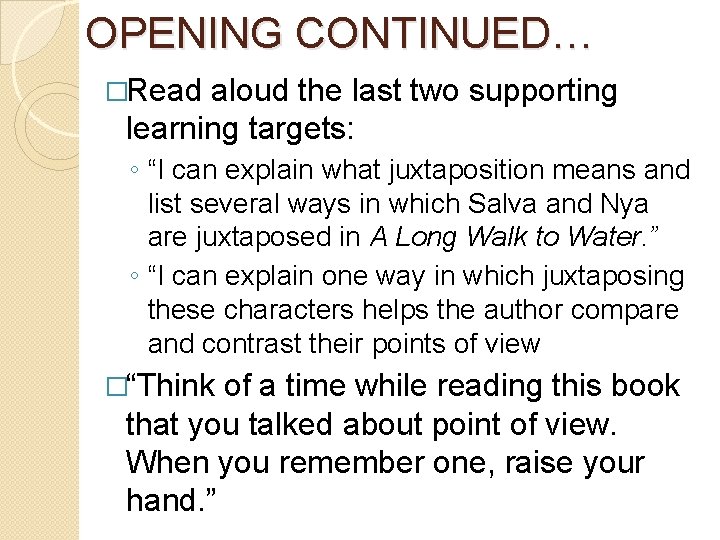
OPENING CONTINUED… �Read aloud the last two supporting learning targets: ◦ “I can explain what juxtaposition means and list several ways in which Salva and Nya are juxtaposed in A Long Walk to Water. ” ◦ “I can explain one way in which juxtaposing these characters helps the author compare and contrast their points of view �“Think of a time while reading this book that you talked about point of view. When you remember one, raise your hand. ”
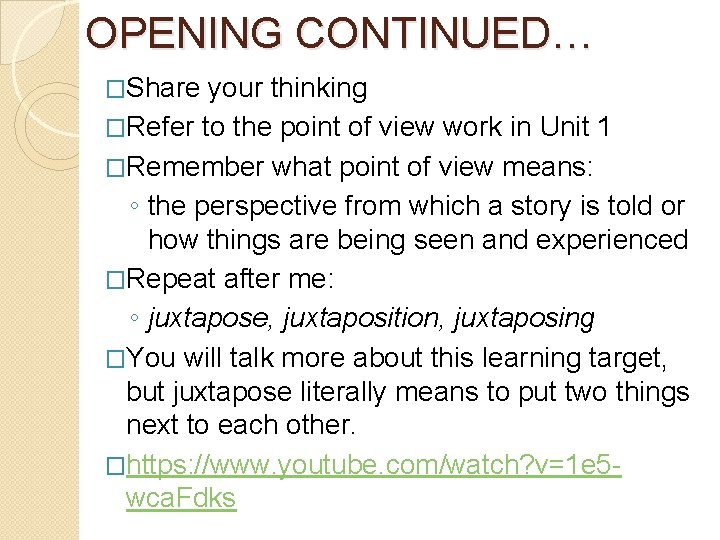
OPENING CONTINUED… �Share your thinking �Refer to the point of view work in Unit 1 �Remember what point of view means: ◦ the perspective from which a story is told or how things are being seen and experienced �Repeat after me: ◦ juxtapose, juxtaposition, juxtaposing �You will talk more about this learning target, but juxtapose literally means to put two things next to each other. �https: //www. youtube. com/watch? v=1 e 5 wca. Fdks
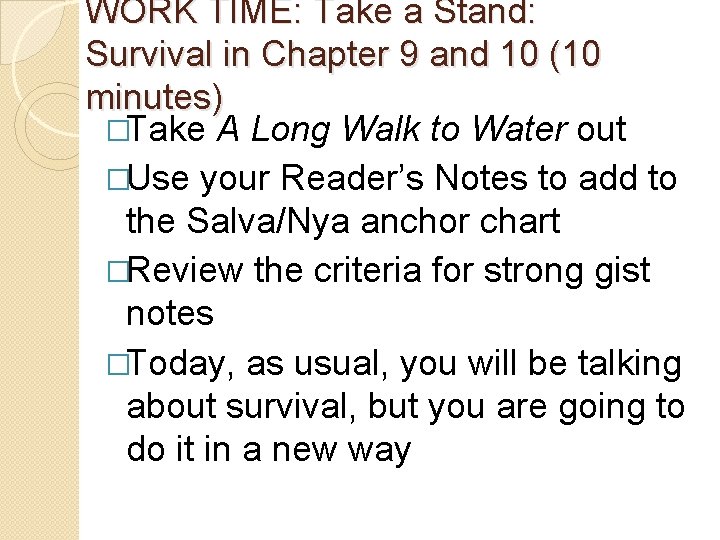
WORK TIME: Take a Stand: Survival in Chapter 9 and 10 (10 minutes) �Take A Long Walk to Water out �Use your Reader’s Notes to add to the Salva/Nya anchor chart �Review the criteria for strong gist notes �Today, as usual, you will be talking about survival, but you are going to do it in a new way
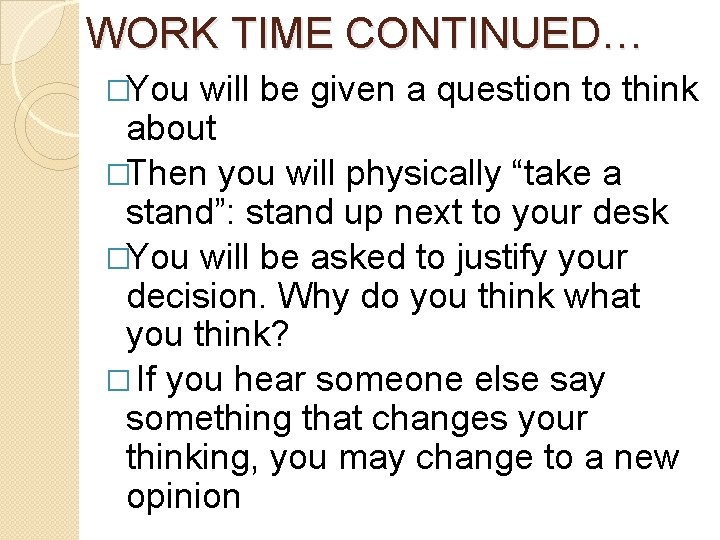
WORK TIME CONTINUED… �You will be given a question to think about �Then you will physically “take a stand”: stand up next to your desk �You will be asked to justify your decision. Why do you think what you think? � If you hear someone else say something that changes your thinking, you may change to a new opinion
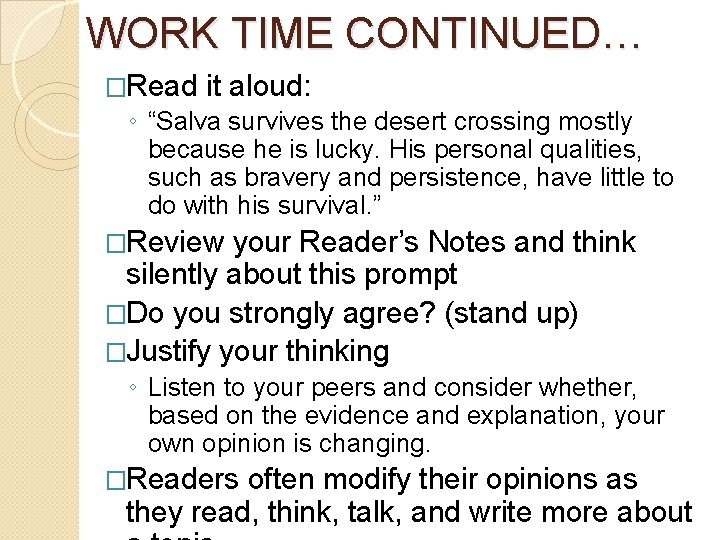
WORK TIME CONTINUED… �Read it aloud: ◦ “Salva survives the desert crossing mostly because he is lucky. His personal qualities, such as bravery and persistence, have little to do with his survival. ” �Review your Reader’s Notes and think silently about this prompt �Do you strongly agree? (stand up) �Justify your thinking ◦ Listen to your peers and consider whether, based on the evidence and explanation, your own opinion is changing. �Readers often modify their opinions as they read, think, talk, and write more about
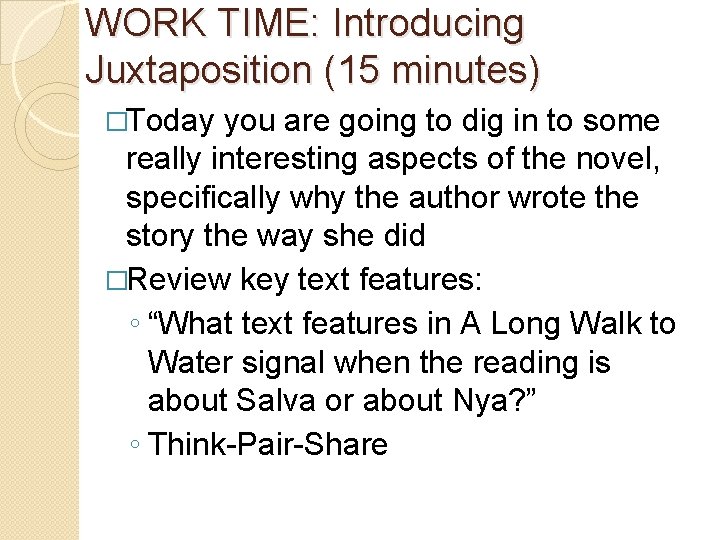
WORK TIME: Introducing Juxtaposition (15 minutes) �Today you are going to dig in to some really interesting aspects of the novel, specifically why the author wrote the story the way she did �Review key text features: ◦ “What text features in A Long Walk to Water signal when the reading is about Salva or about Nya? ” ◦ Think-Pair-Share
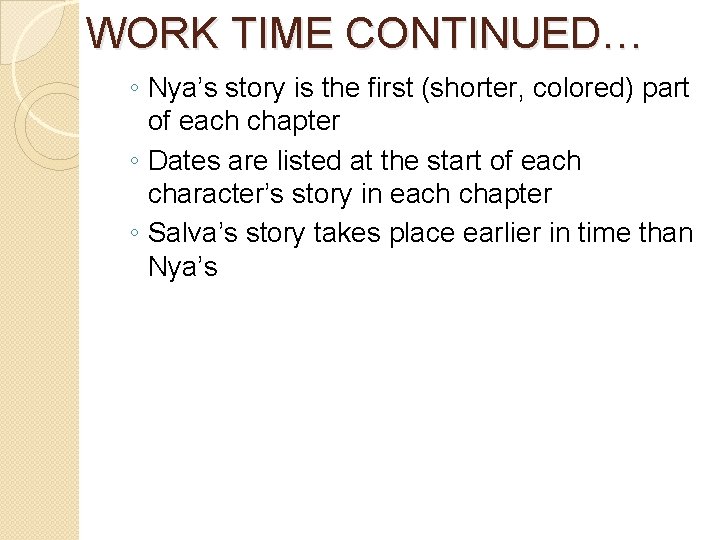
WORK TIME CONTINUED… ◦ Nya’s story is the first (shorter, colored) part of each chapter ◦ Dates are listed at the start of each character’s story in each chapter ◦ Salva’s story takes place earlier in time than Nya’s
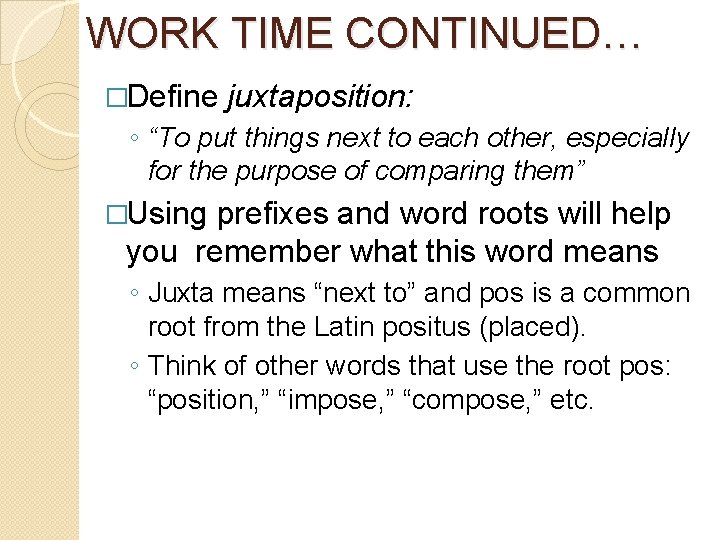
WORK TIME CONTINUED… �Define juxtaposition: ◦ “To put things next to each other, especially for the purpose of comparing them” �Using prefixes and word roots will help you remember what this word means ◦ Juxta means “next to” and pos is a common root from the Latin positus (placed). ◦ Think of other words that use the root pos: “position, ” “impose, ” “compose, ” etc.
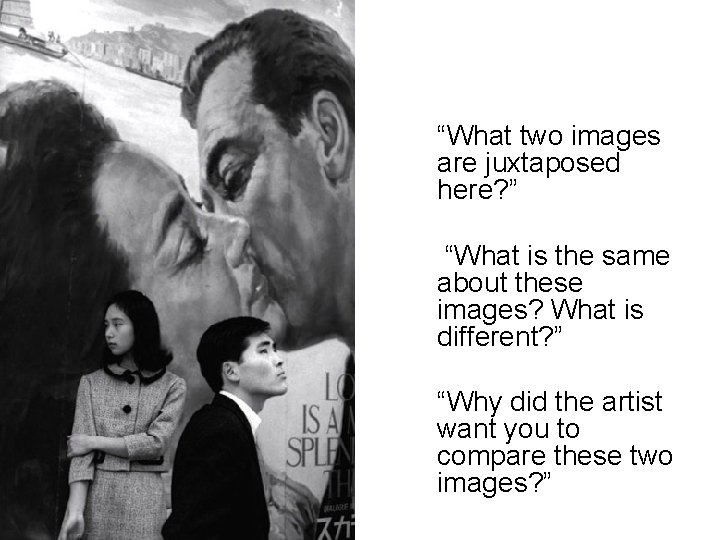
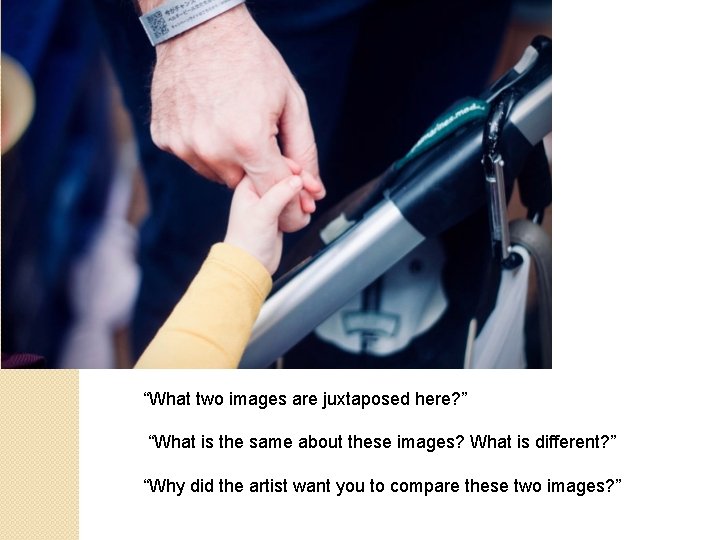
WORK TIME CONTINUED… �Look at the juxtaposition image and read the juxtaposition image discussion prompts
“What two images are juxtaposed here? ” “What is the same about these images? What is different? ” “Why did the artist want you to compare these two images? ”
“What two images are juxtaposed here? ” “What is the same about these images? What is different? ” “Why did the artist want you to compare these two images? ”
WORK TIME CONTINUED… �Now you will think about this question: ◦ “How did the author of A Long Walk to Water juxtapose Nya and Salva? ” �Start a list, get started with the most basic example: ◦ One way Park juxtaposes Salva and Nya is by putting them in the same book, and even in the same chapter.
WORK TIME CONTINUED… �Juxtaposition means putting things side by side BOTH for comparison (how they are alike and different) AND for contrast (how they are different).
WORK TIME CONTINUED… �You are acquiring tools for thinking deeply about complex texts �As you move on to high school and college, you will need tools that match the texts you will read �You will continue talking about how the characters compare with your Ethiopia Discussion Partner ◦ Now that we have noticed that the two characters are juxtaposed, let’s think about how this helps us compare and contrast them ◦ Find at least two similarities and two differences between Salva and Nya
WORK TIME CONTINUED… �Explain your ideas: ◦ The two characters are within the book (the author could have told one story, then the other) ◦ are within the same historical context ◦ are both children ◦ both need water �Listen for contrasts: ◦ boy versus girl ◦ different years, etc.
WORK TIME CONTINUED… �The author clearly chose to write her novel in this way: ◦ She is using juxtaposition to get us, as readers, to think more deeply about the characters and themes �You will practice analyzing one particular instance of how Park uses juxtaposition to help readers compare and contrast the two characters’ points of view
Work Time Continued… �Read the Juxtaposition in Chapters 8 and 9 questions for a Think-Pair-Share: ◦ “In Chapters 8 and 9, what was each character’s experience with water? ” ◦ “How were their experiences the same and different? ” ◦ “Why do you think the author put these two accounts so close to each other? ” ◦ “What does she want you to notice or wonder about survival in Sudan? ”
WORK TIME CONTINUED… �Notice: ◦ In Chapters 8 and 9, Salva is crossing the desert. People live or die depending on whether or not they have water. Nya is worried about getting clean water, since the nurse told them to boil it but there is never enough to boil
Work Time Continued… �Same: ◦ Life depends on clean water �Different: ◦ Nya is at home, where dirty water causes sickness but not death, and there is hope (people come to talk about a well) ◦ Salva is traveling, and people die from thirst �Putting these so close together helps Park show us how important access to clean water is in Sudan, in war and in peace, at home and traveling, in the 1980 s and today. People without access to clean water have difficulty surviving
CLOSING AND ASSESSMENT: EXIT TICKET (5 MINUTES) �exit ticket �Respond in writing: ◦ “How does Park’s decision to juxtapose Salva and Nya in A Long Walk to Water help us better understand each character’s point of view? ◦ Support your answer with at least one specific comparison from the book so far” �Turn in Reader’s Notes and the first part of the Gathering Textual Evidence graphic organizer (for Chapters 6– 8)
HOMEWORK �Reread Chapters 9 and 10 and add two quotes to your Gathering Textual Evidence graphic organizer �Read Chapters 11– 13 and complete the Reader’s Notes (both parts) for these new chapters