
MODULE 1 PREPARING FOR SYSTEMS CHANGE 2 WEBINAR
MODULE 1: PREPARING FOR SYSTEMS CHANGE
2 WEBINAR AGENDA Module Introduction – MJ Mc. Kitterick, Amanda Buchnea o Who We Are? Amanda Buchnea Section One – Setting Up the Change Conversation o Goals for Module One – MJ Mc. Kitterick o What is the Change - Amanda Buchnea Section Two – Change Domains – Discussion with MJ Mc. Kitterick And Amanda Buchnea from A Way Home Canada
WHO WE ARE? Amanda Buchnea A Way Home Canada
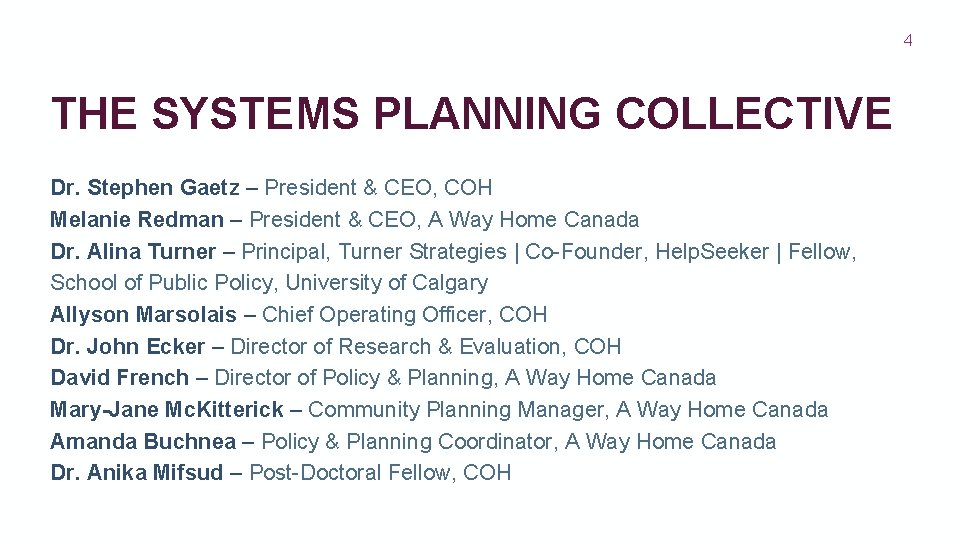
4 THE SYSTEMS PLANNING COLLECTIVE Dr. Stephen Gaetz – President & CEO, COH Melanie Redman – President & CEO, A Way Home Canada Dr. Alina Turner – Principal, Turner Strategies | Co-Founder, Help. Seeker | Fellow, School of Public Policy, University of Calgary Allyson Marsolais – Chief Operating Officer, COH Dr. John Ecker – Director of Research & Evaluation, COH David French – Director of Policy & Planning, A Way Home Canada Mary-Jane Mc. Kitterick – Community Planning Manager, A Way Home Canada Amanda Buchnea – Policy & Planning Coordinator, A Way Home Canada Dr. Anika Mifsud – Post-Doctoral Fellow, COH
5 OUR GOALS o Collaboration between A Way Home Canada, Canadian Observatory on Homelessness and Turner Strategies o Dedicated to helping communities & governments prevent and end all forms of homelessness in Canada o How? Supporting evidence-based systems planning, capacity building and technical assistance o Collective progress towards ending homelessness
6 WHAT ARE WE HERE TO DO? o Provide resources: Systems Planning Curriculum - modules, webinars, guides, infographics o Build capacity: Wealth of information/expertise, supporting communities to do systems planning o Training & Technical Assistance: Help. Seeker, Systems Mapping, Webinars o Partnership building: Designated communities, Non-designated communities, Indigenous leaders
7 HOW DO WE WORK? o Collaboration through the contribution of resources to support community system planning o No one-off resources (toolkits, webinars, definitions) and engaging communities as separate entities, leveraging partner strengths to support common objectives
SETTING UP THE CHANGE CONVERSATION Mary-Jane Mc. Kitterick A Way Home Canada
9 INTRODUCTION: MODULE ONE o Communities identified relationships, trust building and change management as priorities requiring technical support o Large body of work that we are beginning to integrate into homelessness systems planning o Module One introduces foundational systems change concepts to set the stage for future modules o Change management will be addressed in more detail in accompanying Module One Guide and throughout future modules
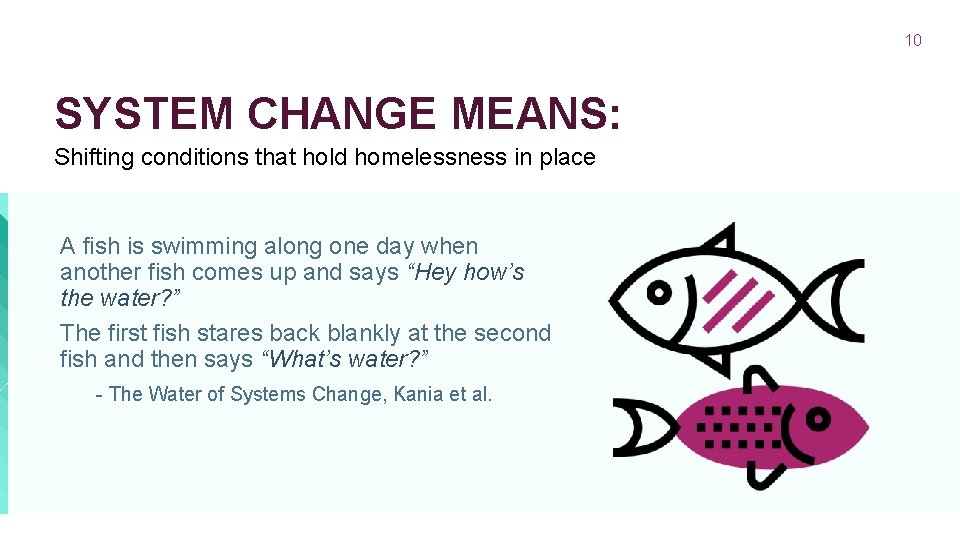
10 SYSTEM CHANGE MEANS: Shifting conditions that hold homelessness in place A fish is swimming along one day when another fish comes up and says “Hey how’s the water? ” The first fish stares back blankly at the second fish and then says “What’s water? ” - The Water of Systems Change, Kania et al.

11 MODULE ONE LEARNING GOALS o Identify the perceived and real barriers as we transform from a single system approach to engaging multiple systems across sectors o Identify & discuss some of the deeper/hidden impacts that can/could occur as we transform from ‘behaving’ like a single system to ‘understanding’ how we interact as systems o Pointing toward where each of these changes will be more developed in future modules with practical tools and strategies o Additional resources or bodies of work that can support this work as it unfolds
SETTING UP THE CHANGE CONVERSATION Amanda Buchnea A Way Home Canada
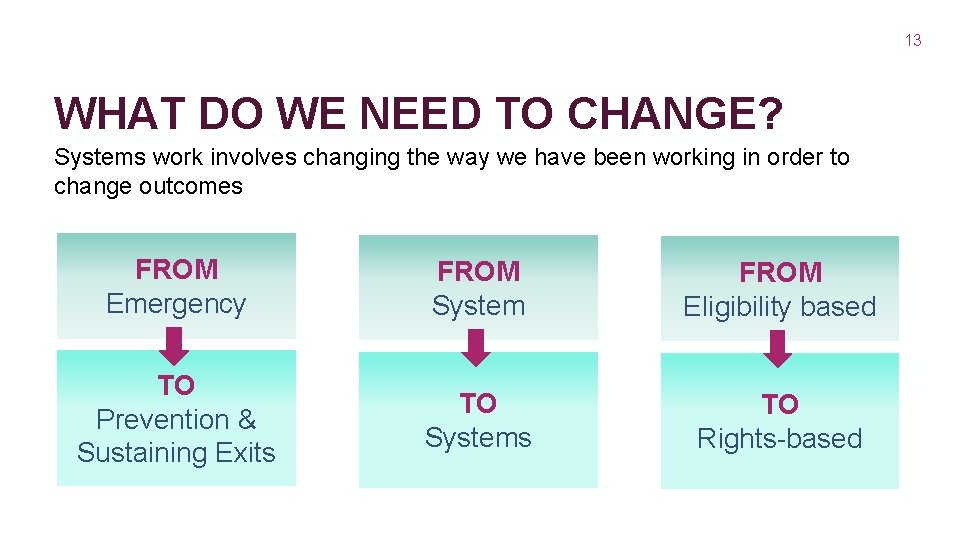
13 WHAT DO WE NEED TO CHANGE? Systems work involves changing the way we have been working in order to change outcomes FROM Emergency FROM System FROM Eligibility based TO Prevention & Sustaining Exits TO Systems TO Rights-based
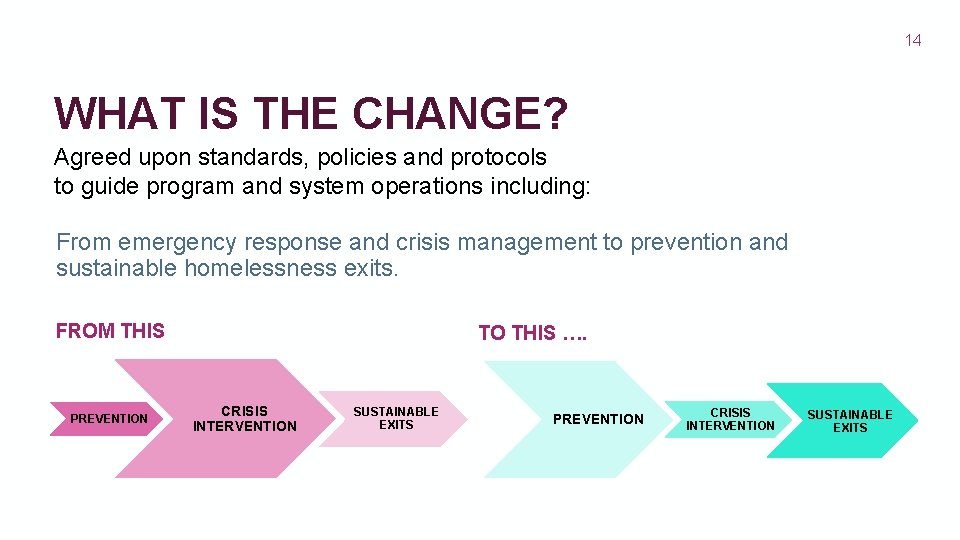
14 WHAT IS THE CHANGE? Agreed upon standards, policies and protocols to guide program and system operations including: From emergency response and crisis management to prevention and sustainable homelessness exits. FROM THIS PREVENTION TO THIS …. CRISIS INTERVENTION SUSTAINABLE EXITS PREVENTION CRISIS INTERVENTION SUSTAINABLE EXITS
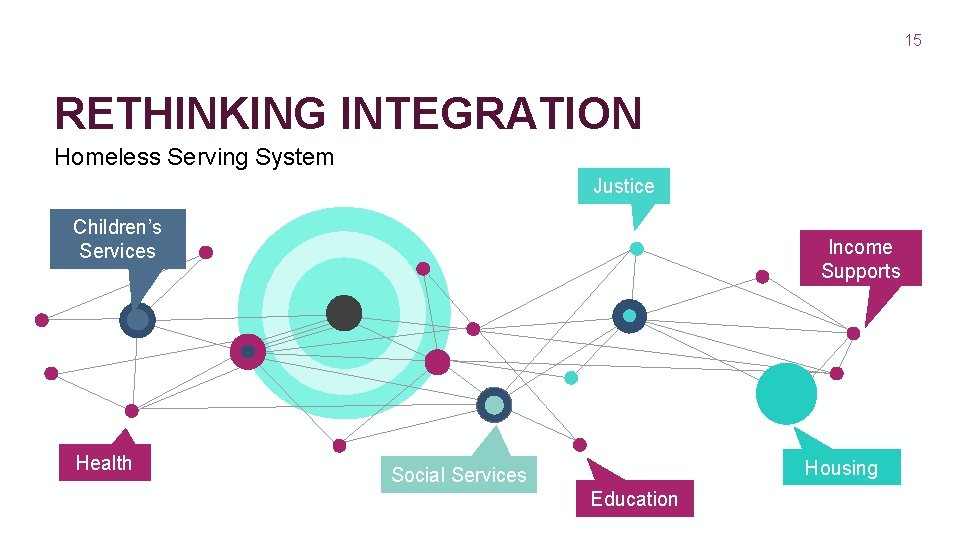
15 RETHINKING INTEGRATION Homeless Serving System Justice Children’s Services Health Income Supports Housing Social Services Education
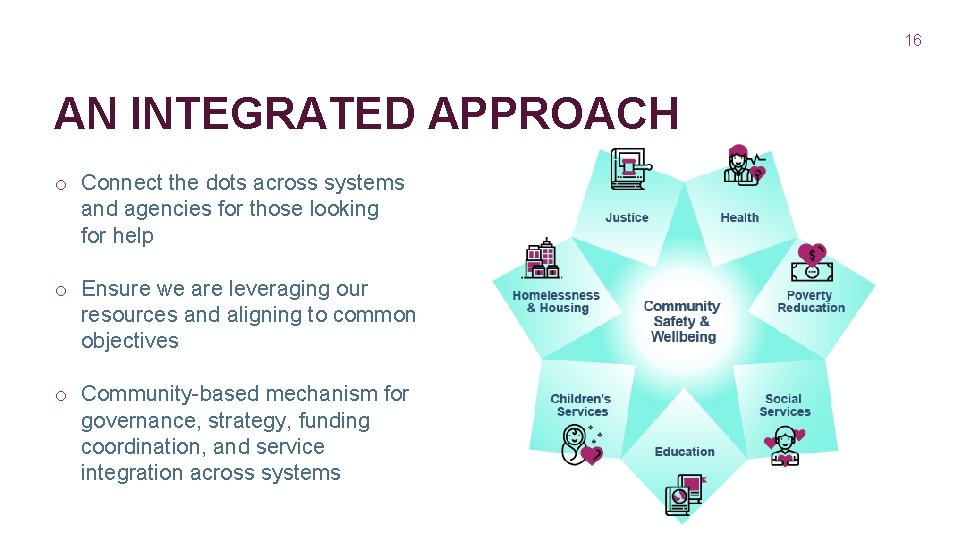
16 AN INTEGRATED APPROACH o Connect the dots across systems and agencies for those looking for help o Ensure we are leveraging our resources and aligning to common objectives o Community-based mechanism for governance, strategy, funding coordination, and service integration across systems
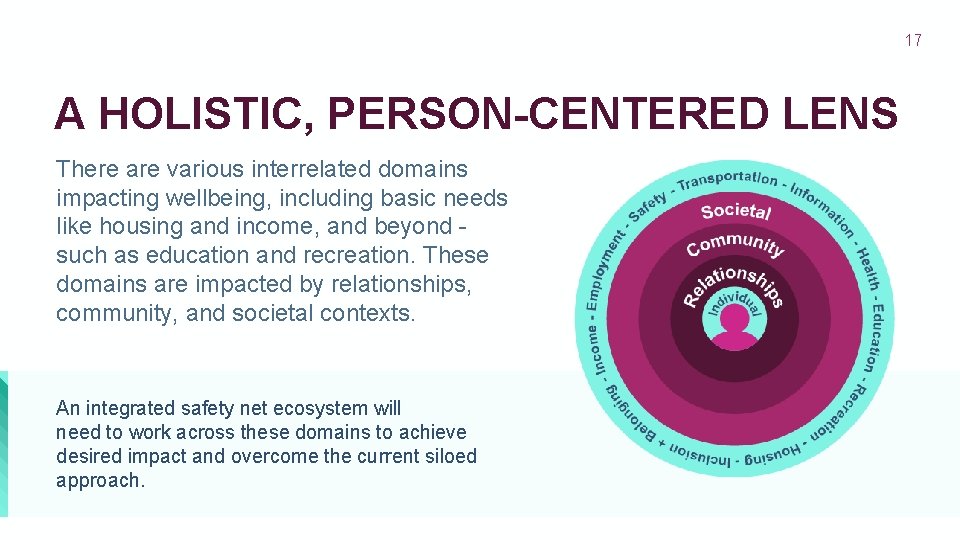
17 A HOLISTIC, PERSON-CENTERED LENS There are various interrelated domains impacting wellbeing, including basic needs like housing and income, and beyond such as education and recreation. These domains are impacted by relationships, community, and societal contexts. An integrated safety net ecosystem will need to work across these domains to achieve desired impact and overcome the current siloed approach.
18 REFLECTIVE QUESTIONS 1 : Are you on board with the shift away from heavy emphasis on Emergency Responses to homelessness, and toward Prevention and Sustaining Exits from homelessness? 2: How do you feel about the shift from the work being the sole responsibility of the homeless-serving sector toward a shared public (government & institution), private and non-profit responsibility? 3: How do you feel about the shift from a charity and eligibility approach toward a rights-based, person-centred approach?
FOUNDATIONAL CONCEPTS Mary-Jane Mc. Kitterick A Way Home Canada
20 FOUNDATIONAL CONCEPTS Complexity Trust Approaches
21 COMPLEXITY “The opposite of tragedy is complexity and creativity and nuance and depth and layers ” - David Truer, Ojibway Author o Multiple systems are beginning to engage deeply for the first time o Embracing complexity, rather than managing it - (will support us to work upstream rather than managing crises)
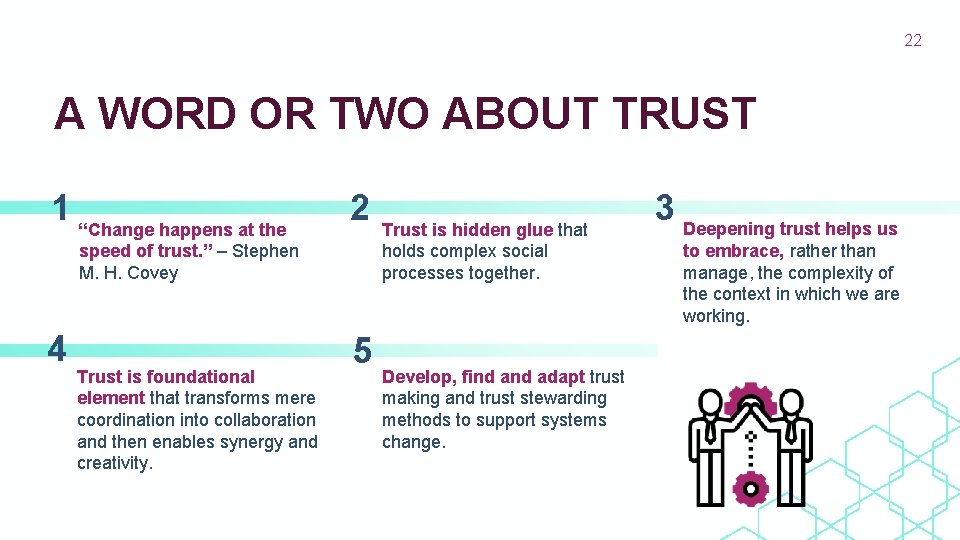
22 A WORD OR TWO ABOUT TRUST 1 “Change happens at the 2 speed of trust. ” – Stephen M. H. Covey 4 Trust is foundational element that transforms mere coordination into collaboration and then enables synergy and creativity. 5 Trust is hidden glue that holds complex social processes together. Develop, find adapt trust making and trust stewarding methods to support systems change. 3 Deepening trust helps us to embrace, rather than manage, the complexity of the context in which we are working.
23 CHANGE MANAGEMENT What is Change Management? The discipline that guides how we prepare, equip and support individuals to successfully adopt change in order to drive organizational success and outcomes. Our Goal Adapt organizational change management to new levels of complexity that support transformative change across multiple systems and sectors.
24 COLLECTIVE IMPACT Commitment of a group of actors from different sectors to a common agenda for solving a specific social problem, using a structured form of collaboration. o Priority placed on equity. Include community members in the collaborative. o Cross-sector partners. o Use data to continuously learn, adapt, and improve. o Cultivate leaders with unique system leadership skills. o Focus on program and system strategies. o Build a culture that fosters relationships, trust, and respect across participants. o Customize for local context.
25 HUMAN CENTERED DESIGN “We don’t know what we think we know” - Gavin Mc. Lusky Tamarack Institute o User design is about understanding the user experience at every aspect of accessing a product. o In this case the “product’ is the service provision and/or resources that the user accesses when they are at risk of or become homeless o HCD is one method to support meaningful integration of people with lived experience as context experts throughout this process o Centred on emotional and cognitive empathy
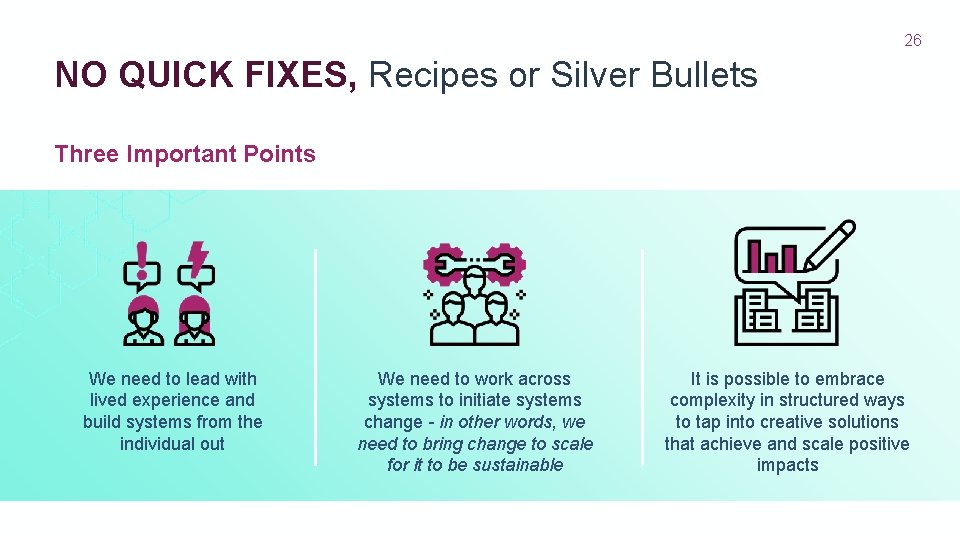
26 NO QUICK FIXES, Recipes or Silver Bullets Three Important Points We need to lead with lived experience and build systems from the individual out We need to work across systems to initiate systems change - in other words, we need to bring change to scale for it to be sustainable It is possible to embrace complexity in structured ways to tap into creative solutions that achieve and scale positive impacts
DOMAINS OF CHANGE Amanda Buchnea & Mary-Jane Mc. Kitterick A Way Home Canada
28 SEEING THE WATER… Attempting to foster systems change without building the capacity to “see” systems leads to a lot of talk and very little results”. (Water of Systems Change – Kania) - Water of Systems Change – Kania
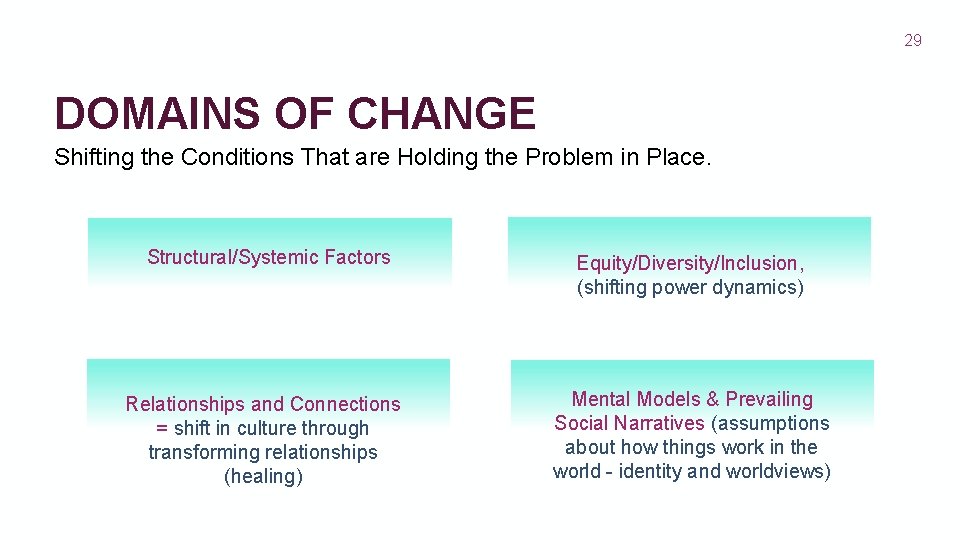
29 DOMAINS OF CHANGE Shifting the Conditions That are Holding the Problem in Place. Structural/Systemic Factors Equity/Diversity/Inclusion, (shifting power dynamics) Relationships and Connections = shift in culture through transforming relationships (healing) Mental Models & Prevailing Social Narratives (assumptions about how things work in the world - identity and worldviews)
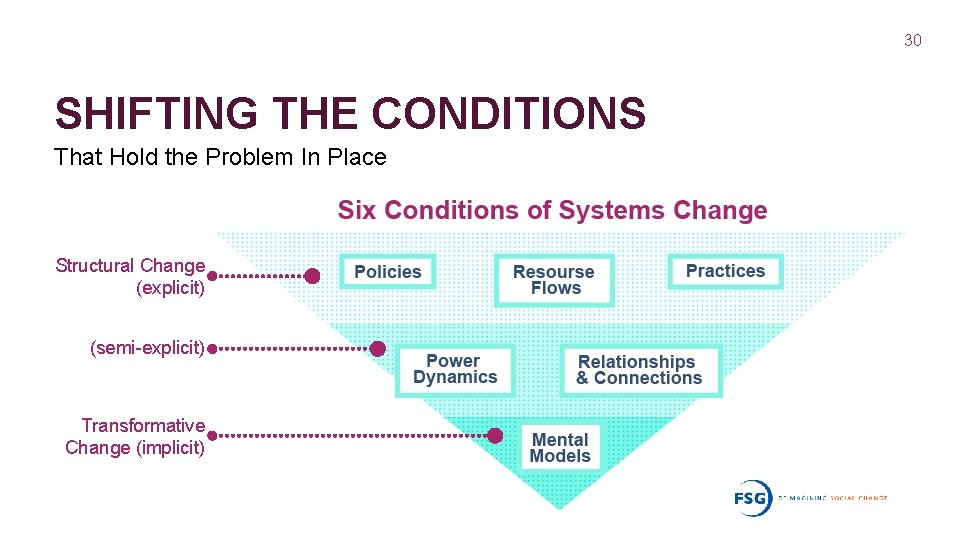
30 SHIFTING THE CONDITIONS That Hold the Problem In Place Structural Change (explicit) (semi-explicit) Transformative Change (implicit)
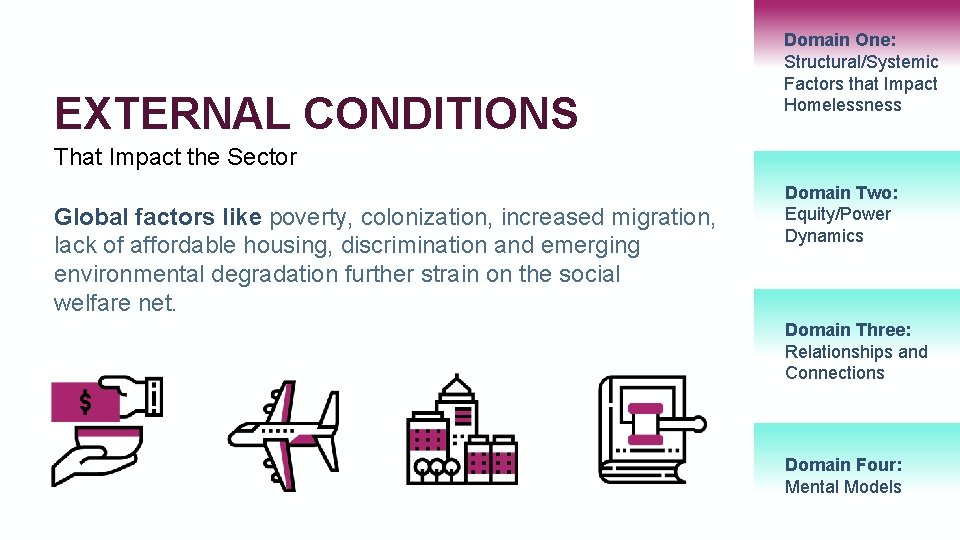
EXTERNAL CONDITIONS Domain One: 31 Structural/Systemic Factors that Impact Homelessness That Impact the Sector Global factors like poverty, colonization, increased migration, lack of affordable housing, discrimination and emerging environmental degradation further strain on the social welfare net. Domain Two: Equity/Power Dynamics Domain Three: Relationships and Connections Domain Four: Mental Models
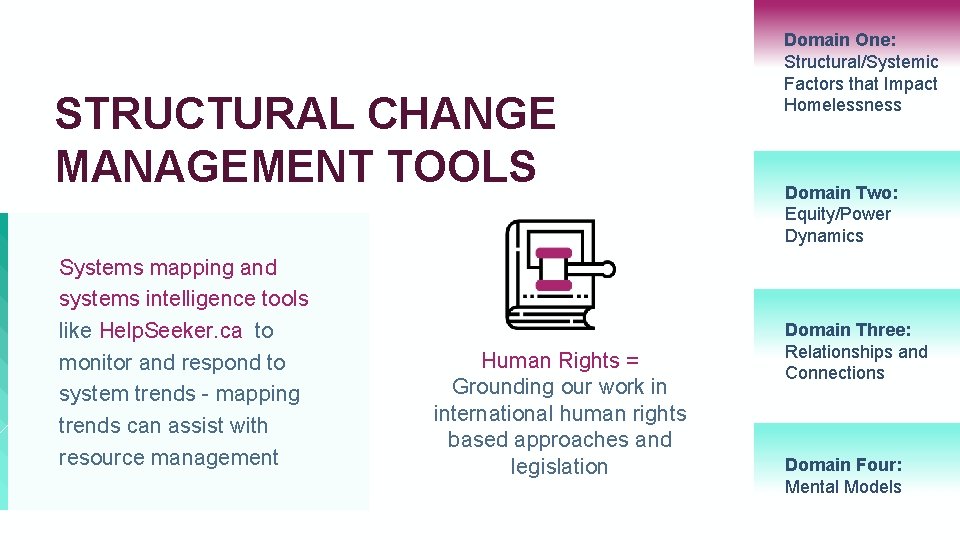
STRUCTURAL CHANGE MANAGEMENT TOOLS Systems mapping and systems intelligence tools like Help. Seeker. ca to monitor and respond to system trends - mapping trends can assist with resource management Human Rights = Grounding our work in international human rights based approaches and legislation Domain One: 32 Structural/Systemic Factors that Impact Homelessness Domain Two: Equity/Power Dynamics Domain Three: Relationships and Connections Domain Four: Mental Models
TAKING IT FURTHER… Domain One: 33 Structural/Systemic Factors that Impact Homelessness o SPC Support to systems planners and leaders to operationalize systems mapping & intelligence tools and the right to housing. Domain Two: Equity/Power Dynamics o SPC curriculum will further develop and support communities to utilize structural change management tools while supporting knowledge mobilization and relational change management support Domain Three: Relationships and Connections o See Module One Guide for where structural change management will be addressed in future modules and additional resources Domain Four: Mental Models
Examples/Case Studies to illustrate Power dynamics between: “Plugging the voice of the community into the right kind of political power grid will do more to create health and wellness than any other single intervention. ” - Water of Systems Change o Underserved communities and the homelessness serving sector o Homelessness Serving System and Public Systems and Funders o Indigenous and Non Indigenous communities and governments o Priority populations - class, race, gender identity, sexual orientation, citizenship status Domain One: 34 Structural/Systemic Factors that Impact Homelessness Domain Two: Equity/Power Dynamics Domain Three: Relationships and Connections Domain Four: Mental Models
APPROACHES WE CAN EMBED Domain One: 35 Structural/Systemic Factors that Impact Homelessness To Shift Power Dynamics Domain Two: Equity/Power Dynamics Proximity - “if you are willing to get closer to people who are suffering, you will find the power to change the world. ” -Bryan Stevenson Domain Three: Relationships and Connections Community as Assets, ‘Context’ Experts - Human Centred Design Domain Four: Mental Models
TAKING IT FURTHER… o Transform our systems to guarantee people with lived experience a meaningful seat at the table in every community o Ensure that our policy, planning and practice places the user at the centre o See Module One Guide for where approaches to equity change management will be addressed in future modules and additional resources Domain One: 36 Structural/Systemic Factors that Impact Homelessness Domain Two: Equity/Power Dynamics Domain Three: Relationships and Connections Domain Four: Mental Models
This is common sense but not common practice… o Becoming Systems Aware (seeing the water)- means the work of understanding the relationships and power dynamics between the system players - in other words people. . . Domain One: 37 Structural/Systemic Factors that Impact Homelessness Domain Two: Equity/Power Dynamics o The real work of transforming systems is about transforming human relationships. o Focus on the quality of connections and communication across systems esp those with differing histories and viewpoints. Domain Three: Relationships and Connections Domain Four: Mental Models
o Reluctance to engage ‘Opposing Forces’ - those with vested interested in maintaining status quo. o A big part of the change management work here is to create and hold enough of the right spaces to include discussions about opposing forces and have those disruptive conversations. Domain One: 38 Structural/Systemic Factors that Impact Homelessness Domain Two: Equity/Power Dynamics Domain Three: Relationships and Connections Domain Four: Mental Models
TAKING IT FURTHER Domain One: 39 Structural/Systemic Factors that Impact Homelessness SPC Support to: o Bringing together diverse stakeholder groups that had never worked together before and valuing and trusting their expertise and leadership. o Effectively adapt tools and approaches like Collective Impact and Human Design Learning. o See Module One Guide for Related Future Modules and Additional Resources. Domain Two: Equity/Power Dynamics Domain Three: Relationships and Connections Domain Four: Mental Models
o Mental models are habits of thought – deeply held beliefs and assumptions and taken-for-granted ways of operating that influence how we think, what we do, and how we talk. o Social Narratives – are visible embodiments of mental models. Changing and transforming social narrative can shift mental models over time. Domain One: 40 Structural/Systemic Factors that Impact Homelessness Domain Two: Equity/Power Dynamics Domain Three: Relationships and Connections Domain Four: Mental Models
EXAMPLES Domain One: 41 Structural/Systemic Factors that Impact Homelessness Social Narratives That Require Challenging o #Me. Too Movement - Sexual Harassment o Drug Addiction vs Public Health Issue Domain Two: Equity/Power Dynamics o Blame people who experience homelessness for their situation o Definition of Homelessness - Indigenous Definition of Homelessness Taking it Further. . . Domain Three: Relationships and Connections See Module One Guide for Related Future Modules and Additional Resources. Domain Four: Mental Models
POWER OF STORIES “If we change the stories we live by, quite possibly we change our lives” - Thomas King, The Truth About Stories: A Native Narrative. Domain One: 42 Structural/Systemic Factors that Impact Homelessness Domain Two: Equity/Power Dynamics Domain Three: Relationships and Connections Domain Four: Mental Models
43 REFLECTIVE QUESTIONS What are some mental models that exist in your organization, community or sector that create barriers to progressive policy? (equity, diversity, inclusion) ● What are some mental models that currently exist in your organization, community or sector that support progressive policy? - (equity, diversity, inclusion) ● What are the social narratives or stories that are told to support regressive mental models? ● What are some counter narratives and stories that could be created?
Funded by the Government of Canada’s Homelessness Partnering Strategy. The opinions and interpretations in this publication are those of the author and do not necessarily reflect those of the Government of Canada.

Icon bases made by Eucalyp from www. flaticon. com
- Slides: 45