
Module 1 Introduction to Crisis and Emergency Risk



- Slides: 33
Module 1 – Introduction to Crisis and Emergency Risk Communication Deborah Grigsby Smith State of Colorado Director of External Communications Homeland Security
Agenda • • Definitions What is a/an crisis, disaster, emergency Potential crisis situations Crisis communications complications Examples good/bad crisis communications Crisis communication lifecycle Parting thoughts/handouts Questions and thank yous
Obligatory disclaimer • Not an expert in any form of public health, healthcare • Basic overview only • Much more to learn, so it’s okay to be confused at this point • Don’t have all the answers, but I’m willing to help you track them down…
CDC Module 1 says… • Four types of communication – Crisis communication – Issues management communication – Risk communication – Crisis and emergency risk communication
Some definitions • Crisis communication – Experiencing something unexpected – Organization must respond – Implies lack of control by the organization Communicator: participant Time pressure: urgent and unexpected Message purpose: explain and persuade
What is a crisis, exactly…? • Unexpected • Uncontrolled • Disrupts or impedes normal operations • Intense public and media attention • Interferes with achieving organizational goals • Threatens reputation/public trust • Damage can be real or PERCEIVED
How well you perform… • Will ALWAYS be front page news – Media coverage of the 911 Commission hearings • “…apparently contradictory evacuation orders…” AFP Coverage • “…conflicting advice from emergency teams…” Reuters • “…communication gaps…lack of coordination…” Associated Press
Some definitions • Issues management communication – Similar to crisis – Organization has luxury of forewarning and can plan response to stakeholders – Organization is central to the event Communicator: participant Time pressure: anticipated, can be controlled Message purpose: explain and persuade, and empower decision making
Some definitions • Risk communication – Flourishes in environmental health field – Provides the receiver with information about the expected outcome from a behavior or exposure Communicator: Expert that did not participate in event; is neutral regarding the outcome Time pressure: anticipated, little or no time pressure Message purpose: explain and empower receiver’s decision making process
Speaking of exposure risk…
Some definitions • Crisis and emergency risk communication – Different from crisis as communicator is not perceived as a participant – Effort by experts to provide information to stakeholder to make the best decision about their well-being within impossible time constraints Communicator: expert who is post-event participant invested in the outcome Time pressure: urgent and unexpected Message purpose: explain and persuade, and empower decision making
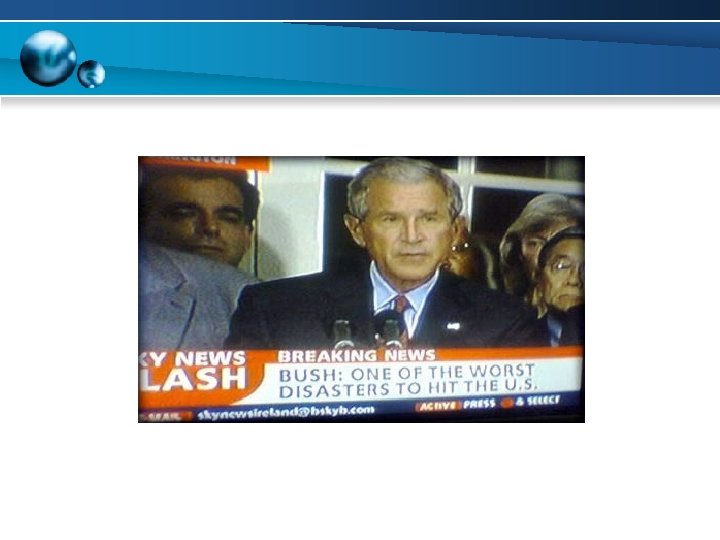
Emergencies, disaster, crises • What do they all have in common? – Simply something bad has happened, is about to happen, or is currently happening – Can be called an emergency, disaster, or a crisis depending on the magnitude of the event and the current phase of the event
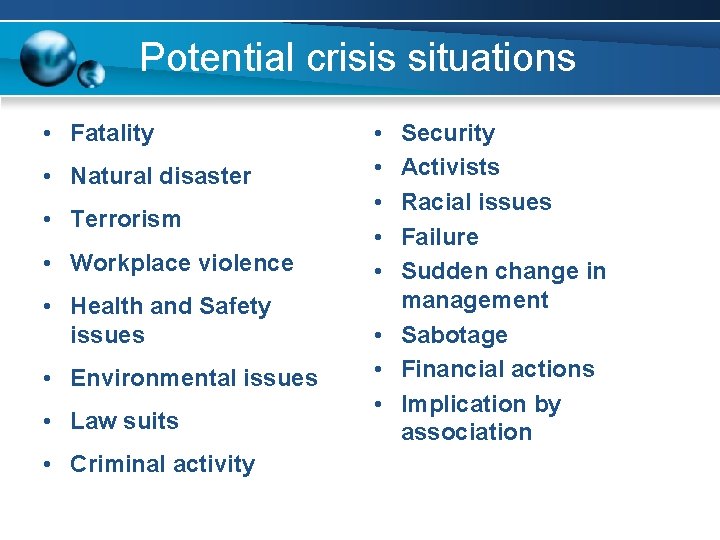
Potential crisis situations • Fatality • Natural disaster • Terrorism • Workplace violence • Health and Safety issues • Environmental issues • Law suits • Criminal activity • • • Security Activists Racial issues Failure Sudden change in management • Sabotage • Financial actions • Implication by association
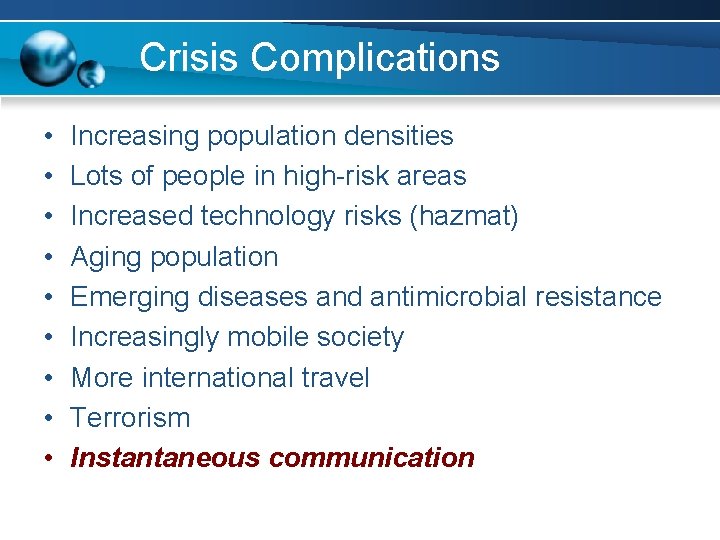
Crisis Complications • • • Increasing population densities Lots of people in high-risk areas Increased technology risks (hazmat) Aging population Emerging diseases and antimicrobial resistance Increasingly mobile society More international travel Terrorism Instantaneous communication
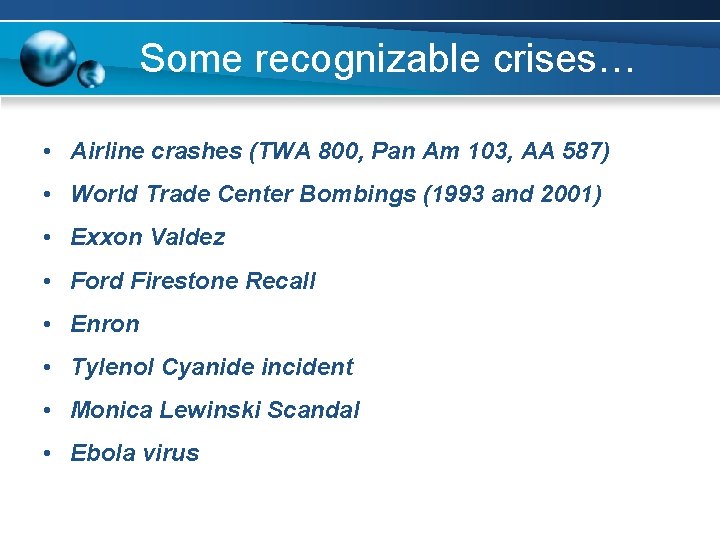
Some recognizable crises… • Airline crashes (TWA 800, Pan Am 103, AA 587) • World Trade Center Bombings (1993 and 2001) • Exxon Valdez • Ford Firestone Recall • Enron • Tylenol Cyanide incident • Monica Lewinski Scandal • Ebola virus
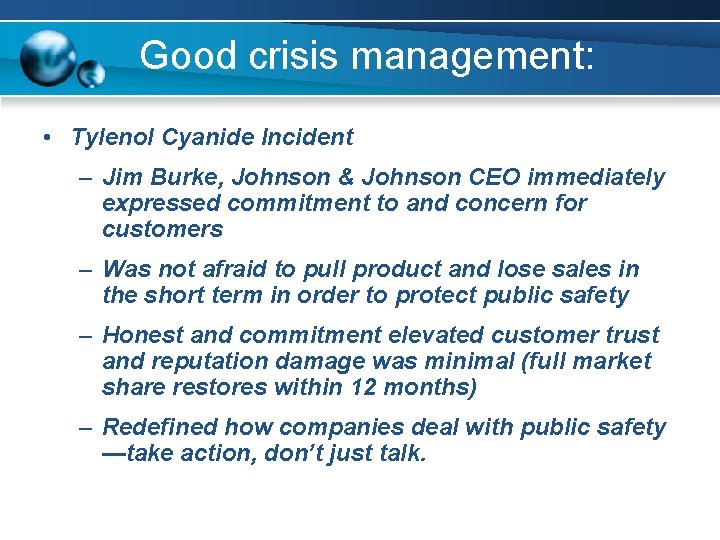
Good crisis management: • Tylenol Cyanide Incident – Jim Burke, Johnson & Johnson CEO immediately expressed commitment to and concern for customers – Was not afraid to pull product and lose sales in the short term in order to protect public safety – Honest and commitment elevated customer trust and reputation damage was minimal (full market share restores within 12 months) – Redefined how companies deal with public safety —take action, don’t just talk.
Bad crisis management: • Ford Firestone™ Recall – Ford dribbled out information as they were pressured by the media. – Started with a partial recall of a defective product – Withheld important information and pointed fingers. – Did not put safety and security of customers first —made litigation strategy the focus – Penny-wise in this case was indeed pound foolish
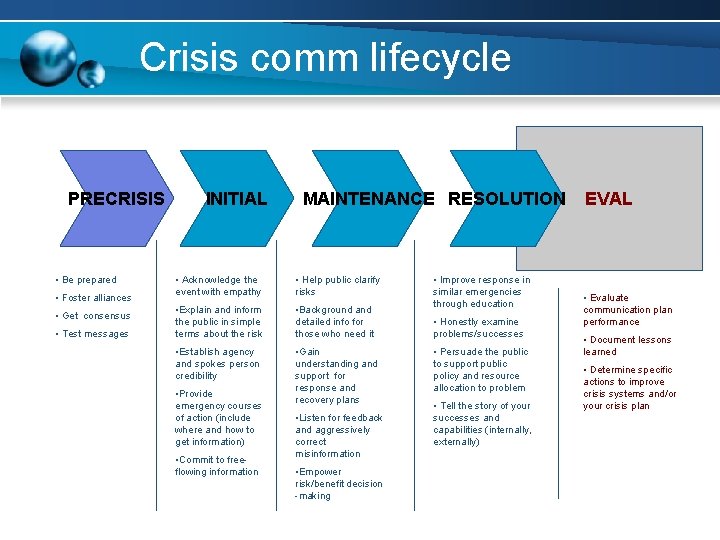
Crisis comm lifecycle PRECRISIS • Be prepared • Foster alliances • Get consensus • Test messages INITIAL MAINTENANCE RESOLUTION • Acknowledge the event with empathy • Help public clarify risks • Explain and inform the public in simple terms about the risk • Background and detailed info for those who need it • Establish agency and spokes person credibility • Gain understanding and support for response and recovery plans • Provide emergency courses of action (include where and how to get information) • Commit to freeflowing information • Listen for feedback and aggressively correct misinformation • Empower risk/benefit decision -making • Improve response in similar emergencies through education • Honestly examine problems/successes • Persuade the public to support public policy and resource allocation to problem • Tell the story of your successes and capabilities (internally, externally) EVAL • Evaluate communication plan performance • Document lessons learned • Determine specific actions to improve crisis systems and/or your crisis plan
Pre-crisis phase • Be prepared – Go-kit (backgrounders, key messages) – JIS/JIC/Virtual JIC – Shadow Web site • Foster alliances, share information – Critical for consistent messages • Develop consensus recommendations • Develop and test plan and messages
Initial phase • Acknowledge the event with empathy – “I understand. ” • Explain and inform the public, in the simplest terms, about the risks involved • Establish org/spokesperson credibility • Provide emergency courses of action (how/where to get more information) • Commit to continued and open communication
Crisis maintenance • Help public and stakeholders more accurately understand their own risks • Provide backgrounders to those who need it • Gain understanding and support for response and recovery plans • Listen to feedback and aggressively correct misinformation • Explain emergency recommendations • Empower risk/benefit decision making
Crisis resolution • Improve appropriate response in future emergencies through education • Honestly examine problems/successes • Persuade public to support public policy and resource allocation • Tell your story to everyone! Promote your activities and capabilities…reinforce your corporate identity both externally and internally.
Evaluation • Evaluate communication plan performance • Document lessons learned • Determine specific actions to improve crisis system and/or crisis plan • Seek feedback from partners and other organizations involved—yes, even the media.
Parting thoughts • Planning is the key – Develop a crisis communication plan in writing • Names, numbers, checklists, role clarification • Arrange MOU with sister organizations • Order supplies (pens, paper, CDs, DVDs, diazepam in the large economy jug) • Build your shadow Web/virtual JIC • Meet regularly and train, brainstorm • Write key messages, backgrounders, collect stock photos, build a Go-kit.
More parting thoughts • Don’t reinvent the wheel – Use others’ work as learning tool – Ask other for help, advice, direction • Don’t even imagine doing it by yourself – Build your human resources now • Train receptionists, interns, non-essential personnel to help (phone calls, log queries) – Plan for the very worst, then scale back as you need
More parting thoughts • Remember to make provisions in your plan to take care of yourselves and your team – By planning for a crisis now, you divert stress, chaos and disorganization • Proper tools for the job • Budget for equipment, software, etc. • Sleep, food, mental health, family responsibility
Most importantly • Trust your instincts… – If it doesn’t look right, or feel right…ASK – Don’t be afraid to challenge the information you receive • Use the Internet, other experts in other departments or jurisdictions if you need – Don’t allow yourself to be bullied • Your job is to help ensure ACCURATE information • Don’t be afraid to do your job – Develop networks, resources and tools.
• And if something happens that you do have to make an uncomfortable exit….
Questions and thank yous! • • Thank you! ¡Gracias! Danke! Merci! Shukran ! Mahalo nui loa! Domo arigato! Tack så mycket!