
Module 1 Introduction to Case Management Agenda 1
- Slides: 47
Module 1 Introduction to Case Management
Agenda 1. 1 Review of CORE 1. 2 Overview of the Case Management Process 1. 3 Purposeful Contacts 1. 4 Laws, Rules and Policies 1. 5 Understanding Quality Assurance Case Reviews and Family-Centered Practice Pre-Service CM Specialty Module 1. 0. 2
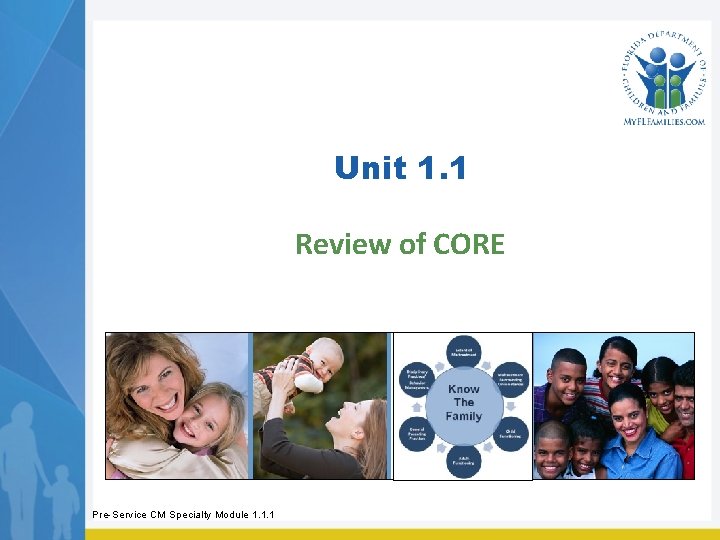
Unit 1. 1 Review of CORE Pre-Service CM Specialty Module 1. 1. 1
Learning Objectives 1. Identify key concepts and terminology from CORE. 2. Review the steps in the Florida Child Welfare Practice Model. Pre-Service CM Specialty Module 1. 1. 2
Activity A: CORE Terminology Recall Game Instructions: 1. Define the term. 2. Explain why the term is important to Child Welfare Practice. Pre-Service CM Specialty Module 1. 1. 3
Activity B: Safety Intervention Across the Florida Child Welfare Practice Instructions: 1. Identify the significant steps in each process. Pre-Service CM Specialty Module 1. 1. 4
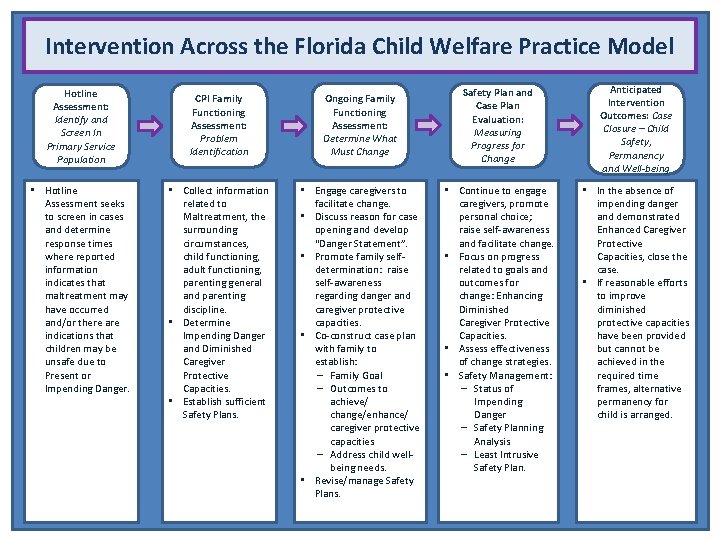
Intervention Across the Florida Child Welfare Practice Model Hotline Assessment: Identify and Screen In Primary Service Population • Hotline Assessment seeks to screen in cases and determine response times where reported information indicates that maltreatment may have occurred and/or there are indications that children may be unsafe due to Present or Impending Danger. CPI Family Functioning Assessment: Problem Identification Ongoing Family Functioning Assessment: Determine What Must Change • Collect information related to Maltreatment, the surrounding circumstances, child functioning, adult functioning, parenting general and parenting discipline. • Determine Impending Danger and Diminished Caregiver Protective Capacities. • Establish sufficient Safety Plans. • Engage caregivers to facilitate change. • Discuss reason for case opening and develop “Danger Statement”. • Promote family selfdetermination: raise self-awareness regarding danger and caregiver protective capacities. • Co-construct case plan with family to establish: Family Goal Outcomes to achieve/ change/enhance/ caregiver protective capacities Address child wellbeing needs. • Revise/manage Safety Plans. Safety Plan and Case Plan Evaluation: Measuring Progress for Change Anticipated Intervention Outcomes: Case Closure – Child Safety, Permanency and Well-being • Continue to engage caregivers, promote personal choice; raise self-awareness and facilitate change. • Focus on progress related to goals and outcomes for change: Enhancing Diminished Caregiver Protective Capacities. • Assess effectiveness of change strategies. • Safety Management: Status of Impending Danger Safety Planning Analysis Least Intrusive Safety Plan. • In the absence of impending danger and demonstrated Enhanced Caregiver Protective Capacities, close the case. • If reasonable efforts to improve diminished protective capacities have been provided but cannot be achieved in the required time frames, alternative permanency for child is arranged.
Unit 1. 2 Overview of the Case Management Process Pre-Service CM Specialty Module 1. 2. 1
Learning Objectives 1. Identify and describe the four family engagement standards used for information gathering. 2. Recognize the importance of information collection during the case management process. Pre-Service CM Specialty Module 1. 2. 2
Case Management You will be responsible for: – assessing how the family is functioning, – correctly identifying what in the family system needs to change, – determining when behavior change has occurred, and – recognizing immediate and ongoing safety needs. Pre-Service CM Specialty Module 1. 2. 3
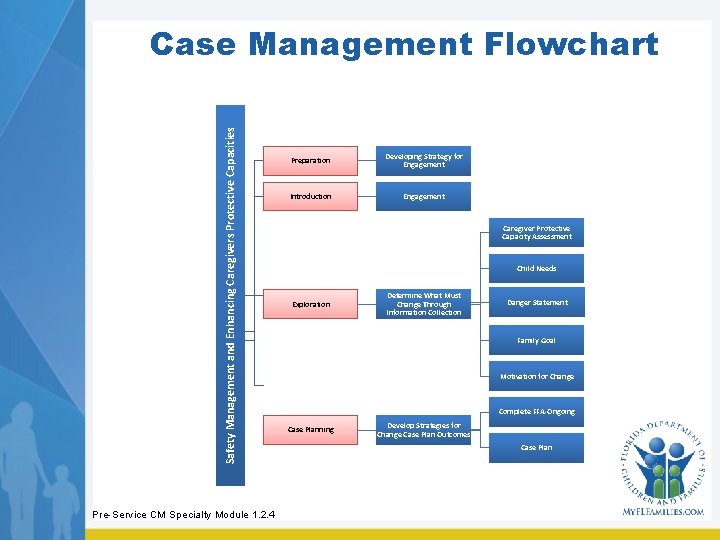
Safety Management and Enhancing Caregivers Protective Capacities Case Management Flowchart Pre-Service CM Specialty Module 1. 2. 4 Preparation Developing Strategy for Engagement Introduction Engagement Caregiver Protective Capacity Assessment Child Needs Exploration Determine What Must Change Through Information Collection Danger Statement Family Goal Motivation for Change Complete FFA-Ongoing Case Planning Develop Strategies for Change Case Plan Outcomes Case Plan
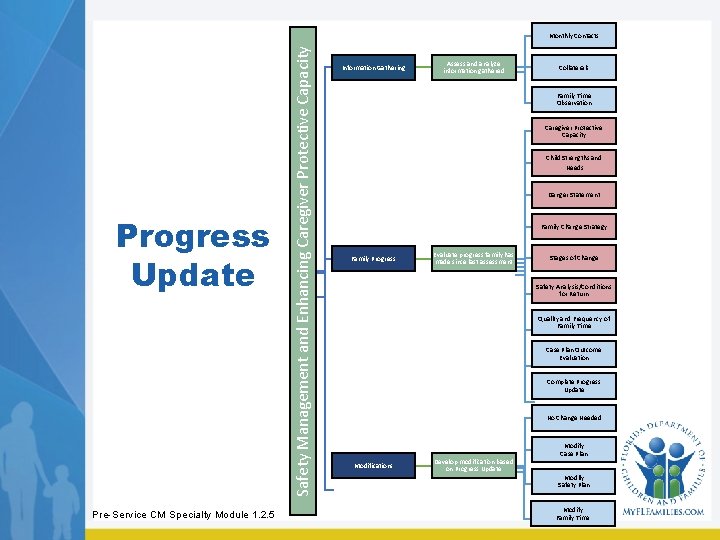
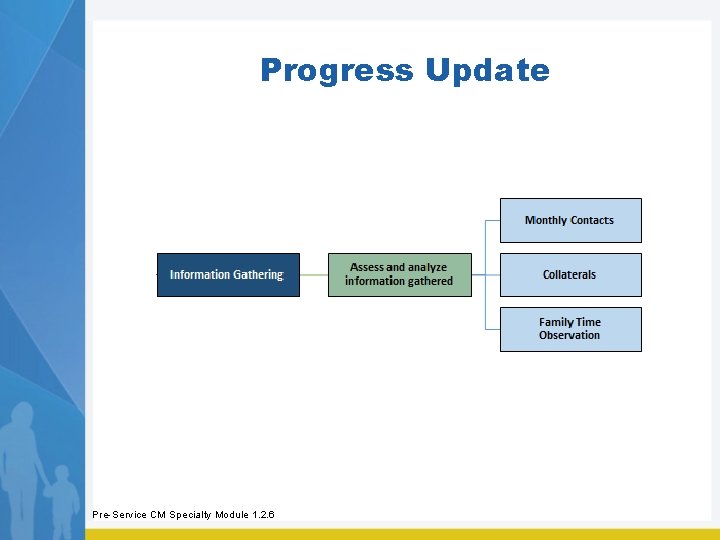
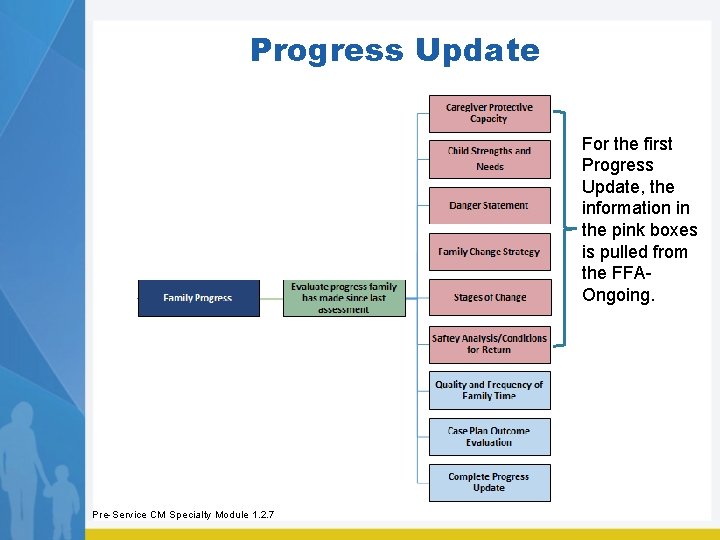
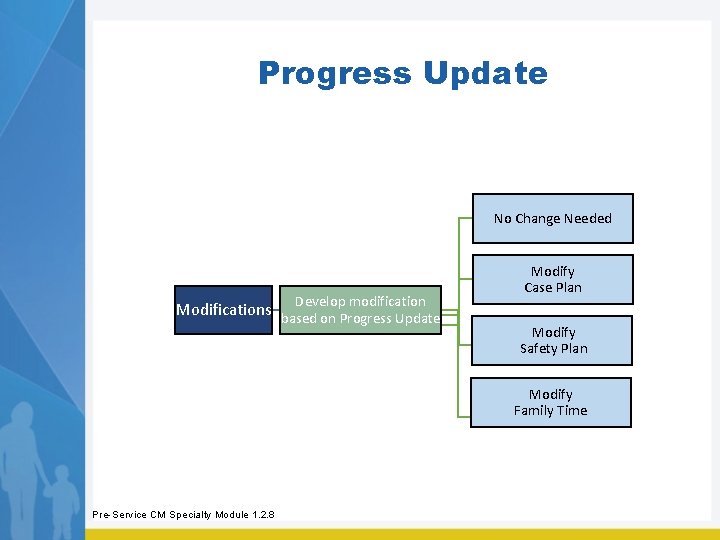
Progress Update Pre-Service CM Specialty Module 1. 2. 5 Safety Management and Enhancing Caregiver Protective Capacity Monthly Contacts Information Gathering Assess and analyze information gathered Collaterals Family Time Observation Caregiver Protective Capacity Child Strengths and Needs Danger Statement Family Change Strategy Family Progress Evaluate progress family has made since last assessment Stages of Change Safety Analysis/Conditions for Return Quality and Frequency of Family Time Case Plan Outcome Evaluation Complete Progress Update No Change Needed Modifications Develop modification based on Progress Update Modify Case Plan Modify Safety Plan Modify Family Time
Progress Update Pre-Service CM Specialty Module 1. 2. 6
Progress Update For the first Progress Update, the information in the pink boxes is pulled from the FFAOngoing. Pre-Service CM Specialty Module 1. 2. 7
Progress Update No Change Needed Develop modification Modifications based on Progress Update Modify Case Plan Modify Safety Plan Modify Family Time Pre-Service CM Specialty Module 1. 2. 8
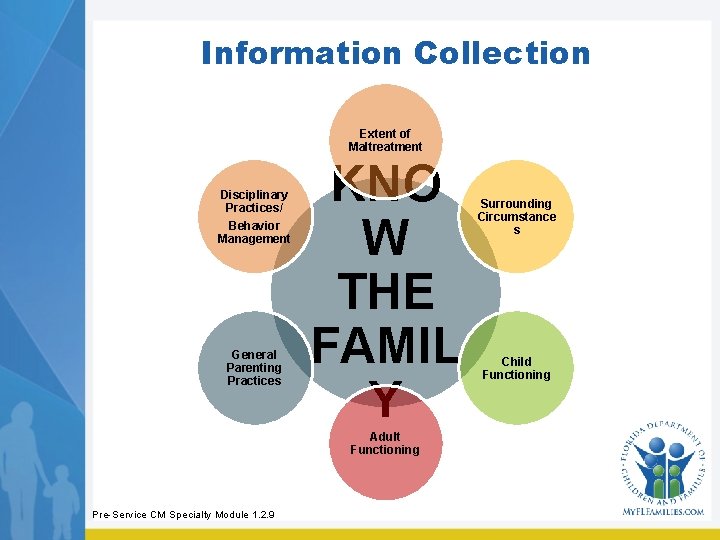
Information Collection Extent of Maltreatment Disciplinary Practices/ Behavior Management General Parenting Practices KNO W THE FAMIL Y Adult Functioning Pre-Service CM Specialty Module 1. 2. 9 Surrounding Circumstance s Child Functioning
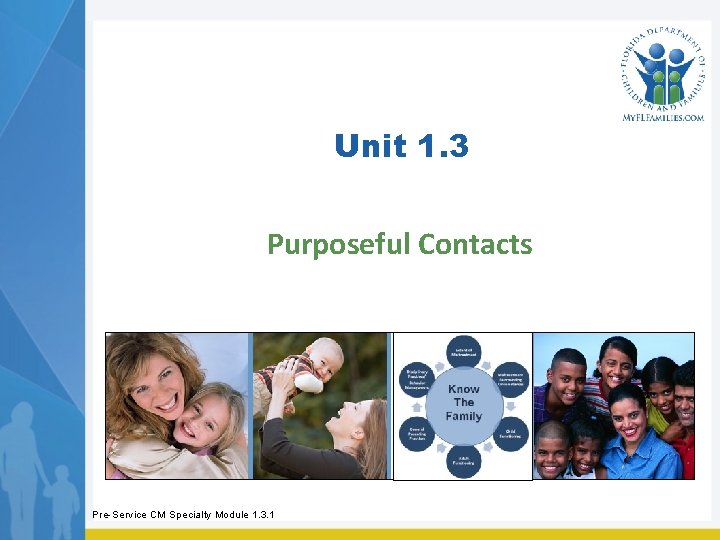
Unit 1. 3 Purposeful Contacts Pre-Service CM Specialty Module 1. 3. 1
Learning Objectives 1. Describe the importance of Case Manager’s working relationships with parents, children and caregivers. 2. Identify the policy requirements for contacts. 3. Identify the tenets of purposeful contacts with families. Pre-Service CM Specialty Module 1. 3. 2
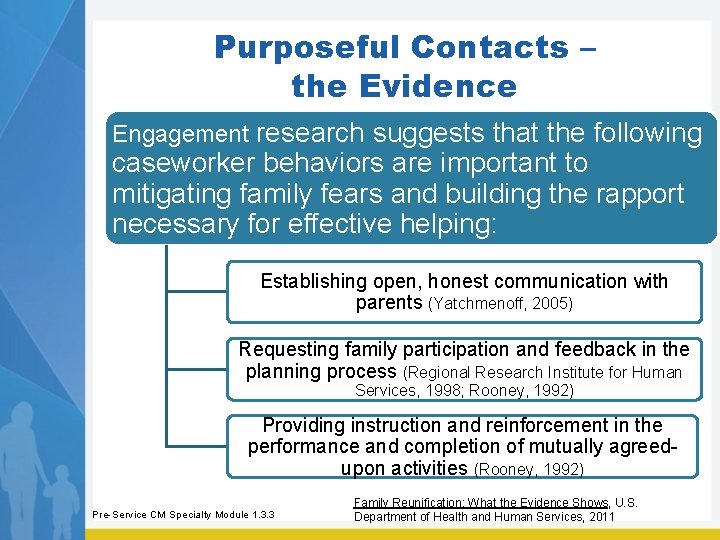
Purposeful Contacts – the Evidence Engagement research suggests that the following caseworker behaviors are important to mitigating family fears and building the rapport necessary for effective helping: Establishing open, honest communication with parents (Yatchmenoff, 2005) Requesting family participation and feedback in the planning process (Regional Research Institute for Human Services, 1998; Rooney, 1992) Providing instruction and reinforcement in the performance and completion of mutually agreedupon activities (Rooney, 1992) Pre-Service CM Specialty Module 1. 3. 3 Family Reunification: What the Evidence Shows, U. S. Department of Health and Human Services, 2011
Purposeful Contacts-the Evidence “Foster parents facilitate family reunification through both the mentoring of the birth parents and the support of child visitation. ” “The development of a positive relationship between the foster and birth parents may allow children to avoid the stress of divided loyalties and position foster parents to play a supportive role after reunification. ” Pre-Service Specialty Module (Lewis. CM & Callaghan, 1993; 1. 3. 4 Sanchirico & Jablonka, 2000).
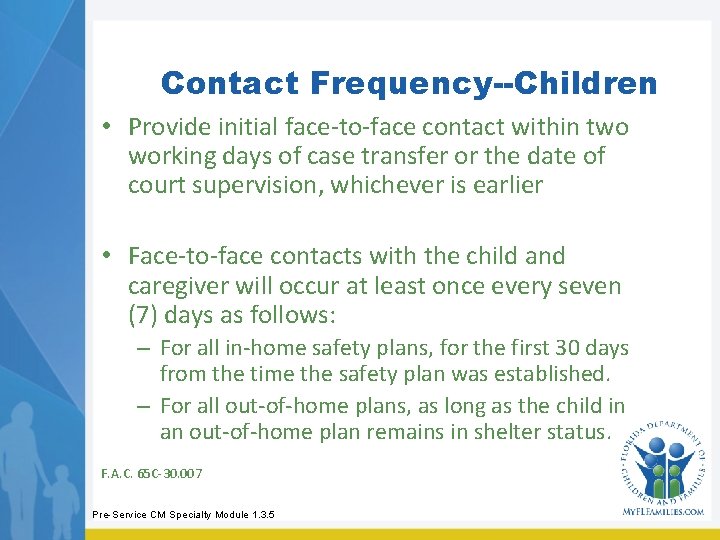
Contact Frequency--Children • Provide initial face-to-face contact within two working days of case transfer or the date of court supervision, whichever is earlier • Face-to-face contacts with the child and caregiver will occur at least once every seven (7) days as follows: – For all in-home safety plans, for the first 30 days from the time the safety plan was established. – For all out-of-home plans, as long as the child in an out-of-home plan remains in shelter status. F. A. C. 65 C-30. 007 Pre-Service CM Specialty Module 1. 3. 5
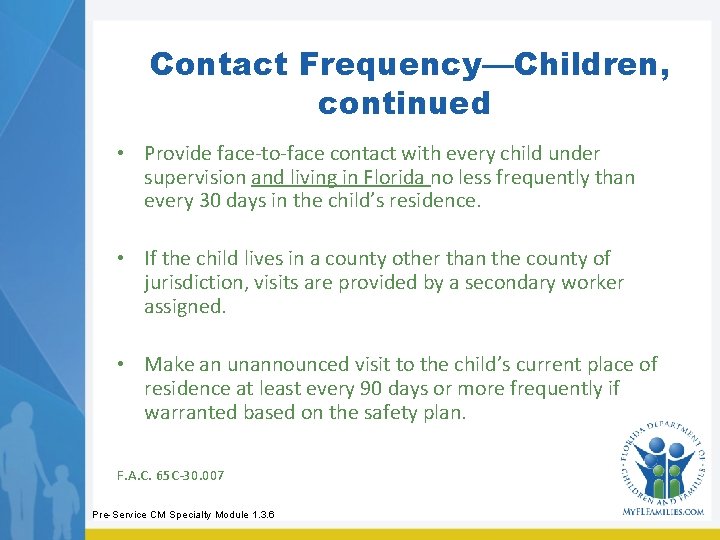
Contact Frequency—Children, continued • Provide face-to-face contact with every child under supervision and living in Florida no less frequently than every 30 days in the child’s residence. • If the child lives in a county other than the county of jurisdiction, visits are provided by a secondary worker assigned. • Make an unannounced visit to the child’s current place of residence at least every 90 days or more frequently if warranted based on the safety plan. F. A. C. 65 C-30. 007 Pre-Service CM Specialty Module 1. 3. 6
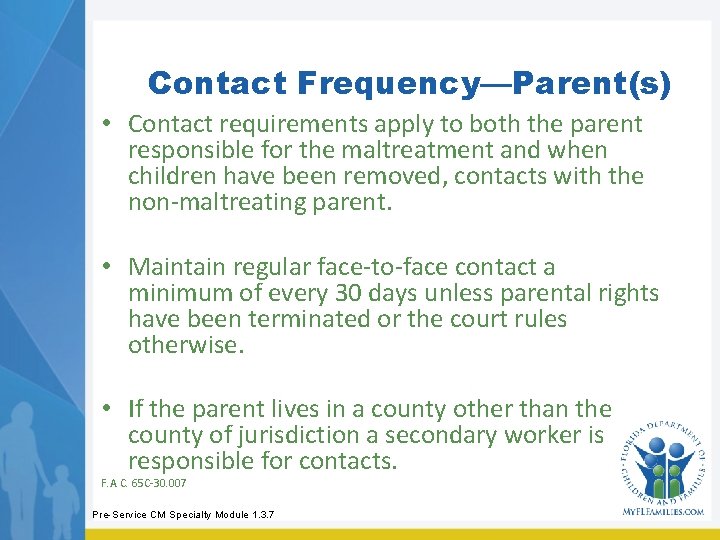
Contact Frequency—Parent(s) • Contact requirements apply to both the parent responsible for the maltreatment and when children have been removed, contacts with the non-maltreating parent. • Maintain regular face-to-face contact a minimum of every 30 days unless parental rights have been terminated or the court rules otherwise. • If the parent lives in a county other than the county of jurisdiction a secondary worker is responsible for contacts. F. A. C. 65 C-30. 007 Pre-Service CM Specialty Module 1. 3. 7
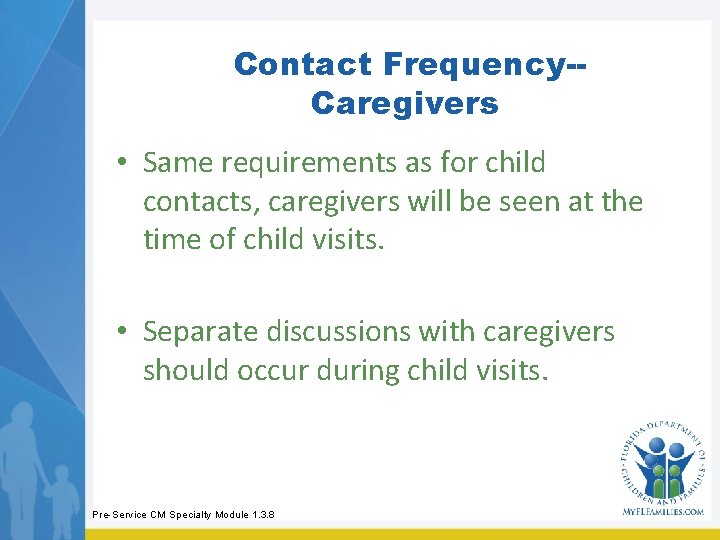
Contact Frequency-Caregivers • Same requirements as for child contacts, caregivers will be seen at the time of child visits. • Separate discussions with caregivers should occur during child visits. Pre-Service CM Specialty Module 1. 3. 8
Other Purposeful Contacts • Family members who know the child and parent. • Other persons who know the child (child care staff, teachers, school counselor, coach). • Treatment providers (substance abuse professionals, Batterer’s Intervention group leader, therapist). Pre-Service CM Specialty Module 1. 3. 9
Purposeful Contacts: Questions to Think About • Are the child’s needs being met? • Is the Safety Plan sufficient in managing the danger threats? • Do the parents understand their rights and responsibilities? • Does everyone know the goal of the case and how it is being achieved? Pre-Service CM Specialty Module 1. 3. 10
Tenets of Ongoing Assessment • Treat families as unique individuals and family systems. • Promote mutual respect. • Identify and build on family strengths. • Encourage purposeful family expression. Pre-Service CM Specialty Module 1. 3. 11
Tenets of Ongoing Assessment, continued • Respect self-determination. • Control your emotional involvement. • Seek to be less-intrusive. • Promote accountability. Pre-Service CM Specialty Module 1. 3. 12
Activity C: Putting the Tenets to Work in Purposeful Contacts Instructions: 1. In small groups, using your assigned core tenets, identify what actions would demonstrate accomplishing the perspective of each of the 8 core tenets. 2. Be prepared to share with the whole class. Pre-Service CM Specialty Module 1. 3. 13
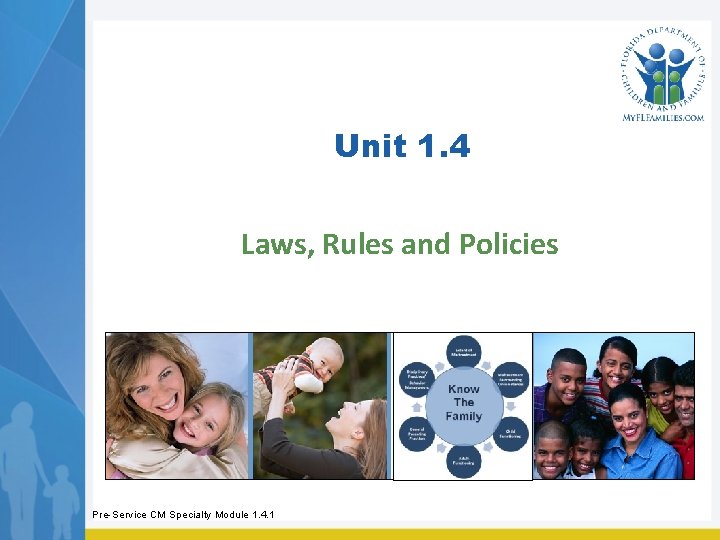
Unit 1. 4 Laws, Rules and Policies Pre-Service CM Specialty Module 1. 4. 1
Learning Objectives 1. Identify and review the laws, rules and policies governing child welfare and case management. Pre-Service CM Specialty Module 1. 4. 2
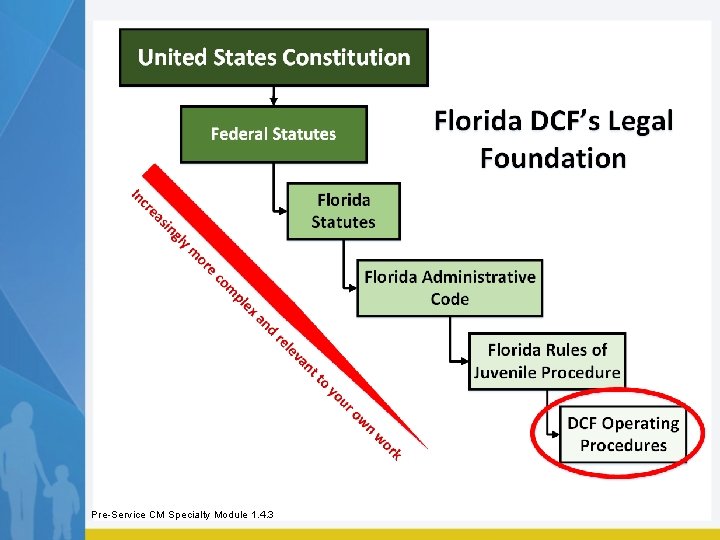
Pre-Service CM Specialty Module 1. 4. 3
Activity D: Laws/ Policies and Procedures for the Case Manager Instructions: 1. In small groups, research your topic(s). On flip chart paper, list what you feel are the highlights or what is important for a Case Manager to know about your topic(s). 2. Class review: Have a spokesperson for the group share with the class. Pre-Service CM Specialty Module 1. 4. 4
Finding Topics in Statutes, Administrative Code, Operating Procedures and Practice Guidelines • Florida Statutes: http: //centerforchildwelfare. fmhi. usf. edu/flsta t/Florida. Statues. shtml • Florida Administrative Code: http: //centerforchildwelfare. fmhi. usf. edu/Hor izontal. Tab/Florida. Admin. Code. shtml# • Operating Procedures/Practice Guidelines: http: //centerforchildwelfare. fmhi. usf. edu/Hor izontal. Tab/Dept. Operating. Procedures. shtml Pre-Service CM Specialty Module 1. 4. 5
Unit 1. 5 Understanding Quality Assurance Case Reviews and Family-Centered Practice Pre-Service CM Specialty Module 1. 5. 1
Learning Objectives 1. Define child well-being, permanency and safety. 2. Explain the application of Family. Centered Practice during the work of the Case Manager. 3. Identify the different types of quality assurance reviews used in child welfare. Pre-Service CM Specialty Module 1. 5. 2
Quality Assurance Case Reviews • Rapid Safety Feedback • Florida Child Welfare Service Reviews • Federal Child and Family Services Reviews Pre-Service CM Specialty Module 1. 5. 3
Safety, Permanency and Well-Being Pre-Service CM Specialty Module 1. 5. 4
Safety Outcomes • Children are first and foremost, protected from abuse and neglect. • Children are safely maintained in their own homes whenever possible and appropriate. Pre-Service CM Specialty Module 1. 5. 5
Permanency Outcomes 1. Children have permanency and stability in their living situations. 2. The continuity of family relationships and connections is preserved for children. Pre-Service CM Specialty Module 1. 5. 6
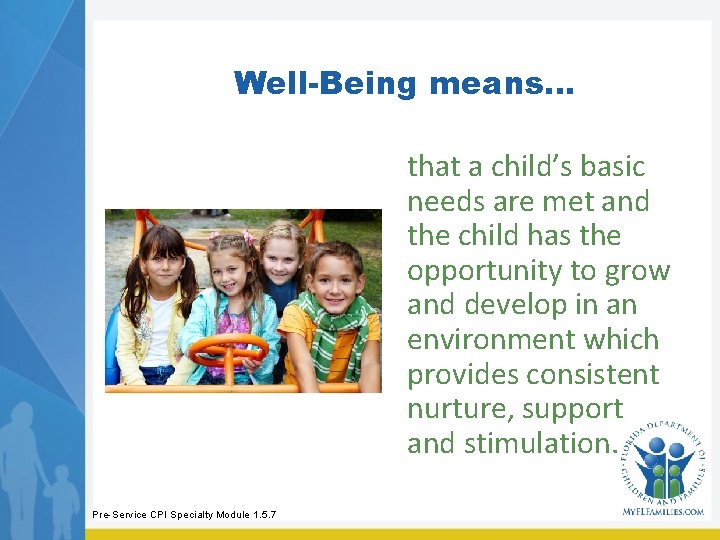
Well-Being means… that a child’s basic needs are met and the child has the opportunity to grow and develop in an environment which provides consistent nurture, support and stimulation. Pre-Service CPI Specialty Module 1. 5. 7
Activity E: Safety, Permanency or Well-Being Instructions: 1. Read the scenarios. 2. Determine what the scenario is describing. In the box place an “S” for Safety, “P” for Permanency or “WB” for Well. Being. Pre-Service CM Specialty Module 1. 5. 8
Family-Centered Practice • Enhances capacity. • Focuses on family as a whole. • Establishes partners in the change process. • Approaches family in a developmentally sensitive way. Pre-Service CM Specialty Module 1. 5. 9
Foundations for Child Welfare Practice Model Demonstrate: • • • Respect Courtesy Empathy Encouragement Professionalism Pre-Service CM Specialty Module 1. 5. 10 Respond: Enable: • Promptly • By following through with commitments • By continually seeking to engage • Participation and involvement • Family expertise • Feedback (Ask what is needed) • Family Education/ Knowledge (Provide necessary information)
Activity F: Using Family-Centered Practice Instructions: 1. Read the scenario. 2. Identify what Family-Centered Practice skills you could use to engage the family. 3. List any barriers, fears, or apprehensions you may have when using Family-Centered Practice with this family. Pre-Service CM Specialty Module 1. 5. 11
Family Teams and Family Meetings Focus on family needs, not symptoms. People are capable of change. All people and families have strengths. A solution generated by a family responds to its uniqueness. • Family and friends provide love and care, which helps a family to take supported risks. • Caring people in the same room create energy for change. • • Pre-Service CM Specialty Module 1. 5. 12
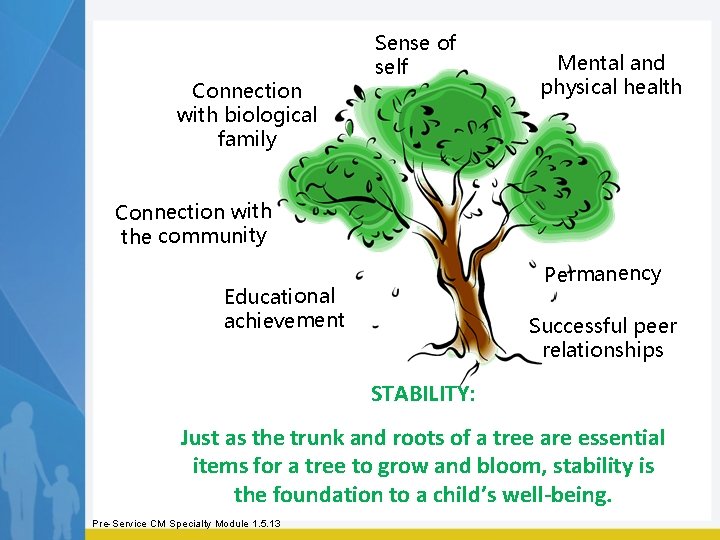
Connection with biological family Sense of self Mental and physical health Connection with the community Permanency Educational achievement Successful peer relationships STABILITY: Just as the trunk and roots of a tree are essential items for a tree to grow and bloom, stability is the foundation to a child’s well-being. Pre-Service CM Specialty Module 1. 5. 13