
MODULE 1 IMAGE NDIC OR RELATED TO TOPIC
- Slides: 48
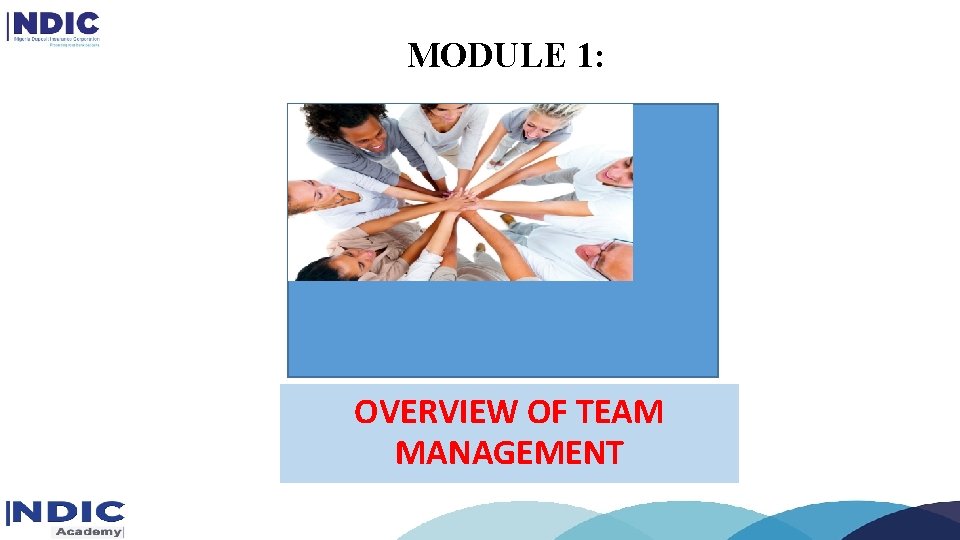
MODULE 1: IMAGE NDIC OR RELATED TO TOPIC OVERVIEW OF TEAM MANAGEMENT
SESSION OBJECTIVE At the end of this session you should be able to : • Explain what is a Team and Team work • Apply the importance of teams in work environment: and • Develop and manage high performance teams
OUTLINE 1. INTRODUCTION 2. WHAT IS A TEAM? 3. WHAT IS TEAMWORK? 4. TYPES OF TEAMS 5. TEAM SIZE AND COMPOSITION 6. IMPORTANCE OF TEAMS 7. CHARACTERISTICS OF AN EFFECTIVE TEAMS 8. TEAM RELATIONSHIPS 9. COMPETENCIES FOR TEAMWORK 10. BUILDING SUCCESSFUL TEAMS CONCLUSION
INTRODUCTION There are some tasks which cannot be done alone. Individuals need to come together, discuss things among themselves and work together towards the realization of a common goal. The individuals forming a team should ideally think more or less on the same lines and should have similar interests and objectives. People with absolutely different tastes can’t form a team. Their goals have to be the same. Teams have complimentary skills and are committed to a common set of values, a common purpose and performance goals for which they hold themselves accountable. Every team is formed to achieve a predefined goal and it is the responsibility of each and every member to contribute his level best and accomplish the assigned task within the stipulated time frame.
INTRODUCTION CONT’D Teams possess certain attributes that easily bring out the best in members, particularly when properly constituted, developed and managed. q. For these reasons, organization's devote a lot of energy to upgrading the capabilities of their managers to build and manage high performance teams. q. In this regard, the emphasis is on understanding • the conditions that must prevail for people working in teams to record outstanding performance, and • acquiring the competencies for developing and managing such
WHAT IS A TEAM? q. A group of people with different skills and different tasks, who work together on a common project, service, or goal, with a meshing of functions and mutual support. q A group does not necessarily constitute a team. Teams normally have members with complementary skills and generate synergy through a coordinated effort which allows each member to maximize their strengths and minimize their weaknesses. q. A team becomes more than just a collection of people when a strong sense of mutual commitment creates synergy, thus generating performance greater than the sum of the performance of its individual members.
WHAT IS TEAM MANAGEMENT? Team management refers to the various activities which bind a team together by bringing the team members closer to achieve the set targets. For the team members, their team must be their priority and everything else should take a back seat. They should be very focused on their goals. q. Let us understand Team Management with the help of a real life situation. “Maria was representing the training and development vertical of a leading firm. Angela, Mahmoud, Sandra and Tim were reporting to Maria and helped her in designing the various training programs.
WHAT IS TEAM MANAGEMENT? CONTD Maria left no stone unturned to ensure that all her team members were satisfied with their job responsibilities. The workload was shared equally among four of them. Ideas were discussed on an open forum and each of them contributed to his level best. They went out for movies and stayed in touch even after work. Maria being the team leader was actually responsible for bringing her team members closer so that none of them feels left out and all are motivated to deliver their level best. With the help of the team management activities, she managed to create a positive ambience at the workplace and promoted healthy competition in her team”
WHAT IS TEAMWORK Team work is actually the collective effort of each and every team member to achieve their assigned goal. No member can afford to sit back and expect the other member to perform on his behalf. The team members must be committed towards their team as well as their organization to avoid conflicts. Nothing productive comes out of unnecessary conflict and in turn diverts the concentration and focus of the team members. Every member should adopt an adjusting and a flexible attitude. One should consider his team members as a part of his extended family all working together towards a common goal. The team members must be dependent on each other for the best to come out.
WHAT IS TEAMWORK cont’d q. Teamwork is the collaborative effort of a team to achieve a common goal or to complete a task in the most effective and efficient way. q. This concept is seen within the greater framework of a team, which is a group of interdependent individuals who work together towards a common goal. q. Basic requirements for effective teamwork are an adequate team size, available resources for the team to make use of (i. e. meeting space and time, guidance from a supervisor, support from the organization, etc. ), and clearly defined roles within the team in order for everyone to have a clear purpose.
WHAT IS TEAMWORK cont’d q. Teamwork is present in any context where a group of people are working together to achieve a common goal. These contexts include an organization (formal work teams), athletics (sports teams), a school (classmates working on a project), and the healthcare system (operating room teams). q. In each of these settings, the level of teamwork and interdependence can vary from low (e. g. golf, track and field), to intermediate (e. g. baseball, football), to high (e. g. basketball, soccer), depending on the amount of communication, interaction, and collaboration present between team members
TYPES OF TEAMS • When individuals with a common interest, goal, attitude, need and perception come together, a team is formed. Individuals need to come and work together to form a team for the accomplishment of complicated tasks. In a team, all team members contribute equally and strive hard to achieve the team’s objective which should be predefined. • In any organization, no one works alone. Every employee is a part of a team and works in close coordination with the team members to perform his level best and in turn benefit the organization. The team members should complement each other and come to each other’s need whenever required. • Teams can be formed anywhere, anytime whenever the task is little difficult and complicated. Let us understand the various types of teams in detail.
TYPES OF TEAMS CONTD q. PERMANENT TEAM q. TEMPORARY TEAM q. TASK FORCE q. COMMITTEE q. ORGANIZATION/WORK FORCE q. SELF MANAGED TEAMS q. CROSS FUNCTIONAL TEAM q. VIRTUAL TEAMS
PERMANENT TEAMS • These teams perform on a permanent basis and are not dissolved once the task is accomplished. Let us understand the concept with an example. • Mike, Peter, Joe and Ana had a strong inclination towards branding as well as promotions and hence were a part of the branding team with a leading organization. They were primarily responsible for promoting their brand designing marketing strategies to generate maximum revenue for their organization. They worked extremely hard and always managed to achieve their targets well in advance, but their team was always in place and never dissolved. Their organization never asked them to leave or ever dissolved their team. Such teams are called permanent teams. • Work or no work, the human resources team, operation team, administration team always function effectively throughout the year and hence are permanent teams.
TEMPORARY TEAM Unlike permanent teams, temporary teams loose their importance, once the task is accomplished. Such teams are usually formed for a shorter duration either to assist the permanent team or work when the members of the permanent team are busy in some other project. When organizations have excess of work, they generally form temporary teams which work in association with the members of the permanent team for the accomplishment of the task within the stipulated time.
TASK FORCE Such teams are formed for a special purpose of working on any specific project or finding a solution to a very critical problem. The government generally appoints special teams to investigate critical issues like bomb blasts, terrorist attacks and so on. The task force explores all the possible reasons which led to a severe problem and tries to resolve it within a given deadline.
COMMITTEE • Committees are generally formed to work on a particular assignment either permanently or on a temporary basis. Individuals with common interests, more or less from the same background, attitude come together on a common platform to form a committee and work on any matter. • To organize any cultural event, organizations generally make committees to raise funds, invite celebrities and all the major tasks involved to successfully organize any event. The committee members work together, design strategies to successfully accomplish the task. • In educational institutes, various committees are formed where students with a common interest join hands to organize cultural events and various other activities required for the all round development of students.
ORGANIZATION/WORK FORCE • Such groups are formed in organizations where team members work together under the expert guidance of leader. A leader or a supervisor is generally appointed among the members itself and he along with his team works hard to achieve a common goal. • The leader all through must stand by his team and extract the best out of each team member. He must not underestimate any of his team members and take his team along to avoid conflicts. • Samuel was working with a leading advertising firm with two members reporting to him. Samuel always believed in his team members and worked together with his team and no doubts his team always did wonders and was way ahead of others.
SELF MANAGED TEAMS • Self Managed Teams consist of individuals who work together again for a common purpose but without the supervision of any leader. Here as the name suggests every individual is accountable for his individual performance. • The team members of self managed teams must respect each other and should never loose focus on their target. No leader is appointed and the team members have to take their own responsibility. Individuals take the initiative on their own and are their own guides and mentors.
CROSS FUNCTIONAL TEAM • Let us understand this with the help of an example. • Adamu and Vincent both were part of the branding team. They got an assignment from their superiors to be completed within two days. Unfortunately Adamu met with an accident and was advised complete bed rest. To avoid delays, Peter from the operations team was shifted to the marketing team to assist Adamu for the time being and form a team. Such teams are called cross functional teams. Ideally the employees should be more or less on the same level. Individuals from different areas come and work together for a common objective to form a cross functional team. In such teams, people from different areas, interests and likings join hands to come out with a unique idea to successfully complete a task.
VIRTUAL TEAMS • Virtual teams consist of individuals who are separated by distances and connected through computer. Here individuals communicate with each other online through internet. • Ijeoma at Lagos office can form a team with Yakubu at Kano and Sara at Enugu all working for a common objective but the communication is totally digital through internet. • Such teams are helpful when employees need to connect with each other and are located at different places. Individuals supporting any community in social networking sites such as facebook also form a virtual team as all the members are from different locations but support a common community. They all have a common objective -to support and promote their community.
TEAM SIZE AND COMPOSITION Team composition refers to the overall mix of characteristics among people in a team, which is a unit of two or more individuals who interact interdependently to achieve a common objective. It is based on the attributes among individuals that comprise the team, in addition to their main objective Team size and team composition affect team processes and team outcomes. The optimal size (and composition) of teams is debated and will vary depending on the task at hand. The ideal size of a team is between 5 -12 members. Fewer than 5 members results in decreased perspectives and diminished creativity. Membership in excess of 12 results in increased conflict and greater potential of sub-groups forming.
THE ATTRIBUTES OF TEAM COMPOSITION q. TEAM SIZE q. HOMOGENOUS VS HETROGENEOUS q. AGE q. GENDER q. KNOWLEDGE SKILLS AND ABILITIES (KSA) q. PERSONALITY
TEAM SIZE • The preferred team size has a significant impact on team composition. Team size is determined by the original purpose for the team, the individual expectations for the members of the team, the roles that the team members need to play, the amount of cohesiveness and interconnectivity optimal for team performance and the functions, activities and overall goals of the team. While the size of a team is dependent upon many variables, the concept of “ideal” team size also varies. A variety of recommendations are easily found in multiple research studies, but these type of recommendations are difficult to evaluate, because they are often based on anecdotal evidence rather than empirical evidence.
HOMOGENOUS VS HETROGENEOUS Homogeneous teams may perform better due to similarities in experience and thought, while heterogeneous teams may perform better due to diversity and greater ability to take on multiple roles. For example, homogeneous groups displayed better initial performance than heterogeneous groups, but these effects dissipated across time and heterogeneous groups later performed better than more homogenous groups. Members of demographically diverse teams are likely to differ to a greater extent in their interpretations of the team’s goals and/or the divergent ideas for an adequate approach to implement strategy than members of demographically homogeneous groups.
AGE The ages of individual team members can have considerable effects on the success of a team. As tenure with an organization and age increase, so can performance. Older individuals may contribute more professional expertise, years of experience, and gathered knowledge. However, older team members also tend to be less willing to adapt to evolving work environments and are less likely to implement innovative strategies, preferring instead to stick to tried-and-true methods.
GENDER Gender is another important factor of demographic team composition. Men and women differ in their levels of conformity, preference of power distribution, and behavioural norms. In a dictator game setting, it has been found that groups are more generous and equalitarian when women are the majority. They also find that the most generous groups are those with two men and one woman. Another implication of this phenomena is the positive relationship that exists between gender diversity in boardrooms and company performance. However, reverse causality is a pervasive problem in these studies, because companies that perform better are quite likely to be companies that also focus more on the gender diversity of their boards.
KNOWLEDGE SKILLS AND ABILITIES (KSA) The team composition determines the array of knowledge, skills, and abilities within a team. The compositional distribution of team members on any social or psychological attribute that potentially leads to the perception that team members differ from one another, are typically driven by how members process information, such as a diverse set of knowledge, skills, and abilities to solve complex problems. Knowledge includes the facts and principles that apply to the domain of the team. Skills can be either basic or cross-functional. Basic skills include developed capabilities that assist in the learning or faster acquisition of knowledge. Cross-functional skills assist in the ability to carry out tasks that occur across jobs.
PERSONALITY Since the early 1990 s, researchers have considered the effects of individual personality traits on team dynamics and performance to be an important team factor. The Big Five personality traits include extraversion, conscientiousness, agreeableness, openness to experience, and neuroticism (also referred to as emotional stability). In general, this research has found a link between aggregate team member personality and team performance
IMPORTANCE OF TEAMS Teamwork is important in an organization because it provides employees with an opportunity to bond with one another, which improves relations among them. q q. Workers who constitute a team working on a project often feel valued upon the successful completion of such tasks. A situation in which all of them find a chance to contribute towards the tasks improves relations within the team and enhances their respect for each other. q. Improved employee relations also result from the fact that teamwork enhances cohesion among members, thanks to increased trust among them.
IMPORTANCE OF TEAMS CONT’D q. Teamwork increases the accountability of every member of the team, especially when working under people who command a lot of respect within the business. q. Team members do not want to let each other down and hence do their best to contribute to the successes of their teams. In contrast to working solo on a project, peer pressure is usually high within teams such that cases of low morale are less likely to impact individuals.
IMPORTANCE OF TEAMS CONT’D q. Cooperating on a project is an opportunity for new workers to learn from more experienced employees. Teams often consist of members who differ from one another in terms of skills or talents. q. Working together is a great opportunity to acquire skills that an employee never had beforehand. Unlike working alone on a project, teamwork affords people the opportunity to challenge the ideas of each other and come up with a compromise solution that contributes to the successful completion of the task.
CHARACTERISTICS OF EFFECTIVE TEAMS • Each team member trusts the judgment of others: Mutual trust and respect is highly important for the team. This is the only way to achieve the organization goals. • The team has to be willing to take risks: Risk taking is an attitude which comes with confidence. Confidence on yourself as well as on the team, besides the ability to face all consequences. • Everyone has to be supportive of the project as well as of others. A team is one unit. Unless these cohesive forces are there, the team will never be able to work efficiently enough. • There is ample communication between the team members. • Team decisions are made by using organized as well as logical methods. • Dissenting opinions are never ignored: In fact, they are always recorded in order to be revisited in case the future situations dictate so.
CHARACTERISTICS OF EFFECTIVE TEAMS q. Success in the workplace depends on your ability to build a team, as well as to interact with others on that team. Together, people are able to accomplish what one person alone can not. This is known as synergy. Following are the characteristics of a Good/Effective team: • A clear, elevating goal: This is a goal which has been communicated to all. • A results-driven structure: The goal has been jointly decided by all the team members. They are fully committed towards achieving it. • Competent members: Each team member has the required skill set in order to achieve the team objectives. • Unified commitment: There is nothing happening in silos. With the total commitment from team members, achieving organizational goals becomes easier.
CHARACTERISTICS OF EFFECTIVE TEAMS CONTD • A collaborative climate: Commitment from team members and a good leadership leads to a collaborative team with a productive work environment. • Standards of excellence: Quality orientation is vital to the success of any organization. • External support and recognition: Appreciation as well as appraisal is required to keep the morale of the team high. • Principled leadership: Leadership defines a team. An able-bodied leadership can chart the team’s path to success. • Each team member participates actively and positively in meetings as well as projects. This shows a person’s commitment as well as understanding towards a project. • Team goals are clearly understood by all: Communication is vital for achieving successful completion of any project.
BUILDING TEAM RELATIONSHIP q. As a leader, it is your responsibility to make sure that your team enjoys working with you. Building a strong team takes time and dedication. But it’s guaranteed to pay off when your team becomes strong and productive, and starts contributing to your organizations success. Though, team relationships are not only about pleasure. Or at least pleasure is not the end goal. But enjoying where you work, what you do, and who you work with, is important for your overall happiness and satisfaction. Happy employees are more productive, more creative, and more effective. And positive team relationships are crucial in accomplishing that.
BUILDING TEAM RELATIONSHIP CONT’D q. Don’t focus much on socializing : Socializing at festive periods and during lunch breaks is great, but it’s not enough when it comes to building meaningful team relationships. So instead of focusing on occasional socialization , you should take a real interest in your team members and make sure they feel heard. q. Give constructive feedback: Your team members need a leader who can help them grow professionally. Instead of focusing on chitchat, ask yourself how you can help them with their careers. Don’t miss any opportunity to praise your people for a job well done. They need to feel appreciated; it boosts morale and motivates them to keep up the good work.
BUILDING TEAM RELATIONSHIP CONT’D q. Build a culture of cooperation : In a work environment where teammates compete against one another, people tend to treat each other as enemies and team relationships suffer. It is your responsibility, as a leader, to encourage cooperation and help people trust each other. Working together has major benefits for everybody involved and brings better results for the organization.
BUILDING TEAM RELATIONSHIP CONT’D q. Don’t micromanage: Whatever you do, avoid micromanaging your team. Nothing shouts lack of trust like a micromanaging boss. Besides that, it affects team morale, destroys people confidence, and their ability to work autonomously. Assuming that you’ve recruited the best people, you need to trust that they are able to do their job. You could never build meaningful relationships with people you don’t trust and who don’t trust you either.
BUILDING TEAM RELATIONSHIP CONT’D q. Set and respect boundaries: Of course, it’s great to take an interest in your team members’ dreams and expectations. It’s also OK and even recommended to be friendly and kind to everybody on your team. However, you need to set some boundaries. Friendships at work might not always be a good idea, especially when they involve a manager and an underling in places with a clear hierarchy.
COMPETENCIES FOR TEAMWORK Teamwork involves a whole set of skills that can’t easily be put under one heading. Below we’ve covered five different skill areas that are integral to a great team player. q. Communication skills: Team players need to be able to communicate verbally and using body language, on both emotional and intellectual levels, in a professional manner. Those who are effective at communication: • Are able to explain their ideas • Listen to others carefully and not always with an intent to reply • Make efforts to express what their feelings are without sounding threatening
COMPETENCIES FOR TEAMWORK • Try to sense or understand how others feel, based on what they are saying or by their body language • Ask questions whenever they want clarification or are uncertain about something • Often reflect on events and interactions that took place and how things could have gone better (they try to learn from bad experiences) • Avoid creating tension between others, and try to break tension rather than build on it
COMPETENCIES FOR TEAMWORK CONT’D q. Support Skills : Team members can show support for one another in various ways: congratulating others in moments of achievement, or consoling in more trying times. It helps to look at other members of your team as collaborators rather than competitors. A huge part of support is the ability to respect one another q. Problem-Solving Skills : Certain problem-solving skills entail a level of wisdom and experience, whereas others are based on analytical prowess. In all cases they are concerned with the capacity to assess a given situation and arrive at a positive outcome. q. Listening and Feedback Skills : To ensure proper feedback is given in the different situations you are exposed to with fellow employees, it’s important to listen attentively. Clarifying what other team members mean, and taking interest in their problems, demonstrates that you care about them and their development.
9. COMPETENCIES FOR TEAMWORK CONT’D q. Conflict Management Skills : Conflict in the workplace is something all of us experience at some stage. How you deal with conflicts can potentially make or break your career. Remember not to let your anger or frustration get the best of you. Ultimately you’re trying to reach a solution that benefits the team generally, even if it puts a few individual noses out of joint.
Competencies for Teamwork cont’d Specific competencies for teamwork include : q. Group working q. Team working q. Relationship building q. Emotional intelligence q. Ability to cope under pressure q. Negotiating q. Cooperation q. Coordination q. Task allocation q. Influencing q. Compromise q. Decision making
BUILDING A SUCCESSFUL TEAM q. Whether you coach a sports team or manage a team at work, building a successful one can be difficult. Much of a team's success is reliant upon a person's ability to lead and manage team members effectively. q. To do this, you'll need the right tactics, strategies, and personality for the job. Luckily, if you select the right people, work on your leadership, and actively aim to improve the team once it's formed, you can build a winning team. q. Building a successful team is about more than finding a group of people with the right mix of professional skills. Their insights can help you lay the groundwork for a highly productive team that can communicate, cooperate and innovate in an atmosphere of mutual trust and respect.
BUILDING A SUCCESSFUL TEAM CONT’D q Consider each employee's ideas as valuable q. Be aware of team members unspoken feelings q. Act as a harmonizing influence q. Be clear when communicating q. Encourage trust and cooperation among employees on your team q. Encourage team members to share information.
CONCLUSION • Successful teams do not just happen. • They have to be built and nurtured. • To be successful in today’s challenging environment, organizations must develop the competencies of their managers. • A major area of need is the ability to build and manage high successful teams. • Managers must acquire the competencies required to lead and manage teams, while team members must acquire he skills to participate actively in high performance teams.