
Module 1 DRILLING 1 2 Handling Machine Chucking
- Slides: 21
Module 1 DRILLING 1
2 Handling Machine Chucking System Coolant Work Material Cutting Conditions Work Piece Clamping Drill Condition 8 REQUIREMENTS FOR SUCCESSFUL DRILLING
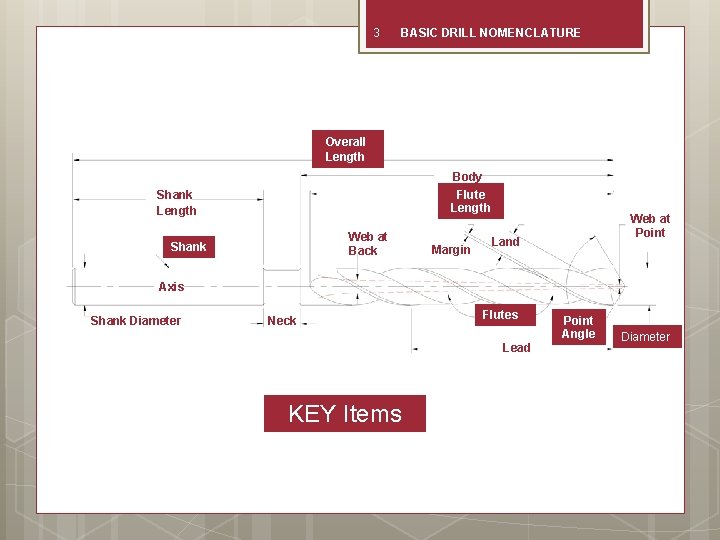
3 BASIC DRILL NOMENCLATURE Overall Length Body Flute Length Shank Length Web at Back Shank Margin Web at Point Land Axis Shank Diameter Neck Flutes Lead KEY Items Point Angle Diameter
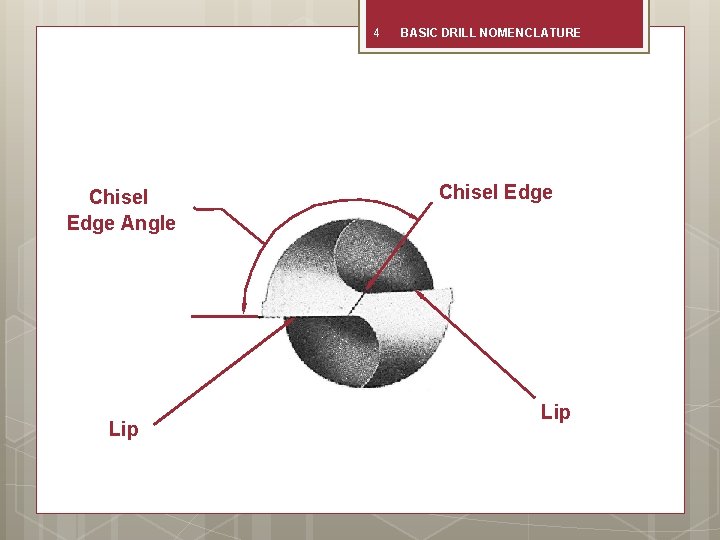
4 Chisel Edge Angle Lip BASIC DRILL NOMENCLATURE Chisel Edge Lip
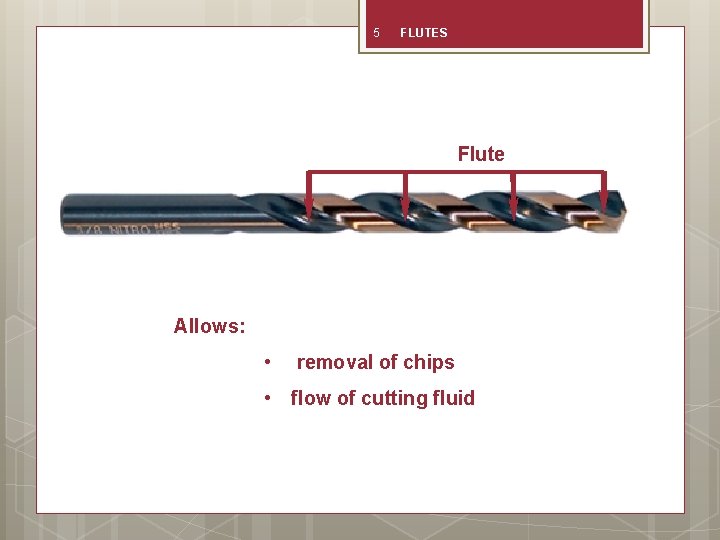
5 FLUTES Flute Allows: • removal of chips • flow of cutting fluid
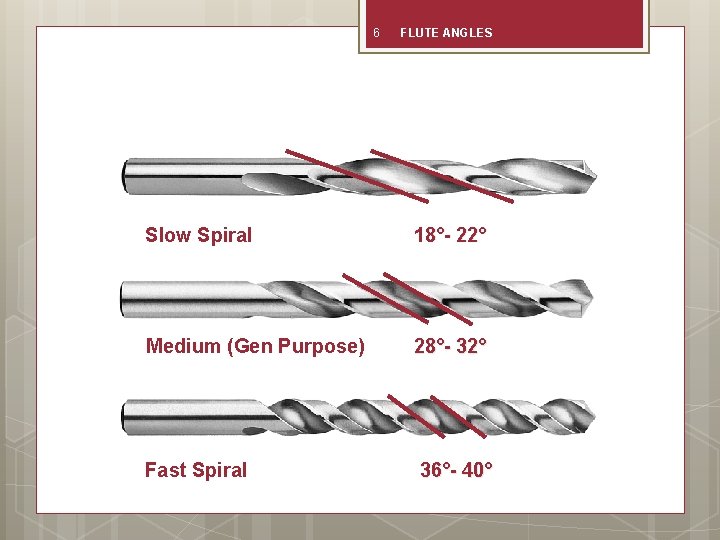
6 FLUTE ANGLES Slow Spiral 18°- 22° Medium (Gen Purpose) 28°- 32° Fast Spiral 36°- 40°
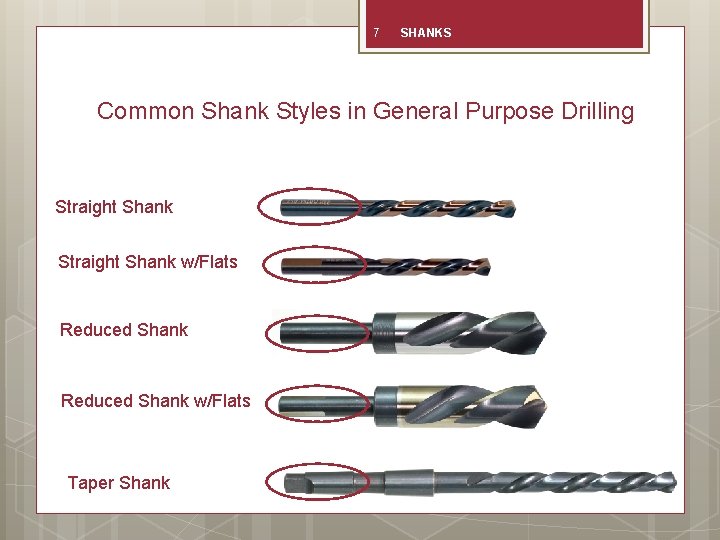
7 SHANKS Common Shank Styles in General Purpose Drilling Straight Shank w/Flats Reduced Shank w/Flats Taper Shank
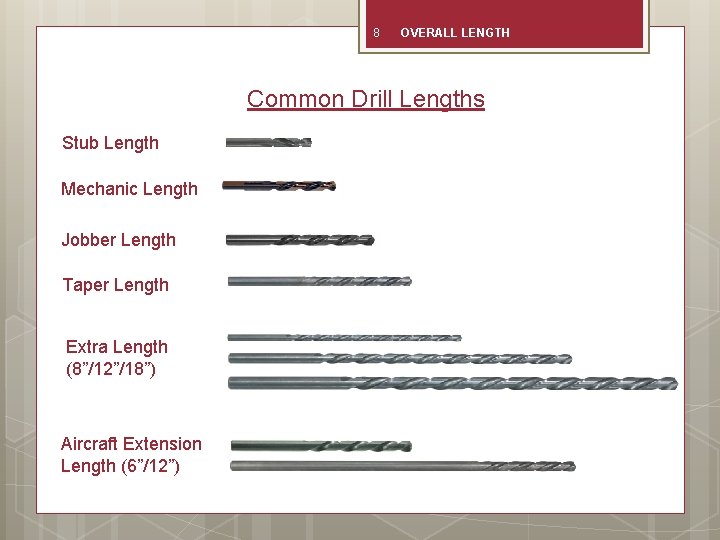
8 OVERALL LENGTH Common Drill Lengths Stub Length Mechanic Length Jobber Length Taper Length Extra Length (8”/12”/18”) Aircraft Extension Length (6”/12”)
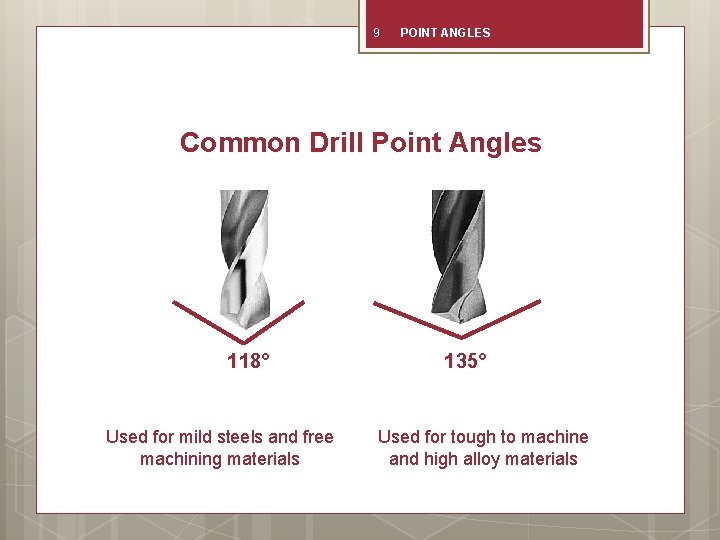
9 POINT ANGLES Common Drill Point Angles 118° Used for mild steels and free machining materials 135° Used for tough to machine and high alloy materials
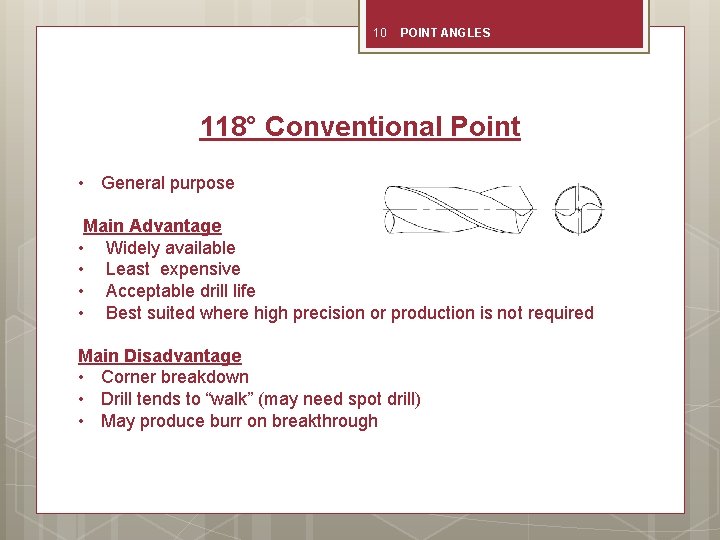
10 POINT ANGLES 118° Conventional Point • General purpose Main Advantage • Widely available • Least expensive • Acceptable drill life • Best suited where high precision or production is not required Main Disadvantage • Corner breakdown • Drill tends to “walk” (may need spot drill) • May produce burr on breakthrough
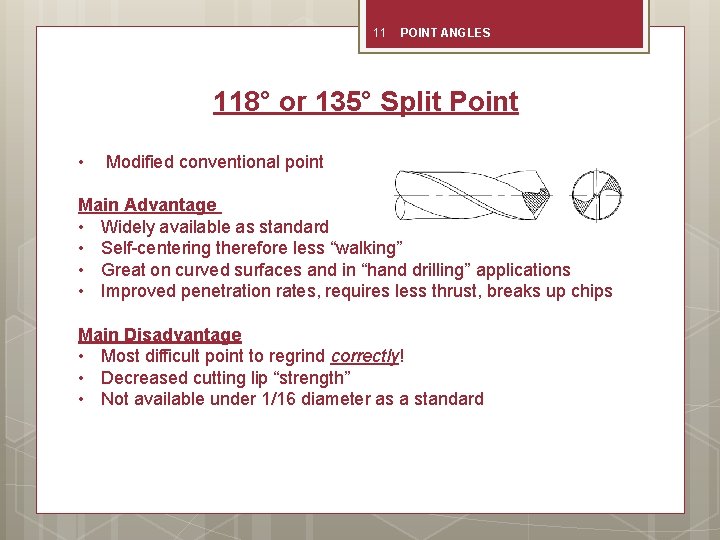
11 POINT ANGLES 118° or 135° Split Point • Modified conventional point Main Advantage • Widely available as standard • Self-centering therefore less “walking” • Great on curved surfaces and in “hand drilling” applications • Improved penetration rates, requires less thrust, breaks up chips Main Disadvantage • Most difficult point to regrind correctly! • Decreased cutting lip “strength” • Not available under 1/16 diameter as a standard
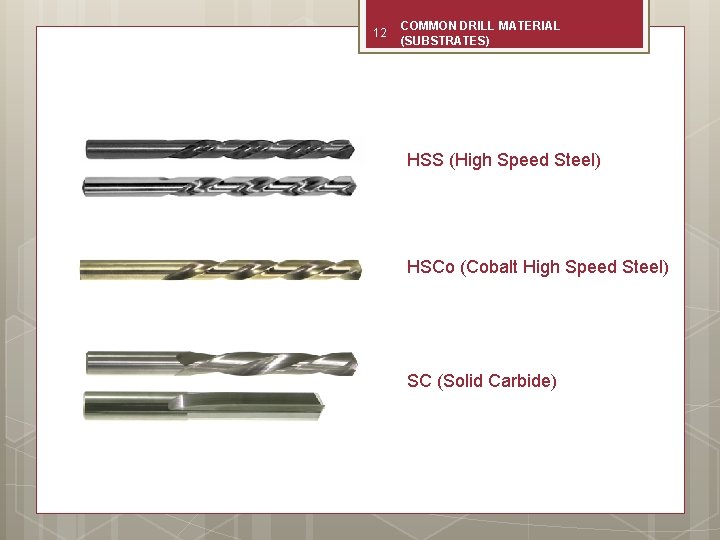
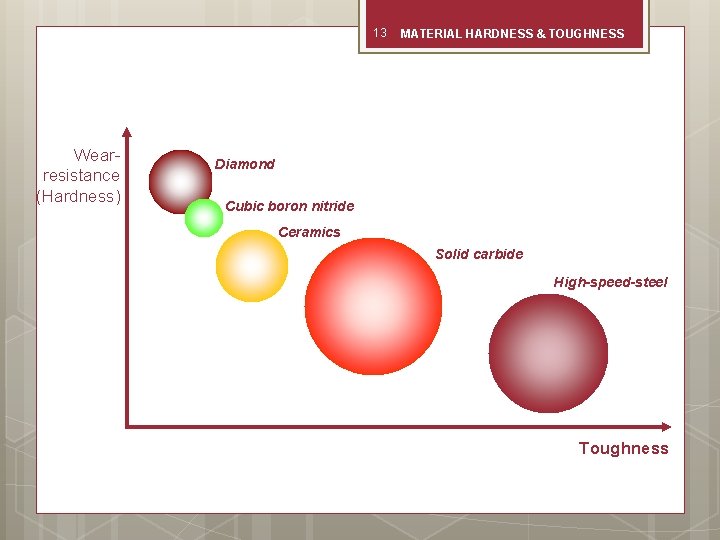
12 COMMON DRILL MATERIAL (SUBSTRATES) HSS (High Speed Steel) HSCo (Cobalt High Speed Steel) SC (Solid Carbide)
13 Wearresistance (Hardness) MATERIAL HARDNESS & TOUGHNESS Diamond Cubic boron nitride Ceramics Solid carbide High-speed-steel Toughness
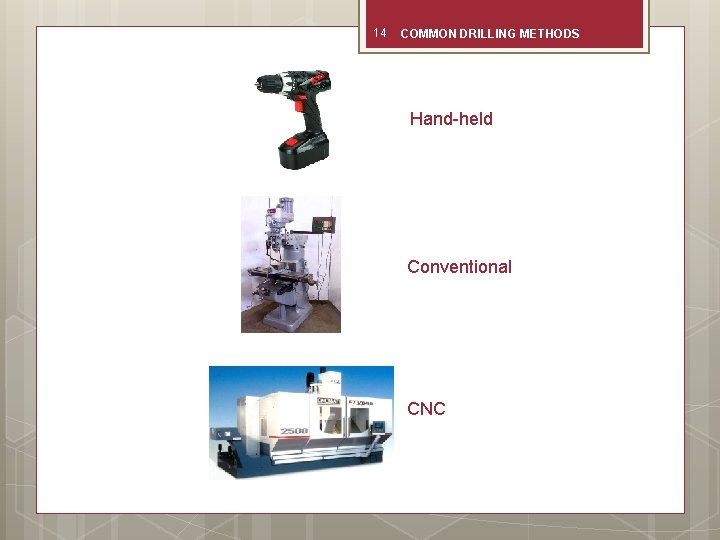
14 COMMON DRILLING METHODS Hand-held Conventional CNC
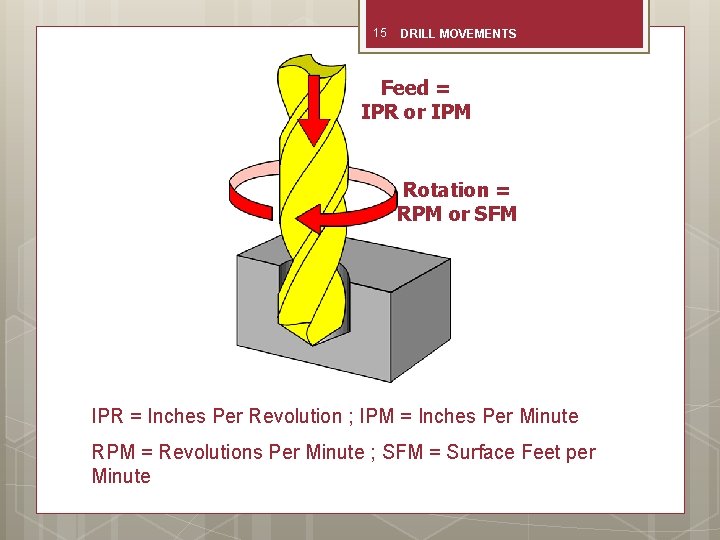
15 DRILL MOVEMENTS Feed = IPR or IPM Rotation = RPM or SFM IPR = Inches Per Revolution ; IPM = Inches Per Minute RPM = Revolutions Per Minute ; SFM = Surface Feet per Minute
16 Speed (DOC) CUTTING CONDITIONS (Vc), Feed (f), and Depth of Cut Speed/RPM has the greatest influence in performance! Speed creates HEAT – HEAT KILLS CARBIDE! Too slow also creates too much heat. Feed is the second factor Feed Too up DOC rate influences chip control. slow, chips pack; too fast, drill walks or spindle loads has the least influence Drills are made to remove material.
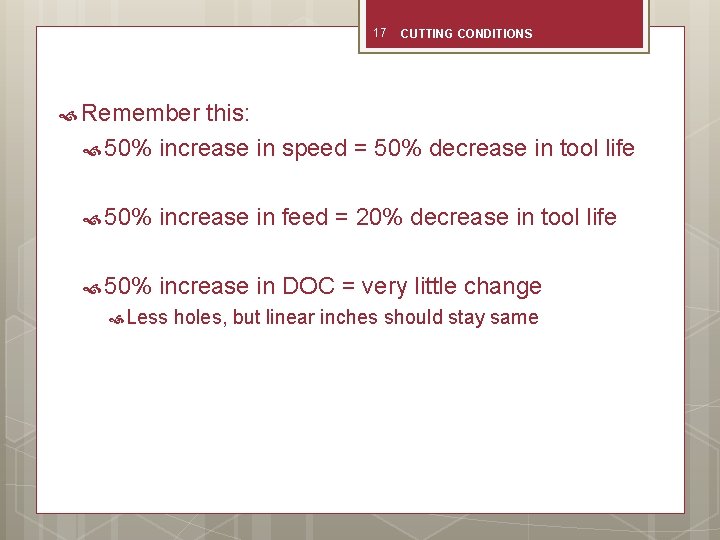
17 CUTTING CONDITIONS Remember this: 50% increase in speed = 50% decrease in tool life 50% increase in feed = 20% decrease in tool life 50% increase in DOC = very little change Less holes, but linear inches should stay same
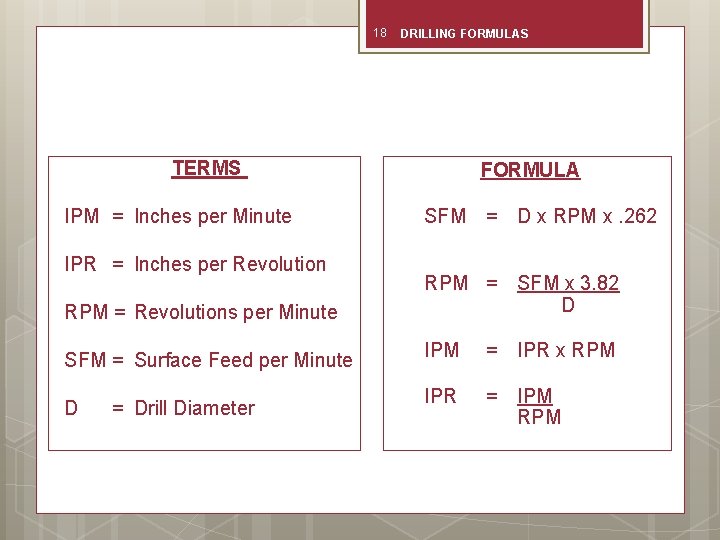
18 DRILLING FORMULAS TERMS IPM = Inches per Minute IPR = Inches per Revolution RPM = Revolutions per Minute SFM = Surface Feed per Minute D = Drill Diameter FORMULA SFM = D x RPM x. 262 RPM = SFM x 3. 82 D IPM = IPR x RPM IPR = IPM RPM
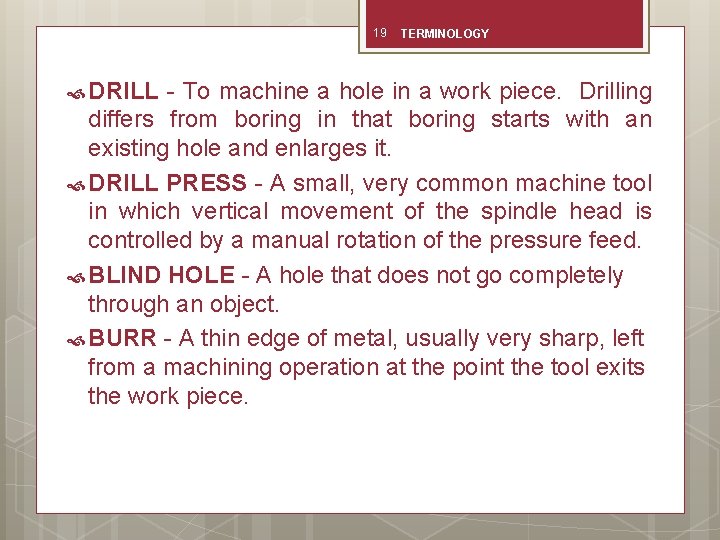
19 DRILL TERMINOLOGY - To machine a hole in a work piece. Drilling differs from boring in that boring starts with an existing hole and enlarges it. DRILL PRESS - A small, very common machine tool in which vertical movement of the spindle head is controlled by a manual rotation of the pressure feed. BLIND HOLE - A hole that does not go completely through an object. BURR - A thin edge of metal, usually very sharp, left from a machining operation at the point the tool exits the work piece.
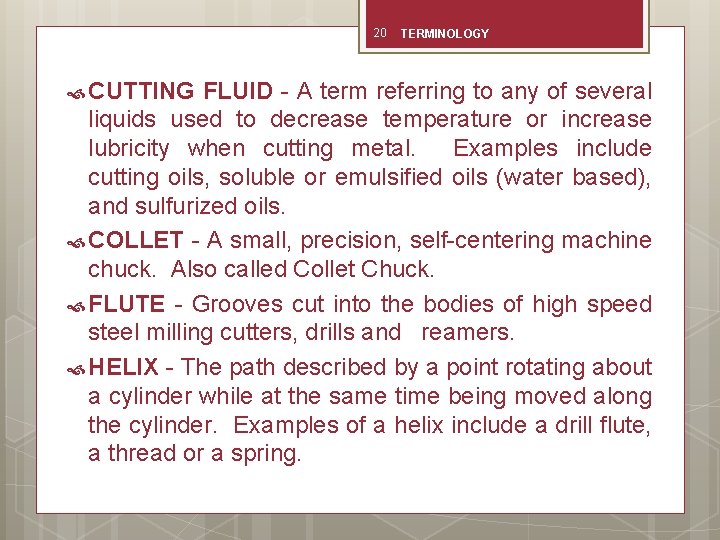
20 CUTTING TERMINOLOGY FLUID - A term referring to any of several liquids used to decrease temperature or increase lubricity when cutting metal. Examples include cutting oils, soluble or emulsified oils (water based), and sulfurized oils. COLLET - A small, precision, self-centering machine chuck. Also called Collet Chuck. FLUTE - Grooves cut into the bodies of high speed steel milling cutters, drills and reamers. HELIX - The path described by a point rotating about a cylinder while at the same time being moved along the cylinder. Examples of a helix include a drill flute, a thread or a spring.
21 REAMER TERMINOLOGY - Precision tool used to bring existing holes to a more exact size and improve the surface finish by machining a small amount of material from the inside diameter surface of the hole. Properly reamed holes remove no more than. 015" of stock and should be within. 001" of nominal size. TORQUE - A force that acts to produce rotation.