
Module 1 Developing intercultural competence through cultural awareness
- Slides: 67
Module 1 Developing intercultural competence through cultural awareness and effective intercultural communication Unit 3 Developing intercultural communication skills Co-funded by the Erasmus+ Programme of the European Union This project has been funded with support from the European Union. This [project] reflects the views only of the author, and the Commission cannot be held responsible for any use which may be made of the information contained therein
MODULE 1 UNIT 3 Module title Module 1: Developing intercultural competence through cultural awareness and effective intercultural communication Unit title Developing intercultural communication skills Learning objectives • • Training hours To develop understanding of what is meant by ‘intercultural communication’ To support participants to develop their understanding of the range of intercultural communication skills that young people involved in intercultural VET experiences may need to acquire To enhance the skills of participants to prepare and support the intercultural communication skills of young people participating in intercultural VET experiences To understand what an intercultural shock / conflict is and to manage it effectively. 3 hours (plus online activities for whole module) Co-funded by the Erasmus+ Programme of the European Union
OVERVIEW OF UNIT 3 This unit will look at • key principles and characteristics of intercultural communication • the differences between verbal and non-verbal communication • adjusting styles of communication to accommodate people from other cultures. • techniques to communicate verbally and nonverbally in culturally diverse environments Co-funded by the Erasmus+ Programme of the European Union
TIME FOR ACTIVITY NUMBER: 1. 3. 1 ACTIVITY TITLE: Understanding what is meant by intercultural communication ACTIVITY DURATION: 30 minutes COMMENTS: Evaluating statements about intercultural communication Co-funded by the Erasmus+ Programme of the European Union
What is intercultural communication? In its simplest form, intercultural communication is any exchange of information between parties who belong to different cultural groups. Co-funded by the Erasmus+ Programme of the European Union
What is intercultural communication? • You will now be asked to classify a number of examples of communication according to whether they are: – Always intercultural – Sometimes intercultural – Never intercultural Co-funded by the Erasmus+ Programme of the European Union
What is intercultural communication? Discussion • How many examples of communication did you think were always intercultural? • How many examples of communication did you think were sometimes intercultural? • How many examples of communication did you think were never intercultural? • Can you explain why you made these choices? Co-funded by the Erasmus+ Programme of the European Union
What is intercultural communication? Discussion • Look again at the examples you thought were never intercultural. • What information or assumptions did you make in order to arrive at this classification? • Did you make your decisions based on an essentialist or non-essentialist model of ‘culture’? Co-funded by the Erasmus+ Programme of the European Union
Key messages • The communication between individuals from different cultural groups will almost certainly be intercultural. • In fact, ‘culture is so deep, complex and varied, that even biologically identical twins cannot be said to be culturally identical, so even their communication might sometimes be intercultural. • This also makes it highly unlikely that any form of communication will never contain an intercultural aspect. Co-funded by the Erasmus+ Programme of the European Union
TIME FOR ACTIVITY NUMBER: 1. 3. 2 ACTIVITY TITLE: Principles and characteristics of intercultural communication ACTIVITY DURATION: 20 minutes COMMENTS: Whole class discussion and commentary on presentation slides Co-funded by the Erasmus+ Programme of the European Union
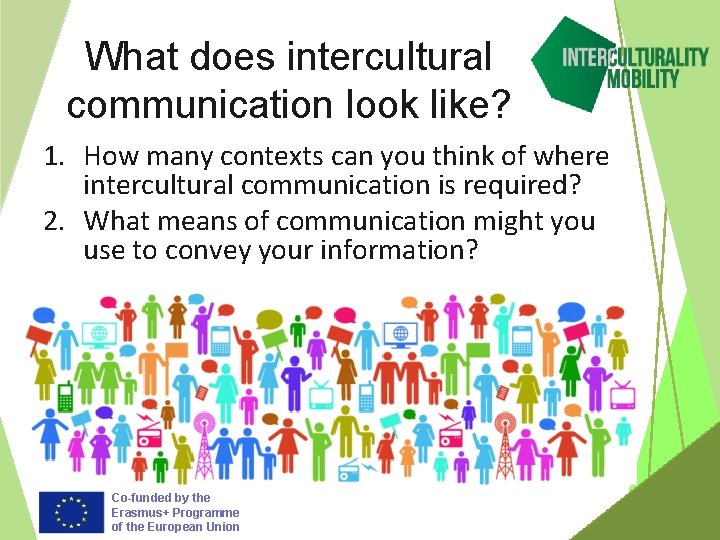
What does intercultural communication look like? 1. How many contexts can you think of where intercultural communication is required? 2. What means of communication might you use to convey your information? Co-funded by the Erasmus+ Programme of the European Union
Is it fair to say that… ? ? …the number of contexts for intercultural communication are numerous? …there are many means through which intercultural communications can be made? …without due care and attention, miscommunication becomes a possibility? Co-funded by the Erasmus+ Programme of the European Union ?
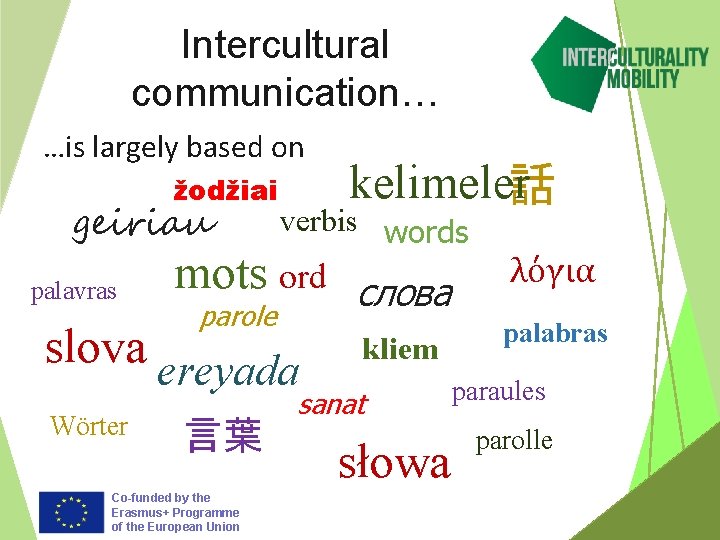
Intercultural communication… …is largely based on žodžiai geiriau palavras verbis words mots ord parole slova ereyada Wörter 言葉 Co-funded by the Erasmus+ Programme of the European Union kelimeler話 слова kliem sanat słowa λόγια palabras paraules parolle
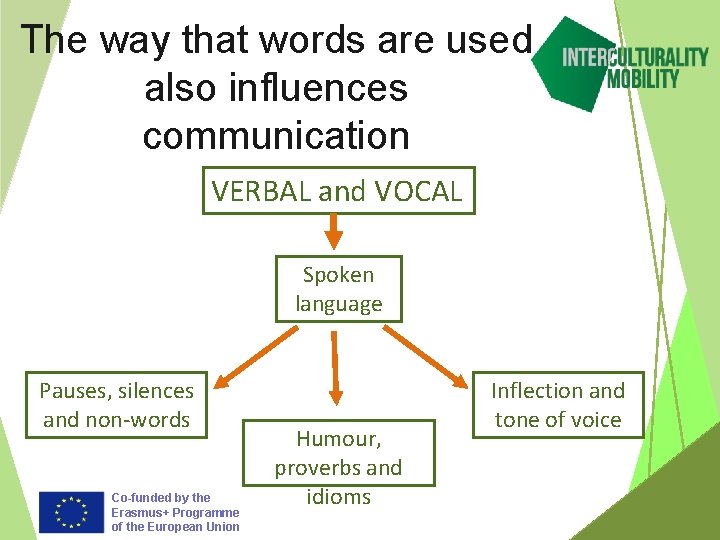
The way that words are used also influences communication VERBAL and VOCAL Spoken language Pauses, silences and non-words Co-funded by the Erasmus+ Programme of the European Union Humour, proverbs and idioms Inflection and tone of voice
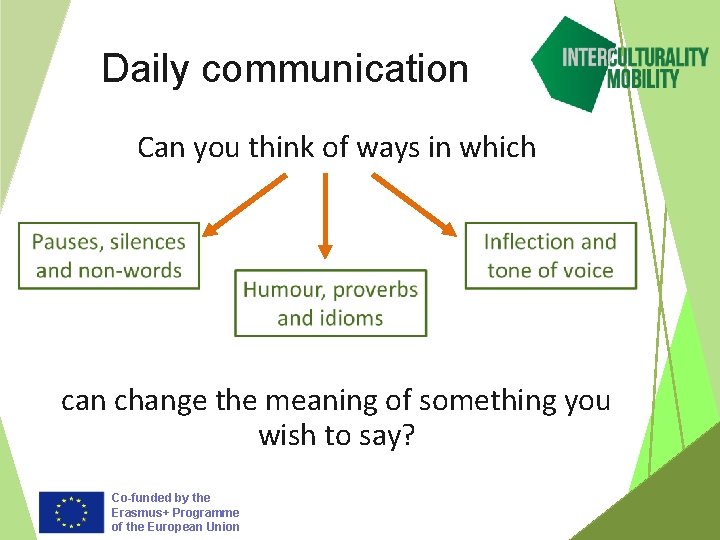
Daily communication Can you think of ways in which can change the meaning of something you wish to say? Co-funded by the Erasmus+ Programme of the European Union
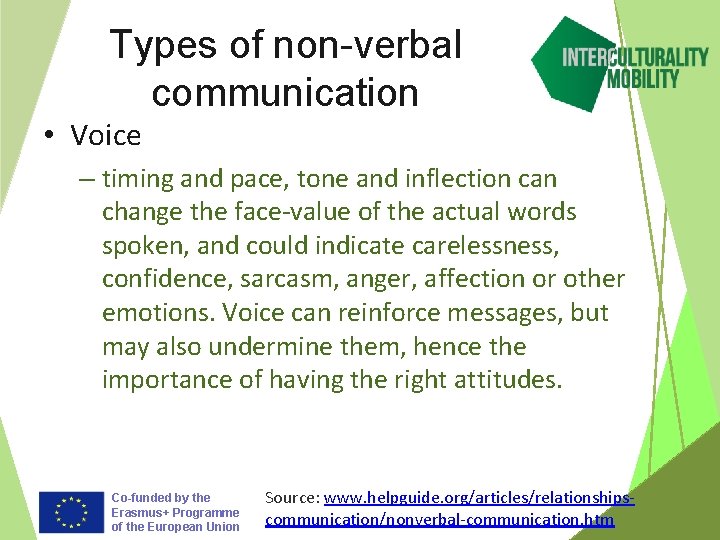
Types of non-verbal communication • Voice – timing and pace, tone and inflection can change the face-value of the actual words spoken, and could indicate carelessness, confidence, sarcasm, anger, affection or other emotions. Voice can reinforce messages, but may also undermine them, hence the importance of having the right attitudes. Co-funded by the Erasmus+ Programme of the European Union Source: www. helpguide. org/articles/relationshipscommunication/nonverbal-communication. htm
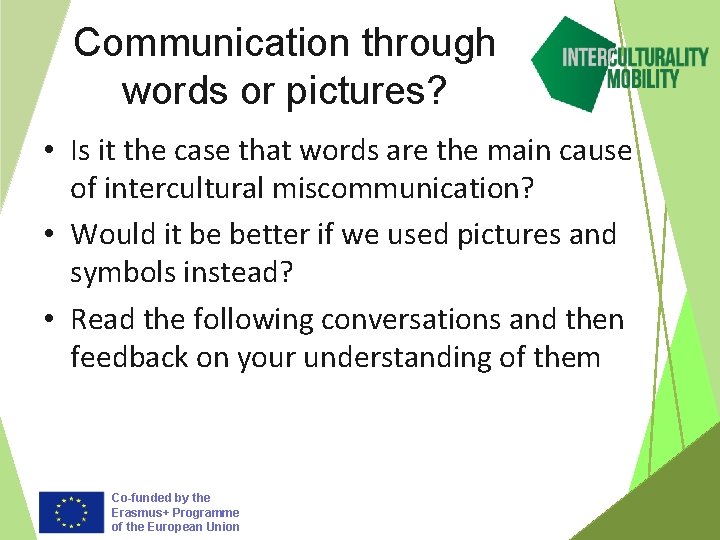
Communication through words or pictures? • Is it the case that words are the main cause of intercultural miscommunication? • Would it be better if we used pictures and symbols instead? • Read the following conversations and then feedback on your understanding of them Co-funded by the Erasmus+ Programme of the European Union
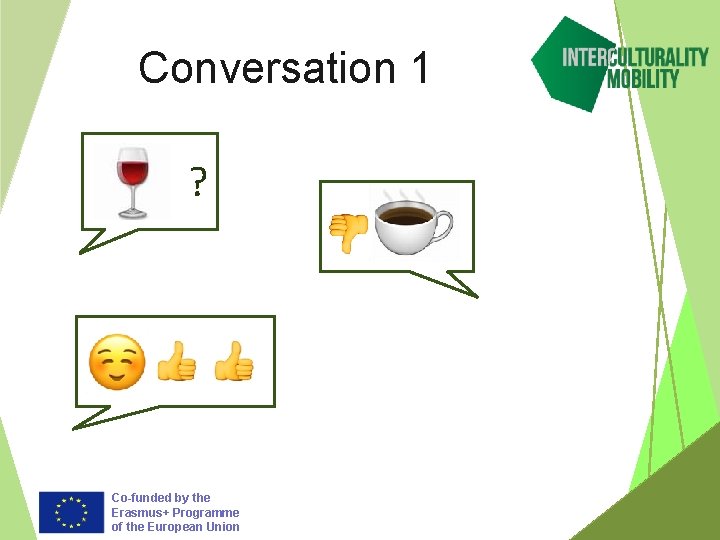
Conversation 1 ? Co-funded by the Erasmus+ Programme of the European Union
Discussion • How easy was this to understand? • How complex was the content? • Could any of the symbols be seen as offensive? • If so, why? • What could we do to improve the communication? Co-funded by the Erasmus+ Programme of the European Union
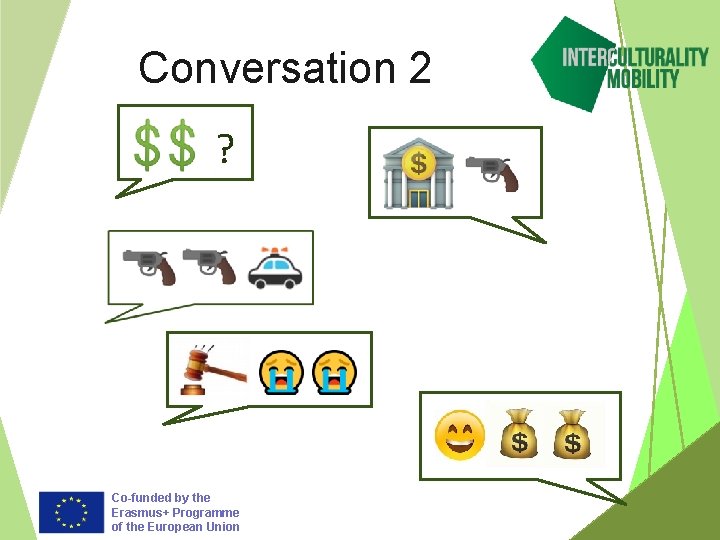
Conversation 2 ? Co-funded by the Erasmus+ Programme of the European Union
Discussion • How easy was this to understand? • How complex was the content? • Could any of the symbols be seen as offensive? • If so, why? • What could we do to improve the communication? Co-funded by the Erasmus+ Programme of the European Union
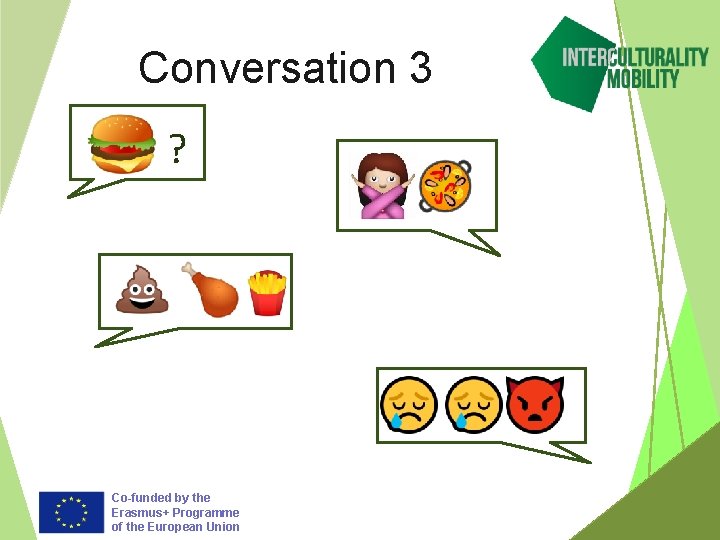
Conversation 3 ? Co-funded by the Erasmus+ Programme of the European Union
Discussion • How easy was this to understand? • How complex was the content? • Could any of the symbols be seen as offensive? • If so, why? • What could we do to improve the communication? Co-funded by the Erasmus+ Programme of the European Union
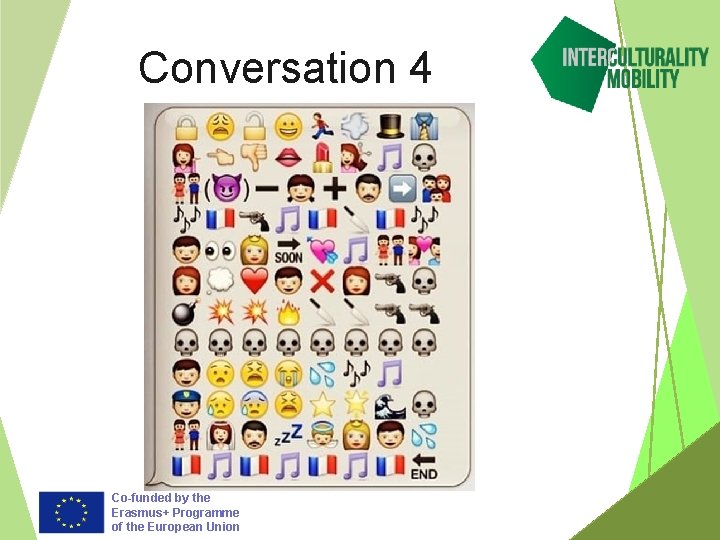
Conversation 4 Now prepare for the best one of all! Co-funded by the Erasmus+ Programme of the European Union
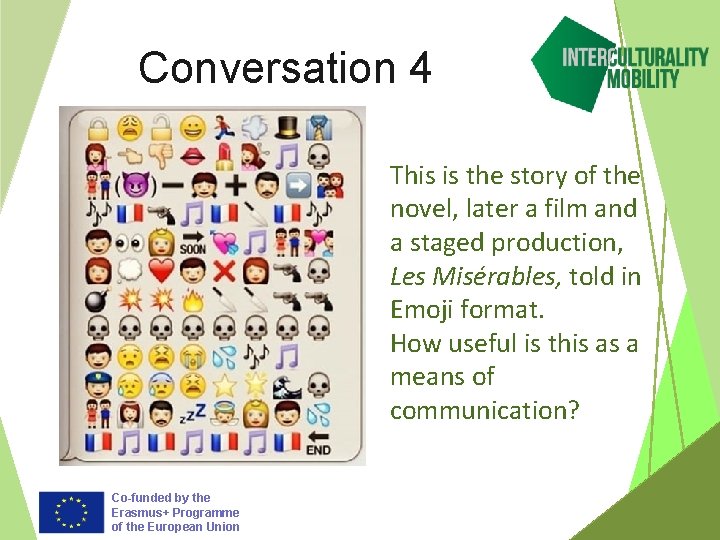
Conversation 4 Co-funded by the Erasmus+ Programme of the European Union
Conversation 4 This is the story of the novel, later a film and a staged production, Les Misérables, told in Emoji format. How useful is this as a means of communication? Co-funded by the Erasmus+ Programme of the European Union
Key messages • Images can aid communication, however, they can be interpreted in multiple ways, which means they become less specific and less precise than words. • Over-reliance on images may obfuscate meanings, thus impeding communication. • Some images have connotations that are culturally sensitive or taboo. Using an image that may represent a word or concept you would normally avoid in conversation, could cause offence. Co-funded by the Erasmus+ Programme of the European Union
TIME FOR ACTIVITY NUMBER: 1. 3. 3 ACTIVITY TITLE: Teaching and researching language and culture ACTIVITY DURATION: 30 COMMENTS: Shared group reading of extracts from an academic text Co-funded by the Erasmus+ Programme of the European Union
Teaching and researching language and culture • Language is an important factor in developing intercultural communication because it is the predominant mode in which communication takes place. • In her book Teaching and Researching Language and Culture, Joan Kelly Hall discusses the connections between identity, culture and language. Co-funded by the Erasmus+ Programme of the European Union
Teaching and researching language and culture • You will now read three extracts from chapter 2 of that book. • How do the extracts help us when preparing to move into an intercultural context? Co-funded by the Erasmus+ Programme of the European Union
Discussion ? ? If our identities, cultural beliefs and attitudes influence our ways of communicating, to what extent, can we, through our personal agency, mediate our behaviour, so that it is not alienating and so that our communications are successful? Co-funded by the Erasmus+ Programme of the European Union ?
Article 1: Relevance of social identity Summary: Although we may have very obvious differences in culture or identity with those we seek to communicate with at a particular moment, there are occasions when markers of identity or culture such as ‘nationality’ may be less important than other social or even professional identities we may have in common, such as those of ‘student’, ‘female car mechanic’, ‘colleague’ or ‘client’. Co-funded by the Erasmus+ Programme of the European Union
Article 2: Agency and identity Summary: We all have multiple identities and belong to different cultural groups. These cultural identities are constantly changing as we move between groups and can influence the way we use language, both to describe ourselves and to conceive of others. This may lead to unexpected outcomes. Co-funded by the Erasmus+ Programme of the European Union
Article 3: Research by Dr T. Kandiah Summary: Lack of shared (cultural) knowledge can lead to miscommunications. However, it is also possible for miscommunications to arise from the use of language (and thought) to interpret differences in communication cues as problematic, and to then use strategies to impede successful communication with an interlocutor deemed “disfluent” or less able to communicate or less worthy of effort to communicate with. Co-funded by the Erasmus+ Programme of the European Union
Key messages • ‘Culture’ is multifaceted and individuals can belong simultaneously to many ‘cultural’ groups. • This means that it is possible to share aspects of the ‘culture’ with someone, even when you (or they) identify as belonging to different or distinct cultural groups. • Attitudes or beliefs which seek to emphasise cultural difference and separateness are more likely to result in communication which is “disfluent”, disjointed and unsuccessful, than those which seek to engage with, amplify and clarify what is being communicated. Co-funded by the Erasmus+ Programme of the European Union
Break Co-funded by the Erasmus+ Programme of the European Union
TIME FOR ACTIVITY NUMBER: 1. 3. 4 ACTIVITY TITLE: Bloom’s Taxonomy – the affective domain ACTIVITY DURATION: 40 minutes COMMENTS: Co-funded by the Erasmus+ Programme of the European Union
Principles of intercultural communication • The first principle that must underpin intercultural communication is the wish for the communication to be successful. • For this reason, it is guided by principles that are intended to ensure the exchange of information across cultural boundaries is meaningful, unambiguous, preserves mutual respect and minimises antagonism. Co-funded by the Erasmus+ Programme of the European Union
What do we need for successful communication? • A recognition that there are different systems of communication and different understandings of what is socially acceptable. • A positive attitude to difference. • The willingness and ability to adapt to different contexts. • Skills as communicator in your first language. Co-funded by the Erasmus+ Programme of the European Union
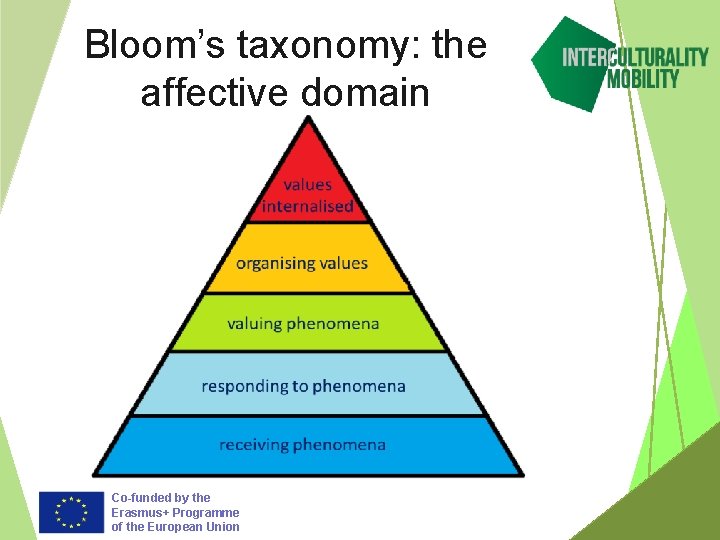
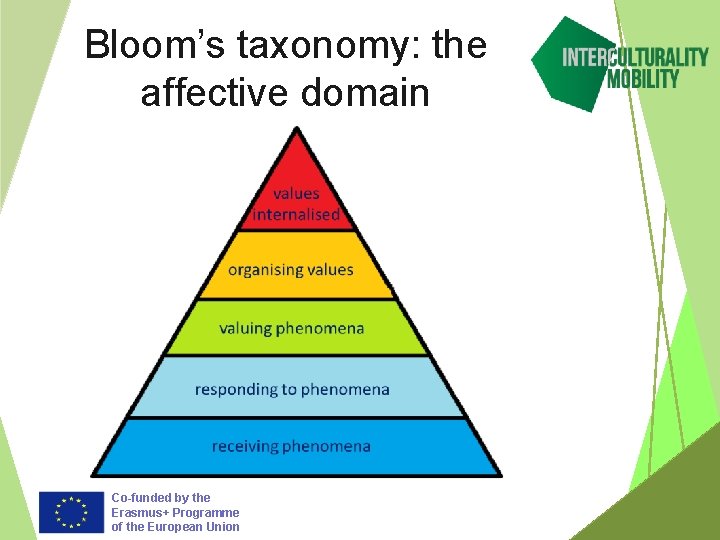
Bloom’s Taxonomy: The affective domain • When most people discuss Bloom’s taxonomy, the model that is usually considered is the cognitive domain. There are, however, three domains: – the cognitive – the sensory – the affective. Co-funded by the Erasmus+ Programme of the European Union
Bloom’s taxonomy: the affective domain Co-funded by the Erasmus+ Programme of the European Union
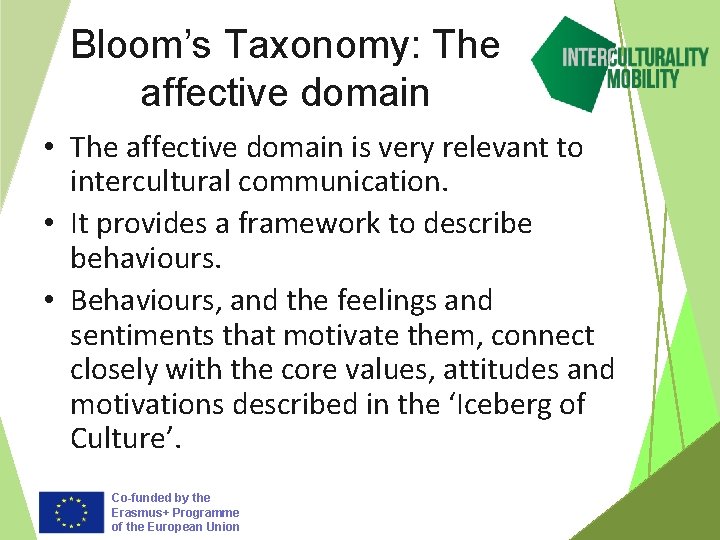
Bloom’s Taxonomy: The affective domain • The affective domain is very relevant to intercultural communication. • It provides a framework to describe behaviours. • Behaviours, and the feelings and sentiments that motivate them, connect closely with the core values, attitudes and motivations described in the ‘Iceberg of Culture’. Co-funded by the Erasmus+ Programme of the European Union
Reading activity - 1 • You will be given six paragraphs from a text about Bloom’s affective taxonomy. Your tasks are: 1. Organise the paragraphs in order to make a coherent text 2. Summarise the content of each paragraph in no more than three words 3. Check your work against the original text Co-funded by the Erasmus+ Programme of the European Union
Reading activity - 2 • Now you will be given five examples of communicative actions. Your task is: 1. Match the actions to the corresponding levels in the pyramid 2. Suggest three associated behaviours to go with each action 3. Compare your work with that of the other groups and make any changes/revisions Co-funded by the Erasmus+ Programme of the European Union
Bloom’s taxonomy: the affective domain Co-funded by the Erasmus+ Programme of the European Union
TIME FOR ACTIVITY NUMBER: 1. 3. 5 ACTIVITY TITLE: Verbal and non-verbal communication ACTIVITY DURATION: 30 COMMENTS: Co-funded by the Erasmus+ Programme of the European Union
Verbal Communication • Much of today’s session has been concerned with verbal communication. • Verbal communication takes place through the medium of words. • The words may be spoken – e. g. conversation, discussion, lecture, interview, broadcast etc. • or written – e. g. email, letter, application form etc. Co-funded by the Erasmus+ Programme of the European Union
Verbal communication • Verbal communication can operate in a face-to-face situation or a remote situation. • Individuals involved in intercultural experiences need to develop a set of skills to support their communication, especially in face-to-face situations. • Bloom’s Taxonomy of the affective domain is a tool that can assist them. Co-funded by the Erasmus+ Programme of the European Union
Non-verbal communication • This can be conscious or unconscious. • Conscious non-verbal communication is where we choose to use physical actions, gestures, mime etc. to communicate a meaning • Unconscious non-verbal communication is where the actions we take, without intending to, signal messages to our interlocutors. Co-funded by the Erasmus+ Programme of the European Union
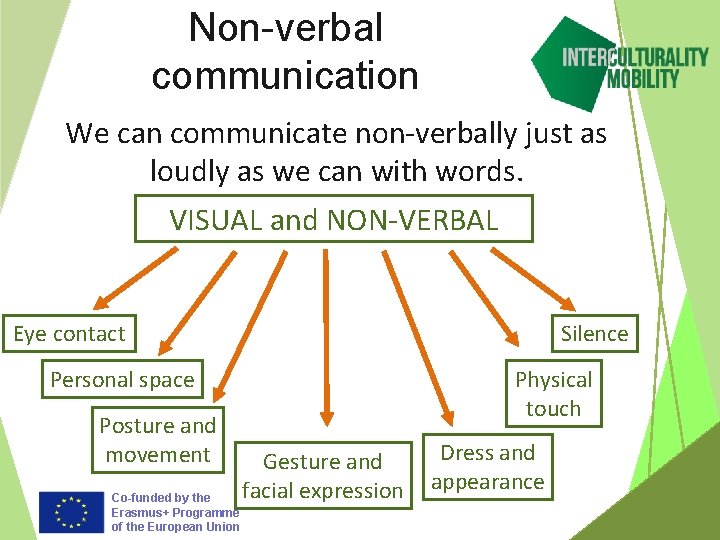
Non-verbal communication We can communicate non-verbally just as loudly as we can with words. VISUAL and NON-VERBAL Silence Eye contact Physical touch Personal space Posture and movement Co-funded by the Erasmus+ Programme of the European Union Gesture and facial expression Dress and appearance
Why does non-verbal communication matter? • The way we listen to people, the way we make eye contact, are all examples of signals that can tell the person you are speaking to: – how interested you are – how truthful or sincere you are • In this way, non-verbal communication can generate mistrust and confusion as well as reassurance Co-funded by the Erasmus+ Programme of the European Union
Why does non-verbal communication matter? • When non-verbal signals match up with what an individual says, it makes for a more cohesive message and can increase rapport between interlocutors, so building trust and understanding. • When non-verbal signals DON’T match up with what an individual says, the potential for miscommunication increases, along with confusion, uncertainty and doubts about the sincerity of the communication Co-funded by the Erasmus+ Programme of the European Union
Types of non-verbal communication • Eye contact – vision is the predominant sense for the majority of us. The way we look at another person may indicate interest, hostility, affection, boredom, attraction. • Personal space – the amount of personal space individuals require varies according to culture. As well as signs of intimacy or affection, physical closeness may also communicate aggression or dominance. Co-funded by the Erasmus+ Programme of the European Union Source: www. helpguide. org/articles/relationshipscommunication/nonverbal-communication. htm
Types of non-verbal communication • Posture and body movement – the way we stand, walk, sit, or hold our head may signal our true feelings – pay attention to posture, bearing and stance • Dress and appearance – we can signal a personal view of ourselves: • creativity, wealth, power, sense of fashion; • our attitudes to values such as modesty; • our affiliation to social movements or religious groups Co-funded by the Erasmus+ Programme of the European Union Source: www. helpguide. org/articles/relationshipscommunication/nonverbal-communication. htm
Types of non-verbal communication • Gestures – the way we point, beckon or use our hands in other ways are important. Gestures tend to have DIFFERENT meanings across cultures and regions • Facial expressions – facial expressions for happiness, sadness, anger, surprise, fear and disgust tend to be the same across cultures Co-funded by the Erasmus+ Programme of the European Union Source: www. helpguide. org/articles/relationshipscommunication/nonverbal-communication. htm
Types of non-verbal communication • Touch – the significance of a touch can vary greatly across cultures. What impressions might be made by a weak handshake, a slap on the back, a pat on the head, a hug, or a hand on someone’s arm? • Silence – used positively, it can allow others to communicate their messages, but used negatively it can oblige others to silence Co-funded by the Erasmus+ Programme of the European Union Source: www. helpguide. org/articles/relationshipscommunication/nonverbal-communication. htm
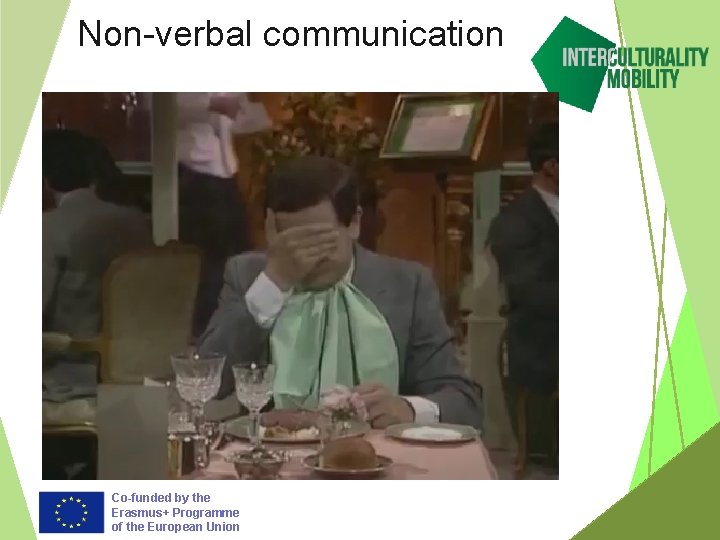
Non-verbal communication in action • You are going to watch a short video clip that depicts several examples of nonverbal communication. 1. Use the viewing sheet to check off the examples as you see them. 2. Work in your groups to answer the questions on the viewing sheet Co-funded by the Erasmus+ Programme of the European Union
Non-verbal communication Co-funded by the Erasmus+ Programme of the European Union
TIME FOR ACTIVITY NUMBER: 1. 2. 6 ACTIVITY TITLE: Preparing for an intercultural experience ACTIVITY DURATION: 10 minutes COMMENTS: Co-funded by the Erasmus+ Programme of the European Union
Preparing for an intercultural experience • When preparing for an intercultural experience it is also helpful to: – Talk to colleagues who have been in that context before you. This will help to gain insight and relevant information. – Be aware of your own ‘culture’. Everyone has personal beliefs, attitudes and assumptions that might impact on how they communicate. Be ready to challenge these beliefs, and to have them challenged. Co-funded by the Erasmus+ Programme of the European Union
Preparing for an intercultural experience • Intercultural experiences are a fantastic opportunity for personal and professional development. Build your skills, but also: – be open and prepared for new experiences – be ready to adapt your behaviour where necessary – anticipate the best outcomes, not the worst! Co-funded by the Erasmus+ Programme of the European Union
Avoiding intercultural shock and/or conflict • Don’t panic – intercultural shock is a rare! • Moving to any new situation, for example, starting school, starting a new job, or moving house, can lead to a certain amount of disorientation, but this is not, in itself, a cause for panic or conflict. • An intercultural experience will be different, new, but hopefully not a shock. Co-funded by the Erasmus+ Programme of the European Union
Avoiding intercultural shock and/or conflict • Finding out about local customs and habits before you go is proactive and corresponds to the ‘Organising Phenomena’ level of Bloom’s taxonomy of the affective domain. • Avoiding cultural stereotypes (see Module 1 Unit 2) makes it less likely that you will miscommunicate or cause offence. • Showing your openness through non-verbal signals as well as what you say will assist communication. • We will cover intercultural shock in more detail in Module 2 Unit 3). Co-funded by the Erasmus+ Programme of the European Union
Further Reading 1. Hall, J. K. , (2013) Teaching and Researching: Language and Identity, Pearson India 1. Bührig, K. and Thije, J. (2006) Beyond Misunderstanding: Linguistic Analyses of Intercultural Communication, Amsterdam: John Benjamins. The twelve chapters in this volume examine intercultural communication in a variety of settings and from a variety of theoretical frameworks to demonstrate how individuals draw on a range of linguistic resources to construct mutual understandings in their interactions. Co-funded by the Erasmus+ Programme of the European Union
E – Learning resources 1. A useful website is https: //www. helpguide. org/articles/r elationshipscommunication/nonverbalcommunication. htm Co-funded by the Erasmus+ Programme of the European Union
Reflection • Take a few minutes to note down your responses to what you have covered today: – Forms of intercultural communication – Methods of intercultural communication – Personal agency in communication – The affective domain of Bloom’s Taxonomy – Verbal and non-verbal communication • How does this content help you prepare for an intercultural experience? Co-funded by the Erasmus+ Programme of the European Union
Congratulations! You have completed this unit Co-funded by the Erasmus+ Programme of the European Union This project has been funded with support from the European Union. This [project] reflects the views only of the author, and the Commission cannot be held responsible for any use which may be made of the information contained therein