
Module 1 Data Management Introduction Topics What is

- Slides: 46
Module 1 Data Management Introduction
Topics What is data management? Why is data management important? What is the data life cycle? Data Management Introduction
Learning Objectives After completing this lesson, the participant will be able to: ◦ ◦ ◦ Define data management Describe the importance of data management Describe the benefits of good data management Describe the costs of poor data management Identify Federal policies governing data management Identify components of the data life cycle Data Management Introduction
Data management – what is it? Data management is a broad catch-all term used by different people in different contexts. It can be used to describe a variety of activities such as: ◦ ◦ ◦ Data storage, Data curation, Data preservation, Database design, Data modeling and more Sometimes it can be used to refer to data management policy and sometimes to the practice of data management. Data Management Introduction Slide credit: Australian National Data Service
Data management for the researcher All those activities which a researcher can undertake ◦ to organize and manage their data ◦ to facilitate their own research, and ◦ to provide a foundation for the longer-term sustainability of the data Data Management Introduction Slide credit: Australian National Data Service
Data management defined “The business function that develops and executes plans, policies, practices and projects that acquire, control, protect, deliver and enhance the value of data and information. ” Source: DAMA Dictionary of Data Management, 1 st Ed. Data Management Introduction
Why is Data Management Important? Expands value of data from original purpose Allows discovery and integration of data Avoids duplication of effort Increases visibility in scientific/public arena Allows new science collaborations Allows rapid response to unexpected events Assists in historical & long-term analyses Avoids costs associated with poor data management Data Management Introduction
Benefits of Good Data Management Practices Short-term Spend less time doing data management and more time doing research Easier to prepare and use data for yourself Collaborators can readily understand use data files Long-term (data publication) Scientists outside your project can find, understand, and use your data to address broad questions You get credit for archived data products and their use in other papers Sponsors protect their investment Data Management Introduction Slide credit: Bob Cook, Oak Ridge National Laboratory
Costs of Poor Data Management According to Larry English, poor data quality can cost companies 15% to 25% of their operating budget What would a 15% cost reduction be worth to the USGS? Data Management Introduction Slide modified from Tom Chatfield, BLM
Poor Data Management Makes Headlines “MEDICARE PAYMENT ERRORS NEAR $20 B” (USA Today, December 2004) “AUDIT: JUSTICE STATS ON ANTI-TERROR CASES FLAWED” (Associated Press, February 2007) “OOPS! TECH ERROR WIPES OUT ALASKA INFO” (Associated Press, March 2007) Data Management Introduction Slide credit: Tom Chatfield, BLM
Case Study 1 In May 2006, a VA employee was blamed for theft of 26. 5 million Social Security numbers after he took home sensitive data and his home was burglarized. The VA sent letters to every living veteran and some of their spouses with the bad news. The stolen data included names, Social Security numbers, dates of birth and numerical disability ratings. According to the VA, no medical records or financial information had been compromised. Data Management Introduction Slide credit: Tom Chatfield, BLM
Case Study 2 A wildlife biologist for a small field office was the in-house GIS expert and provided support for all the staff’s GIS needs. However, the data was stored on her own workstation. When the biologist relocated to another office, no one understood how the data was stored or managed. Solution: A state office GIS specialist retrieved the workstation and sifted through files trying to salvage relevant data. Cost: 1 work month ($4, 000) plus the value of data that was not recovered Data Management Introduction Slide credit: Tom Chatfield, BLM
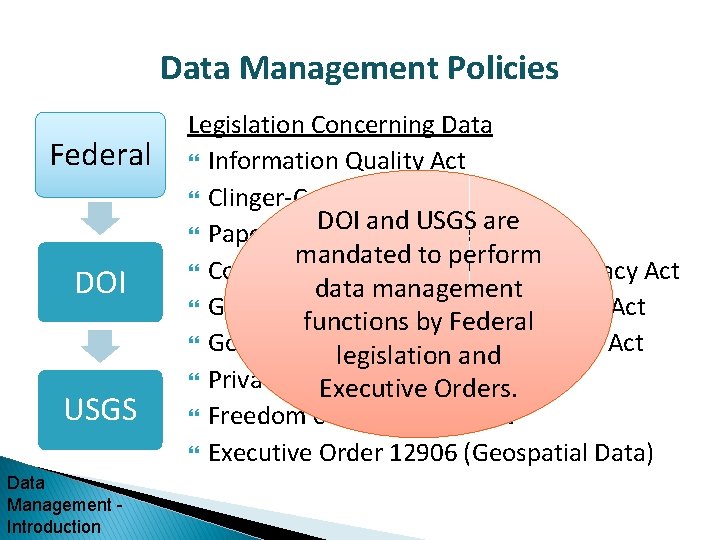
Data Management Policies Federal DOI USGS Data Management Introduction Legislation Concerning Data Information Quality Act Clinger-Cohen Act DOI and USGS are Paperwork Reduction Act mandated to perform Computer Matching & Personal Privacy Act data management Government Performance & Results Act functions by Federal Government Paperwork Elimination Act legislation and Privacy Act Executive Orders. Freedom of Information Act Executive Order 12906 (Geospatial Data)
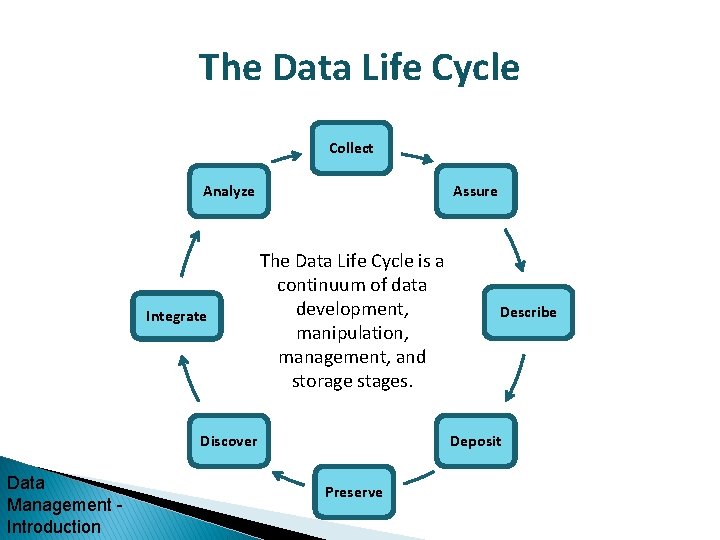
The Data Life Cycle Collect Assure Analyze Integrate The Data Life Cycle is a continuum of data development, manipulation, management, and storage stages. Discover Data Management Introduction Describe Deposit Preserve
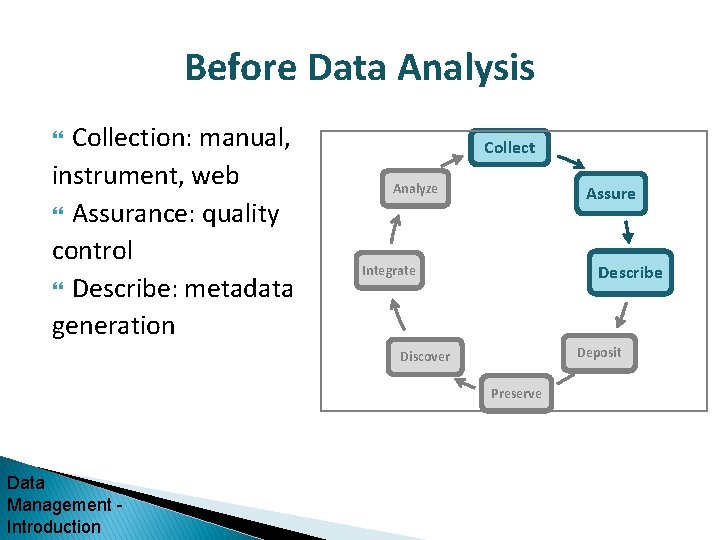
Before Data Analysis Collection: manual, instrument, web Assurance: quality control Describe: metadata generation Collect Analyze Assure Describe Integrate Deposit Discover Preserve Data Management Introduction
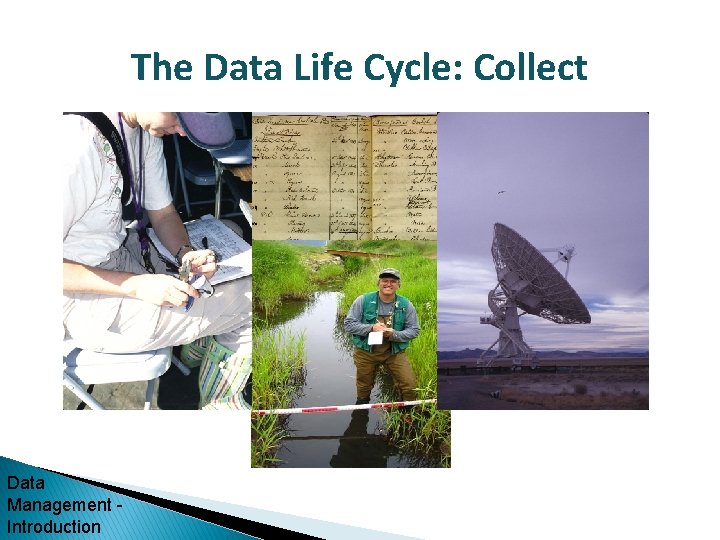
The Data Life Cycle: Collect Data Management Introduction
The Data Life Cycle: Assure A researcher creates strategies for preventing errors to be present in a dataset Quality assurance involves implementing measures that will ensure the quality of data before collection Quality control involves monitoring and maintaining the quality of data throughout the study Data Management Introduction
The Data Life Cycle: Describe “Describe data” can occur at any stage of the data lifecycle Create metadata records to describe a dataset, including how it was collected and definitions used – this will document critical provenance information. Operational metadata can capture and describe computing processes. Adhere to organizational policies and procedures for ongoing collection management, including deaccessioning of data as appropriate. Data Management Introduction
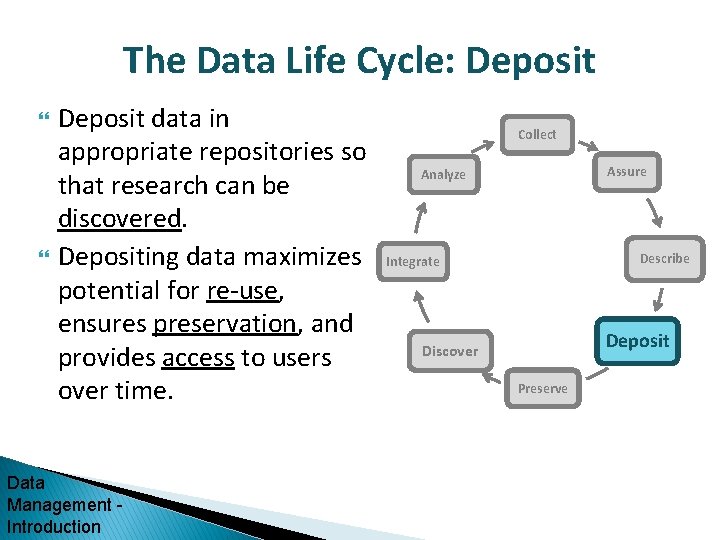
The Data Life Cycle: Deposit data in appropriate repositories so that research can be discovered. Depositing data maximizes potential for re-use, ensures preservation, and provides access to users over time. Data Management Introduction Collect Assure Analyze Describe Integrate Deposit Discover Preserve
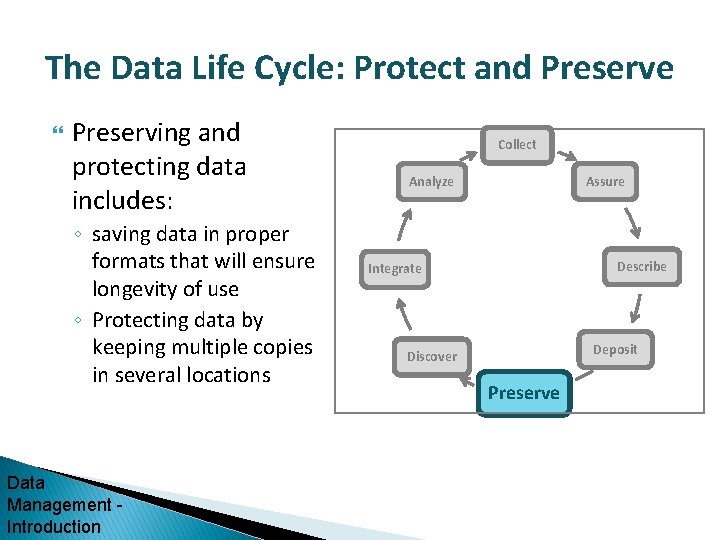
The Data Life Cycle: Protect and Preserve Preserving and protecting data includes: ◦ saving data in proper formats that will ensure longevity of use ◦ Protecting data by keeping multiple copies in several locations Data Management Introduction Collect Assure Analyze Describe Integrate Deposit Discover Preserve
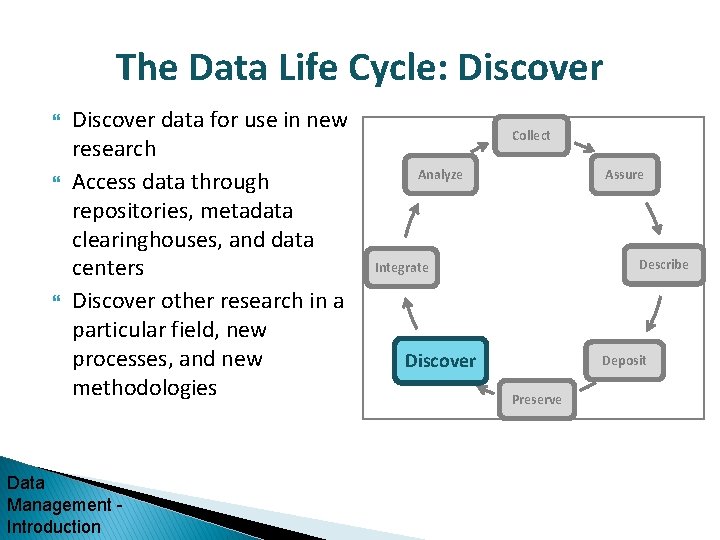
The Data Life Cycle: Discover data for use in new research Access data through repositories, metadata clearinghouses, and data centers Discover other research in a particular field, new processes, and new methodologies Data Management Introduction Collect Assure Analyze Describe Integrate Discover Deposit Preserve
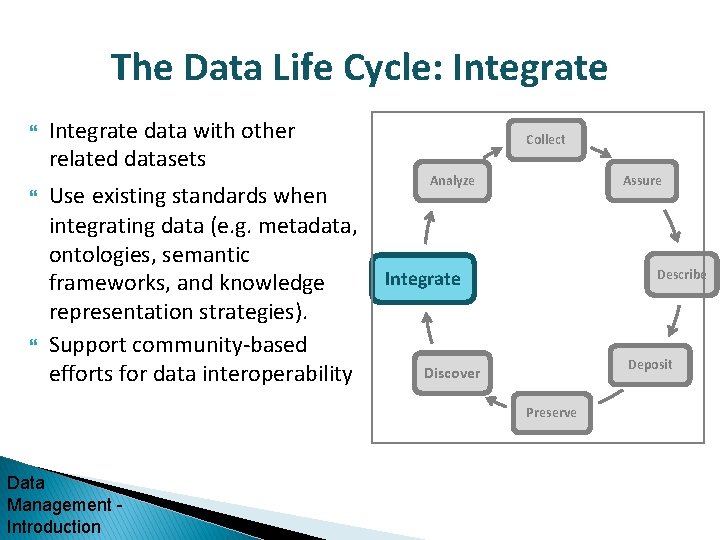
The Data Life Cycle: Integrate data with other related datasets Collect Assure Analyze Use existing standards when integrating data (e. g. metadata, ontologies, semantic Integrate frameworks, and knowledge representation strategies). Support community-based Discover efforts for data interoperability Describe Deposit Preserve Data Management Introduction
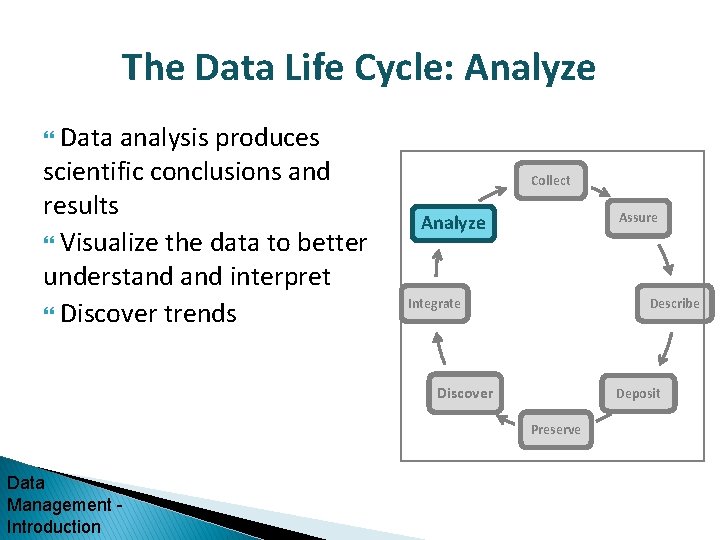
The Data Life Cycle: Analyze Data analysis produces scientific conclusions and results Visualize the data to better understand interpret Discover trends Collect Assure Analyze Describe Integrate Discover Deposit Preserve Data Management Introduction
Data Life Cycle Management (DLM) is a policy-based approach to managing the flow of data through an information system life cycle: from creation and initial storage to long term preservation. Federal guidance on the data life cycle is provided by OMB Circular A-16 Supplemental Guidance Data Management Introduction
Summary Each phase of the Data Life Cycle indicates places in which data should be actively managed The Data Life Cycle is a continuum of data development, manipulation, management, and storage stages DLM or Data Life Cycle Management is an approach to manage the flow of information at each of the Data Life Cycle stages Data Management Introduction
References National Science Foundation http: //searchstorage. techtarget. com/definition/datalife-cycle-management http: //libraries. mit. edu/guides/subjects/datamanagement/cycle. html https: //www. dataone. org/ OMB Circular A-16 Supplemental Guidance - http: //www. whitehouse. gov/sites/default/files/omb/ memoranda/2011/m 11 -03. pdf Data Management Introduction
What did you learn? START QUIZ
1. Which of the following best defines the Data Life Cycle? The Data Life Cycle is a continuum of collecting data. The Data Life Cycle is a continuum of data management. The Data Life Cycle is a continuum of data development, manipulation, management, and storage stages. The Data Life Cycle is a continuum of data collection and analysis. Data Management Introduction
Think about this … You might want to review this section. Return Data Management Introduction
Excellent! Proceed to the next question Next Data Management Introduction
2. Before analyzing data, one is involved in the process or processes of_____. Collection Assurance Description All the above Data Management Introduction
Think about this … You might want to review this section Return Data Management Introduction
Excellent! Proceed to the next question Next Data Management Introduction
3. The deposit stage in the Data Life Cycle provides systems, tools, procedures, and capacity for _________ efficient data and metadata deposition by authors and others. efficient data collection efficient quality control efficient preservation Data Management Introduction
Think about this … You might want to review this section Return Data Management Introduction
Excellent! Proceed to the next question Next Data Management Introduction
4. Data discovery can best be defined as which of the following: New data that has been entered into a repository and is based on new research The process of providing access of data to specialist and non-specialist users through the use of systems, tools, and other methods of dissemination The process of accessingdata through repositories, metadata clearinghouses, and data centers Process of presenting data through various visualization tools to enhance user understanding of the data. Data Management Introduction
Think about this … You might want to review this section Return Data Management Introduction
Excellent! Proceed to the next question Next Data Management Introduction
5. Each phase of the Data Life Cycle defines how data should be actively________. Stored Developed Managed Manipulated All of the Above Data Management Introduction
Think about this … You might want to review this section Return Data Management Introduction
Excellent! Please proceed to the next slide Next Data Management Introduction
6. ______is a policy-based approach to managing the flow of an information system's data throughout its life cycle. Storage Analysis Data Life Cycle Management (DLM) Collection Data Management Introduction
Think about this … You might want to review this section Return Data Management Introduction
Excellent! You have completed this learning module. Next Data Management Introduction
Before you go. . . We want to hear from you! CLICK the arrow to take our short survey. Data Management Introduction