
MODULE 1 Concept of Research and Research Problem
MODULE 1 Concept of Research and Research Problem
Concept of Research is defined as a careful, systematic study in a field of knowledge, undertaken to discover or establish facts or principles (Webster, 1984). It is also defined as a systematic process of collecting and analyzing data to find an answer to a question or a solution to a problem, or to validate or test an existing theory. Research is a systematic investigation of a problem to find out solution in order to establish facts and discover new theories (Caipang, 2000).
Concept of Research is to search again, to take another more careful look, to find out more (Seltiz and others, 1976). From these definitions, it is clear that the ultimate goal of research is to establish facts about the phenomenon being investigated. The facts that will be established during the investigation should be systematic, objective and comprehensive. The gathering, recording, analyses and interpretation of data must be accurate, true and unbiased.
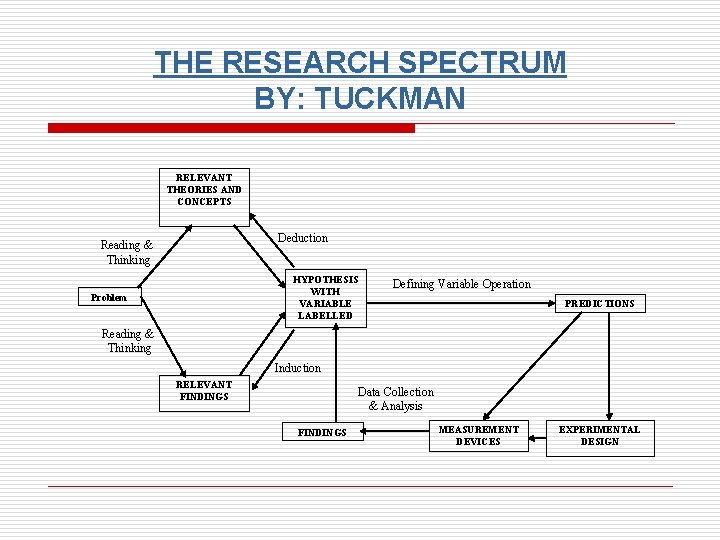
THE RESEARCH SPECTRUM BY: TUCKMAN RELEVANT THEORIES AND CONCEPTS Deduction Reading & Thinking HYPOTHESIS WITH VARIABLE LABELLED Problem Defining Variable Operation PREDICTIONS Reading & Thinking Induction RELEVANT FINDINGS Data Collection & Analysis FINDINGS MEASUREMENT DEVICES EXPERIMENTAL DESIGN
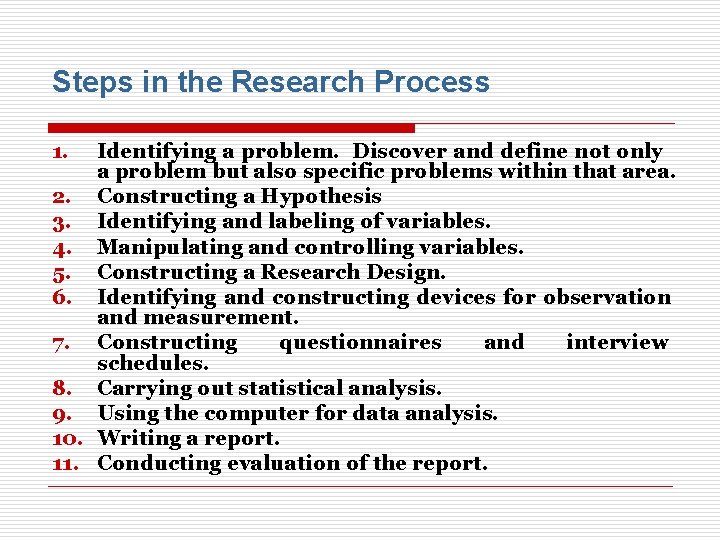
Steps in the Research Process 1. Identifying a problem. Discover and define not only a problem but also specific problems within that area. 2. Constructing a Hypothesis 3. Identifying and labeling of variables. 4. Manipulating and controlling variables. 5. Constructing a Research Design. 6. Identifying and constructing devices for observation and measurement. 7. Constructing questionnaires and interview schedules. 8. Carrying out statistical analysis. 9. Using the computer for data analysis. 10. Writing a report. 11. Conducting evaluation of the report.
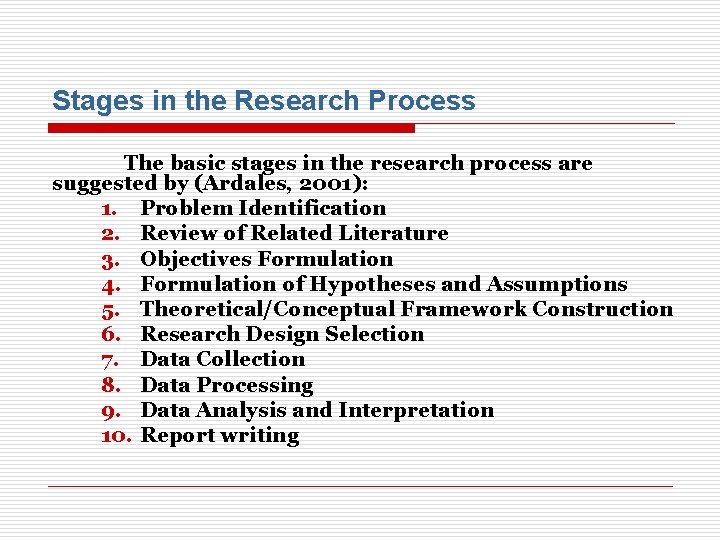
Stages in the Research Process The basic stages in the research process are suggested by (Ardales, 2001): 1. Problem Identification 2. Review of Related Literature 3. Objectives Formulation 4. Formulation of Hypotheses and Assumptions 5. Theoretical/Conceptual Framework Construction 6. Research Design Selection 7. Data Collection 8. Data Processing 9. Data Analysis and Interpretation 10. Report writing
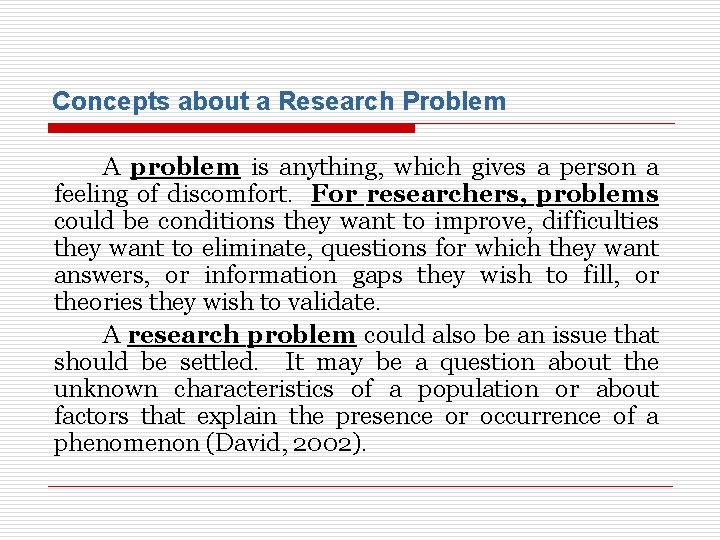
Concepts about a Research Problem A problem is anything, which gives a person a feeling of discomfort. For researchers, problems could be conditions they want to improve, difficulties they want to eliminate, questions for which they want answers, or information gaps they wish to fill, or theories they wish to validate. A research problem could also be an issue that should be settled. It may be a question about the unknown characteristics of a population or about factors that explain the presence or occurrence of a phenomenon (David, 2002).
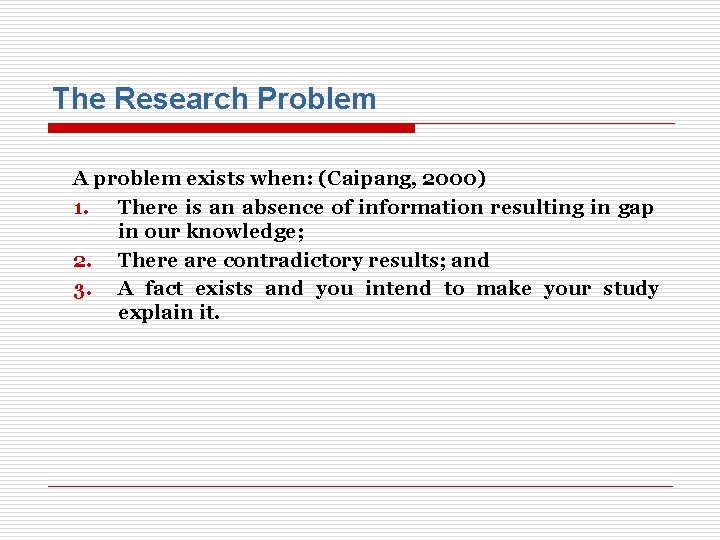
The Research Problem A problem exists when: (Caipang, 2000) 1. There is an absence of information resulting in gap in our knowledge; 2. There are contradictory results; and 3. A fact exists and you intend to make your study explain it.
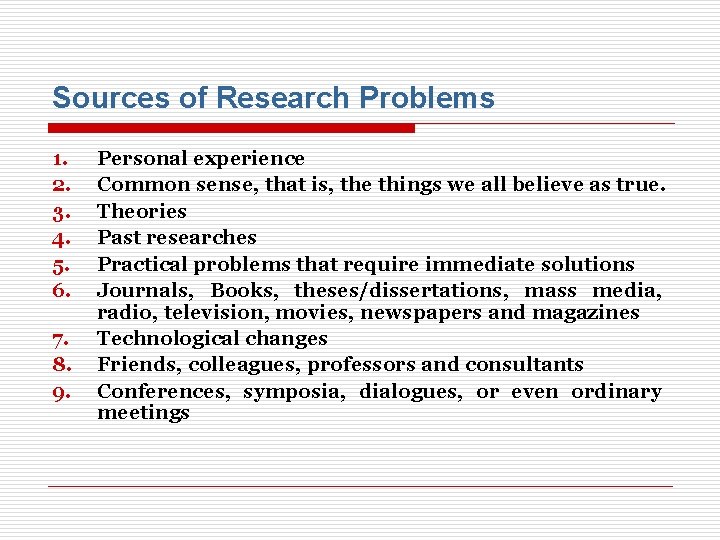
Sources of Research Problems 1. 2. 3. 4. 5. 6. 7. 8. 9. Personal experience Common sense, that is, the things we all believe as true. Theories Past researches Practical problems that require immediate solutions Journals, Books, theses/dissertations, mass media, radio, television, movies, newspapers and magazines Technological changes Friends, colleagues, professors and consultants Conferences, symposia, dialogues, or even ordinary meetings
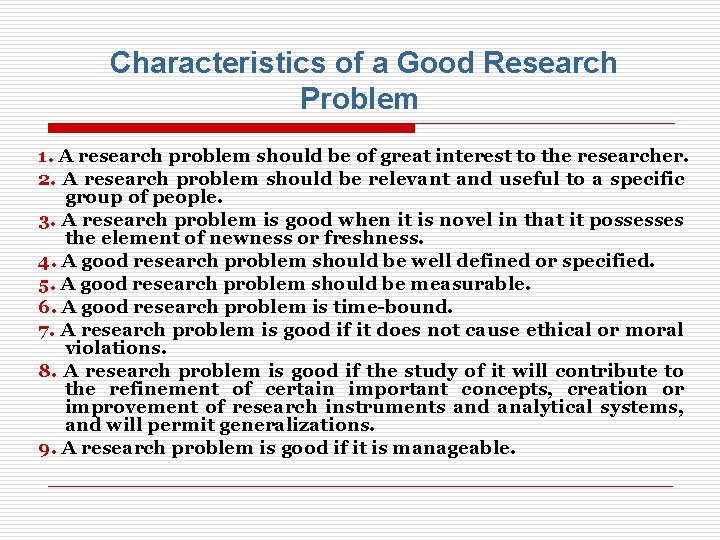
Characteristics of a Good Research Problem 1. A research problem should be of great interest to the researcher. 2. A research problem should be relevant and useful to a specific group of people. 3. A research problem is good when it is novel in that it possesses the element of newness or freshness. 4. A good research problem should be well defined or specified. 5. A good research problem should be measurable. 6. A good research problem is time-bound. 7. A research problem is good if it does not cause ethical or moral violations. 8. A research problem is good if the study of it will contribute to the refinement of certain important concepts, creation or improvement of research instruments and analytical systems, and will permit generalizations. 9. A research problem is good if it is manageable.
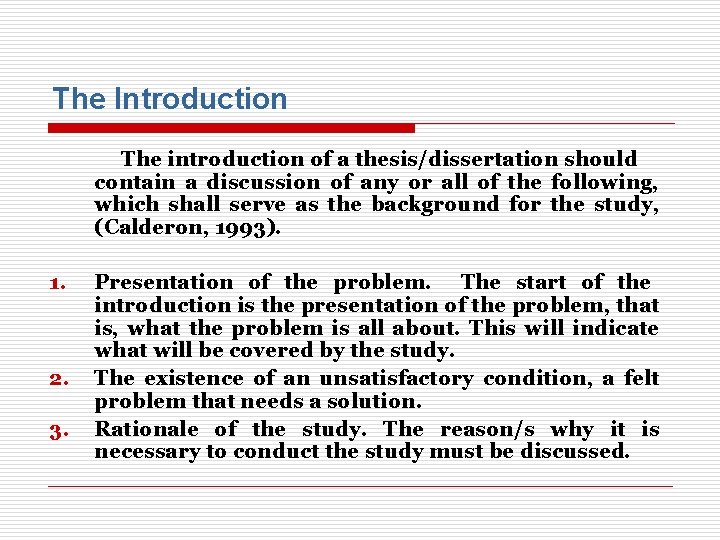
The Introduction The introduction of a thesis/dissertation should contain a discussion of any or all of the following, which shall serve as the background for the study, (Calderon, 1993). 1. 2. 3. Presentation of the problem. The start of the introduction is the presentation of the problem, that is, what the problem is all about. This will indicate what will be covered by the study. The existence of an unsatisfactory condition, a felt problem that needs a solution. Rationale of the study. The reason/s why it is necessary to conduct the study must be discussed.
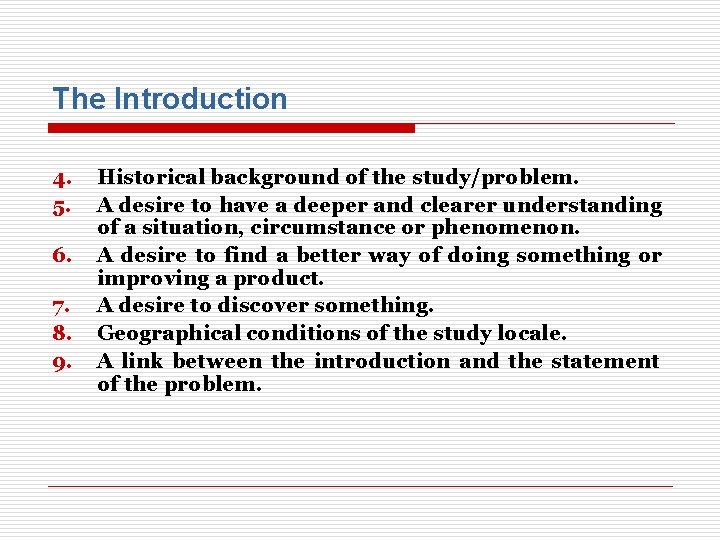
The Introduction 4. 5. 6. 7. 8. 9. Historical background of the study/problem. A desire to have a deeper and clearer understanding of a situation, circumstance or phenomenon. A desire to find a better way of doing something or improving a product. A desire to discover something. Geographical conditions of the study locale. A link between the introduction and the statement of the problem.
WORKSHOP NO. 1 – Problem Identification and Definition Instructions: A. The student is instructed to identify the problem he/she is going to undertake. He/She will also write the introduction, background and rationale of his/her study. B. He/She is requested to present and defend his/her researchable problem. C. He/She is requested to complete the following statements: 1. My research problem is: ______________________________________
WORKSHOP NO. 1 – Problem Identification and Definition 2. The real conditions which gave rise to my research question are (Present evidences from service statistics or related literature that will confirm the existence, seriousness and distribution of your problem) _______________________________________________ 3. The ideal conditions would have been: (standard, rule, expected, mandated, recommended) ______________________________________________ 4. The possible reasons for the discrepancy between No. 2 and 3 are: ______________________________________________
MODULE 2 Research Objectives/Statement of the Problem and Hypotheses
The Research Objectives/Statement of the Problem Research objectives refer to the statements of purpose, aims or goals, which are expected to be attained at the end of the research process.
Major Classifications 1. General objective is a broad statement of purpose, which uses abstract and non-measurable concepts. 2. Specific objective is a statement of purpose, which uses well-defined and measurable concepts the formulation of which should be based on and logically flows from the general objective
Major Classifications Example: General Objective. The purpose of the study is to develop and evaluate the acceptability of the multi-purpose machine. Specific Objectives. Specifically, it seeks to answer the following questions: 1. What is the level of acceptability of the multi-purpose machine as evaluated by the instructors and engineers in terms of design, construction and efficiency?
Major Classifications 2. Is there a significant difference in the level of acceptability of the multi-purpose machine as evaluated by the instructors and engineers in terms of design, construction and efficiency?
Characteristics of Good Research Objectives 1. They should be stated in simple language; 2. They are measurable concepts; 3. They are attainable; 4. They are result-oriented; and 5. They are time-bounded.
The statement of research objectives maybe in declarative or question form. The choice depends mainly on the chosen style of the researcher. The following examples illustrate this: Declarative form: To find out the level of acceptability of the multi-purpose machine as evaluated by the instructors and engineers in terms of design, construction and efficiency. Question form: What is the level of acceptability of the multi-purpose machine as evaluated by the instructors and engineers in terms of design, construction and efficiency?
The Hypothesis is: - a statement about expected relationships between two or more variables, which permit empirical testing (Fisher and others, 1991). - a formal affirmative statement predicting a single research outcome, a tentative explanation of the relationship between two or more variables. - is the most specific statement of a research problem or objective. - is a tentative and educated or intelligent guess or prediction about the existence, attributes or relationship between factors or variables covered in the study.
The following are the guidelines in the formulation of explicit hypothesis (Calderon, 1993): 1. In experimental investigations, hypothesis has to be expressed. 2. In descriptive and historical investigations, hypothesis is seldom expressed if not entirely absent. The sub-problems or specific questions raised before the start of the investigation and stated under the statement of the problem serve as the hypothesis. The specific question serves as the hypothesis. No research is conducted without any hypothesis at all. 3. Hypothesis is usually stated in null form because testing a null hypothesis is easier than a hypothesis in the operational form. Testing a hypothesis simply means gathering data to answer it. 4. Hypothesis is formulated from the specific questions upon which they are based.
Purposes, Functions and Importance of Hypothesis (specific questions) performs important functions in research such as the following (Calderon, 1993). 1. They help the researcher in designing his study: what methods, research instruments, sampling design, and statistical treatments to use, what data to gather, etc. 2. They serve as bases for determining assumptions. 3. They serve as bases for determining the relevance of data. 4. They serve as bases for the explanation or discussion about the data gathered. 5. They help or guide the researcher in consolidating his findings and in formulating his conclusions. Generally, findings and conclusions are answers to the hypotheses or specific questions raised at the start of the investigation.
The following are types of hypotheses: (Sevilla, 1988) 1. The null hypothesis means no existence of an effect, an interaction of relationships, or of difference. 2. The alternative hypothesis is considered the operational statement of the research hypothesis. 3. The non-directional hypothesis does not state any direction. It is two-tailed. 4. The directional hypothesis shows a direction of the effect or of difference. It requires a one-tailed test.
WORKSHOP No. 2 – Formulation of Research Objectives and Hypotheses Instructions: A. The student is requested to formulate his/her research objectives and hypotheses and present his/her output for critiquing. B. He/She is requested to complete the following statements: 1. My research problem is: __________________________________
WORKSHOP No. 2 – Formulation of Research Objectives and Hypotheses 2. The immediate/general objectives of my study is: _______________________________________ ___ 3. The specific objectives of my study are: _______________________________________ ___ 4. The hypotheses of my study are: _______________________________________ ___
MODULE 3 Theoretical/Conceptual Framework
Theoretical Framework The theoretical framework presents a theory, which explains why the problem under study exists. A theory is a set of concepts, which explain and predict the occurrence of a certain phenomenon. The theoretical framework helps the researcher see clearly the variables that he should measure. It provides a general framework, which can guide him in the data analysis.
Conceptual Framework The conceptual framework consists of the researcher’s own position on a problem after his exposure to various theories that have bearing on a problem (Calderon, 1993). The conceptual framework serves as the guide in conducting the study.
Research Paradigm The research paradigm provides explanations why the problem under study exists by showing how the variables involved in the problem are related to each other. The research paradigm or framework not only explains why the problem under study exists but it also helps the researcher see clearly the variables that should be measured, and provides a general framework, which can guide him in the analyses of data.
Variables of the study A variable is a characteristic that has two or more mutually exclusive values or properties. Independent variable is that property or characteristics that make the outcome or objective vary or differ. Dependent variable is the outcome or objective of the study. In lay language, it is the result. Moderator variable is a variable that influences (moderates) the impact of the independent variable upon the dependent variable.
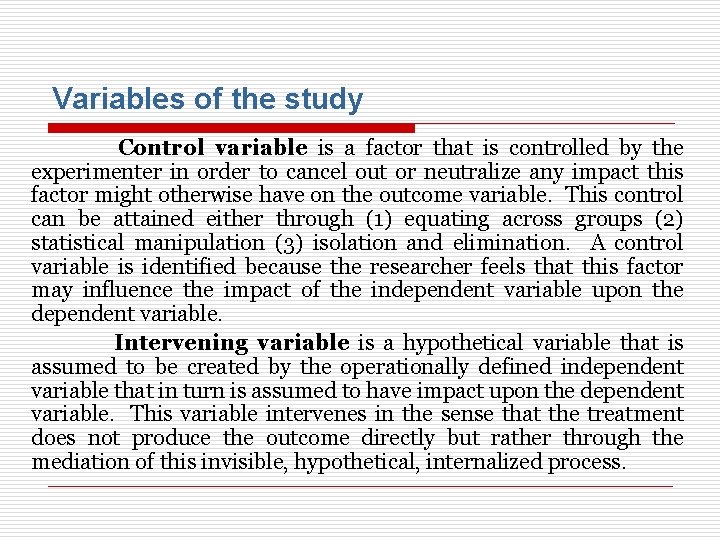
Variables of the study Control variable is a factor that is controlled by the experimenter in order to cancel out or neutralize any impact this factor might otherwise have on the outcome variable. This control can be attained either through (1) equating across groups (2) statistical manipulation (3) isolation and elimination. A control variable is identified because the researcher feels that this factor may influence the impact of the independent variable upon the dependent variable. Intervening variable is a hypothetical variable that is assumed to be created by the operationally defined independent variable that in turn is assumed to have impact upon the dependent variable. This variable intervenes in the sense that the treatment does not produce the outcome directly but rather through the mediation of this invisible, hypothetical, internalized process.
WORKSHOP No. 3 – Theoretical/Conceptual Framework Construction A. The student is requested to formulate and construct his/her theoretical/conceptual framework and to present his/her output for critiquing. B. He/She is requested to complete the following statements: 1. My research problem is: ______________________________________________ 2. The general objective of my study is: ________________________ 3. The specific objectives of my study are: _______________________________________________
WORKSHOP No. 3 – Theoretical/Conceptual Framework Construction 4. My study is anchored on theory of______________________, which states that: _____________________________________________ 5. The major variables of my study are: Dependent Variable: ______________ Intervening Variable/s (if any): ______________________________ Independent Variables: _________________________________ 6. The assumed flow of the major variables of my study is shown in the diagram below (Draw a diagram of the assumed flow of relationship of your variables):
MODULE 4 Definition of Variables, Significance and Scope and Limitation of the Study
Definition of Variables There are two major types of definitions – the conceptual and the operational. Conceptual Definition is the universal meaning that is attributed to a word or group of words and which is understood by many people. The usual source of conceptual definitions is the dictionary. Operational Definition is the meaning of the concept or term as used in a particular study.
Definition of Variables The usual practice when using both types of definition is to state first the conceptual followed by the operational. Example: Acceptability is capable on worthy of being accepted satisfactorily (Webster, 1998). As used in this study, acceptability refers to the degree of acceptance of evaluators of the AC-DC Ignition System Trainer as an instructional device.
Significance of the Study It is in this section where the researcher discusses the value of his study in as persuasive manner as possible in order to get the approval of the screening and approving committee. The significance of the study can be presented on the bases of the targeted beneficiaries or users of the result of the study. A number of individuals or social groups may be cited as beneficiaries of research results. The discussion on how each individual or social group will benefit from the results of the study should be made explicitly or in detail. The basic consideration here is: In what way or customs will the results of the study be useful to the identified beneficiary/beneficiaries?
Scope and Limitations of the Study The scope of the study defines the coverage or boundary of the study in terms of the (1) area or locality, (2) subjects or population, (3) duration or period, and (4) issues which are explicitly stated in specific objectives of the study. Limitations are statements, which alert the reader of the research report to certain conditions, and are beyond the control of the researcher. Such limiting conditions or constraints have direct bearing on the result of the study because they may place restrictions on the conclusions of the study and their application to other situations.
WORKSHOP No. 4 – Definition of Variables, Significance and Scope and Limitations of the Study Writing Instruction: A. The student is requested to write his/her definition of variables, significance of the study and scope and limitations of the study. B. He/She is requested to present his/her output for critiquing. C. He/She is requested to complete the following statements: 1. My research problem is: _____________________________________________ 2. The general objective of my study is: _____________________________________________
WORKSHOP No. 4 – Definition of Variables, Significance and Scope and Limitations of the Study Writing 3. The specific objectives of my study are: ___________________________________________ 4. The variables/terms that will be defined in my study to include its conceptual and operational definitions are: ___________________________________________ 5. The people that will be benefited by my study are: ___________________________________________
WORKSHOP No. 4 – Definition of Variables, Significance and Scope and Limitations of the Study Writing 6. My study is about: _______________________________________________ 7. My study will be conducted at the __________________________on ________. 8. The respondents of my study are: ________________________ 9. The instrument that will be used in my study is the ________________________ 10. The statistical tools that will be used in the treatment of my data are: ________________________

MODULE 5 Review of Related Literature and Studies

Related Literature Defined The Webster Dictionary (1990) defines literature as all the writings having excellence of form or expression and expressing ideas of permanent or universal interest produced in a particular language, country, or age. The adjective related implies that the literature reviewed have some connection, bearing or relation to the problem or concern under investigation. A review of related literature is the process of collecting, selecting, and reading books, journal articles, reports, abstracts, and other reference materials, including electronic sources (CD-ROM) and the world wide web (www/http) to get relevant information about the problem under investigation (David, 2002).

Types of Literature can be classified into two major types – the research literature and the conceptual literature. Research Literature refers to written reports on the result of researches or studies, which were done, previously, either published or unpublished. Conceptual Literature consists of article or books written by authorities giving their opinions, experiences, theories or ideas of what is good and bad, desirable and undesirable within the problem area (Fox, 1969). Fox (1969) suggested that in reviewing literature, it is wise to start with the conceptual literature because it is more readily available than the research literature. The other reason for this strategy is the fact that conceptual literature is more comprehensive than the research literature.
Why Review the Related Literature? 1. 2. 3. 4. The following functions of literature review were taken from the discussions of Kerlinger (1986), Gay (1976), and Seltiz and others (1976). Review of related literature provides the researcher knowledge and background on the subject under study. The review will enable the researcher to avoid duplicating what has been studied already. If a study on the same topic has been conducted before, the review provides the researcher information about the aspects of the problem, which have not been investigated or explored before. By reviewing related literature, the researcher will be helpful in developing various parts of his study such as definition of problems and terms, research design, sampling, and data gathering techniques.

Why Review the Related Literature? 5. The review provides the researcher information on the weaknesses and problems of previous studies and some ideas on how to handle or avoid them in his own study. 6. It also provides the researcher ideas on how to proceed with the investigation. 7. The review provides findings and conclusions of past studies, which the researcher may relate to the findings, and conclusions. 8. Studies reviewed will provide the researcher motivation and impetus that will ensure a good progress toward the goal of completing his study. 9. A summary of writings of recognized authorities and of previous researches provides evidence that the researcher is familiar with what is already known and what is still untested. In reviewing research literature, the researcher should not include all the findings, conclusions and recommendations of the study. Only findings, conclusions and recommendations, which have bearings on the study, should be cited in the review.
Steps in Literature Review In reviewing related literature, the following steps may be followed: (David, 2002) 1. Review the precise definition of the research problem. Note the key variables specified in the study objectives and hypothesis. 2. Formulate “search terms” (key words or phrases) pertinent to the problem or question or interest. 3. Using the indexes of general references, search for relevant primary and secondary sources guided by the “search terms. ” Start with the most recent issue and work backwards.

Steps in Literature Review 4. List in a note or index card the bibliographical data of the pertinent sources selected, including the: a) author of the source, b) its title, c) name of the publication, d) date of publication (if book, include place and date) and e) page/s of the article. 5. Read the selected reading materials, take notes and summarize key points. Notes are preferably written in note cards for easy retrieval and classification. In reading articles, the researcher may follow the following steps: a. Read the abstract or summary. b. Record the bibliographic data. c. Take notes. In taking notes, be as brief as possible, but include all relevant information which you can use in your full review, such as: the problem, the objectives and hypotheses, the procedures, major findings, and conclusions.
Presenting Reviewed Literature In presenting reviewed literature in a research proposal or report, the researcher has the option to choose from among the following approaches: Chronological approach. The literature is presented according to the time they were written, that is, following the time-sequence pattern. The recent ones should be presented first going as far back as three to five years ago. Type of literature approach. The literature is classified into two categories – conceptual and research – with the former presented first. Findings, theme or topic approach which brings together and classifies literature according to similarity of findings. Country approach which classifies literature by country, or into local and foreign studies categories. The researcher may combine two or more approaches in presenting reviewed literature. For example, he will first classify the literature by type conceptual and research categories. Under each type he will present the literature by chronological order from the present to the past.

Writing the Literature Review After taking notes from the different sources reviewed, the researcher prepares the final review. Most literature reviews consists of the following parts: introduction, body, summary/synthesis, and conclusion. Introduction. The introduction briefly describes the nature of the research problem and explains what led the researcher to investigate the question. The summary presents the main topics covered in the literature review section. Body. The body of the review briefly reports what experts think or what other researchers have found about the research problem. Studies done on one key element or factor of the research problem are reviewed under that topic followed by studies done on other aspects of the problem. The common findings of several studies are summarized in one or two sentences and only when necessary, some specific findings of each study may be presented.
Writing the Literature Review Summary/synthesis. The summary/synthesis of the literature review “ties together” the major findings of the studies reviewed. It presents a general picture of what has been known or thought of about the problem to date. It points out similar results, as well as conflicting findings. Conclusion. This part presents the course of action suggested by the literature. Based on the state of knowledge revealed by the literature, the researcher could further justify the need for his/her study.
WORKSHOP No. 5 – Review of Related Literature Writing Instruction: A. The student is instructed to write his/her related literature using various materials. B. He/She is requested to present his/her output for critiquing. C. He/She is requested to complete the following statements: 1. My research problem is: __________________________________________ 2. The general objective of my study is: __________________________________________

WORKSHOP No. 5 – Review of Related Literature Writing 3. The specific objectives of my study are: _____________________________________________ 4. The topics that will be discussed in my literature review are: _____________________________________________ 5. The related studies that will be used are: _____________________________________________
MODULE 6 Research Designs
Appropriateness of Research Design Research design refers to a scheme or plan of action for meeting the objectives of the study. A number of research designs have been developed through the years. Each design has its own applicability depending on the problem and objectives of the study. From available research designs, the researcher is to select that which is most appropriate and effective in attaining the study goals. This implies that there is no best or versatile research design that is applicable to any study. A research design is the “blue print” of the study. It guides the collection, measurement and analysis of data (Cooper and Schindler, 2001). It is a plan or course of action, which the research follows in order to answer the research question/s or solve the research problem (Sanchez, et. al. , 1996). The design becomes the basis for determining what data will be collected, and how they will be analyzed and interpreted.
Reliability vs. Validity (David, 2002) Reliability refers to the consistency, stability and dependability of the data. A reliable measuring device is one, which, if used for the second time, will yield the same results as it did the first time. If the results are substantially different, the measurement is unreliable. Validity refers to the extent to which a measurement does what it is supposed to do, which is to measure what it intends to measure. Valid data are not only reliable, but also true and sound. A researcher must select a research design that will yield a true and accurate information and avoid factors that can invalidate study results.
Validity Threats There are many threats to validity. The most common of them are history, selection, testing, instrumentation, maturation, and mortality (David, 2002). History. Sometimes there are events in the life of a research project, which are not part of the project that can increase or decrease the expected project outcomes. These events are not expected, they just happen and they produce effects that can invalidate study results. Selection. In an experimental study, a threat to validity occurs when the elements or subjects selected for the experimental group is very different from those selected for the control group. For instance, if at the beginning of the experiment, the experimental group already has an advantage over the control group in terms of the focus variables of the study, this difference will definitely affect the results of the study.
Validity Threats Testing. Whenever a pretest is given, it may make the examinees “test wise”, and this can therefore affect the posttest results. Research subjects who have given a pretest may remember some of the test items/questions for which they may search answers and get these correct when they take the posttest. Better performance in the posttest might be due to the effect of the pretest and not necessarily to the intervention or treatment. Instrumentation. When a research instrument, such as a questionnaire or a measuring device, like a weighing scale or a thermometer is changed during the study period or between the pretest and the posttest, the change could result in an effect that is independent of the intervention and yet, may be attributed to it. Maturation. People and things change over time. In other words they become more mature, and this change can threaten the validity of conclusions. Research subjects can get tired, hungry, or bored during the duration of the project. If the effect of the project is measured with a test, their tiredness or boredom can result in scores lower than their “true” scores.
Validity Threats On the other hand, the subjects may become more experienced, more knowledgeable as they grow older and as a result they may get higher scores than they did in the pretest. In this regard the change cannot be attributed to the intervention. Mortality. In studies that take a long time to finish, say, one year or more, like cohort studies, where the subjects (same people) are followed up over time, some cases may drop out, thus resulting in a loss of cases. Some cases may be transferred residence and are difficult to locate during the follow-up interview. Cases, which cannot be contacted, cannot be followed-up. This loss, called mortality, may distort findings and conclusions, if substantial and if it has introduced a bias to the sample. The loss could result in a big difference between the pretest and the posttest results. This change may be wrongly attributed to the intervention, thus, threaten the validity of the conclusions.
Types of Research Design 1. Historical Research Design. It is a systematic and objective location, evaluation and synthesis of evidence in order to establish facts and draw conclusions about past events. The goal of historical research is to know the whole truth of what happened in the past so that we will not only understand the present but will be helped in knowing what to do in the present and future (Fox, 1969). 2. Descriptive Research Design. This design is appropriate for studies which aim to find out what prevail at present: conditions or relationships, held opinions and beliefs, processes and effects, and developing trends. It also seeks to determine relationships between variables, explores causes of phenomena, tests hypotheses, and develops generalizations, principles or theories on the basis of its findings.
Types of Descriptive Research (Ardales, 2001). 1. Surveys. It is suitable for studies the objective of which is to see a general picture of the population under investigation, describe the nature of existing conditions, or determine the relationships that exist between specific variables or events. Its concern is not to find out the characteristics of every individual covered but to come up with general descriptions of the whole group. 2. Case Studies. The case study is the appropriate design to use when the aim of the study is to have a deeper, more thorough and more comprehensive understanding of an individual or group such as the family, class, organization or community. 3. Trend Studies. This is the most appropriate design when some persons want to predict, on the basis of available data, the direction and future status of certain phenomenon like population size, school enrolment, business growth, household expenditures and residential location.
Types of Descriptive Research (Ardales, 2001). 4. Content Analysis. When the objective of the study is to find out the type and quality of message found in current documents then the research design to use is content analysis, also known as document analysis. 5. Feasibility Studies. This research design is used when the objective of the study is to find out the viability of starting a business venture, implementing a development program, establishing an institution, forming an organization, putting up a television network or constructing a commercial building. 6. Development Studies. If the purpose of the researcher is to find out how and to what extent individuals grow or develop in terms of physical, intellectual, emotional and social dimensions then the developmental study is the research design to use. In technical research, this design is applicable when the researcher’s objective is to develop, invent or innovate a gadget.
Types of Descriptive Research (Ardales, 2001). 7. Follow-up Studies. Follow-up studies are those, which are conducted with the goal of finding out what happened to individuals who completed a program, a treatment or a course of study. 8. Evaluation Studies. The purpose of doing evaluation studies is to find out if a given program is working or an institution is successful. In technical research, this design is applicable when the objective of the researcher is to evaluate the finished gadget for its acceptability in terms of design, construction, efficiency, effectiveness and etc. 9. Ethnographic Studies. This design aims to study the characteristics, way of life, belief, attitudes, fears and hopes of cultural or ethnic groups.
Types of Descriptive Research (Ardales, 2001). 10. Relational/Correlation Studies. Researchers are to use the relational/correlation design when their aim is to find out the direction and extent of relationship between two or more paired variables or two or more sets of data. 11. Ex Post Facto Studies. Ex post facto means “from after the fact”. In research, the ex post facto, also known as casualcomparative design is a method wherein the researcher studies the problem by analyzing past events or existing conditions to determine influence or causation. It is also the method to use when the aim of the researcher is to find out the existing differences in the status, behavior, attitude and belief of groups of individuals.
Types of Research Design 3. Experimental Research Design. If the aim of the researcher is to find out what caused the change in the characteristics or behavior of the subjects and what change or effect has been made then the design to use is the experimental research design. It is a design in which an investigator/researcher manipulates and controls one of the independent variables and observes the dependent variable or variables for variation concomitant to the manipulation of the independent variables (Kerlinger, 1986). Another distinguishing feature of experimental research is that it usually involves two groups – an experimental group and a control group. Experimental Group. This group is exposed to the influence of a factor – an intervention or treatment, under consideration. Control Group. This group is not exposed to the same factor to which the experimental group is exposed to, or it receives a different treatment, or it is left to its usual way of doing things.
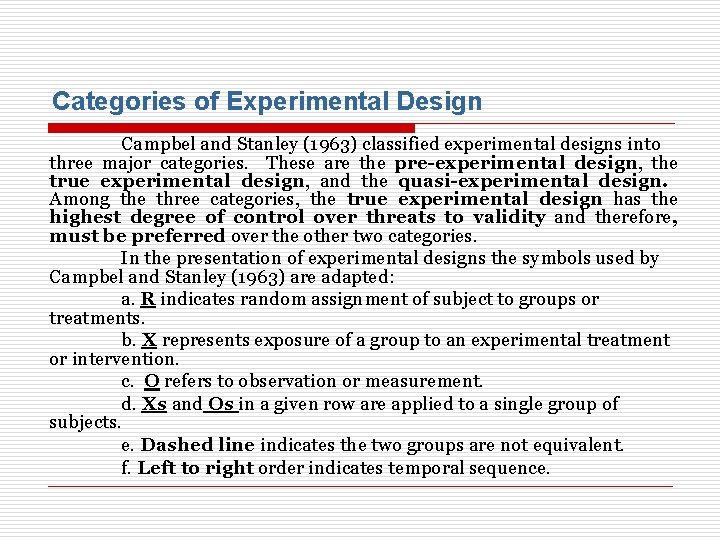
Categories of Experimental Design Campbel and Stanley (1963) classified experimental designs into three major categories. These are the pre-experimental design, the true experimental design, and the quasi-experimental design. Among the three categories, the true experimental design has the highest degree of control over threats to validity and therefore, must be preferred over the other two categories. In the presentation of experimental designs the symbols used by Campbel and Stanley (1963) are adapted: a. R indicates random assignment of subject to groups or treatments. b. X represents exposure of a group to an experimental treatment or intervention. c. O refers to observation or measurement. d. Xs and Os in a given row are applied to a single group of subjects. e. Dashed line indicates the two groups are not equivalent. f. Left to right order indicates temporal sequence.
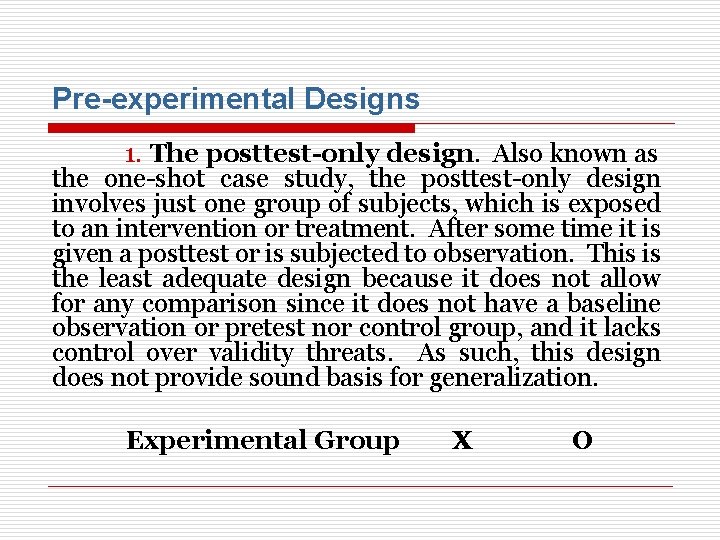
Pre-experimental Designs 1. The posttest-only design. Also known as the one-shot case study, the posttest-only design involves just one group of subjects, which is exposed to an intervention or treatment. After some time it is given a posttest or is subjected to observation. This is the least adequate design because it does not allow for any comparison since it does not have a baseline observation or pretest nor control group, and it lacks control over validity threats. As such, this design does not provide sound basis for generalization. Experimental Group X O
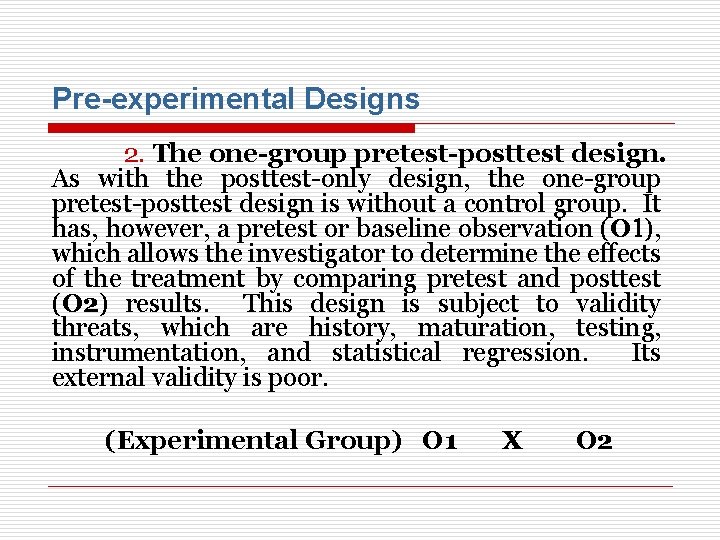
Pre-experimental Designs 2. The one-group pretest-posttest design. As with the posttest-only design, the one-group pretest-posttest design is without a control group. It has, however, a pretest or baseline observation (O ), which allows the investigator to determine the effects of the treatment by comparing pretest and posttest (O 2) results. This design is subject to validity threats, which are history, maturation, testing, instrumentation, and statistical regression. Its external validity is poor. (Experimental Group) O 1 X O 2
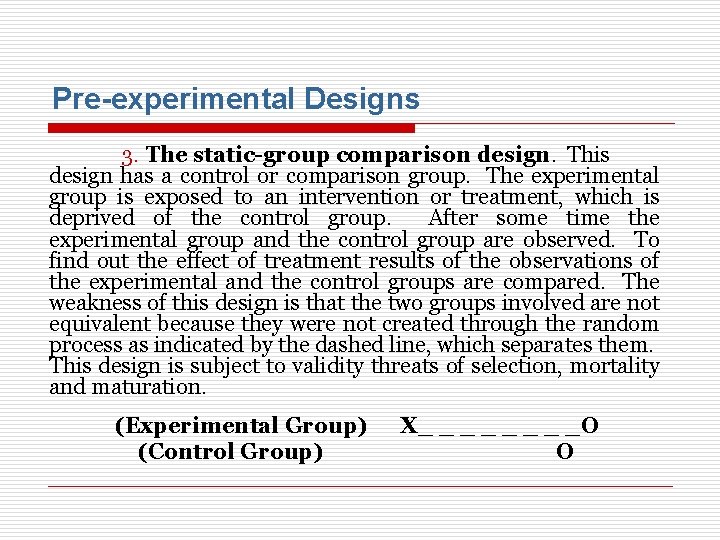
Pre-experimental Designs 3. The static-group comparison design. This design has a control or comparison group. The experimental group is exposed to an intervention or treatment, which is deprived of the control group. After some time the experimental group and the control group are observed. To find out the effect of treatment results of the observations of the experimental and the control groups are compared. The weakness of this design is that the two groups involved are not equivalent because they were not created through the random process as indicated by the dashed line, which separates them. This design is subject to validity threats of selection, mortality and maturation. (Experimental Group) (Control Group) X_ _ _ _ _O O
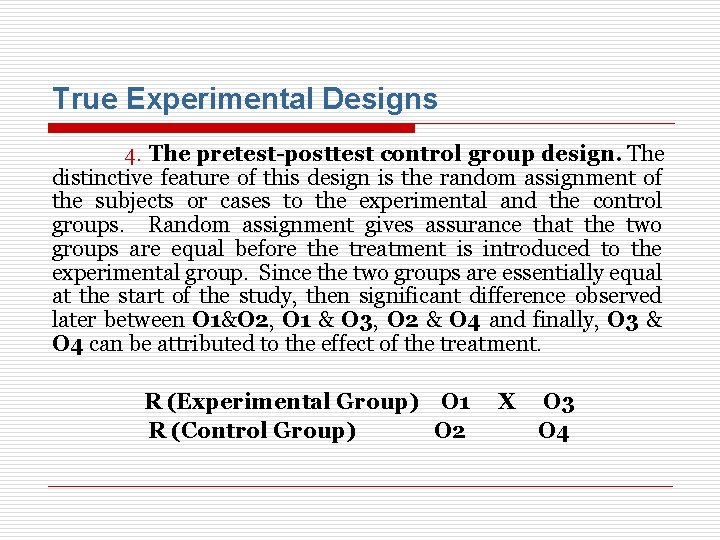
True Experimental Designs 4. The pretest-posttest control group design. The distinctive feature of this design is the random assignment of the subjects or cases to the experimental and the control groups. Random assignment gives assurance that the two groups are equal before the treatment is introduced to the experimental group. Since the two groups are essentially equal at the start of the study, then significant difference observed later between O 1&O 2, O 1 & O 3, O 2 & O 4 and finally, O 3 & O 4 can be attributed to the effect of the treatment. R (Experimental Group) O 1 R (Control Group) O 2 X O 3 O 4
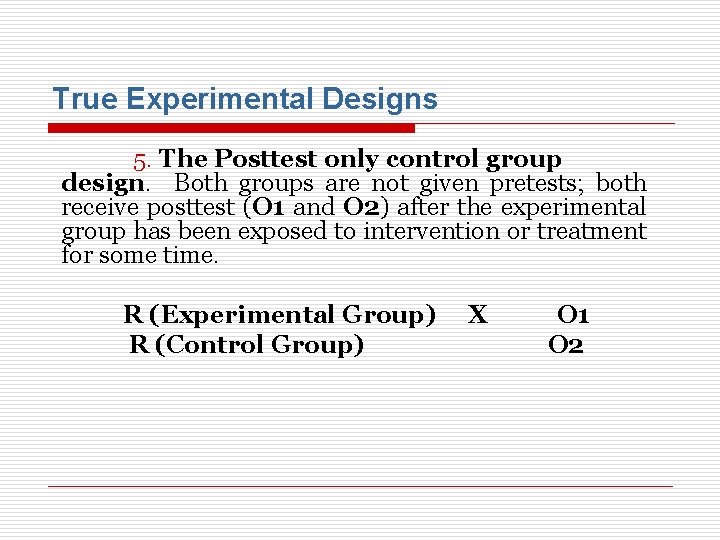
True Experimental Designs 5. The Posttest only control group design. Both groups are not given pretests; both receive posttest (O 1 and O 2) after the experimental group has been exposed to intervention or treatment for some time. R (Experimental Group) R (Control Group) X O 1 O 2
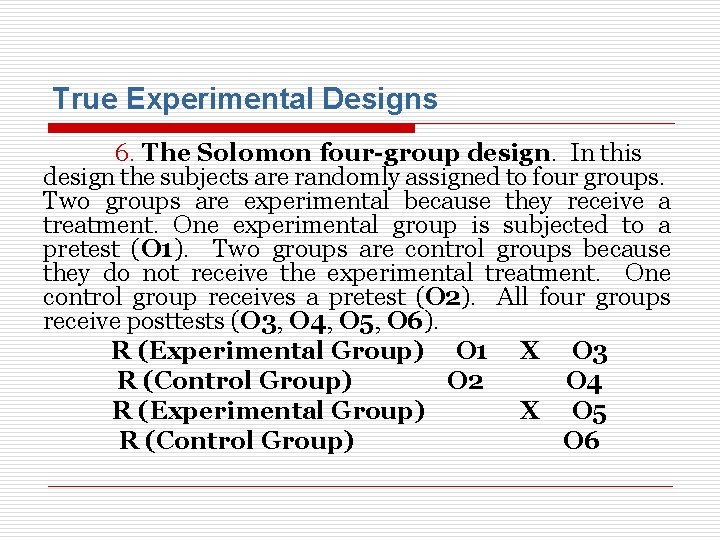
True Experimental Designs 6. The Solomon four-group design. In this design the subjects are randomly assigned to four groups. Two groups are experimental because they receive a treatment. One experimental group is subjected to a pretest (O 1). Two groups are control groups because they do not receive the experimental treatment. One control group receives a pretest (O 2). All four groups receive posttests (O 3, O 4, O 5, O 6). R (Experimental Group) O 1 X O 3 R (Control Group) O 2 O 4 R (Experimental Group) X O 5 R (Control Group) O 6
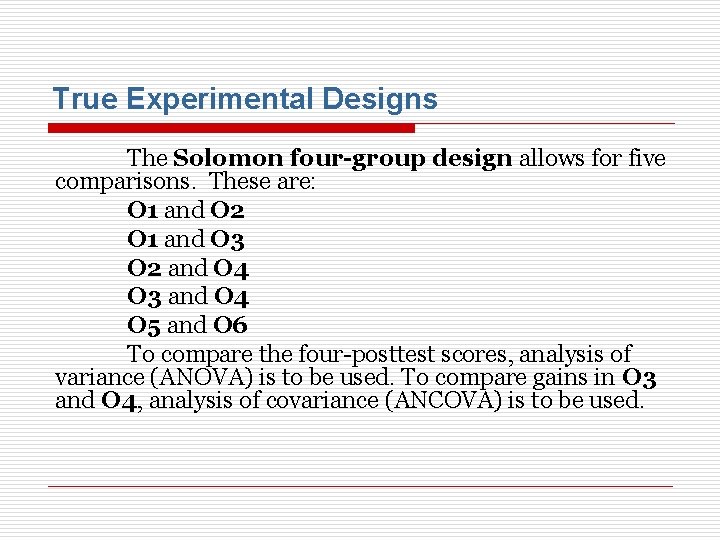
True Experimental Designs The Solomon four-group design allows for five comparisons. These are: O 1 and O 2 O 1 and O 3 O 2 and O 4 O 3 and O 4 O 5 and O 6 To compare the four-posttest scores, analysis of variance (ANOVA) is to be used. To compare gains in O 3 and O 4, analysis of covariance (ANCOVA) is to be used.
Quasi-Experimental Designs
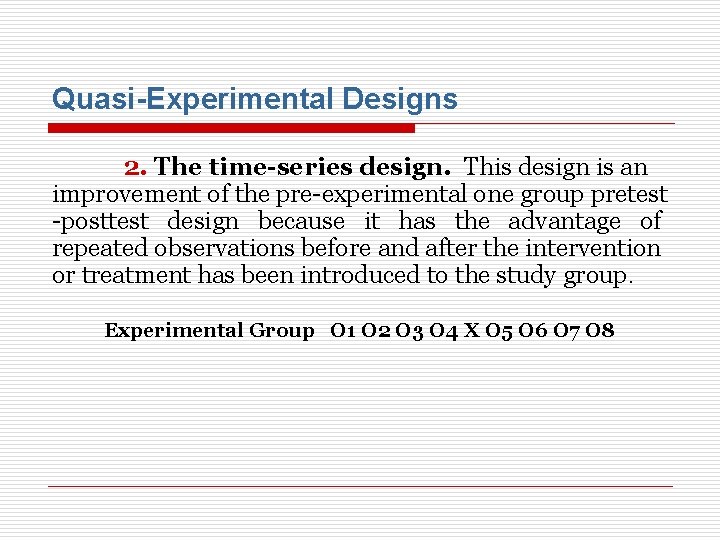
Quasi-Experimental Designs 2. The time-series design. This design is an improvement of the pre-experimental one group pretest -posttest design because it has the advantage of repeated observations before and after the intervention or treatment has been introduced to the study group. Experimental Group O 1 O 2 O 3 O 4 X O 5 O 6 O 7 O 8
WORKSHOP No. 6 – Research Design Selection Instruction: A. The student is requested to select an appropriate research design. The discussion and justification of his/her choice of the research design should be the main output for critiquing. B. He/She is requested to complete the following statements: 1. My research problem is: ________________________________________ 2. The general objective of my study is: ________________________________________
WORKSHOP No. 6 – Research Design Selection 3. The specific objectives of my study are: _______________________________________________ 4. The hypotheses of my study are: _______________________________________________ 5. The research design that I will use is: ________________________ 6. The reasons for my choice of this design are: _______________________________________________
MODULE 7 Sampling Technique
Population and Sample (Daleon, 1989) Population. A set of data for study consists of the totality of observations of the entire universe of people or factors of interest. Sample. A sample is a subset of the total population of interest for inference purposes. -It refers to a subgroup or portion of the population selected to represent the population and on which is based any statement about the population from which it is drawn (Ardales, 2001). Sampling is the process of selecting a sample of individuals from the total population to be studied. It involves determining the adequacy of the sample size and it may require elaborate selection procedure to ensure that the sample is representative of the study population.
Sampling Procedures (Daleon, 1989) There are two basic sampling procedures: 1. Probability sampling or unbiased or random sampling 2. Nonprobability or biased or nonrandom sampling
Probability Sampling In probability sampling, each element in the population of interest has an equal chance of being included in your sample for study. Several sampling techniques can be used for this purpose, and these are as follows: Simple Random Sampling. In this sampling technique, you have to assign each member in the population of interest of say 1, 000, a specific number starting with 1 and ending with 1, 000. Their names and numbers are written on rolled slips of papers and placed in a box. If the sample needed is, say 200, then only 200 rolled slips are drawn out by lottery. Those whose numbered names appear therein constitute the sample group for the study. Or a table of random numbers may be used instead of the lottery technique.
Probability Sampling Systematic Sampling. In this technique, a list of all members of the population is necessary. To determine the sample to be taken from the population, you can systematically get from the list all those whose names are assigned to odd numbers or all names with even numbers. Or, you can get all those whose family names start with a vowel or get every nth name in the master list of the agency concerned starting with the first number randomly chosen there from. Stratified Sampling. In this sampling method, you have to divide the total population into strata. Each stratum is composed of a more or less homogeneous sub-population group but they differ from stratum to stratum in the total population. Say the first year students in a school compose one stratum and so with the others in the second year, third year, and fourth year levels. From this population, the sample group from each stratum is chosen at random, depending on its proportion to the whole targeted population.
Probability Sampling Cluster Sampling. In this type of sampling technique, each member of a cluster or a geographic zone possesses the same characteristics of interest to the researcher as the other clusters. Once you have mapped out all the clusters or areas in the targeted population, you are to choose at random as many clusters as you need for your sample group(s). All the members in the chosen clusters or areas will compose the total number of subjects or respondents for your study.
Non-probability Sampling In non-probability sampling, there is no random selection of cases from the population. Subjects that are needed for the study are merely taken from those who are at hand. Non-probability sampling is also referred to as convenience or judgmental sampling. The following are non-random sampling techniques: Accidental or Incidental Sampling. In this type, you simply take the persons or subjects that are needed from those who are at hand.
Non-probability Sampling Quota Sampling. As the term implies, quota sampling refers to the practice of assigning quotas or proportions of areas to the interviewer-assistants of a researcher. This technique is often used in public opinion surveys where the number is too big to be handled by one researcher. Purposive Sampling. In this sampling technique, you simply pick out the persons whom you think are representative of the population to which you want to make an inference to for purposes of your study. Hence, it is sometimes called judgmental sampling. This is usually resorted to when the boundaries of the desired population of interest are difficult to define.
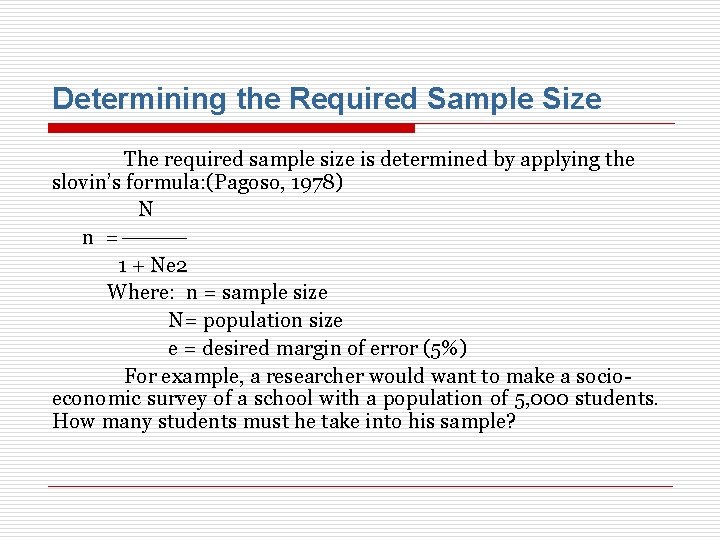
Determining the Required Sample Size The required sample size is determined by applying the slovin’s formula: (Pagoso, 1978) N n = 1 + Ne 2 Where: n = sample size N= population size e = desired margin of error (5%) For example, a researcher would want to make a socioeconomic survey of a school with a population of 5, 000 students. How many students must he take into his sample?
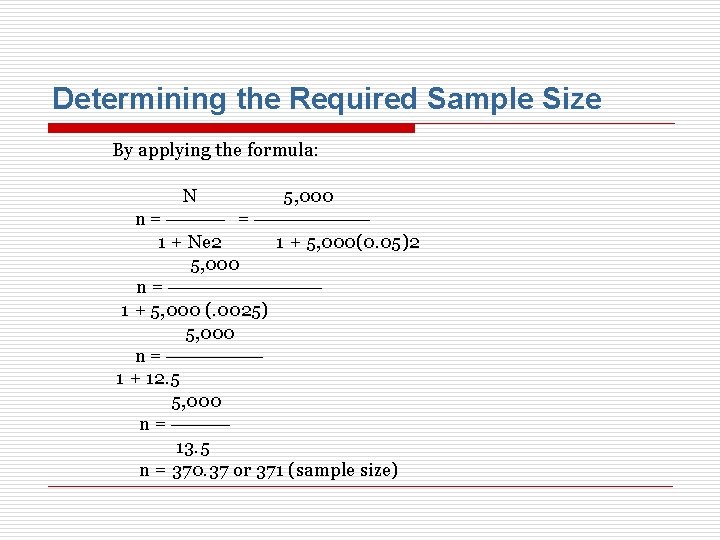
Determining the Required Sample Size By applying the formula: N 5, 000 n = = 1 + Ne 2 1 + 5, 000(0. 05)2 5, 000 n = 1 + 5, 000 (. 0025) 5, 000 n = 1 + 12. 5 5, 000 n = 13. 5 n = 370. 37 or 371 (sample size)
WORKSHOP NO. 7 – Sampling Instruction: A. The student is requested to plan the sampling technique he/she is going to use and determine his/her sample size. B. He/She is requested to present his/her output for critiquing. C. He/She is requested to complete the following statements: 1. My research problem is: __________________________________________ 2. The general objective of my study is: __________________________________________
WORKSHOP NO. 7 – Sampling 3. The specific objectives of my study are: _______________________________________________ 4. My target population consists of: ________________________ 5. Using the formula for the sample size, my sample size is: ________________________ 6. To draw my sample, I will follow the following steps: (describe in detail) _______________________________________________
MODULE 8 Instrumentation
Steps in the Construction of a Questionnaire (David, 2002) A. In designing a research instrument, the designer should identify exactly what information or data need to be collected to attain the objectives of the study. Only relevant items or questions must be included in the instrument. To ensure that all needed data can be collected; the designer must do the following before constructing the instrument: 1. review the objectives of the study; 2. identify the specific variables/areas the study intends to measure;
B. Modifying and Pretesting the Instrument individuals with more or less similar characteristics as the study respondents. The number of pretest respondents should be at least 5 percent of the size of the sample population. The results of the pretest must be considered in revising and modifying the instrument.
C. Improving and Finalizing the Instrument Based on the results of the pretest, the instrument must be modified and improved. In doing so, the following are suggested: 1. Determine the exact space, page by page. 2. Finalize the layout considering the type and size of font, spaces for responses, and instructions. 3. Ask consultants to comment on the content and format. Weigh the recommendations and suggestions given and make the changes called for. 4. Prepare the final draft. Revise format, if necessary.
Validity and Reliability of a Research Instrument The quality of instrument used in research is very important. Since the conclusions drawn from the findings of a study are based on the data collected. For inferences drawn from the study to be valid, the research instruments must be valid and reliable (Fraenkel and Wallen, 1996).
Validity of an Instrument Validity refers to the appropriateness, meaningfulness and usefulness of inferences a researcher makes on the data they collect. A research instrument is valid when it measures what it intends to measure. Researchers should make sure that any information collected through the use of an instrument serves the purpose for which it is collected.
Validity of an Instrument Three kinds of validity of an instrument are: content validity, criterion-related validity, and construct-related validity. 1. Content Validity. An instrument has content validity if the content and format of an instrument appropriately covers the topics and the variables intended to be studied. The items should adequately represent the subject to be assessed. A common way of determining the content validity of an instrument is by having one or more individuals look into the content and format of the instrument and judge whether or not they are appropriate. The person/s who will be asked to look into the instrument should be able to render an intelligent judgment or an expert’s opinion on the adequacy and appropriateness of the content and format of the instrument. When two or more individuals evaluate the instrument, the process is called “jury validation. ”
Validity of an Instrument 2. Criterion-related validity. An instrument has criterion-related validity if a score obtained by an individual using a particular instrument is significantly associated with a score he/she obtains on another instrument or another measure, known as the criterion. To determine the criterion-related validity of an instrument, a researcher can compare the answers or responses of the subjects or respondents in the instrument being evaluated with their responses in another instrument, called the criterion. For example, if one wants to measure academic performance of student, he/she can get the student’s general average in all academic subjects and compare this to his college entrance examination score, which can be criterion variable.
Validity of an Instrument 3. Construct-related validity. This refers to specific psychological constructs or characteristics being measured by the instrument and how well these constructs explain the differences in the behavior of individuals. There are three steps involved in measuring the construct-related validity of an instrument: 1) clearly defining the variable, 2) formulating a hypothesis based on a theory, and 3) testing the hypothesis both logically and empirically.
Reliability of the Research Instrument Reliability refers to the consistency of the responses or the scores obtained by an individual in a test or research instrument administered twice. There are two methods commonly used in determining the reliability of an instrument: test-retest method and the split-half method. 1) Test-retest method. This involves administering the same test twice to the same groups of individuals. After a certain time has elapsed, the same test is administered to the same people again. Then the reliability coefficient is calculated to determine the degree of association between the results of the two administrations. If the coefficient is significant, instrument is reliable.
Reliability of the Research Instrument 2) Split-half method. This approach involves the scoring of the first half and then the second half of the instrument separately for each person and then calculating a correlation coefficient for the two sets of score. If the correlation between the two sets of scores is statistically significant, then the instrument is reliable.
WORKSHOP No. 8 – Preparation of a Research Instrument Instruction: A. The student is requested to prepare the table of specification in preparation for his/her own research instrument. B. He/She is requested to present his/her output for critiquing. C. He/She is requested to complete the following statements: 1. My research problem is: __________________________________________ 2. The general objective of my study is: __________________________________________
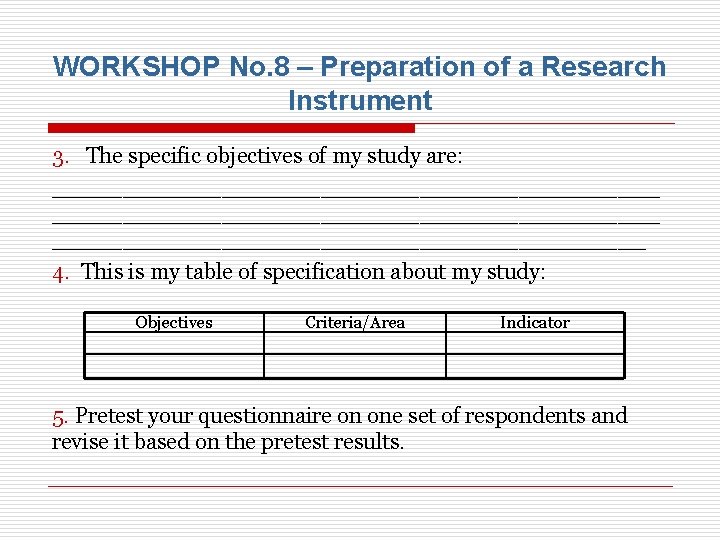
WORKSHOP No. 8 – Preparation of a Research Instrument 3. The specific objectives of my study are: ___________________________________________ 4. This is my table of specification about my study: Objectives Criteria/Area Indicator 5. Pretest your questionnaire on one set of respondents and revise it based on the pretest results.
MODULE 9 Data Collection
What are Data? The term “data” refers to any kind of information researchers obtain on the subjects, respondents or participants of a study. In research, data are collected and used to answer the research question or objectives of the study (David, 2002).
Types of Research Data Research data are generally classified as either quantitative or qualitative. Based on their source, data fall under two categories, namely: primary and secondary.
Quantitative vs. Qualitative Data A study may be intended to generate precise quantitative findings or to produce qualitative descriptive information, or both. Quantitative data are information, which can be counted or expressed in numerical values. Qualitative data are descriptive information, which has no numerical value.
Primary vs. Secondary Data According to source, data may also be classified as primary or secondary. Two important questions to be considered are: Who will provide the data? Where will the data be collected? Primary data are information collected directly from the subjects being studied, such as people, areas, or objects. Secondary data are information collected from other available sources, like recent censuses, or data collected by large scale national or world-wide surveys, such as agriculture and industry surveys, demographic and health surveys, data of completed studies.
Techniques of Collecting Quantitative Data Before starting to collect data, a researcher should decide: what data to collect, where or from whom will the data be obtained, and what instrument or device will be used in collecting the data. The two most common means of collecting primary quantitative information are the structured interview and the selfadministered questionnaire. Quantitative information may also be collected from secondary sources and service statistics (Fisher, et. al. , 1991).
Structured Interview Structured interview involves a face-toface interaction between the data collector (the interviewer), and the source of information (the respondent). The interviewer directly asks the respondent questions from a prepared instrument, which is called an interview schedule.
Self-Administered Questionnaires are distributed to the respondents who write their answers to the questions in appropriate spaces in the questionnaire. Questionnaires may be administered individually or in-group by the researcher or by authorized individual.
Mailed Questionnaires Some questionnaires are mailed to respondents accompanied by self-addressed envelopes. The respondents are asked to mail back the accomplished questionnaires. These are called mailed questionnaires.
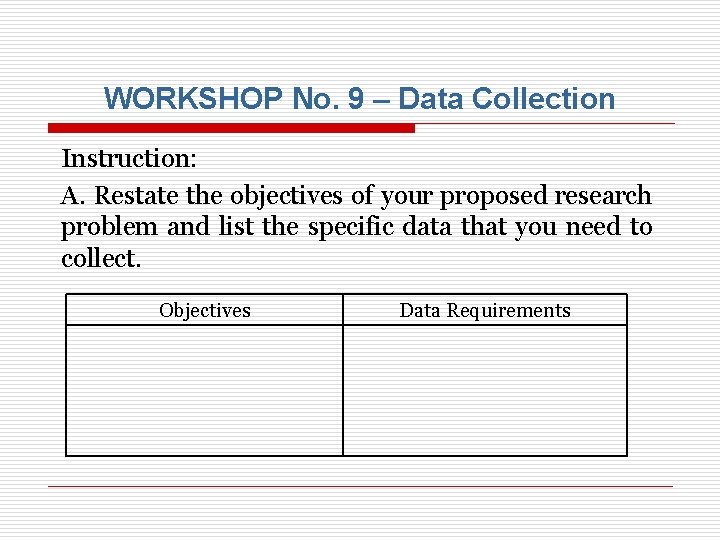
WORKSHOP No. 9 – Data Collection Instruction: A. Restate the objectives of your proposed research problem and list the specific data that you need to collect. Objectives Data Requirements
WORKSHOP No. 9 – Data Collection 2. Identify the data collection technique that you will use in your study and explain your choice. Describe the procedures that you will follow in collecting your data. _______________________________________ _______________________________________ _________________
MODULE 10 Data Analysis and Interpretation
What is Data Analysis? Data analysis is a process of summarizing trends and patterns observed in the data, determining major differentials or relationships among variables used in the study and the application of appropriate statistical tests on a set of data to answer the objectives of a study (David, 2002). The types of data analysis to use depend on: the objectives of the study, the kind of scales of measurement of the data or variables being dealt with.
Scales of Measurement Nominal Scale. The nominal scale has no mathematical value. It is also called a categorical scale. Numbers are assigned to categories of nominal data/variables to facilitate data processing. A higher number assignment does not mean a bigger value or weight. For example, sex is a nominal variable. Its categories, “male” and “female”, do not have mathematical value. If number “ 1” is used to represent “male and “ 2” is used to represent “female”, it does not mean that the “female” category has a higher value than the “male” category. Numbers are assigned to categories to facilitate processing. Ordinal Scale. An ordinal scale is a measure in which data or categories of a variable are ordered or ranked into two or more levels or degrees, such as from low to high or least to most. The distance between the first and the second ranks, however, is not the same as the distance between the second and the third ranks or the distance between third or fourth ranks.
Scales of Measurement Interval Scale. An interval scale has the characteristics of an ordinal scale, but in addition, the distances between points in the interval scale is equal. For example, body temperature is considered interval scale. The distance between a body temperature of 30 degrees Fahrenheit and a temperature of 40 degrees Fahrenheit is the same as the distance between 40 degrees and 50 degrees. Body temperature does not have an absolute zero point. Ratio Scale. A ratio scale is almost like the interval scale, except that the ratio scale has a real zero point. An example of a ratio scale is monthly income. Income values have equal distances between each other. For instance, the distance between Php 1, 000 and Php 2, 000, which is Php 1, 000 is equal to the distance between Php 2, 000 and Php 3, 000. Similarly, the distance between Php 5, 000 and Php 10, 000 is the same as the distance between Php 15, 000 and 20, 000, which is 5, 000.
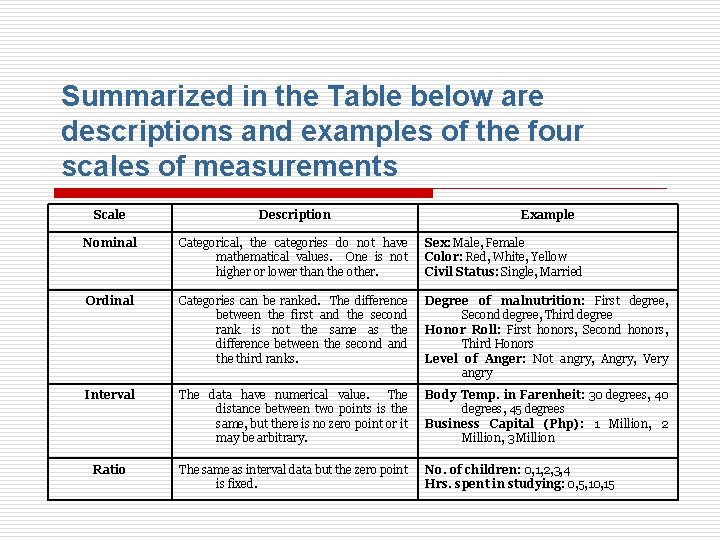
Summarized in the Table below are descriptions and examples of the four scales of measurements Scale Description Example Nominal Categorical, the categories do not have mathematical values. One is not higher or lower than the other. Sex: Male, Female Color: Red, White, Yellow Civil Status: Single, Married Ordinal Categories can be ranked. The difference between the first and the second rank is not the same as the difference between the second and the third ranks. Degree of malnutrition: First degree, Second degree, Third degree Honor Roll: First honors, Second honors, Third Honors Level of Anger: Not angry, Angry, Very angry Interval The data have numerical value. The distance between two points is the same, but there is no zero point or it may be arbitrary. Body Temp. in Farenheit: 30 degrees, 45 degrees Business Capital (Php): 1 Million, 2 Million, 3 Million Ratio The same as interval data but the zero point is fixed. No. of children: 0, 1, 2, 3, 4 Hrs. spent in studying: 0, 5, 10, 15
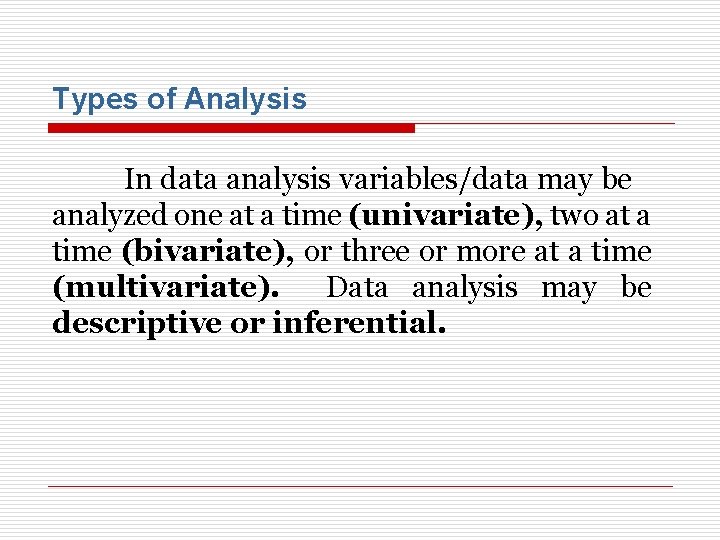
Types of Analysis In data analysis variables/data may be analyzed one at a time (univariate), two at a time (bivariate), or three or more at a time (multivariate). Data analysis may be descriptive or inferential.
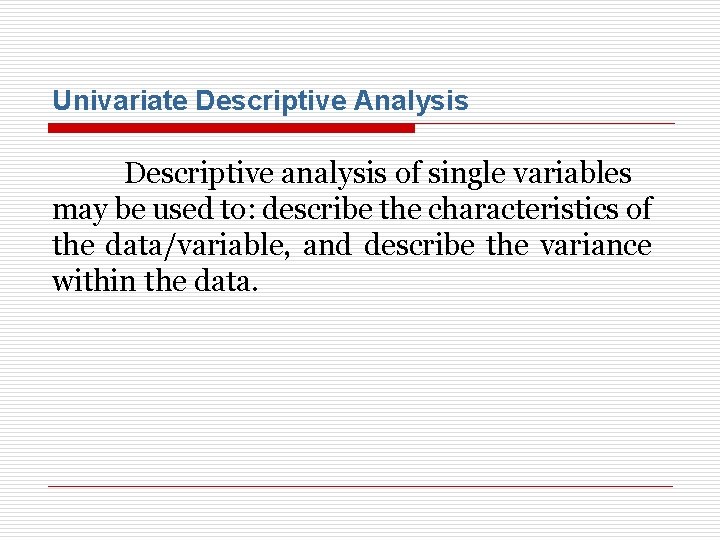
Univariate Descriptive Analysis Descriptive analysis of single variables may be used to: describe the characteristics of the data/variable, and describe the variance within the data.
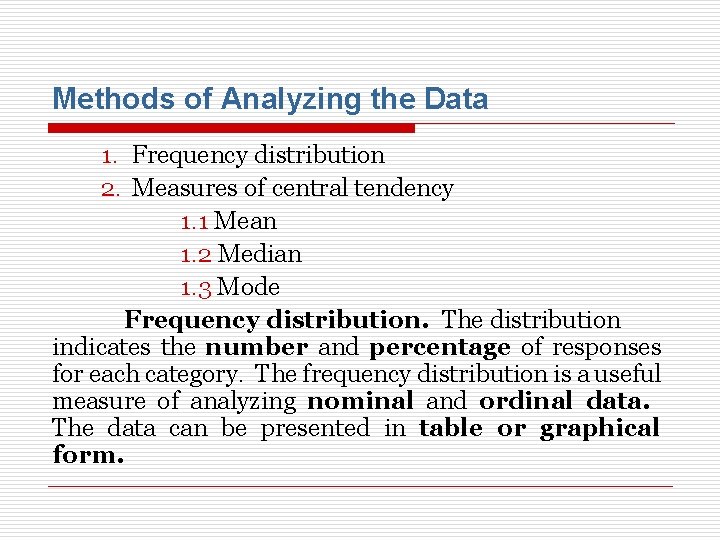
Methods of Analyzing the Data 1. Frequency distribution 2. Measures of central tendency 1. 1 Mean 1. 2 Median 1. 3 Mode Frequency distribution. The distribution indicates the number and percentage of responses for each category. The frequency distribution is a useful measure of analyzing nominal and ordinal data. The data can be presented in table or graphical form.
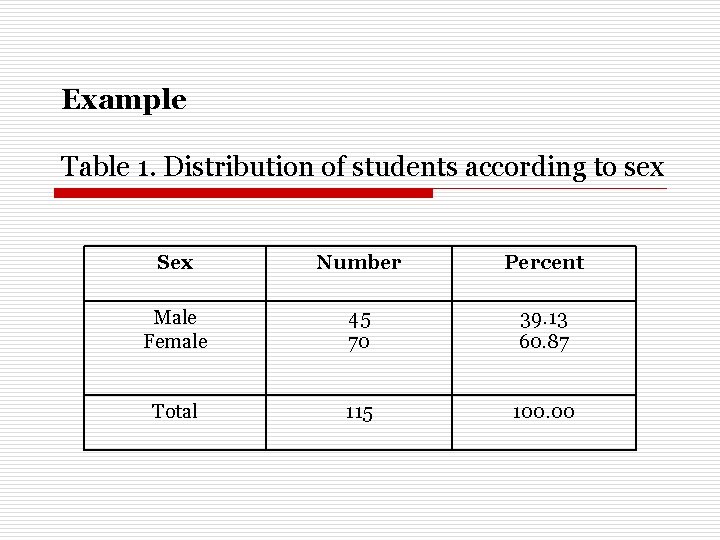
Example Table 1. Distribution of students according to sex Sex Number Percent Male Female 45 70 39. 13 60. 87 Total 115 100. 00
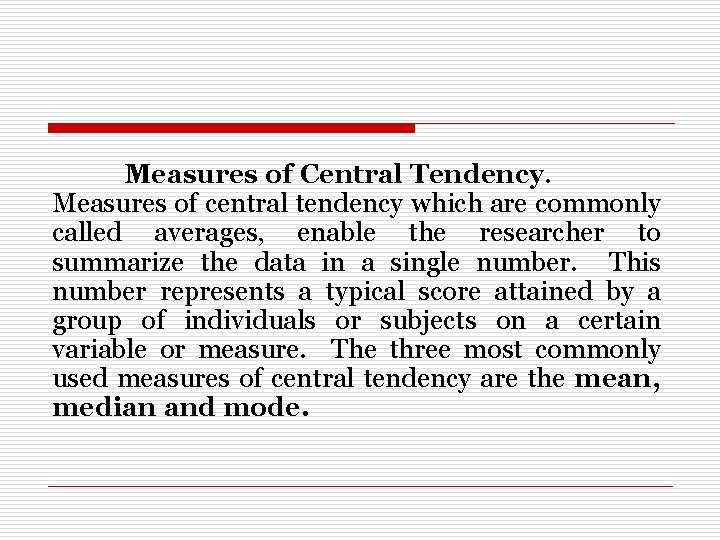
Measures of Central Tendency. Measures of central tendency which are commonly called averages, enable the researcher to summarize the data in a single number. This number represents a typical score attained by a group of individuals or subjects on a certain variable or measure. The three most commonly used measures of central tendency are the mean, median and mode.
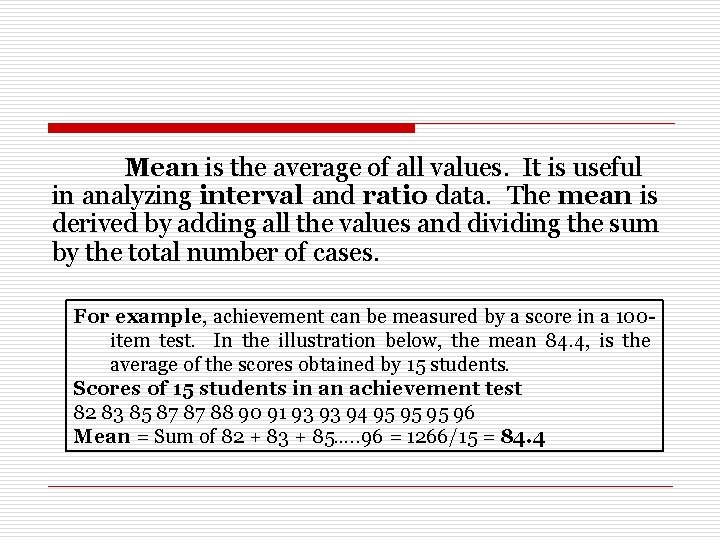
Mean is the average of all values. It is useful in analyzing interval and ratio data. The mean is derived by adding all the values and dividing the sum by the total number of cases. For example, achievement can be measured by a score in a 100 item test. In the illustration below, the mean 84. 4, is the average of the scores obtained by 15 students. Scores of 15 students in an achievement test 82 83 85 87 87 88 90 91 93 93 94 95 95 95 96 Mean = Sum of 82 + 83 + 85…. . 96 = 1266/15 = 84. 4
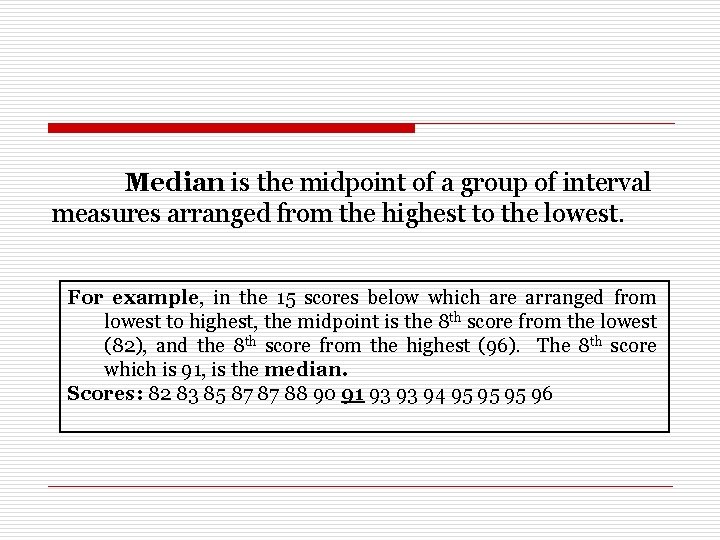
Median is the midpoint of a group of interval measures arranged from the highest to the lowest. For example, in the 15 scores below which are arranged from lowest to highest, the midpoint is the 8 th score from the lowest (82), and the 8 th score from the highest (96). The 8 th score which is 91, is the median. Scores: 82 83 85 87 87 88 90 91 93 93 94 95 95 95 96
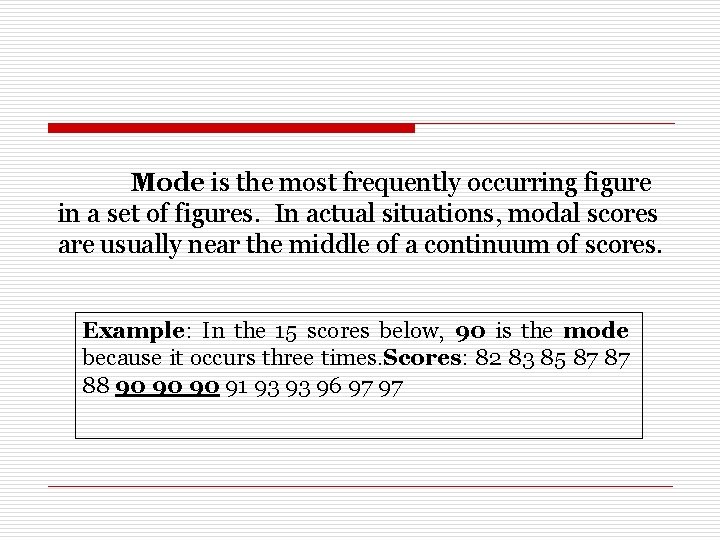
Mode is the most frequently occurring figure in a set of figures. In actual situations, modal scores are usually near the middle of a continuum of scores. Example: In the 15 scores below, 90 is the mode because it occurs three times. Scores: 82 83 85 87 87 88 90 90 90 91 93 93 96 97 97
Describing the Variance in the Data The two commonly measures of variations are the range and the standard deviation. Range. The range is a simple measure of variation calculated as the highest value in a distribution, minus the lowest value. Standard Deviation. The standard deviation gives the average of the distances of individual observations from the group mean, the square root of the average squared deviation of each case from the mean.
Describing the Variance in the Data Analyzing Differences within the Data To find differences between means, the following statistical tests are commonly used: a. t-test for correlated samples b. t-test for uncorrelated or independent sample c. z-test d. One-way analysis of variance e. Two-way analysis of variance f. Three-way analysis of variance
Data Interpretation Data interpretation is the process of explaining the meaning of the data in a table with emphasis on the highlights and trends shown by the data. It further explains the meaning of the data and relates the findings to results of related studies and to theoretical framework or conceptual framework. Before interpretation is made, however, the data must first be presented in reference to a table, graphics or other forms that make it easy for the researcher to see patterns, trends, relationships, which aids the making of generalization.
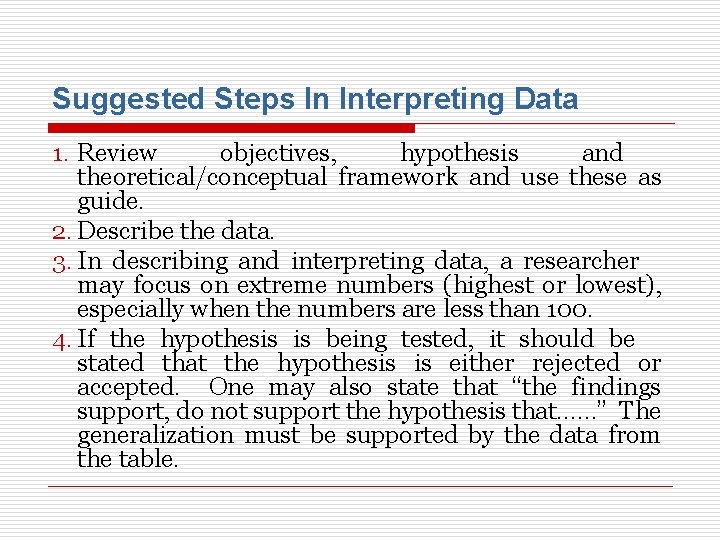
Suggested Steps In Interpreting Data 1. Review objectives, hypothesis and theoretical/conceptual framework and use these as guide. 2. Describe the data. 3. In describing and interpreting data, a researcher may focus on extreme numbers (highest or lowest), especially when the numbers are less than 100. 4. If the hypothesis is being tested, it should be stated that the hypothesis is either rejected or accepted. One may also state that “the findings support, do not support the hypothesis that……” The generalization must be supported by the data from the table.
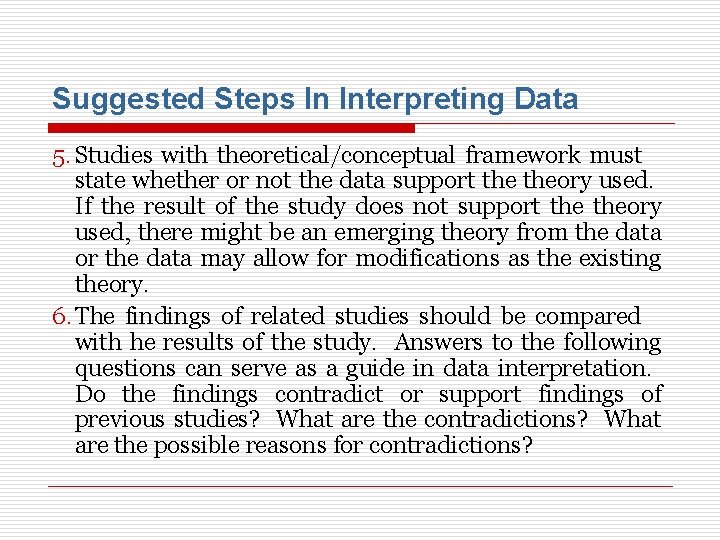
Suggested Steps In Interpreting Data 5. Studies with theoretical/conceptual framework must state whether or not the data support theory used. If the result of the study does not support theory used, there might be an emerging theory from the data or the data may allow for modifications as the existing theory. 6. The findings of related studies should be compared with he results of the study. Answers to the following questions can serve as a guide in data interpretation. Do the findings contradict or support findings of previous studies? What are the contradictions? What are the possible reasons for contradictions?
WORKSHOP No. 10 – Data Analysis and Interpretation 1. 2. Write the specific objectives of your proposed study. ________________________________________ ____________________ Write the hypothesis of your study. ________________________________________ ____
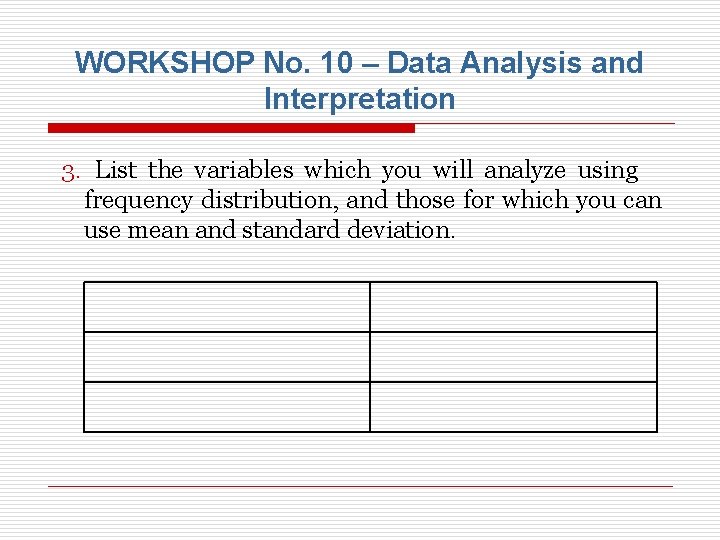
WORKSHOP No. 10 – Data Analysis and Interpretation 3. List the variables which you will analyze using frequency distribution, and those for which you can use mean and standard deviation.
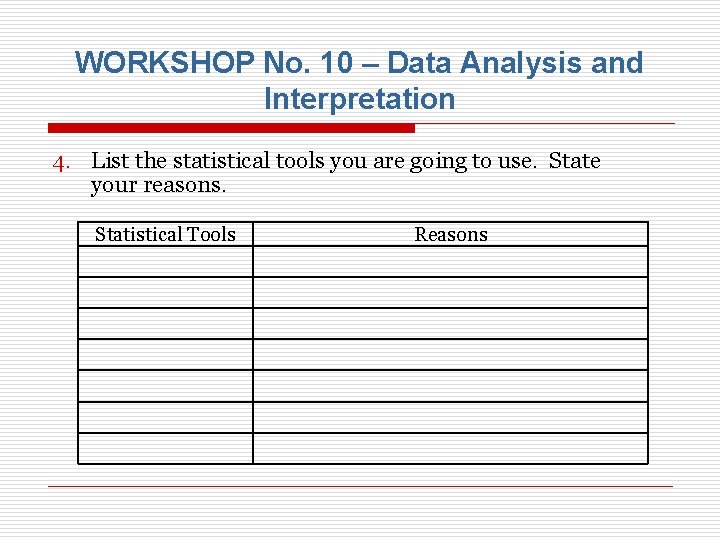
WORKSHOP No. 10 – Data Analysis and Interpretation 4. List the statistical tools you are going to use. State your reasons. Statistical Tools Reasons
MODULE 11 Writing the Research Proposal
The concept of the Research Proposal A research proposal is a plan or guide that will be followed by the researcher in the conduct of the study from problem identification to data analysis. A proposal must be well written and feasible. It should be worth doing, convincing and that the proponent can competently undertake the proposed study.
Characteristics of a well-written Research Proposal A well-written proposal must be persuasive, clear, complete, and flexible. Persuasive. The proposal must show that it is relevant, worth doing and has a logical basis. The proponent must be knowledgeable and has adequate background knowledge about the problem. Complete. The proposal must contain all the parts required as stipulated in the suggested format by the college. Clear. The proposal must be written in clear and simple language. Flexible. The proposal must be flexible and should allow for possible changes or modification.
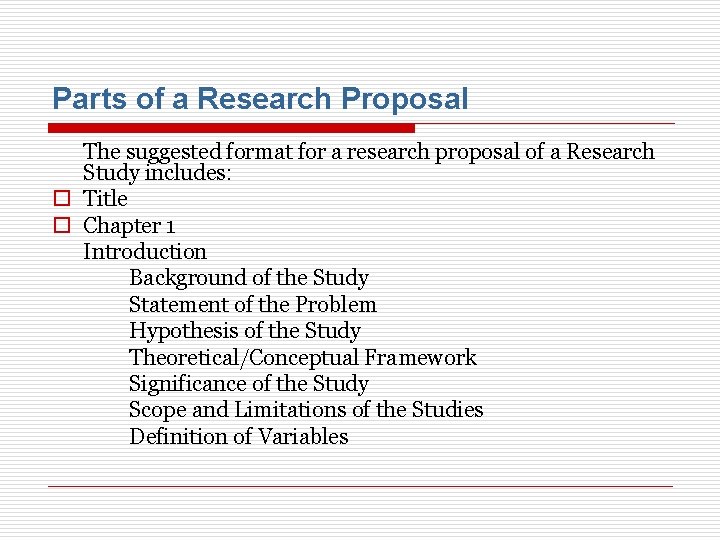
Parts of a Research Proposal The suggested format for a research proposal of a Research Study includes: o Title o Chapter 1 Introduction Background of the Study Statement of the Problem Hypothesis of the Study Theoretical/Conceptual Framework Significance of the Study Scope and Limitations of the Studies Definition of Variables
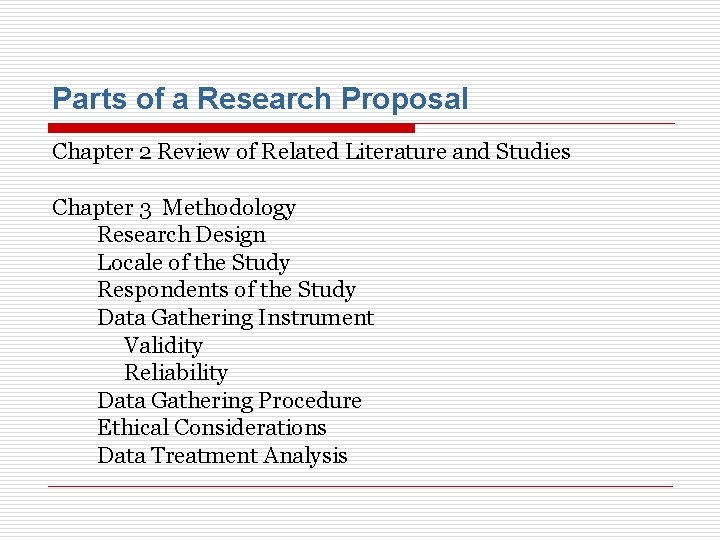
Parts of a Research Proposal Chapter 2 Review of Related Literature and Studies Chapter 3 Methodology Research Design Locale of the Study Respondents of the Study Data Gathering Instrument Validity Reliability Data Gathering Procedure Ethical Considerations Data Treatment Analysis
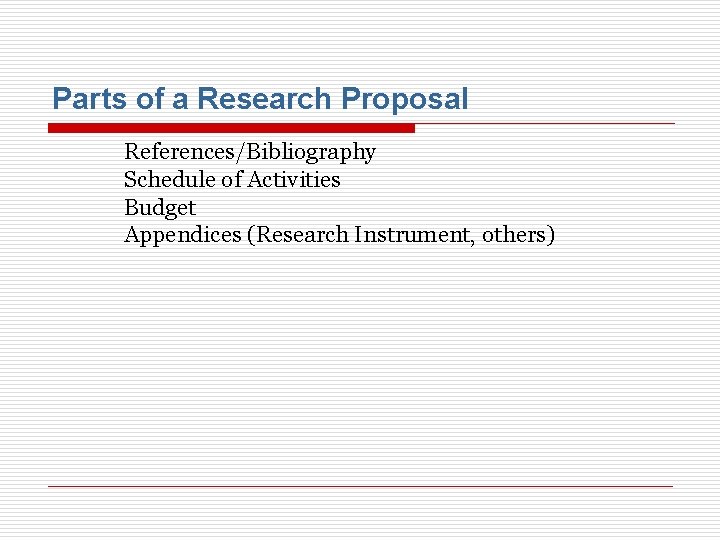
Parts of a Research Proposal References/Bibliography Schedule of Activities Budget Appendices (Research Instrument, others)
- Slides: 142