
Module 1 Coaching for Recovery Mentoring as Part

- Slides: 31
Module 1: Coaching for Recovery: Mentoring as Part of a Recovery Oriented System of Care Carolyn Rodgers, Ph. D, MHS, MPH, MCHES
Module 1: Learning Objectives �Demonstrate Active Listening skills. �Define Recovery Coaching as a term. �Explain the Recovery Coaching Process. �Describe the “Recovery Oriented System of Care”. �Discuss the many roles of the recovery coach. �Identify the competencies and support categories of a recovery coach. �Summarize module one and introduce the second module.
Introductions �Please take 10 minutes to: � Introduce yourself to at least 1 -person that you do not know by providing: �Name and agency affiliation. � Experience in Behavioral Health/ Addictions Studies. �Purpose for taking this training. �Please remember to sign the attendance sheet.
Introductions
Active Listening �Gives verbal cues of interest � Repeating � Paraphrasing �Non-Verbal Cues � Paying attention � Head knotting � Body language of engagement �Reflective Listening � Perceiving � Reasoning � Rewording.
So What is Recovery? �Recovery from alcohol, tobacco and other drugs is a process of change through which and individual achieves abstinence and improved health, wellness, and quality of life” (National Summit on Recovery Participants, 2005; Sheedy & Whitter, 2009).
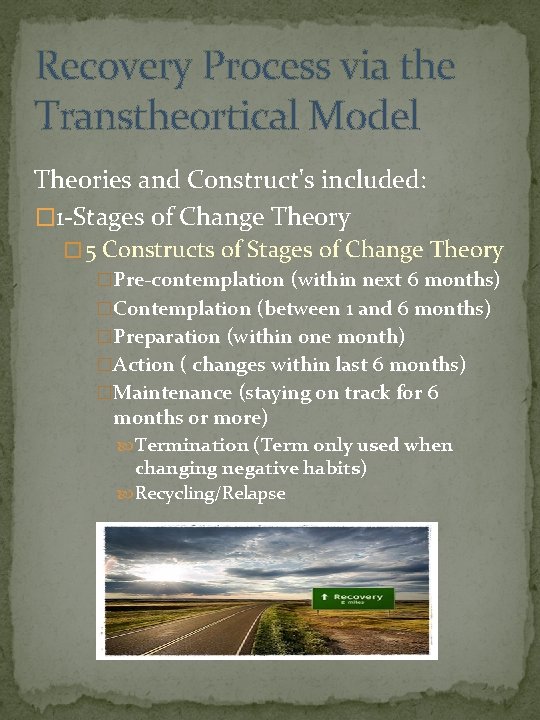
Recovery Process via the Transtheortical Model Theories and Construct's included: � 1 -Stages of Change Theory � 5 Constructs of Stages of Change Theory �Pre-contemplation (within next 6 months) �Contemplation (between 1 and 6 months) �Preparation (within one month) �Action ( changes within last 6 months) �Maintenance (staying on track for 6 months or more) Termination (Term only used when changing negative habits) Recycling/Relapse
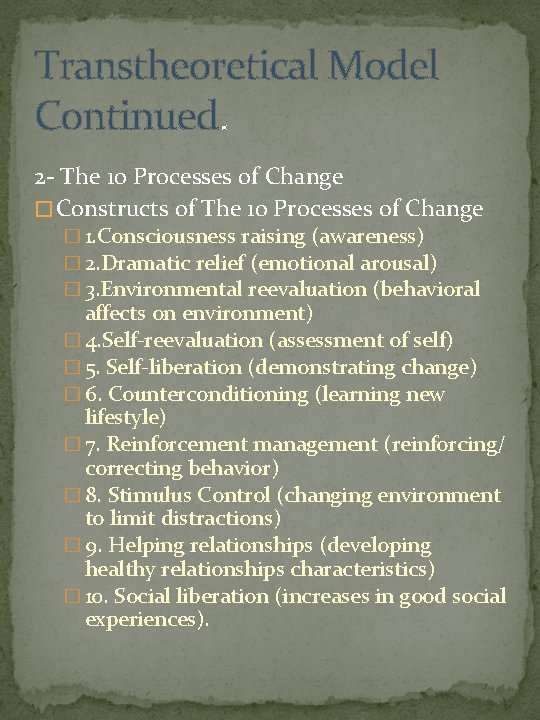
Transtheoretical Model Continued. 2 - The 10 Processes of Change � Constructs of The 10 Processes of Change � 1. Consciousness raising (awareness) � 2. Dramatic relief (emotional arousal) � 3. Environmental reevaluation (behavioral affects on environment) � 4. Self-reevaluation (assessment of self) � 5. Self-liberation (demonstrating change) � 6. Counterconditioning (learning new lifestyle) � 7. Reinforcement management (reinforcing/ correcting behavior) � 8. Stimulus Control (changing environment to limit distractions) � 9. Helping relationships (developing healthy relationships characteristics) � 10. Social liberation (increases in good social experiences).
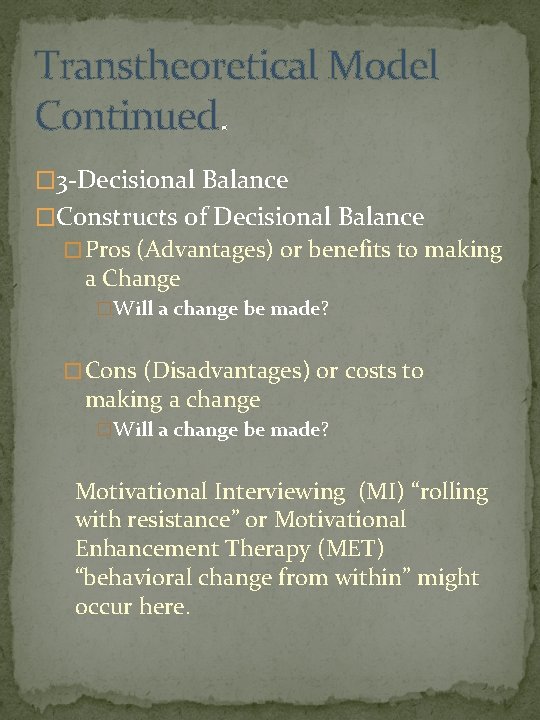
Transtheoretical Model Continued. � 3 -Decisional Balance �Constructs of Decisional Balance � Pros (Advantages) or benefits to making a Change �Will a change be made? � Cons (Disadvantages) or costs to making a change �Will a change be made? Motivational Interviewing (MI) “rolling with resistance” or Motivational Enhancement Therapy (MET) “behavioral change from within” might occur here.
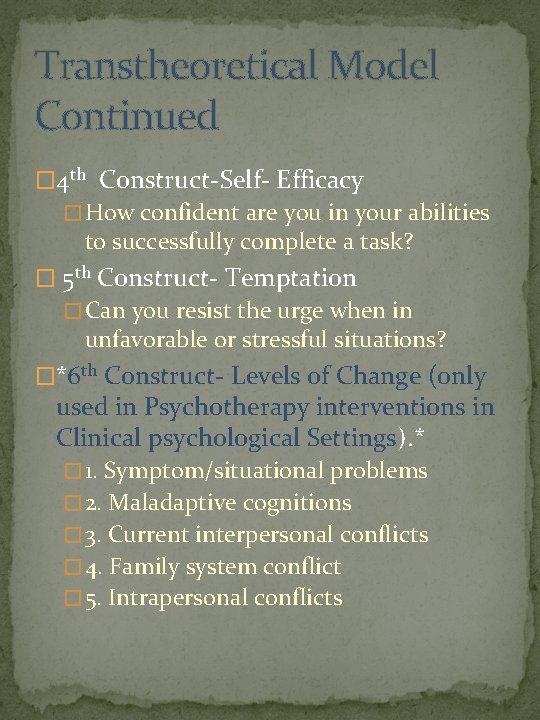
Transtheoretical Model Continued � 4 th Construct-Self- Efficacy � How confident are you in your abilities to successfully complete a task? � 5 th Construct- Temptation � Can you resist the urge when in unfavorable or stressful situations? �*6 th Construct- Levels of Change (only used in Psychotherapy interventions in Clinical psychological Settings). * � 1. Symptom/situational problems � 2. Maladaptive cognitions � 3. Current interpersonal conflicts � 4. Family system conflict � 5. Intrapersonal conflicts
Recovery Process via Services �Three Continuums of Care � Pre-recovery support services � In-treatment recovery support services � Post treatment recovery support services
Recovery Oriented system of Care (ROSC) �Continuous Care � Addresses gap in treatment �Pre-treatment �In-treatment �Post-treatment �A “consumer driven system of care” (Sheedy & Whitter, 2009).
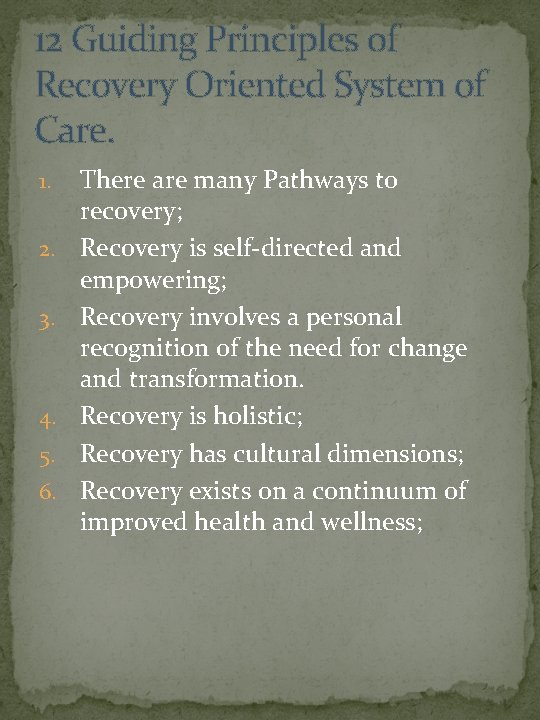
12 Guiding Principles of Recovery Oriented System of Care. 1. 2. 3. 4. 5. 6. There are many Pathways to recovery; Recovery is self-directed and empowering; Recovery involves a personal recognition of the need for change and transformation. Recovery is holistic; Recovery has cultural dimensions; Recovery exists on a continuum of improved health and wellness;
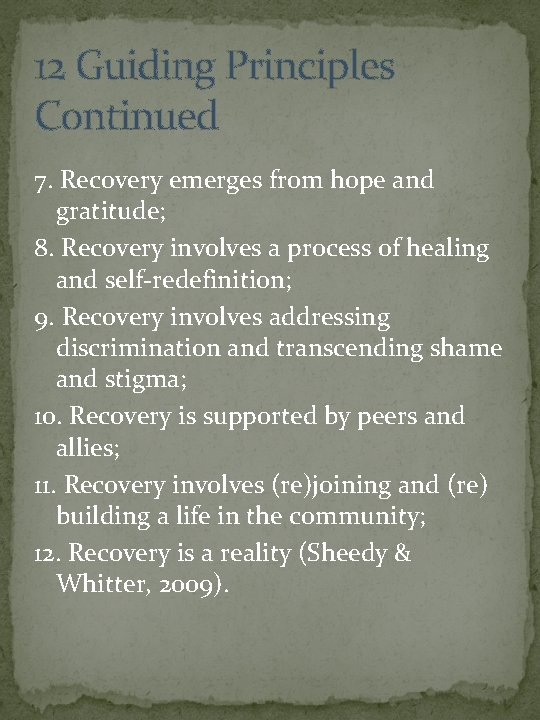
12 Guiding Principles Continued 7. Recovery emerges from hope and gratitude; 8. Recovery involves a process of healing and self-redefinition; 9. Recovery involves addressing discrimination and transcending shame and stigma; 10. Recovery is supported by peers and allies; 11. Recovery involves (re)joining and (re) building a life in the community; 12. Recovery is a reality (Sheedy & Whitter, 2009).
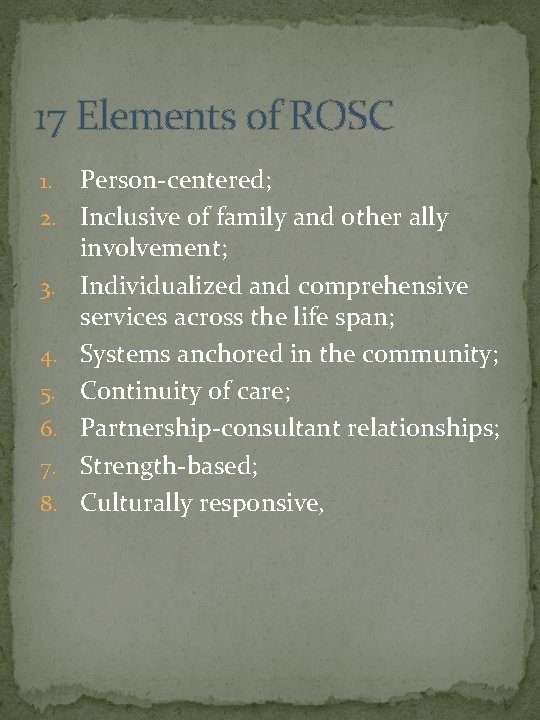
17 Elements of ROSC 1. 2. 3. 4. 5. 6. 7. 8. Person-centered; Inclusive of family and other ally involvement; Individualized and comprehensive services across the life span; Systems anchored in the community; Continuity of care; Partnership-consultant relationships; Strength-based; Culturally responsive,
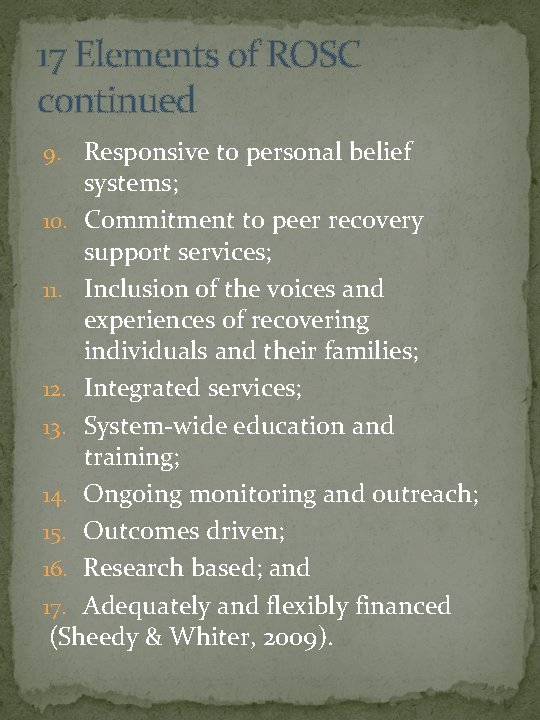
17 Elements of ROSC continued 9. Responsive to personal belief systems; 10. Commitment to peer recovery support services; 11. Inclusion of the voices and experiences of recovering individuals and their families; 12. Integrated services; 13. System-wide education and training; 14. Ongoing monitoring and outreach; 15. Outcomes driven; 16. Research based; and 17. Adequately and flexibly financed (Sheedy & Whiter, 2009).
I'm Tired and I need a break, how about you?
Roles, Competencies, and Support Categories
Recovery Coaching �What is a Recovery Coach?
Recovery Coaching Defined �Recovery coaching, also known as self-help, mutual support groups, or peer recovery support guide, firestarters, and peer resource specialist are “paraprofessionals” that serve as a support to individuals or groups in recovery or to family members and friends usually on a one-on-one basis or in a group setting that is part of a recovery-oriented system of care approach (CSAT, 2008; CSAT, 2009).
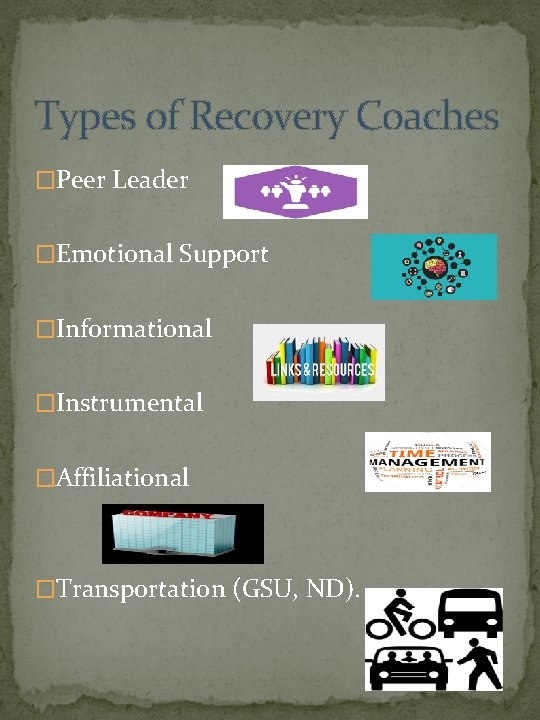
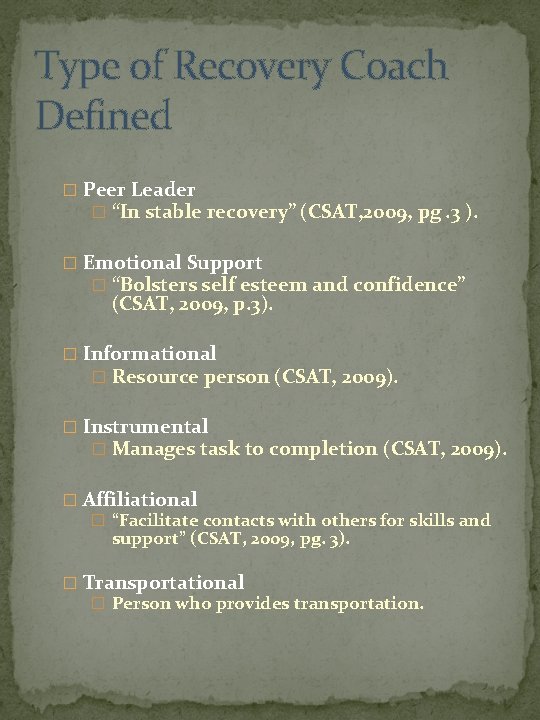
Types of Recovery Coaches �Peer Leader �Emotional Support �Informational �Instrumental �Affiliational �Transportation (GSU, ND).
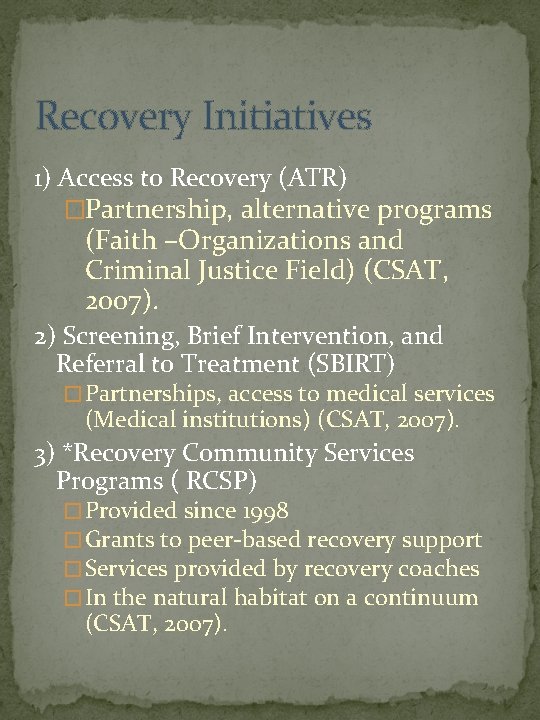
Recovery Initiatives 1) Access to Recovery (ATR) �Partnership, alternative programs (Faith –Organizations and Criminal Justice Field) (CSAT, 2007). 2) Screening, Brief Intervention, and Referral to Treatment (SBIRT) � Partnerships, access to medical services (Medical institutions) (CSAT, 2007). 3) *Recovery Community Services Programs ( RCSP) � Provided since 1998 � Grants to peer-based recovery support � Services provided by recovery coaches � In the natural habitat on a continuum (CSAT, 2007).
Type of Recovery Coach Defined � Peer Leader � “In stable recovery” (CSAT, 2009, pg. 3 ). � Emotional Support � “Bolsters self esteem and confidence” (CSAT, 2009, p. 3). � Informational � Resource person (CSAT, 2009). � Instrumental � Manages task to completion (CSAT, 2009). � Affiliational � “Facilitate contacts with others for skills and support” (CSAT, 2009, pg. 3). � Transportational � Person who provides transportation.
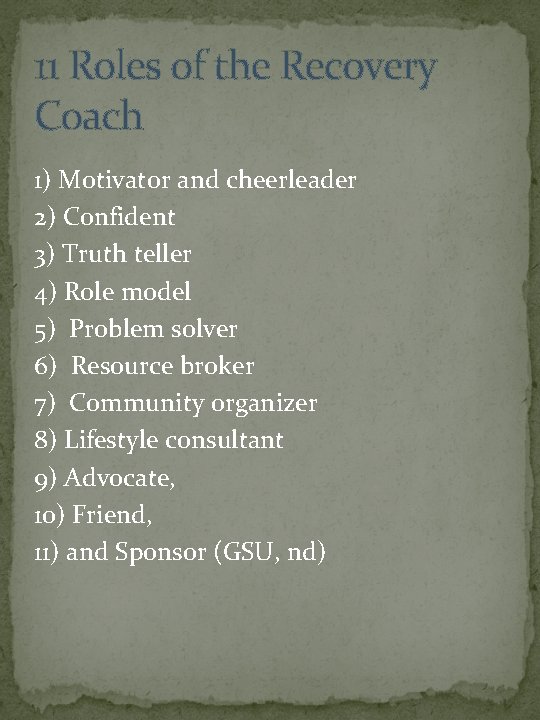
11 Roles of the Recovery Coach 1) Motivator and cheerleader 2) Confident 3) Truth teller 4) Role model 5) Problem solver 6) Resource broker 7) Community organizer 8) Lifestyle consultant 9) Advocate, 10) Friend, 11) and Sponsor (GSU, nd)
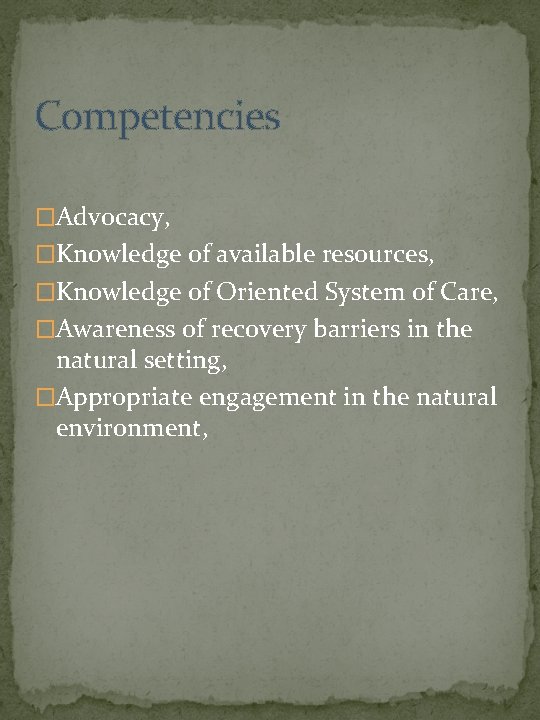
Competencies �Advocacy, �Knowledge of available resources, �Knowledge of Oriented System of Care, �Awareness of recovery barriers in the natural setting, �Appropriate engagement in the natural environment,
Competencies Cont. �Cultural awareness beliefs, �Limitation in knowledge, �Appropriate steps during a crisis, �How to partner with treatment facilities, �How to provide other forms of recovery support (CSAT, 2009).
Where do you see yourself in the support category? *Peer Leader *Emotional support *Informational support *Instrumental support *Affiliational support *Transportational support
Ethical Considerations 1) Clients right to self-determination, 2) Non-Malice, 3) Justice and Fairness, 4) Fidelity, 5) Individualization, 6) Clients have a right to receive supportive services, 7) The client is the director of his or her plan, 8) Help Seeking, 9) Boundaries (GSU, nd).
Summary �Recovery Process �Recovery Oriented System of Care �Recovery Coach � Roles � Competencies � Support �Ethical Considerations �Second Module �Closure
Module 2 Preview �Module 2 is Understanding Addiction, Recovery and Recovery Oriented Systems �Will further discuss the process of addiction and recovery and explain in detail the different aspects of the Recovery Oriented Systems.
References Center for Substance Abuse Treatment. (2008). An Introduction to Mutual Support Groups for Alcohol and Drug Abuse. Substance Abuse in Brief Fact Sheet, Volume 5, Issue 1. Rockville, MD: Substance Abuse and Mental Health Services Administration. Center for Substance Abuse Treatment. (2009). What are Peer Recovery Support Services? HHS Publication (SMA) 09 -4454. Rockville, MD: Substance Abuse and Mental Health Services Administration, U. S. Department of Health and Human Services. Illinois Division of Alcoholism. (nd). Recovery Coaching /Mentoring as Part of a Recovery Oriented System of Care for Individuals and Families in Recovery. Governors State University, University Park, IL. Sheedy C. K. , and Whitter M. , (2009). Guiding Principles and Elements of Recovery-Oriented Systems of Care: What Do We Know From the Research? HHS Publication No. (SMA) 094439. Rockville, MD: Center for Substance Abuse Treatment, Substance Abuse and Mental Health Services Administration/