
MODULE 1 CHILD DEVELOPMENT 1 WELCOME Introductions Overview

- Slides: 32
MODULE 1: CHILD DEVELOPMENT 1
WELCOME • Introductions • Overview • Group Norms • Learning Outcomes 2
LEARNING OUTCOMES • Understand the stages of child development in the following domains: – – Social-Emotional Physical Cognitive Language • Learn about current brain research • Consider the implications of child development on your teaching practices • Investigate strategies to differentiate learning 3
AGENDA • • What is Child Development? Key Understandings What does Brain Research tell us? Domains of Learning & Development for Children Ages 3 – 6 Implications for Teaching What does Child Development have to do with Kindergarten? A Focus on Differentiation: Information & Strategies 4
THINK, CHAT, WRITE • Activity: – With your shoulder partner, share your thoughts about the following question to create and write out your own definition of child development on the “Child Development” recording sheet: What IS child development? 5
CHILD DEVELOPMENT & KINDERGARTEN • “Effective teaching practice in kindergarten is based on our knowledge of child growth and development and increasingly also on discoveries about brain development that have emerged in recent years”. NC Guide for the Early Years, 2009, 13 6
BRAIN RESEARCH Early experiences actually shape the architecture of the brain and strongly affect whether a child grows up to be a healthy, productive member of society. 7
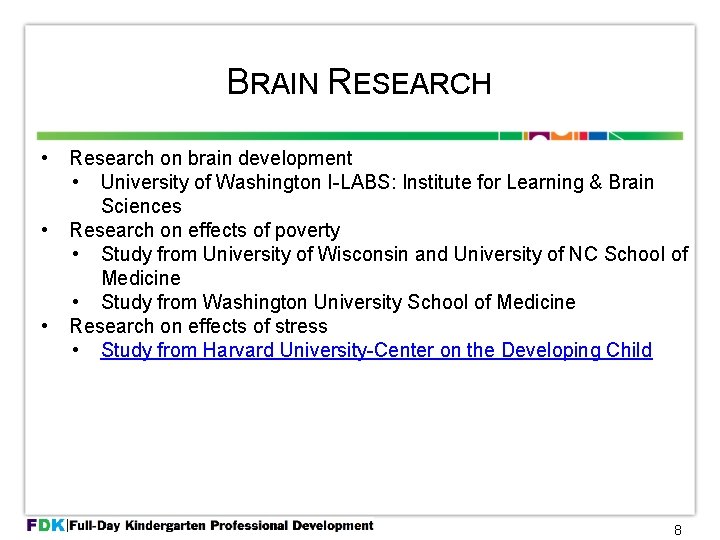
BRAIN RESEARCH • • • Research on brain development • University of Washington I-LABS: Institute for Learning & Brain Sciences Research on effects of poverty • Study from University of Wisconsin and University of NC School of Medicine • Study from Washington University School of Medicine Research on effects of stress • Study from Harvard University-Center on the Developing Child 8
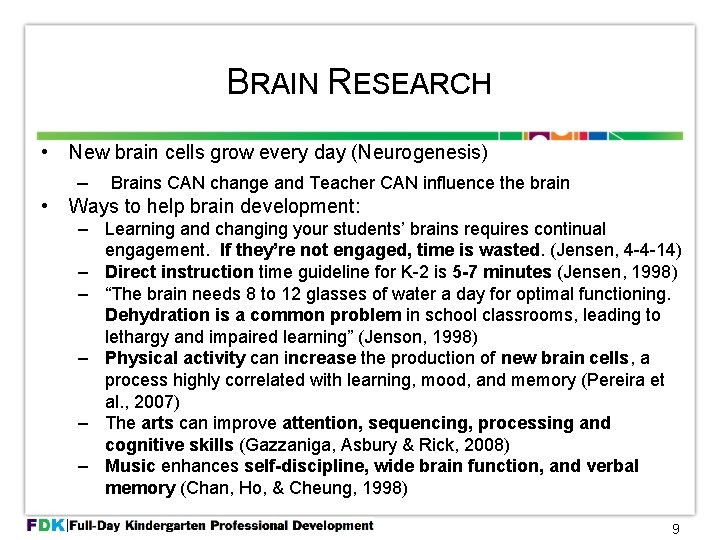
BRAIN RESEARCH • New brain cells grow every day (Neurogenesis) • – Brains CAN change and Teacher CAN influence the brain Ways to help brain development: – Learning and changing your students’ brains requires continual engagement. If they’re not engaged, time is wasted. (Jensen, 4 -4 -14) – Direct instruction time guideline for K-2 is 5 -7 minutes (Jensen, 1998) – “The brain needs 8 to 12 glasses of water a day for optimal functioning. Dehydration is a common problem in school classrooms, leading to lethargy and impaired learning” (Jenson, 1998) – Physical activity can increase the production of new brain cells, a process highly correlated with learning, mood, and memory (Pereira et al. , 2007) – The arts can improve attention, sequencing, processing and cognitive skills (Gazzaniga, Asbury & Rick, 2008) – Music enhances self-discipline, wide brain function, and verbal memory (Chan, Ho, & Cheung, 1998) 9
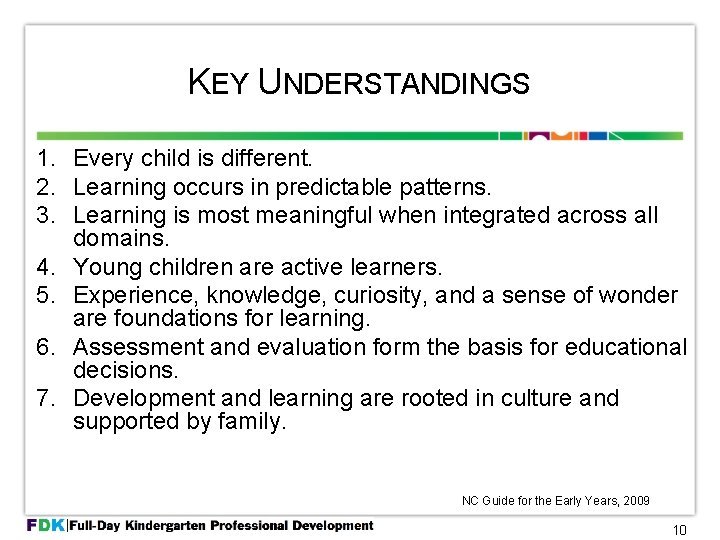
KEY UNDERSTANDINGS 1. Every child is different. 2. Learning occurs in predictable patterns. 3. Learning is most meaningful when integrated across all domains. 4. Young children are active learners. 5. Experience, knowledge, curiosity, and a sense of wonder are foundations for learning. 6. Assessment and evaluation form the basis for educational decisions. 7. Development and learning are rooted in culture and supported by family. NC Guide for the Early Years, 2009 10
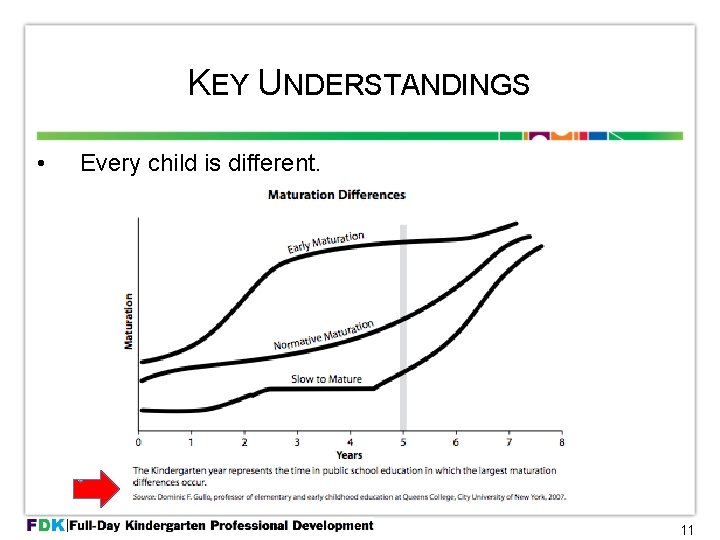
KEY UNDERSTANDINGS • Every child is different. 11
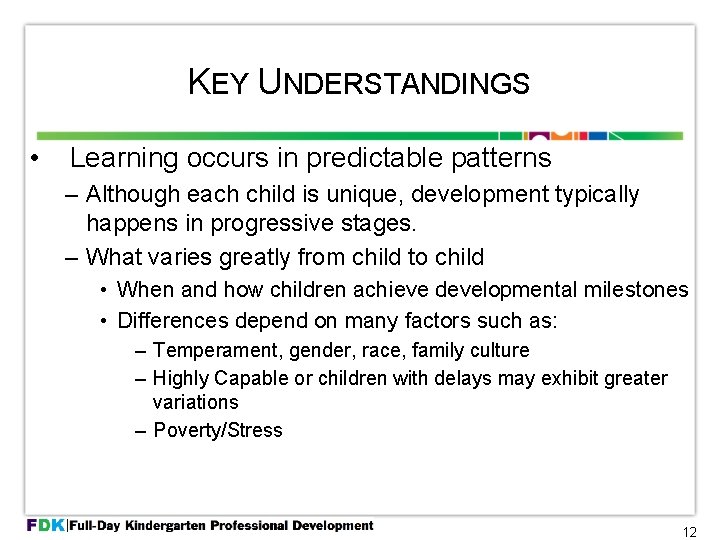
KEY UNDERSTANDINGS • Learning occurs in predictable patterns – Although each child is unique, development typically happens in progressive stages. – What varies greatly from child to child • When and how children achieve developmental milestones • Differences depend on many factors such as: – Temperament, gender, race, family culture – Highly Capable or children with delays may exhibit greater variations – Poverty/Stress 12
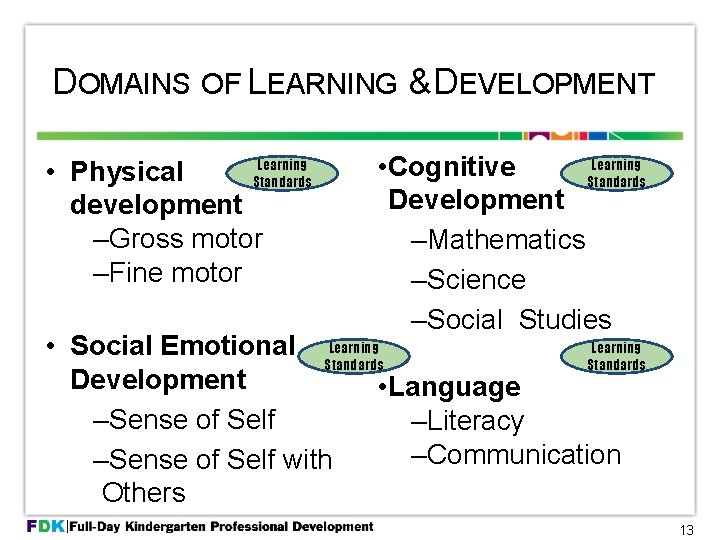
DOMAINS OF LEARNING & DEVELOPMENT Learning • Physical Standards development –Gross motor –Fine motor Learning • Cognitive Standards Development –Mathematics –Science –Social Studies Learning • Social Emotional Learning Standards Development • Language –Sense of Self –Literacy –Communication –Sense of Self with Others 13
ACTIVITY CHILD DEVELOPMENT SEQUENCING • Small Group Work – Create 4 small groups • • Cognitive Development Physical Development Social Emotional Development Language Development – Put cards in order of patterns of development for your assigned domain by age level (3, 4, or 5) – Share out developmental sequences • What were your groups AHAs? • What surprised you about the sequences within your domain area? 14
BREAK • 15 minutes 15
DEVELOPMENTAL STAGES • Video clips on age levels (3, 4, 5) • As you watch the clip, jot down –AHAs, –Questions, and –Significances for Differentiation on the “Developmental Stages Recording Sheet” • Consider: When a child’s development and learning does not seem to fit what is included in the Standards continuum under his/her age level, look at the Indicators for younger or older age groups to see if they are a better fit for the child. The goal is to learn what developmental steps the child is taking now, and to meet the individual needs of that child on a daily basis 16
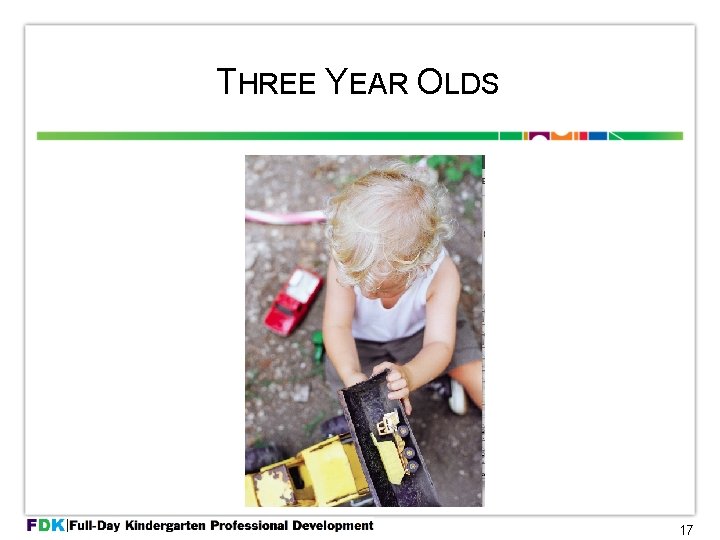
THREE YEAR OLDS 17
FOUR YEAR OLDS 18
FIVE YEAR OLDS 19
THE SHIFT: THE DEVELOPMENT AND LEARNING OF KINDERGARTEN AGE CHILDREN 20
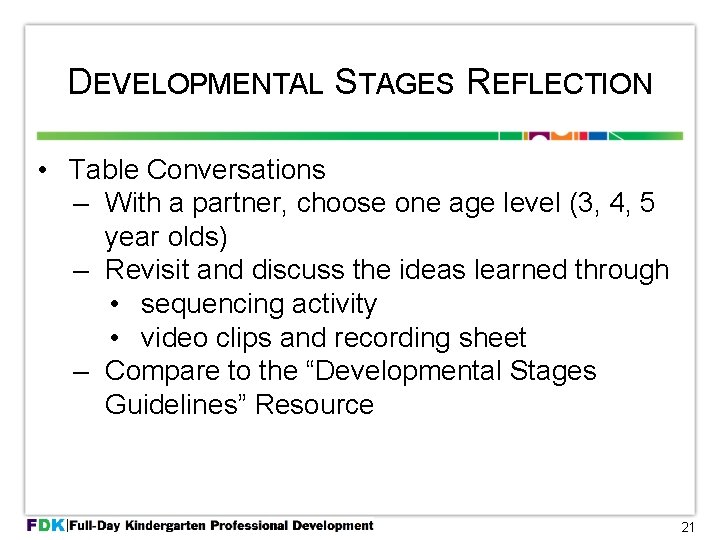
DEVELOPMENTAL STAGES REFLECTION • Table Conversations – With a partner, choose one age level (3, 4, 5 year olds) – Revisit and discuss the ideas learned through • sequencing activity • video clips and recording sheet – Compare to the “Developmental Stages Guidelines” Resource 21
PUTTING IT ALL TOGETHER • With a partner, read and discuss your child’s scenario and Development and Learning report • Identify & record child’s strengths and needs on the handout • Group yourselves by child and discuss scenario • Use “Developmental Stages Guidelines” and “Developmental Sequences Key” handouts as references 22
LUNCH • 1 hour 23
INDICATORS AND IMPLICATIONS • Read “Child Indicators” handout • Use information to determine red flags for your child • With your partner, discuss and record next steps for this child on recording sheet: – developmentally – implications for your teaching practice – suggestions for families • Whole Group Discussion: – A Quick Look at All Six Children • Sharing of ONE next step – Importance of differentiation – Planning for Learning 24
TEACHING TO THE WAYS CHILDREN LEARN • If we know the stages of development, how do we best teach with these in mind? • What do research and theory tell us about how young children learn best? • Standards are the “what”, not the “how” Learning Standards 25
SAVE THE LAST WORD FOR ME • In Groups of 3: • Read “Teaching to the Ways Children Learn” handout • Individually identify and highlight the most significant idea in the article • Share your passage with small group without explanation • Each member then responds to that passage • You explain why passage stood out for you 26
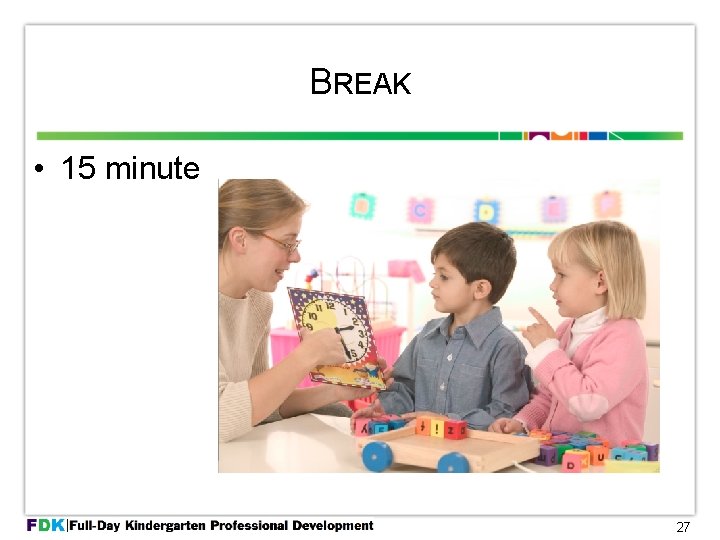
BREAK • 15 minute 27
KEY UNDERSTANDINGS 1. Every child is different 2. Learning occurs in predictable patterns 3. Learning is most meaningful when integrated across all domains 4. Young children are active learners 5. Experience, knowledge, curiosity, and a sense of wonder are foundations for learning 6. Assessment and evaluation form the basis for educational decisions 7. Development and learning are rooted in culture and supported by family NC Guide for the Early Years, 2009 28
TEACHING PRACTICES GALLERY WALK • Review “Informed Teaching Practices” handout • Form small groups • Generate examples of how to incorporate each key understanding into a teaching practice for the four domains of learning and development • Use the handout on “Patterns of Growth and Implications for Teaching” as a resource • As you move through the Gallery, write your ideas on the posters around the room • End at your original poster and be prepared to share with whole group 29
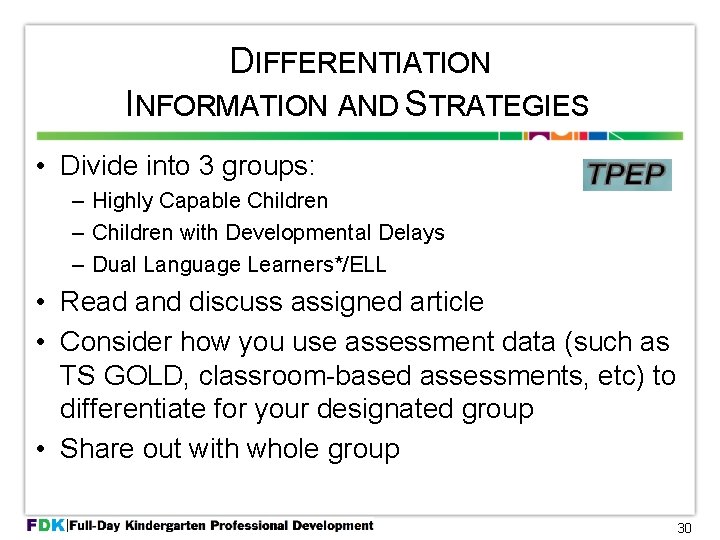
DIFFERENTIATION INFORMATION AND STRATEGIES • Divide into 3 groups: – Highly Capable Children – Children with Developmental Delays – Dual Language Learners*/ELL • Read and discuss assigned article • Consider how you use assessment data (such as TS GOLD, classroom-based assessments, etc) to differentiate for your designated group • Share out with whole group 30
REVISITING LEARNING OUTCOMES • Understand the stages of child development in the following domains: – – Social-Emotional Physical Cognitive Language • Learn about current brain research • Consider the implications of child development on your teaching practices • Investigate strategies to differentiate learning 31
CLOSING REFLECTION • Revisit definition of child development • Ponder these questions: – Based on the experiences today, why is this important information for kindergarten teachers to know? – What are you doing well already? – What will you do differently now? • Record your thoughts on the “Child Development Reflection” handout • Discuss with a partner 32