
Module 1 Biodiversity and Ecosystem Services Training Modules
Module 1 - Biodiversity and Ecosystem Services Training Modules for Applying the Mitigation Hierarchy: Planning Policy and Projects for No Net Loss or a Net Gain of Biodiversity Module 1 Biodiversity and ecosystem services: what are they, why do they matter and what is causing their loss? 1
Biodiversity and Ecosystem Services Module – Abstract This module on ‘Biodiversity and Ecosystem Services’ explains the subject of this training course – biodiversity – so that all the other modules touching on ‘Biodiversity Net Gain’, mitigation of impacts on biodiversity and similar concepts are clear. It covers key definitions, explores the role and importance of biodiversity and why it is under threat. The module shows why attention to mitigating impacts on biodiversity is particularly important in the context of today’s unprecedented losses of biodiversity. 2
Biodiversity and Ecosystem Services Module - Contents Slides What is biodiversity and what is an ecosystem? 3 -8 What are the benefits of biodiversity and ecosystem services? 9 -11 What are threats to biodiversity and ecosystem services? What is being lost? 12 -14 What are the dangers to people from losing biodiversity? 15 Take home messages 16 3
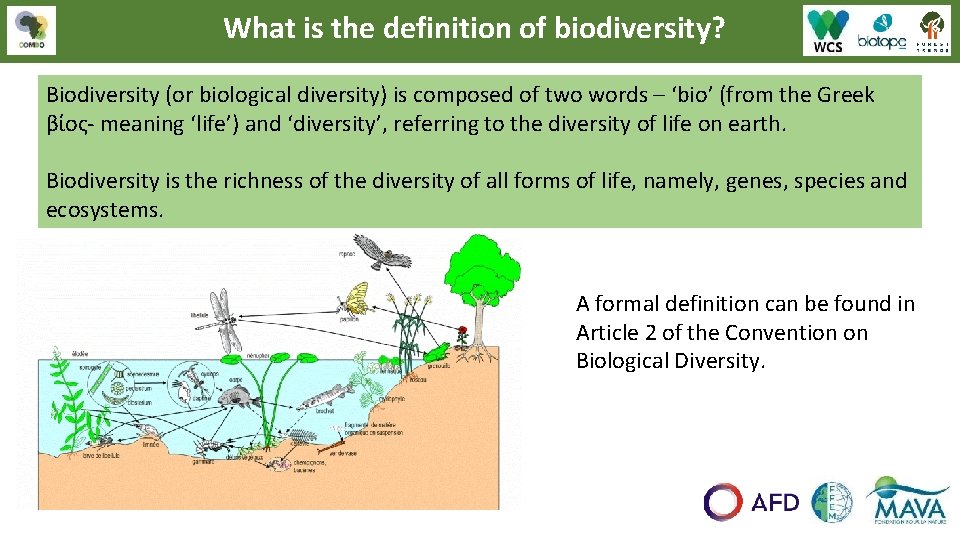
What is the definition of biodiversity? Biodiversity (or biological diversity) is composed of two words – ‘bio’ (from the Greek βίος- meaning ‘life’) and ‘diversity’, referring to the diversity of life on earth. Biodiversity is the richness of the diversity of all forms of life, namely, genes, species and ecosystems. A formal definition can be found in Article 2 of the Convention on Biological Diversity. 4
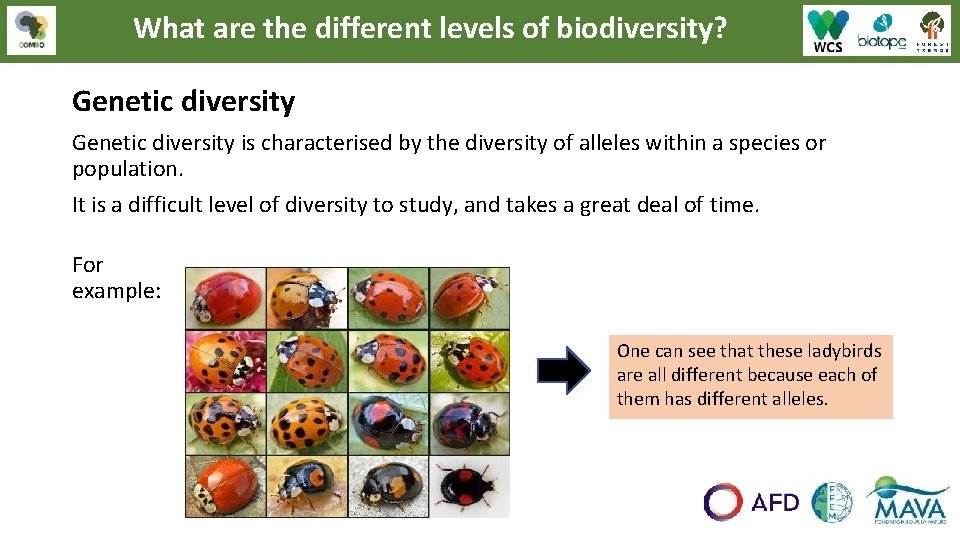
What are the different levels of biodiversity? Genetic diversity is characterised by the diversity of alleles within a species or population. It is a difficult level of diversity to study, and takes a great deal of time. For example: One can see that these ladybirds are all different because each of them has different alleles. 5
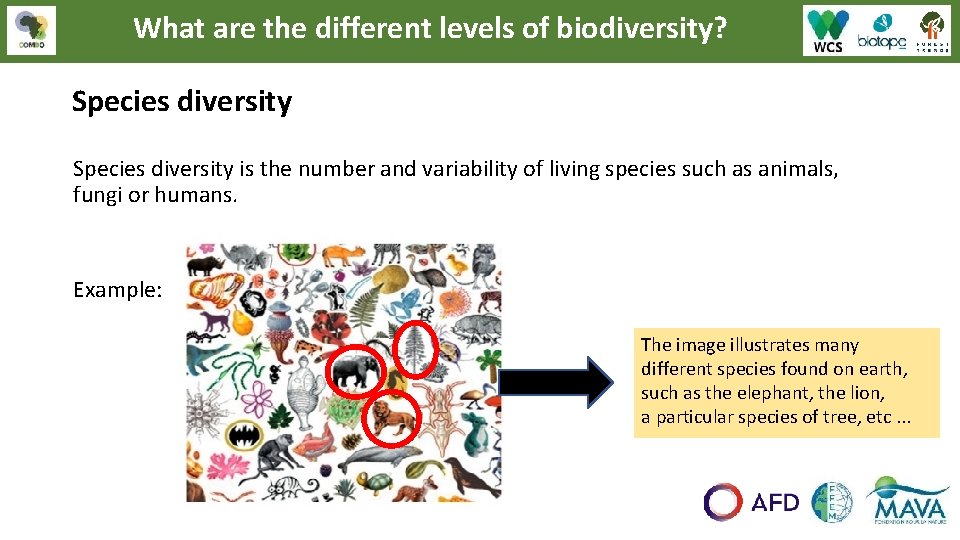
What are the different levels of biodiversity? Species diversity is the number and variability of living species such as animals, fungi or humans. Example: The image illustrates many different species found on earth, such as the elephant, the lion, a particular species of tree, etc. . . 6
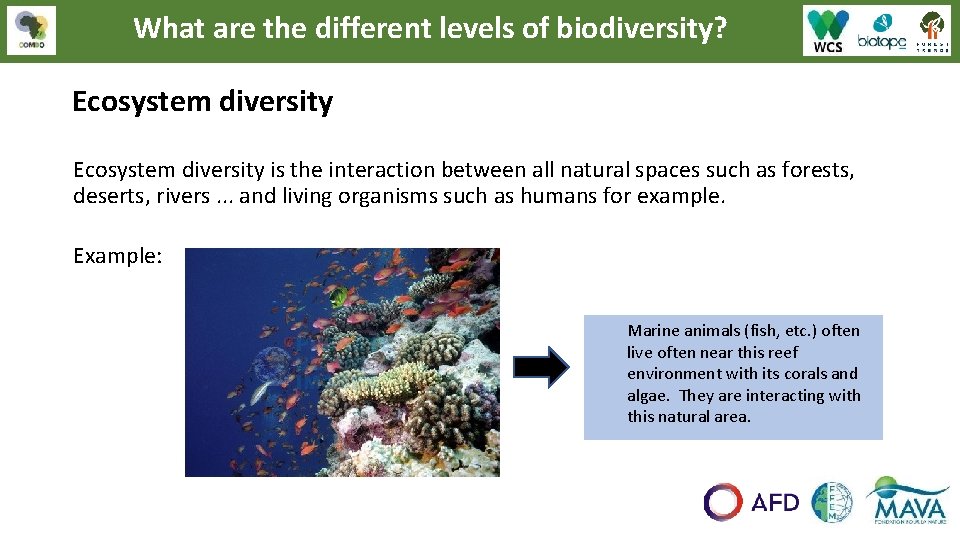
What are the different levels of biodiversity? Ecosystem diversity is the interaction between all natural spaces such as forests, deserts, rivers. . . and living organisms such as humans for example. Example: Marine animals (fish, etc. ) often live often near this reef environment with its corals and algae. They are interacting with this natural area. 7
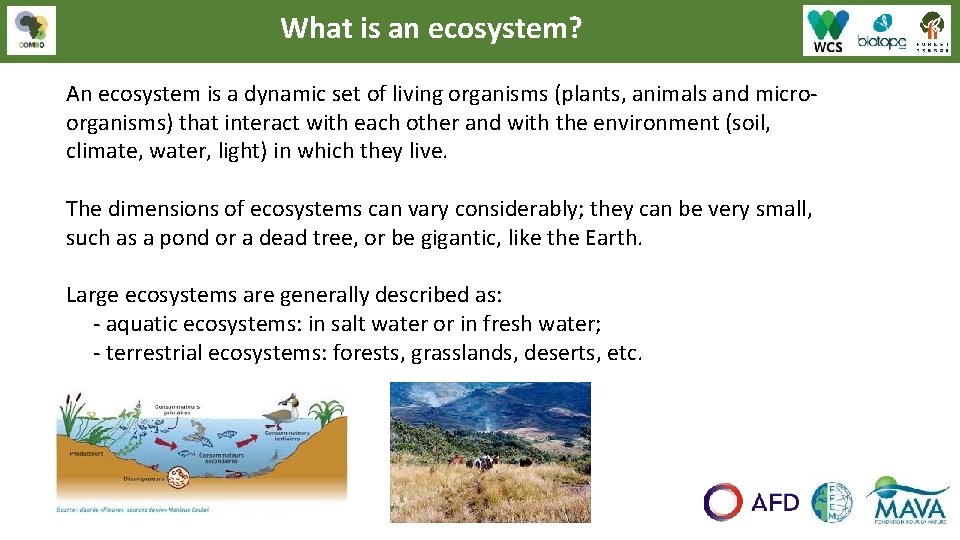
What is an ecosystem? An ecosystem is a dynamic set of living organisms (plants, animals and microorganisms) that interact with each other and with the environment (soil, climate, water, light) in which they live. The dimensions of ecosystems can vary considerably; they can be very small, such as a pond or a dead tree, or be gigantic, like the Earth. Large ecosystems are generally described as: - aquatic ecosystems: in salt water or in fresh water; - terrestrial ecosystems: forests, grasslands, deserts, etc. 8
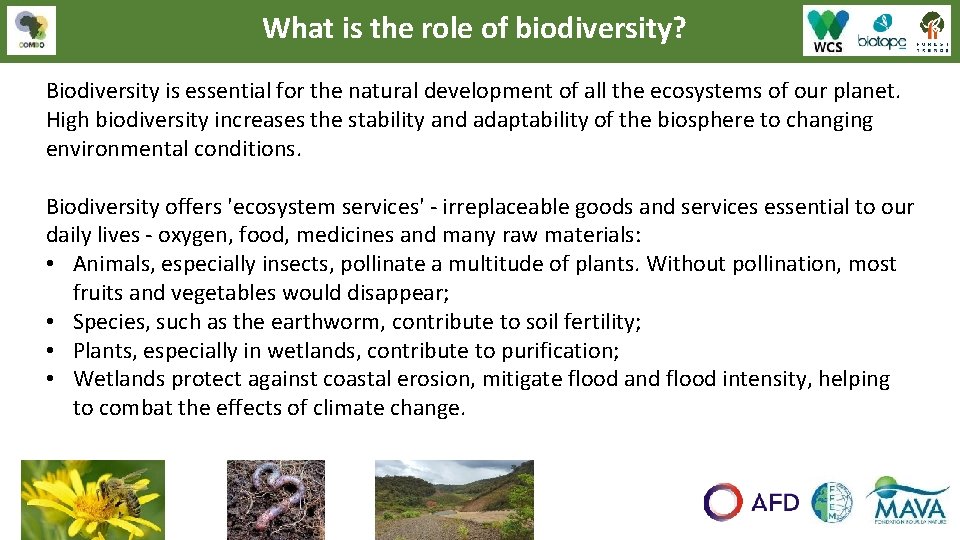
What is the role of biodiversity? Biodiversity is essential for the natural development of all the ecosystems of our planet. High biodiversity increases the stability and adaptability of the biosphere to changing environmental conditions. Biodiversity offers 'ecosystem services' - irreplaceable goods and services essential to our daily lives - oxygen, food, medicines and many raw materials: • Animals, especially insects, pollinate a multitude of plants. Without pollination, most fruits and vegetables would disappear; • Species, such as the earthworm, contribute to soil fertility; • Plants, especially in wetlands, contribute to purification; • Wetlands protect against coastal erosion, mitigate flood and flood intensity, helping to combat the effects of climate change. 9
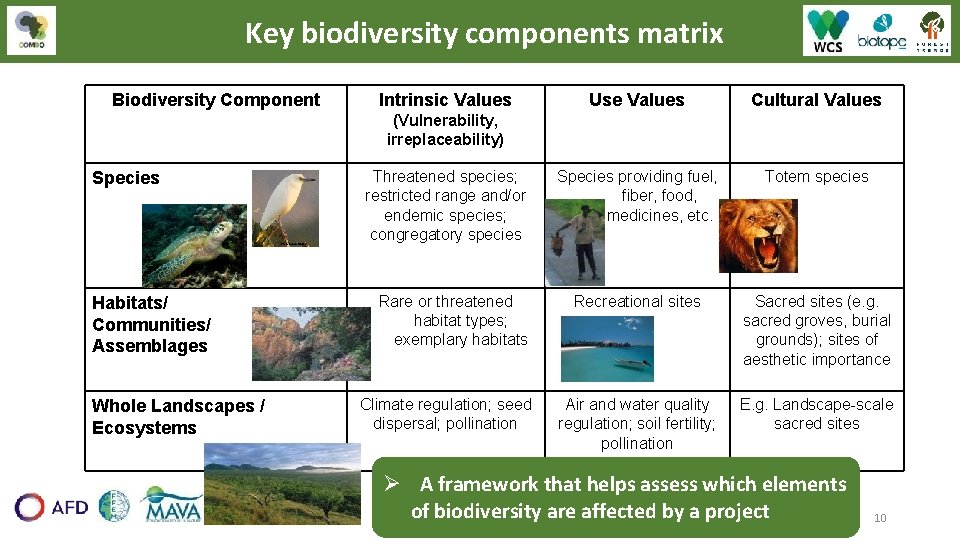
Key biodiversity components matrix Biodiversity Component Intrinsic Values Use Values Cultural Values Species providing fuel, fiber, food, medicines, etc. Totem species Recreational sites Sacred sites (e. g. sacred groves, burial grounds); sites of aesthetic importance Air and water quality regulation; soil fertility; pollination E. g. Landscape-scale sacred sites (Vulnerability, irreplaceability) Species Photo Adam Ridley Habitats/ Communities/ Assemblages Whole Landscapes / Ecosystems Threatened species; restricted range and/or endemic species; congregatory species Rare or threatened habitat types; exemplary habitats Climate regulation; seed dispersal; pollination Ø A framework that helps assess which elements of biodiversity are affected by a project 10
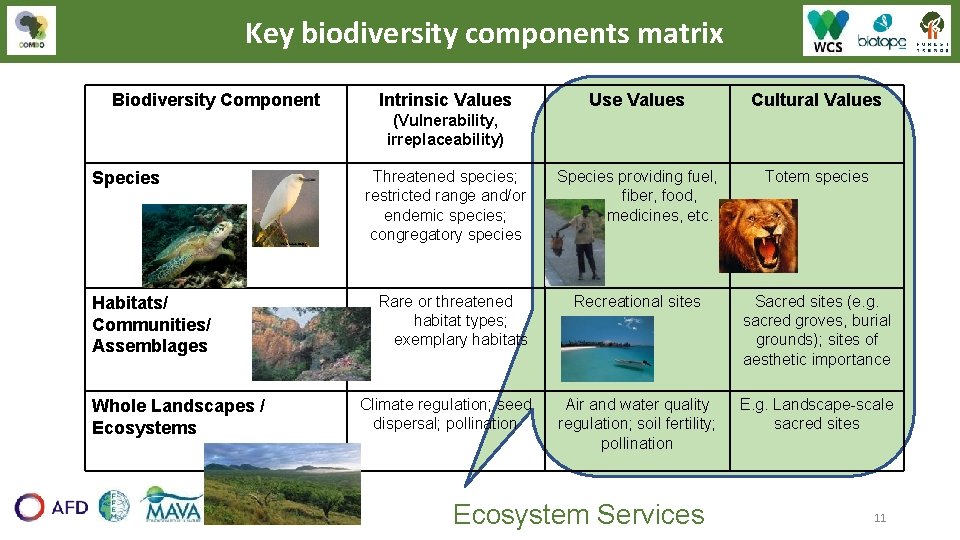
Key biodiversity components matrix Biodiversity Component Intrinsic Values Use Values Cultural Values Species providing fuel, fiber, food, medicines, etc. Totem species Recreational sites Sacred sites (e. g. sacred groves, burial grounds); sites of aesthetic importance Air and water quality regulation; soil fertility; pollination E. g. Landscape-scale sacred sites (Vulnerability, irreplaceability) Species Photo Adam Ridley Habitats/ Communities/ Assemblages Whole Landscapes / Ecosystems Threatened species; restricted range and/or endemic species; congregatory species Rare or threatened habitat types; exemplary habitats Climate regulation; seed dispersal; pollination Ecosystem Services 11
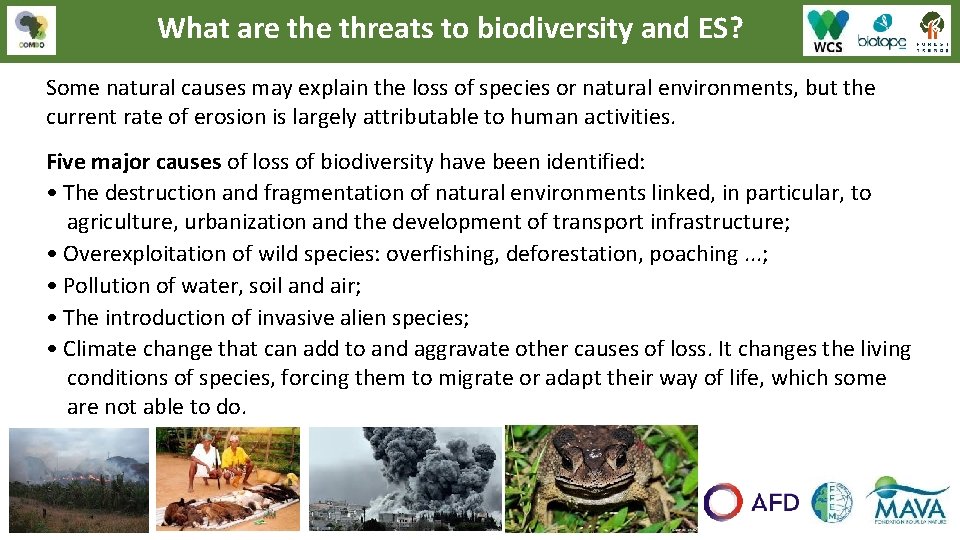
What are threats to biodiversity and ES? Some natural causes may explain the loss of species or natural environments, but the current rate of erosion is largely attributable to human activities. Five major causes of loss of biodiversity have been identified: • The destruction and fragmentation of natural environments linked, in particular, to agriculture, urbanization and the development of transport infrastructure; • Overexploitation of wild species: overfishing, deforestation, poaching. . . ; • Pollution of water, soil and air; • The introduction of invasive alien species; • Climate change that can add to and aggravate other causes of loss. It changes the living conditions of species, forcing them to migrate or adapt their way of life, which some are not able to do. 12
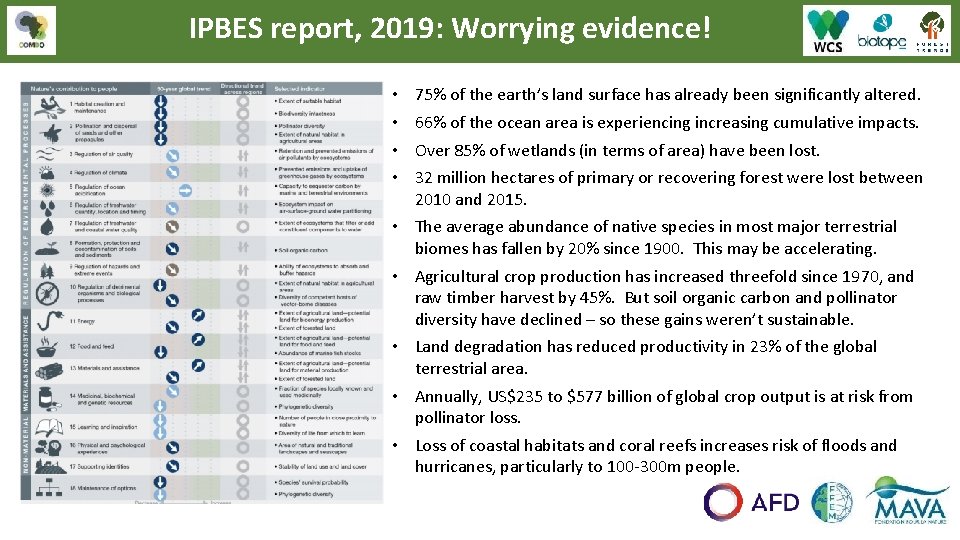
IPBES report, 2019: Worrying evidence! • • 75% of the earth’s land surface has already been significantly altered. 66% of the ocean area is experiencing increasing cumulative impacts. Over 85% of wetlands (in terms of area) have been lost. 32 million hectares of primary or recovering forest were lost between 2010 and 2015. • The average abundance of native species in most major terrestrial biomes has fallen by 20% since 1900. This may be accelerating. • Agricultural crop production has increased threefold since 1970, and raw timber harvest by 45%. But soil organic carbon and pollinator diversity have declined – so these gains weren’t sustainable. • Land degradation has reduced productivity in 23% of the global terrestrial area. • Annually, US$235 to $577 billion of global crop output is at risk from pollinator loss. • Loss of coastal habitats and coral reefs increases risk of floods and hurricanes, particularly to 100 -300 m people. 13
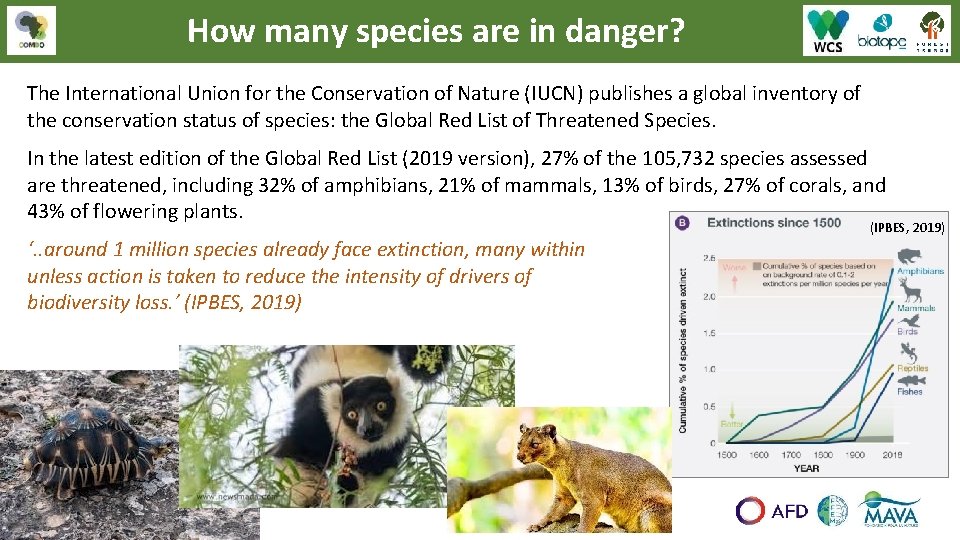
How many species are in danger? The International Union for the Conservation of Nature (IUCN) publishes a global inventory of the conservation status of species: the Global Red List of Threatened Species. In the latest edition of the Global Red List (2019 version), 27% of the 105, 732 species assessed are threatened, including 32% of amphibians, 21% of mammals, 13% of birds, 27% of corals, and 43% of flowering plants. ‘. . around 1 million species already face extinction, many within unless action is taken to reduce the intensity of drivers of biodiversity loss. ’ (IPBES, 2019) decades, (IPBES, 2019) 14
What are the dangers from losing biodiversity? Loss of biodiversity and ecosystem services is dangerous for humanity. It risks our stable environment and stable economy. Prosperity and poverty reduction depend on maintaining the flow of benefits from biodiversity and ecosystems. For example: • Halving deforestation rates by 2030 would reduce global greenhouse gas emissions by 1. 5 to 2. 7 GT that would cause US$ 3. 7 trillion of damage. • Over-exploitation of most commercially valuable fish stocks reduces the income from global marine fisheries by US$ 50 billion annually. • According to IPBES, annually, US$235 to $577 billion of global crop output is at risk from pollinator loss. Sources: TEEB and IPBES 15
Biodiversity and Ecosystem Services Module – Take home messages Ø Biodiversity is the variety of life on earth, at the ecosystem, genetic and species levels. Ø It provides ecosystem services essential to life, from food and medicines to purification of the air we breathe, regulation of water, creation and stabilisation of soil, pollination of crops, protection from floods and disasters and help adapting to climate change. Ø Biodiversity is being lost at an unprecedented rate, particularly through destruction and fragmentation of natural environments, overexploitation of wild species, pollution, introduction of invasive alien species and climate change. Ø Recent reports such as the global assessment report of biodiversity and ecosystem services (IPBES, 2019) offer very worrying evidence. Many studies reveal the impact on people’s lives and the economy of such losses. 16
- Slides: 16